Saint Joseph’s chapel

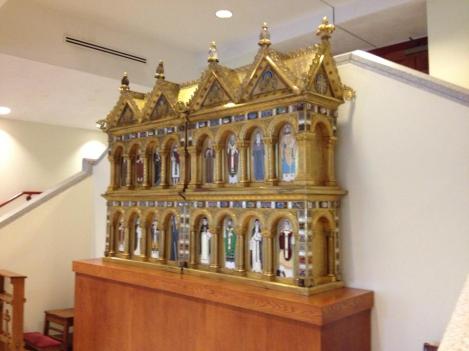
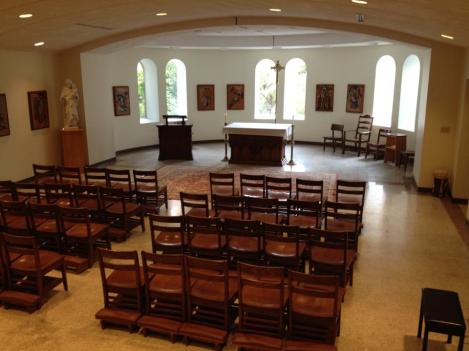
This is a small chapel at St. Meinrad’s.  While it looks very simple and humble, they’ve stored the altarpiece from the original Abbey here.  It is overwhelmingly ostentatious.  Fortunately it is at the back of the room so you don’t get distracted by it when there is a service here.

This is in the hallway on the way to the chapel. 19

This is in the chapel itself. You enter from a raised area. Interestingly to me, there was a small hand drum to the right of the chapel.  Even though it was a silent retreat, I enjoyed playing it at one point during my time there.  There was nobody else around, and I played softly, so I didn’t disturb anyone else.  This chapel is attached to the building that has the seminary, not the guest house.

1


Here is the over-the-top altarpiece.  It was removed when they renovated the Abbey to make the altar no longer attached to the back wall, but in the center of the room, among the people.  That was part of a movement after Vatican 2 that tried to make the symbols of the church match the message of the church – that Jesus is among us, not hidden away, far removed.


11


Here are some details.


Imagine how much money and effort was required to make this.  Imagine how many hungry people could have been fed with that money and effort.  While this is outwardly beautiful, it is a direct affront to the very call of Jesus.  We are specifically not to build up treasures for ourselves here – we are to take care of people.


This is to the side of the chapel. A bit of glass has broken and is now on the music and nobody else has noticed.


I wish that Protestant churches had guest houses for silent retreats so I could go there instead and I wouldn’t get so wound up about the hypocrisy of it all.  This place is beautiful, don’t get me wrong.  But only until all people are taken care of (no more homelessness, no more sickness, no more wars or poverty) can we even think about building places that are this opulent.  They are extras.  Money and effort has to go to following the instructions of Jesus first.  If more Christians followed Christ instead of Christianity, the world would be a better place.

Private places

There are places at St. Meinrad’s Archabbey that are most certainly off limits.  They spell it out with signs, saying that you are not welcome in this area.


There was one area that had a sign and a frosted glass window.

chapter house 2


But there was a clear spot higher up, so I just held up my camera.

chapter house1


There is a lock on the holy oil vials, presumably to keep you from accidentally anointing yourself, or from desecrating it.  Wonder why these vials are on public display then, if they are not for public use?  To show off how pretty they are? These were prominently displayed at the center of the Abbey.

oil2


There are enclosed gardens that I wanted to explore.  I saw them on Google Maps before I went there and looked forward to going.  There were not open to lay people, however.  But there were windows, so I took pictures. I was sad to see them not even being used by the monks.  These beautiful gardens, alone, locked away, unappreciated.  Perhaps the monks stare at them from their rooms, while they are locked away from the world they are called to serve?


They even tried to block the view with signs like this.

3

But I found a way around it.  These pictures are taken through the glass.


Monasticism as it is practiced was not mentioned by Jesus at all. Living together, sharing resources, sharing lives – yes.  It is good for all to work together for the common good.  However, he did not intend that we were to separate ourselves from the world entirely.  When we work together and share what we have, we are stronger people, better able to help others.  However, when we focus all of our energy inwards to the group, we defeat the purpose of what Jesus calls us to do.


With all these signs, I was continuously reminded of the “us and them” approach the Catholic church has to life in general – either you are “in” (a Catholic) or “out” (either not Christian, or just not Catholic).  The most obvious example of this is with their approach to communion.  This exclusionary practice is not Christ-like, and will turn more people away from the message of Jesus than they could ever imagine.


Interestingly, I spent time at their “sister” community, just down the road a few months later.  The Sisters of Saint Benedict have a community in Ferdinand, IN, called Monastery Immaculate Conception.  I walked all over that place and only saw one sign saying “private”.  In fact, the nun who took us on a tour of the place told us we could sit in that area if we wanted.  I’m pretty sure I accidentally wandered into some areas I shouldn’t have, but nobody got upset with me.  Their monastery was older, a little shabbier.  It was obvious that their “brothers” got more money and better resources.  But the Sisters were far more kind and welcoming, always helpful and kind, with open smiles.

Tabouli twist

I like tabouli, but I don’t like raw onions. I also think kale has far more health benefits than parsley. This twist on an old classic delivers familiar tastes in a new way.

Ingredients
Half a large white onion. (See notes)

Half a bunch of kale (about 8 to 10 stalks) – destemmed, torn into pieces

One large tomato, seeded, cut into bite-size pieces (just use the fleshy parts)

½ teaspoon seasoning salt

Lemon juice to taste (at least a tablespoon)

Olive oil for sautéing

Method
Julienne the onion and sauté it in the olive oil. Add seasoning salt (I use “Aunt Cora’s”). Stir often, cooking it until the onion pieces are translucent but still firm. Do not caramelize or wilt them.

Meanwhile, steam the kale. About 5 minutes in, stir it with a fork to further reduce its size.

Remove half the onion to use later. (see notes) and add the tomatoes and kale.

Add lemon juice. Stir frequently. Do not let the tomatoes get mushy.

Notes
I find it easier to cook the entire onion and save off half of it for another use. Store in the refrigerator and use within 4 days.

Serve with couscous. (I find Near East brand very good – tasty, and simple to make)
Makes four servings.

St. Meinrad guest house

St. Meinrad Archabbey is in St. Meinrad, Indiana.  It is a Benedictine monastery and seminary.  The Benedictines have as part of their Rule to serve the guest as if he (or she) is Christ, so they always have guest houses that are quite nice to stay in .  They are good for going on retreats.

Here are some pictures from the guest house there.

The guest house itself, as seen on the way back from the Abbey.

guest house

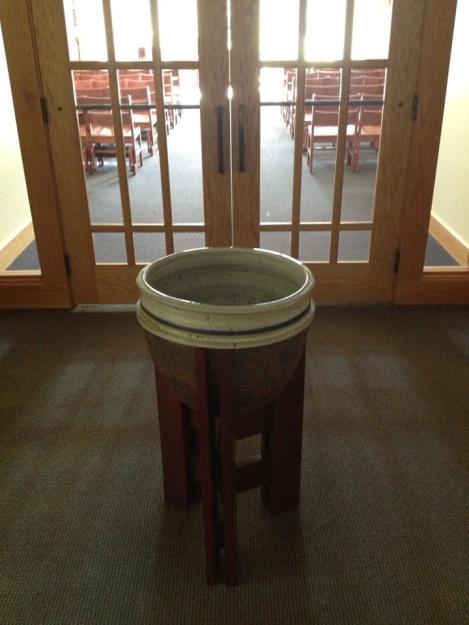
The baptism font is outside of the doors of the chapel. This is right in front of you when you exit the dormitory area.

gh font

At the back of the chapel (in line with the font) is this unusual crucifix.  It looks like Jesus needs a chiropractor.

cross2cross1

(Edit to add – I looked up why his head is tilted, and learned from the website Reachparadise.com that crucifixes “…that show His head tilted slightly down (or up) and to the right are taking some artistic liberties. The right hand, in Christian faith, is the hand of blessing. Since Jesus chose to sacrifice Himself for our sins, He, in turn, gave us the ultimate blessing. This is why His head faces right in some crucifixes – to show that His death is a blessing for all of us.” It goes on to say that other reasons include “One stated that Jesus was facing the good thief, whom He saved before dying. The other said it was to reinforce that Jesus is seated at the right hand of the Father.”

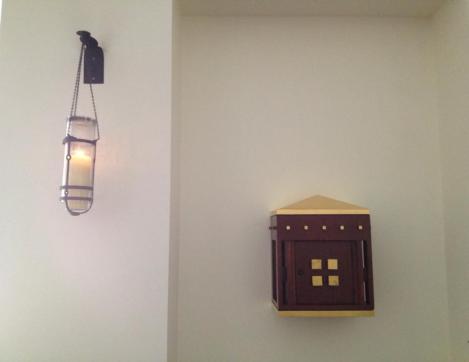
On the right side is the eternal flame signifying the presence of Jesus, and the aubrey, which holds the reserved sacrament (blessed communion wafers).

aumbrey2candleaumbrey

To the left is the paschal candle.

gh chapel 2

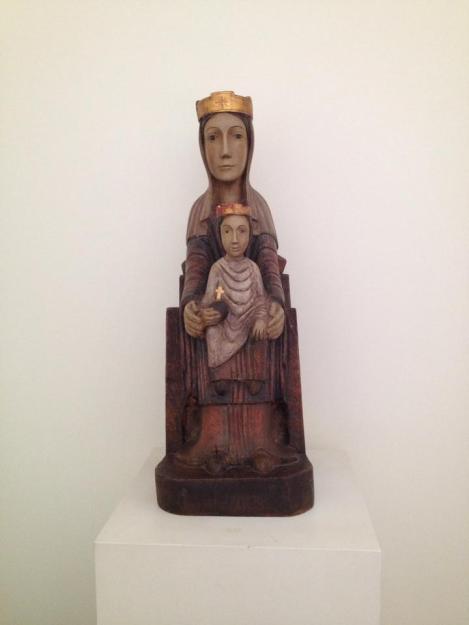
And a carved wooden statue of Mary and Jesus.

gh chapel


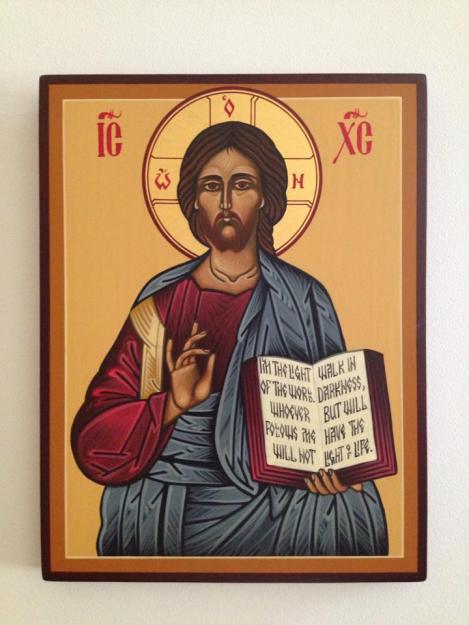
Near the front is an icon of Christ.jesus


We had a room there that had supplies for us to work with while we were there.  There were coloring books, pens, paints, magazines, juggling balls and scarves, and jigsaw puzzles.  I was amused that the one that people pulled out to work on was one of a huge cathedral.  It was impossible for one person to do it all in the time we were there, so we all took turns (without discussing it, because it was a silent retreat) to work on it.  We were working together to build the church in many different ways.  jigsaw2jigsaw1jigsaw 3


Brother Maurus, our host and liaison, made sure to put out wine for us at dinner.  wine


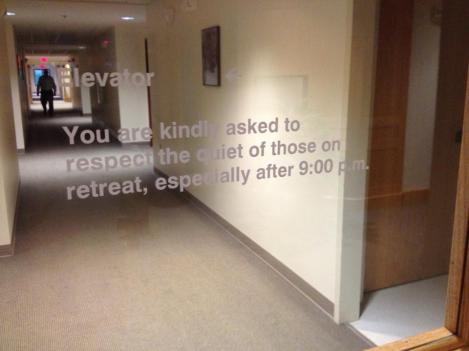
The sign on the door to the dormitory, reminding people to be mindful of others who were there.  Not everyone who goes there is on silent retreat. quiet

Spiced carrots

Ingredients
5 large carrots, julienne-cut
2 tsp cumin powder, divided
2 tsp curry powder, divided
¼ cup parsley flakes, crushed just before use
An inch of butter, divided

Method
Steam the carrots until they are medium-soft. You don’t want them mushy, but you also don’t want them so firm that they won’t absorb the flavor.

While they are steaming, prep a large glass or ceramic bowl. Put half the butter in the bottom, thinly sliced. (You want it to melt quickly.) Add half the cumin and curry powders evenly over the bottom of the bowl.

When the carrots are done, pour them into the prepared bowl and immediately put a cover over it. I used a plate, upside-down. It is ideal if there is a 1 to 2 inch space between the carrots and the cover. This will use the heat of the carrots to melt the butter.

After about 5 minutes, toss the mixture in the bowl and add the rest of the butter and spices, including the parsley. Work quickly to retain the heat. Put the cover back on. Let sit at least another 5 minutes.

Serve immediately, or you can refrigerate and serve the next day, when the flavors are even better.

Makes 4 servings.

4 x 6 art, July 2016

I’ve not done any of these in months. I’ve been trying to walk at least 30 minutes every morning before going to work, so that eats into my art time. Then realized (remembered?) that I can do pieces of this – do the backgrounds one day, and the images and words another day. That makes it easier. I may add more to this post if I create more this month. There is something to be said for limiting myself to only a few forms of artistic expression, but I’m not there yet. Maybe I never will be. I tend to explore similar themes regardless of the form – collage, art journal, painting, beading, or even writing. It all blends together. But it does lead to having to have a lot of different art supplies and room to store them. While this genre produces small art, it takes up a lot of space to store the supplies for it.

come back new 071416

ability 071416

The Mungeon house

2

Very few people really knew where Mr. Mungeon lived. It wasn’t like it was a secret. It was just that his house wasn’t easy to get to.

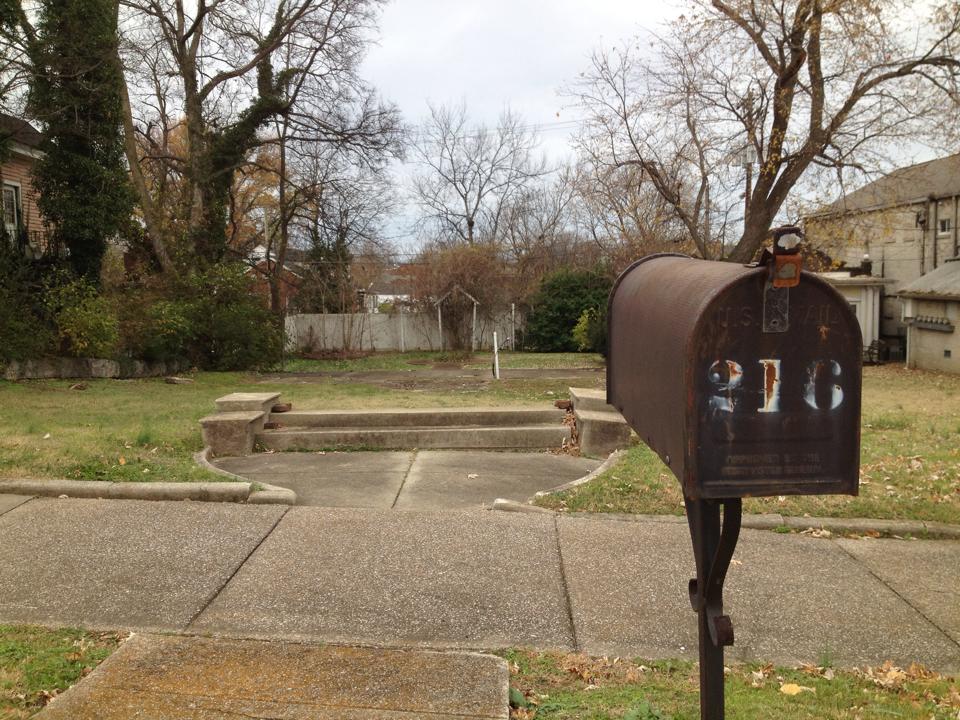
You could drive to the address, that was easy enough. 216 W. Church St. was right in the middle of town, just off the town square. The Presbyterian church, the big one, the first one, made of substantial granite stones, weathered brown with all the years they’d seen, was just across the street. The house just simply wasn’t there, not as far as anyone could see.

Mr. Mungeon had lived there all his life, as had his parents before that, and their parents before that. They had moved to this town as soon as they’d saved up enough money after arriving by ocean liner from Romania. That trip had cost them all they had, scraped together over the years and added to in the last month before they left by selling all their furniture and most of their clothes. Not like they could have taken any of it on the ship. They were lucky they could take as much as they did, as everybody was subject to a weight restriction.

Mama and Papa were sure they could make the grade, but they weren’t sure all of their five children could. Every ounce counted. Once a week they weighed themselves and their belongings, all together, on the scale down at the local hardware store that served the farmers. Every week they had to pare back more, unsure what more they would have to give up the next week. Papa started exercising to lose weight. Mama cut her meals in half to do the same – not like she could afford to, stick thin as she was. After they had sold everything they could, it still was obvious that as a group they were over by 46 pounds. It was decided that the oldest child, their eight-year-old son Bogdam would stay back with his grandparents. There were tears of course, but it was for the best. If it wasn’t him, then two of the younger children would have to stay behind. He promised to be brave, promised to make his parents proud by working hard on the grandparent’s farm, promised to obey them as if they were his own parents. That was many years ago, but the effects of that separation were still felt.

After the family had endured the poking and prodding and paperwork at Ellis Island, along with all the other hundreds of newcomers searching for a new life, they stayed in the cheapest housing they could afford, tucked away in a narrow back alley, a warren of an immigrant neighborhood in New York. Papa Mungeon, Ionut by name, worked hard at the shipyard while his wife Beata took in laundry and watched other people’s children for a few pennies a day. It took them nearly 2 years to save up enough money to relocate.

All during that time they never mentioned Bogdam. It was as if he’d never existed. It was easier that way. In many ways he was dead to them because this trip had been one-way all along. Everyone knew it. “The American wake,” the Irish called it, mourning their living at the docks because they would never see them again. Letters were possible, of course, but they took months to travel across the sea. But it wasn’t as if anyone in the family could write, or read, for that matter. No, this way was for the best. A clean cut heals faster.

The house was perfect for the family when they finally saw it. Ionut had bought it on faith, having heard about it from another immigrant he met in the shipyards. Members of his family had already moved to this town, so far away from the hustle and bustle of the city. It took nearly a week of travel by rail to get to it, and after the sleeper cabin, not to mention the nearly 2 years of being packed like sardines on the fifth-floor walk-up apartment they had in New York, almost anything would have been an improvement. But this was palatial to them. Three bedrooms, a living room where they could all sit in chairs and visit at the same time, an actual kitchen, and even a bedroom with a real tub. It was a dream come true. Sure it needed some work. What would you expect for a house for $20,000? But Papa was good with his hands and had learned enough while working at the docks to do most of the work himself. You had to do a little of everything to get by.

The family history was well-known to the current Mr. Mungeon who occupied the house, all except the part about Bogdam. When there are many generations living in the same house year upon year, the history tends to stay intact along with the heirlooms. No need to pack up the fine china by putting plates, saucers and serving trays in a big pieces of brown butcher paper to prep them for a move when you stay put. No need to divide up the bedroom furniture among the grandchildren. No fights over who got the dining room table or the coveted rocking chair that Grandpa carved. It never left – any of it. They never had to buy housewarming gifts, never had to have going away parties. They never had to fool with undertakers or coffins either, because they created a cemetery in the backyard.

At every funeral they opened with a recitation of all the previously deceased members of the family, and that was when the problem started. Everything was fine until Bogdam died. Since they had omitted him for their story, they had no way of knowing their mistake. He died unnoticed, unremarked, all those many miles away in Romania. He was living alone by then, the grandparents having died years before. He kept up with the farm, same as he’d done since he moved there. Nobody in the village knew how to contact his family in America when someone finally went to check on him nearly a week later, so they buried him without any ceremony and went on with their lives.

The first funeral in the family in America after his death, there was a pause in the air, heavy and expectant, after they read the customary list of names. It was the same kind of pause a parent imposes while waiting for their child to say “thank you” after someone has bestowed a kindness upon them. Everyone felt it, but no one thought twice about it.

Until it happened again, eight years later.

Then, when Papa Ionut died, it was more present, more dense, as if silence can have presence, as if silence can take up space. It was as if there was someone else in the backyard with them, someone they had forgotten to invite.

Every year after that the presence grew heavier, denser, taking up space in an invisible yet present way. Every year it sought to make itself noticed and known to them. It focused on the bricks of the house itself. One by one it made them disappear to the eye. They were still present, still a part of the building. One by one they just weren’t there, but yet they were.

The spirit of Bogdam hoped that they would come to question it, wonder about this happening, wonder how something could be there and yet not be there at the same time. It hoped they would see it as a sign, or maybe an omen. What else was missing? What had they forgotten? Who was absent in their hearts? Secrets cannot stay that way for long. The burden is too great. They spring forth like jonquils, pushed up out of the ground all of a sudden one spring morning.

Yet they never noticed. The secret had been unspoken for so long it had stopped being a secret, had stopped being real to them. The memory of Bogdam had not been suppressed, so much as erased. It wasn’t even like a palimpsest – there was no trace of the former message. It wasn’t as if the page had been pulled out of the family records book. It was as if they had created a whole new book from scratch.

Over the years, the house had simply faded from sight. It wasn’t as if the walls were see-through, though. Anyone who went inside vanished from view as well. There was no trace of furniture at all. It was all there. It was simply that the house and anything inside it was not visible from the outside.

Because it happened so slowly, the family did not realize it had occurred. They rarely invited people over, so friends never mentioned anything was off about the family homestead. Because the furniture was still visible once the family members got inside, they never even suspected anything was wrong. It was as if their minds simply expected to see a house, so they did.

The mailbox and front steps near the street were still quite visible, so they still got mail. The postman had gotten used to it the same as they had, and since there was little turnover and nobody else ever bid on that route, the same postman served that street for nearly 25 years, the time it took for the house to fade from sight. By the time he retired, his son had taken over the route and he knew better than to question. Nobody bothered him at the house. Not children, not dogs. The mail was collected daily – it was never left to the vagaries of the weather. Who was he to question? They never seemed to order any parcels that needed to be signed for, so he never had to negotiate that potentially awkward situation. If he had, he would have discovered the house was just as real as it had always been. It was just as solid, just as present as ever. Just like Bogdam, who was still part of the family even though he was out of sight (and out of mind).

Pilgrim

f6f31b907f77ed242c064fa922ceef12
The country
versus
The city
city

How interesting to consider that the pilgrim feels welcomed and safe in the wilderness, and an anomaly and a target in the city.
How those in the countryside will minister to a stranger in pilgrim’s clothes – feeding, first aid, a drive to a hotel or a dentist – yet those in the city will harass or rob the same person.
How in the countryside the biggest danger is a pack of wild dogs or thunderstorm, but in the city it is people.

People in the city see pilgrims as weak, as helpless, as fools – as relics of a bygone era. They are mocked at best. Assaulted or robbed at worst. They are looked at as the strangers they are and ignored – while in the country they are sought out. The best food and entertainment is provided even if they do not share a language or the same culture. There is respect, admiration.

I had thought that the country would be a problem – no amenities, no resources. A long walk without access to food, water, shelter. I must carry everything and trust in the providence and mercy of God. Yet I read that you can relax in the country as a pilgrim. It is the city where the danger lies. While it has food, water, and shelter, it also has people. Perhaps those in the city live there because they have lost faith in God – they think they must provide for themselves, while those in the country are reminded of God’s grace and mercy every day.

Dolly dearest

7e90470b-3f31-4b9e-9ef1-c2a0dafa78e1

After nearly 5 years, Sara’s dolly had started to talk. Sure, Sara talked to it, dressed it, gave it a name. She even pretended to feed it cookies and tea every Sunday afternoon. She’d even thought she’d heard it answer her before, but it was always in her head or her heart. It was never out loud.
The first time she heard it out loud she thought she was imagining it. The second time, just a moment later, she thought her older sister Janey was playing a trick on her, throwing her voice. It was just like her to torment her little sister in ways that she could easily deny later to their busy and no-nonsense parents. Sara had learned early on that if she brought up charges, there had better be proof or the punishment she expected Janey to get would fall on her. She’d also learned that it was best to settle matters herself right away.
Sara jumped up off the bed, scattering her coloring pages and crayons and scrambled to her bedroom door. She jerked back the door, expecting to see her sister’s back as she ran away. But nobody was there. The hall was empty – not even the sound of bare feet dashing away. Stunned, Sara went to find her sister. After a few minutes she found her outside on the hammock reading some book with dragons on the cover. There was no way Janey could have gotten there that fast. Sara slowly walked back to her room via the kitchen, helping herself to a piece of banana bread and a glass of lime Kool-Aid. She did all her best thinking when she had a snack.
As soon as she sat down on her bed, with her dolly nestled in her lap, she heard it speak again.
“Won’t you give me some of your snack?” The voice was so soft and so sad, so full of loss and longing. Sara held the doll out at arm’s length and stared at it, blinked her eyes. Then, with slow horror, she watched her doll blink her eyes too.
“You’re always pretending to feed me, but you never do. You’re such a tease. No wonder nobody plays with you.”
Sara was frozen with fear, yet managed to stammer out “How can you talk?”
Her dolly said “Silly! How do you think anybody learns how to talk? I listened. I listened to you blabbering on about how sad you are. I listened to your sister taunt you about being a scaredy-cat. I listened to your parents fight. I’ve listened to all of it. I’ve listened to the television announcers talk about pollution and war. I’ve heard the songs on the radio about getting even and how things were better back then. All I ever hear is sad sad sad, so that’s who I am. I’m everything you’ve ever cried about, because you’ve never shared your good days with me. My hair is matted from your tears. What did you expect? You made me this way.”
Sara threw her doll into the middle of the room and retreated to the furthest corner, curled up into a ball. It was nearly half an hour later before she realized her mistake – the doll was between her and the door. How could she escape? She put off the decision a little while longer, but soon she realized she had to pee and there was no ignoring that. It was either creep past that accursed doll or go here in the corner. Even though she was young, she knew that would be a bad idea. Even if her Mom didn’t find out soon and punish her for it, Sara would smell the sickly sweet smell of her dried urine whenever she was in her room. Going to sleep would be terrible. She had to risk it.
Keeping her eyes on the doll, she slowly got up so as not to startle it. As slow as a cat stalking a cricket, she moved around the edge of the room as far away from her former best friend and confidant as she could.
She had told it everything. All the things she couldn’t say out loud to her Mom, her sister, her friends, she told the doll. All her fears, all her failings. Every little sneaky thing she’d done to get back at her sister without her knowing. She’d poured all of her darkness into this doll, and none of her joy.
The slow realization of what this meant descended upon her like an evening fog, clouding her vision, narrowing it to a pinpoint. She knew with dreadful certainty what she had to do next. She must destroy the doll.
So far, there was no movement from the accursed thing, but she couldn’t be sure this would continue. She’d thought it would stay silent for all those years, but that had changed. What other horrible changes would happen? Just because it wasn’t moving now didn’t mean it wouldn’t start, and soon. She had to destroy it as quickly as possible before it ruined her life.
She closed the bedroom door behind her and dragged a chair from her sister’s room to jam up under the doorknob. That would buy her some time to think of her plan. She almost forgot her need to use the bathroom in her fright, but she took care of that now. While in the calm and quiet space of the hall bathroom, she considered her options.
Burial wasn’t good. Her Mama would get mad about the mess she’d make, and how could she be sure the doll would stay buried? It might dig itself out. Perhaps she should chop it up first. Then she realized if she did that she could put all the pieces in separate places around town. The head could go under the drainpipe of the neighbor’s house at the end of the block, an arm in the trashcan in her school’s bathroom. There’s no way it could reassemble itself then. But maybe the head could still talk, she realized with a cold shudder. She’d better bury it, at least, to be sure.
Burning it was right out. Her Mama would whip her if she caught her playing with matches again. She’d gotten in trouble for that when she was three, having set a flip-flop on fire, wanting to see how the rubber melted. It melted alright, and so did the carpet it was on, and the curtains, and the entire bedroom. The whole family had to stay in a motel room for nearly 4 months until the insurance company got the restoration work done. While it was an adventure for the girls, it was a headache for the parents, so they made sure that Sara understood they were not kidding about fire safety. Janey used it as yet another way to torment her little sister, who she never wanted in the first place. Anything she could do to get her to leave her alone, or even leave, was fair game.
This was proving to be the hardest thing Sara had had to contend with in all her tender years. Maybe she could preempt the doll and confess all her slights and sins to her mother before the doll did. Just thinking about that made her stomach go icy cold and wobbly. There were a lot of things to confess.
You or I would consider them trivial, but Sara, with her limited experience, thought them worthy of eternal damnation. The perspective that comes with time downgrades childhood sins to summer showers instead of the tornadoes that they seem to be at the time. She had plenty of time to learn what real sins were about, but as for now, she felt damned.
But she didn’t have plenty of time to figure out what to do about the doll. So she did what she was taught to do in Sunday school. Not like she did a lot, but she figured it couldn’t hurt to try.
“God?” She murmured, on her knees on the cold porcelain tile on the bathroom floor, “I could use some help right now, if you’re not too busy and all.”
Sara wasn’t sure she had a good connection, because she couldn’t hear God’s reply. Was praying like talking on the telephone? Sometimes when she was talking to her grandmother in Canada the connection wasn’t that good. Also, often Gram’s hearing wasn’t that good either. Her mother always told her to keep on talking anyway, that Gram could make it out. Maybe God was the same way? It was worth a try. It wasn’t like she had anybody else she could call. This was some big stuff. She needed to go straight to the top.
“God? I hope you can hear me because I sure need some help here.”
Sara heard a voice so quiet that she ignored it at first. It was centered in the middle of her chest, about heart high, and not in her ears. She didn’t hear it so much as feel it. The feeling-voice said to do nothing at all, to not destroy the doll, to not say anything at all to her parents about it. To act as if everything was normal. This seemed too easy, she thought, but precisely because it made no sense she decided it might actually be a message from God. She would never have come up with this on her own. And, if nothing else, it required almost no effort on her part. It was going to be difficult to pretend everything was fine when it most certainly wasn’t, but if God insisted, there must be a good reason. She decided to play along.
The doll said nothing the next day or the next one after that. It was nearly a full week later before it spoke again, and this time it was around Sara’s Mom. She was straightening up Sara’s room one morning and the doll suddenly started to talk, as clear as you please, staring straight at her. Sara’s Mom stopped making the bed and stood stock-still, refusing to turn and face the voice. It sounded just like her mother, who had been dead for 18 years, long before her children were born. In fact, she realized suddenly with a guilty shudder, the anniversary of her death had been two weeks ago and she had forgotten.
She usually remembered, usually dreaded that day. Her mother had been the model of motherhood in public – PTA chair, Girl Scout troop leader. She even had started her own nonprofit tutoring business to teach all the recent influx of immigrant children and their parents how to read and write in English. Three times in her life she had gotten the coveted “Citizen of Lewisburg” award given out at a huge gala once a year.
Only Laurie, Sarah’s mom, knew the truth. Only she knew the true evil that lay beneath the façade that everyone else saw. Only she knew how twisted and damaged her mother was, yet because everyone else saw her as a saint, nobody believed her when she asked for help. She tried to tell her teachers about the emotional and mental abuse she suffered from her but they never listened for long, thinking Laurie was making up a story. “You’re so creative!” they’d exclaim, and encourage her to write for the fiction column in the school newspaper. “But try to write something nicer next time, honey. Girls don’t write scary stories, do they?” they’d suggest.
After a while, Laurie chose to be silent about the abuse. Her mother was clever. It never was physical. There never were bruises or scrapes. Even if there had been nobody would have believed her anyway.
She didn’t dare look at the doll, but she didn’t dare turn her back to it either. It kept speaking, kept taunting her. It had chosen well. Nobody else was home. Nobody else could listen in. She could keep digging in, taking up where she left off 18 years ago. Laurie was deer in the headlights frozen, speechless. For the longest time the doll kept talking and Laurie listened, breathless, immobile. After an eternity, the shallow breaths she had been unconsciously taking caught up with her and she suddenly drew in a huge breath to make up. It was then that she recovered her power.
Without a word, she snatched up the doll by its arm from the corner chair it was in and carried it to the nearest trashcan. Without a word she swept up the handles of the brown plastic Kroger bag she used as a trashcan liner and tied them shut. Without a word she scooped up the rest of the trash in the house, put it all together in a huge black bag her husband kept for cleaning up after yardwork, snatched her car keys that were hanging from the hook by the front door and marched straight out to her car. Within 10 minutes she was at the city dump and the deed was done.
She was still shaking by the time she got back home. After a little internal debate, she decided to go for a quick walk around the neighborhood first and then have some linden tea. Yes. That order seemed best. Time to shake out some energy and then brush away the crumbs.
Sara got home from school and went straight to the kitchen for a snack. She took her gingersnaps and lemonade to the porch to enjoy. Normally she would go straight to her room to share it with her dolly, but after it had started to talk she had changed her ways. She spent as little time in her room as possible now. She couldn’t bear to think of it staring at her while she slept. She was sure her teddy bear and stuffed giraffe could protect her from it, but she didn’t want to risk them being harmed in the fight. Plus it wasn’t fair to ask a doll to fight against another doll. It was against their code, after all.
But then she soon remembered that she planned to color after school today, and her crayons were in her room. There was nothing for it except to do it, so she got up and went to her room. Waiting was only going to increase her dread and make it harder. Best to get it over with.
In the past week she had learned to not look in the corner chair where she had put her dolly after that terrible day. So she almost missed that it wasn’t there. A wave of terror like ice water poured over her when she noticed its absence. Where was it? Had it finally started to walk? Had it talked to her Mom and told her everything and she was now going to be interrogated?
Sara remembered the still small voice she’d heard when she prayed for guidance a week ago. Don’t worry about it, act like everything is fine, it said. So she pulled herself together and gathered up her crayons and coloring books and went back to the porch. By then her Mom was there sipping her tea. Their eyes met and both smiled awkward, guarded smiles. Something passed between them – a truce? An understanding? For the rest of their lives they never talked about the missing doll.