The lifestyle to which…

Maybe I’m missing something, but I’m not sure why I should have to go to work to pay for someone else to not have to go to work.

I get it if they are legitimately disabled. That is what the system is for. If you are physically or mentally too ill to work, the system is in place so that you won’t starve or lose your home.

I’m not talking about that.

I see no reason why I have to keep someone living “at the lifestyle to which they have become accustomed” when I didn’t marry them. I see no reason why I have to support someone that I didn’t give birth to. If I wanted dependents, I would have had children.

Some people seem to think that they are just sticking it to the government when they get a disability check or food stamps. They aren’t. They are sticking it to the taxpayers. They are sticking it to me.

The government gets its money from taxes. It takes from the poor to give to the poor. The rich have figured a way around this.

So I figure this means that people who are getting money from the government are my employees. They are getting paid by me. But where is the work? What are they doing to earn that money?

This isn’t a very nice way to think, I know.

But I also don’t like it when a perfectly able person is standing in front of me, trying to find their library card in their wallet, and I see the “EBT” card. This is the modern version of “food stamps”. They aren’t disabled.

I knew a guy who was really upset that his wife didn’t qualify for disability. She was mentally ill. She had multiple personality disorder, admittedly because of all the LSD she had done. However, she was well enough to run her own acting company… and he made enough money selling real estate that they were able to build their own house. Their dining room alone had more square footage than a three car garage.

But he still thought she should get disability checks.

I know people who think they should get disability payments for having migraines. Yet they refuse to get enough sleep and take their medicine.

I knew a guy who said he should be on disability because he couldn’t stand for long periods of time. Yet he walked for miles for exercise. He walked five miles from his apartment to the post office one day. He regularly walks the two miles from his apartment to the library. He carries a cane for show – it never touches the ground. But he thinks he should be on disability.

I’ve just recently heard of a guy whose wife left him. He was getting Social Security benefits based on her income. She has a serious medical disorder, but she was the only one employed. He has three cats, and makes sure they are fed. Very little is left over for his food. He also got fired from his last job for yelling at his boss.

So why should I pay for his bad choices? Why should I go to work so he doesn’t have to?

Part of being an adult is taking care of yourself. Why should I pay for a dependant that I didn’t create?
Baby steps

Sometimes the only way to get anything done is to do a little bit at a time. If you want to write a book that is too big a step. There’s no way you’re going to write a book in one day or even one week. You have to take little baby steps in order to do it. Sometimes the baby step is simply writing one thing a day. Sometimes you can’t even get that far and your baby step is simply turning on the computer every day. Do whatever it is that you have to do break it up into little steps.

Sometimes it is overwhelming to think of all the little parts of a project but if you can break it up into little parts it makes the project doable. I am working on an art project using stamps and fortune cookie slips. As long as I do one or two of these every day I will have completed a book very soon. I’m not sure what I’m going to do with the book but I don’t really care. I am enjoying creating and enjoying using these little bits of art and putting them together in an unusual way.

If I start thinking about what I’m going to do with the book – how to promote it, how to sell it, book tours – I’m getting ahead of myself. I need to make it, a page at a time.

The point is to just work towards a goal, step by step.

After you’ve completed a step, then go to the next step.

It is just like cooking zucchini bread. First you need a recipe. That is your road map. But even a recipe is a bunch of little steps. You have to have all the right tools and ingredients necessary. You need a stove and a whisk and a fork and some bowls. And of course you need zucchini and flour and spices and baking powder and soda. It is all made up of a bunch of little things.
If you ever have a really heavy project that you have to deal with then definitely break it up into little steps. I’m thinking of something like dealing with an estate or getting married. These are not everyday projects, and they are important to do correctly.

Do everything that you can get away with early as soon as you can. It is certain that if you leave things to the last minute three other things that you didn’t expect will creep up on you and you will have to deal with them and the other things at the same time.

Payoff

What is the payoff?

If you are constantly stuck in a rut, doing things that you don’t want to do, there has to be a payoff. Discover what that is and address it, and you’ll fix the problem.

Say you want to get in shape, but you keep overeating and “cheating” on your exercise routine. You “forget” to walk or go to the gym. You eat three pieces of pie when really you only wanted half a piece. You eat too much at the buffet, even though you say you don’t want to, again and again.

You feel guilty after you do these things, but you keep doing them.

They are symptoms, not the source.

Dig down further.

Who first taught you what to feel about yourself? What did they say? How did they make you feel?

Perhaps your family ignored you most of the time. Perhaps the only time that they even talked to you was to complain about your size or how you “were eating them out of house and home.” You were called fat, lazy, worthless.

Negative attention is still attention.

So as an adult, you still need attention.

But you’ve been taught that the only way to get attention is to be fat, lazy, or worthless.

So you keep repeating that message to yourself.

So you’ll overeat, and skip the gym, and fail, over and over, because that is how you were taught you should be treated. Even though they aren’t telling you this message anymore, you are now telling it to yourself.

Time to learn a new message, and retrain your brain.

Time to create a different payoff – where you get happy that you have achieved a goal. Maybe the goal was only eating two plates at the buffet, instead of four. Maybe the goal was parking the car further away in the parking lot so you had to walk further to get to work.

Little goals count. They add up.

Just like coming off being addicted to a drug, relearning how to treat yourself with kindness takes a lot of work. You have to rewire your brain. New healthy habits don’t have the same kind of payoff that the old bad habits do – not yet. The old habits were wired into you for years – and the work was done by people you should have been able to trust – your family or friends.

It is hard to go against the feeling of loyalty to your family. It is hard to treat yourself differently than how they treated you, even if it is healthier.

But if they weren’t kind and loving to you, they were your family or friends in name only.

Your first and best obligation is to yourself. Your body and your mind are your first and truest homes.

It is time to remodel.

It is going to be messy.

It is worth it.

You are worth it.

What’s in a name?

At what point do you start calling someone by their first name? How do you feel if someone calls you by your first name and they don’t know you very well? Have you ever insisted that someone call you by your last name? What is in a name? What does all this mean? What is going on behind the names?

There is definitely a difference when you go from being addressed by your first name to being addressed by your last name. After my parents died, I started calling our next-door neighbor by her first name. Before that she was always known as Mrs. Miles. There was something about all that I had been through before and after my parents died that made me realize that I was an adult now and I started calling her Margaret. No one told me to do this. I just knew it was time. She didn’t stop me. Even though she was 50 years older than me I was now equal to her.

Really that is what the difference is. When you call someone by their first name, you are establishing a hierarchy. If you both refer to each other by your first name, you are equals. But if one is referred to by the last name and the other is by the first name, there is a hierarchy. One is higher than the other.

Notice that teachers are addressed as Mrs. (last name) while the children are addressed by their first names. Doctors are the same way. Even if he has given you permission to call him by his first name (“Call me Don”), you will likely still give him a title – Dr. Don. He is above you in skill, so how you address him reflects that.

If someone is referred to by their last name they are considered to be higher than the other person. There is a lady that I know who works at the pharmacy I go to. Her mother-in-law is one of my coworkers. I know this pharmacy tech by her first name and she knows my first name as well. But I was a bit taken aback when she referred to me by my last name. I was suddenly an authority figure and not an equal. I felt that she had said that there was a space between us, and that she was making herself lesser than me. Perhaps her boss would think it would be over-familiar to address customers by their first names, though.

There is a gentleman who comes to the library who is 30 years older than me and I referred to him by his last name. It is Mr. Vanderlip. At one point he said “No, call me Hank.” and that felt really wrong. I expressed to him that I really like calling him Mr. Vanderlip because it is such a cool name. But really the issue is that I don’t feel it is appropriate for me to call him by his last name because he is my elder.

Now, being an elder has something to do with the person’s age but it also has something to do with respect. Someone can be older than you but not an elder. So there is something in there about experience and authority and wisdom. An elder would be referred to by her or his last name, unless s/he gives you permission otherwise.

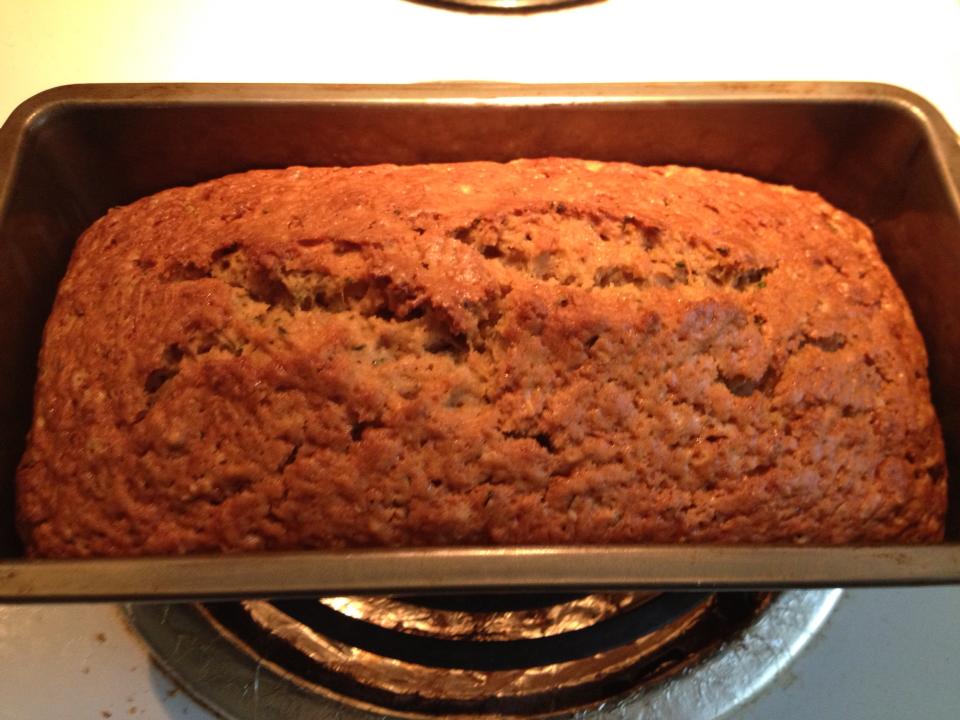
Zucchini bread

zucchini bread

1 & 1/2 cups unbleached all-purpose flour
1/2 teaspoon salt
1/2 teaspoon baking soda
1 & 1/2 teaspoons pumpkin pie spice (or cinnamon)
1/8 teaspoon baking powder
1 egg
1 cup turbinado sugar
1 & 1/2 teaspoons vanilla extract
1/2 cup vegetable oil
1 & 1/2 cups grated zucchini

Directions
1. Preheat oven to 350 degrees F (175 degrees C)

2. Sift together flour, salt, soda, pumpkin pie spice, baking powder.

3. In a separate bowl, beat the egg. Add and mix well the sugar, vanilla, and oil. Add zucchini to this mixture.

4. Add dry ingredients, mixing well. Pour into a loaf pan (grease it first with butter)

5. Bake at 350 degrees F (175 degrees C) for 1 hour.

6. Let it cool in the pan on a wire rack for at least ten minutes, then remove from pan.

(Modified from the “Allrecipies” website recipe called “Mom’s zucchini bread”)

True mental health hospital

I envision a new kind of rehab hospital for people who are mentally ill. Perhaps better said, it will be for people who don’t know how to be human. It will teach people how to take care of themselves. It will teach them how to live on their own in a healthy way.

Rehab shouldn’t just be about getting off drugs but about how to get on life.

People would be there to learn, so they would be students, not patients. “Patient” is a passive word – something is done to you. You are sick, an “in-valid” – a “not-true” person. The word “student” implies an active engaging in learning for self-betterment. Teachers, not therapists, are there to help students help themselves.

One of the most important things will be that students will learn how to have a healthy relationship with food. They will learn what food is healthy and how to buy and prepare it. Every person will learn how to cook. Every person will learn what foods are best for them. There will be a blend of nutritionists and home-economics teachers.

The teachers will find ways that the students can exercise in a way that they will enjoy and are able to do. Exercise is essential to mental health and happy bodies. Not every exercise is possible for every person, and not every person likes every exercise. The trick is to find one or two that the student likes and will stick with. Then they have to commit to doing it daily. Every little bit counts.

This whole idea that I’m envisioning is to teach people how to live in their own bodies as their own homes. Your body is your first and best house. If you don’t take care of it you will be miserable. I have learned from my own personal experience that mental health is directly related to physical health.

It is also important that they discuss what happens when you fall off the wagon. Perhaps the stigma needs to be taken away from falling off the wagon, because falling off the wagon is part of the journey.

For some people it wouldn’t be “re-hab” because there was no “hab” that happened to start off with. They never learned how to take care of themselves in the first place. It isn’t that they forgot, it is that that they never were taught.

Ideally, everyone would learn how to take care of themselves early on in life. Ideally, people wouldn’t have to wait for a crisis in order to learn that they have to take care of themselves.

Perhaps that is just simply part of our society. We seem to fix things after they are broken rather than prevent them from breaking in the first place. This is a habit that should be unlearned. People need to become pro-active about their lives.

Rehab needs to teach people healthy coping mechanisms for life. Students would learn about codependency and enabling and boundaries. They would learn how to be helpful in a way that is safe for them and for the person they are helping.

They would learn the value of volunteering. It is a way to put your own needs and problems into perspective, and to feel not only a part of the community, but a part of the solution to problems.

They would learn how to take care of their bodies and their minds at the same time and learn that they are not separate things. Through books, they would be introduced to teachers from all over the world and all across time. They all have useful information about this thing we call life. Most importantly, they would be given the tools to be able to learn more on their own.

My biggest dream is that rehab hospitals aren’t ever needed, because everyone has already been taught how to handle life’s ups and downs in healthy ways. But until then, we have some catching up to do.

The best medicine you can ever take is to not get sick in the first place. And the best way to do that is to learn how to take care of yourself through eating well, exercise, and learning to establish boundaries.

Plus and minus

Consider the plus sign and the minus sign.

Plus means positive, and minus means negative.

But look at them in relation to the cross.

The minus sign, the horizontal one – represents us here on Earth.

The vertical line represents Heaven and Holy Spirit.

When you try to do things your own way, you are working in the “minus” realm.

When you invite in the Holy Spirit, you’ve added in the vertical line, and you are in the “plus” category.

Welcome in the power of God, allow God to work in your life, and you are positive. Do it all yourself and you are negative.

Trust that God is in charge and it will all work out the way it should.

Counting doesn’t count

I saw a lady whose son was hanging onto the gates near the door at the library. It wasn’t time for the family to leave yet, and she was trying to get him to come back to the children’s section. He was having none of it. He was about 6.

She looked at him and said “1.” Pause. She gave him a stern look. “2”. Pause. Another stern look. “2” she said again, looking at him like he better get the clue. And yet again, she said “2”.

I said “No, you have to say 3, otherwise 2 has no meaning.” She said three, he didn’t come, and she went to him, took him by the arm and marched him back to where he was supposed to be.

He cried, of course, and that is what she was trying to avoid. But if she isn’t firm and consistent with expectations and consequences, then she might as well not say anything at all.

Rules have to have consequences if they are broken. Otherwise they have no meaning.

Sayings “shhh” doesn’t mean anything either. The child learns that they yell, and Mom says “shhh”. It is just an exchange of sounds. The parent has to say “Please be quiet” or explain that “shhh” means that. Otherwise “shhh” is just a sound.

Then there was the mom whose child would not stay with her. He kept running to the door, or just away from her. She told him what to do and he kept not doing it.

There were no consequences. He had no reason to obey her.

It was yet another example of “Stop doing that or I’ll say stop doing that again.”

However you want your child to act as an adult, you need to mold them as a child. You are supposed to be a parent, not a friend.

Sure, they won’t like it. That isn’t the point. It isn’t child abuse to set rules and enforce consequences. It is child abuse to not do this. Otherwise they grow up wild.

Rocks and life.

Good habits are like the reverse of water wearing away at a stone.

If we are intentional and mindful about our lives we will create something really amazing. Good habits are like building a cathedral. Each stone, one at a time, is placed upon another. There is a plan to it and a lot of hard work. It isn’t built overnight, and it isn’t built by accident. It requires a lot of focus and discipline.

When we are intentional about our lives, every little bit counts and every little bit works towards a goal. We are building something amazing and strong.

If we are not intentional about our lives, those stones will end up being more like a field of rocks.

They will cause us to trip.

They will make the field unable to be used to produce a harvest.

Consider this – a stone, left untouched, is just a stone. But with vision and focus and hard work, over the course of several years, can result in an amazing sculpture like Michelangelo’s “David”. Perfection takes a plan, a lot of work, and time. It doesn’t happen on its own.

So how can we be intentional? What we read counts. What we do to take care of our bodies counts. Any classes count – whether a normal course of study or extracurricular.

It may seem like a little bit here and there. But over time, it amounts to a lot. Make it count.

Love everything. Really?

“And God said “Love your enemy,” and I obeyed Him and loved myself.” – Khalil Gibran

Yup. It means love everybody and everything. Love the ugly bits about yourself. Love the bad situation, too. Don’t resist, and don’t fight it. Love it all, all the time, because it is all from God.

Easier said than done.

I keep reminding myself of this. I keep reminding myself that God is in charge, and everything, even the stuff that I think is bad and terrible and crazy, is from God. I keep reminding myself to be thankful about everything.

I think Jesus had it easy. He died before things got really hard. He died before he had to deal with in-laws, and nursing homes, and do not resuscitate orders, and probate.

Actually, it would be easier if I was handling all of this, because I’ve done it before. I know how to detach myself from the situation and just do it. But I’ve intentionally separated myself from all this because these aren’t my parents. I believe that it is the job of the adult child to take care of their parents, not the wife.

I’m trying not to micromanage. I’m trying to stay out of it. It isn’t easy. It is like watching a baby bird – will it fly? Will it crash?

And there is nothing I can do except watch.

And then I think about the guy I know whose wife died from cancer. He’s faking it, and not really taking care of himself. I want him to do well, but he has to do it on his own. If I make food for him, or remind him to eat, or tell him that he needs to eat more vegetables and exercise and stop drinking caffeine and skip all sugar if he wants to stay balanced – I’m not letting him stand on his own.

He could crash. He could sink into depression. He could kill himself.

These are very real things.

And both of these stories affect me. I live with one, and work with one. If they crash, I have to pick up the pieces. That leaves more for me to do. It isn’t really empathy. It is self-preservation.

I’m trying to remember that God is in charge. I’m trying to remember that people need to ask for help first. Unsolicited advice is never heeded. Jesus didn’t make a habit of going up to people and healing them without them asking for it first.

Jonah gave thanks in the belly of the whale too.

This has to be what it is like to watch a child learn to walk. You want to catch them when they stumble, to prevent them from falling and hitting their heads. You don’t want them to get hurt. But pain is an awesome teacher. And we get stronger if we do things ourselves.

I have to trust that this feeling I’m having is part of God’s plan too. I don’t know how it will be used, but I have to trust.

Because the alternative isn’t very healthy.