Books are personal

You can’t just recommend them to anybody. You have to know the person, as a person. Not just that they like to read. You have to know –what- they like to read, and sometimes why they like to read what they like to read.

You can’t assume that simply because you loved a certain book or a certain author that everybody will. Everybody doesn’t need to read John Grisham or Neil Gaiman. Not everybody needs to read Danielle Steel or George Martin. The styles are vastly different. Women who read Debbie Macomber won’t read anything by Zane. Note that Zane is not the same as Zane Grey.

Oh, the horror if you mix those two different audiences up.

Books are like shoes. They don’t fit everybody. Also, different books are for different purposes. Just like you wouldn’t wear galoshes while playing tennis, you wouldn’t read an accounting textbook on your vacation.

Or maybe you would.

And that is the point.

Everybody is different, and that is a great thing. There’s a book out there for you, that fits your mood, and your need. It just isn’t what everybody else is reading, because they aren’t you.

Suffering and service

Jesus’ disciples James and John, the sons of Zebedee, approached Jesus with their mother to ask a favor. They asked Jesus to be allowed to sit on either side of him when he achieved his glory in the kingdom of heaven.

But Jesus said “You have no idea what you are asking for! Are you able to undergo all the trials and sufferings that I must endure?”

“We are able,” they answered.

Jesus said “You will indeed go through the trials that I will go through, but it is not up to me to say who sits with me in heaven. That is something that is decided by my heavenly Father.”

When the other disciples realized what James and John were asking, they were angry because of their audacity. Jesus called all the disciples together and said “The Gentiles have people who exercise power over them such as kings and men of high positions. Things must be different among all who follow me. For you, whoever wants to be great must be like a servant. And whoever wants to be the best must serve everyone. For even I did not come to be served, but rather to be a servant, and even to give my life as a ransom for many people.”

MT 20:20-28, MK 10:35-44

Gabriel predicts John’s birth

There once was a man named Zachariah who was a priest in the Abijah division when Herod was the king of Judea. He was married to a woman named Elizabeth, who, like him, was descended from the priestly line of Aaron. Both were honorable people and followed all the commandments of the Lord. They were childless because Elizabeth was barren and both of them were elderly.

Zachariah was chosen by lot to enter the inner sanctuary to burn incense when his division was on duty in the Temple. The entire assembly stood outside praying while he performed this task. An angel suddenly appeared, standing to the right of the altar of incense. Seeing the angel, Zachariah was startled and a feeling of terror fell upon him.

Then the angel said to him, “Have no fear Zachariah, your prayer has been heard! Your wife Elizabeth will give birth to a son, and you will name him John. Both of you will be filled with joy and gladness, and many people will rejoice with you at his birth. He will be a champion of the Lord. He must never drink alcohol, because he will be filled with the Holy Spirit even before he is born. He will convince many Israelites to turn to the Lord their God. He will serve God with the same kind of spirit and power of Elijah, and will transform the hearts of parents to be like their children, and the hearts of the disobedient back to the wisdom of the faithful, to prepare all the people for the coming of the Lord.

Zachariah challenged the angel saying “How can I know that this is going to happen? Both I and my wife are very old.”

Then the angel replied “I am Gabriel, who stands in the very presence of God. I was sent to tell you this good news. But because you didn’t believe my words, which will come true in due course, you will lose your ability to speak until the child is born.”

Meanwhile, the congregation outside was wondering why Zachariah was taking so long in the sanctuary. When he finally appeared before them they deduced from his gestures (since he wasn’t able to speak) that he had seen a vision in the sanctuary. He continued to work at the Temple until his assignment was over, and then he returned home.

Shortly after that, his wife Elizabeth became pregnant and she went into seclusion for five months. She said “Blessed is the Lord for taking away my public disgrace!”

LK 1:5-25

4 x 6 collage – January 2015

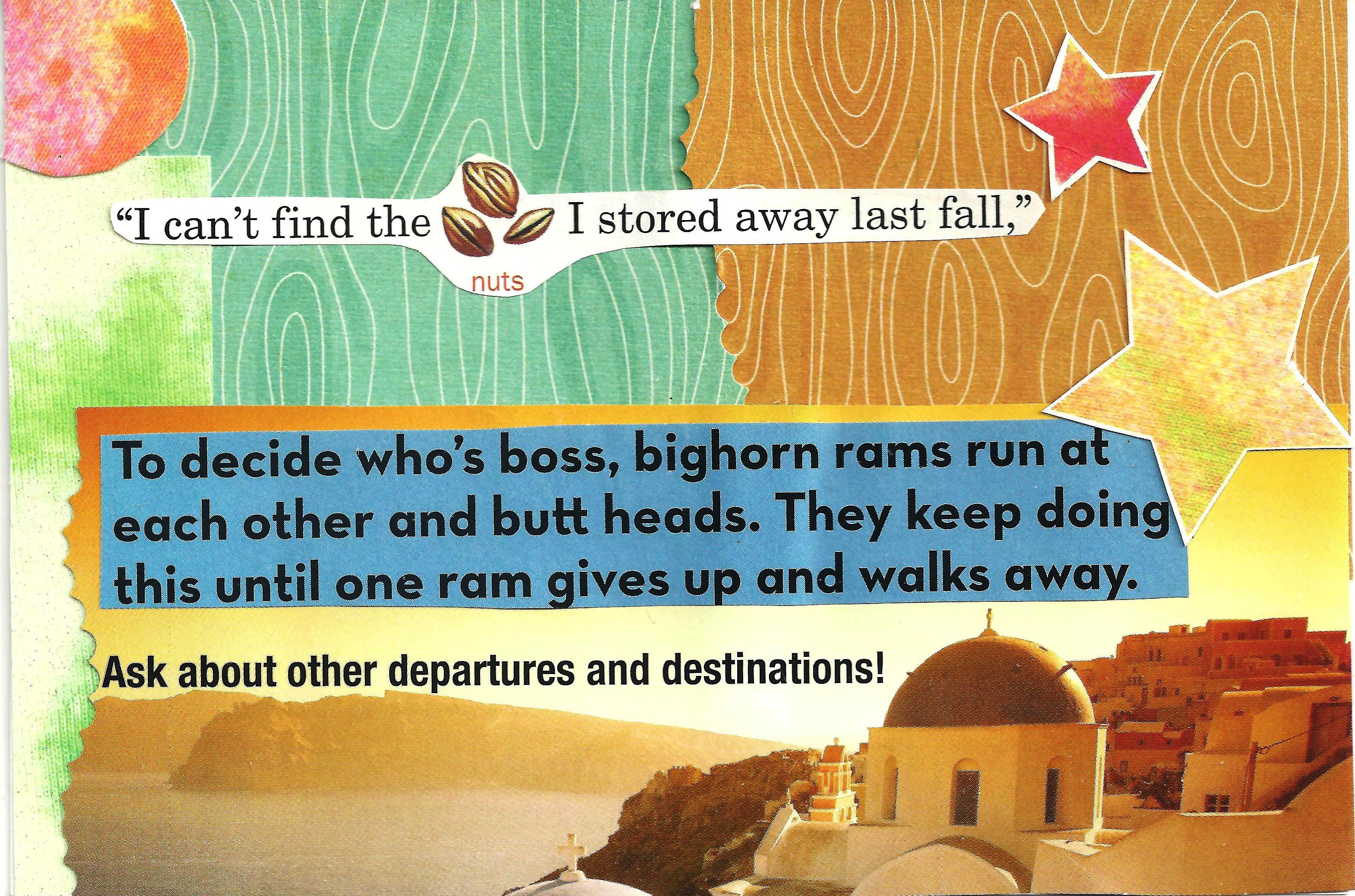
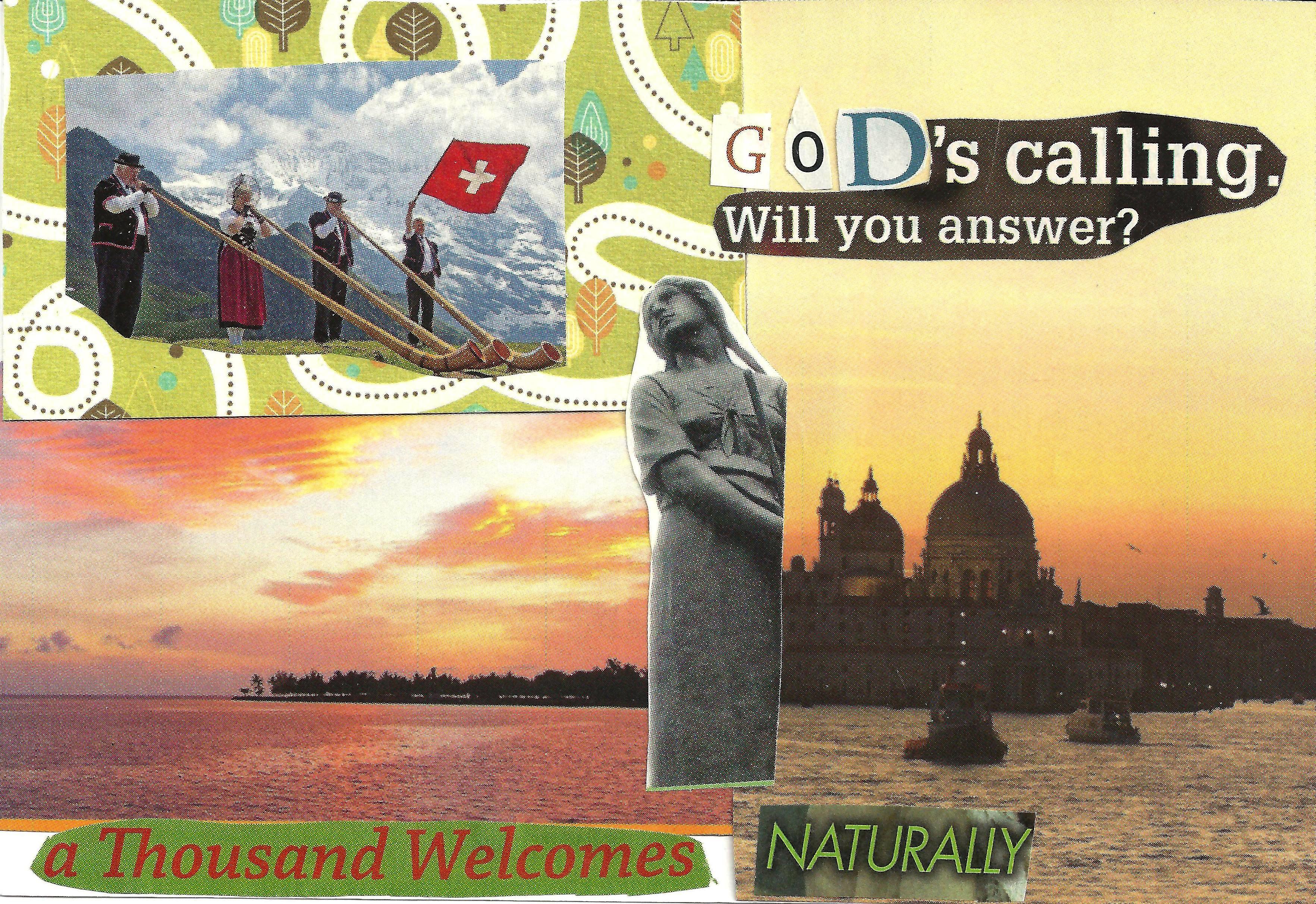
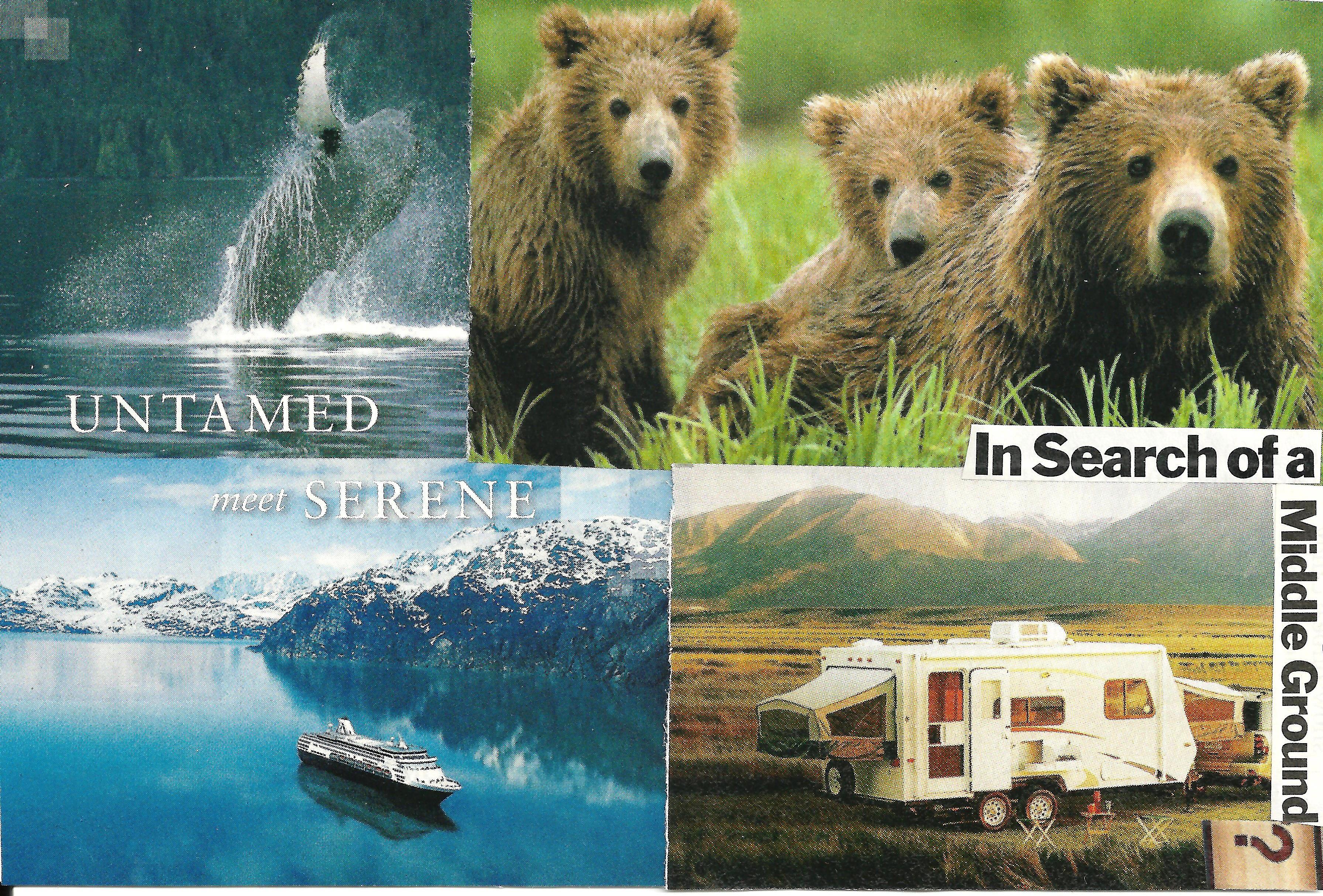
I created my first 4×6 collage at a retreat a few weeks back. When I was given the assignment, I balked at the size. Too small, I thought. I’ve got a lot to say. I made the first one, and then quickly made two more. I’ve learned to appreciate the need to edit my thoughts with this format. It also appeals to my love of collecting phrases and images from magazines. Fortunately, the magazines are free – discards from work. The scrapbook paper is not. I shake my fist at my friend who turned me onto this. Like I need to spend money on a whole new set of crafting supplies…

Wild-tame
wild tame 011915

spiritual landscape (the retreat theme)
spiritual landscape 011015

other way (a reminder to quit butting heads and try things differently)
other way 011015

land-sea (poem)
land sea 011915

hidden treasures
hidden treasures 012515

God’s calling (al
Gods calling 011015

The Visitors part 10

The disappearances didn’t cause the electricity system to fail. That happened about two years after. Plenty of other bits of what they thought of as civilization had started to disintegrate years before. The disappearances just furthered things along.

So many people had gone off the grid by homesteading that it all finally fell apart, like a gyroscope wobbling to a stop. Without enough people paying for electricity, there simply wasn’t enough money coming in to repair the substations.

The upper management did what upper management has done since there were managers. They laid off all the actual workers, and then stayed on until the bitter end, collecting a paycheck but not doing anything. They didn’t know how.

The end came faster that way, because the people who knew how to do the work were gone. What is the point of managers if they can’t manage to figure out how to do anything themselves? Being able to write up schedules and delegate is a pointless exercise when you don’t have any warm bodies to do the dirty work.

Homesteaders were motivated by fear that the authorities were going to take everything away from them. They figured they can’t take away what they don’t have. Perhaps people also just longed for the good old days, forgetting that if the good old days were so good they would’ve kept them.

There wasn’t a central education system anymore, either. Pretty much the same amount of people who had been homesteading had also been homeschooling. They felt like they could do things better themselves. They didn’t want to give away their power to someone they didn’t know.

This feeling of mistrust of authority had gone on for a long time, in part fueled by repeated warnings of an impending apocalypse. Whether it was brought on by zombies or Jesus or the final battle of the Vikings, people were worried. They turtled in, stocking up supplies and shoring up their defenses.

The times to stretch out and trust were over.

It didn’t make sense how a six-month supply of canned vegetables and tuna was going to help if the world fell apart. It seemed like it would simply delay the inevitable impending slow death. Plus, it might attract unwanted visitors. You know, the ones who didn’t get sucked up in the rapture, or had saved up any food.

One thing it meant was that people who weren’t experts were now in charge of their own lives. Simply being a parent did not qualify them to teach their children. Why they thought that they could do better than someone with a Master’s degree in education made no sense. But they were allowed to do it.

The government thought of it as self selection. They thought of it like this – if you give them enough rope, they will hang themselves. All the educated people will be able to rule over the home-schooled, or the newest fad, “un-schooling”, where the child directs his learning. Who ever thought up that idea? Like a child is going to want to learn how to do anything other than play. They’ll never learn how to read or do math because they won’t know they need it.

The city-zens still paid taxes, so their money still went to the education system their children didn’t participate in it. The government made more money and spent less. It was genius. The city-zens thought they’d gotten out, but in reality they were still buying in.

Similarly, what makes an accountant or a mechanic think he’s suddenly a farmer? Sure, with homesteading he’ll know exactly what goes into his food. He’ll know whether there are pesticides or not. But when his crop fails because he didn’t rotate his crops or add enough phosphorus he’ll be starving and just as clueless.

It was a perfect mess, a confluence of confusion.

Those who were left, who’d survived the crumbling of civilization, were those who knew enough to band together. The lone wolves, the dread pirates of the times faded out, forgotten and forlorn. Those who learned how to share what they had, be it cucumbers or Calculus, they made it.

Of course, they couldn’t be obvious about it. Banding together was forbidden for any group larger than 20 was seen as a threat. The mass protests of the early 21st century had taught the government that. People would suddenly appear in the city streets, banners and drums at the ready, faces obscured and mouths open, shouting slogans in unison. They were flash mobs, no doubt, but they weren’t dancing to a pop tune. They were marching, and marching against austerity, against, authority, or just against.

Sometimes they didn’t even know what they were marching or drumming or shouting against. They just did it, and their numbers stopped traffic and started the government thinking. Any group that was larger than 20 got shut down, no debating, no questions asked. Shut down with water cannon or tear gas or drones. Shut down, shut out, shut off.

The Visitors had to be subtle when they got together, but get together they must, and did. With no social media to communicate their meetings in advance, they hid messages in magazine ads, scrawled slogans in graffiti. Those who knew the code knew it all.

It was time to meet. Now, to find the place.

Island – thousand word story

island2

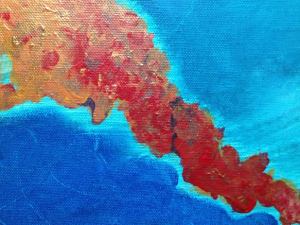
The Island was long, but they were wise in how they settled it.
island4

They put most of the cities and villages to the south along the long stretch of land they called the Lumbo. The grassy plains to the north they left alone, unhampered by the burdens of civilization. There the animals roamed free, just like they had when the people first came here.

They been careful, these wayfaring People, these new-world-creating People, to make sure that the animals they brought with them didn’t invade or take over the habitats of the aboriginal animals. They learned a lot from the mistakes others had made before them, in other lands and other times. This was their plan,

to live
with
the natural world
rather than
in spite of it.

They’d tried to tell the others about the dangers. They’d tried to convince them of the avalanche of waste, of poisons, of the dangers of neglect or of over-use. They’d tried and failed. They continued, the others, in their thoughtless, mindless ways, living as if there was no tomorrow.

The People left, knowing if they didn’t, there wouldn’t be a tomorrow. Their water would be undrinkable, their food would be their poison, their air fouled with smokestacks and acid. They left the “experts”, the doctors, the academics, the politicians, the priests. They left them, seeing the train that was coming was going to run them over, all of them.

This Island was their last hope. Others had left for the stars, hoping to colonize other planets that were as Earth-like as possible. They’d never written back. The citizens of Earth never knew if they’d gotten lost or died along the way, or worse, gotten there and flourished. Perhaps in their zeal to keep what they had, their new secret Terra Firma, they never wrote back, for fear that others would follow and ruin the joy, the unspoiled wilderness.

Too many colonists spoil the planet, you know.

The People had come here to the Island, some too poor to make the first trip, some too scared to box themselves up coffin-like in the space ships. It was 23 years after the first and only ship left that they’d scraped up enough money and interest to make the voyage.

The Island was their home for good now. They’d taken apart the big ships, used the wood to build their first settlements.

It was best this way really, living to the south. The people on the west side of the island had a perfect view of the deep, dark, waters of the MaLungo Sea, while the people to the east not only enjoyed the morning sunrise but also the shallower waters of the Bay of BahrimBa. There was good snorkeling there, and dolphins.

The dolphins told them everything they knew about this Island’s waters and even further out into “the Great Deep,” as the dolphins called it. Few of them went there. That was the realm of the whales, the royalty of the ocean.

The People of the Island enjoyed visiting with each other but the waters weren’t amenable to sailing close into shore. They were choppy and many a ship was lost before the people learned to understand the language of the dolphins. Together they tracked out the sea lanes, the invisible highways that stretched over the ocean, areas of calm where ships may safely sail. This made it possible to establish farming villages in the north as well. No roads could be constructed to transport the produce, so small ships were essential lifelines to the southern towns.
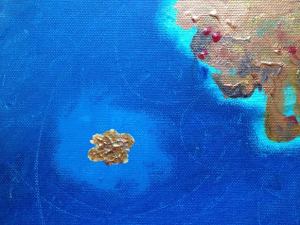
island3

They made a wide berth around the island to the west. It had sprung up some 200 years ago amidst much rumbling and plumes of steam. One day it wasn’t there and then one bright morning, heralded by cracks and booms, the island was born over the course of six weeks.

No one lived there. Not even animals.

They called it “Turtle Island” because it looked like the shell of a great turtle, not because any of those noble animals lived there. They remembered a story from many generations back of a turtle holding up the world on her shell. That turtle was bigger than dreams and stronger than fear. She held up the world, swimming through space like it was a sea of stars. She held the world up on her back, high enough for light and air for it, while underwater she navigated the waters of time, carrying them to their unknown destiny. Her life was a life underneath, a life of service.

The people then never really knew how much she did for them.

They told her story to their children to remind them that all they see isn’t all that is, and that there is a great force that is carrying them safely and with great sacrifice. That was all they knew, and it was all they needed to know.

The story served them well then.

Years of science disproved this story, turned it into a myth. The people shifted away from superstition and ritual, but lost some of their hope when they abandoned the turtle as their benefactor.

These people carried that story, like a small ember from a fire, to their new home. Turtle island’s birth served as proof to them that their faith was warranted – the great turtle was still carrying them.

People would visit but they were not allowed to spend the night. Birds would land here to rest, but would not make nests. Even they knew this was a holy place. The brave among the teenagers would make their rafts or borrow the community rowboats and scull out to this little land

on a dare
or to stake their claim
or to run away
from restrictive parents
and their
even more
restrictive rules.

The island was still settling and still growing. They didn’t ever need the authorities to tell them to leave. They left of their own accord quickly enough, frightened by the rumblings in the land.
Jewelry inspired by The Visitors story

stopped watch
watch2watch1

prayer beads – three characters, three beads.
prayer4

prayer3

prayer5

There aren’t jewelry stores in the time of the Visitors. Things have to be assembled out of what is available. People don’t quite remember how to make prayer beads anymore, so they make what they need with what they have. They follow their own internal ideas rather than institutionally-imposed ideas.

Poem – old lady smell

She arrives, shaggy
shambling, shuffling
shopping bag in tow,
big enough for a child.
Barely able to lift it,
it contains all the cares in the world
and a bakers’ dozen of romance books.

She’s
dressed in flowers and lace
a bag-like shroud
big enough to cover
almost everything,
large, shapeless
stitched from ten thousand days
of regret and disappointments.

Her aroma arrives before she does.

A dance of cat
marking territory
relieving, discharge
doing a tango with her own
urine
soaked through, layered
and a third partner,
waiting for the dance –
flowery perfume to match
cadence
with the other two
sometimes stepping on their feet.

Any one
would be enough
to stop me

but all three
arrest me, full stop
like a police officer
like a spike strip
like a strip search.

The day is over
from that point onwards.

In the beginning

Dedication.
To my friend who loves God: Many people have tried to put together a story about the life and times of Christ, using material from the earliest disciples and other eyewitnesses. It seemed to me that it would help if I shared my research with you. I have independently compiled a sequence of all the events in proper order. I hope that these words will assure you of the truth of everything that you have already been taught.

LK 1:1-4

In the Beginning, God created everything through his Word. The Word was with God, and was God. All things were created through the Word of God. The Word was filled with life, and that life was the light of all people. That light shines forth in the darkness, and the darkness cannot overpower it.

JN 1:1-5

Bazlael 12-12-12

A few years ago, I was tutoring a kindergartner from Ethiopia. The Christmas break was coming up, and I asked him what he was most looking forward to. He’s five, so I figured presents would be at the top of the list, then followed by food, and then maybe visits with family. This is of course assuming he remembered what holidays were all about, being five. I was also guessing that he was Christian – many Ethiopians are.

He surprised me. He smiled hugely and got wistful. He looked off and up. He said very excitedly – “It’s Jesus’ Birthday!”

And a child shall lead them.

He’s got it. It isn’t the break to look forward to. It is Jesus. He’s coming, again, to each of us. Coming to let us know again that we are loved and wanted more than anything else in the world.

We have a God that loves us – even when we don’t love God.

We have a God that is always there, waiting for us with open arms.

We have a God that provides for us all the time, even before we ask.

So many gods demand to be loved. Ours loves us already, loves us before we are even born. Loves us when we stray and loves us when we return.

We have a God that wants us to be active participants in bringing forth the Kingdom. We are called to be A Part of this. Not apart from it.

This is amazing to me. We aren’t passively here. We are active. God works through us to bring forth healing. When God needs someone to be fed, God doesn’t create a miracle. Poof – Food appears. No – God wakes us up to go outside of our own needs. That is the miracle. The miracle is that we aren’t all selfish animals. The miracle is that we notice and care for others.

The everyday is the extraordinary.

And all of this was inspired by a small child who got excited about it being Jesus’ birthday.

(I’m going through my backlog of half-finished posts and finishing them. This was from December of 2012. Some are becoming poems because they are mere sketches of ideas, not fleshed out. They are more stop and start than exposition. This is kind of inbetween.)