On depression, addiction and following God’s commandments

Several of the many blessings in Judaism give thanks to God for sanctifying us by giving us commandments. What does this mean? We are made sacred when we follow the commands that God has given us.

While reading this week’s Torah portion (Bechukotai), I was struck by how this relates to depression and addiction. When we stray from the path of order, we get sick. The word “Sanitary” refers to being clean. Insane literally means “not-clean”. When we act in a good way, we stay clean and sane.

In Leviticus Chapter 26, God is telling us what will happen if we don’t follow the commands that we have been given.
(14-17)
14 “But if you do not obey Me and observe all these commands— 15 if you reject My statutes and despise My ordinances, and do not observe all My commands—and break My covenant, 16 then I will do this to you: I will bring terror on you—wasting disease and fever that will cause your eyes to fail and your life to ebb away. You will sow your seed in vain because your enemies will eat it. 17 I will turn against you, so that you will be defeated by your enemies. Those who hate you will rule over you, and you will flee even though no one is pursuing you.

“Terror, and your life will ebb away”? Sounds a lot like anxiety and depression. And we will run even though nobody is pursuing us? That sounds like anxiety too, always in a panic.

Note that this is not some random punishment. It is the natural result of dis-order – of not following the order, the commandments, of God. It is more that we are punished by our bad choices, rather than God is punishing us.

19-20
19 I will break down your strong pride. I will make your sky like iron and your land like bronze, 20 and your strength will be used up for nothing. Your land will not yield its produce, and the trees of the land will not bear their fruit.

“Your strength will be used up for nothing” sounds very familiar. Depression feels like nothing you do is meaningful or worthwhile. What little energy you have amounts to nothing.

26
26 When I cut off your supply of bread, 10 women will bake your bread in a single oven and ration out your bread by weight, so that you will eat but not be satisfied.

Depression and addiction both feel like you are never satisfied. Nothing ever makes you happy. You never feel fulfilled.

36
36 “I will put anxiety in the hearts of those of you who survive in the lands of their enemies. The sound of a wind-driven leaf will put them to flight, and they will flee as one flees from a sword, and fall though no one is pursuing them.

More anxiety and terror, even though there is no discernable reason for it. Once again, this is part of depression and anxiety.

43
43 For the land abandoned by them will make up for its Sabbaths by lying desolate without the people, while they pay the penalty for their sin, because they rejected My ordinances and abhorred My statutes.

And this is all for when we choose to disobey God.

Yet, even though we abandon God, God does not abandon us.
44-45
44 Yet in spite of this, while they are in the land of their enemies, I will not reject or abhor them so as to destroy them and break My covenant with them, since I am Yahweh their God. 45 For their sake I will remember the covenant with their fathers, whom I brought out of the land of Egypt in the sight of the nations to be their God; I am Yahweh.”

We can turn around right now, and start acting correctly. We can be like the prodigal son, and return, right now, to obeying God.

Jesus boils down all of the commandments to two – Love God, and love your neighbor. Treat your neighbor how you like to be treated.

(All translations are from the Holman Christian Standard Bible)

Viriditas, energy, and time

Saint Hildegard’s “Viriditas” refers to life force, essence. Many translators simply say that this neologism means “greening”, which it does at the most basic level, but it means so much more than that. It is power, energy, growth. It is the very marrow of what it means to be living. You know when you meet someone whether they are simply existing or truly energetically alive. This “Viriditas” is the difference. We have the ability to tap into this force, a gift from God, and be truly alive. We are then expected to use this power in the service of God to help our fellow humans.

It is what Moses talked about when he said “I set before you a blessing and a curse – therefore, choose life.” Life is the blessing. To grow, to use your gifts is the purpose of life. We must choose to tap into the power of God, and then choose to use it wisely. We are not meant to use this energy for our own personal gain, but to benefit others. We are meant to take what God has given us and magnify it.

Two men having sex together is seen as a sin in Judaism because it is “spilling of the seed” – it is seen as a waste of creative life force. The act isn’t the sin so much as the waste of creative force. Their energy is not being used to create, but is used for personal means. They are not making anything with their energy. It is a mis-use of a gift from God.

Likewise, to create laws against homosexuals is also a waste of power. Imagine how many hungry, homeless, and hurting people could have been helped with the money, time, and energy that have been spent on creating laws against people who are gay or transgendered.

The focus must always be on wisely using what God has given you. The energy must be turned outward to help people, with full trust in God.

This is what Jesus talked about in the parable of the talents. Use what you have and make more. Don’t keep energy to yourself.

This is at the heart of the miracle of the loaves and fishes – which happened twice. Take what you are given and add to it. Feed people, in as many ways as possible. Food, encouragement, love – humans need all of these. Our gifts are meant to be shared, not hoarded up.

We are meant to be fruitful and multiply as much as possible, and this does not necessarily mean to have biological children. Our kindness, generosity, compassion are our children as well. Our creative acts – making music or art – are also our children.

This is also about the sanctification of time. The very first commandment that Israel received in the desert was the mitzvah of the calendar. They were to use the moon as their way to mark time, to note its passing, to remember and be mindful about time. It is important to be intentional about the use of time, because it too is a gift from God.

Take nothing for granted. Waste nothing. Trust your gifts and share them with the world, with God’s help.

Remember what Jesus did – he gave thanks to God first before he performed miracles. Tap into the “greening” power of God by giving thanks first for what you have, then turn it outwards to give to others.

Can and can’t

The difference between “can” and “can’t” is the Cross. Look at the two words. Notice that letter at the end of “can’t”. See that letter “t” as the Cross of Jesus, the one where he proved to the world that even death has no say over us.

Take that “t” off. Take it and hold it close, put it into your heart. Remember the love that God has for you, love that caused God to send God’s only-begotten Son to you, to redeem you, to heal you, to show you the path of life. Carry Jesus with you into that thing you thought you couldn’t do.

In the church tradition I was raised in, when you were being baptized you were asked questions before you were dipped into the water. The answer to each of the questions is “I will, with God’s help.” Take the “t” off “can’t” and it becomes “can”. You can do it, with God’s help. Remember the exhortation from an apostle, who tells us “I can do everything through Christ who gives me strength.” Philippians 4:13

Room

Jesus prepares a room for us in heaven,
so that we can be with him.
Likewise, we must prepare a room for him
inside us, so that he can be with us.

Jesus wants to be in every part of our lives.
Our work, our family.
Our fears, hopes, dreams.
Our good days
as well as our bad.
Our sorrows
as well as our triumphs.

“I am able to do all things through Him who strengthens me.” Phil. 4:13
“I am the vine; you are the branches. The one who remains in Me and I in him produces much fruit, because you can do nothing without Me.” John 15:5

(Bible quotations are from the Holman Christian Standard Bible)

Worthy

“The most dangerous stories we make up are the narratives that diminish our inherent worthiness. We must reclaim the truth about our lovability, divinity, and creativity.” Brené Brown

Meister Eckhart writes “It is a lie – any talk of God that does not comfort you.”
And “How long will grown men and women in this world keep drawing in their coloring books an image of God that makes them sad?”

So many of us have grown up with an image of God that is more abusive parent than loving Father, one who is more interested in discipline than delight.

For many of us, the mere suggestion of the thought that God loves us and wants us to be happy causes a knee-jerk reaction against it, believing that way leads towards sin. We must remember that Jesus came to give us life in abundance. This doesn’t mean having more things. This means living life fully, completely, with trust and hope and joy.

When did the Good News become the guilt trip? Who first taught you the image of God as angry, as upset, as never satisfied? Jesus paints for us a new picture. This is a picture of forgiveness, of unconditional love, of mercy and grace.

Read the Gospels for yourself. Talk to God yourself. Not only can you, God wants you to. Learn again, or for the first time, the truth that God loves you.

For many of us, developing a new healthy relationship with God is a lot like the work we have to do with reparenting ourselves, because we grew up in unhealthy homes. We were taught by abusive parents or siblings that we were not worthy of love. They most likely thought it was the best way to control us. Sometimes they used the image of God as the ultimate parent, always watching, always unhappy with what we are doing.

This isn’t who God is.

Remember this verse? This is one of the most-quoted verses by Christians. It is John 3:16

16 “For God loved the world that He gave His One and Only Son, so that everyone who believes in Him will not perish but have eternal life.

Right after it is this one.

17 For God did not send His Son into the world that He might condemn the world, but that the world might be saved through Him.

God does not condemn the world. God is love. God loves you – yes you. God made you, and God, being the source of love and goodness, made you good. Hold this tiny spark in your heart. Make it bigger through prayer and reading the Good News. Then share it with others.

The altar call

I find it interesting that in Rick Bragg’s autobiography “All Over But the Shoutin’”, he said that as a boy in church he waited and wanted for the feeling to come over him that he should go up to the altar to be blessed, to accept Jesus into his heart and his life. And he sat and sat and sat in that pew, and no special feeling came over him. He felt that it must be like being possessed, that he would be lifted up out of his seat and find himself walking up to the front of the church to be received into the arms of Jesus. He wanted that feeling, and it never came. So he never got up.

It isn’t a magical thing.
It isn’t a passive thing.

It is a human, on his or her own, of their free will, choosing to hand their lives over to Jesus, to follow along with him in God’s ways.

It isn’t something that happens to you.
It is something you do.

That turning becomes returning – daily, weekly, monthly. Every day we recommit, we choose.

He eventually left, feeling left out, feeling so low. He never understood that just wanting to go up was the call. God needs us to come to God on our own. It has to be conscious. God chooses us, but we have to choose God too.

Jewish prayer shawls

The prayer shawls used by Jews today were not used in antiquity. They evolved from the everyday item of clothing they wore that had four corners to which they affixed tassels (called in Hebrew “tzitzit”) per the Lord’s command. The Torah has two places where Jews are instructed to wear tzitzit on their clothing.

Numbers 15:37-38 37 The LORD said to Moses, 38 “Speak to the Israelites and tell them that throughout their generations they are to make tassels for the corners of their garments, and put a blue cord on the tassel at each corner.
– and –
Deuteronomy 22:12 “Make tassels on the four corners of the outer garment you wear.”

Why did the Lord command this? Numbers 15:39-40 explains. 39 “These will serve as tassels for you to look at, so that you may remember all the LORD’s commands and obey them and not become unfaithful by following your own heart and your own eyes. 40 This way you will remember and obey all My commands and be holy to your God.41 I am Yahweh your God who brought you out of the land of Egypt to be your God; I am Yahweh your God.”

Only Orthodox Jewish men wear the four-cornered garment with tzitzit these days. For all other Jewish men, there are prayer shawls that serve the same purpose. The shawl is usually worn only during morning prayer, while the garment is worn throughout all the daylight hours. It is rare for Jewish women of other denominations to wear the prayer shawl, and they never wear the garment.

The prayer shawl itself is not important – the tassels (tzitzit) are. They are to serve as a constant visual reminder of the oneness of God and of the need to fulfill God’s commandments. Interestingly, they serve as a reminder not only to the wearer, but also to anyone else who can see the tassels.

The tasseled four-cornered garment that the Orthodox Jews wear is worn underneath the regular clothes and is called a tallit katan, meaning a “small tallit”, or it is also called arba kanfot, meaning “four corners”. It is popularly known as simply “the tzitzit”, while the large prayer shawl is commonly known as “the tallis”.

Here are examples of the tallit katan (or arba kanfot)

Man_wearing_tallit_katan
t-shirt
IDF-tzitzit-01

There are no specific requirements as to the size or color of the tallit. The most important thing is that it has four corners that tzitzit are affixed to. Some tallits are large enough to wrap over the head to make a sort of tent so that the wearer can be in seclusion with God while he prays. Some are so narrow that they look more like scarves.

One side is given a special band, called the Attarah, to mark the top outside of the Tallit, as it is considered a garment and thus must not be worn upside down or inside out.

The Tzitzit have very specific and detailed ways that they are tied and knotted. There are different opinions as to exactly how many knots and wraps around the group are to be done, but each style has significance. In the past, one thread was always a royal blue, but some experts say that the source of that color has been lost, so rather than get it wrong they recommend using all white threads to create the tzitzit.

Here are various examples of tzitzit –
800px-Tzitzis_Shot

800px-Tzitzith

Here are examples on how they can be knotted –

gamatria_2
image029

Before putting on the tallit, one should check the tzitzit to see that they are still kosher, making sure that they are not frayed and the knots are still intact. While checking the tzitzit one recites:

Transliteration:
Bar-chi Naf-shi Et Ado-nai, Ado-nai E-lo-hai Ga-dal-ta M’od, Hod V’ha-dar La-vash-ta. O-teh Ohr Ka-sal-mah, No-teh Sha-ma-yim Ka-ye-ri-ah.
Translation:
My soul, bless the Lord! Lord my G d, You are greatly exalted; You have garbed Yourself with majesty and splendor. You enwrap [Yourself] with light as with a garment; You spread the heaven as a curtain.

Then, when putting on the Tallit, one says the blessing:

Transliteration:
Ba-ruch A-tah Ado-nai E-lo-hei-nu Me-lech Ha-olam A-sher Ki-de-sha-nu B’mitz-vo-tav V’tzi-va-nu L’hit-a-teif Ba-Tzi-tzit.
Translation:
Blessed are You, Lord our God, King of the universe, who has sanctified us with His commandments, and commanded us to wrap ourselves in Tzitzit.

Note that we are commanded to wrap ourselves in the tzitzit, not the tallit. The fringes are the focus, not the garment that holds them. The prayer shawl itself is just a vehicle for the tassels.

Then you pull the Tallit over your head and wrap the two tassels of the right side over the left shoulder and recite the following verses from Psalms 36:8-11.

Transliteration:
Ma Ya-kar Chas-de-cha E-lo-him, U-v’nei A-dam B’tzeil K’na-fe-cha Yir-v’yun M’de-shen Bei-te-cha, V’na-chal A-da-ne-cha Tash-keim. M’kor Cha-yim, B’ohr-cha Nir-eh Ohr. M’shoch Chas-d’cha V’tzid-kat-cha L’yish-rei Leiv.
Translation:
How precious is Your kindness, O G d! The children of men take refuge in the shadow of Your wings. They shall be satiated with the delight of Your House, and You will give them to drink from the river of Your bliss. For with You is the source of life; in Your light we see light. Bestow Your kindness upon those who know You, and Your righteousness on the upright in heart.

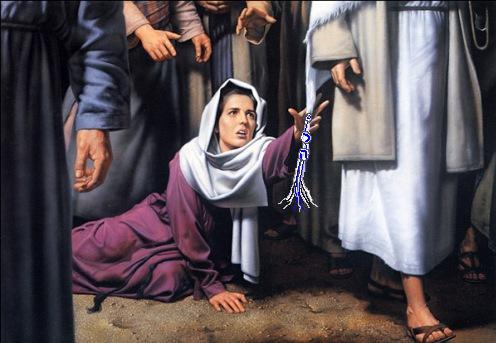
We know that Jesus obeyed the commandment to wear Tzitzit through these verses from the Gospels –

Matthew 9:20-21 Just then, a woman who had suffered from bleeding for 12 years approached from behind and touched the tassel on His robe, for she said to herself, “If I can just touch His robe, I’ll be made well!”

woman_grabbing_yeshua_s_tzitzit

and

Matthew 14:36 They were begging Him that they might only touch the tassel on His robe. And as many as touched it were made perfectly well.

It is worth noting that the tzitzit are visible most when we have our eyes downcast, as when we are depressed. It is then that we most need to be reminded of the closeness of God. Following God’s commandments helps us to get back on the proper path, and seeing the tzitzit remind us to do so.

Resources:
“The Complete Artscroll Siddur” by Rabbi Nosson Scherman
“The Complete Book of Jewish Observance” by Leo Trepp
“How to Run a Traditional Jewish Household” by Blu Greenberg
“Understanding Jewish Holidays and Customs: Historical and Contemporary” by Sol Scharfstein
The Chabad website
All Bible translations are from the Holman Christian Standard Bible.

Fear of God?

The Hebrew word יִרְאָה that is translated into English as “Fear of God” means something entirely different. It is spelled phonetically as “yirah” and pronounced as “Year-uh”.

“Fear” is an improper and misleading rendering, because God does not want us to be afraid. It is said that the phrase “Don’t be afraid” appears 365 times in the Bible – one for every day of the year. We are told repeatedly that “God is love”, so why should we be afraid of God?

According to Strong’s, the word actually means “reverence” or “piety”, not fear.

It is to indicate respect, to know before Whom you stand. To not take God for granted, but remember that God is your Creator. It is the same feeling you would have for a good parent or a wise teacher.

However, it is not the feeling that you would have for a friend. You must always remember that God is greater than you and existed long before and will exist long after you. You must remember that God created you and the rest of the universe. There must be some humility because of this.

But it isn’t fear.

Consider what other words that we have been told about God and Jesus that are not true, that were given to control us.

Decamp

Let us consider the death euphemism “the dearly departed”.

“Departed” is a very useful term when speaking about death. The Greek word analyseos, which is rendered in English as “depart” really means “to break camp”. It means to take down your tent and move on to another place.

Consider the Jewish festival of Sukkot. (Sukkah, singular, means “booth” or “tabernacle”. Sukkot is plural). It is celebrated on the 15th of the Hebrew month of Tishrei, which is around September or October). You’ll find it observed by Jesus in John 7:1-52.

Booths or tabernacles are temporary structures that Jews live in for a week as a remembrance of what they lived in when they traveled for forty years in the desert to reach the Holy Land. The structures are built every year, and intentionally have flimsy walls and a roof you can see the stars through. All meals are eaten inside this structure, and ideally you are to sleep in it at least one night.

This is a very beautiful symbol of our bodies. They are temporary structures that we dwell within. They are fragile, and while able to endure stronger gusts of wind than the sukkah can, they are not permanent and subject to decay. It is a sign of our utter dependence upon God.

Remember that Jesus is said to have “tabernacled” among us”, to have become enfleshed.

When we die, it is really that we have departed. We have left our temporary dwelling behind. We have left for a better place, just like how nomadic people will break camp to follow the herds or to move to where the crops are ripe. Just like how the Jews gave up their tents when they entered the Holy Land.

Death isn’t the end. It is just the end of life as we know it.