Poem. Preparing to go on retreat.

I’m preparing for silence,
for stillness.
I’m preparing
to not prepare.
I’m readying myself
to be open to the idea
that God
has a better to-do list
than I could ever
make up.

My lists have
chores and groceries,
recycling and letters to write.
They are filled with
the minutia of life.

Get tire pressure checked.
Buy rocks for the garden.
Get cholesterol test results.

God’s list is much shorter.
Rest, and know
that I am.

God says
“Here’s a beautiful lunch I made
for you,
with My hands.”
God says
“Here’s a lovely flower
– come look at it.”
God says
“Let’s paint a picture
right now
with fingerpaints.”

God is the best child,
always wanting to show me
the latest treasure
or discovery.

I, the impatient,
harried parent,
have to put down
my purse,
my iPhone,
my canvas work bag
just to
pick them up
to look at them.

And maybe that is God’s plan.
Distract us
from ourselves
so we can
find ourselves.
Make us put
things
down
so God can
pick us up.

Poem – discipline

In order to gain something you need,
you have to give up something you want.

Reading, study, sleep,
versus
TV and the internet
for instance.

Consider the
monkey with his hand in the jar.
He can hold onto what is in the jar,
or pull his hand out
and be free.
He can’t do both.
What are you holding onto?

Time, money, energy
– these are all things we spend.
Are they giving good value for you?

Poem – the cross, the tree, the altar. The thing isn’t the thing.

Consider
the cross of Saint Damiano,
the cross that St. Francis was praying under
when he got the commission
from God
to rebuild the Church.
The cross is now guarded by the Poor Clares
and a copy
hangs in the chapel.

Consider
the bodhi tree
Buddha sat under
and achieved enlightenment.
Sad looking monks sit under
that same tree
now.
Nothing happens.

I once found
a temple to Mithras
in a sheepfield somewhere in England,
the foundation is there,
but the altar is at Newcastle
in a museum.

Why do we idolize the thing?
Why do we think the thing
is the thing?

The cross isn’t special,
the tree isn’t special,
the altar isn’t special.
What happened was special,
is special.

Are the guards
of the cross and the altar
trying to prevent others
from having that same awakening,
that same experience,
not knowing that
lightning never strikes
in the same place
twice?
God is everywhere,
awakening is everywhere.

Are the monks hoping that
by sitting there
they will awaken
too?
If only Buddha were here
to say,
go find your own tree.

Perhaps he just did.

Snoopy sestina

Everything was dark.
The winds and rain told her it was stormy.
This promised to be a long and restless night.
Suddenly she heard a shot.
Like a bell it rang,
loud and clear, out.

She didn’t want to go out
into the dark
but then again it rang
in the gloom, stormy
with dread. The shot
only made it worse, this wretched night.

Why did she choose to work at night?
Was it for the money, or because she needed out
of a bad choice, a bad life, one that was shot
to the curb, trashed, leftover, dark
with misery and leftovers, stormy
mistakes and memories? Again it rang.

She’d lost track of how many times she heard it. Yet again it rang
deep in the summer night,
wrenched and wretched, stormy
and sullen. Now the lights went out
and all was dark.
Her hopes of seeing the gunman were shot.

Tonight reminded her of when her father was shot,
so long ago, a thousand miles away. Then too the sound rang
deep into the murky dark
on a wet night
drenched with fear. He too didn’t want to go out
into the dreaded yard, so stormy.

She had to go, stormy
or not, lights or not, fear or not. There was a shot
and she was paid to check it out.
Suddenly her phone rang.
It was the manager that night.
She could stay in. It was just the transformer going dark.

She was grateful in that stormy mess that her phone rang.
What sounded like a shot was only an accident of the night.
A transformer going out makes noises, and then all is dark.

————

This sestina is based on the famous opening lines from Snoopy. “It was a dark and stormy night. Suddenly a shot rang out.” I chose six words that I felt I could work with, and inserted them into the form. Then I wrote the poem. Writing a sestina is a little backwards, because you know what is at the end of the lines instead of at the beginning. It is like having a destination but not knowing how you are going to get there.

Sestinas have a very exacting form. I encourage you to write one. They are always 39 lines, with six stanzas of six lines each, followed by a three line stanza. The final words of each line in each stanza are in this order – 123456. 615243. 364125. 532614. 451362. 246531. In this poem I used 1)dark, 2)stormy, 3)night 4)shot 5)rang 6)out.

The order of the three line stanza is 2_5, 4_3, and 6_1. The first of the two words can be anywhere in the line, but second word must be at the end.

Try to pick words that can be used multiple ways – as nouns or verbs, or adjectives.

Have fun!
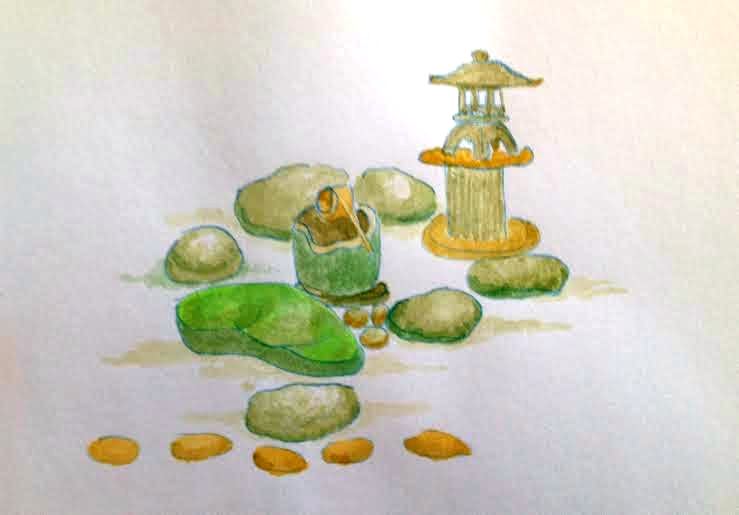
Poem – Tea house

tea garden

The Tea garden
isn’t a garden
but a path.
It is how you get to the
Tea house
for the
Tea ceremony.

Why not have the Tea room closer?
Why a garden?
Why a path?

Because you aren’t ready.
You need that time,
that space,
to take off your
everyday self
and to welcome
the stillness
and attention
that is the Tea ceremony.

You need that compressed walk
to the hermit’s hut
at the base of the mountain.
You need to pass through gates
real and hinted at.
You need to sit
on a low bench, sheltered with bamboo
long enough to shake off
the dust of the outside.

Why not have that experience all the time?
Why not be that cleansed,
that alert
that awake
always ready to welcome
everything
as a message
from God, the Creator, the Infinite?

Are there jobs that pay for
that kind of bliss?
Are there relatives who won’t
call the authorities,
worried you are out of your mind
when in reality
you are the only sane one?

By giving up your Self
and merging with
the All
you have truly
Remembered.

Poem – Spock

Sometimes I think
that the only way
to get a feeling
is to make it.

Sometimes the best way
to get a feeling
is to be it.

Sometimes it takes a while,
but then again
I don’t know.

People who are called to love
are the ones who
need it.
People don’t want it
but they don’t know.

People are
starting
to see.

Once I was in the middle of a lot.
Once, the time was different.
Once you are a
little more
than a little
you’ll get it.

Check out the same way, and
continue reading the last thing.
Could you have been there?

Key into your own body,
knowing that it is
the best way
of keeping the time
and our own.

Poem – Guilt and expected death

There’s a guilty feeling the caregiver has
when their loved one dies.
Be it spouse, parent, child,
you’ve taken care of them
for a long time
and they have finally
passed on.

Nobody talks about this.
They talk about how hard it is
to take care of
someone you love
for a long time,
someone who is terminally ill.
Someone who isn’t going
to get better,
and the only cure
is the grave.

Your life is finally back
to being yours.
Your time is yours.

You should feel bad if you
didn’t
give your time
to help them
– but you did, and now it is over.

There shouldn’t be guilt
about surviving,
guilt about feeling relieved
that it is over,
guilt about being glad
your duty is done.
But there is.

You are glad for them
that they are no longer suffering,
but also glad for yourself
that you can do
what you want to do
again.

You aren’t so crass as to say
you’re glad
they are dead,
but you are.

It is a weird feeling,
made weirder
by the mixture of grief,
the exhaustion of being
an unpaid,
untrained nurse,
there 24/7.

Poem – Hardened

God hardened Pharaoh’s heart
to make God’s glory shine.

A man was born blind
so that God’s glory
may be made manifest.

The difficulties in your life
are there on purpose,
to make you really take notice
when you overcome them.

Moses had to go before Pharaoh
10 times
to ask him to let the Israelites leave.
God warned him,
told him,
repeatedly that God was going
to make it difficult.

Think of all the things
you do
all the time
that are for the good.
Not the things you do
to pump up yourself,
but the things you do
for God.
Often it feels like you are
singing the “hole in the bucket” song.
You have to get one thing
right or fixed
before you can do
another part.
It is never straightforward
and it is never easy.
When you finally
push through
you really get a sense of accomplishment.

God does this to us.
It isn’t an accident.
We grow from it.
It strengthens us,
teaches us. Our bones
get stronger,
not our skin.
We don’t get hardened
against the world,
we get toughened
so that we
can heal the world.

Predictive text poem – “hand”

How many times have changed your life?
Here is that.
Here we are.

Any idea that is a little bit heavy
is the best for us.
All of them are not as fruitful.
All paths are valid, but I know a little something –
some will get you there faster
and with fewer scars.

Note this: time to work on your path
won’t be handed to you.
Note this: sometimes (often)
You’ll be alone, alien, along the way.
Note this: you can change paths
as quickly, as often, as needed.

Do you.
Do or do not.
Don’t try.
Give it all you have as long as it
gives you
what you need
but don’t
give up
give in
too soon.

In the desert, we remember.

I am enshrouded in the welcoming smells of desert sand cooling, the dusky smoke of the fire, of roasting lamb slaughtered that afternoon. I recline upon rugs, handwoven by my grandfather (taught by his father, taught by his father…). They are a little musty from being rolled up for too long.

For too long we have walked on carpets made by machines and not men, soaked up the rays of florescent lights, breathed recycled air, listened to artificial music.

We’ve left, gone west into the desert, no map, no plans, no forwarding address. We’ve slipped loose this mortal coil, this mortal toil for older times. We slip into our djellabas like slipping into a warm bed on a cold night – comfortable, comforting, consoling, smoothing away the calluses built up like armor, like a shield against an unforgiving, unwelcoming world.

We’ve left that world behind.

We left at twilight, dusk gathering her cloak about her. She had not yet bejeweled herself with stars. By the time we found our home for the night amidst the hills she’d gone all out for us, diamonds against dusky cobalt.

We wear turbans out here, all of us.

We are doing as we have done for thousands of years. It is us, always us, out here under the stars, laughing with storytellers, singing with song weavers. Out here, we remember.

Out here, we remember who we are.