Women as appliances – the source of gender violence

I was walking outside at lunch last week, and a guy drove by in a car and yelled at me. It took me a bit to process it. I couldn’t believe that someone was yelling at me. What he yelled was “Your skirt is too f—–g long, b—h!”

Except he filled in the blanks. He threw his words, like trash, out of the car, and at me.

I was shocked. I felt attacked. And I was confused. My skirt is too long? That is a problem? Oh, so I should hem up all of my skirts so they show off my legs so he can see them. I get it.

Like that kind of person deserves to see any part of me.

I’m married, after all. I’m not on the market. But even before I was married I dressed modestly. It just isn’t other people’s right to treat me as an object, a thing, a body. I am a person first. By hiding my body I make people look at me instead of my body.

I’ve written quite a bit about how men objectify women who wear clothing that is revealing. I’ve written that women should think about what they wear so that they do not get unwanted attention.

But now I’m rethinking that. I was wearing an ankle-length skirt, and I got unwanted attention.

And then I remember that at work, wearing very modest clothing, I get unwanted attention. Guys hit on me and they know nothing about me. They don’t know my name other than what is on my nametag. They don’t notice that I wear a wedding band. They don’t know what I read or what my hobbies are. They know nothing about me other than I am female and they are male. They think that should be enough to ask me out.

Perhaps I’ve been going at this wrong all along. Perhaps the boy who killed women simply because (other) women wouldn’t date him is part of this problem. Perhaps all gender violence and miscommunication stems from this same root.

Some guys don’t know that women are people and not objects.

Some guys don’t know that they need to make friends with women first – and as real friends, not just as an attempt to get to date them. And by “date”, I don’t mean “have sex with”. A lot of guys get that confused.

Yes, we women have been sold the idea that our looks are more important than anything. We’ve been sexualized and objectified by the media. We’ve been sold this idea that we have to have a man if we are to be anything. But men have been sold the same message along with us. It isn’t just women who have been short-changed by this message. It is men who are missing out on knowing women as individuals, as people.

For many men, women are a means to an end. Women are girlfriends and then wives and then the mothers of their children and homemakers. Women are yet another thing they have to have in their lives.

They are appliances.

They are washing machines and stoves.

You have to have a washing machine to get your clothes clean. Sure, you could wash your clothes in the sink and hang them to dry. Or you could take them to the Laundromat if you don’t have a washing machine in your house. Or you could take them to the dry-cleaners if you don’t know how to use a washing machine.

Or you could get married and let your wife do it.

The same with food. Everybody needs to eat. You can cook for yourself, or you can eat out. When you eat out, you can eat fast food or you can eat at a fancy restaurant.

Or you can get married and let your wife do it.

Men have been short-changed by our society. We have told them that women are the ones who cook and clean. Women are the ones who hold the keys to these basic needs. So they have to have a woman to fulfill these basic needs.

Sex is extra.

You have to have clean clothes and you have to eat.

If we teach men how to take care of themselves, then women won’t be a means to an end.

It is all making sense now.

If a man cannot take care of himself – cannot clean his clothes, clean his house, feed himself – he will have to have someone else do this for him. This is embarrassing, and it is a slight against his manhood. Sometimes that someone else is a stranger – the dry cleaners, the fast food worker. The prostitute.

Sometimes that someone else is his wife.

One of the most powerful things you can do is to give control back to people. It is essential to teach people how to help themselves. It is vital for their souls. We must, as a society, start teaching all people how to do all the things that they need to take care of themselves. We have to cross-train everybody.

Men must learn how to cook and clean. Women must learn how to repair cars, plumbing, electricity. We both must learn each other’s tasks, and our own. No more gender division. No more “women’s work” and “men’s work”.

For our own sanity, survival, and strength, we must do this. If we all can stand on our own, imagine how much stronger we will be together? People will marry out of strength instead of weakness.

And men won’t “have” to have a woman. They won’t see women as objects but as people. They won’t see women as appliances – washers, dryers, stoves. They will be able to take care of their own human needs, so they won’t feel the sense of empty desperation that comes from feeling helpless.

Give credit where credit is due.

Why did Moses not get to enter the Promised Land? Because he didn’t give credit to the Lord. When I first read this passage I didn’t understand why the Lord got upset and pulled away Moses’ right to lead everybody out of the desert. Moses died in the desert, within sight of the end of the journey. It seemed capricious and unfair. But then I heard a talk about it and I understood. Let’s try to work it out here.

Numbers 20:1-13

1And the people of Israel, the whole congregation, came into the wilderness of Zin in the first month, and the people stayed in Kadesh; and Miriam died there, and was buried there. 2 Now there was no water for the congregation; and they assembled themselves together against Moses and against Aaron. 3 And the people contended with Moses, and said, “Would that we had died when our brethren died before the LORD! 4 Why have you brought the assembly of the LORD into this wilderness, that we should die here, both we and our cattle? 5 And why have you made us come up out of Egypt, to bring us to this evil place? It is no place for grain, or figs, or vines, or pomegranates; and there is no water to drink.” 6 Then Moses and Aaron went from the presence of the assembly to the door of the tent of meeting, and fell on their faces. And the glory of the LORD appeared to them, 7 and the LORD said to Moses, 8 “Take the rod, and assemble the congregation, you and Aaron your brother, and tell the rock before their eyes to yield its water; so you shall bring water out of the rock for them; so you shall give drink to the congregation and their cattle.” 9 And Moses took the rod from before the LORD, as he commanded him. 10 And Moses and Aaron gathered the assembly together before the rock, and he said to them, “Hear now, you rebels; shall we bring forth water for you out of this rock?” 11 And Moses lifted up his hand and struck the rock with his rod twice; and water came forth abundantly, and the congregation drank, and their cattle. 12 And the LORD said to Moses and Aaron, “Because you did not believe in me, to sanctify me in the eyes of the people of Israel, therefore you shall not bring this assembly into the land which I have given them.” 13 These are the waters of Mer′ibah, where the people of Israel contended with the LORD, and he showed himself holy among them. (RSV)

Did you see it?

The Lord commanded Moses to
8 “Take the rod, and assemble the congregation, you and Aaron your brother, and tell the rock before their eyes to yield its water; so you shall bring water out of the rock for them; so you shall give drink to the congregation and their cattle.” (RSV)

He was supposed to take the rod, assemble everybody together with Aaron, and tell to the rock in front of them to yield water.

What did he do instead?

9 And Moses took the rod from before the LORD, as he commanded him. 10 And Moses and Aaron gathered the assembly together before the rock, and he said to them, “Hear now, you rebels; shall we bring forth water for you out of this rock?” 11 And Moses lifted up his hand and struck the rock with his rod twice; and water came forth abundantly, and the congregation drank, and their cattle. (RSV)

He took the rod. Check.
He and Aaron got everybody together. Check.
The rest? Fail.

He said “Shall we bring forth water for you…” We – like it is his doing, not the Lord’s. And then he struck the rock with his rod. God didn’t say to do that. He said to tell the rock to yield its water.

The way Moses did it, it looks like Moses has the power. Moses was great, but he wasn’t God. He was just a vehicle for God’s power.

Not only did he not do it the way God said to do it, he did it in such a way that makes it look like he is God.

And because of that he never left the desert. So close, and yet so far.

We have to remember this. Moses has many things to teach us about standing up to God. There were many times that God wanted to wipe out the entire family of Israel because they were not being thankful. Moses intervened. That alone is a big deal – nobody stands up to God.

But nobody stands in the place of God either.

For Moses to make it look like he was the one bringing forth water instead of God was not allowable.

I’m sure it was an accident. I’m sure he got excited in the situation. He was probably frustrated too. This wasn’t the first time that he had to deal with whiny people. But he did it wrong, and he had to pay for it. He wasn’t struck down, like many others have been in this story, but he wasn’t freed either.

This is an important lesson for us.

Fill in the blanks.

I woke up thinking about my parents-in-law. Things aren’t going well with them, and I’ve been very distant because of that.

I’m angry with them. I’m angry about how they treated my husband, their son, as he was growing up. I’m angry about how they abused him. Their own history of being mistreated isn’t enough to excuse it. They should have known better.

I’m angry about how they haven’t listened to my advice on where to live, so they keep needing to ask for help. I was the one to suggest they move up here, closer to their sons, but that is all they have listened to. Five hours away was too far to help them, so they came closer, but they are still too far. Thirty minutes one way isn’t ten.

They should have bought a condo, or gotten an apartment. Basically they shouldn’t have gotten a yard and a place that has to be maintained. At their age, they personally need to be maintained more than their homes. I told them this, and they ignored me. I told them that my husband, their son, barely has time to take care of our house.

Now they need help. Often. Just like I foresaw. There is no need for these emergencies.

They continue to ask for my advice and input, but they continue to ignore it. They waste my time and that of my husband.

They are very needy.

They are too old to be this childish.

And then I stopped and remembered. Ask Jesus into it.

Jesus Jesus Jesus, I said. I visualized all of these problems as big blocks. I saw the light of Jesus entering them. It was like a glue, filling in all the cracks, making them stronger.

And I came to understand that the brokenness is part of the plan. The brokenness is necessary.

The poet Rumi reminds us that bread can’t become bread unless the grain is ground up. Then it is mixed with other ingredients and heated in an oven.

Clay isn’t useful unless it is shaped and heated too.

These broken bits, these hard times, these trials that we all have – these are what make us who we are.

They aren’t the bits to run away from. They are the whole story. They are it, everything.

They are what make us human. They are what make us who we are.

God isn’t the “bad guy” for letting bad things happen to us. These “bad things” are just the hard things that push us out of what we are and into who we are supposed to be.

They are what get the baby bird to get out of that shell. They are what get that same bird to jump out of the nest and fly for the first time too.

We are those birds.

Stuck in our shells, we would die.

Stuck in the nest, we would never live.

Adversity isn’t.

It is opportunity.

Jesus is the glue that holds us together, is the hand that pulls us out of the hole, is the thing that rescues is from being stuck.

Jesus is “out there” but is also “in here”. Jesus is instantly available -all you have to do is call on him. Ask and you shall receive, after all. But Jesus is also inside every person who has let him into their lives. Jesus builds houses for poor people through Habitat for Humanity. Jesus feeds people at the rescue mission. Jesus holds people’s hands when they die in hospice care. Jesus teaches children how to read.

Jesus wears a lot of faces and goes by a lot of names, and he’s here.

But he had to be broken and blessed for that to happen.

He wasn’t crucified for our sins. He was blessed and broken on that cross, just like how he blessed and broke the bread and the fish to feed thousands.

He became more, so we could become more.

Thanks be to God.

Carbon copy

Sometimes it feels that all we are doing is copying each other. We copy style, ideas, and ways to think. We copy so much that we’ve copied our whole lives.

We have copied for our entire lives.
We have copied our lives, entirely.

Nothing is original about our lives when we copy.

After a while we have copied each other so much that we stop being anything at all. Have you ever seen a Xerox copy of a copy of a copy? After a while it stops looking like anything at all. It starts looking like a big mess. There are dots everywhere that weren’t there before.

White people in Western culture have started to think that they need to be Native American or Indian or Chinese or Tibetan. They don’t like their own culture and so they try and emulate another culture. They do this with clothing, with art, with music, with food. Perhaps they think they are showing respect to the other culture by adopting it.

I know, I’ve done this.

Meanwhile the other cultures are trying to emulate Western culture. They dress like us, watch our TV shows and movies, and have even started to try to look like us. Asian girls are getting plastic surgery on their eyes to look more Western and less Asian. There are products in India and Thailand to bleach the skin so they are more white.

We are trying to be them, and they are trying to be us. At what point are we going to meet in the middle? Then we won’t be anything at all.

Perhaps it is best if each person finds her own path. Stop trying to create it from someone else. Stop even trying to make it from your own culture.

Perhaps we need to stop faking it
so we can make it.

We need to start making it so that we are actually ourselves for a change.

Look at plastic surgery in general. What does “normal” look like anymore? Too tall? Too short? Too fat? Too skinny? Boobs too big/small? Butt too big/small? Eyes are too blue/brown/green?

You can “fix” that. But it isn’t a fix. It is a fake. You aren’t broken.

Eventually we will all have homogenized ourselves into one big mess of nothing.

Be yourself. Don’t copy anybody.

Austrian stamp story

My friend and I went on a trip to Austria. And we went on a trip in Austria. Confused? Keep reading.

Tom and I spent the day wandering around old churches. There is something about the architecture, the reverence, the style of them that we like. And, well, we like the ritual.

We’d already been to three churches that day before we found one that was celebrating Mass. But this wasn’t any ordinary Mass. It looked like something special was going on because a guy with a crozier was there. We guessed he was a bishop.

stamp1

Sadly we hadn’t learned any words to understand what was going on. Our phrase books didn’t venture into religion. We could order our food and get directions, but we couldn’t follow along with the service.

Well, we could, sort of. We both had been to a lot of Catholic services, and they are all pretty much the same. Catholic means “universal”, after all. And it isn’t like we were going to be asked to speak. Church isn’t exactly equal in terms of the speaking parts. If the congregation gets to speak, it is given lines to say from a book.

Usually a guy dressed up like this and with this kind of accessory is a bishop. They only show up for special occasions, like a baptism, confirmation, or ordination. The average, everyday stuff they leave to the priests.

We watched what was going on, but we didn’t see anything special. It looked like a regular service. Tom and I stared at each other, shrugging a little. Who knows? Surely something different will happen.

And it did, but not what either of us could have ever expected.

The Bishop was celebrating Communion, as is normal if the Bishop is there. He outranks everybody except the Pope, so he gets to do this part of the service if he wants to.

We were pretty far away, but it seemed like something different happened when he picked up the chalice to bless the wine. It kind of looked like a snake rose from it. And then it kind of looked like he smiled.

We went up to take Communion and as usual, the Bishop administered the wafer. The priest of that church came by with the chalice.

Everything was normal when I took the wafer, but I felt a little weird when I sipped the wine. I felt a little dizzy, so I grabbed the altar rail to steady myself. I looked at Tom and he was doing the same thing.

Then we looked and saw the craziest thing. The Bishop was being chased by a skeleton!

stamp2

It made no sense. I mean, this is an old church and all, and there are people buried in niches in the walls, but they are dead, definitely dead. This skeleton-guy wasn’t an accident. He wasn’t somebody who got interred recently and by mistake. I could see through him, for goodness sakes.

The bishop ran screaming down the aisle out of the church’s front door, all the while being chased by this skeleton.

We thought this would cause a panic, but nobody else seemed to notice anything. Now, sure, there are people who don’t move when a fire alarm goes off. They need to actually see a reason to run, like seeing actual fire, before they will take the alarm seriously.

But a skeleton. Chasing a guy. Who ran out.

Surely that is enough to rally the whole room.

Nope. It seemed like just Tom and I noticed all of this. We stuck close together after that, constantly looking at each other to check if the other one saw the same thing.

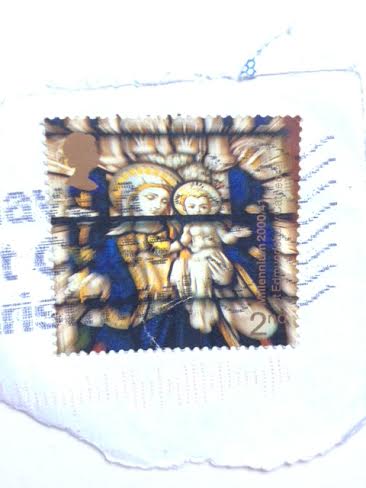
We walked around the church after that and came across this stained glass window.

stamp4

Mary and Jesus were all sharp, and everything else looked like it was warping in time and space. None of the other stained glass windows had done that, but they didn’t have Mary and Jesus. Perhaps that was the difference.
Perhaps there was something that warped time and space when Mary had God contained within her. It is pretty trippy, if you think about it. We date time from when Jesus was born, after all. Things changed, so yeah, I can understand the fabric of reality warping around them. I just didn’t expect to see it.

We stumbled out of the church. The parishioners looked at us like we were drunk. Hopefully they just thought we were ignorant tourists and wouldn’t call the police. A night in a foreign jail wasn’t tops on my list. Actually, a night in any jail wasn’t even on the list.

We wandered around, getting further and further away from the church. Our hope was that if they did call the police, we’d be long gone.

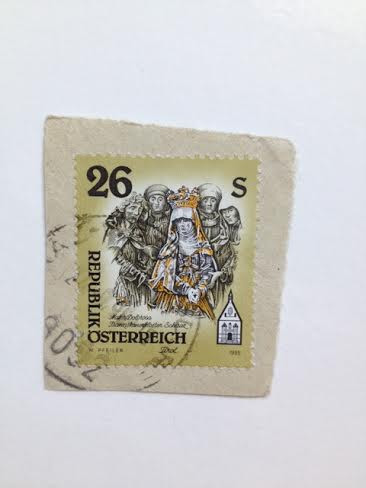
Everything looked fine until the parade came around the corner. We saw a woman being led by these strange men. She was dressed like a queen, and it looked like she was wringing her hands. She looked so sad.

stamp5

Were the men holding her up in her grief, or were they dragging her along to her demise? There was no way of knowing. Once again our tourist phrase book was failing us.

Then the heavens opened up and we saw an angel.

stamp3

By this point we had given up trying to make sense of any of it.

(Notes. This is what happens when I have a lot of stamps. These are all Austrian stamps and they are all odd. They looked like they told a story that hadn’t been written, so I wrote it. I like the idea that stamps illustrate the story – in fact, the stamps are the reason for the story.)

Sea of Stars

Here’s something I’ve been working on recently.

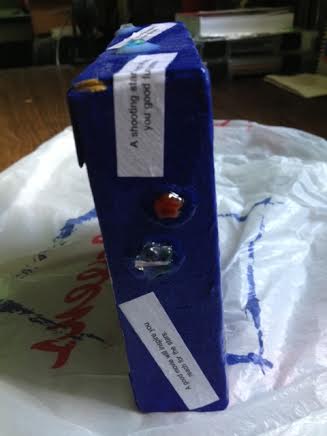
Front view. Acrylic paint, oil pastel, decoupage glue, metal foil.

stars4

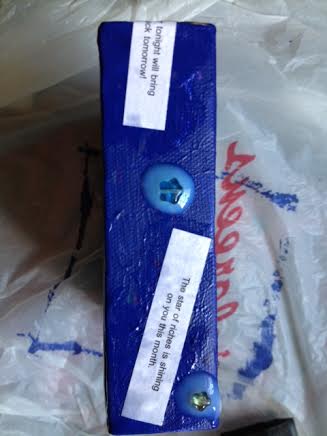
Top left side. Chinese fortunes, Czech glass stars, glue

stars3

Another view of the same.
stars2

Top right view.
stars1

I’ll need to paint matte medium over the top sides again so that it all has the same sheen. But it is mostly done. It hangs like a diamond – it isn’t horizontal. One nail in the wall and then pop it on.

Navigating the “Do you have children?” question.

A patron was making small talk recently, and then it became large talk. He doesn’t know anything about me other than what he can see. Some of what he sees is the mask that I have to put on as part of working customer service. I like helping people, but I’m not their friends. They get confused sometimes.

He asked me how I was doing, and then after that, asked me how my husband was doing. He’s never met my husband. He knows I am married because I wear a wedding ring. He doesn’t know I’m married to a man, even though I am. Just because I am a woman wearing a wedding ring doesn’t mean I have a husband. Nuns wear wedding rings. Lesbians wear them too if they are in committed relationships.

I replied with the vague and noncommittal, “He’s fine”.

Then he asked if we had children, to which I replied “No”. He pressed. “Why not?”

Stupid question.

One – it is none of his business.
Two – what if we did and were heartbroken that we were infertile?
Three – what if we did have a child and s/he died?

I said no, that they are too expensive. Usually that is enough to stop this line of questioning. Sadly I get it a lot. I don’t get why strangers feel it is OK to ask these questions. Perhaps they think they are being friendly, but they don’t realize the potential minefield they are entering. They just don’t think. It could open up a lot of heartache for someone.

He pushed further, and I was done. He said “When you got married, didn’t you want to have children?”

He only knows my name because he’s read it on my nametag. He’s crossed my boundary already and hasn’t read my lack of engagement as a “go away” sign. I’ve not asked him how his wife was doing (I know he has one because he uses her library card as his own) and I’ve not asked him if he has children. A lack of reciprocal questions should indicate stop asking questions.

I was done. I didn’t want any more of this. I didn’t want it to start off with. I pulled out my biggest card.

I said the truth.

“Both of us were abused as children, and so we don’t want any.”

End of conversation.

There is nothing more to be said. No more pleading to get us to have children. No more trying to change our minds. No more prying.

In the past I would have felt bad for even saying that. I would have felt bad that I had to cross over the line of polite conversation into this. I would have felt bad for having to establish my boundaries.

Now I don’t. Now I know I must, and if I don’t draw a line, essentially people will invade my mental space. It is just like if a person shows up at the door to my home. I have the right, the duty, the obligation to establish how far he can get in.

Normally, I have the ability to decide if I even open the door, but a customer service job blurs that line.

Here is some advice – don’t ask strangers if they have children. If you ignore that advice, then don’t push if they say no. Don’t ask why. Don’t try to talk them into having children. There are plenty of kids on the planet as is. And there are plenty of bad parents who should have thought twice about having children. Maybe if they weren’t pressured by family, friends, and strangers into having them, they would have saved everybody the trouble.

New Age faith healing

Several new friends that I have are practicing what is essentially faith healing. But it is New Age faith healing. And they are charging money for it. Something feels decidedly wrong about this. Not just the practice, but charging money.

Now, we have these words from Jesus in Luke 10:7
7 And remain in the same house, eating and drinking what they provide, for the laborer deserves his wages; do not go from house to house. (RSV)

But he also says in Matthew 10:8
8 Heal the sick, raise the dead, cleanse lepers, cast out demons. You received without paying, give without pay. (RSV)

So are we or are we not supposed to get paid for faith work? In the first part, we are, but it seems like the “wages” are food and drink, not money. In the second, it looks like we aren’t supposed to get paid at all because we didn’t pay anything to learn what we do. Being able to heal is a gift from God, not something that has to be learned.

But then are they talking about God? Do they think their gifts are from God? Do these above statements even apply to them?

I say new age because they do not use the name Jesus or God, or even Father. They use the ambiguous term Source or Spirit. Are they being politically correct, to not offend those who have been turned off, turned away from, or turned out of the Christian church? Is Spirit or Source a more inclusive name for God, in that it isn’t owned by any one faith tradition? Or is it something else entirely?

They all say that they are into the feminine side of divinity, and while I feel it is appropriate to balance out the representation of God that our society uses, I think it is important to make sure we are still talking about the same thing.

At a certain point a definition can stop being a definition, stop defining, stop having a limit. At a certain point the walls of meaning fall down and a word stops being a word and starts being a random collection of letters. They stop being a container for meaning.

Jesus says that anything we ask for in his name we will get. Jesus gave his followers the ability to heal the sick. Not some ambiguous Source, or Spirit, or Goddess.

And where are they, really? Did any of them come down to earth in human form to live and die as one of us? Or are they just stories? If there is no proof, it isn’t real. A disappearance isn’t a murder until the body is found. So a story of a god isn’t real unless there is some evidence.

They will play their drums over you or sing through their drums at you. Why drums? I don’t know. They are using frame drums, and because they are unusual, perhaps that adds to an air of mystery. A little of something unusual helps in the suspension of disbelief.

Suspension of disbelief helps in telling a story. It helps in getting a person to believe that a made up story is a true story. In other words, it helps people think that what they are being told is the truth, even if it isn’t.

But it also works in the placebo effect, and maybe that is what is going on here. Belief in a cure sometimes is the cure itself. Sometimes you have to give people a sugar pill in order to get them to get over their belief that they are sick. You have to “sell” it to them, make them believe that what they are getting is the real deal, or it won’t work. When I say “sell”, I don’t mean money, but money is part of it.

Carny men know about “selling”. They have to convince people of the value of what they are buying. With a normal purchase, you exchange money for a product. You can see what you get. There is no ambiguity. A real, physical object is in your hands. With healing, there is nothing there. Healing takes time. But that is part of it.

People are starting to realize that a lot of healing doesn’t come from the doctor, but from the patient. The doctor does what is necessary to get the patient to heal herself. Some of that involves a little sleight of hand, a little head game. A little suspension of disbelief.

Terry Pratchett used the term “headology” in his Discworld books. His character Granny Weatherwax used it to explain her work as a witch. “Witch” in this sense doesn’t mean that she casts spells or put hexes on people. “Witch” in this sense means wise woman or elder. She had authority by virtue of her knowledge and ability to stay calm in a bad situation. She kept her head about her when others were losing theirs. She said she used “headology”, rather than magic.

Perhaps this is “headology”. But perhaps this is deceit. If people are being healed, isn’t that all that matters?

Maybe. Or maybe not. Maybe they are deceiving people as to the source of the healing. Maybe they are leading people astray. Maybe they are leading themselves astray.

Shells and cheese

Two cups of pasta shells
Half a cup of havarti-dill cheese, grated
Quarter of a cup of parmesan cheese – grated or shredded
Knob of butter
Splash of milk
seasoned salt to taste

Boil the pasta per the package directions. Make it “al dente.” Take the pot off the heat. Pour the pasta into a colander. Put the butter (slice it up to make it melt faster) into the pot. Put the pasta back into the pot. Put the cheese into the pot. Stir. Add milk to get the consistency you want –but add it slowly. You can always add more but you can’t undo it if you have too much. Do this all quickly – you are working with the heat of the pasta, not the stovetop.

Serve immediately. Makes four servings.

Art for free, part two.

I once had a problem with ladies who were looking at my beaded jewelry. They asked how long it took to make. Because it didn’t take long, they didn’t appreciate the cost.
I’ve made jewelry for over 20 years. I know what I am doing by now. It doesn’t take long, once I have the idea in mind. But artistry and the cost of the beads (!!!) has to be factored in.
They don’t get it. They are thinking they get paid $15 an hour, and if this takes me 20 minutes to make, it shouldn’t cost $40.
I could lower my prices, but then I feel like I’m being used. I’ve heard that in Arabic countries you can buy gold jewelry for just the price of the gold. The artist gets nothing. The price is based on the type of gold and how much it weighs. Perhaps that is what people expect me to do with my beads. Just charge them the price of the beads, and nothing for the skill or the creativity.
Perhaps I should start telling people that each necklace takes three days. That would factor in the time involved in getting to the bead store, thinking up a design, trying it, and then finding out it doesn’t work the way I thought it would. Then wait a day fuming about it and rethinking it, and try again and discover what comes out.
Some pieces do take forever. Some go fast. Some never sell. Some sell very quickly. I don’t make anywhere near enough money to make a living at this, but I still don’t want to be insulted. I’d rather rip apart a design and reuse the beads than sell it at just the cost of the beads.