Taxes and tithes

Jesus was constantly getting under the skin of the religious authorities of the day. They kept looking for ways to trap him, to make him show that he was a rule-breaker. Here’s a situation where he was asked about paying taxes.

Matthew 22:15-22
15 Then the Pharisees went and took counsel how to entangle him in his talk. 16 And they sent their disciples to him, along with the Hero′di-ans, saying, “Teacher, we know that you are true, and teach the way of God truthfully, and care for no man; for you do not regard the position of men. 17 Tell us, then, what you think. Is it lawful to pay taxes to Caesar, or not?” 18 But Jesus, aware of their malice, said, “Why put me to the test, you hypocrites? 19 Show me the money for the tax.” And they brought him a coin. 20 And Jesus said to them, “Whose likeness and inscription is this?” 21 They said, “Caesar’s.” Then he said to them, “Render therefore to Caesar the things that are Caesar’s, and to God the things that are God’s.” 22 When they heard it, they marveled; and they left him and went away. (RSV)

So – we are supposed to pay taxes. Got it. But what about tithes? If we are supposed to give “to God the things that are God’s” – then we need to rethink tithes. God’s face isn’t on the money we have.

What is from God?

Our time.
Our energy.
Our talents and abilities.
Our creativity.
Our intelligence.

We should give these things in the service of God, not money.

Poem – everyday death

You have had your whole life to prepare for your death.
So why are you surprised?
This death is merely a stepping point from point A to point B.

Death is the same as when you graduated from college.
Death is the same as when you married.
Death is the same as when you gave birth and became a mother.

Every day is a new kind of death.

Death is the end of something old
and the beginning of something new.

All of your life you have had time to prepare for it
and yet
you have done nothing
pretending that everything is fine.

Every day is a new chance
to wake up
and experience
what is happening
right now.

And every day you have
chosen
to ignore
that gift.

Every day you have
chosen
to pretend
that everything is the same.

When we remove all evidence of
time
from our lives
we have no evidence
of change.

This is our undoing.

This is our great lie
that we tell ourselves
and each other.

We say
nothing stays the same
and yet
we keep everything the same
in order to
make ourselves feel better.

And then
when it all
catches up to us
we are
stunned
surprised
scared.

Don’t be that person.

Greet death at the door, smiling, with roses.

One person, one book

Ramadan is the Muslim holy month celebrating Mohammed receiving the Quran while he was alone in a cave. Shavuot is the Jewish holiday celebrating that the Jews received the Torah, which was through Moses when he went up a mountain. Alone.

In both holidays, one person, alone and away from everybody else, was given a large amount of material to share with a group. In both, one person receives the rules that everybody else has to follow.

How does that work? How do people agree that this one person, without any witnesses, actually got a message from God? Why do they then change their ways so that they follow this message their whole lives, and teach it to their children?

Seems like a bad idea to just take somebody else’s word that this thing, just created, is The way that things have to be done. There was no precedent, no history. The stories and rules didn’t grow over generations. These were created out of whole cloth, if you will.

All at once.
By one person.
Who said they were talking to God.

And a large group of people just follows along. Oh, God told you that? OK, we’ll change our whole lives just to fit that.

People don’t even listen to basic health advice which has been proven by science. They still smoke and eat fatty foods and drink caffeine and have all the sugar they want and don’t exercise. They won’t change even one basic thing about their lives so they will be healthier, even though there have been years of studies to prove the truth behind the claims.

But one guy goes into a cave or up a mountain and says God talks to him and tells him to write this stuff down, and they change their whole lives to fit it?

Yeah, that makes sense.

I believe that God who dials direct.

Fake it ’till you make it – not.

Maybe it is best if we all stop pretending to be the same. Maybe if we all stop faking that we are “normal” we will all get to actually be who we really are for a change.

The more we all get cosmetic surgery to average out ourselves, the more the oddball doesn’t know he is normal.

Blind in one eye? Wear sunglasses or a patch.

Have one leg shorter than the other? Wear a lift.

Butt too big? Wear compression underwear.

Boobs too small? Wear padding.

When we smooth and stuff and shave and shape our bodies to fit some imagined idea of “normal” we have stopped being normal.

We do the same with our emotional lives. We say we are fine when we aren’t. We pretend to be on an even keel when we are angry, sad, hurt. We fake it so often we don’t know what we really feel anymore.

Who are we trying to appease/impress? Ourselves, or them? What if they are faking it too, for the same reason? It takes too much energy to be fake.

We need to stop faking it so we can start to make it for a change.

When we start being ourselves, we give everyone else permission to be themselves too. We let them know it is OK to take off their masks when we take off our own.

It is scary, at first, for us and for them. But all change and growth is scary at first. Some people might feel threatened by your new-found honesty and freedom. Be yourself anyway.

Widow’s weeds

There is an old custom of wearing black while you are in mourning. Some people would wear all black clothes, while others would just wear black armbands. People still wear black clothes, but it isn’t just for grief. They will wear black just because they like wearing black.

So the meaning is lost. People don’t know if you are grieving, or just fashionable.

The purpose of wearing black to indicate grief was to warn others to be a little more gentle with you. You had your leave time that you were allowed from work, and now you are back. Whether it was three days or a week, it isn’t ever enough, especially if it was someone close to you.

Wearing black while you are grieving is a bit like wearing a “trainee” tag. It tells other people that you aren’t quite all here yet, and to go a little more slowly. It is a kindness to them and to you, to not expect much out of you for a while.

But perhaps we should all do that, all the time. Perhaps we should all treat each other with a little more kindness and cut each other a little more slack.

Everybody we see is struggling with something. Everybody has suffered a loss or has a problem. “Dysfunctional” is the new normal for families, don’t you know? We all are faking it, and we all aren’t making it. We are just getting by as best we can.

Now, problems can also come in when we think we are the only ones who are suffering, or that our pain is worse than anybody else’s.

I remember a time where a patron said that she wanted to get on disability because she had migraines all the time. She went on and on about it. Every time she came in she told her tale of how hard life was. She was really wrapped up in her own problems. So I decided to share. I told her that I’m on medication for the rest of my life for three different chronic conditions.
I wanted her to understand that we all have our burdens to carry. She got it, and softened.

Buddha told a story about a lady whose young son had died. She went to every person in the village, carrying her dead child with her. She refused to admit that he was dead and begged each person for medicine. One kind person directed her to the teacher, Buddha, who lived in the village.

When he saw her, he understood exactly what the real problem was, and how to address it. He told her to ask for a mustard seed from every person in the village who had not ever grieved. She was to then come back to him with the mustard seeds and he would make a medicine for her from them.

She went from hut to hut, and every person she talked to had experienced grief. Every person had lost someone they loved.

She had no mustard seeds, but she had the medicine she needed. She understood that she was not alone in her suffering. Her life was not harder than anyone else’s. At that moment, she finally was able to accept that her child had died, and bury him. At that moment, she was able to rejoin the community.

May we all be kinder with each other.
May we all understand we are equal in our suffering.
Real art versus copy

I really like Nick Bantock’s art in the “Griffin and Sabine” series. Something I like about it is it seems so dreamy and ethereal. He uses bits of photographs and stamps and other ephemera in order to create his art. There is acrylic paint, certainly, and tissue paper as well. But the most important part to me is that he uses objects.
I read his book “Urgent 2nd Class” about how he makes his art. He says to make color photocopies of everything you use and not use the originals. I felt cheated when I read that. I thought that everything he was using in his artwork was real. It gave it all a magical, totemic quality, a sense of risk. Now, not so much. Sure, it is beautiful, but it isn’t the same to me.
I’ve been making collage art, inspired by him and others. I’m torn as to whether to use copies or originals. I can see the points for both sides.
It might be easier to not use the real thing because then there’s not as much pressure. If I make a mistake with the real thing, I’m in trouble. There is no going back like with beads or with digital manipulation. Paint is permanent, and so are scissors. One wrong blob or cut and I’ll have to figure out a way around it or scrap the whole thing.
I could certainly play around with a copy first while I figure it out. Then I could make the final version with the real stuff. But I don’t really have time to make multiple versions of the same things, and I know from all my other forays into creating art that whatever I think it is going to be, it never is. So even if I get it “perfect” with the copies, it will look different when I use the real stuff. Plus, half of the reason I create is the discovery. It is nice to get what I see in my head, but it is also nice to be surprised when something works out better than I planned.
Well, I’ll be honest. It wasn’t nice at first to have things not come out the way I’d imagined. But I’ve learned to like it. At first I was pretty upset that what I was aiming for just wouldn’t materialize. I had all the pieces – how come they won’t go together like I think they should? But sometimes what results is far more interesting. Sometimes it isn’t, but then I just don’t tell people what I was aiming for. I act like I meant it to look like that. Even if it does look like what I was planning for, they wouldn’t know anyway.
Using the real thing could certainly be intimidating. It might make me not even start on the piece.
Sometimes when creating art you have to think about what will make the art happen. Sometimes having limits helps, and sometimes it hurts. Sometimes having limits on what tools or techniques you can use will actually make you more creative. Sometimes it might stop you before you even begin.
For now, I’m using originals, but I’m doing it carefully. I’ll try out something with a real piece (like a stamp, or a foreign bank note, or a fortune from a cookie) but maybe it isn’t “the” piece. I’m learning how that kind of paper works with the glue and the paint I’m using. Then I can use that knowledge for when I make a “real” piece, with more meaningful ephemera.
I can see another advantage to using copies – the paper is always the same. So there is no adjustment to be made for different textures or absorption rates. If the materials are all the same, it frees you up to work on composition and style.
But I still feel like that is cheating the audience. I like the idea that what they are looking at can’t be replicated. If there are copies of the ephemera being used, then another copy of the artwork can be made. Sure, it won’t look the same – that is part of the nature of art in general and painting in specific, but it will be close. Part of what I like about creating artwork is that each piece is unique.
A painting that has real things in it has an energy to it, like a shaman’s necklace. Each item has a story, a background, a history. Each piece adds to the song. They aren’t just images, but the actual thing. A picture of a shell isn’t the same as a shell itself. And just any old shell isn’t the same as a special one – say the one you found on your anniversary trip. It is that kind of energy that I’m talking about. You just can’t get that from a copy.

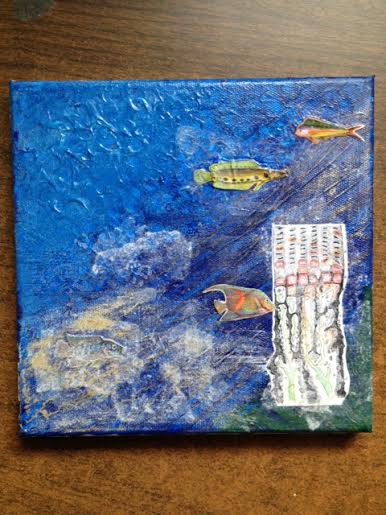
These are some examples of what I’m making.
collage2

collage1

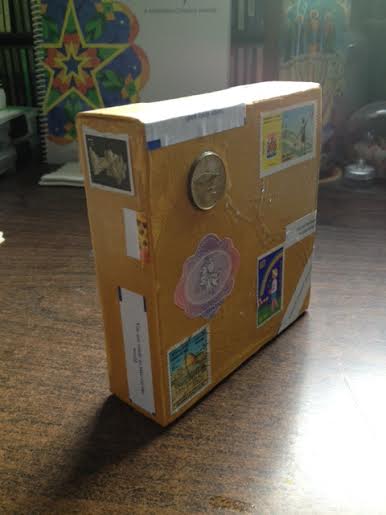
side view –
collage3

Illustrated books – or Comics aren’t just for kids.

Here’s a short list of some illustrated books that I’ve enjoyed, that you might too. Many of them explain or discuss something very deep in a very good way.

The arrival Tan, Shaun.

What it is like to be a foreigner. This deeply moving, beautiful book tells a story without words, illustrating how hard it is to fit in if you don’t speak the language. This applies even to those situations where people do speak the language, but just don’t fit in.

How to understand Israel in 60 days or less Glidden, Sarah.

Follows a young Jewish woman who goes to Israel on her birthright trip. She thinks about the problems in Israel from many sides, and like in reality, comes to no resolution.

Marbles : mania, depression, Michelangelo, & me : a graphic memoir Forney, Ellen.

Mental health from the side of a mental health consumer. Raw and honest.

Harvey : how I became invisible Bouchard, Hervé, 1963-

A young boy experiences the grief of his father’s death.

Kampung boy: Lat.

A story about a young Islamic Malaysian boy as he grows up in a village.

Star Wars : Tag & Bink were here Rubio, Kevin.

This one is just funny. It is about two storm troopers who always seem to be in the wrong place at the right time.

When Wanderers Cease to Roam: A Traveler’s Journal of Staying Put by Vivian Swift
ISBN-13: 978-1596914612

Gorgeous watercolor illustrations of a year in a small town. A feast for the soul.

The Principles of Uncertainty by Maira Kalman ISBN-13: 978-0143116462

An illustrated journal of sorts by one of my favorite minimalist artists. Beautiful and sad and wonderful.

Through the Woods by Emily Carroll 978-1-4424-65954

Young-adult graphic novel featuring 5 short illustrated stories – all a little odd and creepy, but in a good way.

Saga – -series by Brian K. Vaughan and Fiona Staples.

Cosmos-spanning adventure mixing cultures and races.

Circle reading list

Interested in the Circle process for conflict resolution? Here’s a list of books that are helpful.

Calling the Circle: The First and Future Culture. Christine Baldwin.

The Circle Way: A Leader in Every Chair. Christine Baldwin & Ann Linnea.

Doing Democracy with Circles: Engaging Communities in Public Planning. Jennifer Ball, Wayne Caldwell & Kay Pranis.

The Millionth Circle: How to Change Ourselves and the World. Jean Shinoda Bolen.

Peacemaking Circles and Urban Youth: Bringing Justice Home. Carolyn Boyes-Watson.

Heart of Hope: A Guide for Using Peacemaking Circles to Develop Emotional Literacy, Promote Healing & Build Healthy Relationships. Carolyn Boyes-Watson & Kay Pranis.

Wisdom Circle: A Guide to Self-Discovery and Community Building in Small Groups. Charles Garfield, Cindy Spring & Sedonia Cahill.

The Little Book of Circle Processes. Kay Pranis.

Peacemaking Circles: From Crime to Community. Kay Pranis, Barry Stuart & Mark Wedge.

Circle in the Square: Building Community and Repairing Harm in School. Nancy Riestenberg.

Building a Home for the Heart: Using Metaphors in Value-Centered Circles. Patricia Thalhuber, B.V.M. & Susan Thompson

The Way of the Council. Jack Zimmerman, in collaboration with Virginia Coyle.

List gotten with permission from Tracy Roberts at http://www.TheCircleCenter.com

Bird shot dating

A lot of guys seem to look for women the same way they go hunting. They shoot with bird shot. They aim for women just because they’re women. They don’t set their sights on a specific woman. They aim for them just because they are women. There is no aiming for a specific person at all.

All women want to be wanted for themselves, as people, and not just because they have the right plumbing.

I have thought about sharing ideas for men to know how to talk to women. But then I thought I might be doing a disservice. I thought I might be making it easier for the creepy people to not seem creepy. This would then make it harder for women to avoid the creepy people.

Putting a façade on a falling down house doesn’t fix the problem. In the same way, teaching creepy men how to interact with women might be a problem. It might make it easier for creepy men to get involved with women. But perhaps the reason they are creepy is because they don’t know how to interact with women as people. Perhaps the reason they are creepy is because they don’t know how to interact with humans at all.

Perhaps by giving them some tips it might make it easier for them and for everyone else. I’m working on this. It is hard, because I’m not a guy. So I’m not sure what kind of advice they need. It is kind of like reverse-engineering a problem, or translating into a language that is not my own. But I know what creeps me out, so perhaps it is worth a try.

Anything has to be better than nothing, right? We have too many guys who feel frustrated that they don’t know how to interact with women.

First, they have to stop thinking of them as women and start thinking of them as people.

I’ll be working on this. Feel free to offer ideas.

Cherry picking

Every now and then some stranger will disagree with one of my religious posts by saying that I’m “cherry picking” the Bible. Of course I cherry pick. The whole tree is too hard to digest. That is the silliest thing to accuse somebody of.

Perhaps I should just say what I’m going to say and not reference chapter and verse at all. Perhaps I should stop citing any references and just assume that everybody has read what I am referring to.

Jesus did that. He just said what he was going to say and assumed that his audience had read the whole Bible for themselves. He assumed that they could follow along with his logic and know that what he was saying was true.

When people accuse me of cherry picking they’re saying that I’m picking and choosing what I’m using to cite. Of course I am. Everybody does that. That is part of writing. Perhaps they want me to use an argumentative structure? Perhaps they think it would be best if I quoted all sides of the debate? That would draw away from my argument. No writer would do that.

Well, I’ll do it if Jesus’ words disagree with what I’m saying. Paul’s words don’t count. He isn’t the Messiah, and his words aren’t counted as the Gospels. Too many people think they are, but they are the ones accusing me of “cherry picking”.

How about this? I’m going to write what I write and quote what I quote and if “they” get it, then great. If “they” don’t, that is their problem. Jesus’ message wasn’t accepted by everybody either, so I’m in good company.