Rembrandt’s secret

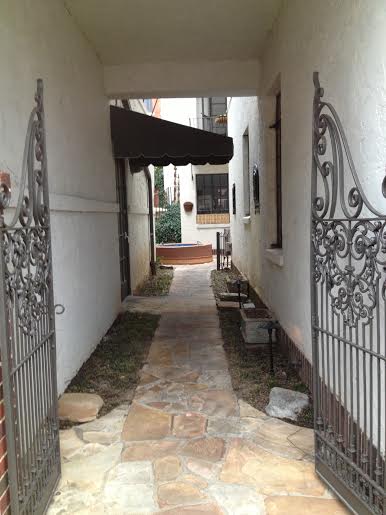
This is my favorite place in the whole world. It is a little garden area behind Rembrandt’s coffee shop in Chattanooga, TN. It reminds me of pictures I’ve seen of Roman and Arabic gardens that are in the center of the house – open to the sky, and protected from view from outsiders. It is a little bit of nature that is cultivated and secret.

Let us enter.

1

Going down the narrow path.

2

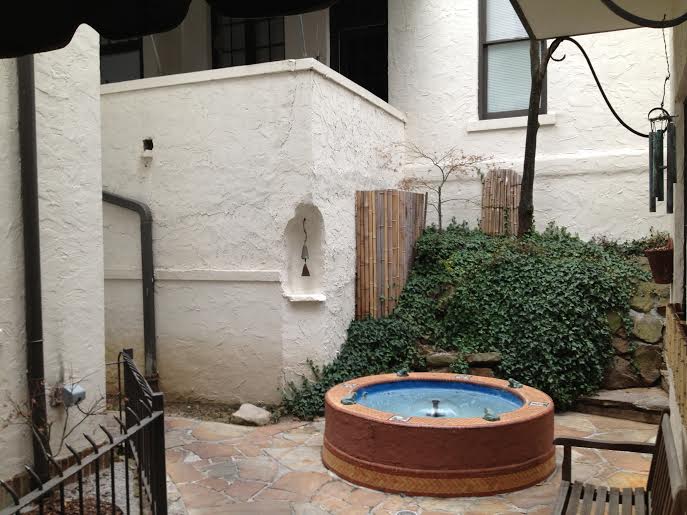
We’ve entered, and here I’ve stepped to the far right to show you the fountain and the courtyard.

wide fountain

Stepping slightly to the left to take a picture of the tree for you.

tree

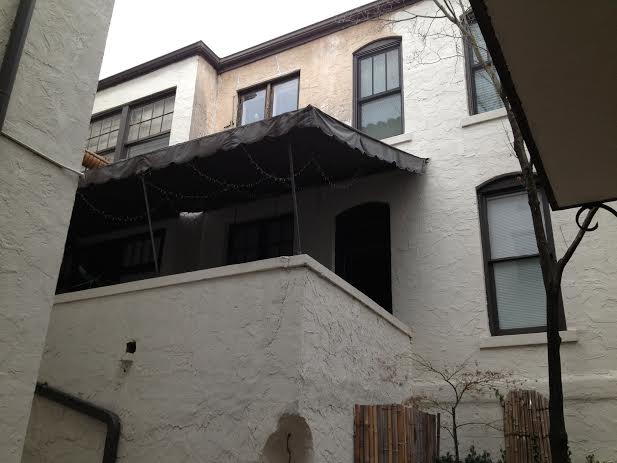
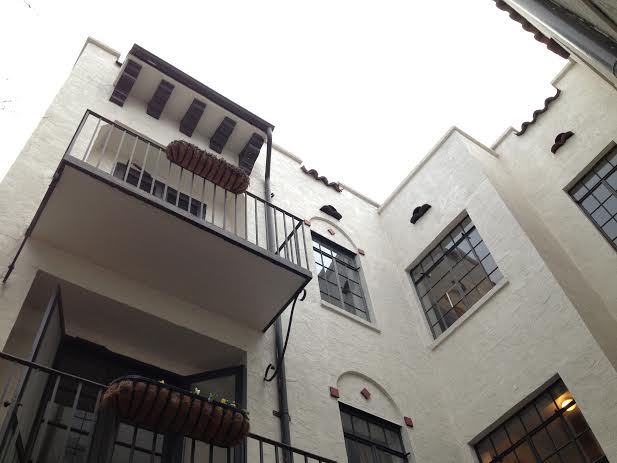
Stepping slightly to the right and looking up to take a picture of the terrace that it attached to the art gallery (worth a trip inside, it is called the River Gallery)

left up

Looking to the left of where I’m standing, a small rock garden. Very nice in this wintertime.

rock garden

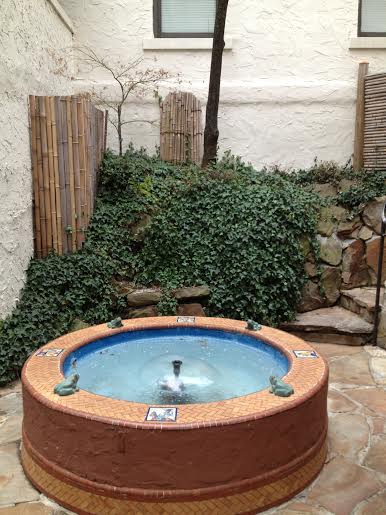
A closer view of the fountain.
fountain

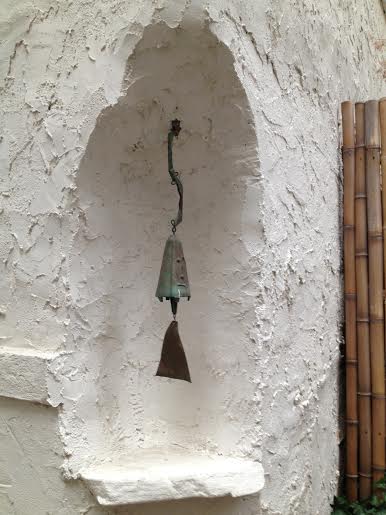
The windchime alcove, going slightly left.
bell

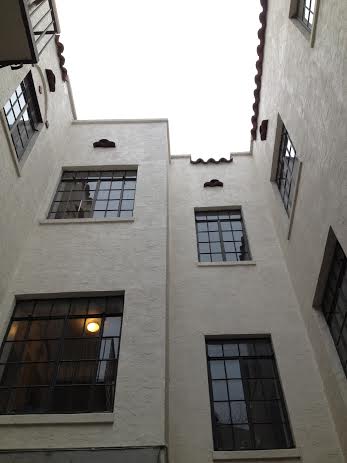
This is looking straight up behind where I’m standing.

high

Slightly to the left of that. The fountain is immediately on your left at this point.

around

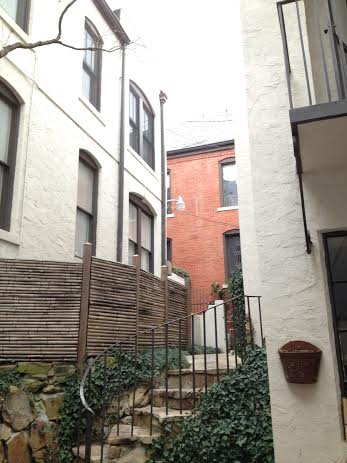
Going further left, the stairs leading out. The fountain is in front of you here.

steps

The fountain

fountain

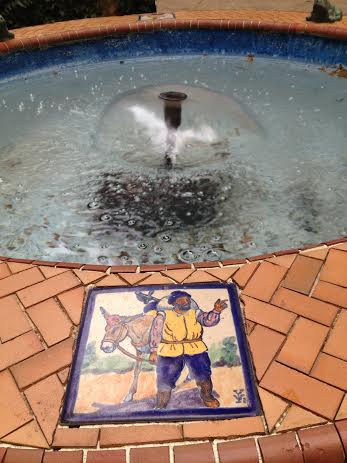
The tilework on the fountain.

close fountain

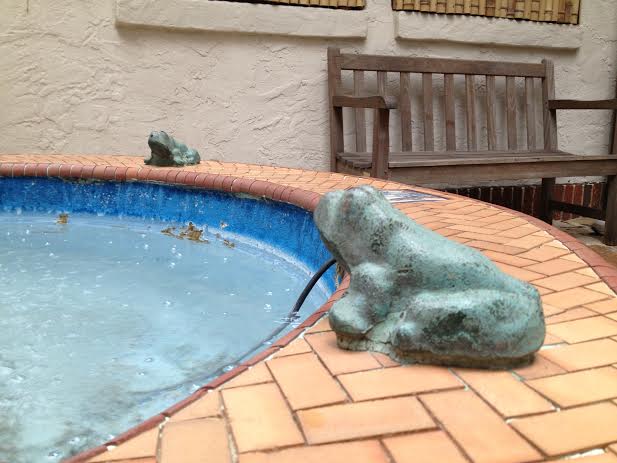
The Frogs.
frog

The Triumphal Entry into Jerusalem

Then they went on to Jerusalem. Near the Mount of Olives, Jesus sent ahead two of his disciples, saying “Go into the next village. As soon as you enter the village you will find a young donkey that has never been ridden. Untie it and bring it to me. If anyone asks you why you are doing this, say ‘The Lord needs it, and will send it right back.'”

The two disciples left and did as Jesus had asked them. They found everything as he had told them they would.

This fulfilled the prophecy that was spoken by Isaiah, which said “Tell daughter Zion, ‘See, your King is coming to you, riding humbly on a donkey’s colt!'”

His disciples did not recognize the significance of what was going on at the time. However, after Jesus was raised from the dead, they remembered this prophecy and that it had been fulfilled in their presence.

They returned to Jesus, laid their cloaks on the donkey, and helped Jesus up so he could sit on it. The crowds began to place their cloaks and leafy branches from the nearby trees on the road.

When he approached the path that went down the Mount of Olives, the whole crowd began to loudly praise God because of all the miracles they had seen, such as the miracle of Lazarus being raised from the dead. They were chanting “Hosanna! Blessed is the King who comes on the name of the Lord! Praise God in heaven!”

Some of the Pharisees said “Teacher, make your followers be quiet!” Jesus answered, “Even if they were to be quiet, the stones would speak for them!”

When he entered Jerusalem, the whole city was abuzz, saying “Who is this?” The crowds with Jesus answered “This is the Messiah, the Son of David, our King!” The Pharisees were very angry, realizing that all they had done to discredit Jesus hadn’t worked. They said “Look! The whole world is following him!”

Because it was late, Jesus and his followers briefly looked around at everything in the Temple area and then went out to Bethany.

MT 21:1-11, JN 12:12-19, MK 11:1-11, LK 19:28-40

In the name of Jesus

Praying “in the name of Jesus” always seemed like a talisman to me. It was a crazy thing to tack on. It sounded like a magical charm – not a prayer. Yes, Jesus tells us to ask for things in his name.

John 16:23b-30 (NRSV)
23 On that day you will ask nothing of me. Very truly, I tell you, if you ask anything of the Father in my name, he will give it to you. 24Until now you have not asked for anything in my name. Ask and you will receive, so that your joy may be complete. 25’I have said these things to you in figures of speech. The hour is coming when I will no longer speak to you in figures, but will tell you plainly of the Father. 26On that day you will ask in my name. I do not say to you that I will ask the Father on your behalf; 27for the Father himself loves you, because you have loved me and have believed that I came from God. 28 I came from the Father and have come into the world; again, I am leaving the world and am going to the Father.’ 29His disciples said, ‘Yes, now you are speaking plainly, not in any figure of speech! 30Now we know that you know all things, and do not need to have anyone question you; by this we believe that you came from God.’

I get it now – Jesus is the proof that God is real, that God makes good on his promises. Jesus is God made flesh, is real, is here with us. Our God loves us so much that he comes down to be with us, right next to us, even inside us. When we pray in Jesus’ name, we are recalling that – to ourselves, and to God. We are reminding ourselves and God that he cares and wants the best for us.

(Started 12-3-12, left to work on for later and forgotten. Edited today. I think I’ve written something similar since I started this.)

Money and energy

If somebody comes up to you and asks for $20 and you give it to them and it’s not a hardship for you, then everything is okay. They aren’t borrowing it – they just want $20.

But what happens when they come up to you the next day and ask for another $20? Do you give it to them? If you do and it’s not a problem, then again everything is okay.

But what about the next day
and the next day
and the next day?

If they keep asking you for money and you keep giving it to them you might start to feel resentful. You might think “I really don’t have this kind of money to give away. Why does this person keep asking me for money?”

Really the question is – why do you keep giving it to them if there’s a problem?

This isn’t about money, but money is a good way to get into this idea. Money represents energy. Someone can’t take something from you without your permission. Someone can’t take advantage of you without you letting them do it.

If there’s a coworker who is constantly shirking at work and you constantly have to pick up her slack, then that’s your problem, not her problem. She is a genius. She figured out how to get paid to do half her job. Meanwhile, you’re doing twice the amount of work for the same pay.

If you feel put upon and upset and hurt by this, then that is all about you not establishing safe boundaries for yourself. Time to say no, and mean it. The other person will push you and test you – this is normal. Keep saying no.

Why do we so often care about not hurting other people’s feelings, while feeling hurt and upset ourselves? Time to change things. We don’t need to turn this so far around that we aren’t considerate of how others think and feel, but we do need to factor in how we think and feel. It isn’t fair if feelings aren’t equal.

Things we found in books

A bus pass.

Rolling papers.

Boarding passes.

Plane tickets.

Gift cards.

Pieces of toilet paper.

Gum wrappers.

Grocery lists.

Family photographs.

Birthday cards.

3 x 5 note cards with study questions on them.

Outgoing mail.

List of errands or chores.

Envelopes with fine money and a note with their library card number inside.

Handmade and store-bought bookmarks, some of which are very old and obviously cherished.

–Medical stuff–
A sonogram.
Doctor’s appointment notices.
Prescription.
Medical test results.

–Money–
Biggest bill was $20.
Checks made out to the patron.
Checks that have not been cashed that are made out to the patron.

–Three dimensional things–
Pens.
Nail files.
Hair ties.

Children are promised

There are many times in the Bible where children are prophesied. Sometimes they are long-wanted, sometimes they are a surprise. Sometimes they are the answer to a prayer and sometimes their birth causes more questions than answers. In each case, God shows us that our lives and our concerns are always in God’s hands. God knows our needs before we do.

This is a complete list as far as I know. If I find more, I’ll add them. Please comment if you know of other examples of God telling people that they were going to have a child.

Ishmael (Gen. 16:7-16)
Isaac (Gen 18:1-15)
Samson (Judges 13:3-20,24)
Samuel (1 Samuel 1:1-20)
John (Luke 1:5-25)
Jesus (Luke 1:26-38)

A blind man healed.

A large crowd was following Jesus and his disciples when they were near Jericho. A blind beggar named Bartimaeus (the son of Timaeus) was sitting by the road. When he asked what was going on, a person told him “Jesus the Nazarene is walking by.”

He began to cry out “Jesus, Son of David, have mercy on me!” People in the front of the crowd told him to keep quiet, but he began to cry out even more, saying “Have mercy on me, Son of David!”

Jesus stopped and asked that the blind man be brought to him. They called to the blind man and said “Cheer up! Come on, he’s calling for you!” Immediately he flung off his cloak, jumped up and went to Jesus.

Jesus asked him “What do you want me to do for you?”

Bartimaeus said, “Teacher I want to see!”

Moved with compassion, Jesus said “Open your eyes. Your faith has healed you.”

He was immediately able to see and he began to follow him on the road, giving glory to God. Everyone who saw this happen began to praise God.

MT 20:29-34, MK 10:46-52, LK 18:35-43

Cure for violence

We’ve had too many examples of people becoming violent and randomly killing people. This isn’t something that is going to go away unless we make it go away. It is a weed that takes many years to grow. We have the ability to eradicate it in the future. Here are some of my ideas about a cure for violence. Some of this I wrote a few years ago, after a rash of these occurrences.

Just like with treating toddlers -ignore the bad behavior and reward the good. Don’t publicize the name of the criminal, the perpetrator. Lets’ not have a payoff.

Notice and acknowledge people. Everybody needs to know that they count. When you see someone who is a loner, make contact with them. Befriend them. It isn’t easy. But it is essential. It is part of this “love your neighbor” thing we are supposed to do.

Remove, discourage violence in the media. Games and movies that depict violence should not be bought. They should not be made, but we can’t control that. Take away the demand, then the supply will go away. I’m not about making laws for these things. Make it illegal and you’ve made it taboo. Make it taboo and you’ve made it desirable. Kids want what they can’t have. Rather, we need to watch what we consume.

We need to make it socially unacceptable for people to play war in their spare time. Especially kids, who don’t have the maturity to understand reality from unreality. How can you know what is real when you never see it? “Reality TV” isn’t. It is over the top, scripted, and fake, much like our celebrities. We have created a society of artifice, where we celebrate the un-real.

We need healthy outlets for emotions. We bottle them up and suppress our real emotions. Everything is supposed to be fine in our society, and this just isn’t normal. We don’t have a way to process pain. We need that. It has to get out.

I’m not advocating gun control. I’m advocating people control.

Is it that we have more violence these days, or that we are just so connected that we can’t help but see it? And why don’t we see a balance of “good” stories? Surely just as much good is happening.

In the desert, we remember.

I am enshrouded in the welcoming smells of desert sand cooling, the dusky smoke of the fire, of roasting lamb slaughtered that afternoon. I recline upon rugs, handwoven by my grandfather (taught by his father, taught by his father…). They are a little musty from being rolled up for too long.

For too long we have walked on carpets made by machines and not men, soaked up the rays of florescent lights, breathed recycled air, listened to artificial music.

We’ve left, gone west into the desert, no map, no plans, no forwarding address. We’ve slipped loose this mortal coil, this mortal toil for older times. We slip into our djellabas like slipping into a warm bed on a cold night – comfortable, comforting, consoling, smoothing away the calluses built up like armor, like a shield against an unforgiving, unwelcoming world.

We’ve left that world behind.

We left at twilight, dusk gathering her cloak about her. She had not yet bejeweled herself with stars. By the time we found our home for the night amidst the hills she’d gone all out for us, diamonds against dusky cobalt.

We wear turbans out here, all of us.

We are doing as we have done for thousands of years. It is us, always us, out here under the stars, laughing with storytellers, singing with song weavers. Out here, we remember.

Out here, we remember who we are.

On carrying cash only.

One of the most common things I hear when I tell people that I carry cash instead of credit cards is that they are afraid. They don’t say the words that they are afraid, but the next sentence does. They say “It is dangerous to carry around large amounts of money all the time.”

I think to myself – why would you need to carry around large amounts of money all the time? Do you have a sudden need to spend large amounts of money? That alone should be something to look into. That indicates deeper problems – ones that can be addressed by taking on the discipline of carrying cash.

For everyday occurrences, simply carrying at least a 20 on you will do. Even before I started carrying only cash, I would have a 20 under my ID as an emergency backup, and a 20, a 10, a 5, and some ones. That meant I had whatever change I needed for whatever circumstance. It also meant that I had enough to pay for my meal when the credit card machine reader was broken.

I have experienced enough times with myself and with observing others that not every place takes credit cards, and not every credit card reader works all the time. It is safer to have some cash on you.

I know a guy who was ‘running on fumes’. He just barely managed to get to a gas station before his car ran out of gas. Ideally, he would have filled up long before the gauge hit E, but that is another story. He gets to the gas station and pulled out his credit card. The card reader did not work. He knew that he did not have enough gas to start the car and drive to the next gas station. He did not have any cash on him. He was stuck. Fortunately someone nearby, (someone older), had cash and lent it to him.

You don’t need to carry large amounts of money on you at all times. You know when you’re going to go to grocery store or the hardware store. You have an idea how much you’re going to spend. Bring that amount. Otherwise keep it at home or at the bank.

I think that all of this anxiety about carrying large amounts of cash is a disease that has been spread to us to make us afraid and controlled.

Think of the stories you’ve heard in the news of people who have been robbed. Then start going backwards. How many people do you personally know who have been robbed? If you know anyone who was robbed, how often where they robbed?

Have they been robbed every week?
Have they been robbed once a year?

How big is this problem, really? More importantly – how small is it?

Then think about the numbers of times you’ve heard about thousands of people experiencing credit card fraud. Their wallet doesn’t even have to be stolen. They won’t even know they have had their information taken from them until it is too late. It is less traumatic at the beginning, sure, but way more expensive at the end. Lots of time has gone by, and lots of money has been spent. Lots of money that isn’t even there to be spent – it is all on credit.

I believe that all the stories we hear of people being robbed are exactly that – stories. I believe that we have been told these stories to keep us afraid, and in line. I believe that the world is exactly as safe as we choose it to be. But also – it is exactly as dangerous as we will let it be.

I would rather have cash on me than credit cards with huge limits. Not only is it dangerous to have the ability to mindlessly spend up to $15000, it is also dangerous that someone could steal my purse and could swipe my card and max it out all the way up to the limit of my credit. These days, if someone steals my wallet, the only thing they’ll steal is the amount of cash that is inside it. That is at most 50. On grocery days it is 100. I’d much rather have $100 stolen than $5000.

But what about unforeseen accidents and problems? My car might break down? What then? What did we do before credit cards? Think. We have created our own monster.

I can live in fear that I’m going to be robbed, or I can live in fear that I’m suddenly going to have to spend lots of money because my car is going to break down.

I chose to not live in fear.