Annunciation

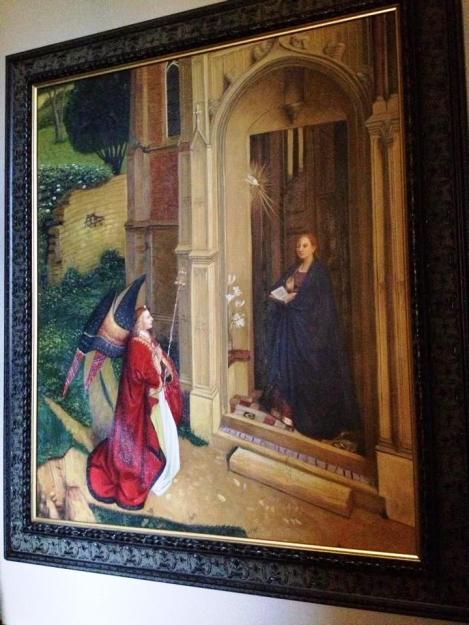
In a gloomy little corner at St. Meinrad’s, there is a painting of the Annunciation.  It is very hard to see – there is little natural light and I couldn’t find a light switch for artificial light.  It is the the only painting in that corner.  It is more of a passage way to get to another room.  It is an afterthought.

annun 1

Yet notice that they have a holy candle mounted on the wall next to it.  A white candle, especially in a red sconce, indicates that the presence of Jesus is there.  Yet someone has let the candle go out.  These candles are normally placed next to the tabernacle or aumbry that has consecrated hosts (Communion wafers).  I’ve never seen one next to a painting – but this painting indicates the moment that Jesus became a physical part of the world by entering into Mary’s womb.


5

Because the only light was right in front of it, I had to stand at an angle to take the picture otherwise my shadow would have gotten in the way.


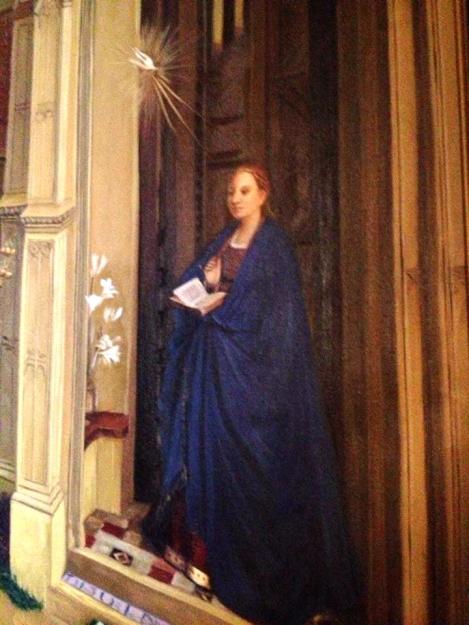
Notice the dove, a sign of the Holy Spirit.  There are lilies too – symbols of the purity of Mary.

4

This is the archangel Gabriel, come to ask Mary if she is willing to be the bearer of Christ.

3

Everything is immaculate in this painting – so why is there a breach in this wall?  Does it refer to when Jesus died on the cross and the division between the Holy of Holies was rendered in two?  That signified that God and humans are reconciled – there is no longer a division between us.  We no longer need an intermediary of a priest to speak with God – we can do it directly.

annun 2

Message for 7-18-2016

I had a very difficult time going to sleep last night and when I finally did I had a very intense and vivid dream.

The lesson that was received was this:

It will all work out.

God is in charge.

Even though it does not currently appear so, walk towards what you think is right and the way will reveal itself.

There is a solution.

Do not remain still. Do not be immobile. All will be revealed but only if you act. Act with calmness, trusting always in God.

Listen constantly for God’s voice, especially now. Now is a time of narrow paths and deep chasms, so it is very important to listen closely.

Trust implicitly in God at this time. This is the time of winnowing. Only those who are awake will be rescued.

Be alert at all times for your call to help others. Remain a beacon of calm. Your mindfulness and centeredness is the salve for the wounds of the world. It comes from God – never forget that.

God says
I am with you.
I am acting.
Trust.
Remember.
Shalom.

Saint Joseph’s chapel

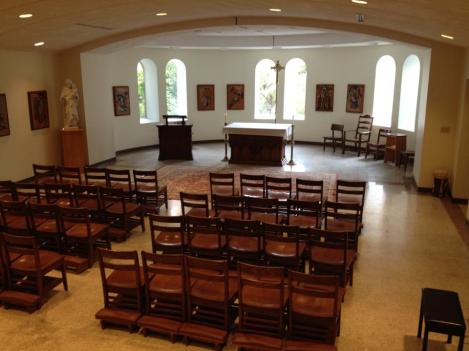
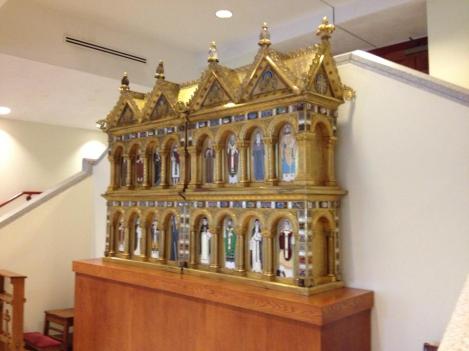
This is a small chapel at St. Meinrad’s.  While it looks very simple and humble, they’ve stored the altarpiece from the original Abbey here.  It is overwhelmingly ostentatious.  Fortunately it is at the back of the room so you don’t get distracted by it when there is a service here.

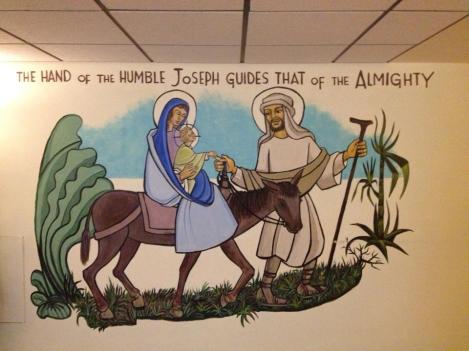
This is in the hallway on the way to the chapel. 19

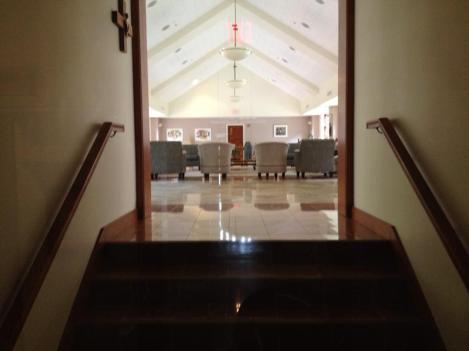
This is in the chapel itself. You enter from a raised area. Interestingly to me, there was a small hand drum to the right of the chapel.  Even though it was a silent retreat, I enjoyed playing it at one point during my time there.  There was nobody else around, and I played softly, so I didn’t disturb anyone else.  This chapel is attached to the building that has the seminary, not the guest house.

1


Here is the over-the-top altarpiece.  It was removed when they renovated the Abbey to make the altar no longer attached to the back wall, but in the center of the room, among the people.  That was part of a movement after Vatican 2 that tried to make the symbols of the church match the message of the church – that Jesus is among us, not hidden away, far removed.


11


Here are some details.


Imagine how much money and effort was required to make this.  Imagine how many hungry people could have been fed with that money and effort.  While this is outwardly beautiful, it is a direct affront to the very call of Jesus.  We are specifically not to build up treasures for ourselves here – we are to take care of people.


This is to the side of the chapel. A bit of glass has broken and is now on the music and nobody else has noticed.


I wish that Protestant churches had guest houses for silent retreats so I could go there instead and I wouldn’t get so wound up about the hypocrisy of it all.  This place is beautiful, don’t get me wrong.  But only until all people are taken care of (no more homelessness, no more sickness, no more wars or poverty) can we even think about building places that are this opulent.  They are extras.  Money and effort has to go to following the instructions of Jesus first.  If more Christians followed Christ instead of Christianity, the world would be a better place.

Private places

There are places at St. Meinrad’s Archabbey that are most certainly off limits.  They spell it out with signs, saying that you are not welcome in this area.


There was one area that had a sign and a frosted glass window.

chapter house 2


But there was a clear spot higher up, so I just held up my camera.

chapter house1


There is a lock on the holy oil vials, presumably to keep you from accidentally anointing yourself, or from desecrating it.  Wonder why these vials are on public display then, if they are not for public use?  To show off how pretty they are? These were prominently displayed at the center of the Abbey.

oil2


There are enclosed gardens that I wanted to explore.  I saw them on Google Maps before I went there and looked forward to going.  There were not open to lay people, however.  But there were windows, so I took pictures. I was sad to see them not even being used by the monks.  These beautiful gardens, alone, locked away, unappreciated.  Perhaps the monks stare at them from their rooms, while they are locked away from the world they are called to serve?


They even tried to block the view with signs like this.

3

But I found a way around it.  These pictures are taken through the glass.


Monasticism as it is practiced was not mentioned by Jesus at all. Living together, sharing resources, sharing lives – yes.  It is good for all to work together for the common good.  However, he did not intend that we were to separate ourselves from the world entirely.  When we work together and share what we have, we are stronger people, better able to help others.  However, when we focus all of our energy inwards to the group, we defeat the purpose of what Jesus calls us to do.


With all these signs, I was continuously reminded of the “us and them” approach the Catholic church has to life in general – either you are “in” (a Catholic) or “out” (either not Christian, or just not Catholic).  The most obvious example of this is with their approach to communion.  This exclusionary practice is not Christ-like, and will turn more people away from the message of Jesus than they could ever imagine.


Interestingly, I spent time at their “sister” community, just down the road a few months later.  The Sisters of Saint Benedict have a community in Ferdinand, IN, called Monastery Immaculate Conception.  I walked all over that place and only saw one sign saying “private”.  In fact, the nun who took us on a tour of the place told us we could sit in that area if we wanted.  I’m pretty sure I accidentally wandered into some areas I shouldn’t have, but nobody got upset with me.  Their monastery was older, a little shabbier.  It was obvious that their “brothers” got more money and better resources.  But the Sisters were far more kind and welcoming, always helpful and kind, with open smiles.

St. Meinrad guest house

St. Meinrad Archabbey is in St. Meinrad, Indiana.  It is a Benedictine monastery and seminary.  The Benedictines have as part of their Rule to serve the guest as if he (or she) is Christ, so they always have guest houses that are quite nice to stay in .  They are good for going on retreats.
Here are some pictures from the guest house there.

The guest house itself, as seen on the way back from the Abbey.

guest house

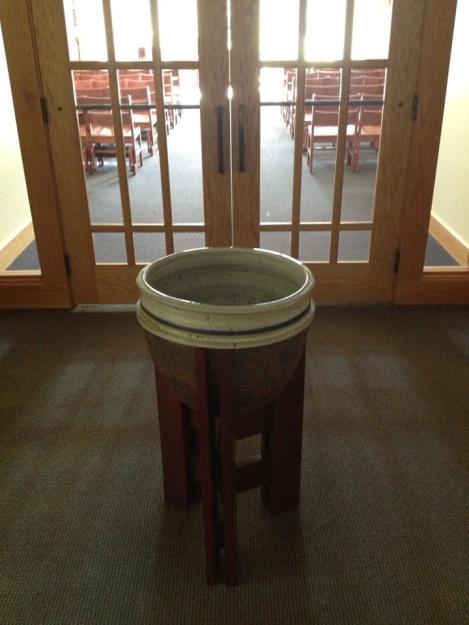
The baptism font is outside of the doors of the chapel. This is right in front of you when you exit the dormitory area.

gh font

At the back of the chapel (in line with the font) is this unusual crucifix.  It looks like Jesus needs a chiropractor.
cross2cross1

(Edit to add – I looked up why his head is tilted, and learned from the website Reachparadise.com that crucifixes “…that show His head tilted slightly down (or up) and to the right are taking some artistic liberties. The right hand, in Christian faith, is the hand of blessing. Since Jesus chose to sacrifice Himself for our sins, He, in turn, gave us the ultimate blessing. This is why His head faces right in some crucifixes – to show that His death is a blessing for all of us.” It goes on to say that other reasons include “One stated that Jesus was facing the good thief, whom He saved before dying. The other said it was to reinforce that Jesus is seated at the right hand of the Father.”

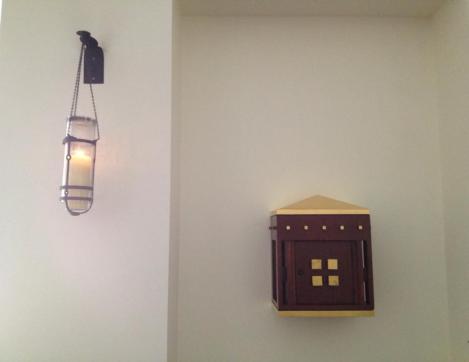
On the right side is the eternal flame signifying the presence of Jesus, and the aubrey, which holds the reserved sacrament (blessed communion wafers).

aumbrey2candleaumbrey

To the left is the paschal candle.

gh chapel 2

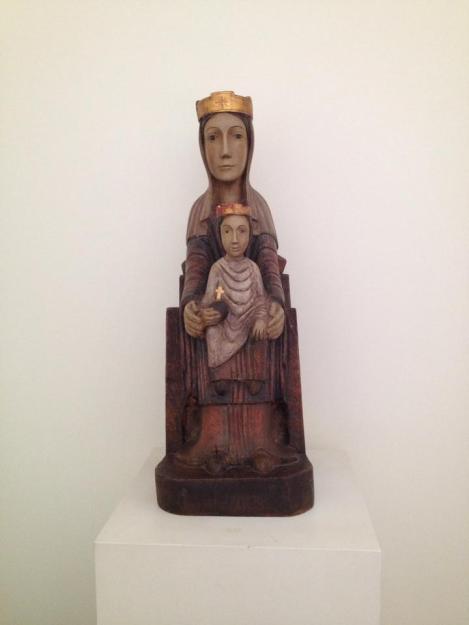
And a carved wooden statue of Mary and Jesus.

gh chapel


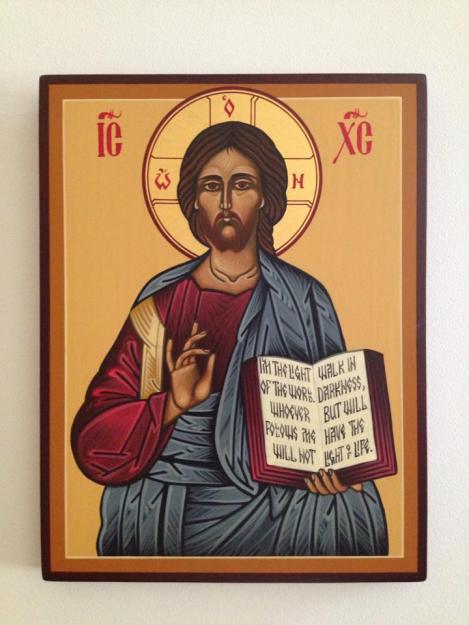
Near the front is an icon of Christ.jesus


We had a room there that had supplies for us to work with while we were there.  There were coloring books, pens, paints, magazines, juggling balls and scarves, and jigsaw puzzles.  I was amused that the one that people pulled out to work on was one of a huge cathedral.  It was impossible for one person to do it all in the time we were there, so we all took turns (without discussing it, because it was a silent retreat) to work on it.  We were working together to build the church in many different ways.  jigsaw2jigsaw1jigsaw 3


Brother Maurus, our host and liaison, made sure to put out wine for us at dinner.  wine


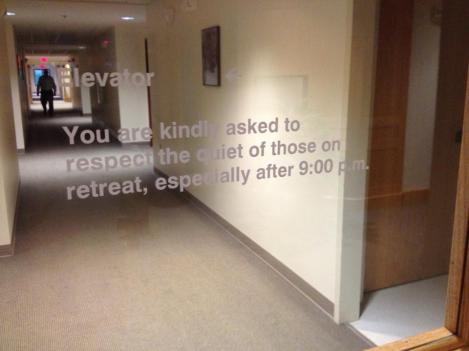
The sign on the door to the dormitory, reminding people to be mindful of others who were there.  Not everyone who goes there is on silent retreat. quiet

Pilgrim

f6f31b907f77ed242c064fa922ceef12
The country
versus
The city
city

How interesting to consider that the pilgrim feels welcomed and safe in the wilderness, and an anomaly and a target in the city.
How those in the countryside will minister to a stranger in pilgrim’s clothes – feeding, first aid, a drive to a hotel or a dentist – yet those in the city will harass or rob the same person.
How in the countryside the biggest danger is a pack of wild dogs or thunderstorm, but in the city it is people.

People in the city see pilgrims as weak, as helpless, as fools – as relics of a bygone era. They are mocked at best. Assaulted or robbed at worst. They are looked at as the strangers they are and ignored – while in the country they are sought out. The best food and entertainment is provided even if they do not share a language or the same culture. There is respect, admiration.

I had thought that the country would be a problem – no amenities, no resources. A long walk without access to food, water, shelter. I must carry everything and trust in the providence and mercy of God. Yet I read that you can relax in the country as a pilgrim. It is the city where the danger lies. While it has food, water, and shelter, it also has people. Perhaps those in the city live there because they have lost faith in God – they think they must provide for themselves, while those in the country are reminded of God’s grace and mercy every day.

Blessing

Jesus says “Take up my yoke and learn from me, because I am gentle and humble in heart, and you will find rest for yourselves. For my yoke is easy and my burden is light.” (Matthew 11:29-30)

The apostle Paul says “I can do all things through Christ who gives me strength.” (Phil. 4:13)

When we align ourselves with what Jesus wants us to do, anything is possible. But the important thing is that we have to remember that it has to be what Jesus wants. Remember he says “Take up my yoke” not “Yoke me with your plans.” We are to get in line with what Jesus is doing, rather than just inviting Jesus into what we are doing.

So often we try to do things backwards. We all too often tell God what we want to do and then ask God to bless it, rather than asking God to bless us by telling us what to do.

Remember the phrase “God is my co-pilot”? I saw a church sign recently that said it works better if we switch seats. Let God be in charge. You might not get where you want to go, but you’ll get where you need to go.

We have to share the message

I once met a lady who was surprised that her son didn’t know anything about Christianity. She was a lapsed believer and her ex-husband mocks those who do have a faith. She was surprised to learn that her son did not know the Lord’s Prayer. She was also surprised that he had never heard the stories of Jonah and the whale or of Noah for instance. She also is dismayed when her son admits that he doesn’t believe in God.

The problem is that she’s never taught her son about God or any of the stories in the Bible. Her ex-husband certainly wouldn’t. She never took her son to church so he never would have heard the stories from someone else. Public schools do not teach Bible stories either.

How could anyone like something they have never been introduced to? For instance, how can you know if you like to eat pizza if no one has ever given you a slice of pizza to eat?

Teaching children about the stories of the Bible and the love of God isn’t something that we can take for granted. It is better for them to hear this message twice rather than not at all. It is incumbent upon us to share with them the things that have helped us in our faith journey.

In the same way that we would teach them healthy things to eat and share insights on exercise or ways to save money for retirement, we should share the stories of our faith with our children. We share the things that we know to be good. We know God is good, and we know the message of God’s love for us through Jesus to be good. This is something that we can’t leave to chance.

Thoughts on the Eucharist

The Eucharist is the Christian ceremony that commemorates the Last Supper, (also known as the First Lord’s Supper) in which bread and wine are consecrated and consumed. The term also refers to the consecrated elements, especially the bread.

According to the online dictionary on Google, the term comes from the late Middle English: from Old French eucariste, based on ecclesiastical Greek eukharistia ‘thanksgiving,’ from Greek eukharistos ‘grateful,’ from eu ‘well’ + kharizesthai ‘offer graciously’ (from kharis ‘grace’).

It is literally a meal of thankfulness. We are eating thanks.

The last meal that Jesus shared with his disciples is described in all four Gospels (Mt. 26:17-30, Mk. 14:12-26, Lk. 22:7-39 and Jn. 13:1-17:26). In each story, he follows the Jewish practice by first giving thanks for the elements of the meal before consuming them. He blesses the food by blessing God, the creator of that food.

There is an echo of the miracles of feeding the large crowds of people.

The first instance, “the Feeding of the 5,000”, is in all four Gospels: Matthew 14:13-21, Mark 6:31-44, Luke 9:10-17 and John 6:5-15. The second instance, The “Feeding of the 4,000”, is reported by Matthew 15:32-16:10 and Mark 8:1-9. Both times, he gives thanks first. He is pointing out to his disciples and us that we must give thanks before we receive anything. Thankfulness must come first for miracles to occur.

On depression, addiction and following God’s commandments

Several of the many blessings in Judaism give thanks to God for sanctifying us by giving us commandments. What does this mean? We are made sacred when we follow the commands that God has given us.

While reading this week’s Torah portion (Bechukotai), I was struck by how this relates to depression and addiction. When we stray from the path of order, we get sick. The word “Sanitary” refers to being clean. Insane literally means “not-clean”. When we act in a good way, we stay clean and sane.

In Leviticus Chapter 26, God is telling us what will happen if we don’t follow the commands that we have been given.
(14-17)
14 “But if you do not obey Me and observe all these commands— 15 if you reject My statutes and despise My ordinances, and do not observe all My commands—and break My covenant, 16 then I will do this to you: I will bring terror on you—wasting disease and fever that will cause your eyes to fail and your life to ebb away. You will sow your seed in vain because your enemies will eat it. 17 I will turn against you, so that you will be defeated by your enemies. Those who hate you will rule over you, and you will flee even though no one is pursuing you.

“Terror, and your life will ebb away”? Sounds a lot like anxiety and depression. And we will run even though nobody is pursuing us? That sounds like anxiety too, always in a panic.

Note that this is not some random punishment. It is the natural result of dis-order – of not following the order, the commandments, of God. It is more that we are punished by our bad choices, rather than God is punishing us.

19-20
19 I will break down your strong pride. I will make your sky like iron and your land like bronze, 20 and your strength will be used up for nothing. Your land will not yield its produce, and the trees of the land will not bear their fruit.

“Your strength will be used up for nothing” sounds very familiar. Depression feels like nothing you do is meaningful or worthwhile. What little energy you have amounts to nothing.

26
26 When I cut off your supply of bread, 10 women will bake your bread in a single oven and ration out your bread by weight, so that you will eat but not be satisfied.

Depression and addiction both feel like you are never satisfied. Nothing ever makes you happy. You never feel fulfilled.

36
36 “I will put anxiety in the hearts of those of you who survive in the lands of their enemies. The sound of a wind-driven leaf will put them to flight, and they will flee as one flees from a sword, and fall though no one is pursuing them.

More anxiety and terror, even though there is no discernable reason for it. Once again, this is part of depression and anxiety.

43
43 For the land abandoned by them will make up for its Sabbaths by lying desolate without the people, while they pay the penalty for their sin, because they rejected My ordinances and abhorred My statutes.

And this is all for when we choose to disobey God.

Yet, even though we abandon God, God does not abandon us.
44-45
44 Yet in spite of this, while they are in the land of their enemies, I will not reject or abhor them so as to destroy them and break My covenant with them, since I am Yahweh their God. 45 For their sake I will remember the covenant with their fathers, whom I brought out of the land of Egypt in the sight of the nations to be their God; I am Yahweh.”

We can turn around right now, and start acting correctly. We can be like the prodigal son, and return, right now, to obeying God.

Jesus boils down all of the commandments to two – Love God, and love your neighbor. Treat your neighbor how you like to be treated.

(All translations are from the Holman Christian Standard Bible)