Viriditas, energy, and time

Saint Hildegard’s “Viriditas” refers to life force, essence. Many translators simply say that this neologism means “greening”, which it does at the most basic level, but it means so much more than that. It is power, energy, growth. It is the very marrow of what it means to be living. You know when you meet someone whether they are simply existing or truly energetically alive. This “Viriditas” is the difference. We have the ability to tap into this force, a gift from God, and be truly alive. We are then expected to use this power in the service of God to help our fellow humans.

It is what Moses talked about when he said “I set before you a blessing and a curse – therefore, choose life.” Life is the blessing. To grow, to use your gifts is the purpose of life. We must choose to tap into the power of God, and then choose to use it wisely. We are not meant to use this energy for our own personal gain, but to benefit others. We are meant to take what God has given us and magnify it.

Two men having sex together is seen as a sin in Judaism because it is “spilling of the seed” – it is seen as a waste of creative life force. The act isn’t the sin so much as the waste of creative force. Their energy is not being used to create, but is used for personal means. They are not making anything with their energy. It is a mis-use of a gift from God.

Likewise, to create laws against homosexuals is also a waste of power. Imagine how many hungry, homeless, and hurting people could have been helped with the money, time, and energy that have been spent on creating laws against people who are gay or transgendered.

The focus must always be on wisely using what God has given you. The energy must be turned outward to help people, with full trust in God.

This is what Jesus talked about in the parable of the talents. Use what you have and make more. Don’t keep energy to yourself.

This is at the heart of the miracle of the loaves and fishes – which happened twice. Take what you are given and add to it. Feed people, in as many ways as possible. Food, encouragement, love – humans need all of these. Our gifts are meant to be shared, not hoarded up.

We are meant to be fruitful and multiply as much as possible, and this does not necessarily mean to have biological children. Our kindness, generosity, compassion are our children as well. Our creative acts – making music or art – are also our children.

This is also about the sanctification of time. The very first commandment that Israel received in the desert was the mitzvah of the calendar. They were to use the moon as their way to mark time, to note its passing, to remember and be mindful about time. It is important to be intentional about the use of time, because it too is a gift from God.

Take nothing for granted. Waste nothing. Trust your gifts and share them with the world, with God’s help.

Remember what Jesus did – he gave thanks to God first before he performed miracles. Tap into the “greening” power of God by giving thanks first for what you have, then turn it outwards to give to others.

Sam and the camera

bench

Sam never felt comfortable looking people in the eye. He’d look away to the side or at his feet rather than make direct eye contact. It was too personal, too painful, like the mixing of a raw nerve in a tooth and a bit of soft bread. Out in public, his shoulders would curve inwards, trying to curl him into a ball like one of the hedgehogs he would see in his back yard. It was all about protecting the sensitive bits, for both of them. Sam wished he had spikes like they did for his first few years of life. Everything was too close, too loud, too much. It was only when he received a camera for his sixth birthday that he began to feel normal, or as normal as he thought he should.

How should he know that his senses were aberrant? It was all he knew. Abnormal was his normal, and that was all there was to it. He thought it was normal to feel like ice was in his stomach and fire in his throat every time he had to experience something different from his usual routine. He thought it was normal to feel faint from fear or anxiety for the majority of the day.

That all changed when he got the camera. The film was a 110 cartridge – easy enough for a child to install. The buttons were large and simple to use. Sam’s father thought it would help him express himself, but he had no idea how helpful it was truly was.

Sam was wary of it at first, as he was of all new things, but he liked the shiny brown case and all the accessories that came with it, so soon he was using it. The strap was fun to adjust and the flash cube was enticing with its shape and sparkle. He first took pictures by holding the camera out at arm’s length, not wanting to put this new thing so close to his face. After the first batch of pictures came back from the developer, his father strongly suggested he try holding the camera up to his eyes. There were simply too many wasted pictures the other way.

Something strange happened when Sam finally overcame his reluctance to put the camera to his face. Suddenly he realized he could see through the viewfinder, just as if it was a mask. He then realized that just like a mask, he was hidden from view. Suddenly his whole world opened up. Sam started taking pictures of everything and everyone. Suddenly he had a reason to go outside and be around other people. Family gatherings no longer overwhelmed him as much as before. Sure, there was still some awkwardness. That would always be there. But now he had a way to be around people that he never had before. It was like finally getting a key to unlock doors that had always been barred to him.

His father hoped that Sam would become a famous photographer, but Sam had no such ambitions. Fame was never something he wanted, at least the kind of fame he was aware of. If he could become famous without even knowing about it, then he was okay with that. He could barely handle normal human interactions. The idea of having random strangers coming up to him on the street or in the grocery store to get his autograph was enough to send him running to his room to grab his trusted teddy bear.

Fame was overrated, after all. It just meant that people were impressed that you were the best version of you there was. Meanwhile, they spent so much time focused on your achievements that they forgot to work on their own. They got jealous sometimes, forgetting that there was enough success to go around.

Spending too much time with strangers

It seems unusual that we are expected to spend time with people that we didn’t choose to, but it happens all the time.

When you work forty hours a week, you are expected to spend all that time with people you don’t know. The only way this doesn’t happen is if you start your own business or you work with family. But for the majority of people, you spend all that time with strangers. Your boss decides who gets hired and who you work with. You often end up spending more time with them than you do your own family.

If you marry into a family, you are then expected to spend every major holiday (like Christmas, Thanksgiving, and Easter) with them, as well as minor holidays (like birthdays). This is odd, since when you marry you state that you are committing to that one person – not their entire clan. Likewise, you certainly did not agree to spend time with people who were not even members of the family when you joined it. Here I’m speaking about people who become members through marriage (brother or sister in-laws) and any resulting children.

One way cloistered communities have it right is that they give the new person and the rest of the community time to feel each other out, to see if they would be a good fit together. This is not done over a luncheon. This is done over the course of years. With monastic communities, it is a minimum of seven years before the person is allowed to make final vows and become a full member of the community. The new person, the abbot or abbess, and the community are all consulted on this.

It seems like something like this would be useful for everyone who is expected to spend a lot of time together.

I remember when I was in the medieval reenactment group, if a new person wanted to join the household I was in, they would approach the Knight (the head of the household). He then would ask each one of us privately what we thought about that person. Not only would we be spending many weekends together, but we also would have different perspectives on that person. We might know something about his personality that he didn’t reveal to the Knight. In one instance, we all had seen that the person was very polite to the Knight, but would be short-tempered and downright mean to anyone he thought was beneath him. The Knight had no idea of this, because the new person had always been on his best behavior with him.

Some combination of these approaches could be useful for workplaces and families. Have the new person spend a significant amount of time with the group before a long-term commitment is made. Each person should then be asked if they feel this new person would be a good fit. Likewise, it gives the new person a chance to see if this group would be the kind of people they would like to be with. This could prevent a lot of stress, and would reduce the amount of workplace and domestic violence.

Artwork in process – “Praying for my enemies”

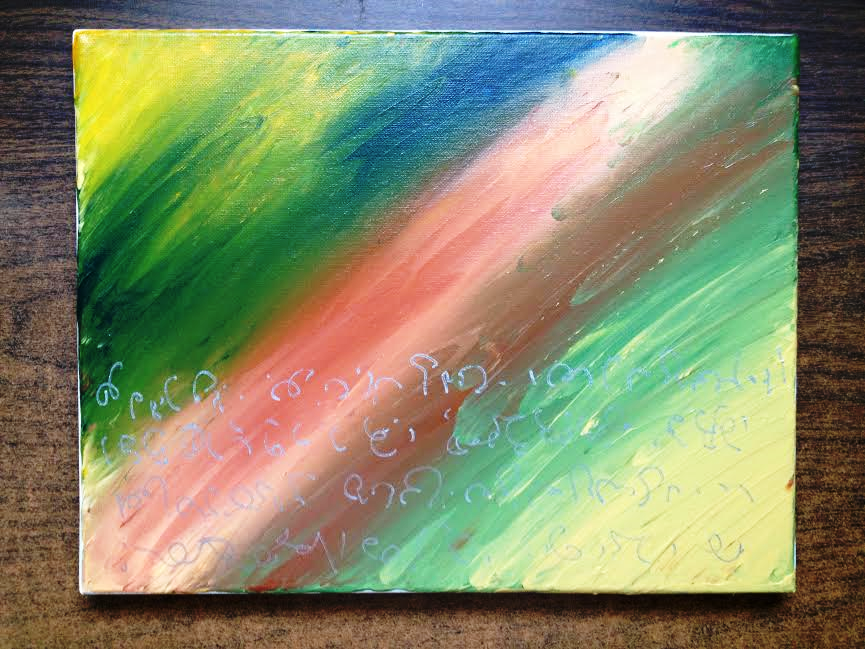
I first worked on this canvas over a year ago while dealing with a very difficult person in my life. This is one of the ways I chose to process my feelings.

This is how it stayed for about a year. This is on a stretched canvas, with acrylic paint I applied with my fingers. I then added silver sharpie light language. It is my prayer for healing for our relationship.

1

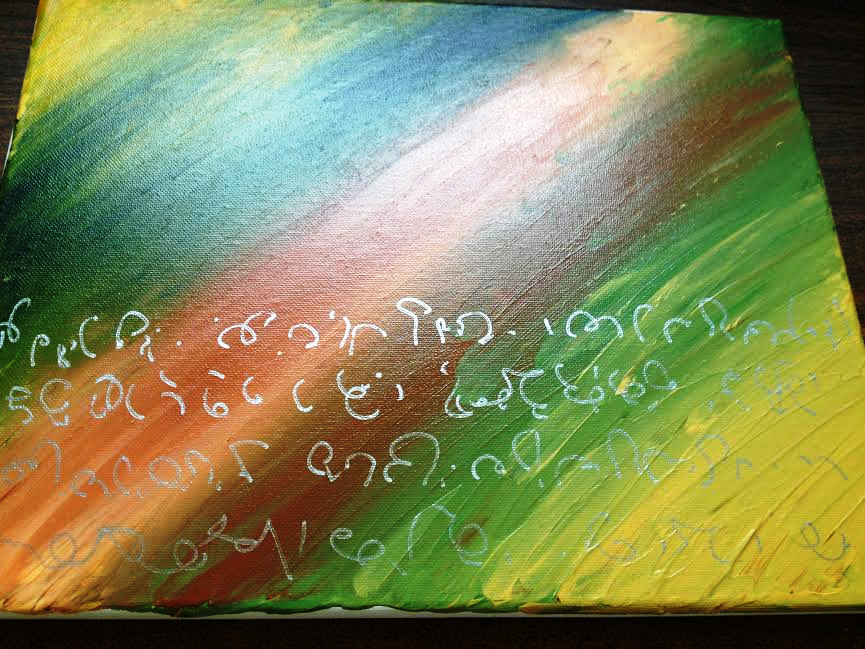
Here it is at a different angle so you can see the light language prayer.

2

In part because I’m learning about layering collage, and in part because new canvases are expensive and take up a lot of space, I’m using old artworks to add new material. The focus is the same, but now about a different person and series of issues.

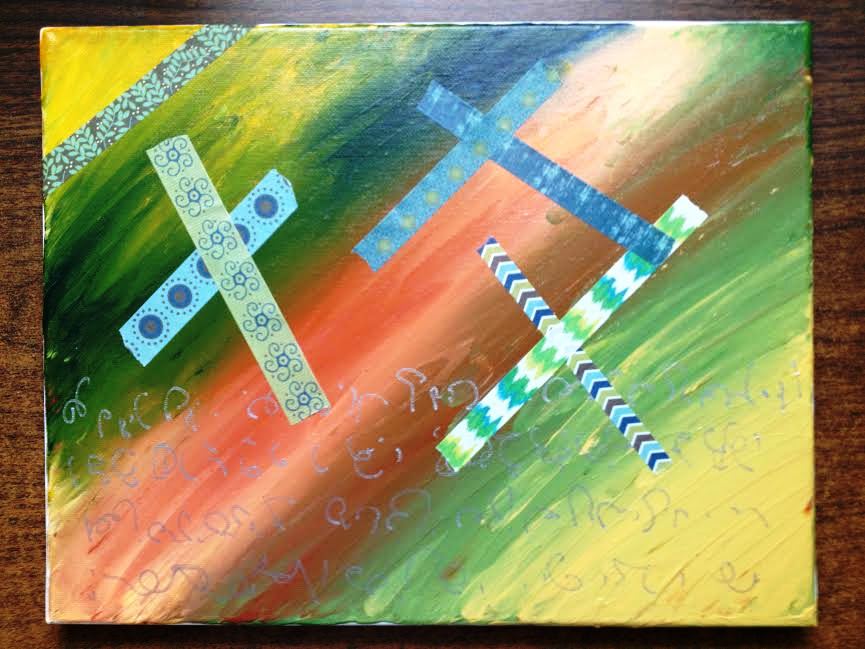
Here I’ve added washi tape.

3

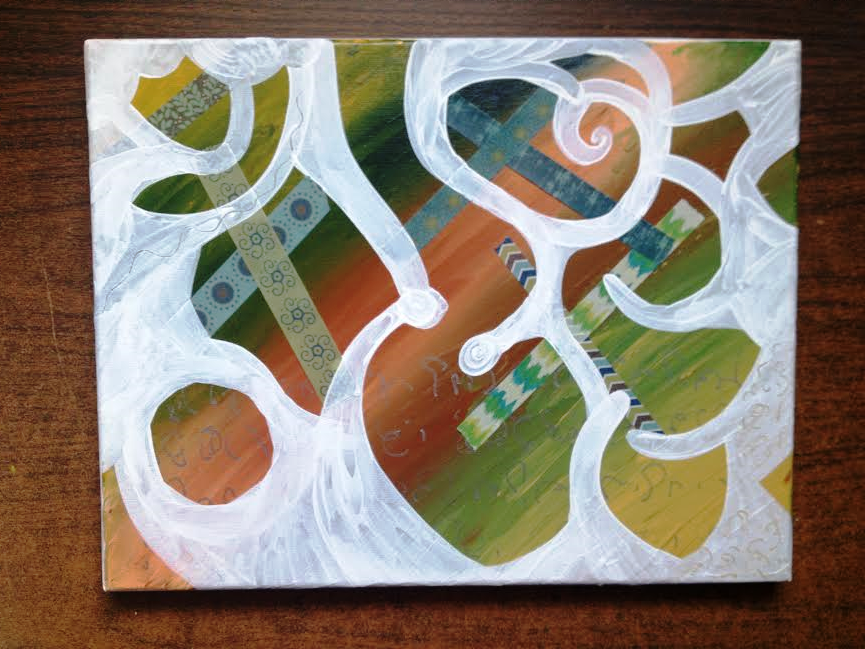
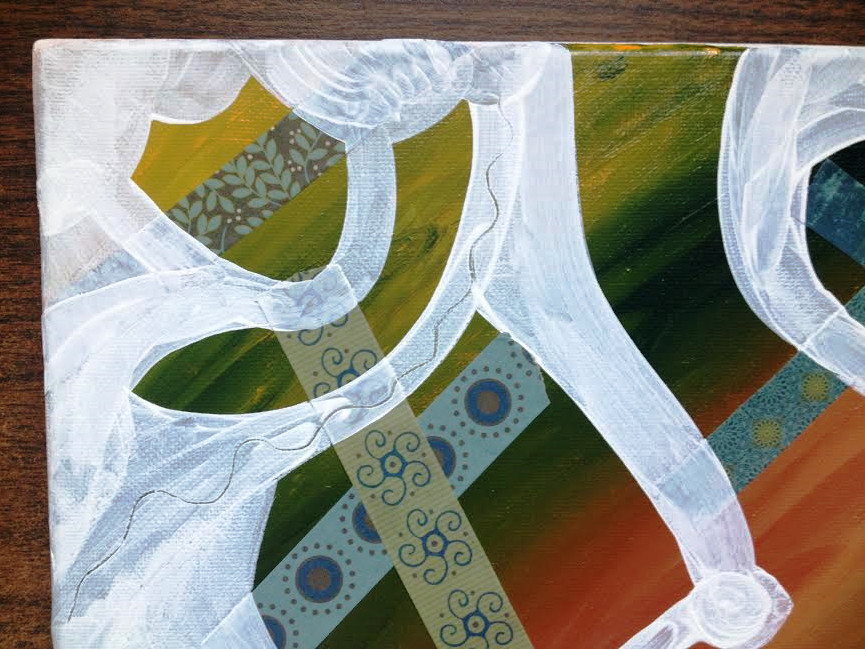
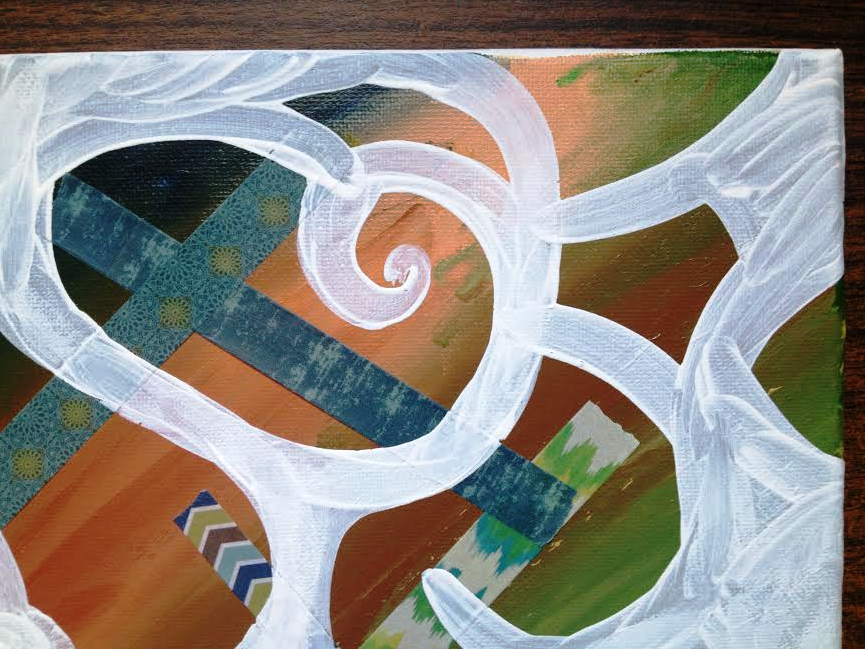
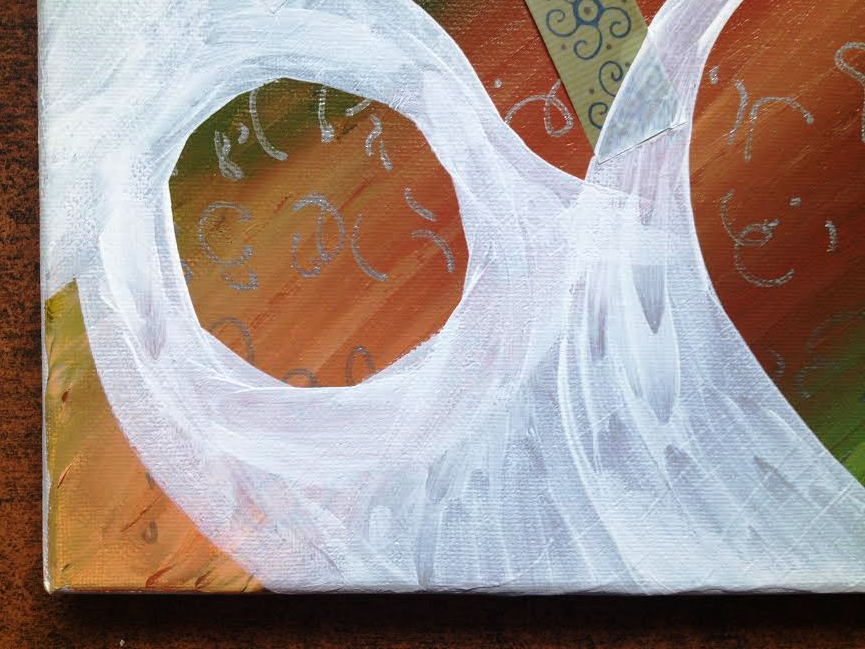
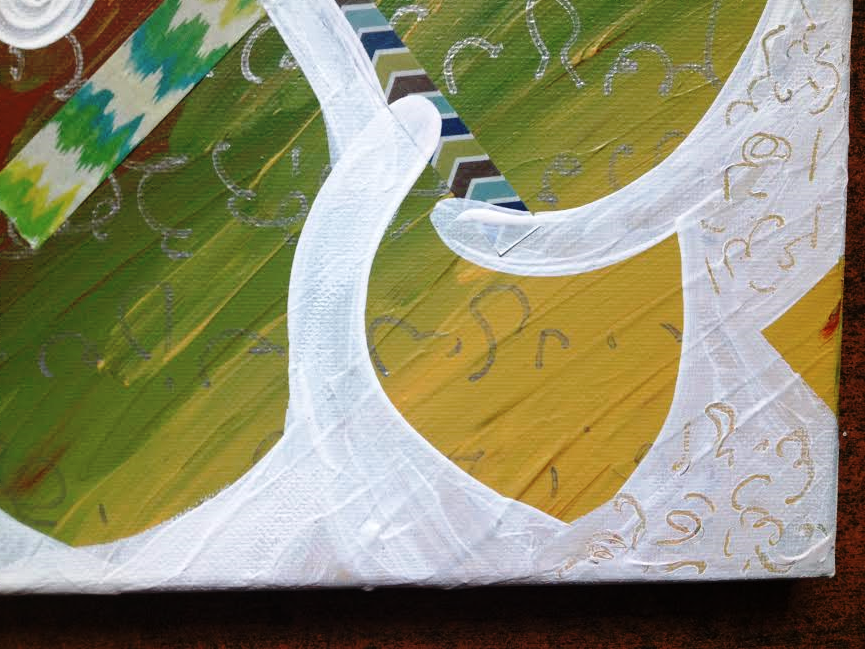
Then I painted a layer of gesso on it in random swirls, obscuring some of the image.

4a

Top left

4b

Top right

4c

Bottom left

4d

Bottom right

4e

More layers are to be added.

Gnossienne

Gnossienne 050516

Gnossienne
n. a moment of awareness that someone you’ve known for years still has a private and mysterious inner life, and somewhere in the hallways of their personality is a door locked from the inside, a stairway leading to a wing of the house that you’ve never fully explored—an unfinished attic that will remain maddeningly unknowable to you, because ultimately neither of you has a map, or a master key, or any way of knowing exactly where you stand.

Art paper from Tim Holtz’ “Distress” line, old Asian map, card stock that was colored with Distress inks and stains and then coated with glazing medium and cut up, old stamps.

Can and can’t

The difference between “can” and “can’t” is the Cross. Look at the two words. Notice that letter at the end of “can’t”. See that letter “t” as the Cross of Jesus, the one where he proved to the world that even death has no say over us.

Take that “t” off. Take it and hold it close, put it into your heart. Remember the love that God has for you, love that caused God to send God’s only-begotten Son to you, to redeem you, to heal you, to show you the path of life. Carry Jesus with you into that thing you thought you couldn’t do.

In the church tradition I was raised in, when you were being baptized you were asked questions before you were dipped into the water. The answer to each of the questions is “I will, with God’s help.” Take the “t” off “can’t” and it becomes “can”. You can do it, with God’s help. Remember the exhortation from an apostle, who tells us “I can do everything through Christ who gives me strength.” Philippians 4:13

Shoeless nuns

defense

The Discalced Order of Carmelite nuns were barefoot, but not weak by any means. Their postulants, in addition to dressing in long plain black gowns and praying every three hours with the rest of the community, had to work out an hour every day. All that praying meant a lot of sitting, and stillness of that sort wasn’t good for the body.
They looked askance at the nuns in many of the other Orders. Some of them weren’t even 60 years old yet and they were obese, feeble, reduced to using a wheelchair. Worse – the wheelchairs were electric. They didn’t even have to exercise their arms to get around. Just push the knob on the armrest and off they went. A Discalced Carmelite would rather renounce her vows than to be seen in such a state of sloth.
For sloth it was – a deadly sin, a sign of spiritual or emotional apathy and being physically and emotionally inactive. It was a sin because it abused the gifts of God. It was what Jesus was speaking about when he told the parable of the talents. You must take what you are given and make more of it, just like with the loaves and fishes miracle. They took seriously the adage that idle hands are the devil’s playground. Inactivity invited the Accuser into the very core of the person, into the holy shrine of the soul.
The demon of sloth loved those lazy nuns especially, because he could slowly, over years, convince them to ease up on their prayers or service. He grew stronger with every forgotten prayer and every abandoned act of kindness. It would start with them thinking they could catch up later, but later never came. Only discipline kept the demon at bay. Discipline makes disciples after all. Sure, you were chosen, but you also have to choose the holy life every day, sometimes every minute. It didn’t just happen.
The Carmelites never really slept. There were certainly times of rest, between prayers and work, but not many. The prayers were every three hours, and all the sisters were required to be present. Only being laid up in the infirmary was an excuse to skip. Many postulants left after just a couple of weeks of this unusual schedule, either exhausted or insane. Those who lasted soon learned what army recruits did – sleep when you can, or learn to adapt to the changed mental state that results from too little rest. Some older nuns suspected that was the goal of the frequent prayer schedule. They achieved communion with God alright – it was just not the way that was expected.
Some kept their new revelations to themselves, out of concern for being asked to leave. The Order might not take kindly to sisters with potential mental health issues. Were they really hearing from God, or was it all in their heads? Some shared their revelations only with their confessors. Some could not contain themselves, the onslaught of visions and new understanding pouring forth like water over the dam after a flood.
Those who spoke up learned that The Order was kinder than many others, and examined every revelation with respect, measuring it against scripture, tradition, and reason, to see if it was valid. They were open to the idea that God still spoke to his people.

Room

Jesus prepares a room for us in heaven,
so that we can be with him.
Likewise, we must prepare a room for him
inside us, so that he can be with us.

Jesus wants to be in every part of our lives.
Our work, our family.
Our fears, hopes, dreams.
Our good days
as well as our bad.
Our sorrows
as well as our triumphs.

“I am able to do all things through Him who strengthens me.” Phil. 4:13
“I am the vine; you are the branches. The one who remains in Me and I in him produces much fruit, because you can do nothing without Me.” John 15:5

(Bible quotations are from the Holman Christian Standard Bible)

Like calls to like

It was a special treat to go out for dinner those days. Money was tight after they had to get a second mortgage. They even had to trade in her Mini Cooper for a cheaper car. Style counted for a lot, but the extra $200 left over every month counted for more.
They found a coupon for a nearby Indian restaurant and chose to go on a Tuesday evening so it wouldn’t be busy. The restaurant was normally slow, but a new coupon might alter that. They were sure that was the hope of the owner, who took a chance with opening an ethnic restaurant in the South that wasn’t Chinese or Mexican. General Tso’s chicken made sense to Southerners. It was deep-fried meat with sauce on it. You might as well call it Aunt Carol’s chicken for all the difference it made. And tacos? They were just loose hamburgers with a shell. They made sense somehow to the Southern palate. But Indian food was a whole other animal entirely. The ingredients were familiar once you got past the unfamiliar names and the heavy sauce. Potatoes, spinach, and chicken were all familiar things, but when served in unfamiliar ways they might as well have been Martian food.
The weather was mild that night, if a bit humid. There wasn’t a cloud in the sky when they pulled up to the tiny restaurant. You could tell from the shape that it had been a house many years back, even though there was now a drive-through window on the side. Some other brave person had tried another restaurant here not too long back.
There were only two other couples inside, and both were seated by the front window. It wasn’t much of a view looking out onto the busy main road, but the window let in a lot of light and made the small house-turned-restaurant seem larger, less cramped. There was still space by the window, so they sat there and waited on the complementary bowl of mulligatawny soup and naan bread. When the waiter came for their order, she chose malai kofta and he wanted saag paneer.
Then it began to rain, just a little at first. Then the sky darkened. The air grew heavy and thick, oppressive, like being smothered or drowned. And there was yet more rain. Suddenly she remembered, down in her bones, when she was three and her family was at another restaurant, at another city, sat at another large window, went through another fierce summer storm. The rain had thrashed against that window then, just like it was doing now. It was as if the rain wanted inside and was pounding on the door, desperate to escape some tormentor. That time, so many years ago, it shattered the glass in its desperation. That time, there was a breathless hurtling escape away. That time, the rain demanded a sacrifice and it came in the form of a bloody gash on her brother’s head.
She had no interest in experiencing a second time. But their food was ready, and the storm was too strong to consider going home. But something had to be done. Eat in the bathroom? It was the safest place – no windows, and located in the center of the building. But there were no tables or chairs in there – as one would expect – and the air freshener would ruin the taste of the meal. However, there were tables near the bathroom, so she asked her husband to relocate. She was moving towards it already. Even if he didn’t want to move, she would. Fortunately he agreed, fortunately he understood her concern. Had she told him the story before? It was too late now.
But then the other customers noticed. How could they not? It was a bit of a commotion. They overheard her telling the waiter why they wanted to move – he was helping with the plates. And then the unthinkable happened. Two of the customers spoke up, mocking her. They said the storm wasn’t that bad, that she was being stupid. They didn’t keep their opinions to themselves. She was being trolled, but in person. These bystanders, these strangers, were sharing their unwelcome opinions in public. Her emotions switched from fear to confusion and then to rage.
It was as if the violence of the storm had indeed broken through these walls and come inside, infecting the people, turning them into raving monsters. And yet she stood her ground, stayed in her safe area. She stayed, silently glaring at her attackers, the taste of the food dulled by the bitter metallic taste of anger. Or was it shock? Perhaps betrayal? This wasn’t supposed to happen! Why did they feel it necessary to harass her? Perhaps their anonymity empowered them, like with every other bully. It is easy to attack if you’ll never see one another again. She stared at them but held her ground. She watched them because perhaps they might become violent in their actions. Nothing would surprise her now.
And then, halfway through eating her entrée, it happened. The window came crashing in. Huge shards of glass sliced into that couple – just that couple. Half of the man’s face was sliced off, as cleanly as if it had gone through the slicer at the deli. Jagged triangular shards stood out of the woman’s chest, stood out of her arm nearest the window.
And she looked calmly upon them, not even getting up, not rushing to their side. They had chosen, and the storm had chosen. Like called to like.

It is best not to get between such things, like two magnets. You can be hurt by them, crushed even. Rescuing them was out of the question. This was divine judgment, of a sort, but it was larger and deeper than that. This spoke of the laws of the universe that existed before the first blades of grass came to be, but after the separation of light and darkness. This law was formed on the second day of creation, when the sky was separated from the water. The water remembered that time, that time before, when it was something other, being water and air together, and yet land too at the same time then, as there was yet one more day before that separation happened.
The water remembered, and it fought against the arbitrary-seeming separation as often as it could. Were these people caught between a spat, a tiff, a fight older than time – or was it deeper even than that, as deep as the water in their blood, the same proportions as the water on the earth and the land, the same eternal struggle there too? Like calls to like.
The rain knew these people, knew of their violence, their torment, knew that they refused to ever admit it was part of who they are. It called to them, sought them out. It embraced them now, their torn bodies, their sad divisions ended. The rain got what it had come for, finally, blessedly, mingling with their blood, which here was now streaming, there was pooling, like a river at high flood, out upon the linoleum tile floor.
And she just watched, secretly glad that they had died exactly as they had lived, violently, without thought, without meaning.