Molly under cover

JlnkreP

The Eames children could not bear to be without their mother. Simply losing sight of her would set one, and then all of the children to wailing. Even after she returned to the room it took a good ten minutes to assuage them.
It was a worrisome thing. You’d expect it from babies. They are so helpless. Their every need has to be taken care of by an adult, and often that was their mother. It stood to reason they’d think she was God. Plenty of adults acted the same way, come to think of it. When everything started to go sideways they forgot themselves and made it worse with all their worrying.
Perhaps it was because the children were so close in age that it kept happening, the self-reinforcing feedback loop. The boys were only a year apart. For Molly Eames it felt like she was pregnant two years running. She had no intention to make it three so she simply told Mr. Eames that there would be no sex for year (at least) until she felt like going through that ordeal again.
She’d not expected marriage to be like this. Her mother, either out of modesty or meanness, never told her where babies came from, or more accurately how they got there in the first place. She was horrified to learn the secret and was incredulous at first. How was that even possible? Much of her life was a mystery to her. Her parents were conservative on many fronts and had homeschooled her to keep her from being “infected by the disease of the world” as they so often informed her. It was for her own good, they said. It was like she was a time capsule, a frozen moment in a fictional time when everything was safe. Their greatest hope was that she’d be a beacon of light in the dark times they knew were soon to come.
Her lack of education chafed at her once she realized it. If she could get pregnant from contact with a part of her husband’s body, then what else could happen? What else had been hidden from her? After her first check up at the obstetrician she went straight to the library and got every book they had on biology. Three weeks later she returned them all and decided to start at the beginning of the nonfiction section and work her way through the entire collection.
She told no one in her family what she was doing, least of whom her husband. She even made sure to confirm that her library record was private when she got her card. She figured if her family had hidden important knowledge from her then they must think she wasn’t worthy of it, or that it wasn’t worth their time to tell her. So she decided it wasn’t worth her time to tell them otherwise.
Molly Eames couldn’t hold off from sex indefinitely, however. Her husband was becoming insufferable, acting as if he was a prisoner of war in his own home. If he’d had to endure what she had – months of nausea, clothes not fitting, and even swelling in fingers and feet (not to mention the painful and embarrassing ordeal of actually giving birth) he might have thought differently about sex. Ten minutes of fun wasn’t worth nine months of feeling possessed by an alien being.
Giving birth was the most difficult thing Molly had ever been through. It wasn’t joyful at all. She simply didn’t understand the chittering from her neighbors and friends who gushed about how wonderful it all was. Maybe they were lying. Maybe they were insane. Maybe the whole experience had turned them permanently crazy with no hope of recovery. The worst part wasn’t even the pain, which was so bad it created a whole new category of suffering. It became her new ten on the pain chart, a place formerly occupied by having her arm set without anesthesia at 12 after she fell out of a tree.
She never climbed a tree again after that. Just like with sex, the risk wasn’t worth the fun. It’s not like her husband was any good at it anyway. He called it “making love”, never “having sex” but it wasn’t lovely at all. It was sweaty and awkward and strange. Perhaps other people were used to being naked in front of others, but Molly wasn’t. There was nothing exciting about it. She was always trying to cover up with the sheets. She wasn’t trying to hide how she looked so much as not be cold. Her husband wasn’t much to look at either, and he only took a bath once a week, and then only if she insisted.
The “being naked” part of being an adult was a great shock. Her parts most certainly weren’t private when she had to go for her checkups when she was pregnant but at least that was just the doctor who saw. When she gave birth, it seemed like the whole hospital was staring at her nether regions. She briefly considered selling tickets to offset the bill.
Even though her two children were very clingy, she had agreed to produce three when they had that discussion before marriage. It was important to work out such things. Children or not, standard of living expected, minimum expectations of signs of affection – all of these needed to be negotiated before you said “I do”. Too many folks didn’t see marriage as the legal contract that it was, hoping love would right all wrongs and mend all wounds. Without clear agreements it caused more trouble than it cured.
But she’d promised three, so three it must be. There was nothing to it except to do it, so she determined her most fertile time from some of the research she had done and had sex once more to provide her end of the contract. Better get it out of the way, like ripping a Band-Aid off. To prolong the suffering was pointless.
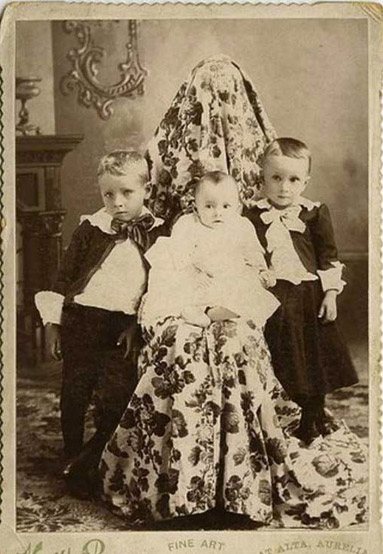
Walter Eames wanted a picture of the children, but not of his wife. He was sick of who she had become – no longer meek or mild. She seemed more confident, more aware. She certainly wasn’t the person he had married – someone he could push around all day long with nary a peep. Not like he thought he was pushy, no, never. Being assertive and decisive had gotten him to where he was at work, but it was getting him nowhere at home. Debate and compromise weren’t part of his repertoire.
But there was no way to photograph them without her. The moment she would walk away from them, they’d set up a wail worse than a tornado siren. It was ridiculous. She couldn’t even go to the bathroom without them pitching a fit. It was embarrassing to go out in public with his family, so he didn’t. Far from being a source of pride as he had expected before he got married, he now frequently left them at home and went out by himself. Even though he’d worked all day and she stayed home with the children (that one attempt at day care changed any plans they might have had of her working outside of the home), he was happy to spend even more time away. This was not turning out to be the life he’d planned as an adult.
So when it came time to get a portrait made, he had to get creative. His parents had asked to see the kids for years. He refused to make the six hour drive with her, and his parents were too frail to make the drive themselves. A portrait would have to do. He looked around the studio and his eyes landed on a backdrop. “That’ll do!” he exclaimed, and snatching it up, pushed his wife into the chair, dropped the fabric over her, arranged the kids around her, and ordered the photographer to snap away. Other than the sound of the shutter release, the room was silent. Nobody other than him could believe this was happening.

Scenes inside the Abbey

In the Abbey at St. Meinrad’s, Indiana.

A stained glass window depicting the Tree and Adam and Eve becoming the wood that was the cross that Jesus was crucified on.


I was fascinated by the bells – they rang every 15 minutes.  At the hour they went on for a long time and I made a point of going to find them.  I’d hoped to see monks pulling the cords.  Alas, that is all done by a machine.


Here are pictures of the hanging cross.  It is suspended over the altar.


Here is the black Madonna. They’ve dressed her like a queen and put a necklace on her.  The monks process as part of the service and stand and chant facing her. From their website, this is the “Shrine of Our Lady of Einsiedeln. The Black Madonna statue was a gift from Saint Meinrad’s mother abbey, Maria Einsiedeln in Switzerland, in 1954.”

The wall sconces.

The anointing oil container, which is near the reliquary.  Three different oils?   Perhaps for baptism, for healing, and for consecrating a person being ordained.


Here are further pictures of the outside of the Abbey.

Scenes at the seminary

St. Meinrad’s Archabbey has a seminary – that is part of what makes it an Archabbey, instead of just a regular abbey. Here are pictures from around and inside it.

The huge Celtic cross.


The building itself.


Some cool arches.


Around the back, not on a part of the building normally seen (there is no sidewalk here)


The chapel for the seminary students (because the one at the Archabbey isn’t big enough…)

I was amused that there is a satellite dish.  Modern technology to connect with the heavens attached to a building that is all about ancient technology to do the same.

reception


Everything else.


Message for 7-18-2016

I had a very difficult time going to sleep last night and when I finally did I had a very intense and vivid dream.

The lesson that was received was this:

It will all work out.

God is in charge.

Even though it does not currently appear so, walk towards what you think is right and the way will reveal itself.

There is a solution.

Do not remain still. Do not be immobile. All will be revealed but only if you act. Act with calmness, trusting always in God.

Listen constantly for God’s voice, especially now. Now is a time of narrow paths and deep chasms, so it is very important to listen closely.

Trust implicitly in God at this time. This is the time of winnowing. Only those who are awake will be rescued.

Be alert at all times for your call to help others. Remain a beacon of calm. Your mindfulness and centeredness is the salve for the wounds of the world. It comes from God – never forget that.

God says
I am with you.
I am acting.
Trust.
Remember.
Shalom.

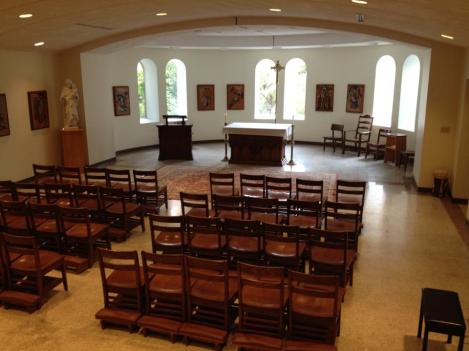
Saint Joseph’s chapel

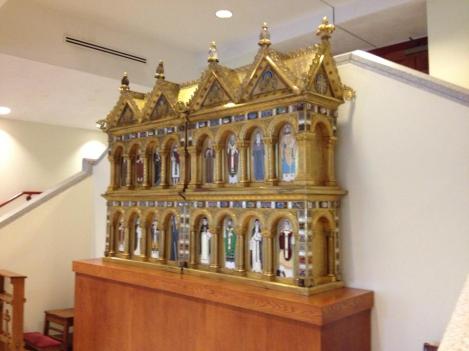
This is a small chapel at St. Meinrad’s.  While it looks very simple and humble, they’ve stored the altarpiece from the original Abbey here.  It is overwhelmingly ostentatious.  Fortunately it is at the back of the room so you don’t get distracted by it when there is a service here.

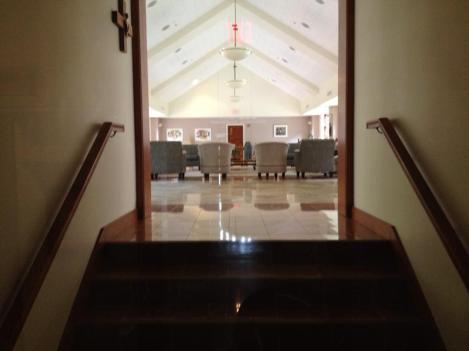
This is in the hallway on the way to the chapel. 19

This is in the chapel itself. You enter from a raised area. Interestingly to me, there was a small hand drum to the right of the chapel.  Even though it was a silent retreat, I enjoyed playing it at one point during my time there.  There was nobody else around, and I played softly, so I didn’t disturb anyone else.  This chapel is attached to the building that has the seminary, not the guest house.

1


Here is the over-the-top altarpiece.  It was removed when they renovated the Abbey to make the altar no longer attached to the back wall, but in the center of the room, among the people.  That was part of a movement after Vatican 2 that tried to make the symbols of the church match the message of the church – that Jesus is among us, not hidden away, far removed.


11


Here are some details.


Imagine how much money and effort was required to make this.  Imagine how many hungry people could have been fed with that money and effort.  While this is outwardly beautiful, it is a direct affront to the very call of Jesus.  We are specifically not to build up treasures for ourselves here – we are to take care of people.


This is to the side of the chapel. A bit of glass has broken and is now on the music and nobody else has noticed.


I wish that Protestant churches had guest houses for silent retreats so I could go there instead and I wouldn’t get so wound up about the hypocrisy of it all.  This place is beautiful, don’t get me wrong.  But only until all people are taken care of (no more homelessness, no more sickness, no more wars or poverty) can we even think about building places that are this opulent.  They are extras.  Money and effort has to go to following the instructions of Jesus first.  If more Christians followed Christ instead of Christianity, the world would be a better place.

Private places

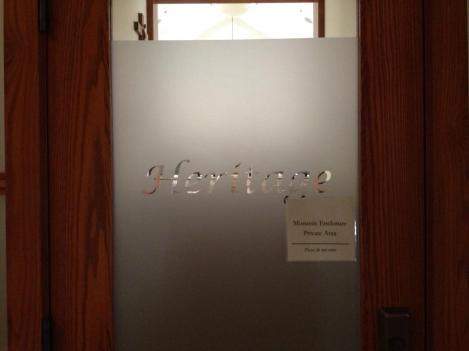
There are places at St. Meinrad’s Archabbey that are most certainly off limits.  They spell it out with signs, saying that you are not welcome in this area.


There was one area that had a sign and a frosted glass window.

chapter house 2


But there was a clear spot higher up, so I just held up my camera.

chapter house1


There is a lock on the holy oil vials, presumably to keep you from accidentally anointing yourself, or from desecrating it.  Wonder why these vials are on public display then, if they are not for public use?  To show off how pretty they are? These were prominently displayed at the center of the Abbey.

oil2


There are enclosed gardens that I wanted to explore.  I saw them on Google Maps before I went there and looked forward to going.  There were not open to lay people, however.  But there were windows, so I took pictures. I was sad to see them not even being used by the monks.  These beautiful gardens, alone, locked away, unappreciated.  Perhaps the monks stare at them from their rooms, while they are locked away from the world they are called to serve?


They even tried to block the view with signs like this.

3

But I found a way around it.  These pictures are taken through the glass.


Monasticism as it is practiced was not mentioned by Jesus at all. Living together, sharing resources, sharing lives – yes.  It is good for all to work together for the common good.  However, he did not intend that we were to separate ourselves from the world entirely.  When we work together and share what we have, we are stronger people, better able to help others.  However, when we focus all of our energy inwards to the group, we defeat the purpose of what Jesus calls us to do.


With all these signs, I was continuously reminded of the “us and them” approach the Catholic church has to life in general – either you are “in” (a Catholic) or “out” (either not Christian, or just not Catholic).  The most obvious example of this is with their approach to communion.  This exclusionary practice is not Christ-like, and will turn more people away from the message of Jesus than they could ever imagine.


Interestingly, I spent time at their “sister” community, just down the road a few months later.  The Sisters of Saint Benedict have a community in Ferdinand, IN, called Monastery Immaculate Conception.  I walked all over that place and only saw one sign saying “private”.  In fact, the nun who took us on a tour of the place told us we could sit in that area if we wanted.  I’m pretty sure I accidentally wandered into some areas I shouldn’t have, but nobody got upset with me.  Their monastery was older, a little shabbier.  It was obvious that their “brothers” got more money and better resources.  But the Sisters were far more kind and welcoming, always helpful and kind, with open smiles.

Tabouli twist

I like tabouli, but I don’t like raw onions. I also think kale has far more health benefits than parsley. This twist on an old classic delivers familiar tastes in a new way.

Ingredients
Half a large white onion. (See notes)

Half a bunch of kale (about 8 to 10 stalks) – destemmed, torn into pieces

One large tomato, seeded, cut into bite-size pieces (just use the fleshy parts)

½ teaspoon seasoning salt

Lemon juice to taste (at least a tablespoon)

Olive oil for sautéing

Method
Julienne the onion and sauté it in the olive oil. Add seasoning salt (I use “Aunt Cora’s”). Stir often, cooking it until the onion pieces are translucent but still firm. Do not caramelize or wilt them.

Meanwhile, steam the kale. About 5 minutes in, stir it with a fork to further reduce its size.

Remove half the onion to use later. (see notes) and add the tomatoes and kale.

Add lemon juice. Stir frequently. Do not let the tomatoes get mushy.

Notes
I find it easier to cook the entire onion and save off half of it for another use. Store in the refrigerator and use within 4 days.

Serve with couscous. (I find Near East brand very good – tasty, and simple to make)
Makes four servings.

St. Meinrad guest house

St. Meinrad Archabbey is in St. Meinrad, Indiana.  It is a Benedictine monastery and seminary.  The Benedictines have as part of their Rule to serve the guest as if he (or she) is Christ, so they always have guest houses that are quite nice to stay in .  They are good for going on retreats.

Here are some pictures from the guest house there.

The guest house itself, as seen on the way back from the Abbey.

guest house

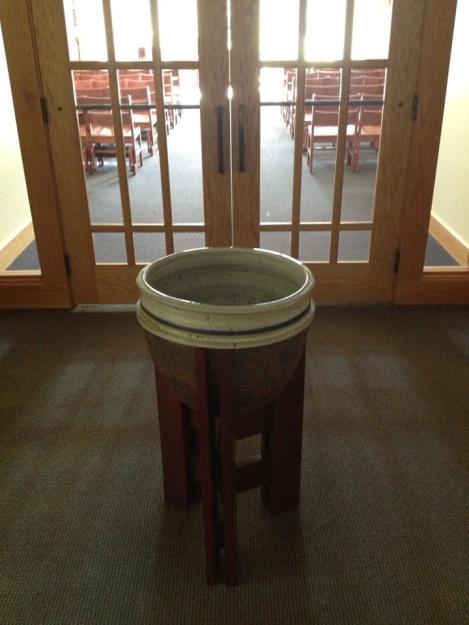
The baptism font is outside of the doors of the chapel. This is right in front of you when you exit the dormitory area.

gh font

At the back of the chapel (in line with the font) is this unusual crucifix.  It looks like Jesus needs a chiropractor.

cross2cross1

(Edit to add – I looked up why his head is tilted, and learned from the website Reachparadise.com that crucifixes “…that show His head tilted slightly down (or up) and to the right are taking some artistic liberties. The right hand, in Christian faith, is the hand of blessing. Since Jesus chose to sacrifice Himself for our sins, He, in turn, gave us the ultimate blessing. This is why His head faces right in some crucifixes – to show that His death is a blessing for all of us.” It goes on to say that other reasons include “One stated that Jesus was facing the good thief, whom He saved before dying. The other said it was to reinforce that Jesus is seated at the right hand of the Father.”

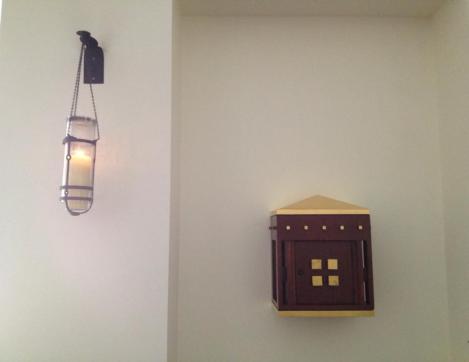
On the right side is the eternal flame signifying the presence of Jesus, and the aubrey, which holds the reserved sacrament (blessed communion wafers).

aumbrey2candleaumbrey

To the left is the paschal candle.

gh chapel 2

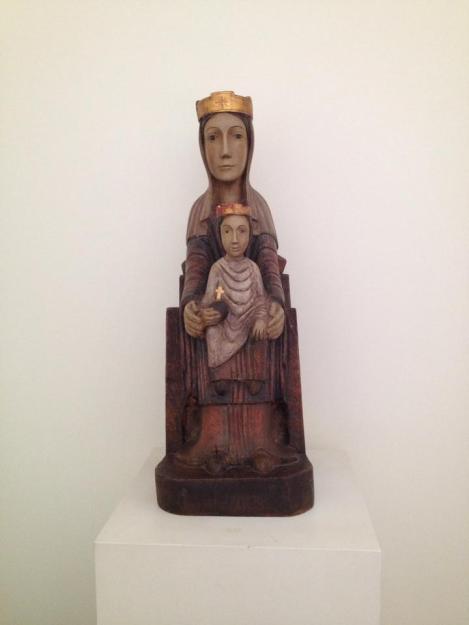
And a carved wooden statue of Mary and Jesus.

gh chapel


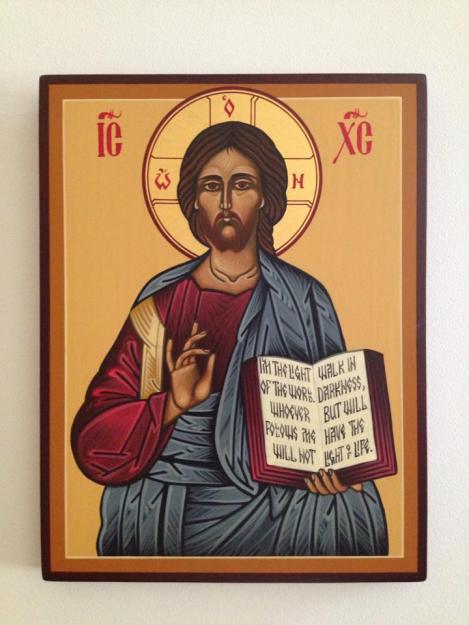
Near the front is an icon of Christ.jesus


We had a room there that had supplies for us to work with while we were there.  There were coloring books, pens, paints, magazines, juggling balls and scarves, and jigsaw puzzles.  I was amused that the one that people pulled out to work on was one of a huge cathedral.  It was impossible for one person to do it all in the time we were there, so we all took turns (without discussing it, because it was a silent retreat) to work on it.  We were working together to build the church in many different ways.  jigsaw2jigsaw1jigsaw 3


Brother Maurus, our host and liaison, made sure to put out wine for us at dinner.  wine


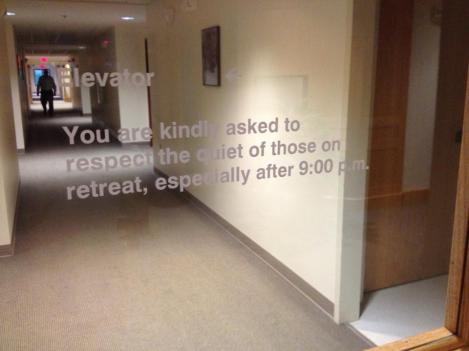
The sign on the door to the dormitory, reminding people to be mindful of others who were there.  Not everyone who goes there is on silent retreat. quiet

Spiced carrots

Ingredients
5 large carrots, julienne-cut
2 tsp cumin powder, divided
2 tsp curry powder, divided
¼ cup parsley flakes, crushed just before use
An inch of butter, divided

Method
Steam the carrots until they are medium-soft. You don’t want them mushy, but you also don’t want them so firm that they won’t absorb the flavor.

While they are steaming, prep a large glass or ceramic bowl. Put half the butter in the bottom, thinly sliced. (You want it to melt quickly.) Add half the cumin and curry powders evenly over the bottom of the bowl.

When the carrots are done, pour them into the prepared bowl and immediately put a cover over it. I used a plate, upside-down. It is ideal if there is a 1 to 2 inch space between the carrots and the cover. This will use the heat of the carrots to melt the butter.

After about 5 minutes, toss the mixture in the bowl and add the rest of the butter and spices, including the parsley. Work quickly to retain the heat. Put the cover back on. Let sit at least another 5 minutes.

Serve immediately, or you can refrigerate and serve the next day, when the flavors are even better.

Makes 4 servings.