Prejudice

In the same way that children learn prejudice, they can unlearn it.

Many years ago, I was at a Balinese shadow puppet performance at the Smithsonian. We were all sitting on the floor. A nearby child noticed that one of the male performers was wearing a skirt. The child was a young boy, probably about seven years old. He and I had worked up a rapport, having talked about the event. It was a pretty exciting show. All the performers were wearing long flowing clothes in rich fabrics. The headdresses alone were pretty off the charts, with all the gold and wires and wiggling bits.

The child looked at me and he said “A man wearing a skirt? That’s weird!” This child wasn’t even my child and yet I felt an obligation to help. I said that women couldn’t even wear pants just 50 years ago, and in Biblical times nobody wore pants. What is normal now isn’t always normal. Normal changes. Plus, there is also the idea of men wearing kilts in Scotland.

It was awesome to watch his head expand. His limited understanding of the world just got bigger.

I also know a child who saw a spider outside and it attempted to kill it. I pointed out that the spider was supposed to be outside. Outside is the home of spiders and so it is okay to leave it alone. She looked at me funny, but then she understood. She had learned somewhere else that spiders were bad and the spiders should be killed but I taught her otherwise. If they are outside don’t kill them.

Prejudices are simply limited understandings. They are simply the result of not having enough information.

This is how all of us learned what we learned. We were given just enough information to get us going, and then left to figure out the rest. Hopefully we fill in the rest with good stuff. If we don’t, it is up to teachers to help us out. Teachers come in all varieties. You can be a teacher, and you don’t even need a certificate. If you come across someone with a limited understanding, it is important to teach them a different way of thinking, to fill in the gaps.

I have a friend who is white. She was walking with a little girl who also was white, whom she had just met. The little girl told her a story about someone in school who was mean to her. That someone happened to be black. The girl generalized and said “Black people are so mean.”

My friend was very upset by this and told her about her nephew who is half black and said not all black people are mean. She was a bit distraught about this whole exchange hours later. She thought it was tragic. She couldn’t believe that prejudice still exists these days.

It wasn’t tragic. It was an important moment to teach this child to see things in a bigger way. Our job as adults is to teach them that not everything they know is everything there is. Our job as adults is to expand their understanding. We are supposed to be teaching them to open up their minds and to understand that the world is a lot bigger place than they think.

If you are cooking on the stove and you burn your thumb you may think that the stove is a dangerous thing, but if you have a good teacher with you she will explain how not to get hurt. Then you will start to cook again.

The same is true with people, and cultures, and insects, and anything. If you get hurt once you may generalize and think that is always the way it is. If you have a good teacher with you, you’ll learn how to interact with that person, that culture, that insect, and you will learn that not everything will hurt you.

Our job as teachers is to help children learn to establish boundaries and also how to break boundaries down.

The best part? You can be a teacher and not even be in the classroom. The whole world is your classroom, and teachable moments can happen anytime.

It isn’t sad that this child thought the way she did. This is just part of being a child. She has generalized, like we all do. The sad part would have been to not use that moment as an opportunity.

Many names of God

When Muslims pray the 99 names of God they don’t believe that there are 99 different gods. They believe that there are 99 different attributes of God. God has many names but is still one God.

It is kind of like me. I am Betsy, but legally I am Elizabeth. To my husband I am his wife, to my coworkers I am their coworker, to my friends I am their friend. I am always me, but other people have different ways of interacting with me and know me in different ways. It depends on how they see me as to how they refer to me.

God is the same. “God” is just a descriptive, after all, not a name. In the Bible, God uses the name “I AM”. God is known as Elohim, as Jehovah, as Lord, as the Almighty, the Creator… the list goes on and on.

While there are different names for God, we are still talking about the same God that created the Earth, spoke to Abraham, and was made known on Earth as Jesus.

I’m not so sure if people are talking about the same God when they refer to Spirit.

I know a lot of people who are disillusioned with church and have left. They seem to like parts of it but not all of it. I get that. I left church too.

Some of them like the ritual. Some like the community. Some like the hymns. They are creating their own version of “church” with the pieces they like, but leaving out the pieces they don’t.

They are having circles where people talk about what is important to them, or they paint, or they drum, or they recite poetry.

I get that too.

But I’m strongly opposed to them calling it “church” if Jesus isn’t present. If they don’t read the Word of God and they don’t celebrate Communion, then why call it church? It is more coffeehouse gathering than church.

Let us call things by their true names. Let us not deceive ourselves and say that we are going to “church” when Jesus isn’t present. The same is true of the “mega churches” with their “Prosperity Gospel”.

Things evolve, of course. I left a medieval reenactment group because it stopped being a medieval reenactment group. Years ago, people who were thinking about joining asked if they could dress up like fairies and vampires, and the members told them no. They said that had nothing to do with the group. The focus of the group was “A day in the life of a European court.” The time period was pre-1500s. But then slowly it became more and more “early period” with more and more people showing up in shapeless garments with animal skins tied around them. Then, the Middle-Eastern re-enactors started showing up.

Now this group looks nothing like what it looked like when I joined. It has stopped being “A day in the life of a European court” and started being a “come as you want to be” party. When will the Klingons and the Silurians show up?

I’m all for everyone feeling welcome and included. I like the idea of “All are welcome” and “radical inclusion”. But I feel like at some point a line has to be drawn. Are we talking about the same thing? Are we still on the same page?

Hummus has a few basic things that make it hummus – garbanzo beans, oil, citrus juice, and tahini, all blended up in a food processor. While you can exchange black beans for garbanzo beans, and you can use lime juice instead of the traditional lemon juice, that is as far as you can go. After that, it stops being hummus. You can’t put apples in a blender and call it hummus. You can’t add tahini to a pot roast and call it hummus. There are certain things that you must have, and if you don’t have them, you don’t have hummus.

Church is the same way. You can strip away the ritual and the hymns and it is still church. You don’t even have to gather together in person – you could have a videoconference. You can add in dance, or painting. You don’t need musical instruments, or you can have a whole symphony.

But you have to have God, and you have to have Jesus, for it to be church. And they can’t be implied or guessed at. There has to be no doubt about it.

What about “the Goddess”?

While I’m fine with the idea of the many sides of God being welcomed and included, actually including the idea of the “Goddess” is totally not acceptable in church. Remember “Thou shalt have no other gods before me”? That is a big one. To worship the “Goddess” is a complete violation of that commandment.

God has many aspects, not all of them related to gender. You can be a feminist and still worship God. But the Goddess isn’t God – she is another thing entirely. If you want to worship the Goddess, fine. That is your choice. But then it isn’t church. It is something else. To call it church is deceiving to yourself and others.

So what about those names of God? At what point does God stop being God? At what point are you worshipping something else? At what point are you not in a worship service at all?

These are important questions to ask yourself.

Addresses?

Am I the only person who needs an address when being invited to an event?

I don’t know if it is a Nashville thing, or a Southern thing, or just a thoughtless thing, but I keep seeing invitations to events and they tell the name of the place but not the address.

There was a medieval group I belonged to that had its meetings “at the Shoney’s near Opryland.” This was the information on the group’s website, open to members and nonmembers. That line tells me nothing. I had never been to Opryland. I didn’t know where it was in relation to where I live, and I certainly didn’t know where the Shoney’s was in relation to that. I understand that Opryland is huge, so the Shoney’s could be anywhere around there. I finally figured it out by going to the Shoney’s website, looking up the addresses of all the Shoney’s in Nashville, then looking up the address of Opryland and comparing.

Is it so hard to put the street address?

Think of how many people might have been interested in joining this group who didn’t because they didn’t know where to meet. Then, once the person is inside the Shoney’s, where do they go? Further directions need to state something like “In the group meeting room” or “ask for the SCA group”.

Don’t assume. If people knew where you were meeting, they wouldn’t need to look it up on the website.

In Nashville, they often tell you where something is by the name of the building and not the address. “The concert is at the War Memorial Building”. This is useless. It might be at “Citizen’s Plaza” or “The TPAC building”. Lots of buildings downtown have names apparently. They also have addresses, but event organizers never share them.

If you want more people to go to your event, give as much information as possible. Assume your audience isn’t from around there. Think about it from their perspective. Sure, you are in the middle of this event and you know all about it, but they don’t. If you want it to be a success, share as much as possible. Oversharing is better than undersharing.

Tell the exact street address. Don’t just give a name of the site. Give that too, but not just that. Provide a map if possible.

Tell what the age range is. Are children allowed? If it is adults only, do you have babysitting arranged on site? It is only for children?

Is there a fee? How much? What payment forms are allowed? If you only take cash, tell that. Plenty of people don’t carry cash these days.

When will it start and end?

Is there a form that participants will need to print out and bring with them?

Are there any special things that participants need to bring – food, musical instruments, chairs?

You will avoid a lot of frustration if you tell people as much as you can. Assume (correctly) that they know nothing about what you are planning, and share it. Sure, there is only so much you can put on a flyer. You could put a link on your flyer, but not everybody has access to the internet all the time. Take the time and the space and put as much as you can on there. And give a contact phone number and a name.

If you don’t have enough information on your event page, you might as well not have the event.

Communion loaves and fishes

The Last Supper, the model for our Communion service, is linked to when Jesus fed the multitudes. This event happened twice.

Here, he feeds over 5,000 people, using five loaves and two fish. There were twelve baskets of leftovers. The story starts just after Jesus has heard that his cousin John the Baptist has been murdered.

Matthew 14:13-21
13 When Jesus heard about it, He withdrew from there by boat to a remote place to be alone. When the crowds heard this, they followed Him on foot from the towns. 14 As He stepped ashore, He saw a huge crowd, felt compassion for them, and healed their sick.
15 When evening came, the disciples approached Him and said, “This place is a wilderness, and it is already late. Send the crowds away so they can go into the villages and buy food for themselves.”
16 “They don’t need to go away,” Jesus told them. “You give them something to eat.”
17 “But we only have five loaves and two fish here,” they said to Him.
18 “Bring them here to Me,” He said. 19 Then He commanded the crowds to sit down on the grass. He took the five loaves and the two fish, and looking up to heaven, He blessed them. He broke the loaves and gave them to the disciples, and the disciples gave them to the crowds. 20 Everyone ate and was filled. Then they picked up 12 baskets full of leftover pieces! 21 Now those who ate were about 5,000 men, besides women and children.

Shortly after that, he feeds over four thousand people, using seven loaves and a few small fish. There were seven baskets left over.

Matthew 15: 29-39
29 Moving on from there, Jesus passed along the Sea of Galilee. He went up on a mountain and sat there, 30 and large crowds came to Him, having with them the lame, the blind, the deformed, those unable to speak, and many others. They put them at His feet, and He healed them. 31 So the crowd was amazed when they saw those unable to speak talking, the deformed restored, the lame walking, and the blind seeing. And they gave glory to the God of Israel.
32 Now Jesus summoned His disciples and said, “I have compassion on the crowd, because they’ve already stayed with Me three days and have nothing to eat. I don’t want to send them away hungry; otherwise they might collapse on the way.”
33 The disciples said to Him, “Where could we get enough bread in this desolate place to fill such a crowd?”
34 “How many loaves do you have?” Jesus asked them.
“Seven,” they said, “and a few small fish.”
35 After commanding the crowd to sit down on the ground, 36 He took the seven loaves and the fish, and He gave thanks, broke them, and kept on giving them to the disciples, and the disciples gave them to the crowds. 37 They all ate and were filled. Then they collected the leftover pieces—seven large baskets full. 38 Now those who ate were 4,000 men, besides women and children. 39 After dismissing the crowds, He got into the boat and went to the region of Magadan.

What are the common elements in this story? Jesus takes what he has, little though it is. He doesn’t pray for more. He gives thanks for what he has and blesses it. Then he breaks it and distributes it.

This is what happens to us when we become part of the Body of Christ, and what we are supposed to do. It is something we receive and something we are to give.

We aren’t enough for the task. We are small and weak. We are broken. Yet God loves us, and is thankful for us. We are blessed by Jesus. And through that thankfulness and that blessing, we are enough. We are exactly what the world needs. We are food for a hungry world.

We are to take that thankfulness and that blessing and multiply it through our actions and our lives.

This is what Communion is. It feeds us, and through that, we are able to feed the world. We are able to be the healing the world needs, because we have been healed.

To create a book. Thoughts.

I’m having debates in my head about how to do the book and if I’m ready to publish. I realize now that I’ve already said it several times – it is already written, I don’t need to add more.

I’m still writing more, and I can and will always write more. I have finally realized that I can publish the new stuff later. I can republish old stuff and put it with new stuff if I find I’m writing a lot on one theme – like Communion, for instance. This book is a taste, a start, a beginning.

I’m weary and I worry about going through editing. But then I remember the only thing to it is to do it. Just start.

Also, then I remember the Jewish idea of the yetzer hara – knowing about it is helpful. I’m seeing all these distractions as a sign that I’m on to something good. It is a sign now, when I stop to notice it playing this game on me.

Just like how a child learns “this” feeling is a sign to go to the bathroom – “this” feeling of being distracted is a sign that outside influences are messing with me, trying to stop me from doing what I’m being called to do, what I’m made for. Sounds paranoid? It isn’t. It is actually very healthy. The idea of the yetzer hara isn’t mine, and it isn’t new. It was very freeing to learn about it. I’ve written about it many times before. It is an indicator to me now. I’ve transformed it from being a stumbling block into a steppingstone.

The idea of the yetzer hara needs to be introduced in mental hospitals. Heck, it needs to be introduced to people before they get into mental hospitals.

So the more I write about writing, the more I’m not putting my book together. See, it is a game, a distraction. This is all part of being human. I still feel a need to publish something every day. It is a way to stretch and clean out my head. But I need to use this unintended vacation time (the library is closed for remodeling) to work on my book, as I’ve said all along.

Perhaps there is a good reason I found out that Internet Explorer isn’t to be trusted. I was using it and Chrome to work on the book. I had my main blog open on Chrome, and I had the Empty Cross Community blog open on IE. I’d post from one to the other, and check to make sure I’d not already posted something. I created the second blog just to create file folders for my book. My first book. Which is already written, mostly. I’ve not added anything new to Empty Cross Community that isn’t already in BetsyBeadhead. It is just more focused – just the religious stuff. No rambles, no pictures.

I found out that IE is highly suspect, so I stopped using it. It is impossible to look at two WordPress sites using the same browser – I can’t log into both and look at both. It thinks I’m “BetsyBeadhead” when I’m on “EmptyCrossCommunity”. It won’t let me post to it. So I had to stop. I’m starting to see this as a good thing – it has created a stopping point. Start on the next part of the project. Stop adding to it. Start formatting.

Time to get going. Wish me luck, and say a prayer if you are the praying type. Pray that my words are of use to people, that they lead them towards God, and towards healing.

Father’s Day, 2014. Eulogy, epiphany

Here’s to all the fathers –
Those who are here, and those who aren’t.
Those who show up every day, and those who were never there.
Those who abandoned us, and those who have died.

They have made us who we are.

It doesn’t take a license to be a father. There is no training for it. Fatherhood can be done by amateurs, and often is. Even having had other children doesn’t prepare you for having more. Every time is a new time, with new challenges.

I had an uneasy relationship with my father. He was emotionally distant. He hadn’t been nurtured by his parents, and he didn’t know how to nurture his children. Is this an excuse? Is this an explanation? Or is it just the way it is?

There are plenty of guys who left when they found out they were going to be fathers. Some stayed, but only half-heartedly. Some initially wanted to be fathers, but found out they weren’t up to the task.

Let us forgive them all. Not excuse them. Forgive them.

The best thing I ever was able to do was to forgive my father. He never knew about that bit of grace that happened that day. Shortly before he unexpectedly died, I finally saw him as just a person, and not my Dad. He didn’t owe me anything. There were no expectations to be unmet. There were no promise to be broken. I saw him as broken and sad and hurting. I finally realized he had done the best he could, with what tools he had.

I’m grateful to have gotten to that point. It took a lot of work.

I’d realized years before that if I wanted to have a relationship with my father, I was going to have to find something we could both do together. He seemed unable to connect with me, so I had to make the effort. Eating out seemed to be the way. We would meet for Sunday brunch at Ruby Tuesday’s, or Bob Evan’s. Every Sunday I would go to church alone, and then come back home and we would go together out to eat.

It was his choice to not go to church, even though he was an ordained minister, even though the church I went to was the one he had gotten married in. It was kind of an awkward routine on Sundays. It would have been easier if we had gone to church together and then to brunch afterwards, but that wasn’t going to happen. I took what I could get.

He didn’t come up with the idea of us eating out together, I did. I saw it as a point of agreement, something we could both enjoy. His other interest was classical music, and that wasn’t really something we could meet on. I didn’t love it like he did, and he would always be the expert on it. We wouldn’t have been on equal ground.

When we ate out, it was our time together, just us. It wasn’t always easy. He was a sloppy eater, a bit greedy. I remember when we would eat at home he would finish his food first and then look at my plate and ask to finish it for me. I ate slowly, carefully. He ate ravenously, like a dog. He was willing to take food from his child. This pattern happened in other areas of my life too.

This is who he was. This is how he was raised. He wasn’t allowed to grow up true and strong. His parents were either overbearing (his dad) or flighty (his mom). There was no healthy role model. It was military precision and perfection, or playtime. He never had a childhood, not really. His dreams were squashed as being unreasonable and unrealistic.

One day, over a mid-day breakfast of pancakes and sausage, it clicked. I stopped seeing him as somebody who owed me a good childhood. I stopped seeing how he had failed me. I stopped expecting anything from him. I started seeing him as just a person.

He died twenty years ago. There was no more time to work on our relationship. There was no more time to rebuild it. I was grateful that I’d had that epiphany while he was still alive. I was grateful that I’d had all those Sunday brunches with him to build up to that point. I wanted more. I wanted to rediscover my Dad as a person, but there wasn’t time. He died unexpectedly, just six weeks after Mom died.

My brother never made the time to get to know Dad as a person. That is his fault. That is his loss. He’d threatened to kill Dad when he was 17, and the relationship had never gotten better. Dad’s will reflected that. My brother blamed Dad for the bad relationship, but it takes two to have a good one. And Dad didn’t threaten to kill his son.

My brother insisted on an etching as part of the estate. It was of “The Prodigal Son” by Rembrandt.

It was worth a lot of money. It was worth nothing. It was a piece of paper.

I had the “returning” in reality, because I’d worked on it. In the story, the son returns, and the father welcomes him. But my brother hadn’t worked on it, hadn’t returned. He had the image, but not what it represents. It is sad, but not tragic. Perhaps he thought he’d have more time. Perhaps he didn’t think about it at all.

When Dad died suddenly, there was no more time to work on the relationship. Tomorrow is never guaranteed. We didn’t know he was that ill. In a way, it wasn’t a surprise – he’d never taken care of himself. He smoked two packs a day. He never exercised. He ate whatever he wanted and it was never fresh.

Relationships transform after death. I’ve come to see that every time I think about him, he’s thinking about me. People who die don’t leave, so much as change state.

Death is freeing – a person is not limited to the body anymore. Your loved one is always with you.

There is a time of transition, surely. There is grief, and acceptance, and anger. There is a time of growth and deepening after that. It isn’t all pain.

Our society doesn’t teach us how to deal with death and grief. It doesn’t teach us how to transform it. It doesn’t teach us the other side of it.

Here it is –

After death, you can ask your Dad anything and he will answer. He is part of you now, just like you were always part of him. All of your ancestors are with you now – even the ones that you never met, even the ones that you don’t even know the name of. Your presence is the sum result of all their efforts. You are the end of the relay race. The baton has been handed to you. They passed on their genes, their knowledge, their fears and hopes – to you.

They are all with you, now.

Death isn’t an end. It is just a beginning.

My Dad.
Dad

Deer Yeshua

So I bought this bit of artwork. And I made it into something else.

I didn’t think to take a picture of it when I started, so here is a picture of it after the first day.

2

It said “Yeshuaddix!” in spraypaint.
Yeshua Addix.
Addicts.
Jesus freaks.

I’m for Jesus, certainly. This is a little weird, even for me. But I like a nearly free canvas. It was on sale at Thrift Smart, and I had a Groupon. This two foot by three foot “painting” cost me $6. I had no compunctions about painting over it. It isn’t a masterpiece by any stretch.

I don’t have (I don’t make) enough time to paint every day. I steal away a bit here and there. I decided to mess around with this canvas and see what happened. I practice “blob” art. I put a bit of paint straight from the tube onto the canvas. I put another color, and another, then I swirl it around with my fingers. It releases my inner three year old. Pretty fabulous, actually.

It is hard to wrench myself away and become a responsible 45 year old, but I have to. It pays the bills.

Here’s a closer shot of a really interesting bit.
3

Then I finished it.
3a

I left two lines of the silver spraypaint – one slightly obscured – to remind me of the underpainting.

I just enjoyed putting the paint on the canvas. I enjoyed the playtime. It doesn’t have a theme or a goal.

I posted my blog post about “Blob Art” on the Facebook page of a creative group I belong to, and one member wanted an example of what I meant by “Blob Art”. I took a picture of this and posted it.

Her comment was “Looks like an aerial view of a deer by a tree. Were you seeing that?”

Nope. Not at all. I like that she saw that, and it proves my point. People see what they want to see. All art, whether representational or abstract, changes meaning when it leaves the hands of the artist.

So this is Deer Yeshua, like Dear Jesus, or Dear John.

WordPress turned the first two pictures sideways, in spite of my best efforts. It does what it does. Feel free to pick up your monitor and turn it to compensate.

Not for sale paintings/collages

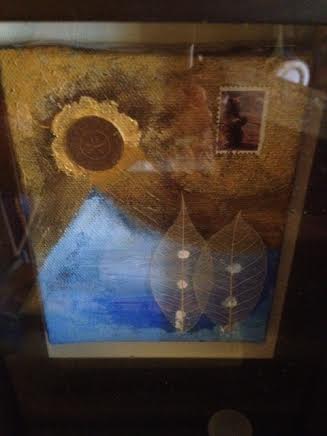
Marriage feast. Acrylic, leaf skeletons, Buddhist coin (in painting), foreign stamp with a bear on it, English sixpence coin I wore in my shoe when I got married (loose in the shadowbox). The canvas is glued to the backing of a shadowbox. Canvas is about 4 x 5. Impressions of honeymoon on Grandfather Mountain.

11

A different view – the glass is hard on the camera.

12

Flight. Acrylic, stamp from Zaire showing DaVinci’s flying machines, leaf skeleton, Canadian coin with a bird, cut out corner of a Visa card with bird hologram. Framed – original canvas was 5 x 7

10

Paintings and collages, posted 6-13-14

Early morning behind the rock, on the planet Graille. (a picture is worth a thousand words series) Acrylic on canvas, 16 x 20
19

Swimming. Silver and aqua acrylic paint on canvas. 8 X 10

18

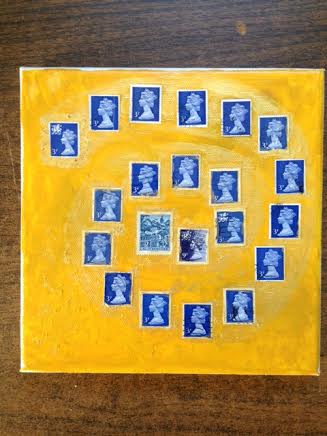
Yellow queen. Acrylic paint, English stamps of the Queen facing left with one Austrian one of a dragon facing right, in a gold spiral path. On 8 X 8 canvas.

16

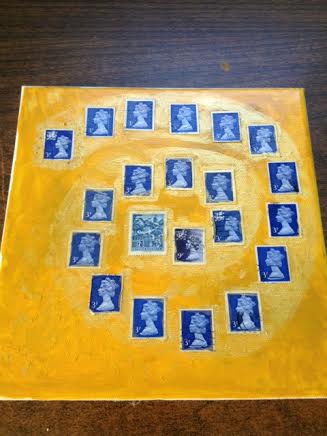
Angled view of the above, to show the gold.

17

Luggage. Stamps and money from around the world, with Chinese fortunes. Acrylic paint on 5 x 7 canvas, with decoupage glue.

15

Mid afternoon rain on the planet Graille (a picture is worth a thousand words series) Acrylic on 11 x 14 canvas

14

Angry eye. Acrylic on 11 x 14 canvas

13

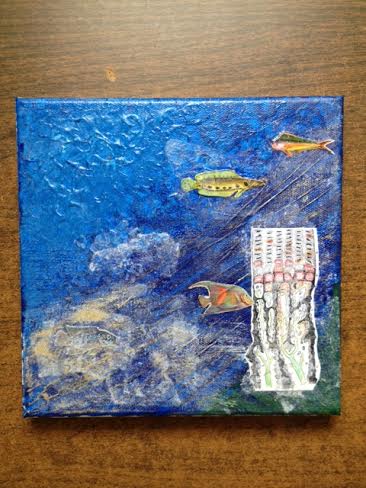
Underwater rabbit fish. Acrylic, photocopy of a cross section of rabbit bone, water color pencils, cut out fish stamps, tissue paper, gold pastel, decoupage glue, canvas 8 x 8

8

Side angle of the same.

9

Leaves in water. Acrylic, gold foil, real leaf skeletons, decoupage glue, canvas 8 x 10

6

Sunset clouds. Acrylic on 5 x 5 thick canvas, sides painted as part of the design as well.

4

A side view.

5

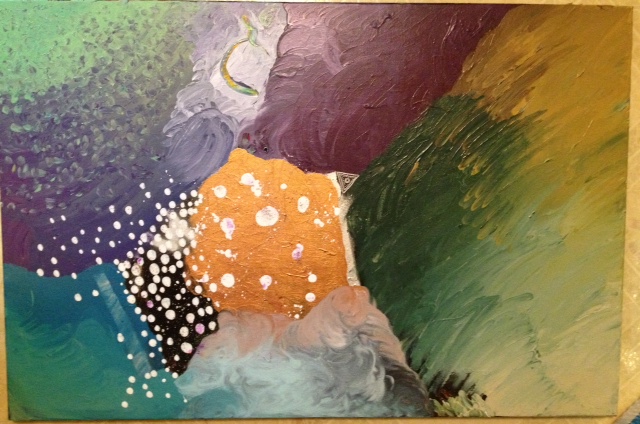
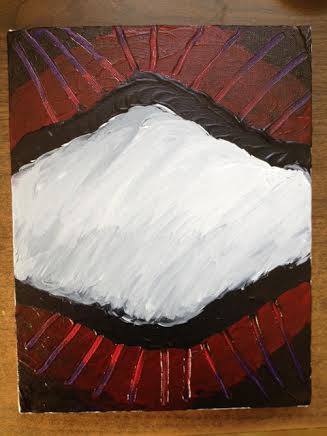
Deer Yeshua (see separate post explaining name) Acrylic, silver sharpie on 24 x 36 canvas
3a

All of these are available for sale. Please write a comment for more information.

People control – on school violence and gender roles

We don’t need gun control, so much as people control.

If you ban guns, then only the people who obey laws will not have guns. The people who don’t obey laws will have as many as they want. They are the ones who kill people anyway.

We need to address why people, especially young boys, are killing other people.

We need to address the rage and powerlessness that young boys are feeling and counter that. They kill to make themselves seen and heard. Address that in a healthy way, early on, and they won’t feel a need to kill.

We have to address the sense of hopelessness and alienation they feel.

When boys are told to not cry, to “be a man”, they are not allowed to be in touch with their softer sides. They are molded into an unnatural shape, like a bonsai tree. But unlike a bonsai tree, they aren’t shaped into anything beautiful, but warped.

If a boy acts in any way other than the traditionally masculine role he is seen as either gay or a girl. He is emasculated by his peers. He is a “pussy” or a “fag” or “has no balls”. A guy who is caring, who is considerate, who is loving, is seen as not a guy. This is unhealthy and damaging to him as a person.

The only way that guys are allowed to express themselves is through being physically aggressive. So is it any surprise that they become violent, and the only way they feel that they can be seen and heard is to use violence? Gun violence is the most extreme form of “acting out,” but it is still in line with being a guy.

First, we must drop all the “rules” about what it means to be male.

Our society has really started to raise its collective consciousness about women’s rights and roles, but we’ve failed the boys. We tell women that they can be anything they want to be but we don’t say the same thing to boys. We tell women that they can be doctors or lawyers or mechanics, but we don’t support boys who want to be dancers or artists or stay-at-home-Dads.

Sure, they can be, but at a loss to their masculinity. Sure, they can be, but they run the risk of being seen as not male. In American society, that is the same as not being a person.

When a woman has a job that is seen as being traditionally “male”, she is a groundbreaker. When a man has a job that is seen as traditionally “female”, he is seen as not being a man. For a woman, it is a step up. For a man, it is a step down.

Let’s drop the “rules” for what defines someone as “male” or “female” and start thinking about what it means to be a person. Let’s focus on character and compassion instead. Let us let people be people, and not gender.

Let us also teach everybody – boys and girls together, as many ways to express their emotions and needs. Humans need connection. We are not solitary beings. We have to communicate with each other. But not all of us are good at communicating with words. We all need to learn different “languages” – of art, of dance, of music. We all need to learn as many ways as possible to “get it out” of ourselves. Bottled up feelings tend to bubble over in unpleasant ways.

Remember how frustrated a small child gets when something isn’t right? He wails and whines and fusses. He’s hungry, or tired, or something hurts, or he needs something that isn’t there. His frustration grows and grows until someone figures out what is wrong and fixes it. Sometimes a parent will say “Use your words” to remind him that he has to communicate his needs. Then he has to slow down and think about what it is that he needs so he can express it. Then the parent can help.

But what if he doesn’t know what is wrong? Or what if he hasn’t been taught the words?

There is a trend these days to teach sign language to infants. They are taught a gestural language because it is easier for them than speech at that point. The frustration level is reduced dramatically. Instead of guessing what is wrong, the parent knows because the child has said it with gestures.

But what if you are older? What if you know a lot of words? And what if they still aren’t enough?

I believe that this, along with the rigidity of the masculine gender role, is the heart of the problem. I believe that everybody needs to learn how to express themselves in multiple “languages”. Bring back art programs. Bring back music in the school. Let everybody take a turn at theatre. Or gardening. Or cooking, or sewing, for instance. Everybody needs to learn the skills necessary for life, for being an independent person, anyway.

I also believe that everybody needs to get moving. Lack of physical exercise results in too much pent up energy.

We can turn this around. We can’t wait for the government to do it, or the school systems. It will take too long for the committees to study it. Every person who cares for a young person is responsible for this change. Anything counts. We can’t do it all, and we certainly can’t do it all at once. But we have to start.

Go to the library for ideas. Check with the Y, or the community center. Get moving, get creating on your own. Think it costs too much? It is cheaper than a coffin.

The life you save will be that of your young friend and twenty random strangers.