Forgiving Fred.

Fred Phelps has died. He was the leader of the Westboro group. They weren’t Baptist, and they weren’t a church. Not really. They were an organized group of haters. They showed up at military and high publicity funerals to protest gay people, even if the person who died was straight.

Among Jesus’ last words were “Forgive them Father, for they know not what they do.” Let us forgive Fred and his followers.

We cannot become like Fred Phelps or his followers. If we do, they have won. To hope that he “rots in hell” or to desire to “piss on his grave” is to let his brand of hate to take over.

This is about really knowing the message of Jesus. This is about knowing that the message is about forgiveness and love. It is about showing that same forgiveness and love that is shown to us through Jesus to others

Why would people want to become Christian if the face of Christianity is Fred Phelps and his group? Why would they want to become part of the Body of Christ when it looks like it is only used to attack others?

This Body was created to heal, not hurt. Our hands are meant for feeding and clothing others, not for holding picket signs. Our fingers were not made for pointing.

Imagine if this group had used its resources to mobilize their members to go to flood areas and other natural disasters to help out. They could have used their powers for good. Imagine if they’d used their money and time to teach people how to read or how to eat healthy food

We, as members of the Body of Christ, are held to a higher standard. We must forgive him. To forgive is not to condone.

We must remember that he was not acting alone. When we talk about how bad he was, we have to remember that it wasn’t just one man who showed up with a picket sign.

We talk about how bad Hitler was, but we forget that it was thousands of his followers that did the dirty work. We talk about Osama bin Laden, but we forget he wasn’t the one who was bombing and killing. Both of them were just giving the orders and others were just carrying them out.

If we are filled with hate towards Fred Phelps, we are one of his followers as surely as they were.

The bad thing is that there are plenty of people who call themselves Christian who agree with the Westboro group’s motives, if not their methods. They think that the purpose of Christians is to tell off other people and to have them live by a certain narrow set of rules.

They don’t remember that Jesus, in John 8:7, when he came across a group that was going to stone an adulterers, said “Let him who is without sin among you be the first to throw a stone at her.” Jesus doesn’t condemn her, or anybody else. Neither should we. They don’t remember that Jesus paid for all sins, for everybody, across time, by his death on the cross. We aren’t sinners, none of us. That debt is paid.

We can’t condemn even those who condemn others. Even Fred Phelps and his followers. We have to love them, because they need it the most. We have to show them love. We have to show them how to love by being loving to them.

Forgive them. Be the face of love to them. We must teach them who Jesus really is by being Jesus to them. Jesus is love. Thus, we should be too.
Who is the dummy? – on boundaries.

Who is the dummy? If Jane asks Bob for ten dollars every day, and Bob gives it to her happily, then there is no problem. If he resents her asking but says nothing, then she isn’t in the wrong, he is. He’s the dummy.

Whatever someone wants from you – time, energy, money, whatever, if it is a burden for you, you must say no.

Consider if someone shows up to your house unexpected. They ask if they can come in. You are tired after a long day and you are about to go to bed. You don’t want to stay up entertaining them. You have to work early tomorrow morning. Do you let them in?

What if they want to stay in your house overnight? Or for a week? Or for a month? Or a year? Or forever?

Where do you draw the line?

At what point do your own needs come into play? If you do not stand up for yourself, who will?

I know several people who if they don’t respond to a text message immediately, their friend or relative will start to freak out. They will send another text. They will call. They will contact another person to check up on them. This is their normal behavior.

But the friend or relative isn’t the dummy. They haven’t been told “no” in a way that they understand. Perhaps they haven’t been told “no” at all.
It is up to each of us to establish boundaries of what is OK and what isn’t.

Now, here’s the funny bit – the other person can establish their own boundaries too. There is a lady at work who wears a really strong scented lotion. It triggers my asthma. The smell is so strong that if she has walked through that area, the smell lingers like a cloud.

Years ago I just suffered quietly, harboring my resentment that this horrible smell was affecting me. She didn’t know that it bothered me. So in that case, I was the dummy for not saying anything.

Then I bolstered up my courage and said something to her. She brushed off my concern. Sadly, this is common. People don’t understand asthma. They don’t get that I have to stop breathing for a little bit when I encounter a trigger smell, in order to not overexpose myself to it. If I get too much of it and the asthma attack starts it feels like someone has grabbed my left lung in a vise every time I breathe in. I cannot get in a full breath. It is terrifying.

And it is preventable. If I had my way, a whole lot of perfumes would just stop being produced, because it isn’t just me that is affected. But that is another post for another day.

Because this lady doesn’t work in my area, I’ve not done anything more about it. She doesn’t spend a lot of time around me. If she did, I’d have to talk to a manager about it. I talked to her, and she ignored me. This was months ago.

Then, yesterday, she saw me in the break room and said that she’d just be in there quickly, because she “had heard” that I was allergic to her lotion. She “didn’t want me to throw up.” Throwing up isn’t part of an asthma attack. And she “had heard” it from me – it wasn’t gossip. She was a bit confused all around, but she had decided to just not be around me. I mentioned that she could choose to not wear it, and she said she didn’t like the unscented lotion.

It was a weird compromise, but it was a compromise. If I’d not said anything to her, then I’d be in the wrong – not her. In the best of worlds, she would have understood the depth of harm her overly-scented lotion does to me. I don’t think that is possible considering her statements from yesterday. It is obvious that she misunderstood what I’d said to her before.

It is weird that she somehow “got it” months later, but that isn’t the point. The point is that I had to say something, and she had a choice.

Six categories – story

Jamilla and Dante’s podcraft was hurtling towards the surface of the planet at an unhealthy rate. Their honeymoon was about to be cut short due to a terminal case of gravity. Little did they know that they had a lot more detective work to do. They simply thought they were about to provide a lot more work for their office.
They had headed to Altair 5 as a cover anyway. Too many other podcrafts had gone down unexpectedly in the past month to be a coincidence. They knew from their many years of working for the office of Judge Jones Malone that sometimes the best way to solve a crime was to become part of it.
They were peacekeepers, both of them, but they were also in love. Dante had noticed Jamilla first. She’d sashayed into Judge Malone’s office that dusty August afternoon, plaspapers in hand, looking for a job as a detective. Her mechanical horse Rusty Nut was tethered up just outside, refueling at the energy trough. Dante thought she sure filled out her crimson chaps well. The fringe swayed in a way that made him look at her a bit longer than he thought he was supposed to.
But there wasn’t time for such memories now. The planet that they had looked forward to spending some quality time on was coming up far faster than they liked, and there wasn’t anybody else on board to help. It was up to them.
And the angels.
In the middle of the cramped podcraft, filled with everything they’d need for a vacation that also was a cover for an investigation, Jamilla put her hands together. She prayed like she always prayed, out loud, unscripted. She prayed to God, the Creator, the Source of all. She prayed to the same God who parted the sea so the Israelites could escape from their enemies. Even though there was no sea this time, the danger was the same. She had no idea what God could do in this situation, but she knew that God could do anything, and hey, it couldn’t hurt to ask.
And the angels came, four hundred of them strong. They came out of nowhere and they surrounded the craft, lifting, buoying it up. Some of them held it on their winged shoulders. Some of them fluttered their wings nearby to keep the ship cool from the reentry. They came, gloriously, triumphantly, majestically.
They were invisible as always to everybody but Jamilla. She could see them from the podcraft’s port window, crowding together. The spaceport tower controllers were oblivious to what was going on. They just thought that the ship had suddenly righted itself. All they knew was that they were going to have a lot less paperwork to fill out now.
————————
(This is what happened when I tried to combine as many categories as I could. I ended up with African American, Mystery, Romance, Christian, Western, and Science Fiction. If you tried to put all those stickers on the spine of one book, you’d never see the author or title. )

Knowing the soul

Western medicine treats the patient like a machine, not like a person. They see the body as the sum of the moving parts, but they don’t see the soul within. They don’t understand the connection between the two – they don’t understand that you can’t separate them.

But then, this is because Western society does the same.

This is the same with modern food production. Animals are treated like parts, like products. They are not treated fairly or humanely. They are not even accorded the kindness we give to pets that live outside. They are treated as a commodity. Their physical needs are barely met, and everything else is ignored.

This started with women and birth. Women used to give birth at home. Then it changed so that women were expected to give birth in a hospital. Birth stopped being a private thing, a personal thing. It started to become as impersonal as possible. Strangers assisted your mother when you were born. Strangers took you away from her just after. You were just another baby in a bassinet. They had to put a nametag on your arm to make sure that you didn’t get mixed up with the other babies who were there. It wouldn’t do any good to send you home with the wrong family, would it? If you’d been born at home, none of that would have happened.

But that is just the tip of the iceberg.

Do we look at the packaging, or at the gift inside?

Do we judge a book by its cover? Sure. All the time.

Women are judged all the time for their appearance and not their ability.

How many people do you know by name? How many people know yours? Plenty of people see me every day. Some have seen me every week for the whole time I’ve worked at the library, and they still don’t know my name. Some, if they know my name, only know the one on my name tag. They don’t know the name I like to go by. They don’t know anything about what I like to read, but they insist on recommending or even giving me books to read.

We can’t get upset about how everybody else has been doing this, and how long it has been going on. The change begins with us. We have to be the change we wish to see in the world.

We can change this. We have to stop and look people in the eyes. We have to slow down and really connect. It starts with us. It starts today. Turn off your cell phone and really connect with one other person today. Ask them how they are doing and wait for the answer. If they say “fine” and they don’t look like they mean it, ask again. Be brave. This can be someone you know or a stranger. Sometimes the people we think we know, we really don’t know at all. Sometimes we’ve been faking it with small talk all along.

It doesn’t have to be everybody you meet. Start with one. If you feel brave, try two. It is hard at first but it gets easier. Just don’t let it get so easy that you forget to really do it.

Imagine what the world will be like if we all did this, every day, for the rest of our lives? Time to start. Let’s go.

Tutoring – and the desk

Many of you may be wondering why I’ve not written about tutoring recently. We are shorthanded at work right now, so I’ve not been able to go like I normally have been. I’ve really appreciated the ability to tutor on work time. This is something that the Mayor of Nashville has made available to Metro employees. Metro schools need help, and there are a lot of Metro employees. He made it possible that if you wanted to, and if it wouldn’t adversely affect your workplace, you could go volunteer in a Metro school for an hour a week. It isn’t much, but everything counts.

We’ve been without a fifth person in my department for months. While we can get by on four, it isn’t even that sometimes. Plenty of people have been out sick so that makes it three. Sometimes one of those three is a temp, so it is more like two and a half. The new branch manager was concerned about how things were backing up on Wednesdays when I go to tutor, so she asked me to put it on pause.

There have been pauses before, and we’ve gotten through them. I’m sure it was a surprise to the students. I wasn’t able to warn them, because it was a sudden decision at work. Time is different when you are five. Patterns are just developing. I remember when I’ve had to pause before and come back I get really amazing hugs from the kids. These are different kids and they are a little standoffish. We’ll see.

I could go tutor on my time off. I’ve thought about it. I’ve done it before. While that is a good idea for the kids, it isn’t a great idea for me. Forty hours a week is a LONG time at work. It just doesn’t leave much time for doing anything else. So while they need me, and while I’d like to go, I don’t think I’ll be going on my own time.

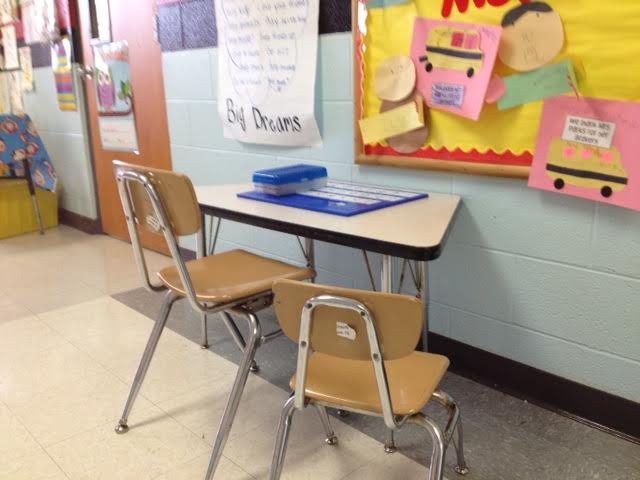
I thought I’d share this with you. It is my “desk” when I tutor.

desk

This is in the hallway just a few steps away from the classroom. There are always two chairs, one big one and one small one. I put them this way – with the big one in the center for the student, and the small one to the side for me. I know this is backwards from how it is normally done. I do it so that when we sit, we are both the same height, so we work on the projects together.

This is really important to me. This is very subtle and psychological. I don’t want them to see me as above them or better than them. I’m a tutor. I’m here to help them help themselves. I’m a guide and a cheerleader. I’m not teaching them anything. I’m showing them the assignments that we have to work on and we are figuring them out. I provide feedback and direction. But all along, they are doing the work.

Food and money

This makes absolutely no sense. I’m strictly budgeting my money by buying everything with cash. I’m cooking more, so I’m buying the groceries for the household now. We have fresh produce, most of it organic. Somehow, we are saving a lot of money and eating a lot better at the same time. It doesn’t make any sense but I’m grateful.

I’ve always been told that it was cheaper to buy prepackaged and conventional, but healthier to eat fresh and organic. I decided to start small and build up. It started with a box of organic oatmeal. Then I got some organic apples. It wasn’t much, but it was a start. Every little bit counts in health. But then I started buying organic as much as possible. I didn’t see that much difference in price. Somehow I was able to justify it even while living on a strict budget. Perhaps I eat less food. Perhaps I’m just more mindful about what I eat. I don’t know, but it seems to be balancing out. Better food and saving money – win/win.

I think part of it is that we aren’t eating out nearly as often. We have fresh food that needs to be eaten. If we don’t eat it, it goes to waste. If you are saving money, wasting food is tops on the list of dumb things to do. Somehow I’ve realized that it is just as fast to cook our own food at home rather than go out and wait for food at a restaurant. And I’ve realized that when I cook, I know what went into the food. I know the amount of butter and salt. I know if the vegetables are organic. I know that all the ingredients are the best they can be.

I’m not cooking gourmet meals, but they are tasty. I’m not following recipes really. I’m following general guidelines. I think all the time I spent watching cooking shows has helped me to understand the general idea of cooking.

I’m coming to realize that I’m grateful that I didn’t learn how to cook from my Mom. I remember one year writing in my diary that all I wanted for my birthday was food that wasn’t brown. Everything was cooked to within an inch of its life. Everything was mushy and dull. Nothing was colorful and crisp. She was from England, and her Mom had cooked all the meals to suit a man who had ulcers. Everything was thick gravies and no fresh vegetables. She even had a special rectangular steamer pot for the frozen vegetables that came in a block. The only time she cooked from scratch was when guests came over, and that wasn’t very often.

Now, I know that some of this was because of the fact that we didn’t have a lot of money when I was growing up. She had to make do with what she had. I also know that some of it comes from the time period. I remember reading a recipe from that era that said for green beans almandine, you should boil the green beans for 20 to 30 minutes, or until tender. By that time they’d be limp and grey and all the goodness would have been cooked right out of them. That was normal for our house. That was normal for a lot of people.

I remember when Mom got sick with cancer and I started cooking. I went to the grocery store and got fresh, colorful veggies for a stir fry. I remember her looking at what I was cooking in amazement. I cooked it all for just a few minutes. She looked at it and asked “Don’t you want to cook that a little longer?” I told her that no, that we could eat the vegetables raw. We were just cooking them for fun. She was unbelieving, but tried anyway. After that meal she was sold on the idea and bought me an electric wok to use to make her more.

I remember seeing a documentary about a family that said they could only afford to eat from the McDonald’s value meal. They spent so much money on diabetes and cholesterol and blood pressure medicine that they couldn’t afford to eat real food. This, sadly, is the norm for America. If we eat better, we don’t get sick. Prevention rather than cure, you know. Food has to be seen as the ultimate medicine.

It is easy to cook and eat right, and it is cheap. I didn’t believe it, but I’m doing it. If I can do it, anybody can. They just have to get started. Little steps at first. Part of it is knowing that you can. Part of it is knowing that the desire to do it is the seed. Nurture that seed and you are on your way.

Death guilt – on the relief you feel after a parent dies after a long illness.

There is a lot of guilt that comes when a loved one dies that we have taken care of. If you have been the primary caregiver, you are suddenly relieved of the majority of your duties. You duties don’t end totally – there is most likely an estate to settle – but they change. You aren’t “on duty” constantly.

There is part of where the guilt comes in. If your loved one has been sick a long time and you have been the main (or only) caregiver, you are worn out from that constant work. Sick people take a lot of attention. They are often sick at very inconvenient times. The middle of the night is a common time for things to go south. Everything is harder to deal with when you have just a little sleep. It is even harder to deal with when that has been going on for weeks. Or months. Or years.

Very few people talk about this, but there comes a time when you look forward to your loved one dying, because that means you are free to start living. It sounds cold to say this, so people will say that they want their loved one to “pass on” or “transition” so that they can be free of pain. They want that too, of course. Part of the pain of dealing with a very sick loved one is seeing them suffer and knowing there is little you can do for them other than bring them food and fluff their pillows. Death is a release and a blessing at times.

In reality, death is a release and a blessing for the patient as well as the caregiver. When the patient dies, the caregiver is now free to live. The caregiver no longer has to stay by the bedside of the sick person. She no longer has to sleep on the sofa, hurting her back. She no longer has to call in to work, using up personal leave or vacation time (if she has it). She no longer has to do double duty of taking care of her parent’s home and her own.

There is something to be said for having families live together. The more the nuclear family explodes into satellite units, the more problems are created when a member needs help. Also, why have three households who have to buy three sets of lawn equipment, when you can have one big one that shares? I wonder if this is part of the “commune” idea. Instead of having friends living communally, start at the source and have families live that way. But I digress.

Sometimes the reason children leave the household as soon as they can is because they don’t really like their parents. Just because someone is your parent doesn’t mean that he is a good person. Becoming a parent isn’t the same as being an adult or a mature person. Sometimes “parent” just means someone who has reproduced. The parent is little more than a maladapted child himself.

Our society doesn’t speak about this very much. We laud parents. We think that parents are all knowing and all powerful. They aren’t. Nothing magical happens when they have a child. They don’t suddenly stop being neurotic or needy. In some cases their problems just get deeper and darker. So when such a parent-person gets sick enough to need help, the child is conflicted. They are expected by society to help. They are expected to drop everything and take care of their sick or dying parent. The only problem is that the abuse that the child received is often never revealed. Sometimes even the child is not aware of how mistreated she was. She just knows deep in her gut that she doesn’t want to take on this task. It isn’t because she is selfish.

It is a double bind. The child was taught her whole life to serve the parent. She was taught that she deserved to be treated badly. She was taught that her own needs didn’t matter. So when the parent is terminally ill, the child is expected to drop everything to take care of him. Then she feels conflicted.

It is hard enough to take care of a really sick person. Nurses have training for this. The average person does not. You don’t just wake up with the know-how to be a competent caregiver. When that sick person is your parent it is extra hard. When that parent was abusive it is nearly impossible.

When your parent is very sick, you have to become the parent. You are in charge. There aren’t classes for this. We don’t talk about this in Western society. I’m not sure any society talks about this, but I know this one sure doesn’t. But Western society rarely talks about anything real anyway.

For years, the child is subservient. Even if the child has become an adult and has a family and household of his own, he is expected to defer to his parents. That role never stops unless he establishes boundaries. The only problem is that there isn’t training on this, and there isn’t a lot of social support for it. If his parents die before he has established these boundaries and stood his own ground, he has a lot of ground to make up.

Even if none of this is going on, even if the relationship is healthy and sound, there are conflicting feelings when the parent dies. One of those feelings is relief, but that feeling alone causes guilt. You aren’t supposed to feel relief when your parent dies. You are supposed to be sad. Often you are sad. Sometimes you are angry too, at them having left you. Sometimes you are frustrated about all the mess they left you to have to clean up. But sometimes it is relief, because it is a lot of hard work taking care of a sick parent. Sometimes it is relief because now for once you can live your life your way without being second guessed by your parent.

It is healthy to feel whatever you feel when your parent dies, regardless of what you feel. Your feelings are yours, and they are valuable. If they have died after a long illness where you were the caretaker, your feelings will be even more complex. Don’t ignore those feelings, and don’t feel embarrassed or ashamed. They are natural. It is healthy to feel them and express them. You may not have heard other people talk about the relief they felt because they thought they shouldn’t talk about it – but it doesn’t mean you are alone. Sometimes just sharing this feeling with others who have been in a similar situation is very healing. This is why I’m sharing this with you.

Shrimp Italian-ish

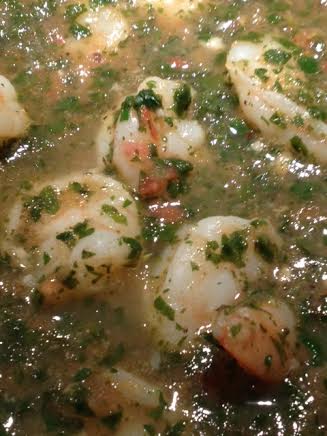
italian shrimp

Ingredients –

1 tablespoon butter

1 tablespoon minced garlic

1/2 tablespoon ground mustard

3 tablespoons dried Italian seasoning blend

3 tablespoons dried parsley

Pinch of salt

A pound of shrimp, no shell or tail.

1 large “ugly ripe” tomato or similar meaty tomato.

1/2 bunch fresh cilantro.

Half a cup of wine (I used white Zinfandel)

Instructions –

Slice up the tomato so it will fit in the food processor. Remove the leaves from the cilantro, discarding the stems. Process the tomato and cilantro leaves in the processor until puréed. Set aside.

Put the butter in a large covered sauté pan over medium-low heat. When that has melted, add the garlic. Then add the shrimp and the dry seasonings. Stir to evenly distribute the seasonings.

Let this cook for a few minutes, then add the wine. Cook a little longer, then turn over the shrimp to cook the other side. Add the tomato-cilantro purée, stir, and cover.

Lower the heat if the mixture starts to bubble.

Allow to simmer for about five minutes or until the shrimp is done (when it turns opaque). Do not overcook the shrimp or it will be tough.

Serve over shell pasta with a glug of olive oil. Makes four servings.

OMG Blondies

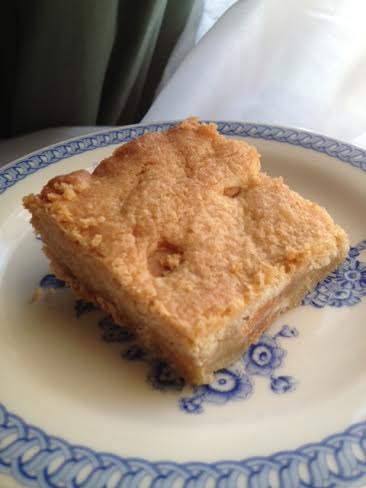
blondie

First ingredients –

1/2 cup of butter, melted (one stick)

1 cup of turbinado sugar (I use “Sugar in the Raw” brand)

1 egg, lightly beaten

1 teaspoon of vanilla

Dry ingredients –

1/2 teaspoon baking powder

1/8 teaspoon of baking soda

Pinch of salt

1 cup of all-purpose flour

1/4 teaspoon pumpkin pie spice blend

Mix-ins –

1/3 cup of butterscotch chips

1/3 cup of pine nuts (option – toast them first)

Instructions –
1 Preheat the oven to 350°F. Lightly butter and flour an 8X8 pan. Whisk together the melted butter and sugar in a bowl.

2 Add the egg and vanilla extract and whisk.

3 In a separate bowl, blend together dry ingredients – flour, baking soda, baking powder, salt and pumpkin pie spice.

4 Pour the dry ingredients into the wet ingredients, stirring together with a fork. When blended, stir in the butterscotch chips and pine nuts.

5 Pour into the pan and spread evenly. Bake for 20-25 minutes or until a toothpick comes out clean. Allow to cool. Cut into squares and serve.

Notes –
Modified from the Simply Recipes website. I added the pine nuts and the pumpkin pie spice, and substituted turbinado sugar for “tightly packed brown sugar”. I also changed it so that the dry ingredients are mixed separately.

A little poem I wrote in honor of the first batch of blondies I made –

Welcome.

You smell of warmth, and love.
You smell of home, and old school buildings.
You smell of mornings and mysteries solved.

Welcome.

Voice (of reason?)

I’ve come across several people recently who say they have something important to say. They want people to read their books or have them speak at events. The only issue is their books look like manifestos and their speeches sound like rants.

One guy writes conspiracy theory tracts. He self published a book, then cut it down to a booklet because people said it was too long to read, then kept cutting it down until now it is all on one sheet of paper, front and back, small print. I think they said it was too long to be kind. They didn’t want to read it at all. He uses a lot of capitals and bold face and italics. Visually his handouts are a mess. Even this short, it is too much.

Another guy is equally paranoid. He wants to grow everything himself because he thinks the government and then the economy is going to collapse. While it is good to be self sufficient, his level of paranoia is palpable. He talks fast and doesn’t listen to the other person’s opinions. He thinks they are deluded. He thinks he is the only person who knows what is really going on.

Another guy is trying to get himself invited as a “controversial speaker” to a local religious group meeting. He has stated that you can’t declare yourself a prophet, but then he say he is one and he is the only one talking. His “introduction” took up the whole page of the group’s homepage.

They sound crazy. They may have something important to say. Truth very well might be revealed to them. But how they are presenting it makes their message questionable.

I’ve considered telling them what I see. I’ve considered pulling them aside and handing them a clue. Nobody is going to take them seriously if they seem wackadoodle.

But then I think maybe it is for the best to not tell them.

If you put a new coat of paint on an old car, it will still run the same. If you try to sell this new looking car to someone they are going to be fooled. They will get in and drive down the road a bit and end up stranded.

I don’t want to do that to the passenger. It is important to not mislead people. Even if I’m not delivering the message, I will have aided and abetted. If I help someone repackage their message so that other people finally listen to it, I’m responsible for the fallout.

Maybe their message is crazy. Maybe that is why they seem messed up.