The hen, the ant, the grasshopper, and Jesus

“The Little Red Hen” is a useful story about people who prepare and people who are lazy. The creatures who are lazy expect to get something for nothing, and the creature who worked is having none of it.

“In the tale, the little red hen finds a grain of wheat, and asks for help from the other farmyard animals (most adaptations feature a pig and a duck) to plant it, but none of them volunteer. At each later stage (harvest, threshing, milling the wheat into flour, and baking the flour into bread), the hen again asks for help from the other animals, but again she gets no assistance. Finally, the hen has completed her task, and asks who will help her eat the bread. This time, all the previous non-participants eagerly volunteer. She declines their help, stating that no one aided her in the preparation work. Thus, the hen eats it with her chicks leaving none for anyone else. The moral of this story is that those who show no willingness to contribute to a product do not deserve to enjoy the product.” – from Wikipedia

Then there is also the story of “The Ant and the Grasshopper”, which echoes this.

“The fable concerns a grasshopper that has spent the warm months singing while the ant (or ants in some versions) worked to store up food for winter. When that season arrives, the grasshopper finds itself dying of hunger and begs the ant for food. To its reply when asked that it had sung all summer, it is rebuked for its idleness and advised to dance during the winter.” – from Wikipedia.

This echoes what the apostle Paul said in 2 Thessalonians 3:10
“For even when we were with you, we gave you this command: If any one will not work, let him not eat.” (RSV)

But fables, and Paul, are not Jesus. What does Jesus have to say about all of this?

Matthew 20:1-16
“For the kingdom of heaven is like a householder who went out early in the morning to hire laborers for his vineyard. 2 After agreeing with the laborers for a denarius a day, he sent them into his vineyard. 3 And going out about the third hour he saw others standing idle in the market place; 4 and to them he said, ‘You go into the vineyard too, and whatever is right I will give you.’ So they went. 5 Going out again about the sixth hour and the ninth hour, he did the same. 6 And about the eleventh hour he went out and found others standing; and he said to them, ‘Why do you stand here idle all day?’7 They said to him, ‘Because no one has hired us.’ He said to them, ‘You go into the vineyard too.’ 8 And when evening came, the owner of the vineyard said to his steward, ‘Call the laborers and pay them their wages, beginning with the last, up to the first.’9 And when those hired about the eleventh hour came, each of them received a denarius. 10 Now when the first came, they thought they would receive more; but each of them also received a denarius. 11 And on receiving it they grumbled at the householder, 12 saying, ‘These last worked only one hour, and you have made them equal to us who have borne the burden of the day and the scorching heat.’ 13 But he replied to one of them, ‘Friend, I am doing you no wrong; did you not agree with me for a denarius? 14 Take what belongs to you, and go; I choose to give to this last as I give to you. 15 Am I not allowed to do what I choose with what belongs to me? Or do you begrudge my generosity?’ 16 So the last will be first, and the first last.” (RSV)

This is totally not fair. But human ways of doing things aren’t the same as God’s ways of doing things.

God says in Isaiah 55:8
For my thoughts are not your thoughts,
neither are your ways my ways, says the LORD.

This doesn’t make any of this any easier, though. Isn’t it “enabling” to let someone slide, to get away with being a slacker? It is hard to work as a team and only two out of the three people are working – but you all get the same pay. It is hard to want to help someone who refuses to take care of themselves.

You know, “Lack of planning on your part does not constitute an emergency on my part.” I grew up with that phrase.

We think like this, but God doesn’t.

It kind of sucks.

I want people to reap what they sow, not what I sow. I want people to fall face first into their own mess, rather than me having to come rescue them from it. But I know I shouldn’t think like this.

This being a disciple is hard. It is kind of like being in AA.

Non-believers think following Jesus is for weak people, but that can’t be further from the truth. Following Jesus means dropping everything that popular culture has taught about being selfish and “every man for himself”. It means putting yourself and your needs last. It means doing the right thing even though it is the last thing you want to do.


Poem – three days

Jonah was in the whale three days.
By himself.
In the dark.
He didn’t know if he’d ever get out.

Jesus was dead for three days.

His disciples thought
it was the end.

Sometimes the wait is forty years.

Sometimes longer.

Redemption isn’t immediate.
It isn’t guaranteed,
either.

Trust that whatever is happening
is meant to happen.
Trust that whatever
is going to happen
is meant to happen
too.

Jealous

I remember a time when the priest at my old church was talking about this non-denominational church that had started up in Nashville. She couldn’t figure out why they had such a hugely following. The unspoken part was that it was huge in comparison to the attendance at her church. Average attendance was about 80 at hers, and about 300 at this new thing.

I felt it, but I didn’t have the words at the time. I now know. She was jealous.

Instead of being glad that the Gospel was being shared, instead of being happy that more people were turning towards Jesus, she was jealous that this church was getting the numbers and hers wasn’t.

Like it is about numbers.
Like it is a popularity contest.
Like it is about her at all.

The fact that she was jealous is why nobody showed up at her church. She had made it her church. She had held on to it so hard that she had forgotten who was in charge of it.

It isn’t the minister.

It is the One who never ordained anybody, and told us not to have Fathers or Rabbis or Teachers, because we have all of that in God.

If Jesus is the head of the Church, all will go well. When it is a competition and a popularity contest, not so much.

She said “We have all of that, and we have sacrament!” as to why her church, her denomination was better. But who needs an empty ritual, a show of communion when you have true Communion with God through Jesus, when you have a living relationship with him?

She was afraid of the relationship I had formed. None of the classes offered there taught about how to have this kind of relationship. I’m surprised she even allowed people to go to Cursillo, which is all about meeting Jesus in person.

But then, she didn’t want me to go to it. She thought I was being called to be a deacon, but Cursillo would have been too much.

The fire still burns in me.

I still wonder about a denomination that confuses someone who wants to help people with someone who should be ordained. Surely, wanting to be helpful should be normal, not so unusual that it requires a committee and Bishop approval and homework and years of study.

Hammer, screwdriver, and love.

Say you were given a set of instructions to build a house. All the pieces are cut out, all you and your crew have to do is assemble them. The architect thinks that you were provided hammers and some nails. But when you get to the job site, instead of hammers you have screwdrivers. You can’t possibly follow the instructions to build a house with screwdrivers. It just doesn’t work. It isn’t designed for that.

But you try anyway, because it is what you have and you have a job to do. Then the architect calls you up and asks you if you are finished yet. You say no, and he gets really mad. You didn’t know that you were supposed to have hammers. You think that screwdrivers are what you are supposed to use, because it is what you were provided.

You are way behind on the project and the architect is really upset. Somebody figured out how to use a screwdriver to dig out a hole in the wood and then put a nail in the hole, and tap it in with the other end of the screwdriver. It isn’t very good, but it is something. You’ve managed to put together a corner of the house this way.

After a few more phone calls and getting more and more upset and confused, the architect finally comes to the job site and he notices you don’t have the right tools. He sees what you have and how hard you’ve been trying with what you were provided, and he understands. He works alongside you for a bit, using the tool that you were given. He doesn’t have a way to get you any hammers, so he changes the plans and he makes them a lot easier.

God is the architect and we are the workers. Our human bodies are the screwdrivers.

We can’t possibly follow all of God’s instructions with the tool we were given. God had no way of knowing how frail and hungry these bodies are. They cause us to fear, so we don’t try anything difficult. They cause us to crave, so we do things we know we shouldn’t. Our senses are very limited, so our perceptions aren’t that great.

But then God the architect comes down to the worksite (Earth) to see us and work with us.

And God gets it. We can’t do what is expected of us. We can’t follow the plans the way they are written with the tools we were given. The only way God would know that was to see things from our perspective, in our limited, frail, needy bodies.

We aren’t off the hook, but the rules got modified. They were boiled down to the essentials. Instead of “eat this, don’t eat this” and “wash your hands this way” and “say this prayer at this time” and six-hundred-plus other rules, we got two.

Love God, and love your neighbor as yourself.

Which really is only one rule. Love.

We can build anything with that rule.

We can build houses for the homeless. We can build schools to teach people how to read and take care of themselves. We can build hospitals so people can get well. We can build farms so we can grow healthy food. We can build gyms so we can exercise and get strong.

Love.

And you don’t even need a hammer or a screwdriver to use it.

Family honor

My brother used to push the idea of family honor on me. He seemed to think that it was my responsibility to keep up the family name and family pride. And yet he was the one who changed his last name and who got two women pregnant without being married to them. He is the one who got divorced four times and who got himself a quarter of million dollars in debt.

So I’m not really sure why he thinks it is my responsibility to keep up with family honor and pride. Perhaps it is my responsibility because he realized that he had failed at it. Trying to make his problems my problems isn’t acceptable.

I have felt like I have failed the family for many years but I’ve gotten over it. He really did a number on me. Because he was older than me, I trusted him. He imprinted me. I finally realized that their madness isn’t my madness.

If you work for a company, everybody should work together to make a good product. But if you work really hard and no one else does, then you will lose your sense of loyalty towards the company. You feel like it doesn’t matter what you do because no one else is pitching in nearly as hard as you are.

The same is true with my family. I feel like they aren’t doing anything for me so why should I do anything for them? In fact they seem to think that it is my responsibility to care about everybody else’s feelings, when they don’t bother with mine. That is the very definition of codependency.

In “Anatomy of the Spirit, Caroline Myss talks about how our first loyalty is to our tribe – our family, our culture, our country. Whatever we are born into and is impressed upon us. Problems occur when we disagree with it and realize that its goals and values are not the same as ours.

She talks about our family of origin as being Divinely chosen. So this means we should accept it.

That isn’t so easy.

This happened with Jesus in the Garden at Gethsemane – 39 And going a little farther he fell on his face and prayed, “My Father, if it be possible, let this cup pass from me; nevertheless, not as I will, but as thou wilt.” (Matthew 26:39, RSV) He was about to be crucified, and he knew it. He was about to suffer a very painful and humiliating death, one that he didn’t deserve. He knew that he was going to be resurrected, but getting to that point was going to be ugly.

He didn’t want what was going to happen to him. He was asking God to let it not happen.

I was angry at God for letting things happen to me. I was angry at God for the abuse and neglect. I was angry at God for it all – not having a better family then and not having a better family now. I didn’t pick these people.

I felt pretty ugly for thinking these thoughts. But if even Jesus can think stuff like this, then I’m in pretty good company. And Jesus says, not my will, but yours, God. It isn’t what I want, but what You want.

I’m trying.

Myss says that problems with this area tend to manifest in the lower back and knees, and that is where my pains are. And from my prayers before I read this, I knew that I needed to let God be in control. It is good to get confirmation, but still hard to do.

There has to be a reason what has happened and is happening to me is going on. God made it happen and is making it happen. It is a way to open up, to learn, to grow. It is a test, a trial. Somehow I doubt that the world will be redeemed through my sufferings, but I might be.

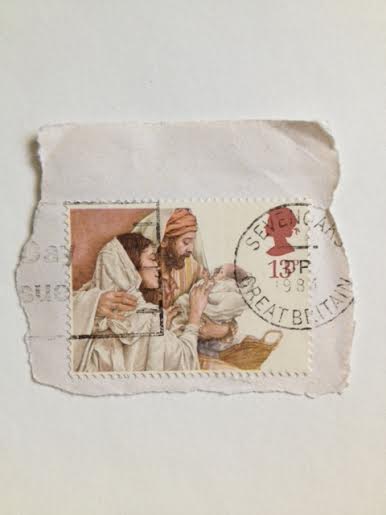
Holy Stamps! Or, the Gospel illustrated with stamps.

In the Beginning

1

2

John 1:1-4
In the beginning was the Word, and the Word was with God, and the Word was God.2 He was in the beginning with God; 3 all things were made through him, and without him was not anything made that was made. 4 In him was life, and the life was the light of men. 5 The light shines in the darkness, and the darkness has not overcome it.

The Birth of Jesus

3

Luke 2:1-7
In those days a decree went out from Caesar Augustus that all the world should be enrolled. 2 This was the first enrollment, when Quirin′i-us was governor of Syria. 3 And all went to be enrolled, each to his own city. 4 And Joseph also went up from Galilee, from the city of Nazareth, to Judea, to the city of David, which is called Bethlehem, because he was of the house and lineage of David, 5 to be enrolled with Mary, his betrothed, who was with child. 6 And while they were there, the time came for her to be delivered. 7 And she gave birth to her first-born son and wrapped him in swaddling cloths, and laid him in a manger, because there was no place for them in the inn.

The Shepherds and the Angels

4

5

Luke 2:8-20
8 And in that region there were shepherds out in the field, keeping watch over their flock by night. 9 And an angel of the Lord appeared to them, and the glory of the Lord shone around them, and they were filled with fear. 10 And the angel said to them, “Be not afraid; for behold, I bring you good news of a great joy which will come to all the people; 11 for to you is born this day in the city of David a Savior, who is Christ the Lord. 12 And this will be a sign for you: you will find a babe wrapped in swaddling cloths and lying in a manger.” 13 And suddenly there was with the angel a multitude of the heavenly host praising God and saying,

14 “Glory to God in the highest,
and on earth peace among men with whom he is pleased!”

15 When the angels went away from them into heaven, the shepherds said to one another, “Let us go over to Bethlehem and see this thing that has happened, which the Lord has made known to us.” 16 And they went with haste, and found Mary and Joseph, and the babe lying in a manger. 17 And when they saw it they made known the saying which had been told them concerning this child; 18 and all who heard it wondered at what the shepherds told them. 19 But Mary kept all these things, pondering them in her heart. 20 And the shepherds returned, glorifying and praising God for all they had heard and seen, as it had been told them.

The Visit of the Magi

6

Matthew 2:1-12
Now when Jesus was born in Bethlehem of Judea in the days of Herod the king, behold, wise men from the East came to Jerusalem, saying, 2 “Where is he who has been born king of the Jews? For we have seen his star in the East, and have come to worship him.” 3 When Herod the king heard this, he was troubled, and all Jerusalem with him; 4 and assembling all the chief priests and scribes of the people, he inquired of them where the Christ was to be born. 5 They told him, “In Bethlehem of Judea; for so it is written by the prophet:

6 ‘And you, O Bethlehem, in the land of Judah,
are by no means least among the rulers of Judah;
for from you shall come a ruler
who will govern my people Israel.’”

7 Then Herod summoned the wise men secretly and ascertained from them what time the star appeared; 8 and he sent them to Bethlehem, saying, “Go and search diligently for the child, and when you have found him bring me word, that I too may come and worship him.” 9 When they had heard the king they went their way; and lo, the star which they had seen in the East went before them, till it came to rest over the place where the child was. 10 When they saw the star, they rejoiced exceedingly with great joy; 11 and going into the house they saw the child with Mary his mother, and they fell down and worshiped him. Then, opening their treasures, they offered him gifts, gold and frankincense and myrrh. 12 And being warned in a dream not to return to Herod, they departed to their own country by another way.

The flight to Egypt

7

Matthew 2:13-15
13 Now when they had departed, behold, an angel of the Lord appeared to Joseph in a dream and said, “Rise, take the child and his mother, and flee to Egypt, and remain there till I tell you; for Herod is about to search for the child, to destroy him.” 14 And he rose and took the child and his mother by night, and departed to Egypt, 15 and remained there until the death of Herod. This was to fulfill what the Lord had spoken by the prophet, “Out of Egypt have I called my son.”

Many years pass. Jesus begins to teach. He tells everyone that God loves them and that they are forgiven, and they are to love and forgive everyone else. Then it comes time for the Passover, and for him to be sacrificed.

Jesus enters into Jerusalem upon a donkey

8

John 12:12-19
12 The next day a great crowd who had come to the feast heard that Jesus was coming to Jerusalem. 13 So they took branches of palm trees and went out to meet him, crying, “Hosanna! Blessed is he who comes in the name of the Lord, even the King of Israel!”14 And Jesus found a young ass and sat upon it; as it is written,

15 “Fear not, daughter of Zion;
behold, your king is coming,
sitting on an ass’s colt!”

16 His disciples did not understand this at first; but when Jesus was glorified, then they remembered that this had been written of him and had been done to him. 17 The crowd that had been with him when he called Laz′arus out of the tomb and raised him from the dead bore witness. 18 The reason why the crowd went to meet him was that they heard he had done this sign. 19 The Pharisees then said to one another, “You see that you can do nothing; look, the world has gone after him.”

Jesus dies and is raised from the dead.

9

John 12:27-36
27 “Now is my soul troubled. And what shall I say? ‘Father, save me from this hour’? No, for this purpose I have come to this hour. 28 Father, glorify thy name.” Then a voice came from heaven, “I have glorified it, and I will glorify it again.” 29 The crowd standing by heard it and said that it had thundered. Others said, “An angel has spoken to him.”30 Jesus answered, “This voice has come for your sake, not for mine. 31 Now is the judgment of this world, now shall the ruler of this world be cast out; 32 and I, when I am lifted up from the earth, will draw all men to myself.” 33 He said this to show by what death he was to die. 34 The crowd answered him, “We have heard from the law that the Christ remains for ever. How can you say that the Son of man must be lifted up? Who is this Son of man?” 35 Jesus said to them, “The light is with you for a little longer. Walk while you have the light, lest the darkness overtake you; he who walks in the darkness does not know where he goes. 36 While you have the light, believe in the light, that you may become sons of light.”

10

Cherry picking

Every now and then some stranger will disagree with one of my religious posts by saying that I’m “cherry picking” the Bible. Of course I cherry pick. The whole tree is too hard to digest. That is the silliest thing to accuse somebody of.

Perhaps I should just say what I’m going to say and not reference chapter and verse at all. Perhaps I should stop citing any references and just assume that everybody has read what I am referring to.

Jesus did that. He just said what he was going to say and assumed that his audience had read the whole Bible for themselves. He assumed that they could follow along with his logic and know that what he was saying was true.

When people accuse me of cherry picking they’re saying that I’m picking and choosing what I’m using to cite. Of course I am. Everybody does that. That is part of writing. Perhaps they want me to use an argumentative structure? Perhaps they think it would be best if I quoted all sides of the debate? That would draw away from my argument. No writer would do that.

Well, I’ll do it if Jesus’ words disagree with what I’m saying. Paul’s words don’t count. He isn’t the Messiah, and his words aren’t counted as the Gospels. Too many people think they are, but they are the ones accusing me of “cherry picking”.

How about this? I’m going to write what I write and quote what I quote and if “they” get it, then great. If “they” don’t, that is their problem. Jesus’ message wasn’t accepted by everybody either, so I’m in good company.

Fill in the blanks.

I woke up thinking about my parents-in-law. Things aren’t going well with them, and I’ve been very distant because of that.

I’m angry with them. I’m angry about how they treated my husband, their son, as he was growing up. I’m angry about how they abused him. Their own history of being mistreated isn’t enough to excuse it. They should have known better.

I’m angry about how they haven’t listened to my advice on where to live, so they keep needing to ask for help. I was the one to suggest they move up here, closer to their sons, but that is all they have listened to. Five hours away was too far to help them, so they came closer, but they are still too far. Thirty minutes one way isn’t ten.

They should have bought a condo, or gotten an apartment. Basically they shouldn’t have gotten a yard and a place that has to be maintained. At their age, they personally need to be maintained more than their homes. I told them this, and they ignored me. I told them that my husband, their son, barely has time to take care of our house.

Now they need help. Often. Just like I foresaw. There is no need for these emergencies.

They continue to ask for my advice and input, but they continue to ignore it. They waste my time and that of my husband.

They are very needy.

They are too old to be this childish.

And then I stopped and remembered. Ask Jesus into it.

Jesus Jesus Jesus, I said. I visualized all of these problems as big blocks. I saw the light of Jesus entering them. It was like a glue, filling in all the cracks, making them stronger.

And I came to understand that the brokenness is part of the plan. The brokenness is necessary.

The poet Rumi reminds us that bread can’t become bread unless the grain is ground up. Then it is mixed with other ingredients and heated in an oven.

Clay isn’t useful unless it is shaped and heated too.

These broken bits, these hard times, these trials that we all have – these are what make us who we are.

They aren’t the bits to run away from. They are the whole story. They are it, everything.

They are what make us human. They are what make us who we are.

God isn’t the “bad guy” for letting bad things happen to us. These “bad things” are just the hard things that push us out of what we are and into who we are supposed to be.

They are what get the baby bird to get out of that shell. They are what get that same bird to jump out of the nest and fly for the first time too.

We are those birds.

Stuck in our shells, we would die.

Stuck in the nest, we would never live.

Adversity isn’t.

It is opportunity.

Jesus is the glue that holds us together, is the hand that pulls us out of the hole, is the thing that rescues is from being stuck.

Jesus is “out there” but is also “in here”. Jesus is instantly available -all you have to do is call on him. Ask and you shall receive, after all. But Jesus is also inside every person who has let him into their lives. Jesus builds houses for poor people through Habitat for Humanity. Jesus feeds people at the rescue mission. Jesus holds people’s hands when they die in hospice care. Jesus teaches children how to read.

Jesus wears a lot of faces and goes by a lot of names, and he’s here.

But he had to be broken and blessed for that to happen.

He wasn’t crucified for our sins. He was blessed and broken on that cross, just like how he blessed and broke the bread and the fish to feed thousands.

He became more, so we could become more.

Thanks be to God.

Communion loaves and fishes

The Last Supper, the model for our Communion service, is linked to when Jesus fed the multitudes. This event happened twice.

Here, he feeds over 5,000 people, using five loaves and two fish. There were twelve baskets of leftovers. The story starts just after Jesus has heard that his cousin John the Baptist has been murdered.

Matthew 14:13-21
13 When Jesus heard about it, He withdrew from there by boat to a remote place to be alone. When the crowds heard this, they followed Him on foot from the towns. 14 As He stepped ashore, He saw a huge crowd, felt compassion for them, and healed their sick.
15 When evening came, the disciples approached Him and said, “This place is a wilderness, and it is already late. Send the crowds away so they can go into the villages and buy food for themselves.”
16 “They don’t need to go away,” Jesus told them. “You give them something to eat.”
17 “But we only have five loaves and two fish here,” they said to Him.
18 “Bring them here to Me,” He said. 19 Then He commanded the crowds to sit down on the grass. He took the five loaves and the two fish, and looking up to heaven, He blessed them. He broke the loaves and gave them to the disciples, and the disciples gave them to the crowds. 20 Everyone ate and was filled. Then they picked up 12 baskets full of leftover pieces! 21 Now those who ate were about 5,000 men, besides women and children.

Shortly after that, he feeds over four thousand people, using seven loaves and a few small fish. There were seven baskets left over.

Matthew 15: 29-39
29 Moving on from there, Jesus passed along the Sea of Galilee. He went up on a mountain and sat there, 30 and large crowds came to Him, having with them the lame, the blind, the deformed, those unable to speak, and many others. They put them at His feet, and He healed them. 31 So the crowd was amazed when they saw those unable to speak talking, the deformed restored, the lame walking, and the blind seeing. And they gave glory to the God of Israel.
32 Now Jesus summoned His disciples and said, “I have compassion on the crowd, because they’ve already stayed with Me three days and have nothing to eat. I don’t want to send them away hungry; otherwise they might collapse on the way.”
33 The disciples said to Him, “Where could we get enough bread in this desolate place to fill such a crowd?”
34 “How many loaves do you have?” Jesus asked them.
“Seven,” they said, “and a few small fish.”
35 After commanding the crowd to sit down on the ground, 36 He took the seven loaves and the fish, and He gave thanks, broke them, and kept on giving them to the disciples, and the disciples gave them to the crowds. 37 They all ate and were filled. Then they collected the leftover pieces—seven large baskets full. 38 Now those who ate were 4,000 men, besides women and children. 39 After dismissing the crowds, He got into the boat and went to the region of Magadan.

What are the common elements in this story? Jesus takes what he has, little though it is. He doesn’t pray for more. He gives thanks for what he has and blesses it. Then he breaks it and distributes it.

This is what happens to us when we become part of the Body of Christ, and what we are supposed to do. It is something we receive and something we are to give.

We aren’t enough for the task. We are small and weak. We are broken. Yet God loves us, and is thankful for us. We are blessed by Jesus. And through that thankfulness and that blessing, we are enough. We are exactly what the world needs. We are food for a hungry world.

We are to take that thankfulness and that blessing and multiply it through our actions and our lives.

This is what Communion is. It feeds us, and through that, we are able to feed the world. We are able to be the healing the world needs, because we have been healed.

Communion words in Hebrew and English.

These are traditional Jewish blessings that I’ve incorporated into the Communion service. They seem logical to use, as Jesus would have known and used these prayers every week for Sabbath. I’ve included the Hebrew, the transliteration, and the English for all the blessings. Feel free to use both the Hebrew and/or the English. It is important to make the people you are celebrating Communion with feel special and included. Use what you feel would be most meaningful and inclusive.

Put out a nice cloth that has room for everything you need. You’ll need two candles, a plate, a goblet, an unbroken piece of matzo, and some grape juice (or wine).

Light the candles with these words –
——————————————————————————————————-
ברוך אתה ה’ א לוהינו, מלך העולם, אשר קדשנו במצותיו וצונו להדליק נר של שבת

Barukh atah Adonai Eloheinu melekh ha’olam asher kid’shanu b’mitzvotav v’tzivanu l’hadlik ner shel shabbat.

Blessed are You, Lord our God, Ruler of the Universe, who has sanctified us with commandments, and commanded us to light Shabbat candles.
————————————————————————————————————-
Then, touching the matzo lightly, bless it with these words –
———————————————————————————————————–
ברוך אתה ה’ א לוהינו, מלך העולם, המוציא לחם מן הארץ

Barukh ata Adonai Eloheinu melekh ha’olam hamotzi lehem min ha’aretz.

Blessed are You, Lord our God, Ruler of the universe, who brings forth bread from the earth.
—————————————————————————————————————
Break it into smaller pieces – enough for everybody there, and distribute it.

Then, holding up the goblet with the grape juice (or wine), say these words –
——————————————————————————————————————
ברוך אתה ה’ א לוהינו, מלך העולם, בורא פרי הגפן

Barukh ata Adonai Eloheinu melekh ha’olam borei p’ri hagafen.

Blessed are You, Lord our God, Ruler of the universe, who creates the fruit of the vine.
—————————————————————————————————————-
Pass around the goblet and let everyone drink from it. They can also choose to dip their matzo piece into the grape juice (or wine) and then eat it.

(If this has been of use to you, you might want to read “The Condensed Gospel” and “Free Range Faith”, both available in print and e-book from Amazon, by Betsy Nelson)