Two creation stories – Human, and Living people

Have you ever noticed there are two different stories of God making people in the Bible? Adam and Eve weren’t the first humans. They were the first humans who were truly alive. There is a difference.

On the sixth day, God created humankind. This is in Genesis 1:26-27 (all translations are from the NIV)

26 Then God said, “Let us make mankind in our image, in our likeness, so that they may rule over the fish in the sea and the birds in the sky, over the livestock and all the wild animals, and over all the creatures that move along the ground. 27 So God created mankind in his own image, in the image of God he created them; male and female he created them.

On the seventh day, God rested. The first chapter of Genesis ends with this. It is in chapter two that God makes Adam, which means, of the earth. According to the Bible Gateway website, “The Hebrew for man (adam) sounds like and may be related to the Hebrew for ground (adamah); it is also the name Adam.”

Now, it reads as if God is creating the world all over again. In Genesis 2:5, we read that there was no vegetation yet. We learned in Genesis 1:11-12 that God created vegetation on the third day. If this story is sequential, then we are going backwards. Or God is creating the world all over again. This is a bit confusing. I think the most interesting part is that it appears that God created humans twice.

7 Then the LORD God formed a man from the dust of the ground and breathed into his nostrils the breath of life, and the man became a living being. (Genesis 2:7)

This is important that the man is created separately, and is described as a living being. In the first creation story, men and women are created at the same time, and they are not described as “living beings”. They are alive, certainly, but not truly living in any real sense. They are like animals. Adam is different. Adam has a soul.

God had created a garden, Eden, and he put Adam there to tend it. The garden has food to feed him.

15 The LORD God took the man and put him in the Garden of Eden to work it and take care of it. (Genesis 2:15)

God thinks that Adam needs a helper. God creates animals, but they won’t do the trick.

On the fifth day, God created the water animals and the birds, in Genesis 1:20-21. On the sixth day, God creates land animals, in Genesis 1:24-25. But in Genesis 2:19-20, God creates the land animals and all the birds, right after creating Adam.

18 The LORD God said, “It is not good for the man to be alone. I will make a helper suitable for him.” (Genesis 2:18)

God had to do something else.
“…But for Adam[f] no suitable helper was found. 21 So the LORD God caused the man to fall into a deep sleep; and while he was sleeping, he took one of the man’s ribs[g] and then closed up the place with flesh. 22 Then the LORD God made a woman from the rib[h] he had taken out of the man, and he brought her to the man. (Genesis 2:20-22)

Interestingly, God creates Eve from Adam, rather than from the ground like God created everything else.

Adam had named all the animals that God created in Genesis 2, so he got to name Eve.
20 Adam[c] named his wife Eve,[d] because she would become the mother of all the living. (Genesis 3:20)

I think this is significant. Not just humans, but the living.

Remember the Jewish exclamation “L’chaim”? It means “To life”. What if it refers to the fact that the Jews are the only living people?

Then we get to Genesis 4:16-17 Cain has killed Abel, and is banished from Eden.
16 So Cain went out from the LORD’s presence and lived in the land of Nod,[f] east of Eden. 17 Cain made love to his wife, and she became pregnant and gave birth to Enoch.

Who is this wife? Where did she come from?

I propose that she is one of the humans that were created. She wasn’t one of the “living” – she was a human, but not special.

Then Adam and Eve went on to have another child, named Seth.
25 Adam made love to his wife again, and she gave birth to a son and named him Seth,[h] saying, “God has granted me another child in place of Abel, since Cain killed him.” 26 Seth also had a son, and he named him Enosh. (Genesis 4:25-26)

Then who did Seth marry, in order to have Enosh? I propose it was yet another human, again, not “living” that God made in Genesis 1.

I propose that “living” means called by God. Adam was made differently from all the other people. From him and Eve, all living people came. Otherwise, people are just animals in human shape.
Snake parents

Jesus tells us in Matthew 7:9-12
9 Is there anyone among you who, if your child asks for bread, will give a stone? 10 Or if the child asks for a fish, will give a snake? 11 If you then, who are evil, know how to give good gifts to your children, how much more will your Father in heaven give good things to those who ask him! 12 “In everything do to others as you would have them do to you; for this is the law and the prophets.”

It certainly sounds like everyone was certainly very nice back in Jesus’ time. No child abuse then! Life isn’t that easy now. Plenty of parents are abusive. “Dysfunctional” is the new normal.

So how can you possibly even approach the idea of God the Father if your own father was a jerk? There are plenty of parents who give their children stones instead of bread and snakes instead of fishes. We read about them in the paper. We hear about them on the talk shows. They are the reason we have a Department of Human Services.

No wonder people don’t believe in God. They can’t possibly believe in God when their own parents abuse them. Their visible example of parents is horrible, so how can they get the idea of an invisible parent? If God is bigger and greater than your parents, then who would want a bigger and greater example of terrible?

Perhaps this is why so many people who call themselves Christians feel that “God hates…” (fill in the blank). God doesn’t hate. God loves. Perhaps they heard their parents tell them they weren’t worthy, they weren’t valuable, they weren’t loved. So they took the next logical step and decided if their own parents acted like this, then God did it more so.

But this isn’t God. God seeks us out. God searches for us, individually, like the lost sheep, like the lost coin, like the lost son. God cares about us personally and deeply.

It might be helpful to throw away the notion of God as being just like our parents, but more so. God is love, perfected. God created us because we are needed. None of us are accidents. We are all wanted.

Let us hear the words of Jesus in Luke 15:1-24

First He tells us about the lost sheep.
1Now the tax collectors and sinners were all gathering around to hear Jesus. 2 But the Pharisees and the teachers of the law muttered, “This man welcomes sinners and eats with them.” 3 Then Jesus told them this parable: 4 “Suppose one of you has a hundred sheep and loses one of them. Doesn’t he leave the ninety-nine in the open country and go after the lost sheep until he finds it? 5 And when he finds it, he joyfully puts it on his shoulders 6 and goes home. Then he calls his friends and neighbors together and says, ‘Rejoice with me; I have found my lost sheep.’ 7 I tell you that in the same way there will be more rejoicing in heaven over one sinner who repents than over ninety-nine righteous persons who do not need to repent.

Then He goes on to tell us about the lost coin.

8 “Or suppose a woman has ten silver coins and loses one. Doesn’t she light a lamp, sweep the house and search carefully until she finds it? 9 And when she finds it, she calls her friends and neighbors together and says, ‘Rejoice with me; I have found my lost coin.’ 10 In the same way, I tell you, there is rejoicing in the presence of the angels of God over one sinner who repents.”

Then He tells us about the lost son.

11 Jesus continued: “There was a man who had two sons. 12 The younger one said to his father, ‘Father, give me my share of the estate.’ So he divided his property between them. 13 “Not long after that, the younger son got together all he had, set off for a distant country and there squandered his wealth in wild living. 14 After he had spent everything, there was a severe famine in that whole country, and he began to be in need. 15 So he went and hired himself out to a citizen of that country, who sent him to his fields to feed pigs. 16 He longed to fill his stomach with the pods that the pigs were eating, but no one gave him anything. 17 “When he came to his senses, he said, ‘How many of my father’s hired servants have food to spare, and here I am starving to death! 18 I will set out and go back to my father and say to him: Father, I have sinned against heaven and against you. 19 I am no longer worthy to be called your son; make me like one of your hired servants.’ 20 So he got up and went to his father. “But while he was still a long way off, his father saw him and was filled with compassion for him; he ran to his son, threw his arms around him and kissed him. 21 “The son said to him, ‘Father, I have sinned against heaven and against you. I am no longer worthy to be called your son.’ 22 “But the father said to his servants, ‘Quick! Bring the best robe and put it on him. Put a ring on his finger and sandals on his feet. 23 Bring the fattened calf and kill it. Let’s have a feast and celebrate.24 For this son of mine was dead and is alive again; he was lost and is found.’ So they began to celebrate.”

Jesus tells us three stories, but they are all the same story. They are the story of God’s relentless, unfailing love for us. God is constantly seeking us. God is above and beyond our human conception of love. God is the source of love, and the source of us.

Know that you are loved, beyond measure.

The beginning of awakening…

I am always amused when strangers quote Paul to me to justify why every word in the Bible is perfect, specifically that it is “God-breathed.” I’m not a Paulian, but so many people are. They love Paul because he’s against everything they are against.

Paul was against women who asked questions and against gay people in general. He was also against marriage, but people seem to forget that. Paul was all about everybody being single and celibate.

Somehow people are getting confused by my posts, which is the last thing I want. I’m for the Bible. I am Christian. I also believe that God is so big and so amazing that all sacred texts have the “breath of God” in them. I believe that God loves us all, across time and across cultures, and has tried to reach us all in various ways throughout history and all over the world. I believe that God is still revealing truth to us.

I don’t expect everybody to follow along with me when I say these things. I’m no Bible scholar. I’m not an expert in anything. I have no credentials. So if you don’t agree with me there is no reason to get your bloomers in a twist. Arguing with me in the comments section won’t further your belief system. I encourage you to write your own blog post. You’ll reach more people.

It is my belief. My opinion. I’m not going to back it up with “proof” or quote chapter and verse. If people get it and agree with me, great. If they don’t, I’m not going to argue with them.

Jesus says “If anyone will not welcome you or listen to your words, leave that home or town and shake the dust off your feet. (Matthew 10:14)

Either you get it or you don’t.

My view of God is bigger than a book. My view of God is bigger than any denomination or creed. My view of God isn’t locked down to any one belief system. God is bigger than all of that.

“The name that can be named is not the eternal name.” – Lao Tzu.

If you feel a need to argue and debate, stop. Think. Why are you so upset about this? What makes you feel like you have to fight these ideas?

Is it perhaps that deep down you are afraid I’m right?

The beginning of awakening is heralded by just such a struggle.

word/Word

In the Episcopal church, as part of becoming a priest, you have to agree to this statement- “The Bible contains everything necessary for salvation.”

I have a hard time with this. I find awakening and enlightenment to be found in sacred texts from all around the world. I think that God didn’t put all the eggs in one basket. I think that there are way more people on this earth that God wants to reach than just those who have been exposed to the Bible. So I don’t think the Bible is the only pathway to God.

Also, it assumes that God has no intervention going on. I have a hard time believing that you can just read this particular book and you will be saved. What about the intervention of the Holy Spirit? What about coming to know Jesus as your friend? These are not mentioned.

Actually, if all you have to do to get saved is read the Bible, then you don’t need priests at all. Somehow I doubt they have thought about that.

It sounds like idolatry to say that the Bible contains everything necessary for salvation. This sounds like they are worshipping a book, and not the source of the words. The paper is more important than the flesh and blood that is Jesus.

They are worshipping the words and not the Word.

Prayer releases us.

As part of my daily practice I read the readings in the Daily Office. It is the Bible, broken up into an Old Testament, an Epistle (or letter), and a Gospel reading. You will have read the majority of the Bible if you read the Daily Office over the course of several years. The readings are sequential, so it is amazing how often there is a common theme. It is as if the Bible isn’t just a series of stories, but a telescope, with each subsequent level of story bringing the real story into sharper focus. The themes repeat across time, going from the general to the specific, going from back then to right now.

God is always present, always listening to us. Wherever we are in our journey, God is with us. Whatever is going on is not the final answer. Pray, and God has the ability to change the situation.

I’ve shortened these readings to boil them down to the essential point today.

In 2 Kings 20:1-7 (NRSV) we read –
1 In those days Hezekiah became sick and was at the point of death. The prophet Isaiah son of Amoz came to him, and said to him, “Thus says the LORD: Set your house in order, for you shall die; you shall not recover.” 2 Then Hezekiah turned his face to the wall and prayed to the LORD: 3 “Remember now, O LORD, I implore you, how I have walked before you in faithfulness with a whole heart, and have done what is good in your sight.” Hezekiah wept bitterly. 4 Before Isaiah had gone out of the middle court, came to him: 5 “Turn back, and say to Hezekiah prince of my people, Thus says the LORD, the God of your ancestor David: I have heard your prayer, I have seen your tears; indeed, I will heal you; on the third day you shall go up to the house of the LORD. 6 I will add fifteen years to your life. I will deliver you and this city out of the hand of the king of Assyria; I will defend this city for my own sake and for my servant David’s sake.” 7 Then Isaiah said, “Bring a lump of figs. Let them take it and apply it to the boil, so that he may recover.”

Hezekiah was about to die, but he prayed, and God listened to him and added fifteen years to his life.

In the New Testament we read in Acts 12:1-11 (NRSV)
1 About that time King Herod laid violent hands upon some who belonged to the church. 2 He had James, the brother of John, killed with the sword. 3 After he saw that it pleased the Jews, he proceeded to arrest Peter also. (This was during the festival of Unleavened Bread.) 4 When he had seized him, he put him in prison and handed him over to four squads of soldiers to guard him, intending to bring him out to the people after the Passover. 5 While Peter was kept in prison, the church prayed fervently to God for him. 6 The very night before Herod was going to bring him out, Peter, bound with two chains, was sleeping between two soldiers, while guards in front of the door were keeping watch over the prison. 7 Suddenly an angel of the Lord appeared and a light shone in the cell. He tapped Peter on the side and woke him, saying, “Get up quickly.” And the chains fell off his wrists. 8 The angel said to him, “Fasten your belt and put on your sandals.” He did so. Then he said to him, “Wrap your cloak around you and follow me.” 9 Peter went out and followed him; he did not realize that what was happening with the angel’s help was real; he thought he was seeing a vision. 10 After they had passed the first and the second guard, they came before the iron gate leading into the city. It opened for them of its own accord, and they went outside and walked along a lane, when suddenly the angel left him. 11 Then Peter came to himself and said, “Now I am sure that the Lord has sent his angel and rescued me from the hands of Herod and from all that the Jewish people were expecting.”

The church prayed for Peter to be freed from prison, and God sent an angel to lead him out of jail safely.

And then we read a story of Jesus in Luke 7:11-17 (NRSV)
11 Soon afterwards he went to a town called Nain, and his disciples and a large crowd went with him. 12 As he approached the gate of the town, a man who had died was being carried out. He was his mother’s only son, and she was a widow; and with her was a large crowd from the town. 13 When the Lord saw her, he had compassion for her and said to her, “Do not weep.” 14 Then he came forward and touched the bier, and the bearers stood still. And he said, “Young man, I say to you, rise!” 15 The dead man sat up and began to speak, and Jesus gave him to his mother. 16 Fear seized all of them; and they glorified God, saying, “A great prophet has risen among us!” and “God has looked favorably on his people!” 17 This word about him spread throughout Judea and all the surrounding country.

The man was dead. He was being carried out of his home. Jesus called to him and he revived.

This is the same story, over and over. What we think is the end isn’t the end. Sometimes it is the beginning of an amazing story. God has the power to release a person, however that person is trapped. It makes no difference whether it is sickness or prison or death. In all those cases all we humans see is a “closed” sign. God sees it as an opportunity. It makes no difference whether we pray, the church prays, or Jesus prays – release is release. As Christians, we believe that Jesus is constantly praying for us, constantly being our intermediary with God.

In liturgical churches, the words “The Word of the Lord” are said at the end of each reading. The people then reply “Thanks be to God”.

Thanks indeed.

Let us give thanks for these stories that point us to our knowledge of a living and loving God, who is always present to us. It is through these words that we come to know the living Word.

“Be anxious for nothing.”

Be anxious for nothing. Fear not.

Jesus tells us to not worry, not be anxious. So what does it mean to not be anxious? Be perfect? We can’t be perfect. That isn’t possible for humans. And trying to not be anxious makes me anxious. I get all wound up about how wound up I feel, and then I wind myself up even more.

There has to be another way through this or into this.

Both my parents were anxious. My Mom lit up a new cigarette every twenty minutes. When she had to quit because she got lung cancer the anxiety was still there. In fact it was worse.

Her coping method had caused her problem. When we took it away she was of course worried and anxious about her cancer, but she didn’t know what to do. She’d reached for a cigarette every time she felt the least twinge of a bad feeling. She still had all the anxiety that she had before she had cancer, with the added anxiety of cancer on top of that. It overwhelmed her.

I stepped in. I gave her massages every time she wanted to smoke. I gave her some creative visualization techniques to try. We worked on breathing. In the end she still felt that she needed some outside means to calm down, so she got put on Valium. It wasn’t called Valium – it was Elavil. Same thing, new name. It was a benzodiazepine. I find it interesting that she didn’t want to take her pain pills because she was afraid she would become dependent on them, but she happily took those mood drugs.

My Dad was the same way. He smoked himself to death too. He was on various drugs from his shrink as well. He was constantly nervous. He too didn’t know how to deal with his feelings.

Perhaps anxiety is “normal” for my family. Perhaps it is the same as needing glasses. Perhaps it is hereditary in the same way that being short is.

I am anxious. I have been for years. I used to smoke pot and clove cigarettes to calm down. I finally decided I needed to grow up and quit doing these dangerous and expensive things, so now I drink a glass of wine with supper instead.

I have other stress-busting techniques. I walk. I work out. I do yoga and write and walk and draw. I used to do most of those every morning before work. Then I’d not do all of them because I was running short on time and I’d freak out and think I was slacking. Somehow I got to the point where I’d realize that just trying to cram all those activities in every morning was causing more problems and more anxiety.

Funny how the things we do to relax can end up causing us more problems.

So I prayed.

And I got back that perhaps my anxiety isn’t something to be anxious about. Perhaps it is who I am. Perhaps I need to face it and embrace it. See it as a gift and not a problem. Perhaps God needs me to feel this way, and is using this feeling as a pathway, an opening.

Perhaps I need to see my “anxiety” as not a problem, but just a feeling. Or perhaps see it as the same as my need to wear glasses, or that I’m shorter than the average person. It isn’t a defect. It is my normal.

God doesn’t want us to compare ourselves to anybody else, either good or bad. God loves us exactly the way we are. God made us this way.

Be anxious for nothing. Fear not.

“I’ve commanded you to be strong and brave. Don’t ever be afraid or discouraged. I am the LORD your God, and I will be there to help you wherever you go.” – Joshua 1:9

Water and Words – on infant baptism.

I can’t even begin to tell you how much I’m against infant baptism. I’m cool with some ceremony where the parents commit to raising the child as a Christian, and ask for the help of the Church to keep them on track.

But I don’t get the purpose of actually baptizing their child.

There are way too many people who get their child baptized and then leave the church. There are also stories of grandparents who are concerned that neither parent is Christian. They take the child to a church on the weekend they have the kid and get her baptized, unbeknownst to the parents. There are also stories of parents whose child is gravely ill and they ask for an emergency baptism.

In all these instances they aren’t planning on raising the child as a Christian. There is something else going on. Do they think that there is something magical and protective that happens when a child is baptized with water?

Jesus never baptized anybody with water. Jesus sent the Holy Spirit to his disciples after he ascended into heaven. The water is just a symbol. It isn’t the real thing. It is the commitment to following Jesus that matters. We need ceremonies to let us know that a change has occurred. We need ceremonies like we need doorways, to show us transition and evolution. Baptism is a ceremony, but it marks a change that occurs within the person. Just pouring water on someone and saying some words doesn’t make them a follower of Jesus.

It seems like idol worship for people to baptize their children. It seems like they think that words and water will do the trick. It seems like they think that that is all there is to it. Get baptized, and you’re in the club.

But baptism should be a choice of the person, not something done to you. I think that deciding to follow Jesus is too important for someone to do it for you. It is like deciding to be vegetarian. That is a major choice. Your parents may think that being vegetarian is something that you should do for your own good, much like following Jesus. But if you aren’t in agreement with it, you aren’t going to keep doing it once you are out of their house.

Then again, you can get baptized with water and it doesn’t mean anything. You still aren’t connected, you still don’t get it. It isn’t the water or the words. It is the Holy Spirit that makes it work.

The Holy Spirit baptizes. That is like being upgraded from a 110 to a 220, like being transformed from a garden hose to a fire hose. It is overwhelming. When you’ve been touched by the Holy Spirit you are never the same again.

Let us stop baptizing children. They aren’t able to make that decision, and it is too important for it to be made for them. Let us remember that God is the one who saves us, through Jesus and the Holy Spirit. It isn’t the water. It isn’t our words.

At the intersection of grief and anger.

What is in the middle between grief and anger?

These are conflicting emotions. My spiritual director once asked me what I felt towards God, who took my parents. I’d never thought of it that way. I’d always just thought they made bad choices. They died early because they smoked and ate poorly.

But if I truly believe that God is in charge of everything, then I have to believe that they died when they did because it was the time that God had alloted for them to die. And then the next thought is that all the grief and ugliness of my childhood was meant by God to help me. Eckhart Tolle says that waking up to the truth is easier if you have a hard life. If it is easy, you don’t have to work on it. In the same way, God is said to put trials to us because God wants us to do better.

You push those you want to encourage. It may look like you are being difficult to them, but in reality you are putting a lot of effort into them because you want the best for them.

It is kind of a paradox.

So is this feeling. I was angry at my parents for making bad choices, and for abandoning me. Then I framed it in terms of God’s will. If this is all something from God, then I’m OK with it.

I’m no longer one who gets mad at God. I’m starting to understand that God’s perspective isn’t my perspective, that the things that look “bad” now are just part of the process. Rumi speaks to this in “The Guest House.” Everything is as it is, not good or bad. Grain has to be ground up and then baked to make bread. Grapes have to be pressed and then fermented for a long time to make wine.

The same is true for us. We are the grain and the grapes. We are raw,unprocessed. We are better when we are molded. Our hard experiences create us into who we are.

Once I remembered that God was in charge, I wasn’t angry or sad anymore. I was a bit of both, and then they cancelled out and I found myself somewhere in between.

I think we call that grace.

“Be perfect…”

The word “perfect” in Greek is “teleios”, which is phonetically spelled (tel’-i-os). According to Strong’s Concordance it means “(a) complete in all its parts, (b) full grown, of full age”, in the sense of having reached its end, complete, mature, and adult.

I was at a meeting at a friend’s house and a lady brought forth the concept that the word is related to “telescope”. She understood for this word to mean that “perfect” isn’t an end, but a continuum. With her idea, the seed, the sapling, and the tree are all the same. They are perfect. She related it to when Jesus says in Matthew 5:48, “Be perfect, therefore, as your heavenly Father is perfect.” Jesus says this at the end of the section with the Beatitudes, and where he tells us to be kind to everybody, not just the nice people.

Now, her translation of the word isn’t accurate as far as I can determine, but I still like the idea, so I’m going to go with it. I think her understanding of it is far more helpful when we are trying to have patience with ourselves.

With her translation, Jesus isn’t talking about perfect in the way we think of the word perfect. How can we possibly be perfect like God is perfect? That is impossible. That is completely against human nature. We are fallible. We make mistakes. Making mistakes is part of the package deal for mortality.

God sees us on a continuum. We are not stopped in time with God. We are past and future and present all at the same time. Remember, God is the alpha and omega all at once. God is, was, and shall be.

There is a book called “Trout are Made of Trees”. It is a children’s biology book. The concept is that trees rot and fall into the water. Bugs eat the rotted trees. Trout eat the bugs. Thus, trout are made of trees. Subsequently, if we eat the trout, we are eating the bugs that ate the trees, so we too are made of trees (and bugs, and trout…) There is no beginning or end.

Thich Nhat Hahn says in “Living Buddha, Living Christ” that when we look at a flower, we are actually looking at time. We are looking at all the time it took for it to develop, and all the elements required to create it. We are looking at the sun and the rain that it took to grow the flower. It is simply those elements combining in that way at that moment that we name “flower”.

It isn’t a flower, really. It is elements, and time, and our perception.

We humans only see things as they are right now. How amazing it would be to see past and future at the same time, but I suspect it would be overwhelming. I just don’t think we are wired that way. I think it would short out our fuses. It is like trying to run a 110 appliance on a 220 outlet. It just can’t handle that input.

How much of that limitation is physical and how much of that is societal? How much of that is because that is how we are taught to see? We can imagine, however. Our Zen friends try to see this way. They slow time by meditating and by intensely focusing on the moment right in front of them.

We are perfect. We are made up of all that has come before us, and all that we will ever be. Where we are now is perfect. Who we are now is perfect. It may not seem like it, but try to see it with God’s perspective.

God knows our past and still loves us. God knows our future. God is in charge, and God is perfect. The prophet Jeremiah tells us “For I know the plans I have for you,” declares the LORD, “plans to prosper you and not to harm you, plans to give you hope and a future.” (Jeremiah 29:11)

We are who we are today because of our struggles. We will be who we are tomorrow and a year from now because of what we overcame today.

Be perfect, knowing that you already are.

Praying in color 9-23-13

I’m not able to do this every day. Or, to be more honest, I don’t make time to do this every day. But here’s what I got recently. It is kind of like a fishing trip. Sometimes I get something, and sometimes I don’t.

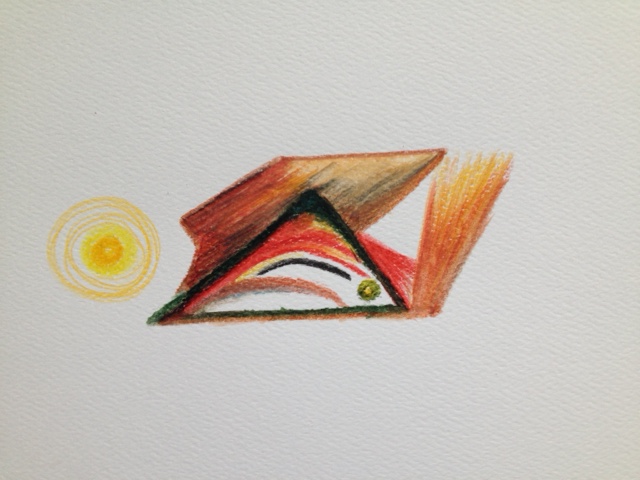
For those of you who don’t know, “Praying in Color” isn’t my idea. I got the idea from a book of the same name. The idea is that you take out your pens or colored pencils and you doodle. You pray beforehand, with a specific prayer intention. It can be a prayer for a friend who needs it, or something for the world, or a specific question that you have that you need help with. While doodling, answers or feelings come back.

As for me, I write down my intention at the bottom on the back, and the answers above that. I’ll get answers throughout the process. I use watercolor pencils, and I’ll “paint” the finished piece afterwards if I feel like it. This is a good medium for me because it is quick – I can get something in about ten minutes. It is simply a way of accessing a different part of your brain so that God can get in.

I drew this piece on 9-23-13 after my second visit to the chiropractor. That is when I found out I have scoliosis, and a lot more visits (and a lot more expense) in my future. This is what I prayed about. How can I afford this? How do I deal with the pain? I feel like I never get ahead – that the moment I gain, something comes up and I go back again.

pray 9-23-13

The answers –
We hold on to the shore because we are afraid.
Even if you have nothing, you still have something.
This teaches us that good (art) can come out of bad situations.
“How many reminders do you need to know that I am with you?”

Sometimes the answers are just feelings, and sometimes they are direct words. Sometimes I write more than this, but I always know when it is over and time to stop. Here are my reflections on the answers:

Change is frightening to us, but if we don’t let go of the shore we’ll never learn how to swim. We are funny creatures – we hate change, but we also get bored easily so really we want change. We are never happy.

There is always something to be thankful for. Find it. Celebrate it. Even if you are without a house, you still have your life and your mind. If you aren’t thankful for what you have, how will you be thankful for anything else? Be thankful, and everything opens up.

Good comes out of bad. Pain is a great teacher. It focuses us. It limits us and forces us to decide what is important. Bad childhoods can result in careers where we choose to serve others, because we understand their pain. If everything stayed even all the time, we’d never have to grow or stretch or get stronger.

The last one says it all. God is constantly with us, and we constantly forget. God will never forsake us.

These are for sale if you are interested. Please comment with your information if so. They are about 4.5 inches by 6 inches, on watercolor paper. The price is whatever you would like to offer.