Filtered water (making ourselves better makes the world better)

I’m having memories from when my Mom was dying from cancer. I’m not sure how much I can trust these memories. After all, they are nearly 20 years old.

But then I think about water. Spring water starts off as rainwater. It seeps down into the rocks and earth and hangs out for years, hiding out among dark caves and moldy leaves. It changes while it is percolating in the earth. It gets filtered. It gets cleaner. The impurities of pollution are stripped out of it and then it comes forth from the earth as spring water or a mountain stream. I think memories are the same way. They need time to percolate and filter.

When my Mom was sick and dying, I found it strangely easy to be with her in her pain. She would have a problem that required a nurse, and they would often take a while. Perhaps they didn’t feel her problem was an emergency. Perhaps she was last on the list because she was on Tenncare. It didn’t matter. She was having a problem and the nurses weren’t coming and she was getting anxious. Her anxiety was causing a further problem. Her tension from her anxiety was causing more pain for her.

I realized something at that time. I wasn’t the one who was in pain, and she was modeling after me in those moments of uncertainty. When I was anxious along with her, she would become more anxious. She needed someone to show her what to do. So I was calm. I intentionally kept my expression calm. I used a soothing tone. And she calmed down. Freaking out wasn’t going to make the nurse come faster. By my actions she felt better, even though I couldn’t fix the leaking chest tube or figure out how to make the morphine drip work properly.

There was something in that moment where I intentionally chose to remain calm for her that was healing. It was healing for her and for me. It taught me that our reactions to events are often more problematic than the events themselves.

I once had a summer job where I worked at the Kennedy Center in Washington, DC. I drove in every day from Centerville, Virginia. It was maybe 20 miles but because of DC traffic it was an hour and a half coming home.

One day I was sitting in my car on the way home, stuck in the usual traffic jam. I wasn’t tired or hungry, just bored. I made the mistake of looking at my watch. It told me that it was 6:30 pm. Suddenly I felt tired. Suddenly I felt hungry. I hadn’t felt that way just a moment before.

I realized something, and it is the same something that I’ve seen in Buddhism. Our minds trick us. It is better to be here, now, in the moment. The goal of Zen Buddhism is not to find enlightenment while peeling the potatoes. The goal is to peel the potatoes. I stopped wearing a watch from that day on. I have a clock. I pay attention to time so I’m not late. But the clock doesn’t tell me how to feel.

I catch myself all the time forgetting this secret. And then I remember and I pull myself back in. And somehow it seems to help others. I’m not caught up in the tornado of chaos with them. At least one person isn’t freaking out. And that sense of calm spreads, just like how it did with my Mom. You, just by being mindful, can be a healing force. Just by being fully present you can make the world better. It seems backwards – help yourself, and you help others, but it works.

Here are some of the ways I use to be mindful of the now and not get distracted. It helps to not watch TV. I’m only vaguely aware of popular culture. It isn’t real anyway, so I’m not missing anything. I read the news online so I can read what I want in the amount that I want, rather than having it force-fed to me via the evening news.

Regular exercise helps. Exercise isn’t a bad word, and it isn’t an extra. We have to move to prove that we aren’t plants. It burns out a lot of stress, and it makes us stronger and better able to handle life physically, emotionally, and spiritually. It doesn’t have to be bodybuilding at the gym – it can be walking every day and some yoga.

It is also essential to be careful about what we eat – as Michael Pollan said in his book Food Rules – “Eat food. Not too much. Mostly plants.” The book explains it better, and if you can get the edition that is illustrated by Maira Kalman, even better. (Her illustrations are beautiful and wise.) Greasy, fatty food weighs us down. And, being mindful of what we eat helps to bring us into the present. We are intentionally making ourselves better and healthier, bite by bite. Another thing I’ve learned recently is also from our Zen friends – chew your food thoroughly. We modern people tend to inhale our food. Chew your food at least 20 times and you’ll find out you are eating more slowly and better digesting your food. You’ll probably also find out that you feel full with less food. You’ll save money and lose weight.

You can make the world better through your choices. You can make the world better by making yourself healthier. It is win-win!

Now, I forget all these things all the time, and fall out of my routines. This is totally normal, so I suspect that you do the same. Just get back on when you remember and go on from there. We are all here to remind each other how to do this thing called “being human.” Sometimes I think I write these posts as reminders to myself on how to do it. I encourage you to be your best, and through that, know that you are bringing healing to the world.

Jesus in disguise.

Mother Theresa suggests that we try to see Jesus in every person. She said that it was her privilege to wash Jesus’ festering wounds and to feed him as a tiny abandoned child with AIDS. Essentially, we should serve each person as if they are Jesus in disguise.

I’ve tried this for the past few years at work and it is pretty amazing, and yet very difficult. Every now and then I want to say, hey, Jesus, can you stop being so weird?

It isn’t all weird. Mostly, there is a lot of good in this practice. Because I have changed how I approach people, they have changed towards me. I used to have a lot of people yell at me. They would come in already loaded up with problems, and they were ready to share. Anything and nothing would set them off. It always seemed random when a person would yell, and I began to get very hesitant around everyone. I expected to get randomly yelled at, and they would read my fear and oblige me.

So I tried Mother Theresa’s approach, with a little bit of “The Dog Whisperer” thrown in. Work with me here. People are animals. We are civilized animals, mostly, but we are still animals. We forget this. We respond to the same cues that animals respond to. So showing calm, positive energy is going to result in better results than showing fear.

Being interested in and calm around every single person I help is honestly overwhelming to do for hours at a time. I am a huge introvert. I like people and am constantly fascinated by them, and I like serving them. But I need a lot of quiet and calm to recharge after a day at work.

The difference in patron’s reactions to me is amazing, though, so it is worth it. It is as if I’m playing a “hide and seek” game. I’m looking really hard for the good, the light. I’m trying to see their soul, the spark of God that is within them. They respond to my curiosity by opening up. Their light may be buried under years of abuse or self-hatred or illness, but it is always there. Where there is life, there is light. Just searching for it can bring it out and make it brighter.

Jesus in disguise can be really overwhelming, however. Gender and age are illusions. She can be lonely and I’m the only person she’s got to talk to. He can be a new widower and on the brink of tears while he is signing up for his library card. He can be really smelly because he walked to the library on a Tennessee summer day because his car broke down and he doesn’t have air conditioning at home. She can be a young mother with more children than she has patience for.

Jesus can be a real pain when he is like this. I want to say, hey, Jesus, can’t you show me your nice side sometimes? Why do you have to be cranky and smelly and mean? Can’t you just be normal for a change?

And then I pray again. I ask him to show himself to me again. I ask him to work through me. I ask that my words be what this cranky, smelly, mean person needs to hear. I ask that I’m able to offer them a bit of healing in the time we are together. I try to be mindful and fully present.

It is hard. But it is everything. It is what each of us is made for, this reality, this presence, this moment when we stop being machines and we start being human. It is beautiful and real and aching and sad and overwhelming and everything we need to make this place we call Earth a home. Because ultimately it is all about a connection between people. It is about incarnate love, this love made real and tender and fragile and beautiful.

But it sure would be nice if Jesus would take a bath and use a breath mint every now and then.

Notes from the Dalai Lama’s talk, May 19th, 2013

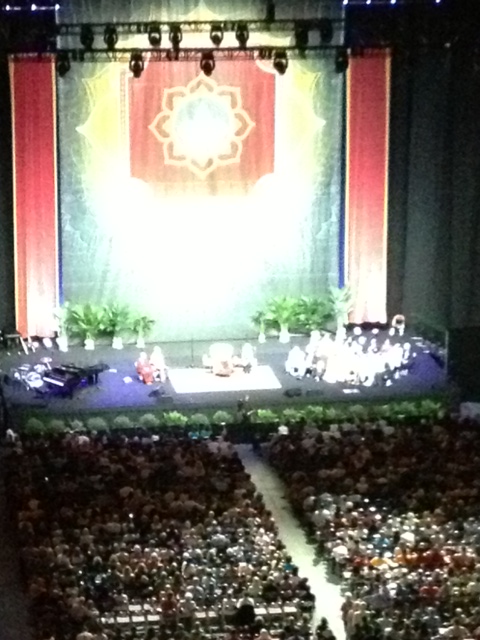
I went to Louisville, KY on May 19th to hear the 14th Dalai Lama speak on “Engaging Compassion”, along with about 14,000 other people. These are my notes from that public talk. My comments are in parenthesis.

This is the century of dialogue. More and more people from all over the world and all religions are talking with each other.

America is the leader of the free world, so it is possible to lead the world in compassion.

It would be good if America could import its democracy style to China.

He is Buddhist, and he prays every day, but he accepts the limitation of prayer. Real effect comes through action.

To make the entire world better, start with yourself. Your actions make a difference.

If you have respect for other’s well-being, then there is no room for violence.

Peace starts within you, now. It creates a ripple effect.

When we are born, our survival is based on other’s care and affection. This continues to be true as we get older. The survival of humans and the planet is based also on care and affection from others.

If you have a healthy mind, you will have a healthy body. If you have a peaceful mind, you will show compassion. If you show peace towards others, you will be healthy. Showing compassion is a benefit to yourself as well as the world. Anger is self-destructive. The counter force to anger and hatred is tolerance.

Attachment leads to bias and a loss of objectivity.

It is possible to have faith in your tradition, and still have respect for all traditions.

On war – If one person kills another person, he is a murderer and goes to jail. If a soldier kills a thousand people, he is a hero. (Killing is killing, no matter who does it.)

The biggest moral and social problem is the gap between the rich and the poor. It is similar to the caste system in India.

There is a oneness within all human beings. We all have the right to be happy.

It is possible to oppose another person’s attitude but still love them.

Instead of anger, have pity. (It is more compassionate to feel sorrow at another person’s bad choice of behavior than to be angry.)

Have a genuine concern for other’s well-being.

Separate action from actor. Oppose the action, forgive the person. People are not what they do.

We must respect all of God’s creation. So environmentalism should be part of your faith.

There are over one billion non-believers, so we must find different ways to help them to understand how to have a “happy life and a happy body.”

In India, “secular” means “respect for all religions,” as well as “respect for non-believers.” (It is not negative like in America, where “secular” means “not religious.”)

Thomas Merton was a bridge between Buddhist and Christian monks. If you follow your own tradition, you will discover that we are all following the same practice.

Politically, His Holiness the Dalai Lama is Marxist. He believes that in capitalism, if profit is the goal, then humans suffer. Humans are more important than profit.

(Edit) – I’m adding some pictures to this, since I’ve figured out how.

On the way to the event –
dl6

Waiting outside to get in. We got there about an hour early. There was a long line past us.
dl7

Seen outside the auditorium.
dl8

Our seats were really really high up. The rest of the crowd has not arrived yet. We had time to get and eat our lunch there.
dl9

The Dalai Lama has arrived. The tiny red dot in the center is him.
dl1

dl2

On the Jumbotron.
dl 3
dl4

dl5

Compassion

Compassion is about love. It is not only about feeling love, it is about showing it and making it real. Prayer is great, but action is greater.

Part of showing love is being aware that every single person is worthy of love. This includes the nice people and the not so nice people. Jesus tells us that it is easy to love the nice people. The real test is how do we treat people who are mean?

A lady asked His Holiness the Dalai Lama when he was in Louisville, KY on May 19th, 2013 how to be compassionate towards the Boston bombers. I think his answer can be used for any situation where a person has been violent. He said we must separate action from actor. The person is not the deed. The action is bad. But there is hope for the person. The person made a bad choice. The person is still deserving of love.

Jesus tells us we are to love our enemies. Buddhists tell us we are to do the same. I’ll add that perhaps if the person had been shown more love in his or her life, she or he would not have been violent.

All behavior is communication so the behavioral manuals say. Children will seek attention in a negative way if they don’t get it in a positive way. What can we do, in our own actions, to make this world a better place? Every single act of kindness can literally save the world.

Remember the story of Abraham bargaining with God that Sodom and Gomorrah would not be destroyed if just ten good people lived there? Sadly, ten good people weren’t found. But how do you know that the same situation isn’t about to happen with your town?

This gives a whole new meaning to the line “Be good for goodness sake.” Your goodness isn’t about getting you a present from Santa Claus. It is about saving the world. It can bring about true healing.

So how can you show compassion? Start off with not being judgmental. You never know what the other person has gone through. Be kind to everyone. Smile. Complement them. Think of the other person’s needs. Put yourself in their shoes. Learn about other faiths and cultures. Learn how to say thank you in other languages.

Think about what you say you believe and what you do. Are they in harmony? If you believe that it is important to take care of the earth, then you need to recycle, and use less gasoline. Buy less stuff. Consume less of everything. Be mindful about your actions – what are the repercussions of what you are going to do, what you bought? Who is affected? How does this affect the earth? Everything is connected.

Being compassionate is about respecting the idea that every person is on their own journey. It is about being patient and kind with everyone. It isn’t about converting others to your belief system – it is about sincerely practicing your own.

Action and Actor

The Dalai Lama, in his address in Louisville, Kentucky on May 19th, 2013 talked about the difference between “action and actor”. The person is not what they do. While the action may be bad, the person themselves is not. I liken this to when Jesus said “Forgive them, Father, for they know not what they do.” Jesus was dying on the cross. It was a painful, degrading, public way to die. His disciples had left him. The soldiers were gambling for his clothing. In that horrible, embarrassing, difficult moment he showed compassion. He understood the difference between the action and the actor.

Forgive the person. They can’t help it. They would if they could.

Every single person is made in the image of God. Every single person has within them the light of God. It is through the will of God that each one of us continues to exist moment by moment, heartbeat by heartbeat.

Consider Judas. He has long been considered the bad guy in the Gospel story, but his role is essential. There are no saint medals for him, there is no special day set aside to commemorate him. But if it weren’t for Judas, that part of the prophecy would not have been fulfilled. Jesus knew that he was going to be betrayed by Judas, and forgave him. How many of us would be able to forgive someone who was going to betray us?

I have to confess that I have a soft spot in my heart for Judas. He was a pawn. God made him do what he had to do. When he came to his senses he killed himself. What a horrible thing to realize you have just sold out the person you believe to be the Messiah, the Savior, the Son of God.

Something about this story appeals to me personally. I have long wrestled with my calling and felt that it was not real. Who would listen to me, a bipolar lady who says she hears from God? God has enough crazy people who say they are His followers. The Christian faith doesn’t need any more crazy people. But if God can use someone like Judas, the most hated disciple, to bring forth what needs to happen, then who am I to argue?

We are told that if you trust in God, you know that all things work for good.

All things. Even the stuff that looks wrong and crazy and weird. Even the acts of terror. Even war. Everything is in God’s control. If we really believe that “He has the whole world in His hands,” as we teach small children to sing in Sunday school, then we need to start actually acting like we believe it.

Part of that is found in not judging anything. Not just not judging people, but not judging ourselves and events. Not deciding if things are “good” or “bad.” This is very Zen here. But it is all about accepting everything and everyone and every moment exactly as is. Without judgment, without trying to change what is, and without trying to escape.

We are told that every moment is the guru.

Every illness, every failing test score, every unwanted, unkind word, everything is our teacher.

Even Judas.

God bless us, every one.

The Test is Rigged.

The test is rigged.

There is no way you can win with the idea of original sin. If you say that humans are faulty from the very beginning, broken and sinful down to our very core, then there is a problem.

This mindset causes dependency. It creates in people a feeling of never being good enough. That they never will measure up.

Let’s go with the Adam and Eve story. They ate from the tree of the knowledge of good and evil before they even had the knowledge of good and evil. Thus they had no way of knowing that what they were doing was wrong. So it wasn’t fair to punish them.

Nothing that is from God is bad. So we were made with free will and curiosity. We are finite where God is infinite. We are mortal. We break. Things aren’t effortless for us. We need a little help. We can’t understand and follow all the rules.

So then Jesus comes along and tells us to love. He breaks down all the rules into two – love God, and love your neighbor. Seems simple enough. Then he pays our tab for us – our debt of sin is paid. Some people need to hear that. But perhaps what he really was doing was just saying that we are fine the way we are. We aren’t perfect and we never will be. We can’t ever win, because the game is fixed. He’s letting us know that we are ok. We aren’t to blame for our nature, because it is just the way we are.

Now would be the time that somebody will quote from Paul or point out that “whoever is without sin” gets to cast the first stone. Nobody gets to throw stones. Because throwing stones isn’t showing love. Thinking you are better than somebody else isn’t being loving.

Rather than load people up with guilt about their sin by making them say the confession every week, why not turn it around and teach people different ways they can be more loving and compassionate?

Every week, every day, every minute, we aren’t going to measure up to the idea of being perfect. We never will be perfect. We can’t be. That isn’t human nature. Focusing on our sin keeps us pointed in the wrong direction. We need to learn how to be better at what we can do, rather than on what we can’t do.

We say that Jesus paid for all our sins. So why do we keep pulling them out and focusing on them? This seems pathological.

Mother’s Day isn’t always flowers and candy. Sometimes it is painful.

Today is Mother’s Day in the United States. This is seen as a day of happiness and joy, where we celebrate our Mothers. Moms usually get taken out to supper at a nice restaurant and get gifts of flowers or candy or jewelry.

But Mother’s Day isn’t all beautiful and easy. We pretend like it is. We fake it for the purpose of keeping the peace. We do that a lot. We don’t like to tell others that we aren’t what they think we are. We don’t like to admit our weaknesses.

There are those whose mothers have died. There are those who had a terrible relationship with their Moms and don’t talk to them anymore. There are those who never knew their Moms.

Then there are women who want to be Moms but can’t. There are women whose children have died. There are women whose children are estranged from them. There are women who have children and wish they didn’t.

What if your mother was abusive? What if she was an addict? What if she is the reason for your therapy sessions? What if your mother died when you were very young? What if she is still alive and very feeble and can’t remember who you are while you take care of her?

Mother’s day is hard for many of us. For many people it isn’t flowers and candy and hearts. It is painful. It is very sad. But we often fake it. We pretend that everything is fine. We don’t tell others our painful truth because we don’t want to bother them. We think we are alone in our pain so we don’t want to trouble others.

But what if everybody else is faking it too?

I was at a Chinese buffet recently and the manager and I have become friendly. He asked me what my plans were for Mother’s day. I decided to be honest. I tried to be gentle with it, because this information isn’t easy for others to hear sometimes. I paused, and told him that my Mom died when I was 25. This turned out to be a good thing to say. It somehow gave him permission to be honest about his mother. She had died when he was very young. She had cancer, and one day had gone to take a nap and just didn’t wake up. To this day he still misses her and is confused how someone can die so simply, without drama.

We were able to share a moment of being real together. In that space, in that time, we were real, and we were vulnerable, and we were both sad. But in our shared sadness we were stronger. We no longer had to carry our sadness alone. We knew that we weren’t alone. There was real beauty in that honesty and vulnerability and sadness.

Why do we fake who we are? Do we do it because we don’t want to rock the boat or upset the apple cart? Perhaps if we were more honest we’d actually be doing the world a favor. By being ourselves, we’d be giving other people permission to be themselves.

We will fake that we are straight, or that we live in a happy family, or that we enjoy our jobs, or that we like pop culture, or that we have lots of friends. We fake that we love what we don’t, and pretend that we don’t like what we do.

All this lying causes pain.

Perhaps we aren’t even aware of how often we fake being ourselves. It is often when people are faced with their own mortality that they open up and decide to be who they really are. Sometimes then it is too late to do anything about it.

So let’s try something. You are a mortal being. You are dying, every single moment. This life is an illusion. It is temporary. All the stuff you have is temporary. Nothing is permanent.

Yet, every single moment you have the choice to live. Every single moment you have the ability to move towards life, and be the person you were called to be. Be that person. Choose this time, now, while you can.

I offer you the best Mother’s Day gift ever – the permission to be who you were born to be, who you were created to be by our Creator.

Interfaith/non faith Christmas dinner prayer

This is useful if you have a family gathering where not everybody is on the same faith-page. I used this at Christmas at my in-law’s house. The words aren’t original, but the assembly is. I put the references at the bottom. Please let me know if you use this prayer at your gathering and how it was received.

Oh, Thou, the sustainer of our Bodies, Hearts and Souls –

We pause this day, joining with others across the world

who, like us, yearn for peace and harmony and understanding.

We pause to celebrate the joy of people coming together;

serving one another with common goals and concerns.

We pause to ask Your blessing on this, our time together,

on gatherings like ours, across our land and across the world.

May we be thankful for the food we are about to receive.

May it be blessed to our use,

and may we be dedicated to the service of that great family of all souls.

When there is peace in the heart, there will be gentleness in the person.

When there is gentleness in the person, there will be fairness in the nation.

When there is fairness in the nation, there will be peace in the world.

May we be centers of peace and help speed the day where we all may be one.

Amen.

——————————————————————————————————-

I assembled this from prayers from the book “For Praying out Loud” by L. Annie Foerster,

specifically “We Pause to Give Thanks” by Laurel Hallman, at a UN peace gathering,

and “When There is Peace in the Heart” by Richard Gilbert, Center of Peace Invocation.

I used a Sufi prayer for the address to the Divine in the first line

.