Writing and beading – on reusing ideas

Every now and then I think that I shouldn’t start a post because I think I’ve written about it before. Sometimes I have, and I’ve forgotten. Sometimes I have, but I don’t feel like I’ve fully explained my point. I very well might have already written on this exact topic of writing about the same thing multiple times. Wouldn’t that be ironic?

And then I realized it is OK.

I do the same thing when I make jewelry. I don’t use all of a strand of beads up when I make a necklace. I have some left over. I use them again with other beads and I get a different effect. Or I’ll not quite get across the look I was going for and I’ll try again with another creation.

Rarely am I able to get across in reality what I envision in my head. If I can’t do this with beads, than how can I possibly do this with words? If I can’t properly envision how the beads I have right in front of me are going to look together, how can I envision how ideas, which are amorphous at best, are going to look together?

While I don’t want to waste my time writing the same topic over and over, I’m learning that part of the process of being a writer is to just write. Even if I intentionally write about the same topic, I’m going to write about it differently every time, because I’m different every time.

Figuring out the answer to a question is like trying to open a closed door. You’ll try different ways to get in.

Sometimes you can just knock and someone will let you in.
Sometimes you try the doorknob and it opens.
Sometimes you have to pick the lock.
Sometimes you can’t pick the lock so you have to look under the door.
Sometimes you go to see if there is an unlocked window on the side of the building.
Sometimes you have to bring a sledgehammer and just get in by brute force.

And sometimes it is about understanding that the “answer” is just the answer you got right then, and it isn’t THE answer, and it is OK to work on that door again, another day.

Duck

Imagine a mama duck and all her baby ducks. They follow behind her, trusting that she is leading them the right way. But she is just leading them the same way that she was lead, and so on.

And what if they are all going the wrong way?

So many people are like those ducks. Just following, blindly trusting. Because the people before them, whether parents or teachers or ministers or elders, walked in this path, it must be right.

Not necessarily.

Who walked that first path? How did she or he discover it? What made her or him go that way? What made others follow in that path?

Whether it is a clothing habit or a diet trend or a way of thinking makes no difference. A path is a path is a path.

Where are you going? Who are you following? Do they know the answers to those questions?

On manna and writing

I have more “seeds” for posts than I have time to write. I carry a notebook with me all the time. I have a list of ideas in my phone as well. Any time I get an idea that I think is worthy of expanding on later I’ll put in one of those places.

Sometimes I get to write from these idea-seeds.

It seems that I never run out of things to write about. While I have those storehouses, I don’t often need them because when I find time to write I always have another topic to write on. Sometimes two or three.

It is like I am storing them up in case I hit a dry spell.

And then I’m reminded of the story of manna in the desert. God provided food for the Israelites in the form of manna. Yet he provided only enough for one day, except right before the Sabbath, where he would provide enough for two days. Every day they were to gather up just enough for that day. Every day after the gathering time the rest would disappear. They had to trust that God would provide for them the next day, and the next day, and the next day.

If they gathered up more than they could use for the day, they got sick.

So by saving up all these ideas, am I hoarding? Am I not trusting in God’s providence? Or am I being a good steward of what I am given, by keeping it for later?

Anne Lamott says to keep a notebook at all times, and write down any and all ideas. She jokes that if you don’t, she will, and she’ll get the idea and make money off of it. She also says that by keeping a notebook you are letting the Universe know that you are open to ideas and are a good place to send them too. I certainly can attest to the truth of that. The more I keep a notebook, the more writing ideas come to me.

I don’t always use them, but when I do, I’m grateful. Sometimes, just keeping a notebook helps me stay focused. Sometimes an idea will just not stay quiet until I write it down. I tell it that “I’ll get to you later” by writing it down. Sometimes I’ll use the idea in a post with a few other ideas and not even know I’ve already jotted it down in my notebook earlier. That is OK too. Better to have it in two places than none.

A pain in the gut.

A regular patron came in recently. Well, by regular I don’t mean he is normal. I mean he has been in often for the past several years. His paranoia has gone to new heights. He makes my former boss’ end of the world preparations look like child’s play.

He has a thirty year supply of seeds. He is raising his own food, and not just vegetables. He is raising sheep and goats and chickens. He even has a beehive.

Or at least I think he has all this. He might just be preparing to be prepared. It is in the works, at least.

He believes that you can’t trust anyone or anything. He believes that the government is out to get us all. He might be right. Who knows?

I’ve noticed that all these preppers don’t seem like happy people. Somehow all of this stocking and storing, this training and testing, doesn’t seem to be making them content. Somehow, instead of getting a sense of calm that they have everything under control and their lives are free from worry about other people and their perceived lack, they seem even more wound up.

I understand some of their desire to fend for themselves and not trust other people. When I was in college, we had to do group assignments. The group had to do the research and work on a project. Rarely did I get to pick the group I was in. I usually ended up doing all the work because I didn’t trust the competency of my fellow students. I didn’t want my grade to be adversely affected by their slack.

So the preppers are doing the same thing, but instead of their grades being affected, it is their lives. They think everything is going to hit the fan and it will be every man for himself.

I can handle only so much of this kind of talk. He has shared some of his theories with me in the past about how things are going to go south and I always feel physically bad afterwards.

I want to be present for people. I also want to be open. I want to study them as well. Sometimes I have to allow myself into situations that are uncomfortable for me in order to personally grow and learn.

But this time was different. Perhaps it was a cumulative effect. Last night’s rambles weren’t especially paranoid, but somehow I was affected adversely.

I started to feel a pain in my stomach shortly after our conversation ended. Now, it might help to know that I have a hernia. I thought it was acting up. I got it when my Mom was dying and I had to lift her from her bed to get her to the bathroom. I remember the feeling of my muscles in my abdomen snapping from the strain. She wasn’t especially heavy her whole life, and she was even less so then because of the chemotherapy, but I wasn’t trained for that kind of lifting.

I’ve strengthened my abdomen quite a bit in the past few years with water aerobics and yoga, but that kind of injury never fully heals. I’ve learned that if I do a forward fold it usually helps.

Not so in this case. I waited a bit, and then went to the bathroom. While sitting there, I thought about this pain. It kind of reminded me of the pain I had when I was in my first year of college. That wasn’t a pain from any physical illness, but it manifested in a physical way. It was a pain from stress, from anxiety, from fear. It was the pain of being too far away from everything I knew and facing a whole lot more of the unknown.

Then, I went to the student health services and they, in their ignorance, gave me an anti nausea pill that knocked me out for half a day.

I didn’t want to be unconscious, but I also didn’t want to be in pain.

So I prayed. What do I do, Lord?

The answer? A hard exhale. Just like in yoga class, the ocean sounding breath. Just like one teacher says “Fog up that invisible mirror in front of your beautiful face.” So I did it. Huhhhh.

And I felt instantly better. I did it a few more times and the pain was all gone.

And now I think I’ll have to tell that patron that I can’t listen to his prepper paranoia any more.

Just like finding out that I am allergic to a certain food and I no longer eat it because it makes me sick, I have to do the same with people and ideas. If they make me sick, don’t let them in my head.

But it is also good to know that the answer to every question is just a question away.
Half prayer

I was sitting at the end of my neighborhood, waiting for the light to change. It is a long light, and that intersection marks a change in the traffic from light to heavy.

I have started to use that time to pray.

This time I was filling up the space with my words, and this suddenly came to me. Be still. Let God fill you with God’s words instead.

Prayer isn’t just about talking to God. It is about letting God talk to you.

In my desire to pray, I was doing it all wrong. Or rather, I was doing it only half right.

Goose, gander

“What is good for the goose is good for the gander.”

While this phrase actually refers to sauce, it can also refer to life. If you want to learn if something is sexist, put each gender’s face on it and see what it looks like. If it seems odd, then maybe something is up.

I’m specifically thinking of books right now, but you can do this with anything.

Teen girls are bombarded with books about how to get and keep a boyfriend. How to lose weight. How to do their makeup and hair. How to dress.

There are no similar books for teen boys.

If they read at all, the books they read are science fiction. Boys rarely read books for fun. This needs to be addressed, but it isn’t the topic of this post.

So if it is OK to teach girls that their focus in life should be on their image, and subsequently, how to catch and keep a mate, how come it isn’t something we teach boys?

Maybe we shouldn’t teach girls this at all. Maybe we should teach them good character skills rather than good cosmetic skills. Maybe instead of teaching them how to dress for success, we should teach them how to be a success. Maybe instead of teaching them how to find a mate we should teach them how to find themselves.

“Computer illiterate”

Fairly frequently, people come into the library and they tell us that they are “computer illiterate” and they ask if there is someone who can help them with the computers.

They don’t ever tell us that they are illiterate and want someone to read the books to them.

Several years ago, they would say this with a certain amount of pride, like it was a good thing. They would say it as if dealing with computers was something that other people did, and they were above it. They would say it as if computers were just a passing fad that they could ignore.

They’ve started to realize that they aren’t going away, and that being “computer illiterate” isn’t such a great thing.

The library does teach classes in computers. They are free, and open to everybody. Our system also has books and DVDs that teach you how to use a computer if you can’t get to one of the classes.

The odd part is that often the people who say this are those who have to get on the computer to apply for a job. These days, a lot of job applications are online. No paper, no typewriter. It is all online, in part because the job itself uses computers. If you can’t fill out the application, you probably can’t do the job.

It is a hard, cold truth.

These days, being computer illiterate is the same as being illiterate. It is out in the cold, left behind, stuck with a low paying job.

The funny part is that these same people will say that their seven year old grandchild does better at computers than they do. The funny part there is that the only reason that a seven year old can work it is that the five year old doesn’t know he can’t. He just looks at it and tries. He thinks about the options and gives the best available one a try. If it doesn’t work, he tries something else. This is how anyone learns anything. Try. If it doesn’t work, try something else.

Maybe they should get their grandchildren to teach them how to work a computer, and for that matter, life in general. Maybe they have forgotten that the secret to everything is to give it your best guess and see what happens.

Knitting, sewing, and the relay race of knowledge

My Mom tried to teach me how to knit. In a way, she did. She taught me how to knit insofar as she taught me how to move the needles so that I added to the piece.

But she only taught me the fun part of knitting. She didn’t teach me how to cast on (to get started) and she didn’t teach me how to fix the problem when I dropped a stitch or picked up another one. Most of the time I didn’t even know I had a problem. I certainly didn’t learn how to prevent it.

Part of being a good teacher is making sure your student can do everything on her own. If she still needs you around then she hasn’t really learned anything at all. The goal is independence.

I had the same problem with her and sewing. We had an old Singer sewing machine that was in a standalone cabinet. It was a huge piece of furniture. While it was cool how the machine folded up inside this thing that served as a sideboard when it wasn’t in use, it wasn’t cool how it worked as a sewing machine.

Of course, I didn’t know that the problems I was having were the machine’s fault and not mine. I thought that when it would jam up it was because I did something wrong, and not because it had a faulty design.

The problems were that my Mom didn’t tell me this, and that every time there was a problem she would fix it for me, rather than teaching me how to do it myself.

After she died, the sewing machine became my nemesis. A friend had taught me a little bit more about how to sew but I still was having a problem loading the bobbin or with having the top thread get stuck and jammed up with the bottom thread. It seemed like I spent more time fixing problems than sewing.

Somehow I came up with the idea of buying a used, portable sewing machine rather than getting that one fixed. It think it was cheaper to get a used one that works than fix the one I had. The new (-ish) one came with a manual. With pictures. I read it and understood how a sewing machine worked for a change. Somehow in time I learned that the Singer sewing machines were known for bobbin and thread problems. If you have bobbin and thread problems, you don’t really have a sewing machine.

I learned that my problems with that machine were not because of me. I learned how to work my new machine. I learned how to sew, for real.

To be a good teacher, you have to teach the good and the bad. You have to show the student the fun parts of the subject to get her interest, sure, but you also have to show her everything else. She has to be able to do it all on her own. Ideally, you’ll teach her everything you know, all your tricks and tips, all your hard earned knowledge, so that she will then be able to learn even more and pass that on.

It is the only form of immortality we have.

We can’t live forever. Our lives are far shorter than we realize. But our knowledge can last far beyond our bodies. If we pass it on well, then we have improved the lives of everyone who lives past us.

It is like a relay race. Every person does her best so that the next person can do her best. The team gets further along with each person who pushes herself. But if we are stingy with our knowledge or are just inept, we might as well not have been in the race at all.

Pasta Italian-ish

food

-Ingredients-

Pasta –8 oz., your choice. I like alphabet pasta.

Capers – about 20. Use some of the vinegar they are in too.

Cilantro – fresh, half a bunch, just the leaves.

One large tomato, diced. I used an “uglyripe” heirloom tomato. You want the meat, not the seeds.

Two cipolline onions, diced, or a quarter of a white onion.

Asparagus – half a bunch, cut into inch and a half pieces.

Green beans – a handful – cut into inch and a half pieces. Remove the tips.

Italian seasoning -to taste

“Miracle blend” – or any other non MSG seasoning blend – to taste

Butter – about a quarter inch

Wine – about half a glass. I used white zinfandel.

Olive oil – a glug or two to taste.

Garlic powder -to taste

-Instructions-

Boil the pasta per the package instructions. Drain off most of the water. Leave the pasta in the pot.

In a separate pot, steam the asparagus and the green beans, with the asparagus stems on the bottom, the “flowers” in the middle, and the green beans on top. You want to steam the toughest things the longest so they will all be equally tender when you are done.

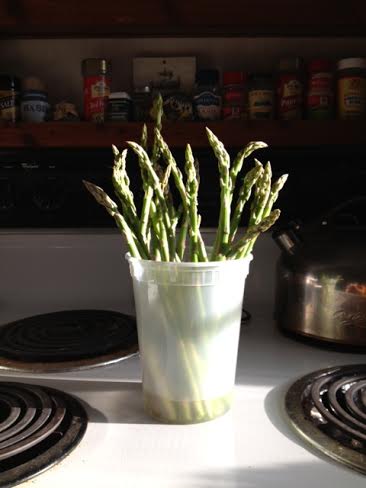
Tip – to get really tasty asparagus, treat the asparagus as the flower it is. Cut off about half an inch of the stems and then put the whole bunch in a cup with water for at least an hour before you cook. The stems will soak up the water and get really tasty and supple.

asparagus2

In a large covered sauté pan, melt butter then add the onions. When they go translucent add the wine, the dry seasonings (garlic, seasoned salt, and Italian seasonings), and the cilantro and the tomato. Cover, and stir occasionally.

When the cilantro and the tomato wilt, add this mixture with the asparagus and the green beans into the pot with the pasta, and dress with olive oil.

Serves four.

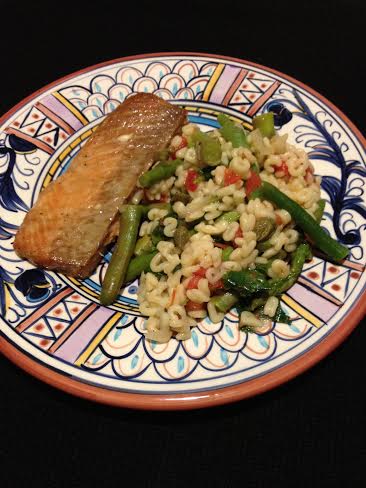
Pictured with “Bourbon salmon” – it is from Publix. Very yummy, and half a fillet is a serving.

I served it all with challah and hummus.