Mixed Messages

“People and things don’t stop our pain or heal us. In recovery, we learned that this is our job, and we can do it by using our resources: ourselves, our higher power, our support systems, and our recovery program.” — From “The Language of Letting Go: daily meditations for codependents” by Melody Beattie

I saw this picture recently.
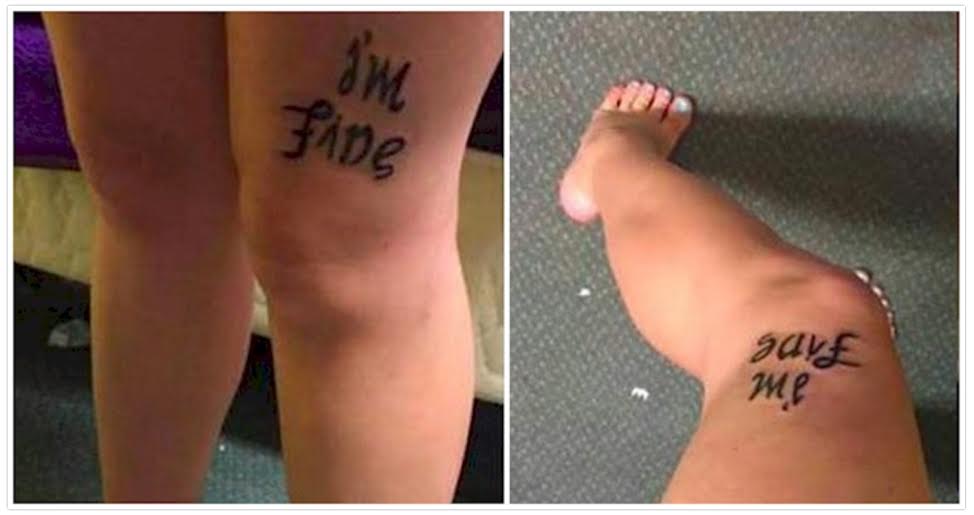
mixed message

The title of the article is “Her tattoo contains a hidden message, and it started an important conversation.” The tattoo is an ambigram – a message that can be read upside down as well as right-side up. In this case, the message is different when read upside down. The normal way it is viewed by others says “I’m fine”, while the way that she sees it says “Save me”.

The article says that she got it as a way of dealing with her depression. It is her way of asking for help. But there is something very wrong about this. It is passive. Help does not come from other people. If you give away your power to others, you will continually feel powerless.

I find it significant that “Save me” is the view from her perspective. Maybe she will finally read it that way – that she is the only one who can save herself.

She is the one who makes choices.
She can choose
to get enough sleep,
eat healthy food,
exercise,
avoid negative people,
find a job that is meaningful,
learn to speak her truth.

She can choose,
and must,
for her own survival.

Being healthy is a choice, and something each person must do for themselves.

Depression is a symptom, not a disease. It is the result of feeling powerless, disconnected, alone. It is a sign of not owning your own power, using your own voice. The way out of it is not to ask others to save you, but to save yourself. If others have to rescue you, you aren’t healed. They cannot do your work for you.

The giving away of power to others is part of the disease, the dis-ease. Ease, comfort, health, comes from taking responsibility for your own life.

You can ask for help to learn different ways of healing yourself, but you cannot expect others to do it for you. You must own your own power. You must be your own best friend. You must save yourself. This is the cure.

Stop being passive about your life.
Stop expecting others to rescue you.

Like water off a duck’s back

I know a lady who is teaching her daughter to be a battered wife.

She doesn’t think that this is what she’s doing, of course. She says she’s teaching her to let things roll off her “like water off a duck’s back”. She wants her to not get riled up by things that happen to her. This is a good idea, but how she is going about it is disturbing.

Her way of teaching this lesson is to tap her daughter repeatedly in the face. The taps aren’t quite slaps but they are close. It is at least ten at a time. The daughter will say “quit it” or try to pull away and the mother will keep doing it. The daughter is about eight. The mom can easily tap her again when she pulls away, so the abuse continues.

I knew something was disturbing about this when I saw it but I couldn’t give words to it. Now I’ve figured it out. What she’s doing is teaching her daughter that she should just accept it when anybody abuses her.

How perfect it will be for a man with low self-esteem to find this girl who has been shaped for him. She will not complain or stand up for herself because her own mother, the person who she supposed to learn from, who is supposed to teach her healthy ways of taking care of herself, has taught her that she is supposed to be abused, and that this is just part of life. Her mother, her authority figure, is teaching her that people will try to harm her and that her only acceptable response is to let it happen.

Poem – This is not a Christmas present

not a present

This is not a Christmas present.
This is hatefulness.
This is the exact opposite
of a present at all,
much less one celebrating
the birth of Jesus.
This is pure aggressiveness.
There is nothing passive about it.
The label is superfluous.
It is quite obvious
what he thinks
about his sister
from how he has packaged
his “gift”.

If this were given to me,
I might set it on fire right in front of him.
I might take it outside first.
I might put it under a steamroller.
I might shoot it with my revolver.
I might tie lead weights to it
and throw it into Percy Priest Lake.

Under no circumstances would I open it.
It doesn’t matter what is inside.
Gold bars?
Enough money
to pay off my mortgage?
The key
to my dream art studio?
A contract
for a personal chef and gardener?

No gift is worth this.
Sure, it wouldn’t take long
to cut through these cable ties.
Maybe an hour.
Maybe a few pairs of scissors
would get destroyed
in the process.
That isn’t the point.

My friend,
I’m telling you
this truth:
don’t take any “gift”
that is given
with this much hostility.
It isn’t worth it.
Walk away from it,
and that person.

That is the best present
you can give
yourself.

New tools

You aren’t crazy, and you aren’t broken. Everything that you’re feeling is normal. The problem is that you’ve spent so much of your life running away from your feelings and using the wrong tools to handle them. This is part of living in this society. You were taught this. It is time to learn something else. It is time to get a new set of tools and learn how to use them.

Maybe you have used the tool of yelling at other people and blaming them for your problems. Perhaps you use the tool of drinking yourself to oblivion or working so hard that you don’t have time to think about what’s going on. One day you might finally realize that these tools don’t fix the problem. These tools may even make it worse by allowing it to grow and fester.

But first you have to relearn what the problem is in order to fix it.

Anxiety and anger and depression are not diseases. They are symptoms of unresolved trauma. They are a sign that something is broken and needs to be healed. Treating them is using a tool on the wrong part. They are what is broken. They are a sign that something is broken.

A lot of us have a hard time admitting that we have suffered from trauma or grief. But trauma and grief take many forms. Any loss can result in grief. Moving to a new town, leaving your old job, or going through divorce can result in grief. Grief doesn’t have to be the death of someone close to you. It can also be the end of something, some event or time in your life. Transitioning from high school to college or college to the adult world can result in grief. It is any change that we are not prepared for.

Trauma does not have to be as big as a car accident or being assaulted. Trauma can be any invasion of your personal space and safety that makes you feel threatened.

Just being aware of instances of trauma or violation in your life is the beginning of healing. You can’t fix it if you don’t know it is broken.

On anger

My grandmother always wore dresses until she didn’t anymore. That time came when she was in the nursing home and she was wearing adult diapers. It was simply easier for the attendants to make her wear jogging pants to help keep them on. I didn’t understand this at the time and so I commented on her pants. I commented on how nice they were and said they must be comfortable. My grandmother looked at me with great astonishment and she said “I’m not wearing pants” and then she looked down at her legs and then looked back at me and stated again “I’m not wearing pants”. Even in the face of reality she stuck with what she had known to be true her whole life.

There are many people who are like this about their anger. When you point out to someone that they’re angry they’ll often say “I’m not angry!” They’ll say that they’re “frustrated” or they’re “upset” but they won’t say that they’re angry. They have all the signs for it but they won’t say it.

I think our greatest problem is that we won’t acknowledge what really is happening outside or inside of us. How can we heal our brokenness if we won’t even admit to ourselves that we are broken?

It is OK to be angry. Anger is a normal feeling. It isn’t healthy to be angry all the time, though, and that can happen when we fail to recognize it and handle it in a healthy way.

Think of anger as needing to go to the bathroom. There is something that is in you that needs to get out. This is a normal part of being a human being. With bowel movements, we are taught as children how to recognize that feeling and to go to the bathroom to eliminate. The bathroom is a safe and appropriate place to take care of this need. If we don’t take care of it in a timely manner then we can end up with physical problems due to having this no-longer needed matter inside us. Or we can have an “accident” and get poop all over ourselves and others.

Anger is just like this. If we keep it inside too long we can hurt ourselves or have an “accident” and spew anger all over the wrong people and in the wrong place. If we don’t do it in an appropriate manner we can make a real mess.

An important part is learning to recognize the feeling. Just like with poop, ignoring it doesn’t make it go away. It will only get worse. But before that, it is important to admit to yourself that anger is real, and it is normal.

What will they think?

Worried about what other people think about you? Constantly obsessed about how your every action will be judged? Do you second and third guess what you want to wear, say, or do, afraid that someone will decide you are lesser than them?

Don’t be.

Here’s the sad part.

You don’t have to worry about what other people are thinking about you because they aren’t thinking about you. At all. They are too worried about themselves, and what others think about them. They don’t have time to even notice you and what you are doing.

Being paranoid about what other people think is the worst form of narcissism. It assumes they care about you. They don’t even notice you.

This may sound mean and dismissive, but that is narcissism rearing its ugly head again. It isn’t about you at all. So go on, living your life free of worry about what other people think.

In the rare case that someone does say something negative about you, think of it this way – they noticed you. So instead of being an attack, it is an affirmation. You affected them. In the big picture, it is a complement to be noticed.

Plus, they are most likely jealous of how unique and special you are. They wish they had the chutzpah you do to stand out and do their own thing.

People who try to knock you down often do it because you simply aren’t them. If you aren’t doing things their way, they think that either you, or they, are wrong. This is a dilemma for them, because it is important for their choices to be right. They will then decide that this means you must be wrong in order to keep their pride intact.

What they don’t get is that you both can be right. Your way, different from their way, is valid for you, and their way is valid for them. Neither one is wrong.

Compassion fatigue and the yetzer hara

Compassion fatigue is a real thing. It is devastating and results in many good people giving up. We forget to take time for ourselves to heal. We give and give and give until we have nothing left for ourselves. We feel that our work is never done.

This is the work of the yetzer hara, the Jewish idea of the “evil inclination”. It says that we have to do it all and save everybody. It says that if we lose one, we’ve failed completely. It says why even try if we can’t fix everybody?

But we don’t fix anybody. We are there to help, and they have to want it. They have to do the real work.

The longstanding idea is that a person has to hit rock bottom to get help, and that they have to ask for it. They have to bring themselves to treatment – it can’t be forced on them.

In a way, this is frustrating. We don’t wait to do CPR on a person who has a heart attack. We don’t ask a drowning person if they want to be rescued. We just do it. We don’t stop first and get them to sign a consent form.

But mental health, often intermingled with substance abuse, is different. To be truly mentally healthy requires not just a change in mindset, but a change in lifestyle. Everything has to shift to keep the process going correctly.

Thus it isn’t up to the caregiver or the facilitator or the mental health provider to “make” the person well. It is up to her or him to keep the ball rolling. The caregiver shows the path – the client has to walk on it.

They have to take their medicine. They have to go to their doctor’s appointments. They have to reduce stress. They have to eat well. They have to exercise daily. They have to get enough sleep. They have to do all the little things that add up to the big thing, the only thing – being stable and sober and well. Balance is hard to achieve. It takes a lot of work.

Getting mentally healthy isn’t like buying a new car. You want to get to “health” and you are tired of walking there. So you want to make a quick change and get there the fast way. You buy a new car and fill it up with gas. But when you get there that way, you still don’t know how to really get there on your own.

It is more like buying a piece of the car, a day at a time. Every day you work closer to the goal. Eventually you have enough pieces that you are able to learn how to put it together. Then you have to get lessons on how to drive it. Then you practice. Finally, you can do it.

It takes years, but all that hard work means that you know how to do this on your own. It means that when the car breaks down, you know how to put it back together. It means you know where the pieces come from. You learn that you have to maintain that car every day or it will break down.

You can’t be driven to mental health. You have to get there on your own.

It should be the goal of the mental health provider to show the client what pieces will work, how to maintain them, and how to use them. They aren’t there to drive the client but to teach them how to drive themselves.

Thus – don’t feel guilty if a person seems stuck on the road. They have to do the work. They have to want to get better. It seems frustrating to watch them struggle, but that struggle is what forces them to make a decision. Work on getting healthy, or go the easy route and stay sick? Pain is a strong motivator to make better decisions.

It is like a baby bird. If you help it get out of its shell, it won’t have built up the muscles to survive. It can’t get help flying either – it has to be strong enough to fly on its own. If you cheat it of the work, it will fail.

Meanwhile, as a caregiver, you have to take extra care of yourself. Don’t get pulled under by the drowning people. Take extra time for yourself. Focus on what you can do, not what you can’t. Focus on your successes. And remember, sometimes you can’t see results right away. Sometimes the result, the reward, of your hard work will “bloom” later, in a way you’ll never see. Trust the process.

Sobriety sucks

I hate being sober. The lights are too bright, the music is too loud. Everything is too much, too fast, too close. I feel too much.

When I’m sober, I feel everything without a filter. Perhaps I have Asperger’s. Perhaps I have sensory processing disorder. Perhaps I’m empathic. Perhaps I’m just human. Perhaps this is normal, and I’d spent so long being altered that I don’t know what normal feels like.

Being sober means that my normal coping mechanism is gone. It was my teddy bear and my security blanket. It was my shield against the onslaught of the world. It was my go-to-thing for everything. If I was happy, I was stoned. If I was sad, I was stoned. If I was with friends, I was stoned. If I was lonely, I was stoned.

I started using it to enhance life. If food tasted good while I was sober, it tasted even better stoned. If a movie was cool sober, it was even more interesting stoned. But then it got to the point that the average everyday wasn’t good enough, and I had to be stoned to do everything. Life was vanilla, and stoned was 31 flavors. Who wants to have vanilla when you’ve had it all?

I don’t like myself sober. I’ve discovered I’m a very angry person. I don’t like being angry. I don’t think it is very ladylike.

So I write, and exercise, and do yoga, and paint, and collage, and bead, and drum. I fill my time with different ways to process my feelings, because I’ve got a lot of processing that has backed up. Instead of having the normal process of feelings go in, get dealt with, and then they go out, I shoved them deep down. I shoved feelings into myself the same way that people shove broken and unwanted things into their basement or attic or storage unit. Eventually, the reckoning time comes and you have to do the work to get all that stuff out of there so you can have room to breathe. It is like poop – if poop doesn’t get out in a timely manner, it backs up and you get sick.

I’ve been sober for four years this time. I say “this time” because I was sober for about the same time, about fourteen years ago. Sobriety, like being messed up, comes in waves. You think the high is going to last forever and it doesn’t. You think being sober is going to last forever, and it might. I’ve given it up, and walked right back. Just like a person in an abusive relationship, I keep going back until I put enough value on myself to stay away, or I find someone new. With sobriety, “finding someone new” just means finding another high – trading alcohol for cigarettes, for instance.

Being sober longer is seen as better, but in a way it is worse. You forget why you left in the first place. You forget how bad it was. You’re tempted to go back, just for a taste. Except a taste is never good enough when you are an addict. One bite becomes a bunch. Next thing you know you are right back where you were, stoned, sick, and stupid.

I don’t want to find another addiction to fill this hole. I just don’t want it to be so big, or gaping. I can feel the wind whistling through me.

Before and after

There is a Zen saying – “Before enlightenment, chopping wood and carrying water. After enlightenment, chopping wood and carrying water.”

Sobriety is much the same way. After you become sober, the problems are still there, but your coping mechanism isn’t. The troubles just trouble you more. You safe cocoon that you spun around yourself is gone. You realize that you got stuck in your own web of lies and avoidances. You realize that you were cramped by that cocoon, not comforted.

But those daily things are still there, those annoyances. You’ve spent years not learning how to deal with them in a healthy way. You are at least a decade behind the curve. Even though chronologically you are an adult, you are a child when it comes to dealing with life.

It sucks. It’s hard. It makes you want to start using again. Dependency groups seem to focus on the disease, not on how to live life. They seem to glorify the illness of addiction, rather than teach new and healthy ways of dealing with everyday and extraordinary stresses.

Sometimes just getting out of bed is a stressor. Sometimes coming home is one too. Sometimes the people you used to hang out with when you used were the only friends you had – and they still use.

So how do create this new life, this life without using? Plenty of people just trade one addiction for another. A lot of ex-drinkers become smokers. I remember one year I gave up smoking pot for Lent, and ended up drinking every day instead. I know a guy whose parents were recovering alcoholics. He loudly proclaimed that drinking was evil, but then every Tuesday when they would go to AA meetings, he would get stoned at home.

Addiction is addiction is addiction.

It isn’t about being a recovering former user. It isn’t about counting the number of days you’ve been without your intoxicant of choice. It is about every day forward and what now.

Back to chopping wood and carrying water.

Sometimes the only way to learn is to just do it, painful though it is. Nobody can tell you how to best live your life. They can tell you how they did it, how they got over the hump. They can offer suggestions. But for you, you just have to do it, step by fumbling step.

Shouldering

I have been having some pains in my shoulder. I haven’t been lifting anything unusual. I haven’t helped anybody move. As far as I know, I don’t have any physical reason for the pain. So I decided to see what Louise Hay has to say about it. She didn’t have anything for “shoulder” but she did have nearby stuff that seemed applicable.

Back – represents the support of life
Rounded shoulders – carrying the burdens of life. Helpless and hopeless
Upper back pain – lack of emotional support – feeling unloved. Holding back love.

We have a winner. I’ve definitely been feeling unappreciated, and that I’m stuck in a no-win situation. I’m trying to offer advice to family members and coworkers and they aren’t listening. I’m watching them fall and fail, and it hurts. I’ve been where they have been and I don’t want them to go through the same misery. I want to save them as step – give them an express ticket out.

But I also don’t want to see the mess.

So some of it is self-less, and some of it is selfish.

Because I spend a lot of time around these people, their pain is my pain. Sure, I know it shouldn’t be that way. I should remember that they aren’t me. I should put up better boundaries.

Codependency habits die hard.

I started to meditate on the meaning. I believe there is some truth to the idea that you can heal physical problems by addressing their emotional roots. But I also think you can address emotional roots by working on the physical problems.

Every time I’d notice that my shoulder hurt, I would sit up straight and think “I am appreciated and valued and loved”.

And then I started to think – why do I need to feel appreciated? By who? Why do I need to have value placed on me by someone else? Why do I feel that I am not valuable on my own?

So that was healing, and painful. The two are the same, often.

If I’m in an “I’ll love you if…” relationship, then that isn’t unconditional.

Sure, God loves me unconditionally. But people aren’t the same. And people are here, every day, in front of me. Sometimes they are so in front of me they are in my way.

Just thinking about it makes my shoulder hurt.

So I sit up straight, and love myself. It is like giving myself a hug. It seems to be working.