Time-slip. Abandoned project #5

Savanna could see the open door, plain as day, but she chose not to walk through. Not yet. It would disturb the counselors. She’d been in this particular asylum for two days now, and wasn’t yet bored. They treated her well enough, as well as could be expected, you understand. A time in the loony bin wasn’t a vacation by any stretch. The food was okay, and the beds were nicer than those in a real hospital, that was for sure. They weren’t hospital quality, of course, but they didn’t have the weird side-rails either.

Maybe tonight she would walk out and look at the stars. They never let the patients out to see the stars, or even the sun. Fresh air was forbidden to them, as if their disease was catching, like it could spread in the air. They were locked away in theory for their own good but really it was for the community. It wouldn’t do to have any sort of weakness on display. It was like how some communities banned homeless people from selling newspapers on street corners out of embarrassment that they were proof that homeless people lived within their boundaries.

She’d walk out as she always did. She would simply walk forward, shifting her vision to the past, back to before the building was there. She’d done this for most of her life. It would get her out of here. It was also what happened to get her into here.

Perhaps her unusual gift was a side effect of her amblyopia. Her eyes hadn’t worked together her whole life. Abnormal vision was her normal. She’d learned to switch her vision from her left eye to her right, because she didn’t have bifocal vision. Her eye doctors didn’t like it one bit that she could switch, didn’t understand it. But it made sense. You make do with what you have. You make it work, even when others think it is broken. If you don’t know otherwise, “broken” becomes a blessing, because it teaches you to see in other ways. Sometimes literally.

While figuring out how to use her (unknown to her) defective eyes, she learned to see the space between time, the shimmering edge between “then” and “now”. These days, Savannah calls this a time-slip, but then she wasn’t aware that what she was doing was any different from anyone else. She could push that shimmering line a little, bend it, fold it back upon itself. Then it was just a little effort more to focus with her inner eye to see what used to be. Thankfully her crib had been on the first floor or she would have been in for a terrible drop the first time she tried her talent.

The first time she tried she was six months old. She shifted back to long before the house was there, before the subdivision, before the town even. She fell 3 feet from what was the first floor of the house onto a rolling hill. Breath knocked out of her, she sputtered in her amazement and suddenly found herself in her own time again, but this time falling into the basement. Her Mama found her there, wailing and dirty near the abandoned coal chute. They never did figure out how she got there. She certainly didn’t know, and at that age wasn’t able to tell even if she did.

That experience stuck with her, and over the course of her childhood she learned how to stay in the past longer and walk around. When her Sunday School teacher told the class about Peter walking out of prison she had an idea it wasn’t an angel who helped, but she wasn’t saying. She knew better by then to not talk about it.

She’d noticed that her ability wasn’t just unusual, it was downright unheard-of. After a few tentative efforts to inquire about it, she learned it was better to keep silent. If nothing else, it made games of hide and go seek much easier.

She learned she could walk to wherever she wanted to while she was in the past and then refocus and return to the present. By that point she could be on the other side of the playground or the neighborhood. She could stay hidden for as long as she wanted, or if she was “it” she could pop in on her prey without making a sound. After a while the other kids stopped playing with her, but she didn’t mind. This gave her more time to play with her friends in the past.

They were native children, who had lived here long ago, but had been dispersed when the whites came. They were like wild animals to these new settlers, who were fleeing religious persecution. It was too bad that their religious practice didn’t extend to seeing the natives as neighbors. The natives were relocated – land was found hundreds of miles away. It wasn’t the same quality of land, but it was somewhere, and the whites thought them ungrateful for not accepting their “charity”. The thought never occurred to them that if they had lived in harmony instead of pushing the inhabitants out that such kindness of a gift of scrubland wouldn’t be necessary.

When she was on her early wanders, Savanna had thankfully shifted into a time before all that unpleasantness, a time before the natives had reason to be wary. Plus, she was a child. Nobody felt threatened by a child.

But this was now, and the amusement of being in a loony bin was wearing thin. She wasn’t afraid like most of the residents. She knew she wasn’t trapped. The counselors and doctors didn’t know (or didn’t care) that their locked-door policy only made the symptoms worse for the residents. Large signs warning of patients “eloping” were affixed to the doors to warn visitors to not let a patient sneak out as they left.

There was no sneaking out now. She’d had her supper and the night shift was signing in. It was as good a time as any. She squinted and saw the shimmer of time bunch up. A twist, a shift and she was over the threshold, neat as you please. She walked out into the twilight painted field and went west towards the sunset. A mile later and she shifted back near a corner café with a payphone. She had researched this place a year ago when she moved to the area. It was best to be prepared. She knew the area around the jail too, just in case. Fortunately she had not concerned anyone enough to get put in there, but you never knew. Some small towns didn’t know the difference between dangerous and delusional so they ended up erring on the side of caution.

How has she ended up in this hospital? A time-slip wander that led to a fall, and a trip to a regular hospital had been the beginning. She had not planned on that wander, not that time. She was tired, overworked. Not enough “work/life balance” as her job prattled on about. She mused that if they really cared they would let her work less and pay her the same. Five days of work with two days off wasn’t balanced no matter how you did the math. This was especially true when most of her time off was spent doing chores and errands. When was she supposed to have some of that “me” time that people were always going on about?

That Thursday afternoon she had wandered at lunch and never came back to work. She was found, unconscious, near the river. She had gone back two hundred years before the river had come this far west, before the flood that had rerouted it almost overnight. She had gone back without thought, without plan and lost her bearings in the foggy haze of sleep deprivation and anxiety which had become her normal over the past year. She had spent so long feeling bad that feeling good was a distant memory. She would have been suspicious of it if it had dared to show up.

But then she slipped and knocked her head while “then”, so she woke up “now”, her head bruised. She forgot what had happened, forgot to keep her mouth shut too when she was found, and babbled on about the past and her native friends, and that very night found her the newest resident of the funny farm.

Yet it wasn’t funny at all, and it certainly wasn’t a farm. If it had been either, or both, maybe it could have done some good for its hapless residents. As it was, it only made things worse with its insistence on mind-bending drugs and no exercise out in the fresh air. Her time-slip wander was the only way to get out in under a week, when most were freed in eleven days. Not because they were healed, you understand. That was just when the insurance money ran out.

But now she was out, and it was time to look for a new place to live. It wouldn’t do for word to get out that she was less than normal. She’d have to be more diligent in the next town. All this moving was getting old.

(The photo was found on Pinterest. Unknown photographer or location.)

Them Bones

How long was she supposed to wait? How long was long enough to know that she’d been cured of her phobia of death?

He could wait all day. He could wait forever, in fact. Well, forever meaning until his bones finally crumbled apart, became just calcium and not bones, in the way that boulders became pebbles over time. It all decays, after all – all that is physical – and that was exactly why she was here for this treatment.

Mary Frances’ fear of death was pervasive. She wasn’t simply afraid of her own death or of the deaths of her parents or spouse. She was afraid of all death, of all change. Any evidence of time passing rendered her inert, full-stop. She no longer could go to doctor’s appointments downtown because of all the change happening there. Too many new apartments! Too many new parking garages! All of her landmarks were gone, well, all save for the Krispy Kreme and Sitar, the Indian buffet. They thankfully never changed and still had actual parking lots right next to their buildings. She wondered how long it would be before some developer snatched them away.

Even the season’s change through her for a loop. She dressed for the weather she wanted and not what was forecast. Her friends were always listening to her complaints about how hot or cold it was, and their efforts to get her to dress more appropriately fell on deaf ears.

Her friend Theresa heard about a new treatment for people who were afraid of change. It was based on something that young Buddhist monks had to undergo as part of their novitiate. They had to spend several days with a corpse to learn non-attachment. She talked Mary Frances into the program by saying it was a fashion show. She was told she’d take all off her clothes and be measured as precisely as possible, and then bespoke clothes would be produced for her. Everything would finally fit perfectly for a change. This sound like a grand idea even though it involved an alteration of her rigid routine. Even though going to this appointment was a change, in the end it would mean no more change – no more having to go to the shop to buy clothes, then to the tailor to have them altered…it was a great trade-off.

But things hadn’t ended up as she had planned. She was welcomed into the office, with its stiff high-back old-fashioned sofa. Mary Frances finally identified it as a camelback and not a Chesterfield as she had first suspected. It was a bit drab but serviceable. She noted that the window was high over her head, like at the gynecologist’s office.

After she removed her clothes in the attached bathroom, she was instructed to return to the room with the sofa. She was disconcerted to notice that there was then someone else in the room – or at least the remains of someone else. By the time she recovered herself the door had been locked. She was stuck with the skeleton. She beat upon the door with her fists but to no avail. All the therapist would say was “It is for your own good”. Over and over she repeated this, regardless of the question from Mary Frances.

After an hour of pacing the room, Mary Frances needed to sit. However, the only option was that couch. There was no way she was sitting with a skeleton! And propriety also demanded she not sit on fabric while naked. That just wasn’t hygienic, and certainly not ladylike. It was two hours later when she finally sat, after a small tray of food was pushed through a low slot in the door. She’d not noticed that before. Why would she? She hadn’t suspected she’d be trapped here.

The therapist made sure she wanted for nothing. The temperature was a pleasant 74° and there was a half-bath attached to the room. Mary Frances considered hiding out in there initially but thought twice about that idea. The room was cold with its porcelain tile and really just too small for staying in very long.

She finally decided to sit on the sofa anyway. If they didn’t care enough about her to provide her with an alternative, they deserved what they got. But there was still the matter of the skeleton.

Something shifted in her after she finally got settled. The skeleton started to look less intimidating. Her years of making art became the way out of her fear. She started to observe the skeleton, not as a reminder of death but as a sculpture, a collection of lines and shadows. She started to look at it – really look at it – and see how beautiful it was. She became an observer, no longer possessed by her fears, but now able to be objective and present.

When the therapist finally opened the door she found her client contentedly gazing at the skeleton, instead of recoiled, huddling in the corner. The treatment was a success.

In a nutshell

nut

The squirrel absentmindedly chewed into the acorn. It was bitter, a little soft. She thought of herself as a bit of a gourmand when it came to acorns. She had learned in her eight autumns exactly when acorns were best, and which ones lasted through a cold winter buried in the ground. She told herself that her memory was impeccable, that every acorn she buried she found.

This was not true, of course. It was how the Creator had made squirrels. If they remembered all the acorns, no new trees would take root. The only reason they remembered where some of the nuts were was so they could survive to plant again for another season. Squirrels were designed to plant trees – nothing else. This is why their meat wasn’t safe to eat. Sure, in desperation, you could eat a few squirrels, but you had to be careful. Wild ones carried parasites. Hunters learned to take them after the first frost to be safe. Those who weren’t in a survival situation, not driven desperate by lack of food or money to buy it, would kill them, clean them (always examining the liver for signs of disease) and put them in the deep freezer to ensure any parasites were taken care of. But most people didn’t bother with squirrels. Too much work for so little meat. “Tree rats,” they were called, too. That was also a plan of the Creator. Have us not notice them, not even think of them as food, but as vermin. Not bad enough to be exterminated like rats, but enough to make you not have squirrel on the menu very often.

This squirrel had successfully made it enough years to plant all the trees that she was required to plant. Anything that she did after this was extra. Was this a form of squirrel retirement? Of a sort. She didn’t know it, of course. She didn’t even know how long she’d been alive. Every day was her birthday in her mind. It was always a special surprise just to wake up, to traipse about the forest. Everything was a joy, because she had nothing to compare it to. Every day was a new day – not better or worse than the one before. She had no family that she knew of – all squirrels were her family. All worked together as the need arose. Sure, there were squabbles now and then, but they never lasted long, much as with people who were stoned. They couldn’t remember anything long enough to be upset about it. Life was easier that way.

This squirrel had a special gift. She was an artist. But just like with planting trees, she was unaware of who she truly was. She didn’t think of herself as a gardener, or an artist, or even a squirrel. She didn’t think of herself at all. Her mind was not filled with thoughts about what she should do next or how to do it. There is no internal monologue, no comparison, no angst. Every moment was the first moment, the only moment.

She finally bit through to the core of the acorn. In one sudden snap she discovered why it was so different from all the others – so dark so bitter, so lightweight. The acorn was hollow, eaten out at least a week before by a tiny worm. She’d not noticed the tiny hole it had left as evidence of its meal, like a tiny breaking and entering. He’d cleaned out the shell of anything valuable, carrying it away in his belly. Then the damp had gotten in and darkened what remained, turning it sour.

She stopped absentmindedly chewing once she reached the void that remained. This moment was new. It needed to be memorialized. It was simply different – not good or bad. While she had hoped for a meal, she got an opportunity to create. She put down the husk and scampered about to find something suitable to place inside. It would be a sign to whoever found it to slow down, to notice, to pay attention. She found the tender tip of an evergreen and bit it off. It took a little effort to get it inside the nut bowl. Then she placed another tiny leaf. Her artwork was done, her masterpiece of the day. She carefully placed it on a stone to the side of the path. It wouldn’t do to have it stepped on and crushed.

Unintentionally she had placed it at a crossroads in the garden. This was a place where the stepping-stones merged to a center point – a larger stone telling the visitor to stop. In the language of this garden it was as effective as a red traffic sign.

Three days later the visitor found the creation. She’d come to the garden to celebrate her birthday. A special day required a special event, and a trip to this garden on the other side of town was in order.

She was dazzled by her luck. While it was almost December, the Japanese maples and Bradford pears were still wearing their autumn best – all cranberry reds and pumpkin oranges. The starkness of winter had not yet reached this special place.

Her eyes were used to the special beauty of her birth month, with its blue skies as clear and clean as a mountain lake, and the lightning-bright bark of the white birch trees finally able to take center stage now that their leaves had disappeared. No, November’s joys weren’t flashy like those from March through August. Those born in her embrace had softer eyes, attuned to subtle beauty. They had to be, or else all they saw was gray and damp.

She’d been dazzled by the unexpected exuberance of the garden and stopped to catch her breath at the center stone in the garden. It was then that she saw it. Perhaps she had been primed by the tsukubai nearby.


nut2

That was filled with rainwater and submerged leaves – an unintentional autumn vignette. This tiny acorn husk, propped on a nearby accent stone, resembled it in miniature, a perfect complement to this particular Japanese garden, compact as it was.

She stooped down to examine this tiny surprise and discovered the treasures within. What a marvel! In that moment she achieved satori. Perfection in a nutshell. There was no need to go through with any of her other birthday plans. This tiny unintentional gift was enough to keep her happy for the upcoming year. If it had been presented to her, it would not have been the same. An afterthought, an accidental surprise, a pause on the way to somewhere else – it was enough and everything at the same time. She was complete.


Earl and the Geese

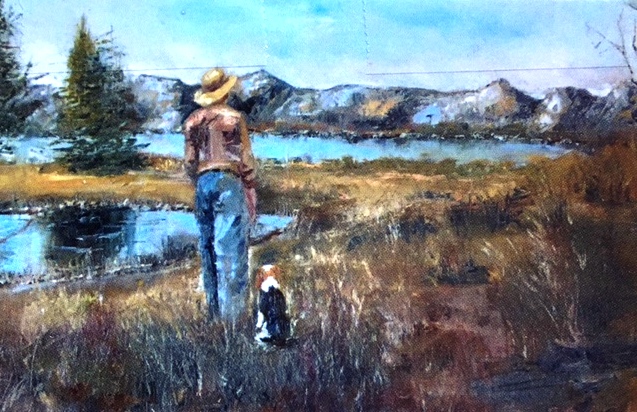
He was waiting for the birds. Every year around this time they flew over his land with their squawks and chirps or silently, only the perturbation of their wings a sign to look up.
So few people looked up anymore, he mused. So concerned about staying on the sidewalk, not veering off the path, not tripping over a root or rock. They never looked up unless told to, and then reluctantly, squinting as if they only half wanted to look.
Duke, his loyal hound, almost never looked up. His neck wasn’t built like that, not when he was walking. He could look when he was sitting, when his spine was closer to being perpendicular to the earth that he loved to sniff and dig at. But even he would stop and take a glance at a gander or a goose when it honked its hello from on high.
It was a sign, he’d learned after all these years of living alone in the woods, that it was time to decide whether to hunker down or move on. Maine in the winter wasn’t easy for someone even in their 40s, and Earl had passed that mark decades ago. If the geese were high, he’d stay. If low, time to go south to his sister’s house for the season. Maybe she’d let him in if he apologized and meant it this time.
False sincerity can come from a fear of frostbite, and she knew it. It wasn’t any use letting him in if his words weren’t from the heart. Otherwise, it would be a long winter, regardless of the weather. If things weren’t right between them, the coldness outside would be nothing compared to the coldness in the house between them.

—————————————–
Notes on the story –
This short story was inspired by a card left in a book by a patron. Her name is Peach McComb, and she is a professional artist. She makes cards of her artwork to use as business cards. Since I was through with the “Short and Strange” series, I decided to write something inspired by her card. I taped it in my journal and chose to only use one page, forcing me to limit what I wrote to just the essentials.
This story is like a sketch instead of a full rendering. I chose to leave the rest up to the reader. Consider these questions – Why are the brother and sister estranged? Why does he live alone in the woods in Maine, far from family? How long will he keep going back to the woods once the weather improves? What did he do before moving there? Is it significant that his name is Earl and his dog is named Duke? Feel free to write the rest of the story and post it here.

Waiting by the fountain 

He waited for her by the fountain for over an hour. She said she’d be there. After the first 15 minutes (the standard in college to wait for the professor) he checked his watch again. Maybe it was fast? So he asked a bystander, a mother watching her children frolic in the little geysers that were part of the park. She switched from texting to the homepage on her phone and showed him the time. 2:15. His watch was right.

Then he wondered if he was in the right park. “Excuse me ma’am. I’m sorry to bother you again, but is this the only Coolidge Park?” She assured him that yes, it was, and gave him a funny look which he ignored. He didn’t feel like explaining that he’d once waited for someone at Nashville’s Centennial Park, having not correctly heard Bicentennial. They were less than 3 miles apart, but because he was on foot it might as well have been 100 miles. It would take him an hour to walk there, and then he would have been truly late.

He had learned from his Papa that you could be at the right place but if it was the wrong time, you were still wrong. Later he learned that everything depended on the right amount as well. Something might be the right time and the right place, but too much or too little effort and you might as well have not done it at all. Or you can have the right amount of effort in the right place, but too late or too soon and it wouldn’t work out.

He had plenty of time to ponder this while he waited, but an hour was the most he was willing to sit around. Was she making fun of him? Did she not want to meet and sent him on a a snipe hunt? Maybe it wasn’t like that. Maybe she forgot. Or worse, he thought with a shiver, maybe she’d been in an accident. He would have called her if he could find a payphone. Of course he had a couple of quarters with him. His Mama had taught him that. Too bad her good advice would only have worked well in the era she grew up in. Then it was easy to find a payphone. Now, because everyone (everyone except her son, he mused grumpily) had a cell phone there was no need for payphones everywhere. And how was he supposed to find one? With a smartphone you could turn on ‘maps’ and ‘location services’ and type “payphone” and you’d have a handful of little red dots all over the digital map in your hand telling you which way to head towards. But (he thought ironically) if you had a smartphone you wouldn’t need to know where a payphone was.

Maybe he’d have to bother that distracted mother again and ask to borrow her phone and give his (maybe) girlfriend a call. Or maybe he would just walk home and call it a night. He didn’t want to appear desperate. But he was.

The garden gate. Abandoned project #4

They made a concession for the southpaws but not for large people. There was only so far they were willing to bend. Exception after exception had been made over the years in the name of inclusion, of being welcoming to all. But this was the final straw.
The gate to the embassy garden wasn’t the only entrance to these grounds, of course not. They would never presume to be that overt. The main entrance was large and welcomed everyone. It wasn’t quite ostentatious – it wouldn’t do to appear vain. It might attract the wrong sort of person who might defect, thinking Trevlig-staat was prosperous. It was, certainly, but not in how anyone would ever imagine. No, their wealth wasn’t something you could see.
They didn’t need laws in Trevlig-staat. There was no Codes department. There were no courts. Everyone who lived there knew the difference between right and wrong without being told, and certainly without it being written down. Laws written on paper can change in an afternoon, but laws written in the heart last forever.
Trevlig-staat was a country that had no national anthem, no flag, and no citizenship test. You were either in or out, and no money crossing the hands of an official could change that.
Being born here wasn’t enough, either. It helped only that you got a head start on learning the unwritten language of how to be a citizen. You weren’t even a “good” or “bad” citizen – only good ones were allowed to stay. Bad ones were ones that never mastered the rules, either through ignorance or intent. They discovered things just didn’t go well for them. They wouldn’t get promotions or they would get fired. Their property kept getting notifications about the height of the grass in the yard. They wouldn’t get approved for loans, or the interest rate would be astronomical. It didn’t take long before they moved elsewhere in search of better luck, never realizing that they took their luck with them wherever they went.
But there was still a need for an embassy. Citizens of Trevlig-staat liked to travel, and while they never caused problems abroad, sometimes they encountered them. Riots and civil wars would occasionally erupt in these less civilized locales, but that was to be expected. They didn’t have the high standards Trevlig-staat did. The embassy was modest and welcomed all in a genteel style, never fully admitting anything to any visitor until they revealed through their actions and language that they were citizens. There was no password, no shibboleths. There was no word or phrase to worry about others overhearing and using like a passkey to gain admission.
The garden at the Embassy was for citizens only. This is why it was so critical to ensure proper admission. The walls were 12 feet high to keep out idle curious folk. The trees provided shade but also provide privacy from satellite mapping services. And there was just one gate, with a center door-handle, and it was only 3 feet high and 18 inches across. Children could easily enter, but this made sense. They were the most likely to be loving and guileless. Adults had to be either very short or very flexible, able to bend low as if entering a Japanese tea house. Those who were very overweight were not able to enter at all, but they would never be citizens of Trevlig-staat anyway, for the same reason that gamblers or hoarders or braggarts wouldn’t. No, Trevlig-staat wasn’t for everyone, and it certainly wasn’t for those who couldn’t even get along with themselves. Self-control was an essential part of what made Trevlig-staat work, and why they didn’t need laws to govern people. They governed themselves.

(The photo was found on Pinterest. Unknown photographer or location. Copyright belongs to the photographer.)

The last trip home. Abandoned project #3

20476042_1511857472213856_3190391236551844638_n

Fouad rode his bicycle to the souk every day, except Friday, of course. Then, if he had to, he walked, carrying just the essentials of his trade. All week long he sold gold jewelry that he had made, but on Fridays he only did repairs, and then only by appointment. Otherwise he was at the mosque along with most of the town. Sure, there were some who went early in the morning and were done for the day, but not Fouad. He spent all day there.

He wasn’t especially virtuous. He just liked being there, seeing the men in their best djellebas, hearing the drone of the chanted prayers. He’d be there every day, all day long if he could, but the only way to do that would be to get paid by the mosque, and this mosque didn’t pay anybody. The imam wasn’t paid in this town and he wasn’t even a particularly noted scholar. It was whoever the congregation decided upon for the month. It was always a man who was learned, for sure, and respected, as well as someone who was comfortable leading the congregation in the prayers.

They all knew the words and the postures, sure, but it was important to have someone set the pace. A prayer service was a lot like a musical performance. Every musician knows his part, but still needs a rhythm, a framework to rely upon for it all to work together. For a band, that was the drummer. For a mosque, that was the imam. The imam set the pace, and his demeanor determined the outcome. Some were nervous and went too fast, others were more hesitant and self-conscious and waited too long between the prescribed movements. The mark of a leader was to be decisive, even if the decision was sometimes wrong. You could always fix it later but you had to have something to work with. Fear of making any decision at all was death.

Fouad had no worries about ever being picked as the imam. He was liked but nobody ever would mistake him for a leader. He could barely keep his own house together. It looked held together with twine and hopes. Everybody knew that leaders had something extra. They had more than enough. People who were just barely getting by weren’t leaders.

And then one day this all changed. It had been raining for a week by that point, and the roads were all but impassable with a thick mud that grabbed at the ankles. Most of the townspeople stayed home the whole week. Either the mud was too much to negotiate with or they were bailing water out of their homes. Friday found only three people at the mosque – Fouad, and two old men who lived just two houses away. The men went to the services there every day to get out from under their wives. They learned early on in their marriages that it was best to give a wife time to herself every day or the household didn’t work as smoothly as you might hope. The mosque was a safe place to retreat to.

The two men were so old that they could barely speak above a whisper, and they couldn’t even remember the order of the Salat if asked to recite it. They had performed the ritual movements so often that their bodies remembered them more than their minds. They both chose Fouad to be the imam for the day, and he agreed only because it would be rude to refuse the request of your elders.

His performance was flawless. Every bow, every recitation, every note was impeccable. He enacted the role as if he was born to it. The two old men could hardly believe it. This was Fouad? Fouad the goldsmith who never said a word unless absolutely necessary? He was an untapped treasure! He wasn’t a diamond in the rough – he was already cut and polished, ready to be shown to those with the most discriminating tastes. And here! In their little town! It would never be the same.

And it wasn’t. After much explaining to the rest of the congregation once they returned, it was decided that they had to ask him to be the imam for a week as a trial. They had just as difficult a time believing it was true as the two old men – and they had heard for themselves! A week would be plenty of time to discern the truth of things. Maybe the old men were mistaken? Maybe it was a fluke? But they had to know.

It took a lot longer to convince Fouad. He was quite shy by nature, and very modest. This is part of why he was a goldsmith. Per Islamic law, he was only allowed to charge by the weight of the gold and not his artistry. He never had to worry about overinflating his prices because of the time and effort involved, or of underselling out of modesty. Charging by the gold’s weight meant he was just a middleman, getting to play with the magical metal in the meantime. Imagine if the Western art world did this with paintings. A paint-spattered piece like a Jackson Pollock would cost the same as a Rembrandt, purely based on the amount of the paint and canvas used.

Another reason Fouad was hesitant was that he’d have to take a week off from selling his wares at the souk. He had no other source of income, but he’d saved his dirhams over the years. Yes. He could take a week off. It would be good practice to not worry about money for a while. He was serving Allah, after all, so who was he to worry about money? If he was following a true call, the money would sort itself out.

The elders of the community were skeptical until they saw it for themselves. Even then, they were sure there couldn’t be a repeat performance. Every day for a week they were surprised. They decided that they must make a way for this hidden treasure to be their imam for as long as possible. Even though they’d never paid an imam before, they knew they’d have to do something different now in order to keep him.

There wasn’t enough money to have an actual salary. Fortunately Fouad was a man of simple needs. They selected a corner storeroom inside the mosque to be his new home, and every day grateful members of the congregation brought him his meals. And as for his bicycle? He no longer needed it, so he rode it to his old ramshackle home and left it on the front stoop for anyone to borrow. That walk to the mosque was the last one he’d ever have to do from that direction, so he savored the sights along the way.


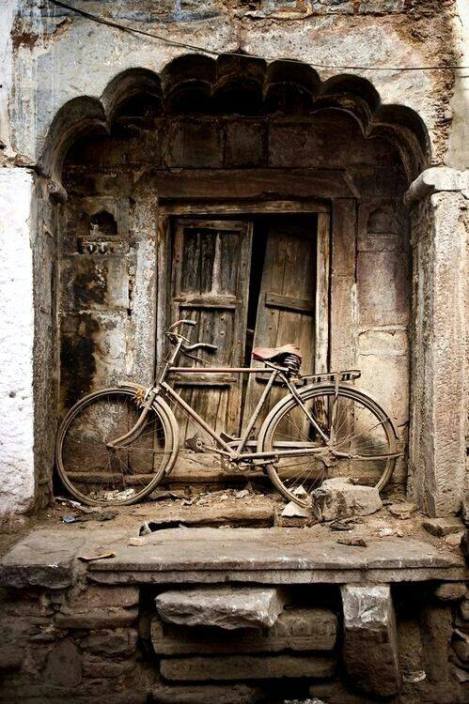
(This story came about because my friend Doug S. posted this picture on his Facebook page.  Another friend commented “That’s strangely beautiful” to which he replied “Yeah, it’s kind of like a picture of a story that you haven’t been told yet.”  I commented “Maybe I can help with that…”  And so I did.  I asked him to give it a name without seeing the story I’d written.  It was a good name, but I had to adjust the end of the story a little to make it fit. Copyright belongs to the photographer.)

The blue door. Abandoned project #2

The door was locked. I expected nothing less. Every day for three months I’d tested this door, every day since I’d first noticed it. Why hadn’t I stepped down this alleyway before? What was it about that Tuesday in July that made me take a different path? My walk to the university had been boring, predictable even, up until that day.

Had I even seen that alleyway before – really seen it? Certainly it had passed before my eyes, but just as certainly it had not passed before my mind.

A new path, once taken, changed the path-taker forever.

A part of me wanted to drink in every nook and cranny, every crease and crevice. I wanted it to stay new, stay fresh. I was wary of this new path becoming worn like my old one, so familiar and comfortable that I didn’t even see it anymore. I was wary of it becoming just a way to get somewhere, instead of a destination in and of itself.

But this door was different. I’d tested it unthinkingly that first afternoon because of the aromas wafting through the gaps created by a century of settling. I was certain it must be the gateway to the side courtyard of a restaurant. Only when the portal did not budge did I take the time to look for a sign on the wall. Finding none, I halted. If this was a home and not a restaurant, I should not persist.

The next day I chose to walk down that alleyway again, noticing even more than I had the day before. How much I had missed! Yet again I was drawn to this door. This time I could hear a child’s laughter and the sounds of a fountain. What treasures lay behind this ancient door? What Paradise was hidden just beyond these walls? To imagine that just a few inches of stone and stucco separated me from this treasure! A hand’s breadth away from the dirt and grime of this forgotten alley-street was another world. I would have to check this door every day from now on until it yielded to me.


(The image is from Pinterest – copyright belongs to the photographer.)

The Pickers

z 0c3dde05-6043-4f10-9207-640b3decc815

Charlie and Rex played together every day, but not like most. Little boys and mutts were usually fast friends, playing tag or chase or tug-of-war. But not these two. Charlie’s dad got him the banjo the same time he got him the dog. Sure, the banjo wasn’t child-sized. Mr. Jason Reinsch didn’t have enough money to buy something that Charlie would outgrow soon enough. So he got him an adult one at a used musical instrument store. He got Rex from what he liked to think of as the used dog store.

There were a lot of choices of instruments there – all castoffs from the hundreds of hopeful people who came to their city every month, trying to become the next big star. Trouble was that very few of them had much talent, and even fewer had the discipline to make anything of it. There were instruments in there that had been bought and sold a half-dozen times, all at a small profit to Zeke, the owner. He didn’t want to charge too much, but he had bills to pay the same as anybody else, so he did what he had to do.

Charlie had never met Zeke or anybody else in the music business before then, but things changed. Once word got out about his act with Rex, he met nearly everybody who was attached to the music business. It seemed like that was most of the town in one way or another. If they weren’t actual musicians, they were songwriters, or producers, or agents, or roadies, or fans. Everybody wanted to see Charlie and Rex play. It hadn’t been like that at the beginning.

Charlie first learned bluegrass songs because that was what his dad knew. Why try to pretend to be an expert in something you know nothing about? That was a sure path to ruin. No, best to stick with what you know and build up on that. It wasn’t long before he was picking out a passable rendition of such classics as “Muddy Road to Ducktown” and “Dream of a Miner’s Child”. The latter was especially well-received because he hammed it up with a little soot on his cheeks to play the part.

He wasn’t a miner’s child, of course, but there were some similarities. His dad, Jason, dug out precious gems in a way – he was a picker. He never could see a way to having a full-time job, even when he had a wife and five children to support. He was too independent for that. He wasn’t one to submit to a boss, especially one who thought he could tell Jason how to complete the task he’d never even personally tried. Why did so many businesses think it was a good idea to have a supervisor who was a stranger to the task at hand? He had bosses try to tell him what to do in his first couple of jobs, thought better of it, and decided that as soon as he could, he’d never have anybody above him

Times were sure lean when he was married with children. All those mouths to feed and backs to clothe! A few years ago his wife and the children had wanted a dog and he put his foot down. He couldn’t see clear to how that would even be possible. It was hard enough making do with the earnings he made from up-selling his finds to antique malls and consignment shops. Did they expect him to rent a booth at the flea market as well to pay for the dog’s needs? That was too much like what he was trying to avoid.

Spring left him and took four of the kids one afternoon to her sister’s house and never came back. Jason had taken Charlie to the hardware store to get some chicken wire. He had the idea that raising his own chickens would save a lot of money in the long run, what with not having to buy eggs or meat ever again. He didn’t know anything about raising chickens, but he hadn’t known anything about raising children either and hadn’t done too bad. Or so he thought.

Spring was fed up with his get-rich-quick schemes that always turned out to be get-poor-slow ones instead. He never gave up, which in some situations is an admirable trait. But sometimes it is good to know when the time has come to move on and let go.

Like now. Spring was through with his promises that never work fulfilled, his dreams that seemed more like nightmares. Without even leaving a note, she left. Sure, she missed Charlie, but four other children were plenty enough to keep up with, and Charlie had been Jason’s favorite after all.

Jason noticed the quiet first when he got home. It seemed so peaceful. He couldn’t ever remember a time when the house didn’t have at least some noise from some child banging on something or his wife complaining about something else. He then noticed why it was so quiet. It was just him and Charlie there. This was unusual for his wife to leave without saying anything.

He was so grateful for the quiet that he decided to take a nap right then and there in the middle of the day. The last time he’d done that he’d been in kindergarten. It was just as delicious and just as needed now. Jason decided he’d take a nap every day from now on out. This was yet another reason not having to work for “the man” was a great idea. He could nap anytime he felt like it.

What did Spring know anyway? Always whining at him about how he needed to grow up and be a man. What did she know about being a man? She wasn’t one. She had no idea how hard it was to carry all this responsibility. It was a miracle he hadn’t snapped like some guys did and started killing people. Mass murder and road rage came from the same root after all – unexpressed anger. Jason figured it was best to not get angry in the first place, so he avoided everything and everyone that made him angry. Well, except for his wife of course. He meant it when he said his vows. Divorce wasn’t an option in his mind, no matter how hard it got.

Things were easier now that it was just him and Charlie. Less to keep up with. Sure it was harder without Mary to keep on top of the household things, but he could manage. He did before he met her, didn’t he? If the dishes didn’t get washed for a week, who would it bother? It seemed a waste of time to have to do it so often. She was always nagging about every little thing. He was better off with her elsewhere. He kind of missed the other kids, but Charlie really was his favorite. This meant they got to spend more time together, undisturbed by everyone else.

Of course, with Mary gone, he had to keep up with Charlie all the time now. He was too young to leave alone at home, like you could with a dog. That was how Jason came up with the idea of getting a dog and teaching them both to sing for their supper. This way he could set them outside on the curb to perform while he was doing the grocery shopping. The home farm hadn’t yet taken off like he thought, so there were still carrots and broccoli and potatoes to buy. Even when his crop did come in, he’d still have to go get milk and fruit. No way was he going to raise a cow or fruit trees. Too much work, and Jason was all about putting in the least amount of effort. If he could get someone else to do the work for him, all the better.

Charlie took to the banjo like a duck takes to water, and Rex was happy to howl along. Jason hadn’t figured having him as part of the act but it was sure funny to see him crooning in more or less in the right pitch. His timing was a little off but practice would fix that. Plus, he soon realized, people weren’t as likely to call the authorities when they saw them together. It was as if they thought the dog was a suitable guardian for Charlie, little as he was. Alone, they thought he was abandoned or had wandered off and tended to call the police to check up on things. But the dog there? That was okay somehow and they let them be.

Jason was through trying to figure out why people thought and acted the way they did, so as long as things worked out in his favor. His wife leaving him was certainly working out, better than he’d ever expected. Not like he’d even imagine she’d leave. But he certainly wasn’t one to pass up a good thing that came his way. That was part of the picker mentality, after all.

Eye contact

The parents never knew. To them, their children were kind. Sure, they were quiet around strangers, but that was to be expected, even desired. It kept them safe to be wary. They were sure their children were polite to any and all. Little did they know that their children’s eyes lit up only for them. Otherwise they were as cold as the grave, as dangerous as ice on a March pond.
It was easy for Jenny’s mother Stephanie to brush off concerns from her Mother’s-day-out program. They told her how little Jenny was hostile to the workers, that the other children stayed away from her. They were scared of her. Her eyes bored through, searching for hidden darkness. The children had never seen anything like this before. The adults had, those with sons who come back from the Army, scarred in body and soul. They made it back in body only. A part of them was still out there, searching for the enemy, always alert for danger. Some went one way, and jumped at every car backfire or firecracker blast. Some went the other – went dark. Kill or be killed. Do unto others before they do unto you.
Jenny’s eyes were like those folks, but she was only five. She had no reason to look that way. Both of her parents were loving and kind. There was no abuse of any sort. She was well provided for, wanted for nothing. Maybe if she’d had a sibling they would have noticed, the signs would have been heeded. Probably not, though. Siblings are always suspect. The petty rivalries and squabbles that naturally ensue guarantee that unfavorable reports were always seasoned with a handful of salt.
The boy named Arnold was the same. He first spoke on his fifth birthday, his eyes still dead. He was intelligible only to his grandmother, who translated his muttered birthday lunch plans as “a visit to McDonald’s” and not to “Aunt Dee” as he’d said. Even she didn’t understand why he said this, because the clerk’s name was Judy at the restaurant they frequented.
The problem was that he wasn’t here in this place. Neither child was. In bodies in this dimension, but otherwise elsewhere. Or else-when. Perhaps they weren’t defective, but inadvertent time travelers, unaware of their failure to truly be in one place at a time. How would their caregivers notice, after all, what with their own distractions? Perhaps these children were the newest iteration, designed by natural selection to never be truly anywhere. It was a good psychic defense against the insensitivity that was now endemic.