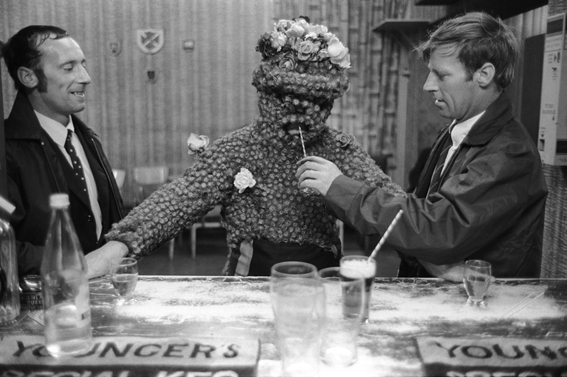
He had to keep at it, Even though it was turning him into a monster. The years of the 12 ounce curls had transformed him into something and someone unrecognizable. Was he even human anymore? He had the basic shape, but his skin was more reptile than recognizably human. Green and bumpy, he looked alien, foreign, and in reality he was. He has transformed himself into a creature that existed to feed its ego only. Anything he wanted he got – begged, borrowed, or stole. He wasn’t ashamed to guilt trip or manipulate. He used every trick in the book, and even added a few pages of his own.
Now he had gotten the council to give him an assistant to follow him around to cater to his every whim. Sometimes that was walking him to the pub and holding up his pint for him since he could no longer see for himself.
His eyes had swollen shut in a vain attempt to protect him from further harm. They figured if he couldn’t see, he wouldn’t want. So much of human “need” comes from what pours into the eyes. It is why people who give up watching TV (either voluntarily or not) end up saving money. It wasn’t just the cable bill they were doing without. They were doing without all the ads telling them what they were missing out on, telling them they would find love and acceptance and community if only they bought this thing that they didn’t even want or knew existed 10 minutes earlier.
And now he was part of that industry, that machine, cranking out 1000 widgets a minute, creating the supply first and then the demand. He was a spokesman for these fellow monsters, who weren’t yet ugly on the outside but were certainly ugly on the inside.
The air raids continued, but so did the entertainment. When the war had finally crawled to their shores, finally climbed in fits and starts over their borders, the citizens knew that life as they knew it was over. The first few weeks they stayed inside, huddled around the television for news of where the riots were. They planned excursions based on these reports. It wouldn’t do to go to the grocery store or church and run into a firefight.
Work was quietly canceled for the first week. Who could be expected to even try? Work then was all about staying alive in the moment. Who could take the time to worry about spreadsheets or stockrooms? But then the reality set in that this wasn’t a temporary thing. The invaders had settled in for the long haul. They planned to take this land no matter what – even if that meant destroying everything and everyone on it.
After a month of living under siege, the citizens knew they had to keep on going with their lives. They had resumed going to work – they had to once the paychecks stopped coming – but it was only now that they understood there was more to life than work. Entertainment wasn’t simply a distraction or diversion – it enriched life. Perhaps it could be said that they worked so they could afford to play.
And play they did! Movie theaters were re-opened, converted into cabarets and live theater And symphony halls. Colleges were converted into lecture halls for everyone, not just the paying students. All were welcome, and there were no tests or papers to write. People carried on with their lives, not in spite of, but perhaps because of the violence in the streets. They had no control over that, so they celebrated even more when they were able to make it through a complete performance. Many were the shows they got cut in half, with the cast or audience having to disperse because of insurgents coming too close. Rarely would the violence spill inside but it wouldn’t do to risk it. So the people left rather than draw the attention of the fighters to their secret.
And it was a secret, these diversions and entertainment. They were carefully curated and prized. They weren’t random. They had to be planned for and scheduled. It wouldn’t do to go a week without a gathering of some sort so it was important to make them good.
The people had come to understand that the source of their joy wasn’t how much money they made, or what football team they rooted for. It was in being together. Groups of like-minded people together – united by a common interest – were happier and healthier. Something about simply being together made them whole in a way they could never be alone.
But the gas masks still needed to be worn. It wouldn’t do to undergo a chemical assault while they were communing. Because that is what was happening – communion, union-with. Only together, with others, could they feel the peace of union, where they were no longer torn in two, fragmented. They needed each other in a symbiotic, inter-dependent way.
That was why all the mass murders from the past had happened in densely populated arenas. Those who felt alienated, excluded knew down in their core that the people who were gathered together had something they missed. Jealousy clouded their hearts to the point that they couldn’t see that they didn’t have to kill anything – except their “need” to be alone. Their cure would have taken place if only they had sat down with all these people and joined the group. Instead they had swallowed the poison of the message of independence, which taught them to be lone wolves, leaderless, a pack of one.
This message was taught to them by billboards and television and magazines, and stories and in songs, because the pushers of this drug also sold their version of the cure – to be found in pills, or alcohol, or retreats, or yoga, or a diet, or a religion or even spirituality. They caused the dis-ease in order to sell their “cure”, because true health was free and that wouldn’t do in a culture that saw money as its God.
So in a way, the war had healed this community. It had showed them what really mattered.
The aliens were everywhere. They had been “immigrants” or “ex-pats”. They thought they had psychological issues and went to see the psychiatrist (who was in the old days called an alienist.)
They weren’t crazy. They weren’t normal though, and that was the point. Normal people were miserable. They complained more than they thanked. They weren’t happy with what they had, no matter what it was, even if it was what they had wanted. They had been programmed to minimize their success. Only complaining was allowed.
Saying things like “I’m good. I’m really blessed. I love my work and my family. I have a great life.” was met with suspicion if not outright incredulity.
So the aliens came, in the form of gods or rock stars or TV talking heads or even self-help gurus. They came to teach a better way but the people were so used to being sick and tired and anxious that they just couldn’t believe they didn’t have to be. They were so used to being half that being whole wasn’t normal to them. Especially when they were told that they didn’t have to do anything – not take a pill or eat a root or even exercise. They just had to accept the new Script that they were healthy. “Fake it till you make it” had become fake it in order to make it. They had to reprogram themselves, to learn that they were not broken, not damaged, not addicted.
Society told him otherwise, because sickness is marketable. Dis-ease has a dollar sign. The well don’t need a doctor after all.
So the aliens came, not to invade but to immunize, to inject a vaccine against melancholy and mediocrity. But they had to be sly about it, because the natives had been programmed to kill all aliens, all “others”, all those who were different or strange, because that was how the disease replicated.
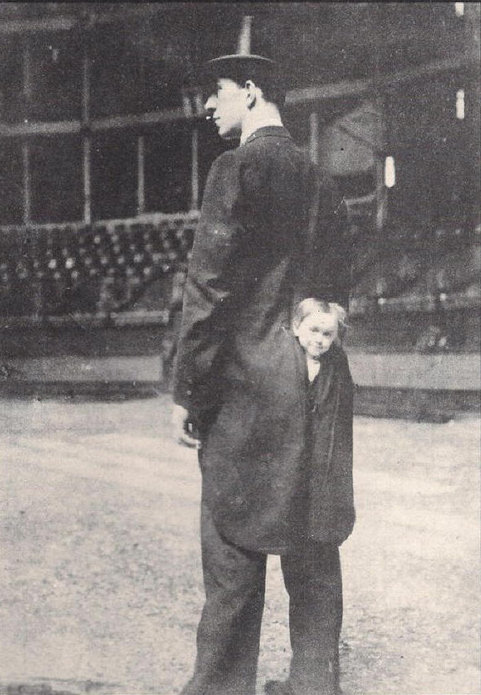
Little Ben shimmied into his man suit to go to the arena. He”d learned the hard way that he had to or people would step on him – sometimes literally. They just didn’t take him seriously most of the time.
Maybe it was his age. Maybe it was his joyful spirit. They just didn’t like being around someone who refused to get drawn into their glum gravity. His cheeriness in the face of their crankiness was disconcerting. It reminded them that they had a choice to be cranky, that it wasn’t automatic, or fate.
It was like sobriety – drunks don’t like to hang around those in recovery. It reminded them that there was a way out. They felt embarrassed, or shamed, by his presence. And while it would be easy to go along to get along, he chose not to. It had taken too much work to get where he was to fall back into bad habits again.
They tried to teach us. They put their words into every bag, inside every fortune cookie. You ordered the meal and the cookie came along with. Maybe you opened the cookie. Maybe you read the fortune. And just maybe, if you were lucky, you had the insight to turn it over. It was right there, on the back. A word, in Chinese, with the translation. Collect enough and you had a sort of makeshift dictionary. You got fed in body and mind that way.
They had given us a chance, but so many of us ignored it, or overlooked it. So many of us did that all the time anyway, with everything. But not anymore. No longer do we have a luxury of being the Masters of our own destiny. No longer do we have the luxury of ignoring the signs that had been around us all these many years. For now, we are the minority. Now, we are the ones who have to meekly ask if the shop owner speaks our language. Now we have to go to tiny shops and strip malls in questionable neighborhoods to find a box of Cap’n Crunch or Jif peanut butter. Because now we are all Chinese. Now, English is a second language for all of us, and hot dogs have been replaced by Hunan cuisine.
There wasn’t a war. It wasn’t sudden. But the invasion happened all the same. They were here all along, quietly working, quietly saving, quietly planning. Their strategy was so subtle, so long range, that we didn’t even notice it. We thought they were OK with a second or even third-class existence. It seemed like a good system for everyone. We let them live here, let them own property, let them open up shops. We thought their ways were exotic if we thought of them at all. We certainly didn’t think of them as a threat. Sure, they assimilated, flew under the radar. They changed their names that we couldn’t (or wouldn’t) pronounce into ones like Jack, or Susie, or Joe. They put away their own clothes and adopted the anonymous uniform of America, all jeans and T-shirts, but never went so far as to debase themselves with sweatpants and singlets, not even in private. Even they would not stoop that low in playinf the game to fool us into not noticing them. Because that is what they were doing. They couldn’t change their skin or hair or eyes (though some did with lightening cream or bleach or even surgery to remove the epicanthic fold) so they blended in with all the other little ways that made us experience them as background noise. Hell, they could’ve been from Mars, looked like little green men as far as we’d pay attention if they only wore our costume and took our names. It was that lack of attention that was coming back to haunt us now.
It was opened by appointment only, so it did no good to just show up – or to be late or early. It was on time or nothing.
It hadn’t always been this way. But she’d read about rules for the queen of England. You couldn’t touch her unless she initiated contact. Not a handshake, not a pat on the back – nothing. She was the one who would reach out first. It seemed like a good rule for everybody – not just monarchs. It would certainly start very instances of sexual harassment.
She’d first thought it was a good idea for just women, but then thought it would be a good rule for everybody. Men had been harassed too. Men had been victims too. And whether the encounter was between people of the opposite sex or the same didn’t matter. Boundaries and consent mattered for everybody, all the time. Even if an interaction had occurred before. Even if you were married, or family. Every time you touch somebody there must be consent.
The guys who acted badly – maybe they had never been taught otherwise. Nobody has said “No, that isn’t right”, so they assume it is OK. This is not blaming women… but how can men know how we feel if we don’t tell them? They do not have the same lived experience. They can’t empathize with being groped, ogled, cat-called. They don’t hear “Hey baby, why don’t you smile?” Or “That dress looks hot” or “while you’re down there” with a smirk and a glance to the crotch to a female coworker who is digging something out of a cabinet at their feet. They don’t hear or experience this, and they are told that having a woman, a “piece” (not a whole, just that part, not a person), is what makes them a man.
She might as well give up. It worked for finding a husband. Maybe it would work for a friend. This door looked unlikely – more tomb than treasure. But then again, all the likely doors had been dead ends.
Maybe there was something to giving up, after all. Maybe she needed to stop trying to have a friend, or a group of friends. The ones who wanted to hang out with her just wanted her for her ear, or shoulder, or heart. They wanted to lean things on her, weigh her down. But the scales weren’t even. Was it her fault? She never unburdened herself on them. If they were treating her like they wanted to be treated, then maybe she should. But that had often led to ridicule, dismissal, or worse – betrayal. A secret kept was a secret that was safe. It would never sneak around the corner to surprise at inappropriate moments. In the past she’d had to suddenly switch gears, act indifferent instead of shocked that her secret was out. That took away some of the power. The teller would see there was no weight to it – no value in the retelling. It wasn’t a secret that could be used as blackmail. But then she knew she could never talk to that person again, about anything. A person who thought secrets were for leverage wasn’t a person worth keeping around.
And how about the friends who ghosted her on social media? No use trying to private message or request friendship again. Any person who would leave without explaining wasn’t worth the time.
When the student is ready, the teacher will appear. What is the same true with friends?
All the missing people were here, on the other side of this door. Well maybe not this exact door, but one like it in shape or color, if not style.
They all came here eventually, either on their own or with a guide. But even that wasn’t guaranteed. Guides could only come here once and then they had to disappear too.
There were plenty of robin’s-egg blue doors, and plenty of others that were arched. Not all of these were part of churches, but many were. Churches were the best place for secrets, after all.
Perhaps it had started with confessions, where deep sins were revealed and had to be hidden away. It wouldn’t do to have anything escape the confessional. Then word would get out and nobody would come. Without confessions, the church might as well cease to exist. Those relieved of their burdens were often so grateful that they tithed more. It wasn’t a one-to-one correlation, you understand. It wasn’t as if the priest said “say 20 Hail Mary’s and put $200 in the offering plate” but it worked that way anyway.
But there were plenty of other lost people who came through doors like these. People who’d lost their way in the world. People who didn’t fit in. People who were unwanted, or who just felt that way.
Children weren’t allowed, at least not in this kind of sanctuary. There was a sort of asylum for them, there had to be. Plenty enough children went missing over the years, so there had to be places for them. But this place was permanent. This place was no turning back. This place was more serious, more forever than marriage. There were vows here too, legal documents to sign here too, but there was no change of heart when things got tough. To be more accurate, hearts could change but the situation wouldn’t. No matter how much you begged or pleaded or cried, you could never go back through the doors into the real world. This was your world now.
Plenty came who were turned aside, deftly but firmly informed that there was no such place here. They left, confused, still searching. Perhaps they would find a different clue, overhear a different snatch of conversation. Perhaps they would locate another safe house entrance. Those who were turned aside were fleeing problems – money, love, drugs, either too much or not enough. They wouldn’t last here, wouldn’t be able to knuckle down and get to the business of really living this new life. They would be the first to want to leave and the last to settle down when they finally were made to understand there was no going back.
This new life was more permanent than marriage, more permanent than a tattoo. Both of those could be erased.
Finally, on a Wednesday they walked through the door at the
bottom of the garden. On the other side, all identity was erased. No longer
defined by race, or gender, or religion, or nationality … anything. This meant
the pros as well as the cons. It all had to go. Now just a number, X17359 was a
little sad, because some of the old identities were useful and conferred a bit
of priviledge. But there was no way to separate the wheat from the chaff with
this process. It all had to be burnt away in the purifying fires of re-branding.
Even the new “name” was as un-unique and vague as possible, with no accompanying
meaning for or against. The “names” were even randomized so people couldn’t
brag about how long ago they had walked through the door. Not like they wanted
to, not after that experience, but this way there was no chance of temptation.
For you see, nobody was forced to walk through that door, a
nobody who had gone through mentioned it to others. It wasn’t advertised, but
everyone knew about it, one way or another. Some thought about it every day
until they finally just did it, and for some it barely registered with them and
they never did. But they all knew. It was encoded in fairytales and scripture.
It was woven into pop lyrics and advertising jingles. It was never overt, but
it was always there. It was kind of like a pattern you could only see when you
had polarizing sunglasses on. It was hidden in plain sight, but only those with
eyes to see noticed.
Papa brought his gun everywhere he went. It wasn’t a small gun,
either, no sir. It was a shotgun, meant for bears and the like. Gardening or
the grocery store made no difference. He toted it all over Grandville, in the
elbow-carry position most of the time. Sure, he got some strange looks when he
was off his property, but everybody knew he was a retired Colonel (full bird,
not Lieutenant) and cut him some slack. He’d never shot anything or anyone his
whole service career, but that didn’t matter now. He’d been an electrical
engineer before the World War started and he signed up as soon as he could. He
wanted to do his part to help out his country. Maybe deep down he also wanted
to make right the shame his father had brought to the family all those years
ago when he left his family the permanent way.
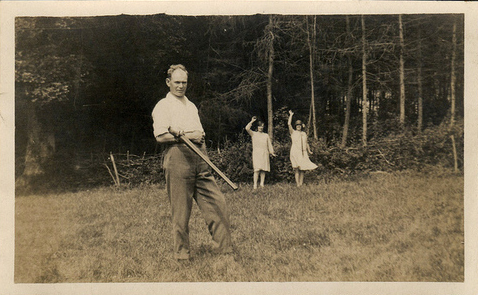
But now he was at his new home, his two children (the requisite
boy and girl) waving at the edge of the forest. They had just moved there, the
3 bedroom, 2-and-a-half bath, 2288 square-foot house they came from just wasn’t
enough for him anymore. Maybe he was like a hermit crab and had outgrown his
shell. He’d had to find a new one and fast or he’d die. That unsettledness was
his inheritance from his Pa.
Papa was a tender soul in a hard world. Deep down he would have
preferred to walk in the woods, without a care or obligation. He married out of
social expectation, but had requested they have no children, but his wife had
snuck two in on him before he’d insisted on separate rooms. He didn’t want
children because he couldn’t bear to think of a child having to undergo what he
and his sister had – the hardship, the skimping, the growing up fast after
their dad died at his own hand. The family story was that it was during the Depression. It was a depression alright, but not the
capital-D kind. More of a personal kind than a public one.
Yes, that was why he carried a rifle. His father had used a
revolver. And while you could kill yourself with a rifle, it was a lot harder.
You’d think he wouldn’t carry a gun at all, but he needed a
reminder of the weakness that might affect him. He wanted to never succumb to
weakness – whether inside or out. He needed a reminder to never forget how easy
it was to go astray. Some former cigarette smokers kept their favorite ashtray,
while some ex-drinkers kept empty bottles on display. It was all for the same
reason. They kept their old sin before them so it wouldn’t become their new sin
all over again. He never knew if suicide would sneak up on him like it had his
father, but he was determined to not let it get a chance.

 betsybeadhead
You must be logged in to post a comment.