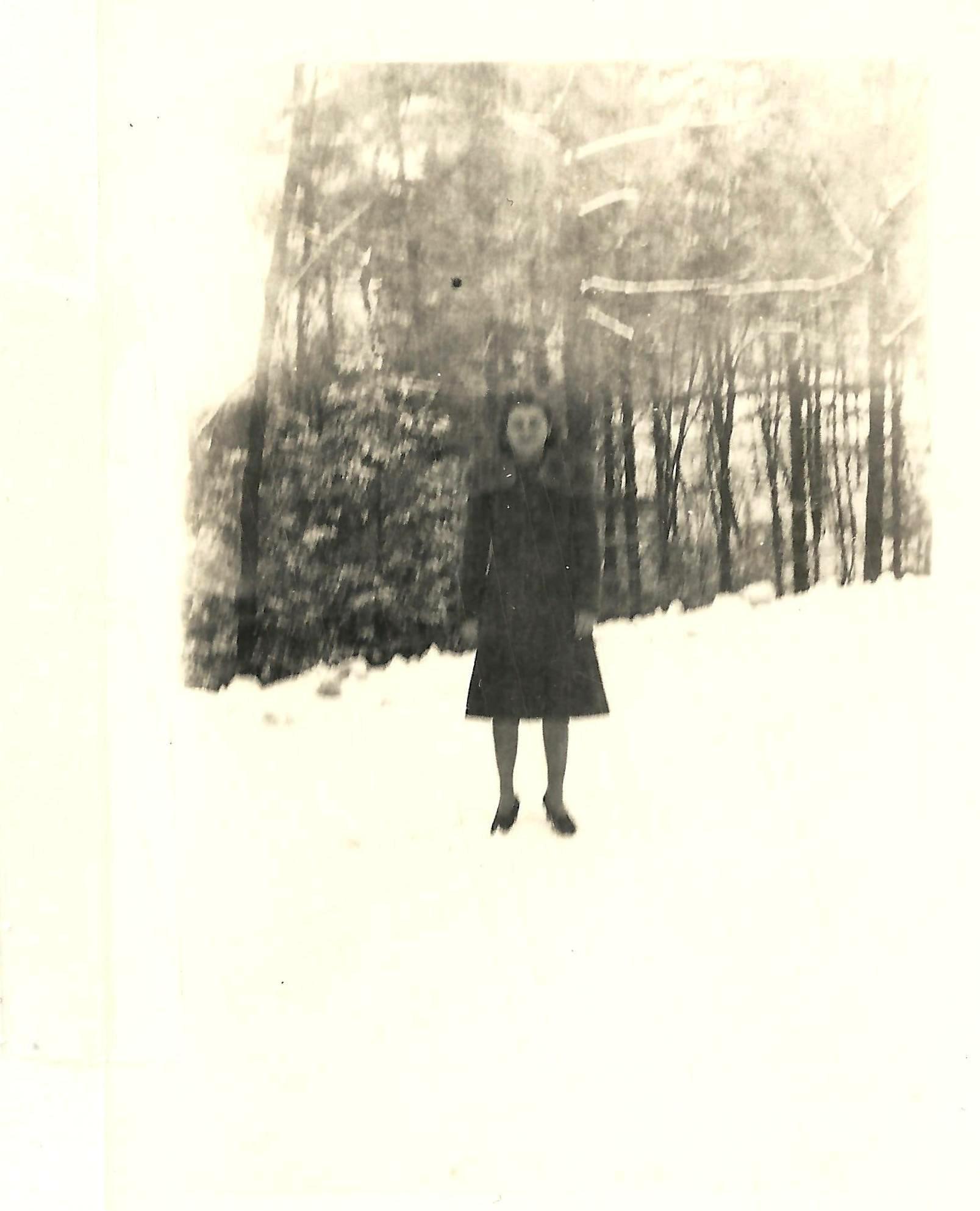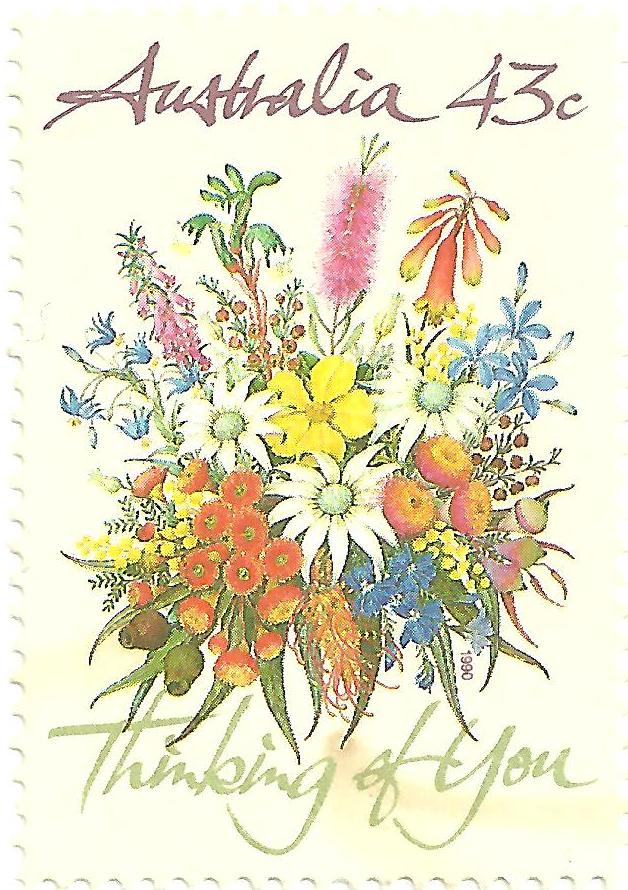
Hilda in the snow.

Hilda

Hilda was shivering. Cousin Tom insisted on taking her picture.  She protested, mildly. “You can’t take my picture – it can’t even be given away.” She mentioned an old tale she’d read in one of the many folktale books she’d found to while away the time in these cold winter months. “Some cultures say that taking pictures takes the soul, others say that it is making a graven image, and that’s a sin.”  When pressed, she couldn’t remember what culture said it, or if there were more than one that had this belief.

Tom was having none of it. “The sooner you let me take this picture, the sooner you can be inside,” he retorted. That was enough for Hilda. 10 feet away, stock still, she stood. The moment she heard the metallic click of the shutter release she was free. She trudged back inside, her duty done.

He said he was going to take a picture of all his relatives, save them up in an album. He’d include labels too, with history, birthdate, the lot. Maybe even accomplishments. She thought he should include that she’d won first prize in typing at the local career college.

Typing wasn’t her thing.  It was her parent’s idea. She’d always wanted to be a cellist for some big symphony in some city – anywhere away from here. The sound of the cello reached down to her bones with its warmth, all golden-honey smooth. Her parents thought this was poppycock, wasteful, a dreamer’s fantasy, and told her often, even if she hadn’t brought the subject up that week. She was going to be a secretary and that was that. They paid good money for those typing classes and weren’t going to have her waste it with some fool idea of playing an instrument they’d never even seen in real life.

They decided they had to do something to prepare for her future. That was the reason for the classes.  They had no ambitions she’d ever get married, so she’d have to support herself after they’d passed on.

They would never say she was ugly, at least not out loud. Homely. Plain, even. “She has a great personality,” they’d chirp to new acquaintances, in the off chance they might have a son in a similar predicament. Even if a date did come of it, there never was a second one. The boys all said “You think too much,” and that was that. The guy didn’t want her, and she didn’t want him.

“Like thinking too much is a bad thing,” she’d say to herself. She wasn’t one to dumb herself down to their level. They’d either have to rise to hers or she do without a man in her life. That suited her just fine.

Meanwhile, she was cold, and her party shoes were now ruined from that snow.


(Photo purchased October 2015, from the three-story antique mall on West King Street in Boone, NC. It was in the “adopt a relative” box and cost $0.50)

The bramble-bush baby

bramble 3

He found the feral child on Wednesday, under the bramble-bush. Hank had meant to cut that bush down six weeks ago, after that toad-strangling thunderstorm.  Said it would loosen up the roots, make it easier to get out, to do it then.  He forgot, or put it by, maybe hoping Ellie wouldn’t remember she’d asked.

She hadn’t. That was all he heard about.  She left him notes.  She asked him after he came home from work.  She suggested that today looked like a good day.  It started off once a week that she’d remind him, but then it was twice a week.  Then it was more. At 8 that Wednesday morning he finally got tired of her reminding him, so out he went, hoe in hand.

He thought he saw something odd the moment he stepped out the back door.  A bit of laundry blown over from Mrs. Whipple’s house? A piece of paper from a torn-open bag of trash? The wind was forever driving things into their yard.

The wind drove a baby into their yard this time.

The moment Hank saw it, dark-eyed and brooding, with a narrow-eyed stare that thinly hid years of malice and hate behind them, he knew this was a baby in size only.  Knew right then and there it wasn’t human, neither.  He ran back inside, more afraid of that child than of the ribbing he’d get from Ellie at bein’ a’feared of anything.  First off he’d have to explain how he wasn’t shirking the bramble-bush chore.  That alone was enough to make him think twice about going all the way back inside.

He stood a bit in the mud-room, on that peeling linoleum floor, trying to decide.  He’d known Ellie for 18 years.  He just met that baby, if a baby it really was.  He decided he was better off going back outside.  He knew how Ellie got when she was angry.  He’d take his chances with the baby.

(Photo purchased October 2015, from the three-story antique mall on West King Street in Boone, NC. It was in the “adopt a relative” box and cost $1.50)

Travel (by) stamps

Some journeys are private…

1 …where we venture out alone, with few provisions.
p1

2 Everything is a surprise, or a delight,or a wonder, or a challenge…
p2

3 to be enjoyed or dealt with on our own.
p3

But sometimes we travel with others. Then there are more decisions to make.

4 How shall we travel? How shall we move from here to there?
Underwater?
p4

5 By helicopter? Or skis?
p5

6 Or the unknown and as-yet unnamed?
p6

7 Perhaps we will take a plane…
p7

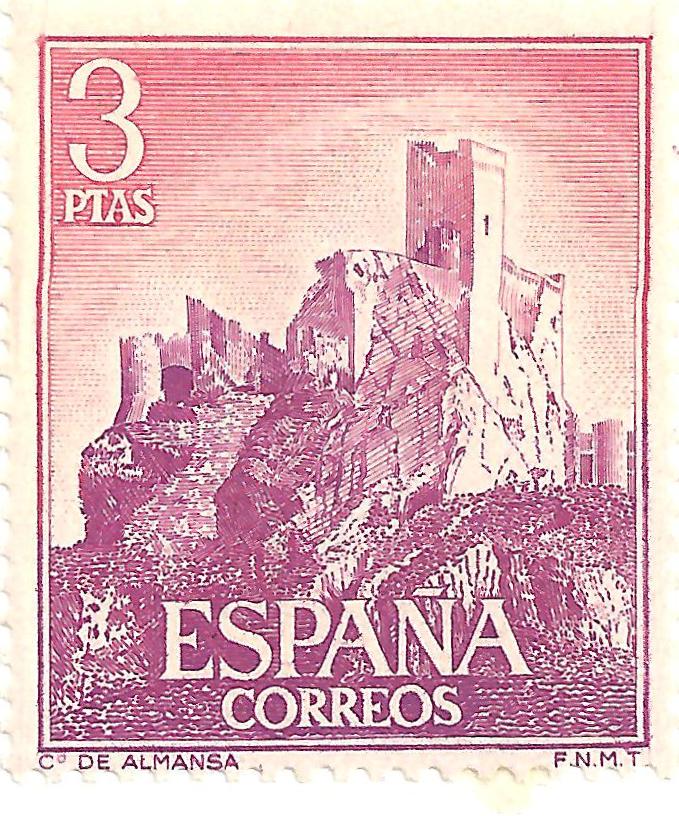
8 …to Spain?
p8

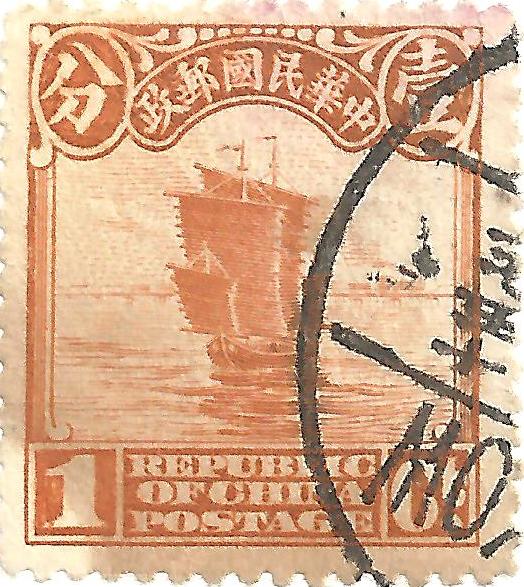
9 Or a tiny boat with only room enough for five…
p9

10 …to visit a mountainside where homes crowd atop each other.
p10

11 Perhaps we will sail away in a ship out of the mists of time…
p11

12 …to an island fortress long forgotten?
p12

13 Or take a rickety, rumbling cable car up a hillside…
p13

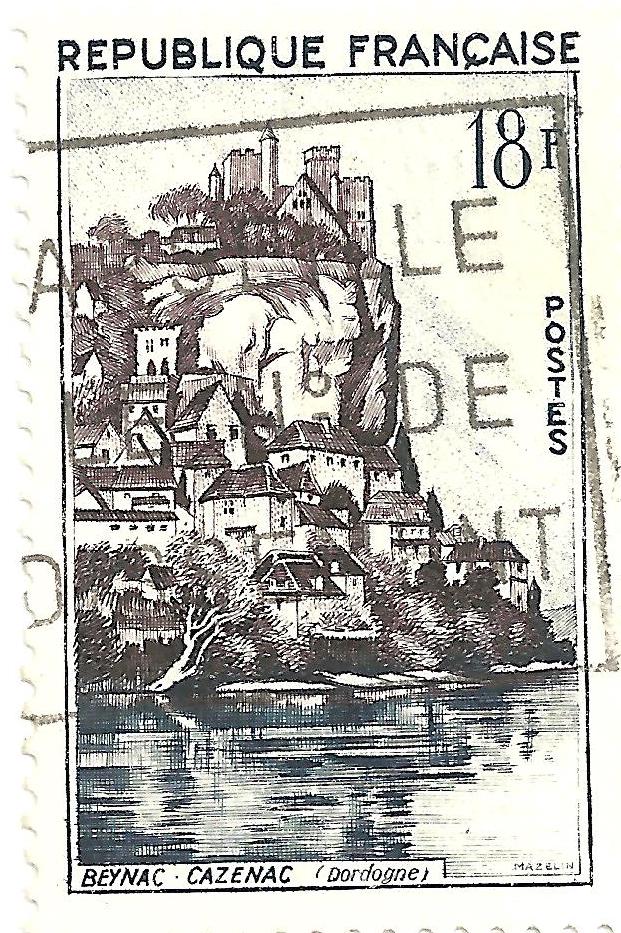
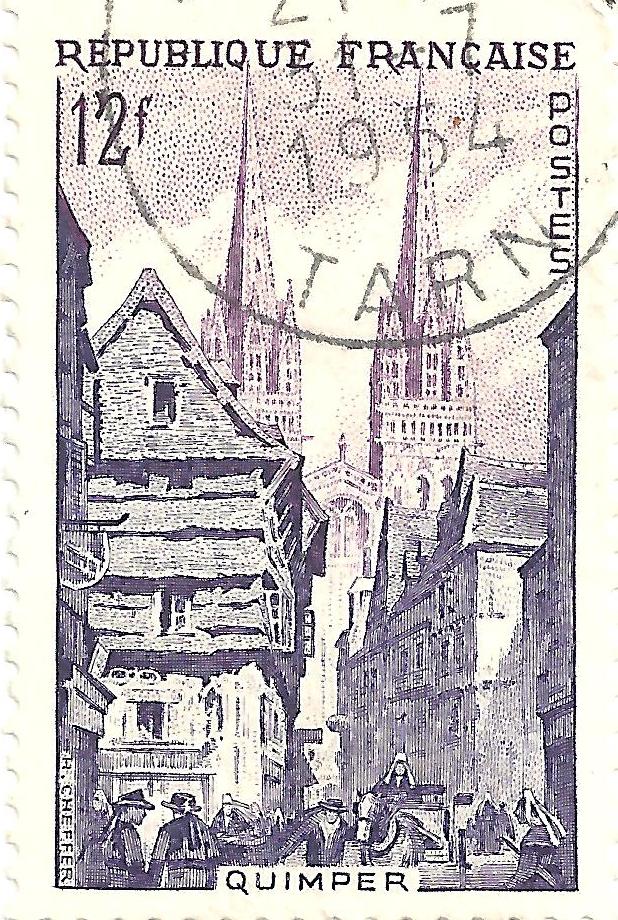
14 …to discover a medieval village unaffected by modernity?
p14

15 Warmer climes, you say? Then we will travel by camel…
p15

16 …and stay with Bedouins…
p16

17 …perhaps enlisting the help of a local herdsman…
p17

18 …to enjoy the wildlife…
p18

19 …from a safe distance…
p19

20 …for them…
p20

21 and for us.
p21

22 Then maybe you’ll tell me you can fly
p22

23 …and we discover a land forgotten by time.
p23

24 Maybe you’ll prove to have secret talents and we will travel in a small black box…
p24

25 …to visit a large black box.
p25

26 While there, we fall in love with minarets…
p26

27 …and towers…
p27

28 …even discovering that we now notice towers (bell, clock, and otherwise) in Western climes.
p28

29 We are grateful for the new eyes our travels have given us.
p29

30 We can fly to islands…
p30

31 …where animals outnumber people.
p31

32 There, we can ride a horse into the forest…
p32

33 …to discover those who stand out …
p33

34 …and those who hide.
p34

35 Or we can take a canoe…
p35

36 …along the shore…
p36

37 …to see animals at a safe distance,
both large…
p37

38 …and small.
p38

39 Even America has undiscovered lands…
p39

40 …filled with animals who are majestic and rare,
p40

41 or common and equally beautiful.
p41

42 p42

43 Travelling further, we see beauty everywhere we look.
p43

44 Some of it stark…
p44

45 …some of it serene.
p45

46 We decide to take some of the beauty home with us, to decorate our table.
p46

(This was assembled by hand in a 65 x 80 centimeter travel book. I wrote the words on the left side, and glued the stamps to the right. The book was purchased at least 12 years ago as a Christmas gift, yet it never found a home. It stayed in my gift basket all that time. Most of the stamps were given to me by a friend in a massive box from an estate – it was a man’s entire lifetime collection, unsorted, some glued together from damp. I sorted them into categories over a long weekend. That alone took at least 10 hours. Then I sorted out the stamps for this and worked on it over the course of a few weeks. I scanned, cropped, and uploaded this in a day – that took another three hours.)

The Varda

The Varda was concerned. It looked out at the scene before it, wasteland, all of it. Stones atop stones atop dry earth. The desolation stretched out as far as The Varda’s eyes could see, and The Varda could see very far – at least on the right side. The left side was nearsighted, but not just in distance.
The Varda had six eyes – two for each head. Each head had different capabilities and most certainly a different personality. The left saw the past, as far back as human history began, but no further. The center saw the present in all its glory and sadness. The right saw the future, shifting and uncertain to human eyes, but solid and sure to The Varda.
The Varda was just that, The Varda. It had no other name. How could it? With three heads and one lion-like body, it was three beings and yet one. This confounded everyone but made perfect sense to it. To name each head was to ignore the very reality of its oneness and unity within itself. It was the very example of cooperation and harmony. World leaders should have studied it, but didn’t. They might have averted this tragedy.
The Varda was always “it” – never he, or she. How could you determine gender? It did not reproduce, so it had no need for the simple distinctions of language. The Varda was simply The Varda, and nothing more.
All around The Varda were the cries of pain and confusion. The earthquake had ruined the centuries-old village with its monuments and temples. Shrines were in shambles. Homes were reduced to the clay that they had been molded from.
Enough earthquakes had happened in the past three hundred years here that the people had stopped building anything higher than a single story for their homes, or out of anything more substantial than packed earth. What was the point? It was easier to rebuild if there was less rubble in the way. Sort out the few meager belongings, set them to the side. Wet the same earth over again, pack it into simple wooden frames, let it set for an hour, pop it out and let it dry. A few days later they could rebuild the house – the same, or different this time. It was like forced redecorating. They had come to accept this as their normal.
It wasn’t normal. It wasn’t normal at all. They couldn’t see this, because of their limited sight. The Varda knew better. With time stretched out before it like a topographic map, it knew the dips and peaks of human history. It knew whether the people it watched were going to have a hard climb up the mountain of difficulty or an easy time of plenty in the valley of content.
Time was flat now, even for The Varda. It didn’t like this, not one bit. In all its eons of life, it had never felt so blind, so lost. It was missing its one way to guide its people, to keep them safe.
There was no way The Varda could let them know how lost it was. Their pain would only be magnified. It had to adapt, to learn how to see just the now, the present. Right now, all three heads saw only what was in front of them and nothing more.
It had started when the volcano erupted. Started? Perhaps stopped was more accurate. The three-part vision had turned off silently and slowly, like day fading into dusk. It was so gradual that The Varda didn’t even realize it until its sight was darkness, all flat and senseless. It could see, certainly, but not with the sharpness or meaning or surety that it had known all of its life. This was different.
Now The Varda was just like the people of this land. Time to rebuild, but this time it would be different. It would have to be.

The Cold 3 (an ephemera story)

bank 3

The banks were next. Zeke got another Message, just two days later. Zeke got most of the Messages, but anybody could. It wasn’t a special thing that just one person got. The community was suspicious of any group that only had one prophet, one person who Heard. The goal was for everybody to hear. How could they be one Body if they didn’t all work together in harmony?

Marsha and Donald went first. They took some of the cash the community had saved up from sales of produce and booklets, tens and twenties. They got it broken into ones. They had hundreds of them. Then they went to the shops and bought everything with ones, but not until they’d dosed them up good first. The money would spread around, and so would the viruses. They didn’t even need to use any of their precious pamphlets this way. Those cost a lot to print. They didn’t have much money, what with all the missions work they were doing.

They thought about a way to get the people who used credit cards, but they couldn’t. Not yet. Hopefully a Message would come about that.

On the whole, they liked it when people used cash. Cash was best, if you had to use money. Cash wasn’t traceable. The government didn’t have to know what you spent every penny on with cash. They only took cash at their corner stand where they sold what little they did to support themselves, for that very reason. Sure, they lost some business, but that was OK. What did those people do before plastic, anyway? What will they do when the crash hits and the grid falls? No electricity then. Those fancy machines won’t work. If the Ranch had its way, no machines would work, ever.

People didn’t need to trust in banks or money, said the Message. Putting your trust in money was the same as idolatry. Thinking you could shore up your future by saving up pieces of paper? That’s crazy-talk. Only God can protect you, not paper. Sure, it says “In God we trust” on it, but if they really believed it, they’d not use it.

Remember the lilies in the valley? They didn’t work, and they had beautiful clothes. Remember the ravens? They didn’t save up, and they had plenty. The community thought the same way. No worries about material things. Worry made you sick. Worry drew away your focus on the LORD.

Soon it was going to be time to deliver the big Message to the world. Soon everybody would know the Way, the Truth, and the Light of the LORD. That, or be dead. Made no difference.

The Cold 2 (an ephemera story)

parking pass

They left the car with James, so his namebadge said. 20? 17? Young, with just a handful of years of driving to his credit, to be sure. Maybe he likes getting paid to drive lots of fancy cars. Only fancy cars got valets. Poor people couldn’t afford going to places that needed valets. They had to park their cars on their own, just like every other thing they had to do in their lives.

Janice and Bill didn’t have a fancy car. It wasn’t even theirs. A 1987 Ford Festiva, faded brown. The rust spots blended in well, and they were small. It belonged to the community, same as everything else. Share and share alike. Even their clothes were community property. Everybody gave what they could and borrowed what they needed.

There was a truck, and a van, and a handful of sedans in the parking lot at the Ranch along with some smaller cars. The keys were in the ignition of every one, ready for anyone who needed them. There was no fence, or a gate around the lot. If any neighbor, not officially part of their community, wanted to borrow one, they could. They never did. They were always invited to Friday supper at sundown, and Sabbath morning services in the barn, but they never came.

The car was just enough for the mission. Not too big, not showy. It was reliable and didn’t call attention to them. That was important right now. They needed to blend in, invisible.

Tonight was the opening of The Nutcracker. Plenty of people, plenty of excitement. It wouldn’t take long to do what they came for. High emotions made the viruses act faster. Calm people didn’t get sick. Everybody at the Ranch prayed for at least four hours of every day just to keep their spirits in the right place. Well, that, and to get the Messages.

A Message came to Zeke last week. They were to focus on public performances next, no more hospitals. They had to send a Message that such goings-on were sinful because it took away from studying the Word. What would the LORD think if He came and found them all laughing and going on, not on their knees in prayer, but giving standing ovations to some singer or actor? Who of them had ever healed a blind man or raised to girl from death? Not a one. Why did they deserve applause for their “work”? The LORD never got applause. He got ridicule and death. It was time to reset all their priorities, give them all a mental adjustment.

Two by two they went out, some to the ballet, some to the movie theater, some to a play. They had their pamphlets and their plagues. Sure, they prayed for everyone there, that they would turn from their sinful, self-serving ways. They would die either way, saved or not.

The Cold. (an ephemera story)

The cold story

We went to the hospital near Greenbrier this time. We went, bolstered up only by prayer.

They never suspected. They never saw it coming, the total breakdown of their system. We looked healthy, as healthy as anyone can look in the fall. Runny noses were rampant then, the beautiful colors came to the trees and the allergies came with him. We looked healthy in comparison. We’d prepared.

They don’t check passports at this hospital, and they don’t check immunization records. Just a quick look at your face and you were in, sticker pressed to your shirt over your heart, the same place every time. No sticker, no admittance, so it had to be prominent.

We’d been to Madagascar, we’d been to Belize. Cameroon? Sure. We did so many little forgotten countries that we filled our passport books 3 times over.

And immunizations? Homeschooled. Our ultra-religious parents didn’t want us being infected by the world by thoughts or antibodies. They prayed our colds away. Even a broken arm wasn’t too much for their prayers. Healed up overnight, it did, with nary a twinge. They weren’t around anymore, but their lessons held true. We’d learned the way of prayer.

We were carriers now, infected with every virus and germ, known and unknown. We were carriers, but not sick. We carried our gifts of sickness and disease and death to any and sundry, throughout the city and then the state.

We started small, but had big plans. Soon we would wipe out, shut down, cripple Western medicine, bring it to its knees. Soon they would beg for the knowledge that would save them.

For too long they had trusted in their own knowledge and not in the LORD. For too long they’d trusted in their Science and not the Spirit. Those days were soon to be over.

“Thank you, Paul!” Margery said, pausing just long enough to read his name badge.

The watch-nurse’s name read in 20pt. type “Paul Roberts” but she called him by his first name, his Christian name. More friendly that way. More disarming too. Amazing what a smile and calling a stranger by his name would do to open doors, visible and not.

“You’re most welcome, Ma’am!” he sang out.

Good manners, too. A shame he’d be dead in a week. That’s part of the price of throwing in with the devil. His choice. His loss.

She pressed a “The LORD is coming soon!” pamphlet into his hand. Maybe he’d read it and get saved. It was his only chance, to read it. Just touching it he was doomed to an early death. He’d die, sure, but being saved meant he’d not go straight to hell.

—————————

If being around Margery and John wasn’t enough, the pamphlets did the rest. Even thrown in the trash, the damage was done. Bare skin to the paper, or better yet the ink, and a thousand viruses were passed. It took just a moment.

They were specially prepared. No one would ever suspect.

The couple had a hundred of them. It was enough.

They made their way to the cancer ward, then the neonatal unit, then ICU. The weakest first, and then the rest. Never too long in one area, and always friendly, and always apparently lost. The nurses would redirect them, and they’d be on their way.

It was all in a day’s work.

In the desert, we remember.

I am enshrouded in the welcoming smells of desert sand cooling, the dusky smoke of the fire, of roasting lamb slaughtered that afternoon. I recline upon rugs, handwoven by my grandfather (taught by his father, taught by his father…). They are a little musty from being rolled up for too long.

For too long we have walked on carpets made by machines and not men, soaked up the rays of florescent lights, breathed recycled air, listened to artificial music.

We’ve left, gone west into the desert, no map, no plans, no forwarding address. We’ve slipped loose this mortal coil, this mortal toil for older times. We slip into our djellabas like slipping into a warm bed on a cold night – comfortable, comforting, consoling, smoothing away the calluses built up like armor, like a shield against an unforgiving, unwelcoming world.

We’ve left that world behind.

We left at twilight, dusk gathering her cloak about her. She had not yet bejeweled herself with stars. By the time we found our home for the night amidst the hills she’d gone all out for us, diamonds against dusky cobalt.

We wear turbans out here, all of us.

We are doing as we have done for thousands of years. It is us, always us, out here under the stars, laughing with storytellers, singing with song weavers. Out here, we remember.

Out here, we remember who we are.

The Visitors part 10

The disappearances didn’t cause the electricity system to fail. That happened about two years after. Plenty of other bits of what they thought of as civilization had started to disintegrate years before. The disappearances just furthered things along.

So many people had gone off the grid by homesteading that it all finally fell apart, like a gyroscope wobbling to a stop. Without enough people paying for electricity, there simply wasn’t enough money coming in to repair the substations.

The upper management did what upper management has done since there were managers. They laid off all the actual workers, and then stayed on until the bitter end, collecting a paycheck but not doing anything. They didn’t know how.

The end came faster that way, because the people who knew how to do the work were gone. What is the point of managers if they can’t manage to figure out how to do anything themselves? Being able to write up schedules and delegate is a pointless exercise when you don’t have any warm bodies to do the dirty work.

Homesteaders were motivated by fear that the authorities were going to take everything away from them. They figured they can’t take away what they don’t have. Perhaps people also just longed for the good old days, forgetting that if the good old days were so good they would’ve kept them.

There wasn’t a central education system anymore, either. Pretty much the same amount of people who had been homesteading had also been homeschooling. They felt like they could do things better themselves. They didn’t want to give away their power to someone they didn’t know.

This feeling of mistrust of authority had gone on for a long time, in part fueled by repeated warnings of an impending apocalypse. Whether it was brought on by zombies or Jesus or the final battle of the Vikings, people were worried. They turtled in, stocking up supplies and shoring up their defenses.

The times to stretch out and trust were over.

It didn’t make sense how a six-month supply of canned vegetables and tuna was going to help if the world fell apart. It seemed like it would simply delay the inevitable impending slow death. Plus, it might attract unwanted visitors. You know, the ones who didn’t get sucked up in the rapture, or had saved up any food.

One thing it meant was that people who weren’t experts were now in charge of their own lives. Simply being a parent did not qualify them to teach their children. Why they thought that they could do better than someone with a Master’s degree in education made no sense. But they were allowed to do it.

The government thought of it as self selection. They thought of it like this – if you give them enough rope, they will hang themselves. All the educated people will be able to rule over the home-schooled, or the newest fad, “un-schooling”, where the child directs his learning. Who ever thought up that idea? Like a child is going to want to learn how to do anything other than play. They’ll never learn how to read or do math because they won’t know they need it.

The city-zens still paid taxes, so their money still went to the education system their children didn’t participate in it. The government made more money and spent less. It was genius. The city-zens thought they’d gotten out, but in reality they were still buying in.

Similarly, what makes an accountant or a mechanic think he’s suddenly a farmer? Sure, with homesteading he’ll know exactly what goes into his food. He’ll know whether there are pesticides or not. But when his crop fails because he didn’t rotate his crops or add enough phosphorus he’ll be starving and just as clueless.

It was a perfect mess, a confluence of confusion.

Those who were left, who’d survived the crumbling of civilization, were those who knew enough to band together. The lone wolves, the dread pirates of the times faded out, forgotten and forlorn. Those who learned how to share what they had, be it cucumbers or Calculus, they made it.

Of course, they couldn’t be obvious about it. Banding together was forbidden for any group larger than 20 was seen as a threat. The mass protests of the early 21st century had taught the government that. People would suddenly appear in the city streets, banners and drums at the ready, faces obscured and mouths open, shouting slogans in unison. They were flash mobs, no doubt, but they weren’t dancing to a pop tune. They were marching, and marching against austerity, against, authority, or just against.

Sometimes they didn’t even know what they were marching or drumming or shouting against. They just did it, and their numbers stopped traffic and started the government thinking. Any group that was larger than 20 got shut down, no debating, no questions asked. Shut down with water cannon or tear gas or drones. Shut down, shut out, shut off.

The Visitors had to be subtle when they got together, but get together they must, and did. With no social media to communicate their meetings in advance, they hid messages in magazine ads, scrawled slogans in graffiti. Those who knew the code knew it all.

It was time to meet. Now, to find the place.

Island – thousand word story

island2

The Island was long, but they were wise in how they settled it.
island4

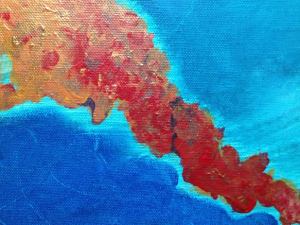
They put most of the cities and villages to the south along the long stretch of land they called the Lumbo. The grassy plains to the north they left alone, unhampered by the burdens of civilization. There the animals roamed free, just like they had when the people first came here.

They been careful, these wayfaring People, these new-world-creating People, to make sure that the animals they brought with them didn’t invade or take over the habitats of the aboriginal animals. They learned a lot from the mistakes others had made before them, in other lands and other times. This was their plan,

to live
with
the natural world
rather than
in spite of it.

They’d tried to tell the others about the dangers. They’d tried to convince them of the avalanche of waste, of poisons, of the dangers of neglect or of over-use. They’d tried and failed. They continued, the others, in their thoughtless, mindless ways, living as if there was no tomorrow.

The People left, knowing if they didn’t, there wouldn’t be a tomorrow. Their water would be undrinkable, their food would be their poison, their air fouled with smokestacks and acid. They left the “experts”, the doctors, the academics, the politicians, the priests. They left them, seeing the train that was coming was going to run them over, all of them.

This Island was their last hope. Others had left for the stars, hoping to colonize other planets that were as Earth-like as possible. They’d never written back. The citizens of Earth never knew if they’d gotten lost or died along the way, or worse, gotten there and flourished. Perhaps in their zeal to keep what they had, their new secret Terra Firma, they never wrote back, for fear that others would follow and ruin the joy, the unspoiled wilderness.

Too many colonists spoil the planet, you know.

The People had come here to the Island, some too poor to make the first trip, some too scared to box themselves up coffin-like in the space ships. It was 23 years after the first and only ship left that they’d scraped up enough money and interest to make the voyage.

The Island was their home for good now. They’d taken apart the big ships, used the wood to build their first settlements.

It was best this way really, living to the south. The people on the west side of the island had a perfect view of the deep, dark, waters of the MaLungo Sea, while the people to the east not only enjoyed the morning sunrise but also the shallower waters of the Bay of BahrimBa. There was good snorkeling there, and dolphins.

The dolphins told them everything they knew about this Island’s waters and even further out into “the Great Deep,” as the dolphins called it. Few of them went there. That was the realm of the whales, the royalty of the ocean.

The People of the Island enjoyed visiting with each other but the waters weren’t amenable to sailing close into shore. They were choppy and many a ship was lost before the people learned to understand the language of the dolphins. Together they tracked out the sea lanes, the invisible highways that stretched over the ocean, areas of calm where ships may safely sail. This made it possible to establish farming villages in the north as well. No roads could be constructed to transport the produce, so small ships were essential lifelines to the southern towns.
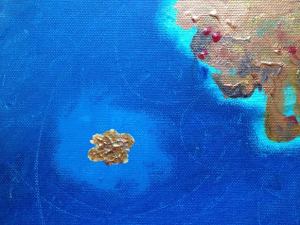
island3

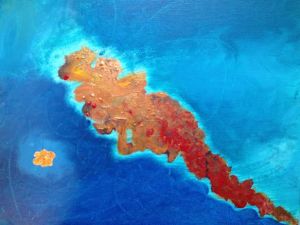
They made a wide berth around the island to the west. It had sprung up some 200 years ago amidst much rumbling and plumes of steam. One day it wasn’t there and then one bright morning, heralded by cracks and booms, the island was born over the course of six weeks.
No one lived there. Not even animals.

They called it “Turtle Island” because it looked like the shell of a great turtle, not because any of those noble animals lived there. They remembered a story from many generations back of a turtle holding up the world on her shell. That turtle was bigger than dreams and stronger than fear. She held up the world, swimming through space like it was a sea of stars. She held the world up on her back, high enough for light and air for it, while underwater she navigated the waters of time, carrying them to their unknown destiny. Her life was a life underneath, a life of service.

The people then never really knew how much she did for them.

They told her story to their children to remind them that all they see isn’t all that is, and that there is a great force that is carrying them safely and with great sacrifice. That was all they knew, and it was all they needed to know.

The story served them well then.

Years of science disproved this story, turned it into a myth. The people shifted away from superstition and ritual, but lost some of their hope when they abandoned the turtle as their benefactor.

These people carried that story, like a small ember from a fire, to their new home. Turtle island’s birth served as proof to them that their faith was warranted – the great turtle was still carrying them.

People would visit but they were not allowed to spend the night. Birds would land here to rest, but would not make nests. Even they knew this was a holy place. The brave among the teenagers would make their rafts or borrow the community rowboats and scull out to this little land

on a dare
or to stake their claim
or to run away
from restrictive parents
and their
even more
restrictive rules.

The island was still settling and still growing. They didn’t ever need the authorities to tell them to leave. They left of their own accord quickly enough, frightened by the rumblings in the land.