Jesus is my map

Jesus is my map.

He’s my goal and my guide.

He’s what I use to measure myself and the message of others. How do I and they line up with the message? If they say they are preaching correctly, he is how I know. But I have to be immersed in the Word to recognize the Word.

I separate the wheat from the chaff this way. It is how I know who is true and who is false. Sadly, I’ve even had to use this with ministers. Sadly, the people that I was supposed to be able to trust were the ones who were leading me astray.

I am for every Christian reading the Gospels for themselves, so that they can discern for themselves whether their minister is leading them correctly. To be even more honest, I’m for every Christian becoming a minister themselves. I’m for everyone waking up to the fact that God made them with a mind to be used.

We are not sheep. Jesus has redeemed us, has freed us. And he now guides us home, together.

Mary’s finger

So, I found Mary’s finger. And not just any finger, her right index finger. That has to mean something. That has to mean more than just her pinkie finger, right?

I was on retreat at Mercy convent – a convent for retired nuns of the Sisters of Mercy. There is a statue of Mary in the back garden, made of marble. I went outside to draw it. I’m not much of an artist but I like to try. I’d just realized that drawing is easier if I use pencil and an eraser rather than a pen to make my first sketch. You can go as deep on that as you like.

This is the angle I was working with.

mary1

Part of drawing is noticing what is actually there. When we take pictures, we often work so quickly that we miss things. Or, well, at least I do. There are things that our brains fill in and we assume things are like we think they are. I’ve learned that when I take time to actually draw something I learn where those gaps are. I learn what reality is, versus what I think reality is. It is a very useful meditation.

While looking, I noticed that she is missing some fingers. She looks a little sad about this.

mary3

Here is her left hand. Some repairs have already been done.
mary8

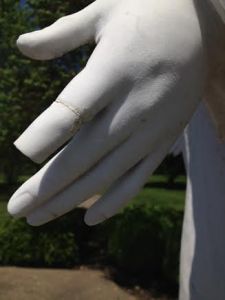
Here’s her right hand. There is a lot more damage here.

mary2

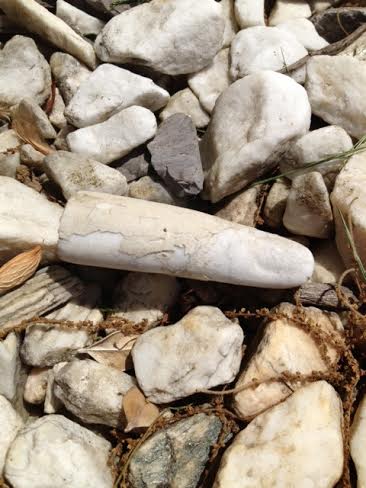
There are six intact fingers, and only one thumb in total. There is a small chip marble rock garden at the base, so I thought that the rest of the fingers could be there. It was a long shot. Surely someone else has looked for it.

Here’s the rock garden. The plaque says “Our Lady’s Garden” In memory of Sister Mary Demetrius Coode, Fall 1993.

mary4

I started looking on the left-hand side. That is the side I was closest to. I looked around a bit, but not really very hard. I mean really – someone else has to have thought of this, right? White marble statue pieces fall into a small rock garden filled with white marble pieces. That is where you look.

But the people who live here are all old. They don’t have great eyesight. They aren’t quite fit enough to hunch over and study these pieces. Their knees and backs aren’t so great anymore. They’ve had a life of service and now they are resting.

I gave up looking on the left side and moved to the right. There was more to look for over there – bigger pieces. It should be easier.

After about a minute I found it.

mary5

An electric shock ran through me. It was like finding an Easter Egg, or a four leaf clover, or a diamond. I found it. Me. It was here.

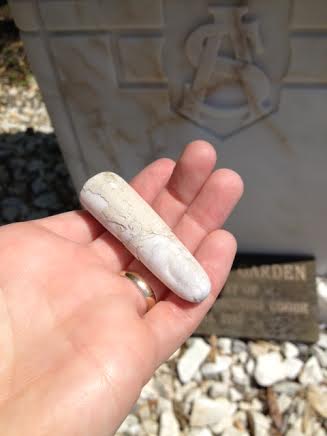
mary6

I thought briefly that they had left it in there as a treat, as a special thing to be found. It was the fact that I found it that made it special. It wouldn’t have been the same if it had been intact, or if it had been sitting at the base.

There is something about seeking, and finding, that is special. There is something about putting forth the effort and having it rewarded.

I thought about keeping it. Then I thought about taking a piece of chip marble as a token instead. In fact, I thought about taking one anyway, even before I found the finger. I thought about taking a piece as a memento of the search. I was going to pretend that the chip was a piece of the finger. Kind of like a diamond in the rough. The pieces at the base and the statue were both marble. The only difference between the two is one had a lot more work and skill applied to it. But the material is the same.

How do things get value? Why is this piece of marble more valuable than that piece? How does this relate to ourselves and our lives? Deep down, we are all the same.

I didn’t take the finger. I put it on the base, easily visible. This was during the silent part of the retreat, so I knew I couldn’t explain it to the sister who is the caretaker of the place. I figured if I left it there it would make it easier to tell her later.
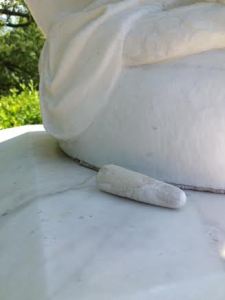
mary7

Then I thought that maybe it is safer in the rock garden. It can’t fall off the base and break into more pieces. It could shatter if it fell again. And I thought also, maybe I should leave the joy of finding it for someone else.

I didn’t find her right thumb, but then again I didn’t look too hard after finding that finger.

A whole finger! Of Mary!

She looks pretty happy that her finger has been found. This is around 11:30 a.m.

mary9

Later, at the end of the retreat when we can talk again and it is time to go home, I went to tell the Sister in charge. I thought she was going tell me that they left it there on purpose. No – she was delighted that it had been found. “Now I can write up a work order!” she said.

I was about to leave, but I followed her outside to make sure that she found it. Maybe it had fallen off. Maybe someone had moved it. I went to have some resolution. I went to help find it again if necessary. I went, in part, because I didn’t really want to leave.

She was beaming when she noticed it, and carried it carefully, like a baby bird, in her hands.

She told me that members of the church that sponsored the retreat came once and cleaned this statue. She was so happy about this kindness done to the Sisters.

She told me “We have to be the finger of Mary.”

Yes, and her thumb, and her big toe. And everything. We have to be Mary, willing to let God into the world. We have to let her take care of us, and we have to take care of her. It is reciprocal, this relationship. She isn’t God, but she is a face of God. She is mothering, kindness, compassion. She is a willingness to say “Yes, here I am” when God asks for a favor. She represents who we are when allow God to work through us.

And we also have to be marble, allowing ourselves to be shaped by a Master’s skill.

And we have to understand that we are valuable even as chips at the base of a statue.

Mary is beaming now. This is at 7, after I told the Sister about her finger.

mary10

What does it mean to pray to a saint?

Praying to a saint isn’t like praying to God. If you are praying to a saint, you don’t think that saint is God. It is more like you are getting a friend to help you out.

Say God is the CEO of the place you work. You are a bit intimidated by him. You need to ask a favor, but you don’t think that he will listen. You don’t think that you are high enough up on the institutional pecking order to talk to him. Maybe you can’t get an appointment. But maybe you don’t even try, because you just don’t think he’ll make time for you.

So you talk to your manager, or his secretary. You ask them to carry the message to the CEO. You ask them because you really need this favor done, or you really need to get this message across. Perhaps something isn’t going right in the organization. Perhaps you see a way that it can be done better. If only this information can get to the CEO, then some action can take place.

You don’t have the authority to make a big sweeping change, but the CEO does. So you let someone know, and they talk to the CEO. Then the change happens (or not).

Because not every time you pray to God does the change happen. Sometimes it isn’t a good thing to ask for. God has the whole picture in mind. So God knows what is best. We can put in our opinions in the opinion box, but we have to trust that what happens is what is supposed to happen.

Now, ideally, you’d go straight to God. Or, you can go to Jesus, who will go to God. But Jesus removed all barriers between us and God. We don’t need intermediaries. We don’t need priests or ministers. We don’t need saints.

Sometimes we feel like we do, in the same way that we feel like we need training wheels when we start to learn how to ride a bike. But what happens when we learn how to ride, and we still use the training wheels? We don’t get as strong as we should.

Jesus makes us worthy to stand before God. When the veil before the Holy of Holies in the Temple was torn in two at Jesus’ death, all barriers between us and God were removed. By his blood we are cleansed, and by his stripes we are healed.

But this is a very human thing. People were constantly throwing themselves facedown when an agent of God (read – an angel) appears to them. They were constantly saying they aren’t worthy. There is nothing in the Bible that says they aren’t worthy, but they keep saying they are. We still do.

So we have saints, and priests, and ministers. We have intermediaries, and go-betweens.

And the message still gets through.

God wants to hear from us, no matter how. Keep praying. Keep asking. Keep knocking. Keep seeking. Keep praying. If you have to use saints, fine. You aren’t praying to them, so much as with them. They are like spiritual friends. But keep praying. God is listening.

Alphabets

If you want to gain an appreciation for how hard it is to learn to write, try learning another alphabet. I’ve always thought that the English alphabet is fairly simple. But that is because I was raised with it. I’ve been using it for years.

When I started tutoring kindergartners, I realized that are a lot of letters that look alike. Lower case “p” and “b” and “d” and q” look a lot alike. A lower case “n” is just a “u” upside down. In one way this is useful. It is a great way to see if a child has a learning disability. If she can’t ever “see” these differences, then perhaps her brain isn’t processing them.

Part of learning to write an alphabet is learning at what point a letter isn’t that letter anymore. This comes into play when you are handwriting the letters. At what point is an “n” an “n”, and at what point is it an “h”? If you put just a little too much tail on the “n” it changes into an “h”. If you put the tail on the right it is wrong. If you put the lines in the wrong place then it isn’t a letter at all. It is just a squiggle.

Writing is just an agreed-upon set of squiggles. Teaching letters to a child is just teaching these symbols, these agreed-upon squiggles. They are symbols because they have meaning. They have meaning because we agree that they do. In and of themselves they mean nothing.

I’ve come to appreciate how hard it is for anybody to learn the English alphabet because I’m learning Hebrew these days. I’m learning to write, read, and speak it. Well, maybe not the whole language. Just now, I’m learning the prayers. I bought a siddur, a Jewish prayer book, but it didn’t show the pronunciations. It showed the Hebrew words and the translation. I want the middle bit – the how-to-pronounce-it bit. I have a book by Blu Greenberg called “How to Run a Traditional Jewish Household” and it has a lot of what I want. There is also a website called “Hebrew 4 Christians” that is very helpful. But none of this is portable. So I’m making my own prayer book. And this involves handwriting the prayers.

Sure, I could literally copy-and-paste, but that would make my little book not so little. Pasting paper onto paper makes the book too thick. Ideally, I’d find some way of assembling this online and then printing out my own little prayer book, but I’ve not found a way to do this. Other alphabets aren’t always supported. And, ultimately, I do want to learn this alphabet. I like learning alphabets. So the best way is to write the words onto the pages myself.

I’m learning a lot of the letters look the same. Some look like just slight variations on other ones. I don’t quite know what makes one letter different from another. What must be included to make sure this letter is this letter? What is too far? What isn’t enough? It is the same as with the “n” and the “h” – what is the line that makes this one different from this one?

I want it to be perfect, but it isn’t going to be perfect without practice. I’m sure that if a reader of Hebrew looks at this, she might be able to figure out what I’ve written. Sure, I could practice on my own, away from this book. I could try to write the prayers and the letters out by hand and then copy them over to this book when I feel that I’ve gotten it – or I can just do it. I think there is something honest about that. I think God likes us to just try, to open ourselves up to being able to make mistakes.

You’ll never learn to walk unless you let go of the table you are holding on to. You have to try to take a few steps on your own. And when you do, your parent is overjoyed. Your first few baby steps are beautiful to her. They are awkward, and wobbly, but they are beautiful. They are beautiful because you are doing it. And with every step, you are walking closer to your parent’s open arms.

I think God thinks the same about my little prayer book. The letters are awkward and wobbly, but they are beautiful. I’m trying. And with every stroke I’m getting better. And with every stroke I’m walking closer to God.

Jesus in the stacks

I was in the stacks getting paging slips. I see this guy using his laptop. He has his legs up on a stool. It is against the rules, but I don’t say anything. I’ve just gotten challenged about the rules for what we are going to allow as proof of address for library cards, so I leave it.

This guy calls to me. Sort of. “Becky!” he says. “Becky!” I’m not Becky, I’m Betsy, but he’s close. I have “Elizabeth” on my nametag, so maybe I’ve told him my name and he’s half remembered it. I tell my name to people I like.

The only problem is that I don’t recognize him.

I look, and look, I and I think maybe he’s a regular, but he has cut his hair? Nothing.

So I think about it, and because he sort of knows my name, I come closer. He says “I’ve got something for you.” and he pulls out a box of cookies and starts opening them.

I’ve just finished a piece of banana bread, and I’m trying to not eat a lot of snacks. You don’t keep 50 pounds off by eating snacks. Plus, I don’t know this guy. Sure, the box was sealed, and they aren’t homemade, so I’m not worried about being poisoned. But something doesn’t feel right.

I tell him I can’t, that I’m trying to stay fit, so I can’t eat extra calories. He tells me he just walked several miles. I point out that I haven’t.

I walk away.

And then I think, is this Jesus in disguise? Did I just refuse to share a cookie with Jesus? Is this communion in the library?

And I think of this verse.

Matthew 25:31-46

31 “When the Son of Man comes in his glory, and all the angels with him, he will sit on his glorious throne. 32 All the nations will be gathered before him, and he will separate the people one from another as a shepherd separates the sheep from the goats. 33 He will put the sheep on his right and the goats on his left.

34 “Then the King will say to those on his right, ‘Come, you who are blessed by my Father; take your inheritance, the kingdom prepared for you since the creation of the world. 35 For I was hungry and you gave me something to eat, I was thirsty and you gave me something to drink, I was a stranger and you invited me in, 36 I needed clothes and you clothed me, I was sick and you looked after me, I was in prison and you came to visit me.’

37 “Then the righteous will answer him, ‘Lord, when did we see you hungry and feed you, or thirsty and give you something to drink? 38When did we see you a stranger and invite you in, or needing clothes and clothe you? 39 When did we see you sick or in prison and go to visit you?’

40 “The King will reply, ‘Truly I tell you, whatever you did for one of the least of these brothers and sisters of mine, you did for me.’

41 “Then he will say to those on his left, ‘Depart from me, you who are cursed, into the eternal fire prepared for the devil and his angels. 42 For I was hungry and you gave me nothing to eat, I was thirsty and you gave me nothing to drink, 43 I was a stranger and you did not invite me in, I needed clothes and you did not clothe me, I was sick and in prison and you did not look after me.’

44 “They also will answer, ‘Lord, when did we see you hungry or thirsty or a stranger or needing clothes or sick or in prison, and did not help you?’

45 “He will reply, ‘Truly I tell you, whatever you did not do for one of the least of these, you did not do for me.’

46 “Then they will go away to eternal punishment, but the righteous to eternal life.”

And I start to wonder. Am I doing the right thing? There are a whole lot of boundary issues with being a follower of Jesus. More on that later. At what point do I protect myself, and at what point do I realize that I’m safe all along?

Paul isn’t the Messiah

I just got into an argument with a minister. Well, that isn’t uncommon. I get into arguments with Christians and their leaders all the time. The issue is when we follow Paul and not Jesus. Plenty of Christians use the words of Paul to harm others, and to exclude them. This is contrary to the message of Jesus, and damaging to the reputation of Christians as being Christ-bearers.

Sure, if we discount the words of Paul, we discount the majority of the New Testament. But do we really need more? We have the Gospels. Isn’t that enough?

More does not mean better. If Paul’s words add to the message of Jesus, then great. It is when they take away that is the problem. Paul’s words have been used to attack and divide for centuries. They paint Jesus as aggressively intolerant – and that is not Jesus. The Jesus I met when I read the Gospels on my own wasn’t the Jesus I was introduced to by people who said they were Christian. The more people use the words of Paul when they are counter to the words of Jesus, the fewer people will find the real Jesus.

Our job as Christians is to bring Jesus to people. We are to bring that same healing love, that same forgiveness, that same compassion.

I remember thinking the same way as that minister. I remember taking a women’s studies class and a female minister was invited to talk to us. She said “Paul said…” – and I said “You mean Saint Paul?” She looked down her nose at me, as if I’d just offered her dog doo and said “I don’t call him Saint.” I thought, how dare she attack a leader of the church?

At the time, I was going to a church called “Saint Paul’s”. We heard Paul’s words almost every week. The Bible readings during the service are always one from the Old Testament, a Psalm, one from the Epistles (Letters) and one from the Gospels. So we heard a lot from Paul, because Paul wrote a lot of letters. Paul wrote while he was in prison for preaching about Jesus. It wasn’t considered Scripture at the time.

It is now, and that is the problem.

Paul isn’t the Messiah. When we follow Paul instead of Jesus we are going to get mislead.

Paul is for telling people they are sinners, and for making women be silent in church. Paul is against anybody who isn’t Paul. Paul did a lot to spread the message of Jesus, and that is great. The problem is when we start to think that Paul’s words ARE the message of Jesus.

The only way to differentiate between the two is to read Jesus’ words first, then Paul’s. Then we have to separate the wheat from the chaff. What agrees? What builds up? What strengthens and clarifies? Then – what takes away? What is added in that wasn’t there?

The philosopher Descartes talked about the color teal. He said he could explain what teal is by telling you that it is sort of green and it is sort of blue, but you really won’t know what teal is until he shows you what it isn’t. At some point it is peacock blue. At some point it is emerald green. It is seeing the line of what it isn’t that shows you what it is.

So, yes, read the words of Paul. Read them, so you can learn what isn’t the message of Jesus. Read them so you can learn what God’s message looks like through a fully human filter. And then learn from that. Learn how easy it is to take the message of Love and turn it into judgment and condemnation.

The minister had said that we need to “Speak the truth in love”, that a “sincere sin seer” should point out the sin in others. Because of my readings, I knew that “Speak the truth in love” is not from Jesus, but Paul. I said this, and said that Jesus tells us to take the plank out of our eyes first. Our sin is greater than the sin of someone we are trying to “correct”. The minister brought up the story of the woman who was caught in adultery. He said that Jesus said to “Go and sin no more.”

That was all he mentioned. If I’d felt awed by the fact that he is a minister, it would have stopped there. But Jesus came to take away all such distinctions. Jesus didn’t ordain anybody. We are all ministers. So we all need to think for ourselves.

Here’s the full text. It is John 8:2-11 (HCSB)
2 At dawn He went to the temple complex again, and all the people were coming to Him. He sat down and began to teach them. 3 Then the scribes and the Pharisees brought a woman caught in adultery, making her stand in the center. 4 “Teacher,” they said to Him, “this woman was caught in the act of committing adultery. 5 In the law Moses commanded us to stone such women. So what do You say?” 6 They asked this to trap Him, in order that they might have evidence to accuse Him. Jesus stooped down and started writing on the ground with His finger. 7 When they persisted in questioning Him, He stood up and said to them, “The one without sin among you should be the first to throw a stone at her.” 8 Then He stooped down again and continued writing on the ground. 9 When they heard this, they left one by one, starting with the older men. Only He was left, with the woman in the center. 10 When Jesus stood up, He said to her, “Woman, where are they? Has no one condemned you?” 11 “No one, Lord,” she answered. “Neither do I condemn you,” said Jesus. “Go, and from now on do not sin anymore.”

See? When the minister just quoted “Go and sin no more”, all he was focusing on was the sin. He left out the line before that – “Neither do I condemn you.”

I mentioned this, and said that we cannot point out other’s faults, that we must show love without fail. He said we should point out people’s faults, that it is called intervention. He also then said that I was pointing out Paul’s faults, so I was contradicting myself.

I’m not pointing out Paul’s faults. I’m pointing out the Church’s fault when we take the words of Paul as the Gospel. I’m pointing out the danger of following Paul as the Messiah.

I point out where Paul deviates from the words of Jesus. We cannot base our faith and our lives on the message of Paul when it does not harmonize with the message of Jesus. Remember the hymn “They will know we are Christians by our love”? Sadly these days it is more judgment and condemnation that we are known for.

Intervention indeed. The Church needs one.

McNugget Communion

One reason I became a chalice bearer was to see things up close. There are things that happen at the altar that the church members don’t ever see. You can remove the “gate” at the communion rail all you want to make the church seem more open and inclusive, but there is always going to be a sense of “us” and “them” when the altar is twenty feet away from the nearest person, and at least a hundred feet from the furthest one.

One part that nobody knows about unless you are up there is the hand washing bit. Even the acolytes usually don’t even notice it. It is a ritual hand washing, and only the priest does it. This is done right before the elements of communion (the wafers and the wine) are handled.

Another member of the altar party, sometimes the crucifer (the person who carries the main cross), sometimes just another chalice bearer, will bring over a cruet of water, a small metal basin, and a linen cloth. The priest puts out his/her hands and the other person pours a little bit of water over the fingers, catching the water in the basin. The priest dries his/her hands with the linen cloth. The priest says some words quietly during this time – quietly enough that other person cannot hear them.

None of this is in the prayer book. The congregation has no idea this is going on from the “script”. I asked once, and the priest wouldn’t tell me what the words were. Like it is a secret.

It isn’t a real hand washing. There is no soap. There is no scrubbing. It is ritual.

So what is it?

It is straight from Passover, and thus straight from Shabbat.

At the beginning of Shabbat, you are to wash your hands and say the Netilat Yadayim prayer. “Blessed are you, Lord our God, Master of the Universe, who has sanctified us with thy commandments and commanded us about washing the hands.” Everybody does this – not the “leader”. All are equal.

The more I read about Judaism, the more I realize what a cheap thing the Christian Communion ritual is. The two candles on the altar? They are the two candles on the Sabbath table. The communion wafers? On the regular Sabbath table it is challah, which is nice fluffy egg bread. At Passover, when the Last Supper took place, it would have been matzo, which is unleavened bread. Why are the pieces so small for communion? Because an “olive sized piece of bread is the smallest piece you can make a blessing over.” There is always wine at the Sabbath table if it can be afforded, and always enough for everyone to have at least a glass. Not a sip.

These things are mandatory for a Sabbath meal – bread, wine, and two candles. There are different blessings for each. The candles are always lit first at Sabbath and at the beginning of the church service. At Sabbath there is always a nice meal, using the best linens and plates. The meal is always a real meal – homemade. No leftovers.

We’ve mass produced the Sabbath. We’ve reduced it to a snack, not a meal. We’ve packaged that snack with so much pomp and puffery that we think it is really awesome.

It is the difference between Mama’s fried chicken and chicken McNuggets.

It is the difference between Granny’s pecan pie and a Tom’s mini pecan pie you bought in a gas station.

Me? I want the real thing. I’m not able to settle for the replica, the ritual any more.

The treasure of the Grail

The quest for the Holy Grail, if done right, is a quest inside your very self. It isn’t to be found “out there” in an archaeological site or an abandoned warehouse. It is to be found right where you are.

Remember in the last Indiana Jones film how he passed the test by picking the simple cup? Jesus wouldn’t have used a gold chalice, encrusted with gems. It would have been simple and efficient. It was a last minute Passover meal, held in a borrowed room. There wasn’t time for fancy. They didn’t even carry money on them, so they certainly wouldn’t have had a fancy gold chalice.

The cup is simpler than even that. The grail, the cup of Christ, isn’t even a simple wooden vessel. It isn’t a piece of pottery. The Grail is your body. The blood of Christ runs in your veins. The kingdom of heaven is within you, after all.

The Grail, like God, isn’t in some inaccessible place. The Grail, like God, is here on Earth, within easy reach.

It doesn’t mean that you don’t have to look for it. Just telling you isn’t enough. You have to work for this treasure. But the longer you think that it is something far away and something that someone else has found, the more you are missing it.

You are Christ’s body on this Earth. If you have Jesus in your heart, he starts to take over. You start to realize that your life isn’t your own anymore. It never was anyway. You just didn’t know it.

It is kind of like AA. Once you resolve to change your life, everything starts to need to be changed. But like AA, this awakening comes from within. Someone else can’t do it for you. In fact, if they try, it will just shortchange and delay you.

Your job on this earth is to be the cup of Christ, and share the healing that he shared. Your job is to carry him within you, serving everyone you meet in the same loving way.

When we all do that, the Kingdom of Heaven is here.

Jesus is the Word.

I read a post recently by a Rabbi who has a Facebook page. He is very upset about the number of Jews he knows who have embraced Jesus as the Messiah. He says that he will not call them Christians, but that they are still Jews, just mislead.

His biggest issue is not that they have found the Messiah, but that they think that a human being is God. This is idolatry in his eyes.

I get that. But the problem is, Jesus isn’t God. Well, he is, and he isn’t. Jesus is the Word made flesh. Jesus is the Torah in human form. Jesus is an aspect of God, in the same way that the Torah is an aspect of God.

The Torah is “The infinite compressed into the finite” according to David Sacks, from the podcast “Living with G-d, Spiritual Tools for an Outrageous World.”

The Torah is the Word of God. Jesus is the Word made flesh.

Jesus isn’t God, but a part of God. God is quantum. God is everywhere. If Jesus was really God in totality, then who was Jesus praying to in the garden (Matthew 26:36-56)? Who talked to him when he was baptized (Matthew 3:17), and when he was transfigured (Matthew 17-5)? Was he talking to himself?

God gave us the Torah, the first five books of the Bible, as an instruction book. It tells us how to live. It keeps us awake and aware. With these stories, we have a pattern for how to live our lives. It is like letting someone else do all the mistakes first for us. We can read these words and know “Oh, this works, do it” or “Hey, that is a big mistake, don’t do it.” With the study of gematria, you can dig down even deeper. There are people who study the letters of the Hebrew alphabet inside and outside. They assign numerical values. They look at the beginnings of the words and the middle. They find in all this study that the Torah is constantly revealing the Message of God, no matter how you divide it.

The Torah is like a fractal. No matter what part you look at – big or little, you are seeing the whole pattern. It is pretty amazing.

Jesus is like that. Jesus is a part of God, and God, and not God. Jesus is a tiny piece of the whole. But because of the nature of the whole, Jesus has the same pattern as the whole.

Get it? Not really? That is fine. I don’t really either. But I kind of do.

God is so much bigger than our human minds can comprehend. We can’t get “I am the Alpha and the Omega” at the same time. Our processor – our brain – isn’t big enough to handle it. We are black and white and 2D. We are a sheet of paper, copied on a copier. God is not only full color but as many dimensions as possible – way more than four. God is everything all together.

That just doesn’t fit here on this planet very well.

It is like trying to play a CD-rom on a Victrola. It just isn’t going to work. There is a lot more information on that tiny disk. You can put a whole encyclopedia on it. And while that Victrola looks like it can play it – it is a turntable after all, and the CD-rom is round, and there is a needle for reading it, it just is going to destroy that disc.

Now sure, Jesus says “I and the Father are one.” – John 10:30

That is what got him killed. That, and “working” by healing people on the Sabbath.

Jesus, or Y’shua as his name is more accurately pronounced, is the Torah, in human form. God can do that, you know. God can do anything.

The Torah wasn’t working. People weren’t getting it. They were following the rules but they weren’t getting where the rules were leading them. It is like they had the recipe but they weren’t putting any love into it, so the food tasted bad. It wasn’t nourishing. You have to put love into it, or you’ll get nothing out of it. If the rules lead you to be loving, then keep the rules. If they just become rules for the sake of rules, then drop the rules and try something else.

God figured that if He sent a human to explain it to live it, it would work out well. Sadly, not so much. People got really angry. People still get angry. Sadly, that is the way of people.

As for me, I see Jesus as a pathway. I see his life as an example. I believe that Jesus came to point towards God, not himself. I believe that Jesus is proof that God loves us – not because of Jesus’ crucifixion, but because of his existence. I believe that what makes Jesus different is that he proves that God isn’t “up there” but “right here” with us, right now.

And that is worth it all.

Acolyte instructions

Back when I was a full-time church member and active member of the altar party (the people who make the service “go”), I wrote out instructions for how to be an acolyte. There probably were instructions written down somewhere. I was never given any. I was given a quick explanation five minutes before the service and away I went, figuring it out on the fly. Sometimes I sat next to the acolyte master, sometimes across from. Either way, there were a lot of directions gotten on the fly, either whispered or pointed. It was a bit nerve-wracking, because things changed from week to week, depending on how many acolytes there were. There never were enough. I wrote out these instructions to myself so I’d have something to look back over during the week as a refresher. I provide them here as some insight on the role of the acolyte, and on how much emphasis the modern church puts on show. Some of this may only make sense if you have been an acolyte.

“First” means the crucifer – the one who holds the big cross. “Second” means the one who holds the smaller cross. There are also (ideally) two torchbearers. Sometimes there are just two acolytes and they end up doing all the roles.

Light the candles 15 minutes before the service begins. Facing the cross, the left-hand altar (gospel) candle is always lit second, and never is left lit alone.

The series of candles behind the altar are lit from the inside to the outside, extinguish opposite.

Light altar, then behind the altar. Enter at front, leave on side. Turn to bow at stairs.

At beginning – take cross or torch and meet in the center front. Left hand on top of cross pole.

Big first, two torches in middle, then second cross. Face the crucifix. Bow. Turn towards the cross. Process to the front to collect priest in foyer.

Come back in. Bow at crucifix (with head – don’t bob the torch or cross)
If two torchbearers, stand on either side of crucifer.

(Dismiss for children’s church – second takes cross and leads kids to the top of the stairs, comes back, puts cross back. Regathers the children at the confession of sins (with cross))

At Gospel reading time, gather torches and cross and meet at the center front as before. Second holds no cross but waits for the priest who raises the gospel, hands it to second.
Turn to the right, process to the seventh pew. Turn, second holds the gospel braced against chest.

When returning, stand to side, crucifix always leads.

Oblations (Priest says “Walk in love as Christ loved us, and gave himself as an offering and perfect sacrifice for us”). Second rises, gathers alms trays from first, (bows) stands to the left of the entrance. Waits for oblationers, ushers. Gives top two basins to ushers, takes count from ushers and takes it to the altar.

Waits to Gospel side for ushers to return. Takes two alms basins on top of main basin, turns to altar, raising it up, gives to first. Priest blesses the alms.

Rail closing – two together, do it without gloves so you won’t snag. Don’t forget to bow. Done after “the gifts of God for the people of God…” lines.

Keep gloves in belt. (cincture)

Open back when Communion is over, and the cleaning-up happens.

At final hymn, extinguish candles – altar (left -gospel side first) and behind altar-(outside to inside). Enter to extinguish from the front, leave on side). Turn to bow at stairs.

Gather torches and cross, arrange as before, turn right, process out.