Inside the Kaaba

Muslims face the Kaaba five times a day in prayer, no matter where they are in the world. Hundreds of thousands of people turn towards this immense cube (which is what “Kaaba” means).

Did you know that it isn’t solid? It has a place to worship inside. The Kaaba is a mosque, a holy house. It is said to have been originally built by Adam and Eve, then restored by Abraham and Ishmael, as the very first place to worship the One God, who Muslims call Allah.

The interior is 13 m (43 feet) high, and the sides are about 10.15 m (33.3 ft) by 8.24 m (27 ft). There are no windows but there are lanterns.

241b4f20kaaba4

These are screenshots from a 3D animation of the interior.

kaaba 4

kaaba 3

Here’s another view.

May be an image of text that says "InsideTheKaaba Inside The Kaaba MIeTA"

This is a top-down map of it.

kaaba-plan

These are cutaway illustrations.

Kaaba inside

What is inside the Kaaba

What is inside the Kaaba

The Kaaba used to be opened twice a week for anyone to pray inside. But now it is opened just twice a year, and then for only dignitaries and exclusive guests, who enter to ceremonially clean it. The door is 2.13 m (7 feet) above ground. There is a wooden staircase on wheels that is used to reach the door.

The key is kept by one tribe. Here are pictures of the key.

k key

k key2

This is all very interesting, but I think this is the most interesting part– if you are inside the Kaaba, what direction do you pray? You are in the center of the center of worship.

The 12th century Sufi mystic and friend of the poet Rumi, Shams of Tabriz said – “The Kaaba is in the middle of the world. All faces turn toward it. See! Each is worshipping the soul of each.”

Now try this. Visualize that you are inside the Kaaba every time you pray, no matter where you are, no matter what faith tradition you practice. You are in the epicenter. You are in the eye of the storm. You are in the heart of the Creator. You are in the first holy place ever made by human hands. Hold that feeling in your heart.  You don’t have to face any direction.  Your prayers go directly to God, right where you are.

May be an image of text that says "nside InsideTheKaaba The Kaaba aelA HiKo"

(Pictures and information are from Wikipedia and other online sources. All copyright belongs to the original owner. Used for educational uses only.)

Spiritual but not religious (poem)

There are many people who say
that they are spiritual but not religious.
Perhaps they are this way
because there are so many
other people
who are
religious but not spiritual.

These are people who
go to church
but they don’t realize that
they are the Church.

They go into a building
but they don’t realize
that the Church
isn’t that.
It is them.

They believe that their
entire obligation to God
is to go sit passively
in a building
and listen
to someone else talk
for an hour
once a week.

This is not what Jesus meant
when he died for us
to create his Church.
When he said
“upon this rock I will build my Church”
to Peter,
he’s talking to a human being.
He didn’t mean a building.
He meant that we are supposed
to serve God
with every moment
of our days.

This does not mean
sitting in a church building
and singing hymns
and praying for people.
This means actually working.
This means actually helping people.

Many people have
left the Church
because the church
has left Jesus.
Many people don’t go to church
because they don’t find
Jesus
there.

Prayer bead chain

main
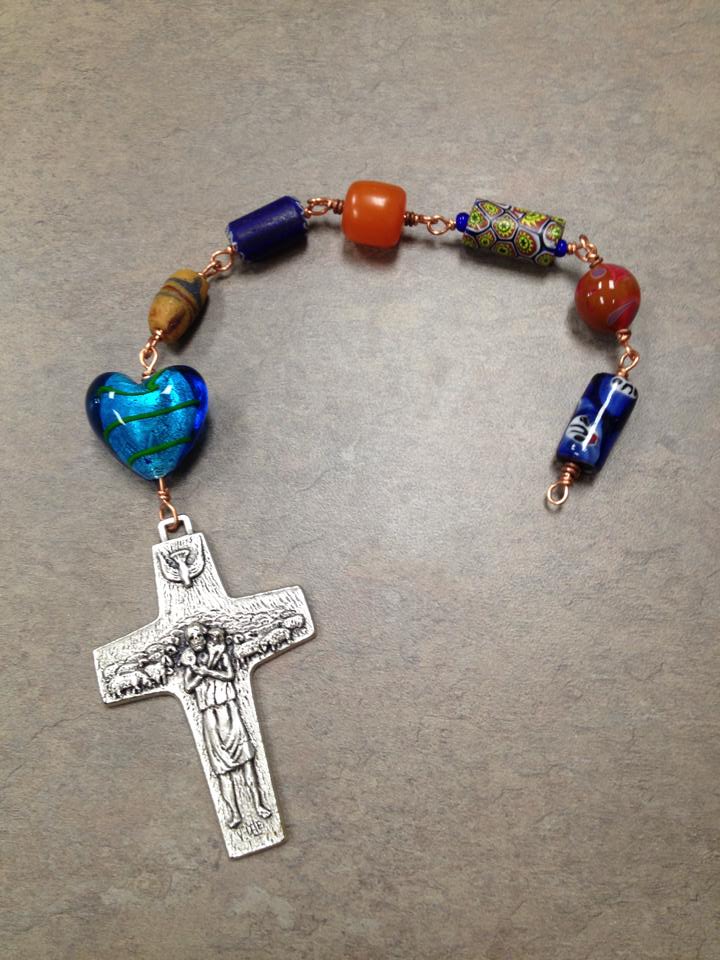
This is a prayer bead chain that I made. It isn’t a rosary, but it kind of is. It is a reminder to pray but there are no set prayers for it. I’m open to adding more beads to it in the future, but it is still good the way it is. It would be too heavy to make into a necklace. It is meant to be carried in a pocket so that it is ready to be used as a prayer aid whenever needed.

cross
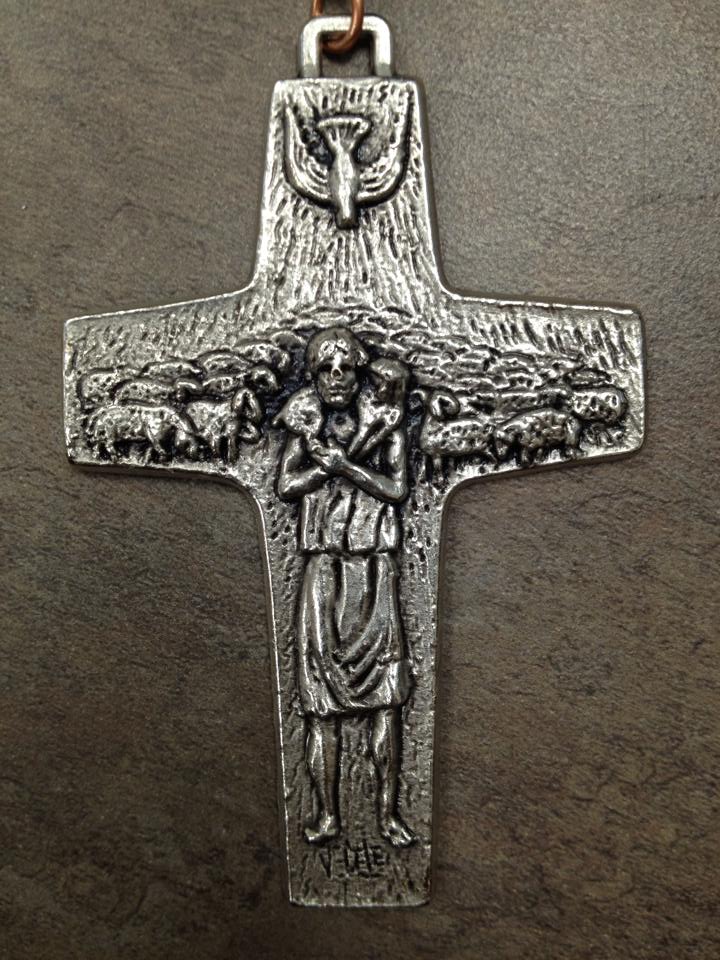
The cross is a replica of the cross that Pope Francis wears. It is not a crucifix – rather than depicting Christ crucified, it celebrates his life and teaching by depicting him as the good shepherd, one who seeks out the lost and protects them, even willing to lay down his life for them.

heart
The next bead is a heart, as a reminder of God’s love for us, that God loved us enough to come down to earth to experience life among us.

recycled
This bead is made from broken pieces of glass that have been put together and remade into a new bead. It is a reminder that God can make something new out of our brokenness.

This bead is a chevron bead.
chevron1

It doesn’t look special until you see the sides.
chevron2

The only way you can see it is if you cut the bead and then grind away at the edges. This is a reminder that our true beauty isn’t on the surface, but is what is revealed after we are tested.

copal
This bead is made of copal. It is a reminder of the incense used in churches as “an aroma pleasing to the Lord”. Instead of making animal sacrifices, our prayers and work are what God desires.

millefiori
This millefiori bead has six pointed stars, as a reminder of the faith of Israel that told the world about the One God.

egg
This is a glass bead that I made myself many years ago. Unintentionally, it looks like an egg. It is a reminder that what I did many years ago can still be of value and needed today. It is also a reminder to use whatever talents I have to glorify God.

people
This bead is also a millefiori bead, but it has faces. Because it is made of many different canes of glass fused together, it is a reminder that the Body of Christ is made up of many people, all working together in unison to do God’s will on earth.

The Hunt (an Easter musing)

It is kind of hard to ignore that Easter is soon upon us. I’ve always been mindful of how strange it is to be the minority faith in America, even though I’m part of the majority. My closest friends were Hindu or Jewish while I was in school, and I still remember how awkward it was that the principal would say a Jesus-centric prayer at every football game at our public (meaning not private, thus not religious) high school football games.

It seems so strange that non-religious organizations such as grocery stores and pharmacies and craft supply shops will have displays for every Christian holiday but totally ignore the fact that there are people who have other festivals and observances who live in the same community. I think it is best to have all, or none.

But I digress.

I saw a sign at the local grocery store saying “The Hunt is On” over a huge display of Easter candy. The hunt? Oh right. Easter eggs. Hidden. And you go find them.

Plenty of people say that Easter is a pagan holiday, that the Christians simply adopted the celebration of Ostara as their own. They say that to celebrate Easter is to worship a false god (or goddess). Maybe this is true. It bears further research.

But, it seems backwards, this entire idea of us hunting for eggs.

We aren’t the ones who do the seeking. God is.

God is the one who seeks us.
God is the father to the prodigal son.
God is the one who goes to find the lost sheep.
God is the one who seeks the lost coin.
God puts everything aside to find us, to gather us up like a hen shelters her chicks.
God is the one who heals us.

We are the eggs, hidden, lost, confused, ashamed.
God finds us, brings us out into the light.

Notice how beautiful hand painted Easter eggs are. Each one is different and special. That is how God sees us.

Traditional-Easter-eggs-008

Melissa’s story

3


Melissa knew it was time to leave her job when her boss sent her that email. Nearly 20 years with the same firm and it all came down to one thing – trust. She simply didn’t trust him to be honest. Or fair. Or rational. He was her third boss, but they were all the same. All toed the party line, all had degrees in “CYA”. Normally, she would have put her head down, not drawn any attention, and soon things would blow over or the manager would retire or get transferred.

It took her six years to realize that her job, while saying that it cared for its employees, didn’t back that up with real action. The bullies and incompetents got the management positions. They wrote the performance reviews too, and they were all one-way. All the reviews were top-down, so the subordinates never had a say in how they were being managed. This was the norm all over, so it never occurred to her that it was wrong, never occurred to her that it was possible to change it.

Her friend Bobby had died because of it. He’d drunk himself to death over anxiety and fear, too much stress and a job he had to have to pay his mortgage and his alimony. He managed to work up the momentum to leave the sinking ship of his marriage, but his job was another matter. He was dead three days before he was found. In many ways it was three years.

Melissa wasn’t going to go out like that. She wasn’t going to give her boss the pleasure of knowing he’d won with his squirrely ways. She ran over Paul Simon’s song in her head for options. Hop on the bus? Make a new plan? Drop off the keys? Well, she wasn’t leaving a lover, but it still sounded like a good exit strategy. And, after all, she had been screwed.

The email that morning said it all without saying anything. She’d asked for some time off. Her only joy now was looking forward to vacations, yet she was told, in writing, that her request did not meet his guidelines. There was also a mention that this was her second attempt to violate this policy. The only problem was that it wasn’t written policy. It certainly wasn’t corporate policy. And he did not say at the time that it was his policy, but just a guideline. She had no way of knowing that she’d stepped over some line into dangerous territory.

He told her more with that email than simply “no”. By putting it in writing, his not-so-veiled threat was made clear. Two violations, without the first one even being intentional, meant that three and you’re out. What nonsense. How could she have known she broke a rule the first time she did it when he hadn’t told her the guidelines? Heck, he hadn’t even given her a list of her job duties. Suddenly she was one step away from trouble. It was like driving on a road that had dangerous curves and no guard rails and no warning signs.

He was a squirrel.  That was certain. Everybody knew that he was a manager in title only. The problem was that nobody bothered to tell him. So he sent passive aggressive emails rather than confronting people directly. He didn’t manage. There was no plan or direction. He didn’t lead. Well, he led by negatives. Don’t do what he does. He didn’t even know what people did for their jobs, so how could he manage them?

Melissa took a breath in and reminded herself that Jesus said only God is above us. Don’t follow people. If you do, you are saying that they are more important than God is. To follow a person, no matter who they are – brother, father, aunt, boss, teacher, minister, spouse, governor, president, – anybody – was to make them into an idol.

She often wondered why she had so many bad bosses, so many who let the power go to their heads and quit working. It wasn’t fair that they got paid four times what so she did yet did a fourth of the work. It’s like they forgot what it was like to be a subordinate.

Perhaps that was the problem. Where could she work with there were no was no hierarchy? She left the social group she was in because of that kind of bullying. She left the church too for the very same reason, among many others. Over and over again she kept hitting that wall. The lesson wasn’t learned yet, apparently.

She’d waited out bad bosses before. How long until he retired? But deep down, she knew that if she didn’t learn the lesson with this one, it would resurface with another one.

Back to Jesus. What does he say? First, give thanks for the situation because it reminded her to pray and seek his help. Sometimes that was as far she got in her prayer, but now she knew there was more.

Jesus said that before you take your offerings to the Temple that if you have issue with anyone, you must leave your offering and go make things right. But how was she to do that? She was starting out in the negative. And she wasn’t even the one who had caused the problem.  Her boss was in the wrong.  This was backwards.

She remembered that story in the Bible when David was small and had no armor. With God’s power he killed Goliath with just one stone. Not even a sword. Anything was possible with God on your side.

Would talking with him make him feel threatened and thus worsen her standing? She knew she’d get no backup from higher up in the corporation. She’s gone that route before with an even worse manager. She still had unresolved trauma from that time. There’d be no help from her husband, either. He was even more bullied in his past. He couldn’t be objective.

So she was alone, again. Sure she had Jesus, and God, and the Holy Spirit. That had to count for something, right? But they weren’t physically here. They couldn’t go talk to him for her, or find her another job, or kill him off, or magically change everything. Perhaps that was the point too.

Perhaps Jesus came and said all that he did to tell her to not even have him above her, but within her, to give her the strength to do it herself. She wasn’t alone, then. She was doubled. Enhanced. There was a synergy, more than the sum of the parts.

But she still didn’t know what to do. Wait, and seem passive? Or wait until there is a clear path, a plan, and instruction from God? In the past, she always found herself doing the right thing, like a puppet, motivated by God. This current problem was a jigsaw puzzle and she didn’t have all the pieces yet, but God always does.

Was this event shifting her away from this job? Was it right to stay in a place, work 40 hours, and not feel like she fit? Had she outgrown it? It isn’t like she married this job. It wasn’t “till death do you part”. It certainly wasn’t for richer.

She prayed some more, and then she knew what to do. She was grateful that even though God doesn’t provide a map for life, God most certainly provided a compass.  With her heart focused on God, she knew she could walk through any situation, knowing that it would come out the way it was supposed to be.

Easter and Ostara

I have an opportunity this week to go to two different religious events that are not part of my faith tradition. They are being held at a Unitarian Universalist Church. I’m interested in other faith traditions and attending their events. I feel that we cannot truly “love our neighbors as ourselves” if we don’t know anything about them. It is important to know where we are both coming from.

But I’m conflicted. The first one is a Purim celebration. That is a Jewish festival, celebrating the defeat of people who wanted to kill the Jews. It centers around the story of Queen Esther. I’d like to attend because I’ve never participated in this festival, but do I want to do it at a place where they might not be doing it correctly? It might be more “show” than real, because the Unitarians aren’t Jewish. Going to a synagogue would be the best option if I want an authentic experience, but I don’t want them to feel threatened by the fact that I follow Jesus.

This then leads me to this thought. I find it interesting that the very things that the Jews hold against Jesus for why they can’t accept him as the Messiah aren’t true. They think it is blasphemous that he said he was God. But, he never said he was God. He said all the time that he was the Son of Man. He said he was the son of God, but said that we all are. They are also repulsed by the idea of human sacrifice, as well as the concept of sacrificing yourself for other people’s transgressions. I’ve not found anywhere that Jesus said he “died for our sins” – Paul said that, but he isn’t the Messiah. Jesus died out of obedience to God’s commandments, and to show us that death is not final.

I’m also little confused as to why the Unitarian Universalists even call themselves a “church” – as the term is associated with Christianity. If they want to be inclusive, then the word “church” is going to be a problem for the very people they are trying to attract. “Congregation” or “community” might be a better term for them. They don’t consider themselves particularly Christian, nor do they act in usual Christian ways. They don’t even mention Jesus or God in their services. They don’t read from Christian scriptures, and in some gatherings they don’t read from any scriptures from any faith tradition. They want to not offend anyone and be as inclusive as possible. This means that they have watered everything down so much that it doesn’t taste like anything at all. Sure, some Christians go there, but so do atheists and agnostics. How can it be a “church” if you can be a member and not even believe in God?

There is also going to be an Ostara celebration at the same place in the evening. This is the origin of the Easter celebration in Christian churches, where they celebrate Jesus being raised from the dead. But Ostara is most certainly a pagan celebration, not Christian. Is it appropriate for me, a disciple of Jesus, to go to?

What does the Bible say? When in doubt, it is good to look to good examples.

Paul, when asked if it was OK for Christians in the early church to eat food that had been sacrificed to idols said that it would not harm them, but that it could cause other members to falter in their faith.

1 Corinthians 8
About food offered to idols: We know that “we all have knowledge.” Knowledge inflates with pride, but love builds up. 2 If anyone thinks he knows anything, he does not yet know it as he ought to know it. 3 But if anyone loves God, he is known by Him. 4 About eating food offered to idols, then, we know that “an idol is nothing in the world,” and that “there is no God but one.” 5 For even if there are so-called gods, whether in heaven or on earth—as there are many “gods” and many “lords”—
6 yet for us there is one God, the Father.
All things are from Him,
and we exist for Him.
And there is one Lord, Jesus Christ.
All things are through Him,
and we exist through Him.
7 However, not everyone has this knowledge. In fact, some have been so used to idolatry up until now that when they eat food offered to an idol, their conscience, being weak, is defiled. 8 Food will not make us acceptable to God. We are not inferior if we don’t eat, and we are not better if we do eat. 9 But be careful that this right of yours in no way becomes a stumbling block to the weak. 10 For if someone sees you, the one who has this knowledge, dining in an idol’s temple, won’t his weak conscience be encouraged to eat food offered to idols? 11 Then the weak person, the brother for whom Christ died, is ruined by your knowledge. 12 Now when you sin like this against the brothers and wound their weak conscience, you are sinning against Christ. 13 Therefore, if food causes my brother to fall, I will never again eat meat, so that I won’t cause my brother to fall.

Jesus said after being resurrected from the dead that we wouldn’t be harmed, even if we drank poison or handled snakes.
Mark 16:17-18
17 And these signs will accompany those who believe: In My name they will drive out demons; they will speak in new languages; 18 they will pick up snakes; if they should drink anything deadly, it will never harm them; they will lay hands on the sick, and they will get well.”

Jesus did not separate himself from people and only associate with people who were “safe”. He constantly was challenged by the religious authorities who mocked him for “dining with sinners”. They said that if he was a prophet, he should know that the people he was hanging out with weren’t righteous. His answer to their challenge –

Mark 2:17
17 When Jesus heard this, He told them, “Those who are well don’t need a doctor, but the sick do need one. I didn’t come to call the righteous, but sinners.”

Jesus touched and healed lepers. Nobody touched lepers – they lived apart from everyone else because their disease was so contagious. To touch a leper was to become one. Yet he touched them, along with those with other infirmities that were seen as socially stigmatizing.

Matthew 8:1-3
When He came down from the mountain, large crowds followed Him. 2 Right away a man with a serious skin disease came up and knelt before Him, saying, “Lord, if You are willing, You can make me clean.” 3 Reaching out His hand He touched him, saying, “I am willing; be made clean.” Immediately his disease was healed.

I remember one time I went to a talk and guided meditation that was sponsored by a Hindu meditation group. The vast majority of the attendees were Caucasians. I felt OK listening to the talk, but very uncomfortable closing my eyes and participating in the group meditation, so I didn’t. Afterwards, the members all descended upon the newcomers and started questioning them in a manipulative way. Yet I had chosen to wear a necklace that had the Sacred Heart of Jesus as the image on the pendant. I used it as a way to show them a side of Jesus that they had never heard of, with Jesus being so open and vulnerable that he was willing to share his heart with the world. He didn’t hide who he was from people. He lived fearlessly.

So instead of being afraid that I’m going to be led astray by the Ostara celebration, perhaps I need to go as a representative of Christ. Perhaps I need to go in case there is an opportunity to show people who Jesus really is. But I still don’t know. I don’t want to “crash” their party. I don’t want to be “that Christian” who is rude and who covers over other traditions with her own. There are too many of those kinds of people. But, perhaps I am being called to go, to hang out with people who have either been excluded from the Church for being different, or have never heard the message of Jesus clearly.

I’m still praying about it, and I think this is always the path we need to take. We should always remember that it isn’t what we want to do, but what God wants us to do. Only through prayer and discernment can we know the difference. Only if we are truly following God can we do any good in this world.

(All Bible translations are from the Holman Christian Standard Bible.)

Dwell

brace
I made this bracelet to illustrate God dwelling among us. This is the picture of the whole thing, which has three units of the same “story”.

Here I’ve blocked off just the story itself. It reads going up.
brace2

This is how you read it –
(light green beads) God created the world. God sustained it for thousands of years.

(Deep green small bead)
Then, God said to the Jewish people
“I want to dwell among you”
and the Mishkon,
the traveling tabernacle, was built.
The tangible reminder that a non-tangible presence was among them.
It wasn’t a house for God
so much as a reminder
that God was already present with them.

(Large deep green bead)
Thousands of years passed with Jews following the One God.

Then the Holy Spirit (red bead)
spoke to Mary (blue bead).
God wanted to dwell among us even more intimately.
God took up residence inside Mary.
It wasn’t something forced.
She was asked.
She said “Here I am. I’m your servant.
Do unto me according to your will.”

God took up residence within her and created a pure, holy, being, a blend of past, present and future, fully human, fully Spirit, and the culmination of the Jewish hope. (Bead with green, red, blue, and white)

Never before in human history has God spoken to someone and asked them to make a place for God within themselves. He’d asked plenty to trust and to follow, but never to actually have God dwell within.

When Jesus came into the world, he asks us to do the same – to make a place for God in our hearts, to let God work through us. God is not in a building – God never was. God is here, within us, now.

Nativity set at Mercy Convent

Mercy nativity 1-9-16

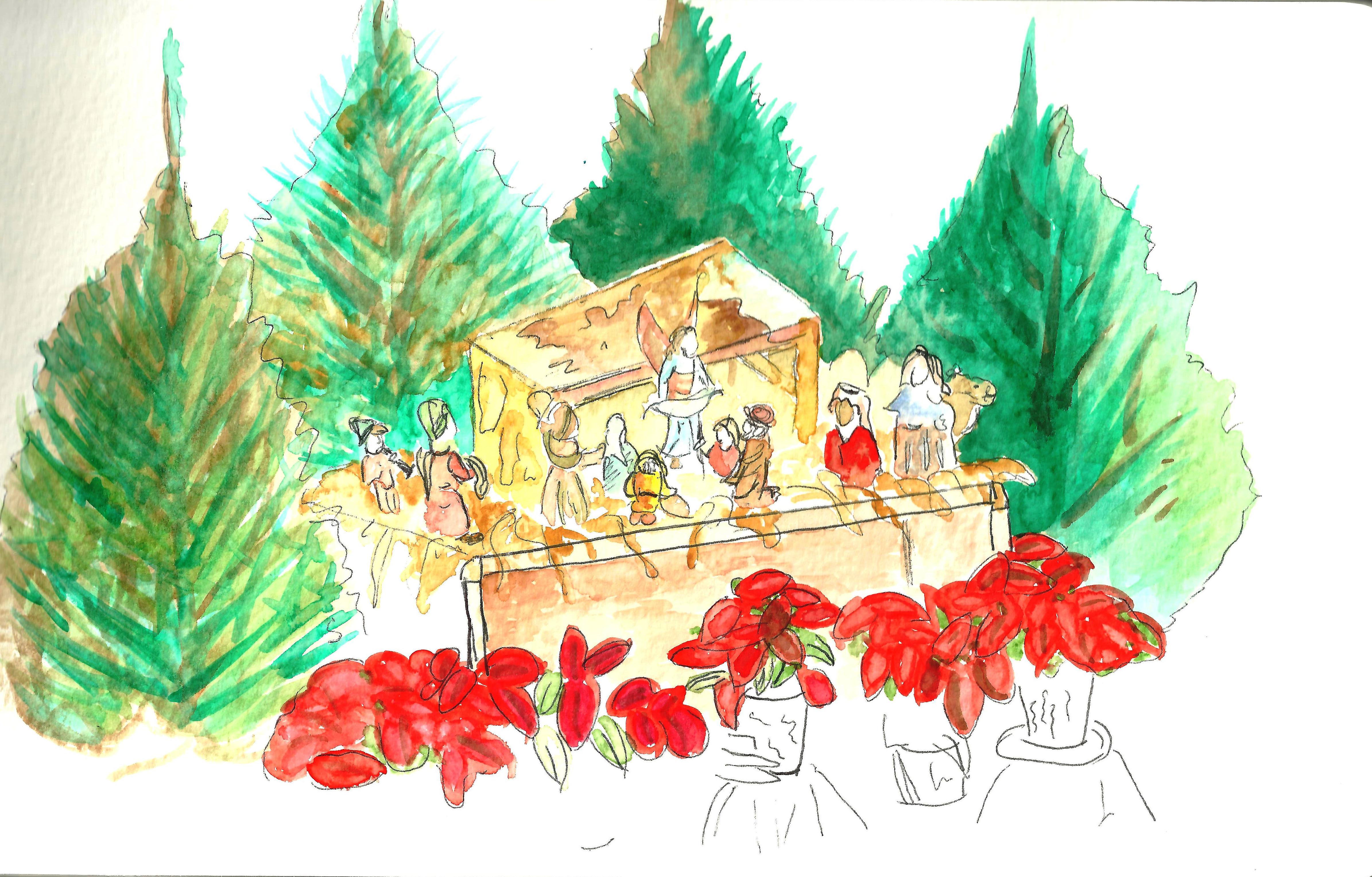
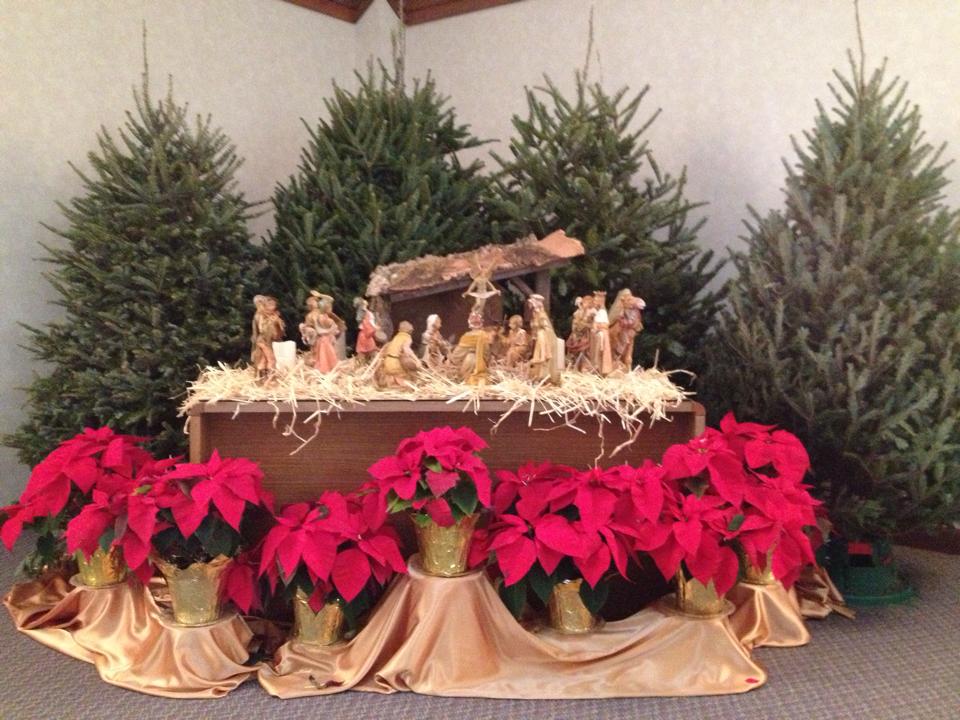
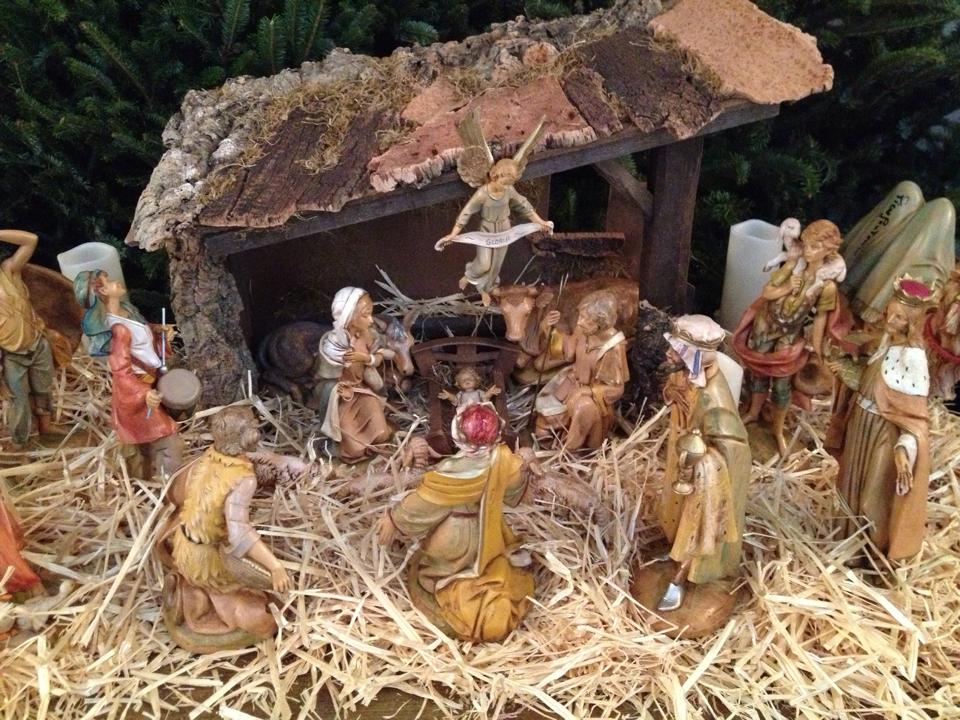
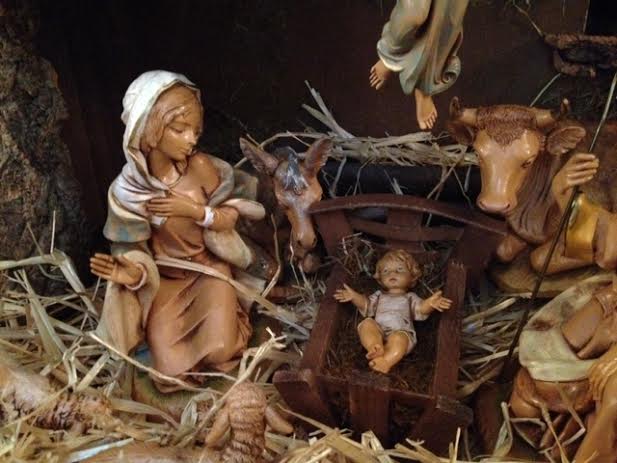
I learned that the Catholic Church observes the season of Christmas until they celebrate the Baptism of Jesus, which this year is 1/10/16. This meant that the really nice Nativity set was still up in the chapel when I went on retreat from 1/8 – 1/9. There are real evergreens behind the creche. They are about 8 feet tall and smell amazing. The creche is on a table that is about three feet off the ground, and it is about five feet wide. The tallest figurine is about a foot high. Everybody is here – it is a packed scene! They have seven pots of poinsettias decorating the front.

I enjoyed sketching it in the chapel and then watercoloring it in my room. Ideally I’d watercolor it on site but the nuns were setting up for Mass so I felt I’d be more comfortable doing the messy bit without an audience.

Plus, I still can’t take Communion because of their (The Church’s) rules.
Again, not that Jesus made those rules…

I’m not sad/angry/upset about it because I feel I’m missing out – it is because they are. To exclude anyone is to be the exact opposite of what Jesus wanted. I pray that the Holy Spirit opens their eyes to the un-welcoming nature of a policy that says only Catholics can take communion.

Mercy nativity1

Mercy nativity 2

(edit 2-28-16, I decided to add more pictures that I’d taken)
n2
n3
n4n5n6n7n8n9

On geodes and cracks and God

Leonard Cohen says – “There is a crack in everything. / That’s how the light gets in.”

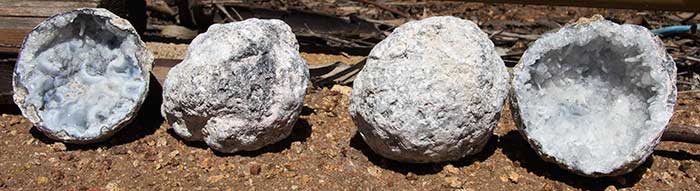
geode2

The Gospel tells us –
A man who was deaf and had a speech impediment was brought there by a person who begged Jesus to lay his hands on the man and heal him.

Jesus led him away from the crowds so he could heal him privately. He put his fingers in the man’s ears, spat, and then touched the man’s tongue. He then looked up to heaven, sighed deeply, and said in Aramaic “Ephphatha!” (which means “Be opened!”) The man was instantly freed from his afflictions and was able to see and speak perfectly.

He ordered the crowd to not tell anyone about what had happened, but the more he ordered them, the more they spread the news. They were amazed and told everyone “He does everything well! He even makes deaf people hear and cures people of being unable to speak!”

MK 7:31-37 (From The Condensed Gospel rendition)

geode1
The outside is boring and dull on a geode. There is nothing special to see. But when you crack it open, there is amazing beauty inside. This is how God sees us – beautiful on the inside. God sees what others cannot. Also, I find it excellent to mediate on the fact that you can’t see the beauty until this rock has been broken open. It is the trials that we undergo that bring out our true nature.

Gifts to Jesus – an Epiphany meditation

So what gift are you going to give Jesus today?

Remember the story of the little drummer boy? I think it’s appropriate that the story of the Magi happens on the 12th day of Christmas, the one with the 12 drummers drumming in the Christmas carol “The Twelve days of Christmas”. We often talk about the gold, frankincense, and myrrh that Jesus received from the Magi but I think what is most important is the gift that the drummer boy gave him. He gave him the only thing he could give him. He didn’t give him anything that had to be wrapped. He gave him his best. He played his drum the best way he knew how, from his heart. That is the kind of gift to Jesus wants. Jesus wants us to give the best of ourselves to him and for him.

Jesus often says in the Gospels “I desire mercy and not sacrifice”. When he says that, he’s quoting from the prophet Hosea. Jesus doesn’t want your money. He wants your love and your service and your heart and your compassion.

So often, people talk about all that Jesus has done for them. They talk about how he sacrificed his life for their sins or how he promised them eternal life. They talk about how he saved them. But what happens after that? This isn’t a one way transaction. After that is when we have to prove ourselves worthy of that gift, “to bear fruit worthy of redemption”. That is when we have to give our gifts.

We give gifts to Jesus when we feed the hungry, show compassion, volunteer our time to help people who are needy. We give gifts to Jesus when we open our hearts and our homes to people who are fleeing injustice and war and oppression. We give gifts to Jesus when we treat every single person as if they are Jesus, remembering that he said “Whatever you do to the least of these you do to me”.