Poem – what Church really is

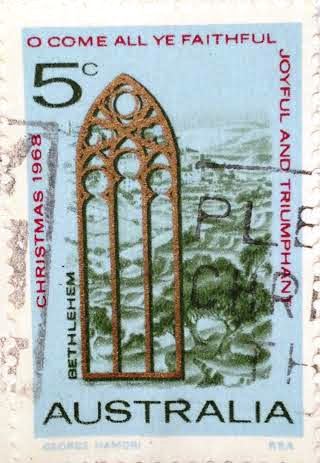
Christmas stamp

I dream of a world
where people understand
that you don’t
go
to church.
You are Church.

That service is what God wants,
not hymns,
not prayers from a book.

Where people see every window
as a church window
and see the whole world
through it.

Where church buildings
are more like
thrift stores,
the Red Cross,
food banks,
soup kitchens.

Where they aren’t a place
to escape the world
but to equip people
to serve it

– not by preaching the Gospel
but by being a living example of it.

Everything starts in darkness – a Christmas observation

Here’s Mary. She’s been told that she is going to bring forth the Messiah, the Savior, the King. This has been promised to her by an angel.

But things aren’t looking so good.

Her fiancé almost left her when he found out she was pregnant. Perhaps her family and friends actually did leave her – we hear nothing about them, and she and Joseph were alone when it came time to give birth. Far away from home, with no support system, no help. Stuck in a barn – no place for anybody to be, much less a place to give birth. Much less a place to give birth to a King.

How must that all have seemed to Mary? She had to start doubting everything. Maybe it was all a dream? Maybe she was going crazy?

Maybe she started talking to God, maybe a little less reverently than you’d expect. “Yeah, right, God! Sure, you promised that this special thing was going to happen, but what about this? What about right now? It doesn’t look so good, God. In fact, it looks pretty bad.”

But here’s something interesting to consider. In Judaism, everything starts in darkness. The day starts the night before – it runs from sunset to sunset – not sunrise to sunset. The month starts at the new moon – when it is darkest. When you can’t see anything.

This is God’s way.

Anything good starts when it seems like things are at their worst. The lowest point is the beginning.

Remember “It is always darkest before the dawn”, and “It can only get better”? That. A thousand times that.

When things seem to be at their darkest, that is when God is working the hardest, bringing forth the Light.

Peace is possible

We tend to have a set of blinders on when it comes to peace. We forget that the world isn’t always at war. Let us focus on times of peace that have happened – times when long-standing disagreements have been resolved. What “could never happen” has happened before and can happen again.

I invite you to recall specific moments of peace –

The end of apartheid in South Africa.
The removal of the Berlin wall.
The peace accord in Ireland.

All of these conflicts seemed to dissolve overnight, yet they required the intense energy and attention of many people who prayed and worked for their resolution. All along it seemed hopeless – too big to fix, too large to solve.

Do you feel the energy of the change? A huge shift in energy occurred that made it possible for peace to flow.

Now take that energy and push it towards today’s issues –

Israel and Palestine.
Race relations in America.
Refugees fleeing war and poverty.

These seem bigger than us, impossible to resolve. And yet the past tells us otherwise. There is hope. Change is possible.

Keep pushing.
Keep believing.
Keep working.

The Chanukkah gift

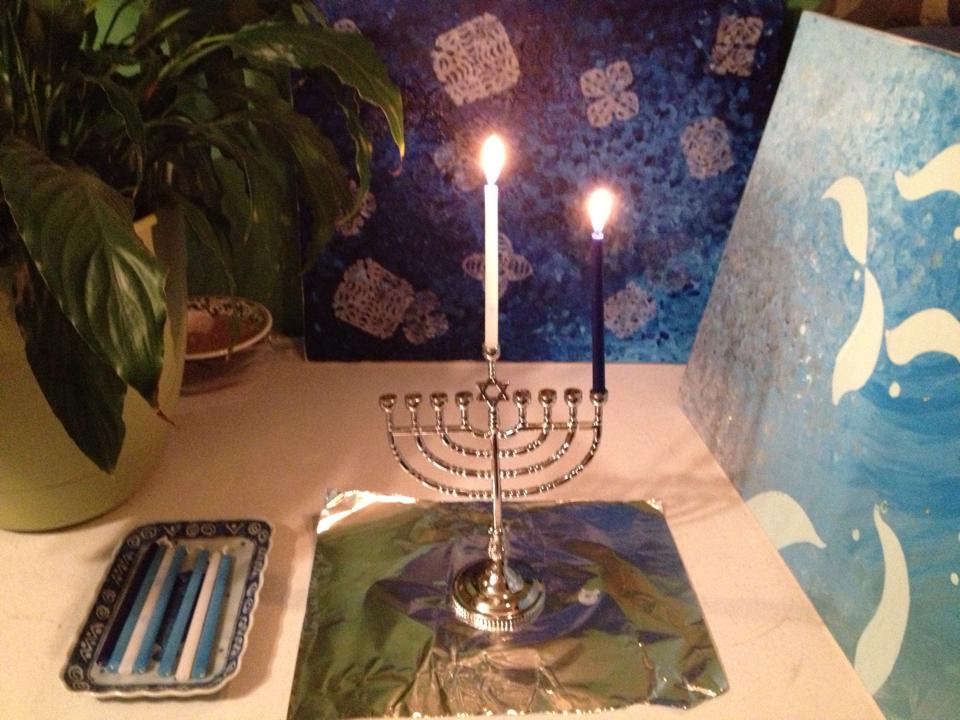
Chanukah1 (the lights from the first night of Chanukah)

I learned something on the second night of Chanukah.
I learned to trust that God will provide.

I have a small box of Chanukah candles that I bought last year on clearance. That was the first year that I have lit Chanukah candles. If I did it the normal way, by the time the whole thing is done the entire box would have been used. That is 44 candles. That seemed really wasteful.

What I did instead that first year was to light them and say the prayers, let them burn for maybe ten minutes and then I’d blow them out. I’d use the same candles over and over, so over the course of the holiday this meant that the candles were different heights and looked very odd. There was a definite slope downward to the right where the first night’s candle was, which had been burned the most.

This year I learned that not only are the candles supposed to burn for at least 30 minutes, but the woman of the house is not supposed to work for those 30 minutes. I’m not one for sitting still, so I decided to dedicate that time to making 4 x 6 collages.

I’d started making these this year and posted some here, but got out of the habit of assembling them. I’d taken the time to cut out and sort words and pictures already, so I really have no excuse. The funny thing is that so many of my craft projects are like “There’s a hole in the bucket” song – where in order to do one part, I have to do another part, and I have to do yet another part to get to that part. So sometimes I don’t do anything at all. I’m learning to break up the projects into small bits so that I feel that I’ve gotten something done. Since I already have all the pieces, it is easy to do at least two of these while the candles burn.

This year, while making the collages, I looked at the candles on the second night and saw how lopsided they looked already after letting them burn the longer time the first night. I got up and blew them out.

And then I thought about it. Part of what is celebrated in Chanukah is the miracle that the oil that was supposed to only last for one day lasted for eight. They needed to rededicate the Temple after it had been desecrated, and didn’t want to wait. It took eight days to make more oil, but they knew that it was too important to delay. They lit the light anyway, and God made it last long enough until the new oil was ready.

It is about trusting that God will provide for our needs.

Why was I being so guarded about these candles, only letting them burn for a little bit? I got them on sale, after all. Even before that, they cost $7. I can buy another set next year. They’ll make more.

Things are tight right now, with my husband out of a job, but even before that I’ve lived like a pauper most of my life. I was raised poor. Not having much is my normal. Worrying about future finances was part of my training.

We are comfortable, but not set by any means.

But God is using these candles to teach me something important.

I relit the candles and watched them, delighting in their cheery light.

I don’t think God wants us to be wasteful – certainly not. I think that God wants us to be good stewards of what we are given.

What does Jesus teach us?

Jesus tells us in the story of the loaves and fishes that God can make the little we have much more. We have to give thanks first, and we have to give what little we have away. This isn’t about making more money and hoarding it.

Jesus tells us in the story of the ten talents that we have to use what we are given. God gives us resources (as they said in my previous church – “time, talent, and treasure”) to use them for God’s glory, not our own, and not to hide away.

Jesus tells us to not worry about anything, that God provides for the least of the creatures, so surely God will take care of us.

So this was the gift that God gave to me – to trust, and not be afraid. To not think that I have to do it all. To remember that everything comes from God, and God can do anything.

How to play the Dreidel game at Chanukkah

The traditional Chanukkah dreidel is a reminder of the times when the armies of King Antiochus controlled the Holy Land. This regime passed a series of laws making it illegal to study or practice Judaism. The Jews decided to do their Torah learning secretly in outlying areas and forests. The children brought along small tops to pull out and play with after hiding their texts, so that they could pretend to be playing games instead of studying if a patrol came by.

Playing the dreidel game reminds us to always be true to our faith even when it is dangerous. This is a valuable thing to remember for all faith traditions.

Here’s how to play the dreidel game –

Things you need –

1 Dreidel (or several to speed up the game play)
2 or more players
The “Ante” Chocolate coins, nuts, or pennies, for instance.
A flat surface to spin the dreidel on, such as a table top or floor.

A platter of Latkes (hash browns) and/or Sufganiot (jelly doughnuts) add to the fun. Fried foods are part of the holiday. They commemorate the miracle of the one small jar of oil lasting eight days during the re-dedication of the Temple.

1. All players sit around the playing area.
2. All players get an equal amount of the “ante”
3. To choose who goes first, everyone takes a turn at spinning the dreidel. The one with the highest spin has first turn. (Nun is highest, then gimmel, hey, and shin.) Spin again if there is a tie.
4. Everyone puts one unit of the ante (Chocolate coin, penny, etc.) into the pot. (A bowl is useful for this)
5. Player A spins the dreidel and does the appropriate action according to the result.
6. The play proceeds to the left.

Nun looks like נ
It stands for the Yiddish word nul, which means nothing.
Take nothing from the pot.
This letter also refers to the Hebrew word “nes” – which means “miracle”.

Gimel looks like ג
It stands for the Yiddish word gantz, which means whole.
Take everything in the pot.
This letter also refers to the Hebrew word “gadol” – which means “great”.

Hay looks like ה
It stands for the Yiddish halb, meaning half.
Take half of what is in the pot.
This letter also refers to the Hebrew word “haya” – which means “happened”.

Shin looks like ש
In Yiddish, Shin is for shenk, which means give.
This means put one item from your ante into the pot.
This letter refers to the Hebrew word “sham” which means “there”.

These four letters together are an acronym for the sentence “nes gadol hayah sham” which means “a great miracle happened there.”

In Israel, the letter “shin” is replace with a “pey” פ – which refers to the Hebrew word “po” – meaning “here” , saying “A great miracle happened here.”

May we all be ready to receive miracles at all times and in all places.

Who are the Samaritans? And why is this relevant today?

There are many stories in the Gospels about the Samaritans. Why are they referenced? Who are they? Why is the fact that they are Samaritan significant? I believe a little background is in order to help us understand the Gospel stories in question.

The following is taken from the Wikipedia article “Samaritans”. It is rather long. For our purposes the entire article can be reduced to these few paragraphs –
—————————————
“The Samaritans are adherents of Samaritanism, an Abrahamic religion closely related to Judaism. Samaritans believe that their worship, which is based on the Samaritan Pentateuch, is the true religion of the ancient Israelites from before the Babylonian Exile, preserved by those who remained in the Land of Israel, as opposed to Judaism, which they see as a related but altered and amended religion, brought back by those returning from the Babylonian exile.

Ancestrally, Samaritans claim descent from the Israelite tribes of Ephraim and Manasseh (two sons of Joseph) who survived the destruction of the Kingdom of Israel (Samaria) by the Assyrians in 722 BCE, as well as from the priestly tribe of Levi.

Samaritan historiography places the basic schism from the remaining part of Israel after the tribes of Israel conquered and returned to the land of Canaan, led by Joshua. After Joshua’s death, Eli the priest left the tabernacle which Moses erected in the desert and established on Mount Gerizim, and built another one under his own rule in the hills of Shiloh.

The Samaritans claimed that they were the true Israel who were descendants of the “Ten Lost Tribes” taken into Assyrian captivity. They had their own temple on Mount Gerizim and claimed that it was the original sanctuary. Moreover, they claimed that their version of the Pentateuch was the original and that the Jews had a falsified text produced by Ezra during the Babylonian exile.

Both Jewish and Samaritan religious leaders taught that it was wrong to have any contact with the opposite group, and neither was to enter each other’s territories or even to speak to one another.”
————————————————–

The stories that have Jesus directly interacting with Samaritans are:

Jesus and the Samaritan woman JN 4:1-42
The parable of the good Samaritan LK 10:29-37
The ten lepers LK 17:11-19

You can look the verses up in your Bible, online on BibleGateway.com, or by using the search feature on this blog on the far right column, towards the bottom.

I invite you to read these stories now, either again or for the first time, knowing the huge rift that was (and still is) between these two faith traditions. Notice how Jesus bridges these traditions to point them towards the One True God – with no more divisions. Jesus says that we are to love God where we are, that there isn’t a specific place to worship (not a mountain or a temple). Jesus says that are to love everyone equally, and this includes those people who historically have been our enemies.

What does this tell us about what the Church is – is it a place, or a way of living?

What does this tell us about how we are to interact with people of other faith traditions?

What does this tell us about how we are to show the love of God in the world, as followers of Jesus?

What does this tell us about including and excluding?

Specifically relevant to the issues of the day, what does it tell us about refugees who are of other faith traditions?

Harvest from Mercy Convent retreat, November 15th 2015

The theme of the retreat was “Autumn: A Season of New Beginnings”. The Bible reading was Mark 4:1-20 and 30-32. These are the Parables of the Sower and the Mustard Seed. Here’s my Condensed Gospel version of them:

The parable of the sower

Jesus was again teaching beside the sea. He decided to teach while sitting in a boat in the water because a large crowd had gathered around him. The crowd stood on the shore to listen to him. They had come to hear him from every town.

He taught them many things using parables, including this one: “Think about the person who went out to sow his field. While he was sowing, some seeds fell along the path and birds came and ate it. Other seeds fell where there were more rocks then soil. The seed sprang up quickly, but then withered just as quickly in the sun because it didn’t have deep roots to gather moisture. Other seeds fell among the thorn bushes and the thorns made it impossible for them to produce a crop. Yet other seeds fell on good ground and were able to produce 30, 60, even 100 times what was sown. Anyone who has ears should listen to this!”

MT 13:1-9, MK 4:1-9, LK 8:4-8

When Jesus was alone with his disciples, they came up and said to him “Why do you speak to people in parables? What does the parable of the sower mean?”
Jesus answered them “The mystery of the kingdom of God has been revealed to you but not to everyone. For them the information is transmitted in parables so that Isaiah’s prophecy is fulfilled. It says ‘They may listen but never understand, and they may look and never see. For people’s hearts have grown hard and their ears have grown deaf, and they have closed their eyes, otherwise they might see, hear, and then understand and turn back, and I would heal them.'”

MT 13:10-15, MK 4:10-12, LK 8:9-10

Jesus said “Do you not understand this parable? Then how are you going to be able to understand any of them? The seed is the word of God. The sower is the one who shares it with others. The people along the path are those who have heard the message about the kingdom and don’t understand it. Satan has snatched away the words that were sown in their hearts so they would not believe and be saved.”

“As for the seed sown on rocky ground, this represents the people who hear the word and immediately receive it joyfully. However, because they are not rooted in their faith, they believe for a little while but stumble when troubles come because of the word.”

“Regarding the seed sown among thorns, these are the people who hear the word but are distracted and paralyzed by worry and greed, and the word is not able to take root in them and produce any fruit.”

“But the seed sown on good ground represents the people who hear the word with honest and open hearts. They understand it, welcome it, and through endurance are able to bear much fruit, even up to 100 times what was sown.”

MT 13:18-24, MK 4:13-20, LK 8:11-15

The parable of the mustard seed

“How can I explain what the kingdom of God is like? What can I compare it to? It is like a mustard seed sown in the ground. It is smaller than any other seed, but when grown, it is a huge tree, taller than any plant in the garden. It becomes a tree big enough for birds to make nests in its large branches.”

MT 13:31-32, MK 4:30-32, LK 13:18-19

I’d never thought of Autumn as a time of new beginnings. To me, it was always seen as a sign of endings. It is harvest time, a time of wrapping up, of preparing against the winter that is to come. It is a beautiful time, but short-lived, and leads to a time of sparseness and lack. It is hard to fully enjoy the glory of Autumn knowing that the trees will soon be bare and ice and snow are coming.

But I like this new idea that was offered at the retreat – think of Autumn as a time to sow seeds. They have to be planted in the ground in Autumn, and rest quietly underground in darkness, in silence, unseen, in order to grow into what they are to become.

The poet Mary Oliver said “Is it not incredible that in an acorn something has hidden an entire tree?”

I saw a church sign recently that said “We can count the seeds in an apple, but only God can count the apples in a seed.”

Seeds are powerful things to think about.

It is also a gift to be invited to see old things in new ways.

My Mom gave me shiny pennies. My Dad gave me leaves. I’m grateful that they gave me simple things to remember them by. But interestingly, these things are both brown. I’ve been drawn to brown for a few months now, sketching with it, writing with it, painting with it, making jewelry with it. Different shades of brown – chocolate, caramel, sepia, café au lait.

I’ve been meditating on the fact that Dad was red-green color blind, so most of the time he saw nature as brown. The army green that I wear as my neutral color these days would have been brown to him. Autumn was his favorite time of the year because he could finally see colors.

While at the retreat I made some art to think about him and how he saw the Autumn world, the time when he was happiest. This is the first one I made. It is 7” x 10”.

Dad collage at Mercy 1

I was going to make a simple one on a 4 x 6 index card, but I couldn’t find them in the craft supplies so I decided to work bigger instead. I’m glad I did.

I had some leftover materials so I made a second one. They work perfectly together. It is hard to see that here, and I don’t have a larger scanner. You could click on the pictures, print them out, and put them together to see what I mean.

Dad collage at Mercy 2

While making these pieces I had quite a bit of understanding and peace come over me concerning my parents. I’m grateful I took the time to make this art, and also grateful that I was in the craft room alone so I could cry a little.

One thing I’m coming to understand is that there is great beauty in just allowing experiences to be what they are without defining them. I’m also learning that life is richer if it is a blend of things – for instance, happy/sad/wistful/grieving/hopeful is a valid feeling, even though we don’t have a word for it. Just like with Autumn leaves, they are more beautiful if they are a range of colors – reds, greens, yellow, orange, brown – all on the same tree, and often on the same leaf.

It was a gift from my Dad’s spirit that when we happened to take his ashes to scatter, it was the peak of Autumn in the mountains. This is where I sat to disperse his ashes, some 20 years after he had died.

GM 10 2015 a

GM 10 2015 c

GM 10 2015 d

GM 10 2015 e

GM 102015 b

You know where you stand with Autumn.
Not tall, not short.
But between.
Between life and death,
awakening and slumber,
the present and the future,
the known and the unknown.
Autumn is a time of harvests, of reaping
yet also sowing, of planting.
Hardy bulbs planted now sleep deeply,
hibernate like mother bears,
deep underground,
in darkness,
in silence,
in stillness.
Both awake in spring,
with flowers, with cubs,
new growth, new life
out of that stillness,
that silence,
that darkness.

We too are called into that cave, that tomb, that dark earth into the death and resurrection of Jesus.

We too are called into quiet, into stillness, so the seeds that God has planted within us can grow.
Poem – afterlife

Nobody can tell you
where the flame goes
after it is
blown out,
so how do we know
where the soul goes
after
we die?
How do we know
there is more,
there is life after life?

Is it a bedtime story we tell
(our children, ourselves)
to keep away the boogeyman,
the things that go bump in the night?

Now is all we have.
Why worry about
the afterlife
and waste the life you have?

Live before you die.

If there is an afterlife,
let it be a bonus,
an extra.
Don’t let it be your only,
because it might not be.
Don’t worry
about whether
it is
or is not,
because that steals away
time
from the life you have,
now.

Trunk or Treat

Why do some Christian churches celebrate “Trunk or Treat” rather than Halloween? It is because some denominations are strongly opposed to the idea of Halloween because they think it is honoring the devil. They also are concerned about the safety of their children knocking on strange neighbor’s doors asking for candy. So they want to find a safe alternative.

Instead of having “Trunk or Treat”, perhaps would be better not to have anything at all. “Trunk or Treat” still gives reference to Halloween. Perhaps have a harvest festival if you have to have something. To observe even part of a holiday that you are opposed to is still acknowledging it. Referring to it gives it credence. If they are truly opposed to it, then don’t have any festival of any kind on Halloween or in the week before.

But there are other things to consider. As to worrying about the neighbors, remember that part of being a follower of Jesus means that you should treat your neighbors as you would like to be treated. So you want people to be afraid of you and to never talk to you? If not, then why would you treat the neighbors like that? Why is it that Halloween is the one time of year where we are encouraged to talk to our neighbors? Halloween is a great time to be a Christian. You can meet your neighbors and make new friends.

Another problem is that there is no “trick” in “Trunk or Treat”. It is all “treat”. There is no risk of anything unusual happening. The risk is part of Halloween. Halloween is about things being different, where the unexpected can happen. It is about acknowledging that we aren’t in control of our lives. This too is in line with the words of Jesus, who reminds us constantly that God is in charge, and we aren’t.

Halloween and Christianity

I’ve met a lot of people in the small community I work in who say that they don’t celebrate Halloween because “It’s the Devil’s holiday”.

There are a couple of points to be made. Halloween is, fully spelled out, “All Hallow’s Eve” – the name refers to the day before All Saints Day, which is observed on November 1st. The word “hallows” refers to “hallowed”, meaning “sacred”. All Saints Day is a holiday that is primarily observed by Catholics and Episcopalians. All other Christian denominations generally have no idea of its existence, thus they don’t know what the word “Halloween” refers to. All Saints Day is the day to remember and honor all the famous people who have died who were strong in their faith and lead the way for us. This includes people such as Saint Francis of Assisi, Saint Patrick, and Mother Theresa. They are our role models in faith. Lesser known is that November 2nd is “All Soul’s Day” – where we remember all the people we know and love who have passed on. This includes any relatives or friends we might have who have inspired us to be better people.

Another point is that we believe that there is just one God. To give any power to another force is in violation of the commandment saying “You shall have no other gods before me.” Everything is from God. To personify the idea of evil and to ascribe power to it is to say that there is another god, which is not possible. To say that it has power over you verges on idolatry. So remember that God is in charge, first and foremost.

When I was at Cursillo, I received a bookmark that really helped re-frame Halloween for me. I’ve reworded it a little to polish it up. Here you go –

Being a Christian is like being a pumpkin. God chooses you, raises you up, takes you in and washes the dirt off of you. He opens you up, reaches deep inside, and scoops out all the yucky stuff – including seeds of doubt, hate, greed, and the like. Then God carves a new smiling face for you and puts His light inside of you to shine for all of the world to see.

“Let your light shine before men, that they may see your good deeds, and praise your Father in heaven.” Matthew 5:16