On geodes and cracks and God

Leonard Cohen says – “There is a crack in everything. / That’s how the light gets in.”

geode2

The Gospel tells us –
A man who was deaf and had a speech impediment was brought there by a person who begged Jesus to lay his hands on the man and heal him.

Jesus led him away from the crowds so he could heal him privately. He put his fingers in the man’s ears, spat, and then touched the man’s tongue. He then looked up to heaven, sighed deeply, and said in Aramaic “Ephphatha!” (which means “Be opened!”) The man was instantly freed from his afflictions and was able to see and speak perfectly.

He ordered the crowd to not tell anyone about what had happened, but the more he ordered them, the more they spread the news. They were amazed and told everyone “He does everything well! He even makes deaf people hear and cures people of being unable to speak!”

MK 7:31-37 (From The Condensed Gospel rendition)

geode1
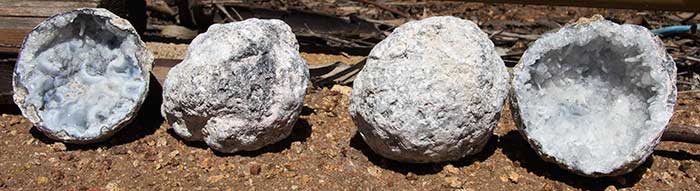
The outside is boring and dull on a geode. There is nothing special to see. But when you crack it open, there is amazing beauty inside. This is how God sees us – beautiful on the inside. God sees what others cannot. Also, I find it excellent to mediate on the fact that you can’t see the beauty until this rock has been broken open. It is the trials that we undergo that bring out our true nature.

Poem – What gets you up?

What gets you up?
You have to have a reason
for getting up in the morning
and for making it
through the day.

Children? Work? Art?

What brings you joy? Do that.
What does the world need? Do that.

Can you get paid for it? Even better.

But even if you can’t,
do it anyway,
because it will feed your soul
and that kind of nourishment
can’t be bought
in a store.

There is no nutritional supplement
for a soul deficiency,
like there is for scurvy.

Rumi says: “Let yourself be silently drawn by the strange pull of what you really love. It will not lead you astray.”

Buechner says: “The place God calls you to is the place where your deep gladness and the world’s deep hunger meet.”

Everything starts in darkness – a Christmas observation

Here’s Mary. She’s been told that she is going to bring forth the Messiah, the Savior, the King. This has been promised to her by an angel.

But things aren’t looking so good.

Her fiancé almost left her when he found out she was pregnant. Perhaps her family and friends actually did leave her – we hear nothing about them, and she and Joseph were alone when it came time to give birth. Far away from home, with no support system, no help. Stuck in a barn – no place for anybody to be, much less a place to give birth. Much less a place to give birth to a King.

How must that all have seemed to Mary? She had to start doubting everything. Maybe it was all a dream? Maybe she was going crazy?

Maybe she started talking to God, maybe a little less reverently than you’d expect. “Yeah, right, God! Sure, you promised that this special thing was going to happen, but what about this? What about right now? It doesn’t look so good, God. In fact, it looks pretty bad.”

But here’s something interesting to consider. In Judaism, everything starts in darkness. The day starts the night before – it runs from sunset to sunset – not sunrise to sunset. The month starts at the new moon – when it is darkest. When you can’t see anything.

This is God’s way.

Anything good starts when it seems like things are at their worst. The lowest point is the beginning.

Remember “It is always darkest before the dawn”, and “It can only get better”? That. A thousand times that.

When things seem to be at their darkest, that is when God is working the hardest, bringing forth the Light.

Quotes about making art

“Artists paint apples because they have the urge to paint apples. And if people like the art, that’s a bonus.” – Jeanne-Claude (partner of Christo)

———————
“You should paint pictures because you want to paint them, not because everyone wants you to paint them.”

“It’s your picture, and all that is important is developing your own vision. It only needs to please you semicolon pleasing everyone is impossible, anyway.”

From “Urban Watercolor Sketching” by Felix Scheinberger

———————-

“Don’t think about making art, just get it done. Let everyone else decide if it’s good or bad, whether they love it or hate it. While they are deciding, make even more art.” – Andy Warhol

———————
“The point is, art never stopped a war and never got anybody a job. That was never its function. Art cannot change events. But it can change people. It can affect people so that they are changed…because people are changed by art – enriched, ennobled, encouraged – they then act in a way that may affect the course of events…by the way they vote, they behave, the way they think.” -Leonard Bernstein

———————
“If you hear a voice within you say ‘You cannot paint’ then by all means paint, and that voice will be silenced.” – Vincent Van Gogh

Poem – go walk yourself

How interesting that people will
buy a dog because
they
want to go for a walk.
They know that the dog
has to be walked at least
once a day
and so they have to
take him out.
They get the dog
as an excuse
to go for a walk.

It seems like it would be far cheaper
to forget the dog
and take yourself
out for a walk.

Why do we put more value
on the needs of others
rather than ourselves?
Why is a dog’s need to walk
more important than
the fact that
you
need to walk?

We have all been trained that we
should be
self-sacrificing
and serve others.
But they should not be
at the expense
of not taking care
of ourselves.
There should be a balance
where both happen.

So, skip the dog.
Skip the dog food,
the shots,
the veterinarian bills,
getting her fixed,
taking him to the groomers,
the whole thing.
Skip all of that.

Save your money
and go take
yourself for a walk.

Poem – experts try

Experts,
masters in their field
are only experts
after years of trying
and failing
but not failing
to try again.

Be an expert.
Make every day
a new day
to make something,
something better,
something new.

This includes,
but is not limited to
yourself.

Getting jealous
of another’s success
is your failure,
your choice to compare
their ten years of work
to your
ten weeks of
thinking about it.

Do. Just Do.
There is no thinking.
Try and try again
and fail
and learn
and become
your own expert,
your own master.

In sickness and in health

African healer Credo Mutwa in “Shaking out the Spirits: a Psychotherapist’s Entry into the Healing Mysteries of Global Shamanism” by Bradford Keeney says this about disease:

“Every one of us exists in two worlds at once. There is another earth existing side by side with this earth. In the other earth, we are all cannibals. When a person develops cancer, we believe it involves the cannibal counterpart of ourself from the other world that is slipping into this world to devour us. When a person is attacked by cancer, he must never show fear or else he makes himself weak. Disease, being a living animal, is ahead when you are afraid. In the religion of the Great Mother, you must not call anything or anyone an enemy. If you do this, you make it stronger. … When you have cancer, you must never panic. You must fight your sickness with a great calm. You must, above all, realize that what kills you is not so much the actual disease itself as it is your own mind that is tempted to surrender to the disease. Take your mind and occupy it fully in a very exciting project or occupation. This will give the body time to heal itself. This I know. I have kept diabetes, tuberculosis, and cancer at bay with this understanding.”

I believe there is a hidden message to this. I believe that this is telling us in a roundabout way how to prevent disease. From learning how to heal sickness, we can learn about how to create health.

Here it is – If you engage yourself in an exciting project, in something of great purpose and meaning, then you will prevent disease from striking at you. Laziness, sloth, inactivity causes disease. It opens the door.

It is when we do not live out our purpose in life that we get sick. We were created for much more than eating chips on the couch and watching reality TV. We were created for so much more than engaging in gossip and worrying about what latest trend we should follow.

God has created us to do good in this world. God has created us to be a force for change. We weren’t created for ourselves.

The prophet Micah tells us – “He has shown you, O mortal, what is good. And what does the LORD require of you? To act justly and to love mercy and to walk humbly with your God.” (Micah 6:8 NIV)

The prophet Isaiah tells us more (Isaiah 58:6-7)

6 Isn’t the fast I choose:
To break the chains of wickedness,
to untie the ropes of the yoke,
to set the oppressed free,
and to tear off every yoke?
7 Is it not to share your bread with the hungry,
to bring the poor and homeless into your house,
to clothe the naked when you see him,
and not to ignore your own flesh and blood?

We are created to heal others – to feed, clothe, and house them, and to rescue them from all kinds of prisons (mental, physical, educational, psychological). We are to be the hands of God.

We have to take care of these bodies that we have been given. They are delicate machines and need to be maintained. It is important to do this so that we are in our top form to be able to do the will of God in this world. Yet we must remember that we must do this only so that we can serve God. We must never believe (like so many modern ideas say) that we should just take care of ourselves. Self-less service is why we are here, not self-ish gain. We were not created to bask in waves of delight for delight’s sake. God most certainly wants us to be happy, but even more certainly wants us to be useful to others.

These thoughts from “The Four-Fold Way: Walking the Paths of the Warrior, Healer, Teacher and Visionary” might help you see a way to help yourself so that you can help others, or a way to remind others how to unlock their own healing from within –

“In many shamanic societies, if you came to a shaman or medicine person complaining of being disheartened, dispirited, or depressed, they would ask one of four questions:
1. When did you stop dancing?
2. When did you stop singing?
3. When did you stop being enchanted by stories?
4. When did you stop finding comfort in the sweet territory of silence?
Where we have stopped dancing, singing, being enchanted by stories, or finding comfort in silence is where we have experienced the loss of soul. Dancing, singing, storytelling, and silence are the four universal healing salves.”

So healing is to be found in dancing, singing, storytelling, and silence. Do those things and you will get well. Do those things and you will prevent sickness. It isn’t really about when you stopped doing these things – so much as starting to do them again right away.

Poem – becoming sober

Becoming sober is like
doing surgery
on yourself.
Everything hurts,
because the things that you used
to run away
from the pain
are the very things
you know
you can’t do
anymore.
So you have to sit down
with yourself
and dig deep
and uncover
all the pain
that you ran away from,
no matter how long ago,
no matter how it happened,
with no anesthesia.

Nobody can do this work for you.
Nobody gives you the tools.
You can watch others
with their struggles
and pick up an idea or three
of what might work for you,
but you’ll only know what works
when you try.
It might work that week,
but not next year.
You’re a different person then.

When we drink or smoke
or do drugs or overeat or
blame others or make excuses
we put up walls
around ourselves
so we don’t have to feel.
We become divorced
from our bodies,
from our lives.
We become immune
to the day to day feelings
of being alive.

Being sober
isn’t just about
stopping using
whatever it was that you used
as a shield,
as a crutch,
as anesthesia.
Being sober isn’t about
forgetting
the past or
the pain either.
Being sober is about
being alive,
and facing your past
and present reality
with courage
and love.

Poem – your body is a sanctuary

Your body is a sanctuary,
a home to a
piece of the
light
of God.

Just like a regular home,
you have to maintain it.
Just like a mosque
or a church
or a synagogue
or a temple,
you want to make sure
it is clean
and strong.

It is an act of worship,
of respect to God
to take care of your body
– to eat healthy food,
get exercise
and enough sleep,
to not put any poisons in it.

Just as you would not
dump a bag
of trash
in a house of God,
do not do so
to your body.

You wouldn’t allow vandals in,
who leave the place a shambles,
a wreck,
so don’t allow people
into your mind
who attack you
by bringing your down.

You are the keeper
and the guardian
of your sanctuary.
It is a gift from God to you.
How you take care of it
is your gift
back to God.
A strong, healthy body
is better able
to be of service
to God
by serving
the world.

Mental slavery

“It is a curious but little known fact that the Israelites enslaved in Egypt for four hundred years never once asked to go free. Nowhere in the Hebrew Bible do they say to Pharaoh or Moses or God, ‘Get us out of here!’ All they say, and they say it a lot, and in a lot of different ways, is: Life is hard: we don’t like it.
This may explain why God had to put on such a big show with all those miracles and plagues. If God had simply wanted them free, God could have just made them free. But that wouldn’t have been enough. The slaves themselves had to want to go free. Only by watching all those great signs and portents might they, little by little, begin to realize for themselves that there was a power in the universe even greater than Pharaoh, a power dedicated to freeing slaves.
What had to be broken was not Pharaoh’s will, but the dullness of their own routine, the comfortable reliability of putting up with things the way they were.”

– From “Invisible Lines of Connection: Sacred Stories of the Ordinary” by Rabbi Lawrence Kushner.

How many of us are stuck in the same place, day by day, year by year – a whole lifetime of thinking that things aren’t good enough? We get by, muddle through, but deep down we are miserable. Deep down, we want to be free but we aren’t brave enough to ask for it. Maybe we don’t think we deserve to be free. Maybe we think we are stuck in this room and the only way out is the one way door of death. So we wait for it to come to us, or we rush towards it. We stay in that room not even really alive.

We don’t call out – we don’t ask for help. What we see is what we get.

After Isaac is born, things don’t go well between Hagar and Sarah. She asks Abraham, her husband and the father of both boys, to send Hagar and Ishmael out into the wilderness. This is certain death. He doesn’t want to do it, but God assures him that things will go well. God says nothing to Hagar at this point.

Genesis 21:14-21 (HCSB)

14 Early in the morning Abraham got up, took bread and a waterskin, put them on Hagar’s shoulders, and sent her and the boy away. She left and wandered in the Wilderness of Beer-sheba. 15 When the water in the skin was gone, she left the boy under one of the bushes.16 Then she went and sat down nearby, about a bowshot away, for she said, “I can’t bear to watch the boy die!” So as she sat nearby, she wept loudly. 17 God heard the voice of the boy, and the angel of God called to Hagar from heaven and said to her, “What’s wrong, Hagar? Don’t be afraid, for God has heard the voice of the boy from the place where he is. 18 Get up, help the boy up, and support him, for I will make him a great nation.” 19 Then God opened her eyes, and she saw a well of water. So she went and filled the waterskin and gave the boy a drink. 20 God was with the boy, and he grew; he settled in the wilderness and became an archer. 21 He settled in the Wilderness of Paran, and his mother got a wife for him from the land of Egypt.

God heard their cries and answered – and “opened her eyes” (see verse 19) to see a well of water in the desert. This isn’t a spring coming out of a rock. This isn’t a miracle of water in the desert that didn’t exist until just that very moment. This is a normal, everyday well that Hagar didn’t notice until God opened her eyes.

There are wells near you all the time. You just can’t see them, because you don’t ask to see them.

They say that alcoholics and drug addicts won’t benefit from treatment until they get so far down that they ask for help. This seems cruel – we don’t ask people having heart attacks if they want to go to the hospital. We just call an ambulance.

So what is the difference? We have to want to be free – but first we have to know that we are enslaved.

The best part? We have a loving Father who is ready to help us, as soon as we ask.