The cemetery at St. Meinrad’s Archabbey

November first is an appropriate day to share these pictures. Today is All Saint’s Day, where all the famous Christians who have died are remembered. These are notable people who have led the way and been examples of being the Body of Christ – of making love visible in the world. November 2nd is All Soul’s Day, where everyone else – family members and friends, for instance, who have lived honorable lives are remembered.

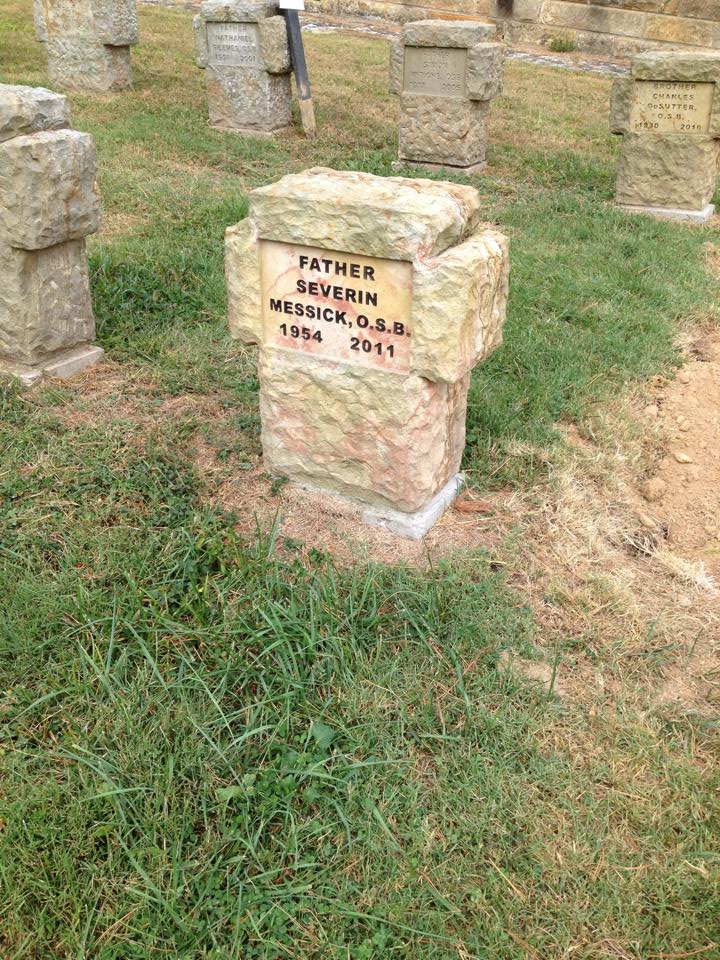
These pictures were taken in late September at St. Meinrad’s Archabbey (Benedictine monastery) in St. Meinrad, Indiana. This is the cemetery for the monks. The cemetery is slightly downhill from the seminary, and the headstones are made of the same local rock that the Abbey itself is built out of. They are very stout.

sign

8

The 5 former abbots are buried in the walkway. The first abbot was buried elsewhere and then relocated here.
6

5

A newer grave, showing the same color of rock as the Abbey. The older ones have weathered to a grey.
4

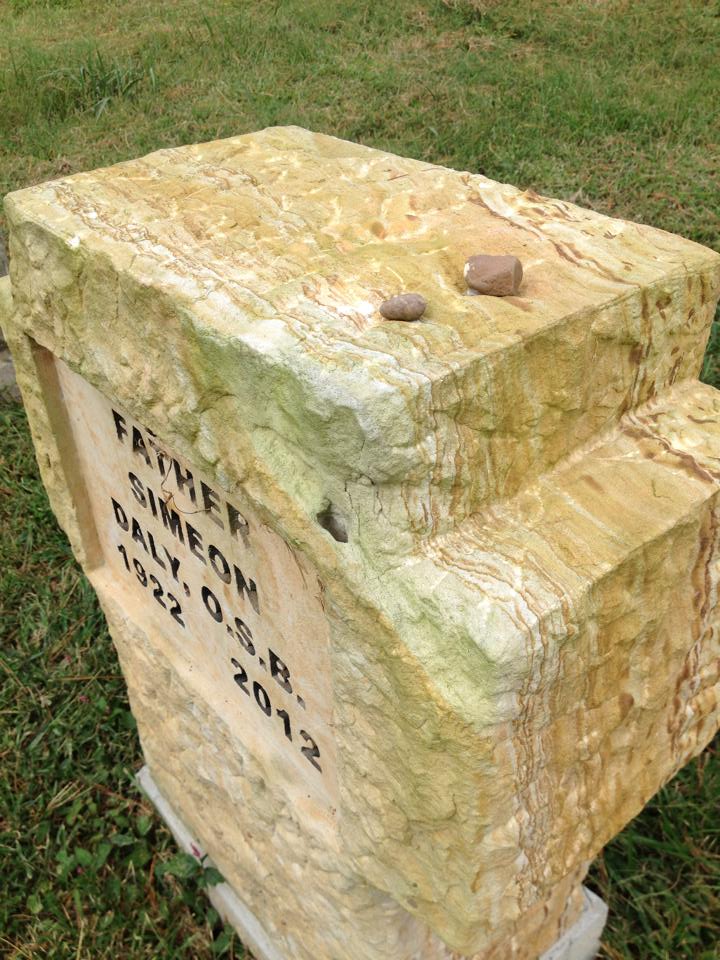
Even though they do not decorate graves, someone has practiced the Jewish custom of leaving a stone atop the headstone as a way of marking that they have visited it.
3

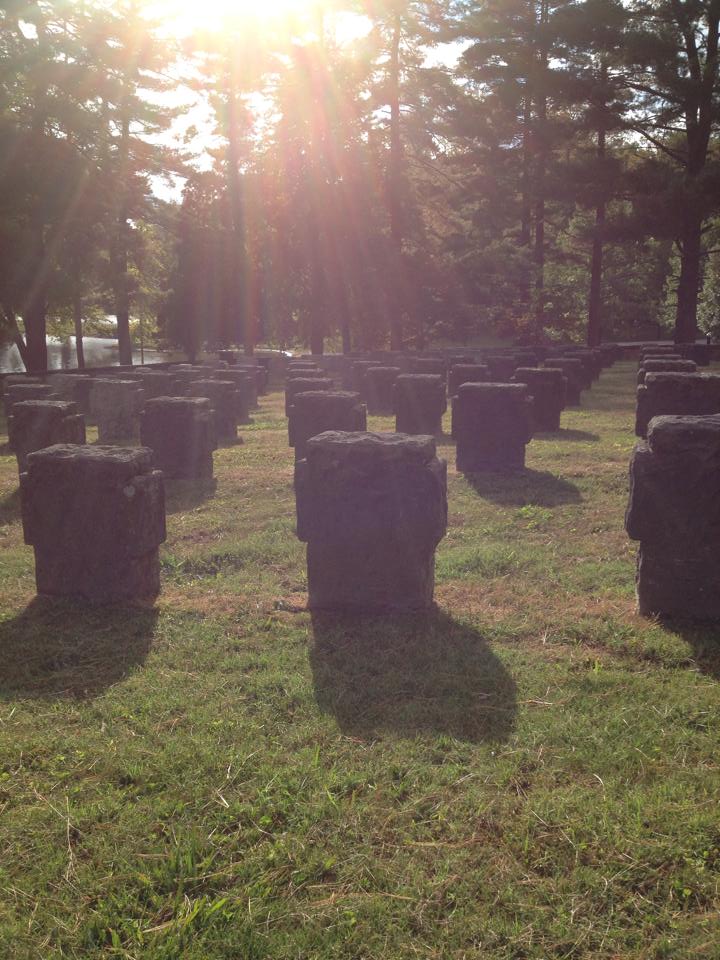
Quite atmospheric in the late Autumn sun.
2
1

There was a new grave – for Brother Benedict Barthel, born 1919, died September 15th, 2015. His birth name was Carl Frank.

The graveyard is walled, so it is limited as to how many more brothers can be buried here. There are only 42 spaces left. There are 252 monks already buried here. There are seven rows deep on two sides, with 21 columns.

I thought it was over.

My father, dead these twenty years, not buried but filed away in a niche like a folder, forgotten it turns out, not over and done with. I thought it was over, that time of shock / of loss / of surprise / of earthquake, after tornado. He died just six weeks after Mom did, no warning, just a heart attack, his heart gave out / his heart had died when she did. It took six weeks for him to realize it. Six weeks for his body to catch up with his spirit.

It isn’t “passed on”. It isn’t “transitioned”. It isn’t soft and gentle, these euphemisms we have for the end of life. It isn’t even “kick the bucket”, “bought the farm”, “pushing up daisies”. It is dead, plain and simple.

Dead, body shucked off like a used coat, abandoned, sent to Goodwill or the dump. Or perhaps not. Sometimes it shows back up, even though you’ve moved, even though you’ve outgrown it, that person, their shell, shows up like that coat, somehow back in your house.

To get to the niche required asking off from work, calling the funeral home, arranging with the funeral director, getting a notarized form from my aunt (for the other two), finding a map, cleaning out the car, a long drive, and then waiting in the reception room, the same where I waited all those years ago with my aunt, to put her Mom’s ashes next to his, the same where we waited for his father, the same place I sat three times before for death. There were cookies on the table, wrapped in plastic bags, to keep them fresh. They don’t get a lot of visitors there, but they like to be ready. A lady asked if we would like water, or a fresh cup of coffee. She didn’t mind, she said. No bother, she said.

He died maybe seven years before his mom did, at least twenty years too soon. I remember her, my grandmother, in shock that her son had died before her. Sitting in her room in that rambling house. He died just five feet away, in his old room, that dark room, that narrow room. No room for him, and he died there, alone.

I can’t find the Bible with her dates in it. I don’t know when she died, or when she was born. Each family has their own, it seems. It wasn’t important enough to keep in a safe place, it seems.

They sat together, all these years, in niche number 19, at the end of a series of halls, themselves filled with filing cabinets stuffed with folders and notes. They sat, filed away, together – this was the O’Shee clan, the last of the line. I’d changed my name at marriage, not even keeping it as a middle name. People could spell it or pronounce it, but not both, and not well either way. I was grateful to get an easy name, but not as easy or anonymous as Smith or Jones. There are worse names than one with an apostrophe.

Nobody went into that room at the end of the hall. The relatives, those who knew them, were dead and buried themselves, or long forgotten. It was a funeral home, not a columbarium. They had that room as a favor to another funeral home that went out of business. I’d never thought of it, but funeral homes do go out of business, but cemeteries don’t. (But sometimes they do). Sometimes your “Final resting place” isn’t so final, and isn’t such a rest.

Sometimes people get dug up, like Tutankhamen, or the Lindow man, or anonymous Indians. There’s a farm to be tilled or a skyscraper to be built. The markers were lost or never were. Sometimes strangers in masks and latex gloves carefully desecrate your body, your insides, in the name of science. I wonder if a kind person, a priest perhaps, asks forgiveness (if not permission) of the soul that wore that body like a costume, a shroud, for these unbelievers, these scientists, to excavate, exhume, ex everything. No more sacred slumber. No more resting in peace. More like pieces.

I thought it was over, that time of grief, of sadness. I thought he was “dead and buried”. But now he’s in my craft room, on the top of my shelving unit I bought with my own money and assembled with my own hands. The shelving unit that has books to teach me, to inspire me to make things along with the things needed to make those things. There’s my father, along with the rubber stamps, the beads, the canvases, the paint, the glue, the wire. There he is, another craft project or supply or inspiration.

Perhaps I should invite him into the book project I’m working on. Perhaps I should do it in his memory, in his honor, like the Jews do. When someone dies too soon, you finish their work for them, giving them credit. You do the work, but they inspire you. Your grief for them propels / compels you to work. It isn’t yours but not quite theirs, it is a collaboration, a sharing. Instead of being stunned and immobilized by your grief, you use it to do, to create, to make. It is a kind of martial arts, this thing, using the energy of a sad situation against itself, a sort of energy aikido, a trauma taekwondo.

I thought it was over.

I didn’t have the tools to deal with his death when it happened. I just did it, as best I could figure out. There is no training for the hardest time of your life. How do you suddenly take on the responsibility of cremation certificates and funeral plots and closing out bank accounts and estate taxes and probate in the middle of grief? The person you’d ask for advice is the very person who is gone.

It has been twenty years, and my father is still with me, not just in spirit but in form, in shape, taking up space in my craft room, watching everything I do. I suspect he’s still a little sad. He was always sad. He never got to do what he wanted – always what his parents wanted. “Poor Pat” is what his Mom said to him. All he heard was how sad it was to be him. So he grew into that prophecy. It is sad that they didn’t want him to be him – even his name wasn’t his own. He was a junior. How is that for messing with your child? A child named like this isn’t his own. They are expected from birth to take on your task and live it out, rather than their own.

So here he is, in my craft room, in my house.

When I was born, he made a point of going into the house before Mom did and putting Beethoven on the turntable. Beethoven’s music was playing as I was brought home. This time, I wasn’t paying attention, and my husband wasn’t thinking, so when he was brought into the house, this time, this (hopefully) final time, there was no music, there was no notice. His ashes were brought in along with his parents, without ceremony and without ritual. Brought in just like the luggage.

I don’t even know if I have any Beethoven music to play here for him. It always makes me sad, how he didn’t get to be a music conductor, how he didn’t let himself be one. I need to listen to it, and be sad, and let that feeling happen, that loss, that sadness, let the tears fall heavy like glue, sticking together the past and the present into one big mess.

If I don’t have a CD, I’m sure I can download some on my phone. Where to start? What was his favorite? Why don’t I know?

We are now planning an early trip to the mountains. I feel that opening his urn on the bridge overlooking the Blue Ridge Mountains is what I want to do. Open it up and let them fly on a windy day, so his ashes cover those mountains. When I see them, I’ll think of him. No marker, no cemetery. Mountains, miles and miles of them, a sea of blue waves in the distance, fading fading fading away. Hopefully it will be windy. We’ll have to do this after the tourists have gone, after the rangers have checked on us. We always have permission to be there after hours, but I’m going on the “don’t ask don’t tell” for the ashes. Just like how I did with Mom’s. There was a little bit of covert action then too.

No roadside memorial. No press-on decal on the back of the car. No tattoos. All the myriad ways of memorializing, and I’m going on a roadtrip, with three people and coming back with two. One will be left in the mountains, on the mountains, part of the mountains. His ashes – ground up bones, really, not ashes like in a campfire – will be eaten by insects, worn by birds in their feathers, sunk down to the bottom of small pools of rainwater, used in rabbit’s burrows.

We’d not planned on going until May, but then this happened, this urn, this death, reappeared in my life. Like a pregnancy unplanned, an extra family member is suddenly in my house, my home. Am I dumping him at a shelter, leaving him on a church doorstep, an orphanage by doing this early and not waiting until we would usually go? Am I properly dealing with this unexpected appearance, reappearance, of my father in my life?

Or by planning a trip, am I making sure that I use this time well, to talk with/to/at him, to invite him in, to process this grief, this loss I couldn’t hold, couldn’t handle twenty years ago?

Is there a right way to grieve? Is there a wrong way? Perhaps simply, the way is the way.

The picture is of him as a different kind of conductor. He spent one summer driving the electric trolley at the Chattanooga Choo Choo. One childhood dream come true. The smile is tiny, but there. His smile was often an afterthought, an accident, a surprise.
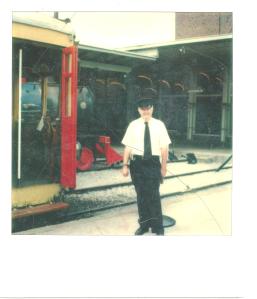
Dad at the Choo Choo

He spent way too much of his life making other people happy. Not selfish, certainly, and that is commendable, but no balance either. Such loss. Such pain. I wish he was here now so I could teach him what I know, to help him deprogram and discover who he really is. Perhaps that is what I am doing in his memory. Perhaps I am using his (bad / sad ) example of how not to live, and learning how.

He never wrote that book on Beethoven. He never traveled to England. He never did a lot of things he wanted to do. Never retired. And I see this, and remember – never take a day for granted. Never assume there is tomorrow.

But now, I’m learning, he’s teaching me, never assume the past is past either.

The impurity of death

What was Jesus talking about when he said to the Pharisees, scribes, and other religious authorities these words about them?

Luke 11:44 (HCSB)
“Woe to you! You are like unmarked graves; the people who walk over them don’t know it.”

Why would it matter if someone walked over an unmarked grave?

These verses from Matthew 23:27-28 (HCSB) give more insight.
27“Woe to you, scribes and Pharisees, hypocrites! You are like whitewashed tombs, which appear beautiful on the outside, but inside are full of dead men’s bones and every impurity. 28 In the same way, on the outside you seem righteous to people, but inside you are full of hypocrisy and lawlessness.

Jesus has already said in several different ways in Matthew 23:1-26 and Luke 11:37-52 that the religious authorities don’t practice what they preach. They tell people to follow the Law of Moses yet they don’t do it themselves. They get in the way of people who are about to enter the kingdom of heaven because they don’t understand the real reason for the rules and they give a bad example in their lives. The “kingdom of heaven” is not about when you die, but a state of awakened consciousness and connection with God here and now. It is about actively participating with God in making the world a better place.

Let us dig deeper on the “unmarked grave” idea. There is a Jewish concept about being defiled by death. Having contact with a dead body will result in you being unable to participate in normal life for seven days. It takes a lot of work to get you ritually pure again. You are essentially a leper – you have to live outside of the camp (or city). You don’t get to live with your family or hang out with your friends.

The rule comes from Numbers 19:11-12 (HCSB) –
11 “The person who touches any human corpse will be unclean for seven days.12 He is to purify himself with the water on the third day and the seventh day; then he will be clean. But if he does not purify himself on the third and seventh days, he will not be clean. 13 Anyone who touches a body of a person who has died, and does not purify himself, defiles the tabernacle of the LORD. That person will be cut off from Israel. He remains unclean because the water for impurity has not been sprinkled on him, and his uncleanness is still on him.

If this wasn’t difficult enough, the cure itself isn’t easy. This isn’t just any water (see verse 12) that is being talked about. The “water for impurity” – rather, the water used to remove impurity – isn’t easy to make. It requires a long and involved process. Here are the instructions for making that.

Numbers 19:1-10 (HCSB)
The LORD spoke to Moses and Aaron, 2 “This is the legal statute that the LORD has commanded: Instruct the Israelites to bring you an unblemished red cow that has no defect and has never been yoked. 3 Give it to Eleazar the priest, and he will have it brought outside the camp and slaughtered in his presence. 4 Eleazar the priest is to take some of its blood with his finger and sprinkle it seven times toward the front of the tent of meeting. 5 The cow must be burned in his sight. Its hide, flesh, and blood, are to be burned along with its dung. 6 The priest is to take cedar wood, hyssop, and crimson yarn, and throw them onto the fire where the cow is burning. 7 Then the priest must wash his clothes and bathe his body in water; after that he may enter the camp, but he will remain ceremonially unclean until evening. 8 The one who burned the cow must also wash his clothes and bathe his body in water, and he will remain unclean until evening. 9 “A man who is clean is to gather up the cow’s ashes and deposit them outside the camp in a ceremonially clean place. The ashes must be kept by the Israelite community for preparing the water to remove impurity; it is a sin offering.10 Then the one who gathers up the cow’s ashes must wash his clothes, and he will remain unclean until evening. This is a permanent statute for the Israelites and for the foreigner who resides among them.

So walking over an unmarked grave and not knowing it would be terrible because you would accidentally become defiled. Whether you know it or not you are still defiled. If the grave is marked you have a chance to avoid it – but if it is unmarked you don’t have a chance. The same is true of the religious authorities that Jesus is talking about. They are defiling people with their examples. So people who look up to them are being dragged down into hell. They don’t realize they are being mislead.

This is why I paraphrased the verse from Luke 11:44 like this in the Condensed Gospel: “Woe to you! You are like unmarked graves. People walk over you not even knowing that they have become defiled.”

While this rendering gives a little more insight into the verse, I felt a further understanding of the Jewish death taboos was helpful, so that is why I have included it here.

Ritual to honor a deceased parent

This uses something called “Hell” money. Chinese people use this fake money to show respect and honor to their deceased relatives. It is a way of keeping their memory alive. The Chinese have no “hell” or “heaven” – it is simply the afterlife. It is closer to “purgatory” or a “holding” area. It isn’t a place of punishment – it just simply isn’t a corporal existence here with us. Western missionaries translated the idea as “hell” because they did not understand it. You can obtain Hell money online (I used ArteCrafts on Etsy) or if you are fortunate enough to have a Chinatown section in your town, you can get them there.

If Western culture had a way of showing honor to deceased parents, I’d include it. They don’t. They don’t have a way of respecting and releasing grief. The Mexican Day of the Dead ceremony is very healing – you welcome back your dead ancestors for the day so they are still with you. In Western culture, you visit the grave (maybe) and pretend everything is fine. I’m all for adopting other culture’s ideas if they are healing. This represents my own twist on the idea.

These are the ingredients:
A candle.
Lighter.
Water to put out the fire if necessary.
Tray to hold the ingredients.
An incense stick for each person being honored.
A bell.
Regular and gold-orange Hell money.

You need a safe place to burn things – we used a fire pit. This should preferably be done outside, but could be done inside with a fireplace. There should be a way for the smoke to go up and outside.

To begin –
Cover your head – a hat or a handkerchief will do. This is for safety and for reverence. Avoid a ball cap.

Light the candle and put it at the top center of the burning area. This is not in the middle. Consider if the area is a clock. The center where you will burn the items is in the middle, where the clock arms are. You put the candle at the 12 o’clock position.

Light the incense sticks – one for each person you are remembering. Stick them in the burn area at the edge – at the 9 or 3 o’clock position. Angle them in towards the center, but not sharply. Say the name of each person, saying “I welcome (name) into this moment. I honor, love, and miss you.” (or other words that feel appropriate for you and your relationship)

Ring the bell once, calmly and reverently. This marks the beginning of silence.

Then burn the hell money one at a time, taking turns for each person who is participating in the ceremony. Have several different kinds of hell money. Some include representations of clothing or household goods. The idea is that you are “sending” these items to your relatives to make their stay in the otherworld easier.

If it feels right, burn one together in honor of your shared grief for the other’s parent.

Then burn the golden-orange hell money last. Only burn one of each.

Then ring the bell to signal the end of the ceremony.

Leave the incense burning. You can waft over you to bring some of its healing to you.

Regular Hell money looks like this
hell money2

Gold-orange money looks like this –
hell money1

Death is not a failure.

We need to turn around our view of death in the society. Death isn’t a failure. Death is a person transitioning from one level of existence to another. They are graduating. They have completed their mission here on earth and are now moving on to their next assignment.

In the same way that we gather together when someone is being born, we should gather together with the same joy and excitement when someone is passing on. When someone is being born we don’t even know who is being born. But when someone is dying we know who it is. We get to celebrate all that we have done with her or him together and that we were blessed with the opportunity to know her or him and share a little bit of our lives together.

I find it disturbing that the dying process is not taught in nursing school. I find it odd that a separate organization generally known as “hospice” had to come into existence to assist people and their families with death. Death is a fact of life. If you are alive then you will die. But we’ve isolated ourselves from this knowledge to the point that death seems to be something that happens to someone else. The medical institution treats death as a sign that their efforts have failed – they have not cured the disease.

Thoughts on public displays of grief.

There are several different ways that people publicly grieve. Here are few I’ve noticed that seem especially modern. Many seem counterproductive to the healing process. Many seem to exacerbate and prolong grieving.

Commemorating relative’s deaths on Facebook. Every year we hear when their relatives were born or died. Sometimes the birthday post will say “Happy Birthday Mom! You would have been 87 years old today!” Is it suitable to wish happy birthday to someone who has died? Mom has been dead for 20 years. Many of the people who are their friends never even met their Mom.

The side of the road memorials. These often have crosses with the person’s name on it and some fake flowers. Is that where the person died? Was there a car crash? Is this meant to warn others that this is a dangerous area and to drive safely? Is it legal to put private roadside memorials on public property? Could the memorial itself become a safety hazard by distracting someone? How long is too long to leave one of these up? When did this start? These have not always been.

The stickers on the car – “In loving memory of (insert name here)”. These are very large, some of which cover the entire back window of the car. Sometimes there is a profile of praying hands or of Jesus. Often there are birth and death dates. There is a possibility that the sticker itself could be a hazard to the driver, making it hard to see when they are changing lanes. The people on the road most likely did not know that person. How is this message relevant or helpful to them?

Tattoos for the dead. Either with birthdates and death dates, or an image of the person, or both.

Many of these different public memorials are designed to be permanent. Sure, we want to remember the dead. To not remember them and what they meant to you is to make it as if they didn’t exist. But is it helpful to grieve forever? It is meaningful to show your grief to complete strangers? They don’t know your loved one. Is it a way of saying that your grief is worse, because you are showing it off? We all have loved ones who have died. It seems that to have a public display of grief indicates that you feel that others do not grieve.

Grief is a long and difficult process, and Western society does not have a very healthy relationship with it. This is the same society that doesn’t even acknowledge death as a natural part of life. The dying process is seen as an aberration or something to be treated. No wonder our grieving has no set pattern for beginning, middle, and end. No wonder it gets so messy.

I’m not questioning the need to grieve. I’m questioning the need to grieve publicly and permanently. Is that healthy? Is it productive? Is it fair to everyone else?

Poem – Guilt and expected death

There’s a guilty feeling the caregiver has
when their loved one dies.
Be it spouse, parent, child,
you’ve taken care of them
for a long time
and they have finally
passed on.

Nobody talks about this.
They talk about how hard it is
to take care of
someone you love
for a long time,
someone who is terminally ill.
Someone who isn’t going
to get better,
and the only cure
is the grave.

Your life is finally back
to being yours.
Your time is yours.

You should feel bad if you
didn’t
give your time
to help them
– but you did, and now it is over.

There shouldn’t be guilt
about surviving,
guilt about feeling relieved
that it is over,
guilt about being glad
your duty is done.
But there is.

You are glad for them
that they are no longer suffering,
but also glad for yourself
that you can do
what you want to do
again.

You aren’t so crass as to say
you’re glad
they are dead,
but you are.

It is a weird feeling,
made weirder
by the mixture of grief,
the exhaustion of being
an unpaid,
untrained nurse,
there 24/7.

Poem – Happy death day!

I look forward
to the time
when we see death
as graduation
and not failure.

I look forward
to the time
where we
celebrate
death

not in a dark way
but as a release
into the light,
The all
The ever.

Death should be anticipated,
prepared for
and expected
like births are
with planning
and parties
and maybe even presents.

Not like you need much
where you are going.
You can’t take it with you
after all.

Death isn’t so scary
that way
isn’t so foreign, so frightening.

Perhaps
Hallmark will come out with cards.
Hurray! You are mortal!
Happy death day!
Or
Congratulations! Your Mom died!
You must be so proud of her!

Death is a stepping from one country
to another
no passport required
no overnight bags needed.
Death isn’t something
to be afraid of.
Fear of it is.

Give me away

When I die if you need to weep
Cry for your brother or sister
Walking the street beside you
And when you need me put your arms around anyone
And give them what you need to give me.

I want to leave you something
Something better than words or sounds.

Look for me in the people I’ve known or loved
And if you cannot give me away
At least let me live in your eyes and not on your mind.

You can love me most by letting hands touch hands
By letting bodies touch bodies
And by letting go of children that need to be free.

Love doesn’t die, people do
So when all that’s left of me is love
Give me away.

-Anonymous, copied from Page 346 of the book “Life Prayers”
I read this at a coworker’s memorial service.

The Dragonfly

Once, in a little pond, in the muddy water under the lily pads, there lived a little water beetle in a community of water beetles. They lived a simple and comfortable life in the pond with few disturbances and interruptions.

Once in a while, sadness would come to the community when one of their brother or sister beetles would climb the stem of a lily pad and would never be seen again. They knew when this happened that their friend was dead, gone forever.

Then, one day, one little water beetle felt an irresistible urge to climb up that stem. However, she was determined that she would not leave forever. She would come back and tell her friends what she had found at the top.

When she reached the top and climbed out of the water onto the surface of the lily pad, she was so tired, and the sun felt so warm, that she decided she must take a nap. As she slept, her body changed and when she woke up, she had turned into a beautiful blue-tailed dragonfly with four broad wings and a body designed for flying.

So, fly she did! As she soared she saw the beauty of a whole new world – and a far better way of life than what she had ever known existed.

Then she remembered her beetle friends, and how they were thinking that by now she was dead. She wanted to go back to tell them, and explain to them that she was now more alive than she had ever been before. Her life had been fulfilled rather than ended.

But her new body couldn’t not go back into the water. She could not get back to tell her friends the good news. Then she understood that the time would come when they, too, would know what she now knew. So, she raised her wings and flew off into her joyous new life.

-author unknown-

(This was read at my Mother-in-law’s memorial service, and I think it is worthy of passing on)