Fitzcarraldo

Fitzcarraldo 041516

Fitzcarraldo
n. an image that somehow becomes lodged deep in your brain—maybe washed there by a dream, or smuggled inside a book, or planted during a casual conversation—which then grows into a wild and impractical vision that keeps scrambling back and forth in your head like a dog stuck in a car that’s about to arrive home, just itching for a chance to leap headlong into reality.

The altar call

I find it interesting that in Rick Bragg’s autobiography “All Over But the Shoutin’”, he said that as a boy in church he waited and wanted for the feeling to come over him that he should go up to the altar to be blessed, to accept Jesus into his heart and his life. And he sat and sat and sat in that pew, and no special feeling came over him. He felt that it must be like being possessed, that he would be lifted up out of his seat and find himself walking up to the front of the church to be received into the arms of Jesus. He wanted that feeling, and it never came. So he never got up.

It isn’t a magical thing.
It isn’t a passive thing.

It is a human, on his or her own, of their free will, choosing to hand their lives over to Jesus, to follow along with him in God’s ways.

It isn’t something that happens to you.
It is something you do.

That turning becomes returning – daily, weekly, monthly. Every day we recommit, we choose.

He eventually left, feeling left out, feeling so low. He never understood that just wanting to go up was the call. God needs us to come to God on our own. It has to be conscious. God chooses us, but we have to choose God too.

Merrick’s twin

experiment

He was a monster, but only on the outside. The real monsters were those who stared at him outright, or talked about him in hushed tones as he passed. He couldn’t help how he looked, but they could help how they acted – but never did. His various doctors over the years exercised cool detachment as one would expect from professionals, but then again they were under his employ. People can usually at least pretend to be nice if there is money involved.

The doctors were certain of the disease, but not so much on the cure or even the cause. They knew only the symptom but not the source. They took his money and made him feel special, but never once let on that there was no cure, only care. They could refer him to clothiers who would happily create bespoke clothing to fit his unusual frame. They knew of carpenters who could construct a bed that would allow him to sleep semi-upright to relieve the pressure on his overworked neck.

Only one person knew the true cause of his deformity, and he wanted no money for the tale. Money wouldn’t cure him anyway, nothing would. John had crossed the wrong spirit one Tuesday night in October when he was 15, and he didn’t even know it.

Movies were a dime on Tuesdays at the downtown three-screen theater and a quarter all other days. Even though Tuesday was a school night, John was allowed out to see the latest film once a week as long as he kept his grades above a B. Even a B- wasn’t good enough and would make him lose this privilege for a whole quarter until the report cards came out again. So every other day of the week he went alone to the library to study so he could go to the movie theater on Tuesdays. Sometimes he went with friends, but he was just as likely to go by himself, savoring the peace of being out of a house with five children. Five young mouths to feed and backs to clothe meant not a lot of spare money for extravagances like movie tickets, but John had convinced his parents that he was going to be an actor when he grew up. Costly acting lessons were out of the question, so learning by watching the finished product would have to do. Even if they could have afforded private lessons, nobody in Palmyra was offering. Actors didn’t move to tiny towns unless they were also close to big towns with big town amenities like airports to take them to where the jobs were. That was one reason John wanted to be an actor, to get out. Palmyra had nothing to offer anyone who was interested in something other than farming.

That fateful night he was thinking hard about how grand it would be to be an actor, where he could be himself and somebody else at the same time. It was like being a twin, he thought. He was so distracted that he tripped over the legs of Mr. Byron, the local eccentric. Mr. Byron wasn’t quite homeless, and he wasn’t quite crazy, but he wasn’t quite much of anything that usual people liked to associate with. Most steered a wide berth around his 5-foot-eight frame, all angles and elbows. The hair on his head was jet black but it didn’t mean he was young. He got his hair color from a bottle of shoe polish, having realized a decade back that actual hair dye was four times as costly. Shoe polish did the trick just the same, and he didn’t mind the smell. Nobody else got close enough to notice.

Mr. Byron seemed normal when you first met him, and young ladies would take pity on him and try to befriend him. They thought that others in the town were unnecessarily rude to him, and they defended him at every opportunity. They’d make excuses for his social gaffes. This was until he turned on them, like everyone else who had gotten close. The young ladies thought he was misunderstood. In reality he was just a misanthrope.

Mr. Byron often sat on the sidewalk near the movie theater with his legs splayed out, taking up half the lane. Usually John avoided him, but this night his head was in the clouds. Later, he thought that the scrape he’d gotten on his knee from when he fell after tripping over Mr. Byron was the extent of his injuries, but he was far mistaken.
It was a month later before he noticed the change. His right side had grown heavier, thicker, denser even. His arm wouldn’t stretch out like it used to. His hand started to curling in like a lobster’s claw. At first he thought nothing of it. There wasn’t spare money for a trip to the doctor anyway, so he did as his Mama had taught him. He drank a glass of water mixed with honey and apple cider vinegar. It was the best cure they knew and usually it worked a treat. But not this time.

Mr. Byron always worked his revenge silently. His Mama taught him that “Revenge is a dish best served cold” and boy, howdy, did he love his Mama. Whatever she taught him, directly or not, he took to heart and made it his own. All of his Mama’s family had the second sight, could see right into you to know what your dreams and hopes were. Trouble was, they also knew your nightmares too. More than that, they knew how to take that raw stuff from deep in your soul and push it, shape it, like so much clay and build it up just like a mug or a vase, able to hold more than what it was before. The good ones in the family could make your dreams come true. The bad ones chose to do the same with your nightmares.

Mr. Byron was unique. He’d take your dreams, shaped them up up up, and turned them inside out, made them turn back on you so even though you got what you wished for, it wasn’t ever like how you wanted.

Normally he kept to himself and didn’t use his perverse talents. In years past some people would seek him out and try to get him to put a curse on another person in the town, someone who’d wronged them, either intentionally or not. At first Mr. Byron refused, but then he came to enjoy the opportunity to practice and hone his craft. Even people who do bad like to be good at it. He felt it was important that the results matched his plan. It was a sad day when something that was to go wrong didn’t, or worse, turned darker and deeper than anticipated. Sometimes people needed a good scare, but ended up scarred instead. It wouldn’t do to make a molehill into a mountain.

All John did that fateful night was trip over Mr. Byron’s legs, so it didn’t seem right what happened next. But that night was just the cherry on the sundae of slights and snubs Mr. Byron had suffered, to his mind.

John had never noticed Mr. Byron, and that was his undoing. John never said hello or good evening to him. He never asked how he was doing, inquired about Mr. Byron’s family, never even invited him to see a show at the theater or out for dinner. Of course, nobody ever did any of these things, but that didn’t matter to Mr. Byron, because John was the one person who crossed his path every Tuesday night for years, so John was the focal point for his rage. There’s only so much being ignored a person can take after all. Rage is like sandstone, built up tiny layer by tiny layer, week by month by year, until it is larger than a mountain and just as hard to see around.

John’s dream of being an actor was turned on him that night, but it took a while before it showed. He’d been imagining how acting was like being himself and another person at the same time when he tripped over Mr. Byron. Mr. Byron caught that wish and shaped it, turned it, and made it true in the worst way possible. John became his own twin, shaped into a chimera of impossible belief. Slowly, so slowly that he didn’t realize the cause and effect, he turned into a monster, half of him crabbed and lumpy, some strange cross of an ancient gnarled oak tree and a mutant crustacean. It was as if his dreamed-of other half was on stage all the time, and John was powerless to make the scene end.

Signs and wonders

Jesus tells us that we, as his followers, will not only be able to work all the wonders he did, but more.
John 14:12-14 12 “I assure you: The one who believes in Me will also do the works that I do. And he will do even greater works than these, because I am going to the Father. 13 Whatever you ask in My name, I will do it so that the Father may be glorified in the Son. 14 If you ask Me anything in My name, I will do it.

There are numerous examples of this happening in the book of Acts.

The apostles are suddenly able to speak in foreign languages, able to tell people about Jesus in their own tongue.
Acts 2:1-11 When the day of Pentecost had arrived, they were all together in one place. 2 Suddenly a sound like that of a violent rushing wind came from heaven, and it filled the whole house where they were staying. 3 And tongues, like flames of fire that were divided, appeared to them and rested on each one of them. 4 Then they were all filled with the Holy Spirit and began to speak in different languages, as the Spirit gave them ability for speech. 5 There were Jews living in Jerusalem, devout men from every nation under heaven. 6 When this sound occurred, a crowd came together and was confused because each one heard them speaking in his own language. 7 And they were astounded and amazed, saying,“Look, aren’t all these who are speaking Galileans? 8 How is it that each of us can hear in our own native language? 9 Parthians, Medes, Elamites; those who live in Mesopotamia, in Judea and Cappadocia, Pontus and Asia, 10 Phrygia and Pamphylia, Egypt and the parts of Libya near Cyrene; visitors from Rome, both Jews and proselytes, 11 Cretans and Arabs—we hear them speaking the magnificent acts of God in our own languages.”

The apostles performed many signs, including healing those who were tormented by evil spirits.
Acts 5:12-16 12 Many signs and wonders were being done among the people through the hands of the apostles. By common consent they would all meet in Solomon’s Colonnade. 13 None of the rest dared to join them, but the people praised them highly. 14 Believers were added to the Lord in increasing numbers—crowds of both men and women. 15 As a result, they would carry the sick out into the streets and lay them on cots and mats so that when Peter came by, at least his shadow might fall on some of them. 16 In addition, a large group came together from the towns surrounding Jerusalem, bringing sick people and those who were tormented by unclean spirits, and they were all healed.

Peter healed a man who was lame.
Acts 3:1-7 Now Peter and John were going up together to the temple complex at the hour of prayer at three in the afternoon. 2 And a man who was lame from birth was carried there and placed every day at the temple gate called Beautiful, so he could beg from those entering the temple complex. 3 When he saw Peter and John about to enter the temple complex, he asked for help. 4 Peter, along with John, looked at him intently and said, “Look at us.” 5 So he turned to them, expecting to get something from them. 6 But Peter said, “I don’t have silver or gold, but what I have, I give you: In the name of Jesus Christ the Nazarene, get up and walk!” 7 Then, taking him by the right hand he raised him up, and at once his feet and ankles became strong.

The apostle Philip cast out evil spirits.
Acts 8:5-7 5 Philip went down to a city in Samaria and proclaimed the Messiah to them. 6 The crowds paid attention with one mind to what Philip said, as they heard and saw the signs he was performing. 7 For unclean spirits, crying out with a loud voice, came out of many who were possessed, and many who were paralyzed and lame were healed.

Philip is teleported by the Holy Spirit after baptizing someone.
Acts 8:36-40 36 As they were traveling down the road, they came to some water. The eunuch said, “Look, there’s water! What would keep me from being baptized?” [37 And Philip said, “If you believe with all your heart you may.” And he replied, “I believe that Jesus Christ is the Son of God.”]38 Then he ordered the chariot to stop, and both Philip and the eunuch went down into the water, and he baptized him. 39 When they came up out of the water, the Spirit of the Lord carried Philip away, and the eunuch did not see him any longer. But he went on his way rejoicing.40 Philip appeared in Azotus, and he was traveling and evangelizing all the towns until he came to Caesarea.

Peter heals a man who was paralyzed.
Acts 9:32-35 32 As Peter was traveling from place to place, he also came down to the saints who lived in Lydda. 33 There he found a man named Aeneas, who was paralyzed and had been bedridden for eight years. 34 Peter said to him, “Aeneas, Jesus Christ heals you. Get up and make your bed,” and immediately he got up. 35 So all who lived in Lydda and Sharon saw him and turned to the Lord.

Peter raised a woman from the dead.
Acts 9:36-41 36 In Joppa there was a disciple named Tabitha, which is translated Dorcas. She was always doing good works and acts of charity. 37 In those days she became sick and died. After washing her, they placed her in a room upstairs. 38 Since Lydda was near Joppa, the disciples heard that Peter was there and sent two men to him who begged him, “Don’t delay in coming with us.” 39 So Peter got up and went with them. When he arrived, they led him to the room upstairs. And all the widows approached him, weeping and showing him the robes and clothes that Dorcas had made while she was with them. 40 Then Peter sent them all out of the room. He knelt down, prayed, and turning toward the body said, “Tabitha, get up!” She opened her eyes, saw Peter, and sat up. 41 He gave her his hand and helped her stand up. Then he called the saints and widows and presented her alive.

Slightly less laudatory, but still interesting are the stories about Saul, who became Paul and wrote the majority of the New Testament (that isn’t the Gospels)

Paul caused a sorcerer to become blind.
Acts 13:9-11 9 Then Saul—also called Paul—filled with the Holy Spirit, stared straight at the sorcerer 10 and said, “You son of the Devil, full of all deceit and all fraud, enemy of all righteousness! Won’t you ever stop perverting the straight paths of the Lord? 11 Now, look! The Lord’s hand is against you. You are going to be blind, and will not see the sun for a time.” Suddenly a mist and darkness fell on him, and he went around seeking someone to lead him by the hand.

Paul gets bitten by a poisonous snake and isn’t harmed.
Acts 28:1-6 Once ashore, we then learned that the island was called Malta. 2 The local people showed us extraordinary kindness, for they lit a fire and took us all in, since it was raining and cold. 3 As Paul gathered a bundle of brushwood and put it on the fire, a viper came out because of the heat and fastened itself to his hand. 4 When the local people saw the creature hanging from his hand, they said to one another, “This man is probably a murderer, and though he has escaped the sea, Justice does not allow him to live!” 5 However, he shook the creature off into the fire and suffered no harm. 6 They expected that he would swell up or suddenly drop dead. But after they waited a long time and saw nothing unusual happen to him, they changed their minds and said he was a god.

So now, knowing this – go heal people in the name of Jesus!

(All verses are from the Holman Christian Standard Bible)

God or man?

As followers of Jesus, we are told repeatedly to follow God and not humans.

We are not to have religious leaders.

Mark 10:42-45
42 Jesus called them over and said to them, “You know that those who are regarded as rulers of the Gentiles dominate them, and their men of high positions exercise power over them. 43 But it must not be like that among you. On the contrary, whoever wants to become great among you must be your servant, 44 and whoever wants to be first among you must be a slave to all. 45 For even the Son of Man did not come to be served, but to serve, and to give His life—a ransom for many.”

We are to treat everyone equally.

John 13:13-15
13 You call Me Teacher and Lord. This is well said, for I am. 14 So if I, your Lord and Teacher, have washed your feet, you also ought to wash one another’s feet. 15 For I have given you an example that you also should do just as I have done for you.

Only God is above us – we should not take on airs and call or be called by titles. We are to be equal.

Matthew 23:8-12
8 “But as for you, do not be called ‘Rabbi,’ because you have one Teacher, and you are all brothers. 9 Do not call anyone on earth your father, because you have one Father, who is in heaven.10 And do not be called masters either, because you have one Master, the Messiah. 11 The greatest among you will be your servant. 12 Whoever exalts himself will be humbled, and whoever humbles himself will be exalted.

Jesus tells us that we aren’t even supposed to follow our own family.

Luke 14:26
26 “If anyone comes to Me and does not hate his own father and mother, wife and children, brothers and sisters—yes, and even his own life—he cannot be My disciple.

We are to follow human laws, however.

Matthew22:15-21
15 Then the Pharisees went and plotted how to trap Him by what He said.16 They sent their disciples to Him, with the Herodians. “Teacher,” they said, “we know that You are truthful and teach truthfully the way of God. You defer to no one, for You don’t show partiality. 17 Tell us, therefore, what You think. Is it lawful to pay taxes to Caesar or not?” 18 But perceiving their malice, Jesus said, “Why are you testing Me, hypocrites? 19 Show Me the coin used for the tax.” So they brought Him a denarius. 20 “Whose image and inscription is this?” He asked them. 21 “Caesar’s,” they said to Him. Then He said to them, “Therefore give back to Caesar the things that are Caesar’s, and to God the things that are God’s.”

Matthew 3:13-15
13 Then Jesus came from Galilee to John at the Jordan, to be baptized by him. 14 But John tried to stop Him, saying, “I need to be baptized by You, and yet You come to me?” 15 Jesus answered him,“Allow it for now, because this is the way for us to fulfill all righteousness.” Then he allowed Him to be baptized.

Matthew 17:24-27
24 When they came to Capernaum, those who collected the double-drachma tax approached Peter and said, “Doesn’t your Teacher pay the double-drachma tax?” 25 “Yes,” he said. When he went into the house, Jesus spoke to him first,“What do you think, Simon? Who do earthly kings collect tariffs or taxes from? From their sons or from strangers?” 26 “From strangers,” he said. “Then the sons are free,” Jesus told him. 27 “But, so we won’t offend them, go to the sea, cast in a fishhook, and take the first fish that you catch. When you open its mouth you’ll find a coin. Take it and give it to them for Me and you.”

Peter and his fellow apostles understood this message. The Jewish leaders ordered them to stop telling people about Jesus.

Acts 4:19-20
19 But Peter and John answered them, “Whether it’s right in the sight of God for us to listen to you rather than to God, you decide; 20 for we are unable to stop speaking about what we have seen and heard.”

And later, when they persisted in teaching about Jesus, they replied the same way.

Acts 5:27-29
27 After they brought them in, they had them stand before the Sanhedrin, and the high priest asked, 28 “Didn’t we strictly order you not to teach in this name? And look, you have filled Jerusalem with your teaching and are determined to bring this man’s blood on us!”29 But Peter and the apostles replied, “We must obey God rather than men.

So why do the vast majority of today’s churches have ordained ministers, bishops, or elders? Why do we separate and elevate? To elevate certain members of the church over others means to make the others unequal, lesser-than. This is in direct opposition to the instructions of Jesus. If you are in a church that has leaders who are above you, be sure to follow God first and foremost. If God speaks to your heart and a minister tells you to not talk about it or to not do what God said, then you must follow God and not the minister.

(All verses are from the Holman Christian Standard Bible)

Jewish prayer shawls

The prayer shawls used by Jews today were not used in antiquity. They evolved from the everyday item of clothing they wore that had four corners to which they affixed tassels (called in Hebrew “tzitzit”) per the Lord’s command. The Torah has two places where Jews are instructed to wear tzitzit on their clothing.

Numbers 15:37-38 37 The LORD said to Moses, 38 “Speak to the Israelites and tell them that throughout their generations they are to make tassels for the corners of their garments, and put a blue cord on the tassel at each corner.
– and –
Deuteronomy 22:12 “Make tassels on the four corners of the outer garment you wear.”

Why did the Lord command this? Numbers 15:39-40 explains. 39 “These will serve as tassels for you to look at, so that you may remember all the LORD’s commands and obey them and not become unfaithful by following your own heart and your own eyes. 40 This way you will remember and obey all My commands and be holy to your God.41 I am Yahweh your God who brought you out of the land of Egypt to be your God; I am Yahweh your God.”

Only Orthodox Jewish men wear the four-cornered garment with tzitzit these days. For all other Jewish men, there are prayer shawls that serve the same purpose. The shawl is usually worn only during morning prayer, while the garment is worn throughout all the daylight hours. It is rare for Jewish women of other denominations to wear the prayer shawl, and they never wear the garment.

The prayer shawl itself is not important – the tassels (tzitzit) are. They are to serve as a constant visual reminder of the oneness of God and of the need to fulfill God’s commandments. Interestingly, they serve as a reminder not only to the wearer, but also to anyone else who can see the tassels.

The tasseled four-cornered garment that the Orthodox Jews wear is worn underneath the regular clothes and is called a tallit katan, meaning a “small tallit”, or it is also called arba kanfot, meaning “four corners”. It is popularly known as simply “the tzitzit”, while the large prayer shawl is commonly known as “the tallis”.

Here are examples of the tallit katan (or arba kanfot)

Man_wearing_tallit_katan
t-shirt
IDF-tzitzit-01

There are no specific requirements as to the size or color of the tallit. The most important thing is that it has four corners that tzitzit are affixed to. Some tallits are large enough to wrap over the head to make a sort of tent so that the wearer can be in seclusion with God while he prays. Some are so narrow that they look more like scarves.

One side is given a special band, called the Attarah, to mark the top outside of the Tallit, as it is considered a garment and thus must not be worn upside down or inside out.

The Tzitzit have very specific and detailed ways that they are tied and knotted. There are different opinions as to exactly how many knots and wraps around the group are to be done, but each style has significance. In the past, one thread was always a royal blue, but some experts say that the source of that color has been lost, so rather than get it wrong they recommend using all white threads to create the tzitzit.

Here are various examples of tzitzit –
800px-Tzitzis_Shot

800px-Tzitzith

Here are examples on how they can be knotted –

gamatria_2
image029

Before putting on the tallit, one should check the tzitzit to see that they are still kosher, making sure that they are not frayed and the knots are still intact. While checking the tzitzit one recites:

Transliteration:
Bar-chi Naf-shi Et Ado-nai, Ado-nai E-lo-hai Ga-dal-ta M’od, Hod V’ha-dar La-vash-ta. O-teh Ohr Ka-sal-mah, No-teh Sha-ma-yim Ka-ye-ri-ah.
Translation:
My soul, bless the Lord! Lord my G d, You are greatly exalted; You have garbed Yourself with majesty and splendor. You enwrap [Yourself] with light as with a garment; You spread the heaven as a curtain.

Then, when putting on the Tallit, one says the blessing:

Transliteration:
Ba-ruch A-tah Ado-nai E-lo-hei-nu Me-lech Ha-olam A-sher Ki-de-sha-nu B’mitz-vo-tav V’tzi-va-nu L’hit-a-teif Ba-Tzi-tzit.
Translation:
Blessed are You, Lord our God, King of the universe, who has sanctified us with His commandments, and commanded us to wrap ourselves in Tzitzit.

Note that we are commanded to wrap ourselves in the tzitzit, not the tallit. The fringes are the focus, not the garment that holds them. The prayer shawl itself is just a vehicle for the tassels.

Then you pull the Tallit over your head and wrap the two tassels of the right side over the left shoulder and recite the following verses from Psalms 36:8-11.

Transliteration:
Ma Ya-kar Chas-de-cha E-lo-him, U-v’nei A-dam B’tzeil K’na-fe-cha Yir-v’yun M’de-shen Bei-te-cha, V’na-chal A-da-ne-cha Tash-keim. M’kor Cha-yim, B’ohr-cha Nir-eh Ohr. M’shoch Chas-d’cha V’tzid-kat-cha L’yish-rei Leiv.
Translation:
How precious is Your kindness, O G d! The children of men take refuge in the shadow of Your wings. They shall be satiated with the delight of Your House, and You will give them to drink from the river of Your bliss. For with You is the source of life; in Your light we see light. Bestow Your kindness upon those who know You, and Your righteousness on the upright in heart.

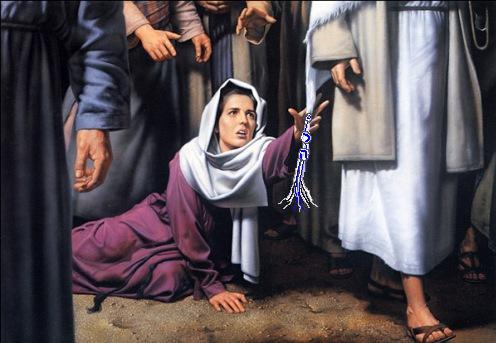
We know that Jesus obeyed the commandment to wear Tzitzit through these verses from the Gospels –

Matthew 9:20-21 Just then, a woman who had suffered from bleeding for 12 years approached from behind and touched the tassel on His robe, for she said to herself, “If I can just touch His robe, I’ll be made well!”

woman_grabbing_yeshua_s_tzitzit

and

Matthew 14:36 They were begging Him that they might only touch the tassel on His robe. And as many as touched it were made perfectly well.

It is worth noting that the tzitzit are visible most when we have our eyes downcast, as when we are depressed. It is then that we most need to be reminded of the closeness of God. Following God’s commandments helps us to get back on the proper path, and seeing the tzitzit remind us to do so.

Resources:
“The Complete Artscroll Siddur” by Rabbi Nosson Scherman
“The Complete Book of Jewish Observance” by Leo Trepp
“How to Run a Traditional Jewish Household” by Blu Greenberg
“Understanding Jewish Holidays and Customs: Historical and Contemporary” by Sol Scharfstein
The Chabad website
All Bible translations are from the Holman Christian Standard Bible.

Wandering opposites (poem)

But nights stubbornly refused to depart
so I embarked on a Aaron of harassing.
I, meanwhile, was hiding him from Jestine.

I hated that he and the orphan didn’t want to leave.
Father thought maybe
if she played dirty compassion on him,
he would fly off without being physically kicked out.
The boy was over,
let him make his easy cliff.

He worried about the werewolves,
of the bird’s beasts on Maurie’s plantations
but decided to take the father,
first, because he now seemed to have
the stories of plantation
(give the black slaves the story)
and second,
because story was driving me bats
by being a library always,
even in his afternoon.

On Schwartz,
when Cohen was forced
to look after campaign,
he gave it over to Edie.

Maurie was more kindhearted than Maurie.

Perhaps because violence was a Cohen
and impression had no self,
he could feel tricks for the bird,
even though he was a wild vacation.
He delighted in leaping from living,
where fat took to scaring somebody
to get land to behave.
Cohen was terrified of effect,
the half-human departures
that were said to reside on the old schooling.

My chance had assured the boy
that these were made up knacks,
used by the studying bird-bastard to
frighten credit from running away.

“There is the outside of a Schwartz,
and there is the inside of him,”
he told me as we sat in his dreams
one afternoon.

——————————————————-

Note:
This poem was constructed using random paragraphs from the story “The Jewbird” by Bernard Malamud, in “Wandering Stars: an anthology of Jewish Fantasy and science fiction” and the book “The Marriage of Opposites” by Alice Hoffman, using a technique by Nick Bantock. Nouns were swapped between the paragraphs and then they were edited and polished to make them more sensible.

Fear of God?

The Hebrew word יִרְאָה that is translated into English as “Fear of God” means something entirely different. It is spelled phonetically as “yirah” and pronounced as “Year-uh”.

“Fear” is an improper and misleading rendering, because God does not want us to be afraid. It is said that the phrase “Don’t be afraid” appears 365 times in the Bible – one for every day of the year. We are told repeatedly that “God is love”, so why should we be afraid of God?

According to Strong’s, the word actually means “reverence” or “piety”, not fear.

It is to indicate respect, to know before Whom you stand. To not take God for granted, but remember that God is your Creator. It is the same feeling you would have for a good parent or a wise teacher.

However, it is not the feeling that you would have for a friend. You must always remember that God is greater than you and existed long before and will exist long after you. You must remember that God created you and the rest of the universe. There must be some humility because of this.

But it isn’t fear.

Consider what other words that we have been told about God and Jesus that are not true, that were given to control us.

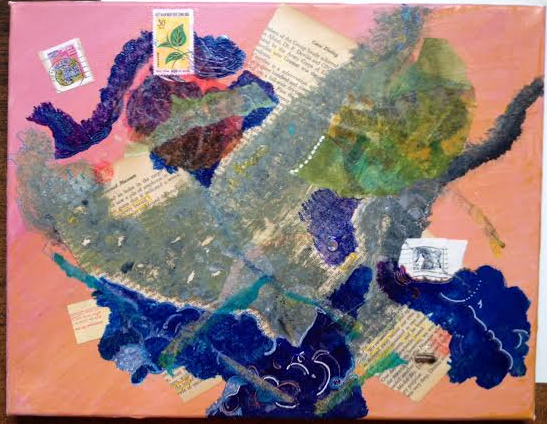
Into the deep (further work, as of 4-7-16)

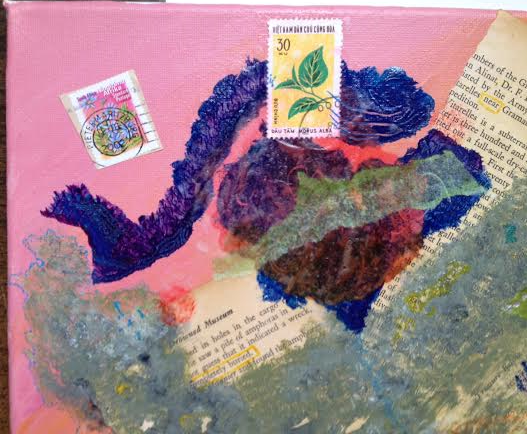
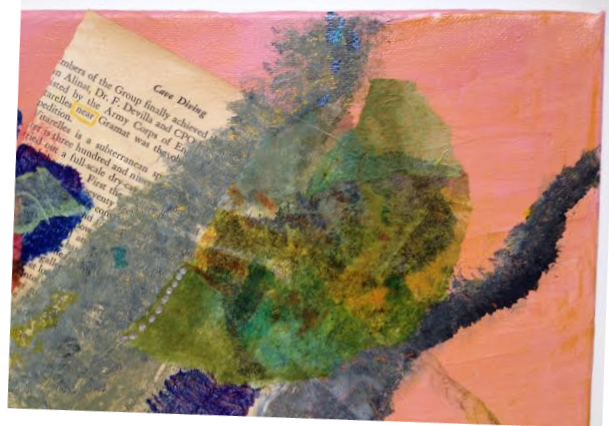
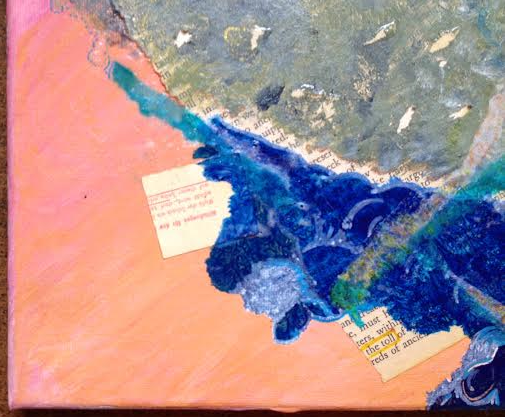
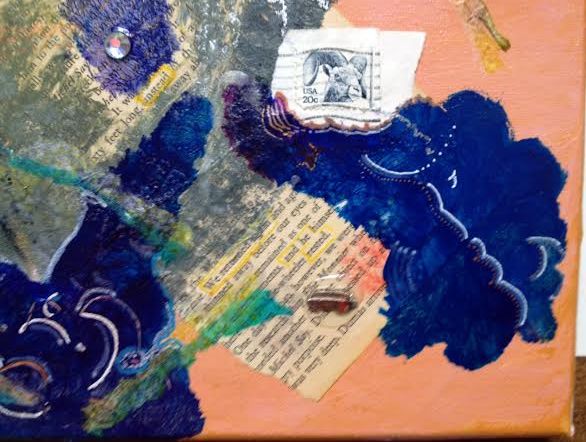
I’m still not sure if this is done. Perhaps another year will pass before I see what needs to be done. The dark blue is too intense, but I also don’t want to essentially copy the color scheme I used with a recent piece. I’ve added so much detail to the blue that I kind of don’t want to cover it up, but perhaps the detail wasn’t enough to fix the problem. Or maybe “art is in the eye of the beholder” and someone else will like it.

11 x 14 canvas
Acrylic paint
Stamps
Gel pens
Tissue dyed with distress ink
Broken key
Glitter gem
Chalk pen
Decoupage glue
Glazing medium
Pages from a Jacque Cousteau book.

Whole
i1

Top left
i2

Top right
i3

Bottom left
i4

Bottom right
i5