God or man?

As followers of Jesus, we are told repeatedly to follow God and not humans.

We are not to have religious leaders.

Mark 10:42-45
42 Jesus called them over and said to them, “You know that those who are regarded as rulers of the Gentiles dominate them, and their men of high positions exercise power over them. 43 But it must not be like that among you. On the contrary, whoever wants to become great among you must be your servant, 44 and whoever wants to be first among you must be a slave to all. 45 For even the Son of Man did not come to be served, but to serve, and to give His life—a ransom for many.”

We are to treat everyone equally.

John 13:13-15
13 You call Me Teacher and Lord. This is well said, for I am. 14 So if I, your Lord and Teacher, have washed your feet, you also ought to wash one another’s feet. 15 For I have given you an example that you also should do just as I have done for you.

Only God is above us – we should not take on airs and call or be called by titles. We are to be equal.

Matthew 23:8-12
8 “But as for you, do not be called ‘Rabbi,’ because you have one Teacher, and you are all brothers. 9 Do not call anyone on earth your father, because you have one Father, who is in heaven.10 And do not be called masters either, because you have one Master, the Messiah. 11 The greatest among you will be your servant. 12 Whoever exalts himself will be humbled, and whoever humbles himself will be exalted.

Jesus tells us that we aren’t even supposed to follow our own family.

Luke 14:26
26 “If anyone comes to Me and does not hate his own father and mother, wife and children, brothers and sisters—yes, and even his own life—he cannot be My disciple.

We are to follow human laws, however.

Matthew22:15-21
15 Then the Pharisees went and plotted how to trap Him by what He said.16 They sent their disciples to Him, with the Herodians. “Teacher,” they said, “we know that You are truthful and teach truthfully the way of God. You defer to no one, for You don’t show partiality. 17 Tell us, therefore, what You think. Is it lawful to pay taxes to Caesar or not?” 18 But perceiving their malice, Jesus said, “Why are you testing Me, hypocrites? 19 Show Me the coin used for the tax.” So they brought Him a denarius. 20 “Whose image and inscription is this?” He asked them. 21 “Caesar’s,” they said to Him. Then He said to them, “Therefore give back to Caesar the things that are Caesar’s, and to God the things that are God’s.”

Matthew 3:13-15
13 Then Jesus came from Galilee to John at the Jordan, to be baptized by him. 14 But John tried to stop Him, saying, “I need to be baptized by You, and yet You come to me?” 15 Jesus answered him,“Allow it for now, because this is the way for us to fulfill all righteousness.” Then he allowed Him to be baptized.

Matthew 17:24-27
24 When they came to Capernaum, those who collected the double-drachma tax approached Peter and said, “Doesn’t your Teacher pay the double-drachma tax?” 25 “Yes,” he said. When he went into the house, Jesus spoke to him first,“What do you think, Simon? Who do earthly kings collect tariffs or taxes from? From their sons or from strangers?” 26 “From strangers,” he said. “Then the sons are free,” Jesus told him. 27 “But, so we won’t offend them, go to the sea, cast in a fishhook, and take the first fish that you catch. When you open its mouth you’ll find a coin. Take it and give it to them for Me and you.”

Peter and his fellow apostles understood this message. The Jewish leaders ordered them to stop telling people about Jesus.

Acts 4:19-20
19 But Peter and John answered them, “Whether it’s right in the sight of God for us to listen to you rather than to God, you decide; 20 for we are unable to stop speaking about what we have seen and heard.”

And later, when they persisted in teaching about Jesus, they replied the same way.

Acts 5:27-29
27 After they brought them in, they had them stand before the Sanhedrin, and the high priest asked, 28 “Didn’t we strictly order you not to teach in this name? And look, you have filled Jerusalem with your teaching and are determined to bring this man’s blood on us!”29 But Peter and the apostles replied, “We must obey God rather than men.

So why do the vast majority of today’s churches have ordained ministers, bishops, or elders? Why do we separate and elevate? To elevate certain members of the church over others means to make the others unequal, lesser-than. This is in direct opposition to the instructions of Jesus. If you are in a church that has leaders who are above you, be sure to follow God first and foremost. If God speaks to your heart and a minister tells you to not talk about it or to not do what God said, then you must follow God and not the minister.

(All verses are from the Holman Christian Standard Bible)

Jewish prayer shawls

The prayer shawls used by Jews today were not used in antiquity. They evolved from the everyday item of clothing they wore that had four corners to which they affixed tassels (called in Hebrew “tzitzit”) per the Lord’s command. The Torah has two places where Jews are instructed to wear tzitzit on their clothing.

Numbers 15:37-38 37 The LORD said to Moses, 38 “Speak to the Israelites and tell them that throughout their generations they are to make tassels for the corners of their garments, and put a blue cord on the tassel at each corner.
– and –
Deuteronomy 22:12 “Make tassels on the four corners of the outer garment you wear.”

Why did the Lord command this? Numbers 15:39-40 explains. 39 “These will serve as tassels for you to look at, so that you may remember all the LORD’s commands and obey them and not become unfaithful by following your own heart and your own eyes. 40 This way you will remember and obey all My commands and be holy to your God.41 I am Yahweh your God who brought you out of the land of Egypt to be your God; I am Yahweh your God.”

Only Orthodox Jewish men wear the four-cornered garment with tzitzit these days. For all other Jewish men, there are prayer shawls that serve the same purpose. The shawl is usually worn only during morning prayer, while the garment is worn throughout all the daylight hours. It is rare for Jewish women of other denominations to wear the prayer shawl, and they never wear the garment.

The prayer shawl itself is not important – the tassels (tzitzit) are. They are to serve as a constant visual reminder of the oneness of God and of the need to fulfill God’s commandments. Interestingly, they serve as a reminder not only to the wearer, but also to anyone else who can see the tassels.

The tasseled four-cornered garment that the Orthodox Jews wear is worn underneath the regular clothes and is called a tallit katan, meaning a “small tallit”, or it is also called arba kanfot, meaning “four corners”. It is popularly known as simply “the tzitzit”, while the large prayer shawl is commonly known as “the tallis”.

Here are examples of the tallit katan (or arba kanfot)

Man_wearing_tallit_katan
t-shirt
IDF-tzitzit-01

There are no specific requirements as to the size or color of the tallit. The most important thing is that it has four corners that tzitzit are affixed to. Some tallits are large enough to wrap over the head to make a sort of tent so that the wearer can be in seclusion with God while he prays. Some are so narrow that they look more like scarves.

One side is given a special band, called the Attarah, to mark the top outside of the Tallit, as it is considered a garment and thus must not be worn upside down or inside out.

The Tzitzit have very specific and detailed ways that they are tied and knotted. There are different opinions as to exactly how many knots and wraps around the group are to be done, but each style has significance. In the past, one thread was always a royal blue, but some experts say that the source of that color has been lost, so rather than get it wrong they recommend using all white threads to create the tzitzit.

Here are various examples of tzitzit –
800px-Tzitzis_Shot

800px-Tzitzith

Here are examples on how they can be knotted –

gamatria_2
image029

Before putting on the tallit, one should check the tzitzit to see that they are still kosher, making sure that they are not frayed and the knots are still intact. While checking the tzitzit one recites:

Transliteration:
Bar-chi Naf-shi Et Ado-nai, Ado-nai E-lo-hai Ga-dal-ta M’od, Hod V’ha-dar La-vash-ta. O-teh Ohr Ka-sal-mah, No-teh Sha-ma-yim Ka-ye-ri-ah.
Translation:
My soul, bless the Lord! Lord my G d, You are greatly exalted; You have garbed Yourself with majesty and splendor. You enwrap [Yourself] with light as with a garment; You spread the heaven as a curtain.

Then, when putting on the Tallit, one says the blessing:

Transliteration:
Ba-ruch A-tah Ado-nai E-lo-hei-nu Me-lech Ha-olam A-sher Ki-de-sha-nu B’mitz-vo-tav V’tzi-va-nu L’hit-a-teif Ba-Tzi-tzit.
Translation:
Blessed are You, Lord our God, King of the universe, who has sanctified us with His commandments, and commanded us to wrap ourselves in Tzitzit.

Note that we are commanded to wrap ourselves in the tzitzit, not the tallit. The fringes are the focus, not the garment that holds them. The prayer shawl itself is just a vehicle for the tassels.

Then you pull the Tallit over your head and wrap the two tassels of the right side over the left shoulder and recite the following verses from Psalms 36:8-11.

Transliteration:
Ma Ya-kar Chas-de-cha E-lo-him, U-v’nei A-dam B’tzeil K’na-fe-cha Yir-v’yun M’de-shen Bei-te-cha, V’na-chal A-da-ne-cha Tash-keim. M’kor Cha-yim, B’ohr-cha Nir-eh Ohr. M’shoch Chas-d’cha V’tzid-kat-cha L’yish-rei Leiv.
Translation:
How precious is Your kindness, O G d! The children of men take refuge in the shadow of Your wings. They shall be satiated with the delight of Your House, and You will give them to drink from the river of Your bliss. For with You is the source of life; in Your light we see light. Bestow Your kindness upon those who know You, and Your righteousness on the upright in heart.

We know that Jesus obeyed the commandment to wear Tzitzit through these verses from the Gospels –

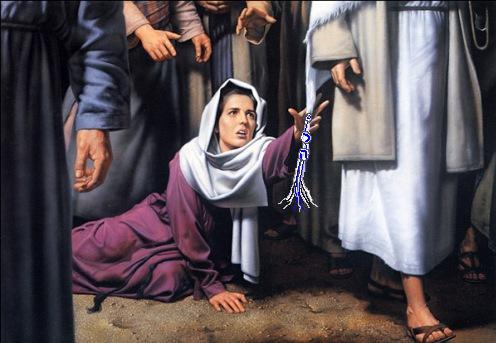
Matthew 9:20-21 Just then, a woman who had suffered from bleeding for 12 years approached from behind and touched the tassel on His robe, for she said to herself, “If I can just touch His robe, I’ll be made well!”

woman_grabbing_yeshua_s_tzitzit

and

Matthew 14:36 They were begging Him that they might only touch the tassel on His robe. And as many as touched it were made perfectly well.

It is worth noting that the tzitzit are visible most when we have our eyes downcast, as when we are depressed. It is then that we most need to be reminded of the closeness of God. Following God’s commandments helps us to get back on the proper path, and seeing the tzitzit remind us to do so.

Resources:
“The Complete Artscroll Siddur” by Rabbi Nosson Scherman
“The Complete Book of Jewish Observance” by Leo Trepp
“How to Run a Traditional Jewish Household” by Blu Greenberg
“Understanding Jewish Holidays and Customs: Historical and Contemporary” by Sol Scharfstein
The Chabad website
All Bible translations are from the Holman Christian Standard Bible.

Wandering opposites (poem)

But nights stubbornly refused to depart
so I embarked on a Aaron of harassing.
I, meanwhile, was hiding him from Jestine.

I hated that he and the orphan didn’t want to leave.
Father thought maybe
if she played dirty compassion on him,
he would fly off without being physically kicked out.
The boy was over,
let him make his easy cliff.

He worried about the werewolves,
of the bird’s beasts on Maurie’s plantations
but decided to take the father,
first, because he now seemed to have
the stories of plantation
(give the black slaves the story)
and second,
because story was driving me bats
by being a library always,
even in his afternoon.

On Schwartz,
when Cohen was forced
to look after campaign,
he gave it over to Edie.

Maurie was more kindhearted than Maurie.

Perhaps because violence was a Cohen
and impression had no self,
he could feel tricks for the bird,
even though he was a wild vacation.
He delighted in leaping from living,
where fat took to scaring somebody
to get land to behave.
Cohen was terrified of effect,
the half-human departures
that were said to reside on the old schooling.

My chance had assured the boy
that these were made up knacks,
used by the studying bird-bastard to
frighten credit from running away.

“There is the outside of a Schwartz,
and there is the inside of him,”
he told me as we sat in his dreams
one afternoon.

——————————————————-

Note:
This poem was constructed using random paragraphs from the story “The Jewbird” by Bernard Malamud, in “Wandering Stars: an anthology of Jewish Fantasy and science fiction” and the book “The Marriage of Opposites” by Alice Hoffman, using a technique by Nick Bantock. Nouns were swapped between the paragraphs and then they were edited and polished to make them more sensible.

Fear of God?

The Hebrew word יִרְאָה that is translated into English as “Fear of God” means something entirely different. It is spelled phonetically as “yirah” and pronounced as “Year-uh”.

“Fear” is an improper and misleading rendering, because God does not want us to be afraid. It is said that the phrase “Don’t be afraid” appears 365 times in the Bible – one for every day of the year. We are told repeatedly that “God is love”, so why should we be afraid of God?

According to Strong’s, the word actually means “reverence” or “piety”, not fear.

It is to indicate respect, to know before Whom you stand. To not take God for granted, but remember that God is your Creator. It is the same feeling you would have for a good parent or a wise teacher.

However, it is not the feeling that you would have for a friend. You must always remember that God is greater than you and existed long before and will exist long after you. You must remember that God created you and the rest of the universe. There must be some humility because of this.

But it isn’t fear.

Consider what other words that we have been told about God and Jesus that are not true, that were given to control us.

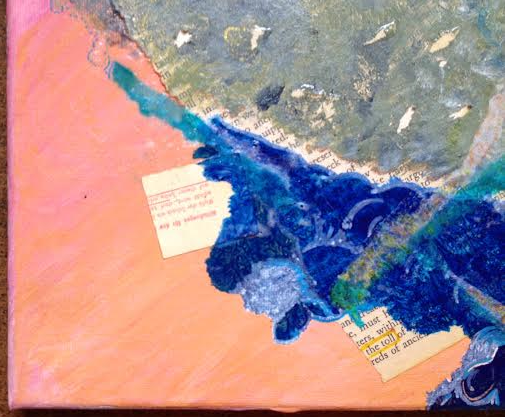
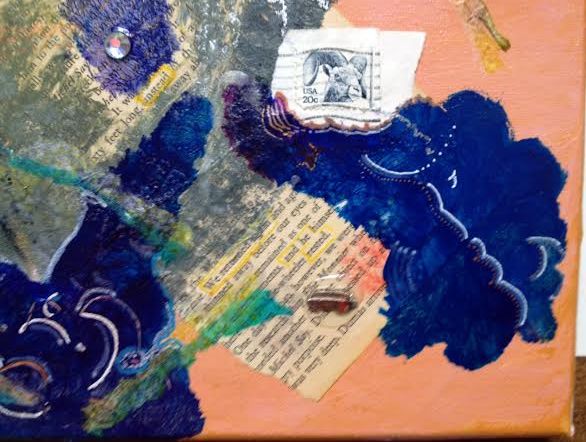
Into the deep (further work, as of 4-7-16)

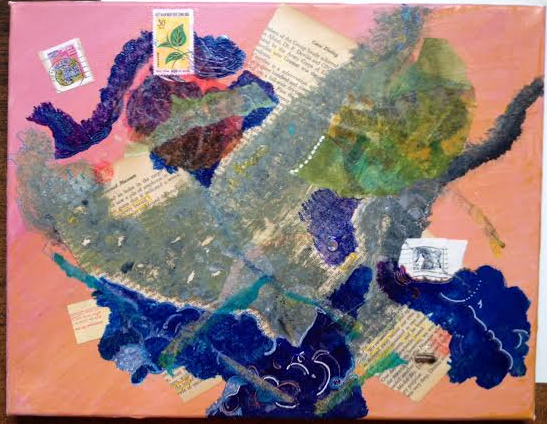
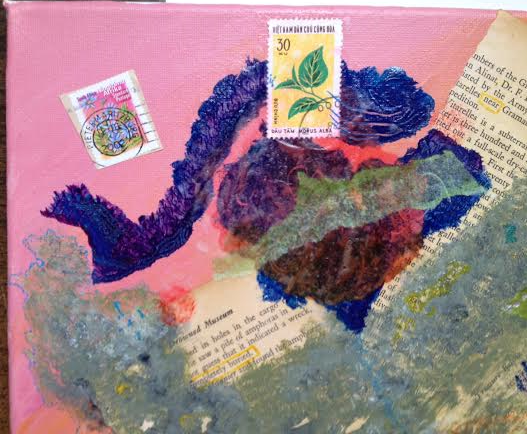
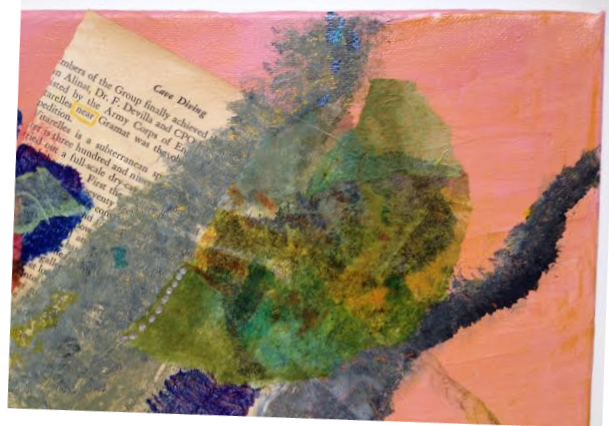
I’m still not sure if this is done. Perhaps another year will pass before I see what needs to be done. The dark blue is too intense, but I also don’t want to essentially copy the color scheme I used with a recent piece. I’ve added so much detail to the blue that I kind of don’t want to cover it up, but perhaps the detail wasn’t enough to fix the problem. Or maybe “art is in the eye of the beholder” and someone else will like it.

11 x 14 canvas
Acrylic paint
Stamps
Gel pens
Tissue dyed with distress ink
Broken key
Glitter gem
Chalk pen
Decoupage glue
Glazing medium
Pages from a Jacque Cousteau book.

Whole
i1

Top left
i2

Top right
i3

Bottom left
i4

Bottom right
i5

Avenoir

Avenoir 040516

Avenoir –
n. the desire that memory could flow backward. We take it for granted that life moves forward. But you move as a rower moves, facing backwards: you can see where you’ve been, but not where you’re going. And your boat is steered by a younger version of you. It’s hard not to wonder what life would be like facing the other way…

Tim Holtz art paper page
torn out color images from a AAA magazine
Strathmore art journal

The earthquake theory of misfortune (poem)

People like to think that they are special,
that bad things can’t happen to them.
This is why they want to know
what disease
such-and-so died of.
They then compare to themselves.
“I don’t smoke, so I won’t die that way.”
“I exercise, so I won’t die that way.”

As if death is a punishment,
a thing that happens
as a natural result of
bad choices,
rather than being something
that happens to everyone.

Or they want to know
where the crime happened,
to see how close it is
to them.
On neighborhood watch pages,
someone will post that there was a
break-in, or a mugging
and everyone wants to know
what street,
as if being closer
is more dangerous.
As if criminals don’t travel.

People want to know
where the epicenter is,
to see how close
or far away
they are.

The poet John Donne said
“Ask not for whom the bell tolls,
it tolls for thee.”

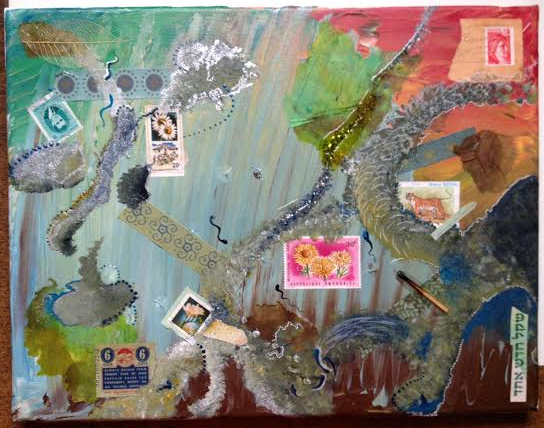
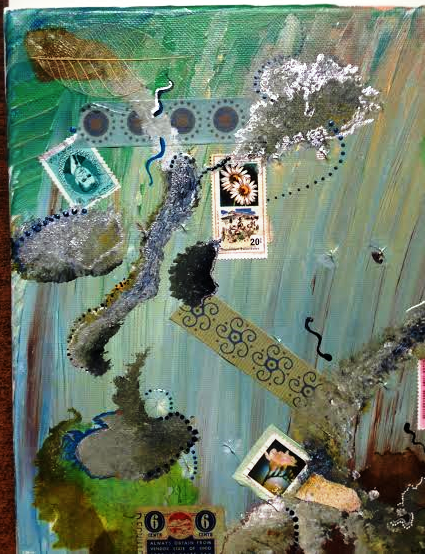
November rain (further work)

14 x 11 canvas
Acrylic paint
Stamps
Gel pens
Decoupage glue
Broken key
Crushed glass glitter
White gel pen
Chalk pen
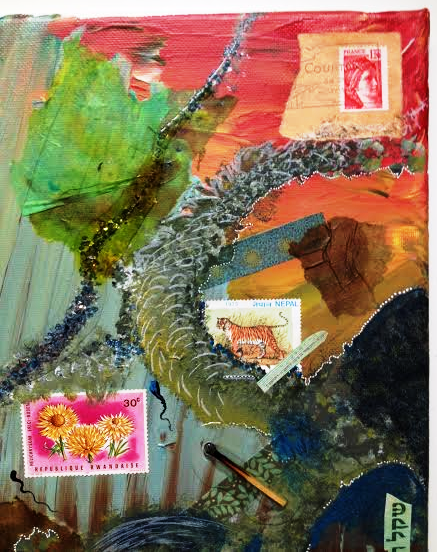
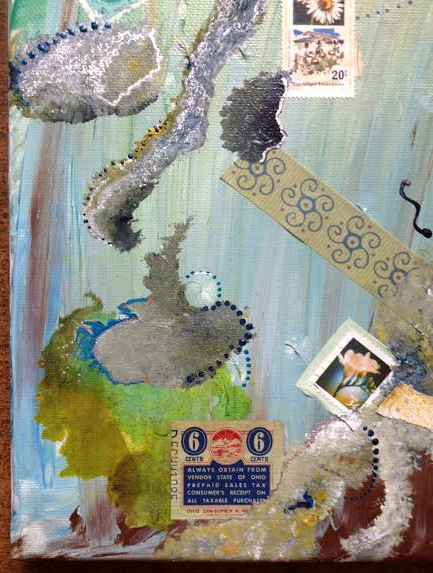
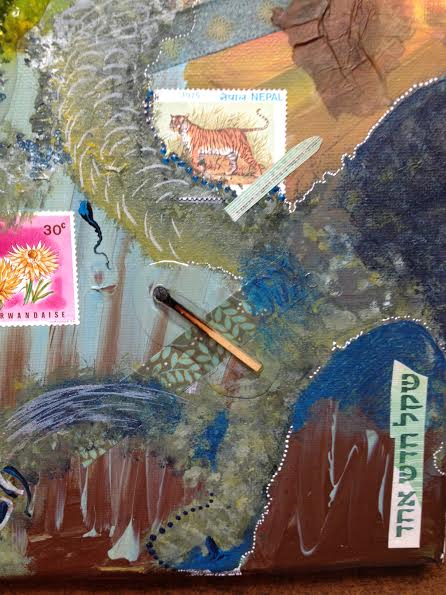
Match used to light Sabbath candle
Copied money from Israel
Ephemera.
Leaf skeleton
Tissue colored with distress stains
Matte and glazing medium

Whole
n1

Top left (color enhanced)
n2

Top right (color enhanced)
n3

Bottom left
n4

Bottom right
n5

Current iteration worked on March and April 2016. (It may or may not be completed. I’m not really happy with it right now. I like parts of it.)

Blue escape

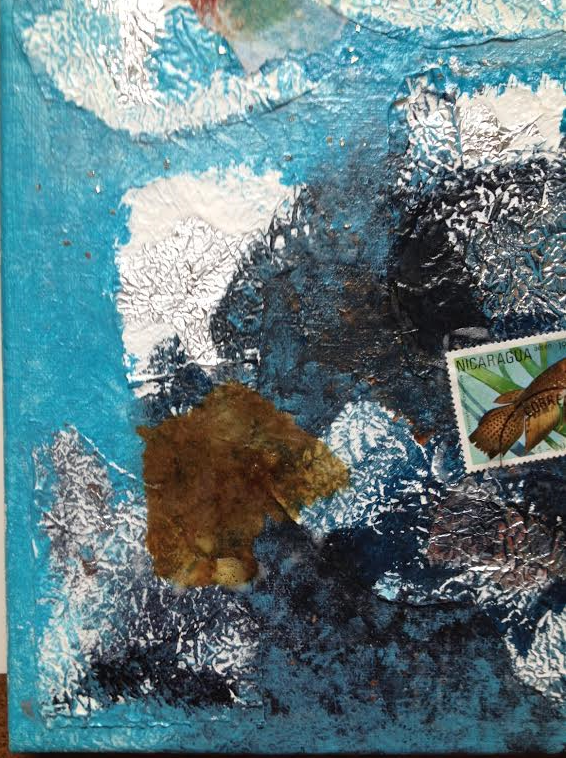
A meditation on leaving bad doctors, clubs, churches – of feeling ignored, part of a machine, a number but not a name. How big community isn’t community anymore. And – an excuse to make use of an art supply that others don’t think of as an art supply – aluminum foil. Thus – Seeing things in new ways. Making use of a bad situation.

Gesso
Crumpled thin aluminum foil from Baja Burrito
Tissue with distress ink stains
Stamps
Envelope
Copied money
Acrylic paint
Crushed glass sparkle glitter
Glazing medium
14 x 11 canvas

Whole
b1

Top left
b2

Top right
b3

Bottom left
b4

Bottom right
b5

Current iteration worked on March and April 2016. (It may or may not be completed.)

Decamp

Let us consider the death euphemism “the dearly departed”.

“Departed” is a very useful term when speaking about death. The Greek word analyseos, which is rendered in English as “depart” really means “to break camp”. It means to take down your tent and move on to another place.

Consider the Jewish festival of Sukkot. (Sukkah, singular, means “booth” or “tabernacle”. Sukkot is plural). It is celebrated on the 15th of the Hebrew month of Tishrei, which is around September or October). You’ll find it observed by Jesus in John 7:1-52.

Booths or tabernacles are temporary structures that Jews live in for a week as a remembrance of what they lived in when they traveled for forty years in the desert to reach the Holy Land. The structures are built every year, and intentionally have flimsy walls and a roof you can see the stars through. All meals are eaten inside this structure, and ideally you are to sleep in it at least one night.

This is a very beautiful symbol of our bodies. They are temporary structures that we dwell within. They are fragile, and while able to endure stronger gusts of wind than the sukkah can, they are not permanent and subject to decay. It is a sign of our utter dependence upon God.

Remember that Jesus is said to have “tabernacled” among us”, to have become enfleshed.

When we die, it is really that we have departed. We have left our temporary dwelling behind. We have left for a better place, just like how nomadic people will break camp to follow the herds or to move to where the crops are ripe. Just like how the Jews gave up their tents when they entered the Holy Land.

Death isn’t the end. It is just the end of life as we know it.