Spiritual but not religious (poem)

There are many people who say
that they are spiritual but not religious.
Perhaps they are this way
because there are so many
other people
who are
religious but not spiritual.

These are people who
go to church
but they don’t realize that
they are the Church.

They go into a building
but they don’t realize
that the Church
isn’t that.
It is them.

They believe that their
entire obligation to God
is to go sit passively
in a building
and listen
to someone else talk
for an hour
once a week.

This is not what Jesus meant
when he died for us
to create his Church.
When he said
“upon this rock I will build my Church”
to Peter,
he’s talking to a human being.
He didn’t mean a building.
He meant that we are supposed
to serve God
with every moment
of our days.

This does not mean
sitting in a church building
and singing hymns
and praying for people.
This means actually working.
This means actually helping people.

Many people have
left the Church
because the church
has left Jesus.
Many people don’t go to church
because they don’t find
Jesus
there.

Sealed (poem)

What would you do
if I told you
that the same oil
used to mark you
at your baptism
is the same
used to anoint
priests, bishops, kings, emperors?

You, in being marked
as Christ’s own forever
have a share in his kingship,
a part in his priesthood.

You, yes, you.

It was not for nothing
that you were born.
You are anointed,
consecrated to God.

Royal. Holy.

This honor is not limited to those
in the royal family.
Look at David.
A poor shepherd boy,
the youngest in the family.
Look at Moses,
raised in a stranger’s house.
They were nobodies until God called.

God called you too,
marked you as God’s own at your baptism.
Sealed. Sanctified. Saved.

What would you do now,
knowing this?

Why are you giving away your power,
your calling, to others?
Why do you follow priests and pastors, bishops, popes?
Your one teacher is God,
and God only.

Jesus says that we will do more and greater than he did –
more and greater than
restoring sight to the blind,
making the deaf hear,
making the lame walk,
making the dead come alive.

Us.

Imagine the healing of the world
at our hands,
the power of God
coursing through us.

It is here, now.
Anyone who tells you otherwise,
who keeps this to themselves,
is misleading you.

Easter eggs at the public library

I spy with my little eye, something that begins with E.

3

Eggs.

4

Easter eggs, to be specific.

2

At a public library.

1

The idea of separation of church and state means in part that the state cannot do anything to hinder people’s practice of their faith. But it also means that the state should not promote a particular faith either.

For a government-run entity to have any display of any one faith tradition implicitly excludes all others.

Where was the Purim festival for the Jewish families? How about an observance of Holi for the Hindu families? Both of these celebrations happened this week, but there was no notice of them.

How about understanding that there are people who do not practice any faith tradition at all? How about understanding that there are people who have been psychologically harmed by Christians?

Government-run organizations get their money from tax dollars from every citizen. That means that it should represent all of them, not just a few. If they are going to have religious displays, then they must have all of them. Ideally, they would not have any displays at all.

The little white house

little white house

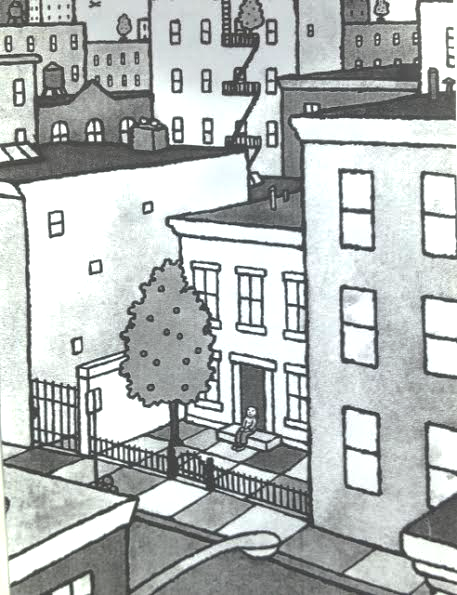
The little white house had been there longer than anyone could remember. The cornerstone said 1781, but nobody thought that was possible. Sudbury wasn’t a town that far back. The archives in the local library said the first deed had been issued in 1824 to Saul Abrams, a fur trader, but it was the only house for miles then. It was four years later before the town had its first boom and then there were a dozen homes scattered about like corn thrown to chickens. Close enough to help if there’s a need, but far enough away that you didn’t have to worry about your neighbor seeing your business. Not like anybody was up to anything, mind you, but it was still nice to have the breathing room.

Nell was currently the youngest resident of the little white house, but she certainly wasn’t going to be the last. Her mom was due to give birth within a week to her latest sibling. Meanwhile, grandma Rose and uncle Pat lived upstairs in the north-east facing room. They preferred the early morning light to paint by. They said it meant they got a head start on the day before the rest of the family got up.

The little white house had resisted all sorts of change over the years. It had plumbing but no electricity. The family had never seen a need for it, preferring natural light over artificial. Plus the money they saved was nothing to sneeze at. Of course, money wasn’t a problem for Nell’s family. Up to four generations at a time lived there, sharing their skills and resources along with their joys and sorrows. It was so much cheaper to pay one mortgage than four (or more). The money saved was worth the minor annoyance of the cramped quarters. For starters, it meant that they didn’t all have to work full-time, and especially not at jobs that took more than they gave.

The Abrams family realized early on that they would have to be careful about how many children they had if they were going to share a house. It wouldn’t do to be too crowded. Plus, more mouths meant more food, and food wasn’t cheap. They’ve had a lot of land to work with years back, but now that the city had grown up around the house they had to buy food just like everyone else.

Of course, there was always the apple tree out front. It had been the reason Saul had bought the property in the first place. The apples had just ripened on it once Saul came over the hill, looking for a campsite for the evening after a long day of marmot trapping. That tree’s beauty stopped him in his tracks and he set up his canvas tent smack dab under it to spend the evening with it as his company. The next morning he knew he’d finally found a place he could call home. He dreamed about that tree the whole night long.

Saul’s family put great stock in dreams, being descended from Jacob, who God renamed Israel. Jacob knew that where he slept was a holy place and so set up an altar to God once he awoke. Saul knew the same was true here, but he knew he was to establish a house rather than a temple.

There wasn’t much difference, really, to his mind.

The city had grown up around the house, getting closer and closer. The yard had shrunk down to a little patio in front with the tree. Tall buildings bracketed the little white house on the sides but not at the front or back. Somehow, there was still an alleyway to one side, and Nell would often play there when she wanted to be alone.

The alley was gated, and only her family had a key, but it didn’t matter. Nobody would even think of walking through that gate. Most didn’t even notice it. It was kind of like one of those Japanese gates that weren’t really gates, marking out a difference between “there” and “here”. “Here” was the difference between storm and calm, between noise and harmony. Most people walked on by because this little island wasn’t what they were looking for, even though it was what most of them needed. Most people were looking for peace in the wrong places – more activity, more possessions, a different job / spouse / church / hobby. They figured if they weren’t happy it was because of something outside of them. Change that and they’d change how they felt, they thought. Yet they made the changes outside and they still felt empty inside.

The little white house had no ornamentation to speak of but it was always clean and tidy. It stuck out only in that it didn’t stick out at all, taking up just enough space but no more.

The residents kept a low profile, always doing things the same way. They always put the trash out on Wednesday mornings, always went to get the groceries on Thursday. On Friday they prepared for a day of rest by cooking double portions of food to make Saturday easy. On Sunday they might travel or work on school projects. They were always learning, whether they were enrolled in an institution or not. All of the Abrams kids went to public school and then to college, yet they also were expected to follow their own inspirations and learn as much as they could about whatever they wanted. The Sahara desert, bowling, tea, it made no difference. Anything was fair game to do a research project on, but each person had to do something.

Right now, for Nell, that something was sitting on the front steps, sketching the apple tree. Year after year it produced crisp red apples that the family lovingly harvested and ate fresh, baked into pies, made into sauce and preserves. Every single fruit was carefully harvested and used or processed immediately. “An apple a day keeps the doctor away” should have been engraved as the Abrams family motto because they sure took it seriously. Even if they were traveling they were sure to take enough applesauce or apple butter along with them so each person could have their daily allotment. Every day they ate from the fruit of that tree just like it was medicine, just like it was prescribed by the family doctor.

In a way, it was. All those many years ago, God told Saul in that dream to eat the fruit of that tree every day – him and his descendants, and they would never get sick. He took God at his word and had an apple for breakfast first thing when he woke up. Within moments the usual aches and pains he’d had for the past three years of making his living out of the wilderness were gone, like he never had them.

The family never told a soul their secret, out of concern that someone would try to steal the tree or chop it down out of spite. Some folks would rather destroy something beautiful than share.

Of course, they had to tell anyone who married into the family, but marrying into that family was harder than getting a job at the real White House.

Background checks were just the beginning. Then there was a complete physical. Financial records were obtained. Even visits to a psychiatrist were required. It was like applying for full term life insurance, a second mortgage, and a Secret Service job all at once.

In the end, if you were in, you were made truly part of the family by a dip in the local river. And, no matter what, you had to change your last name to Abrams. After that you were the same as anyone else who lived in the little white house, and you too got your daily serving of apple.

Getting a serving a day meant you didn’t get sick, but it didn’t mean you wouldn’t die. Accidents and old age could kill an Abrams the same as anyone else. They tended to heal faster from accidents, and age slower, but death still visited that house on occasion. Even then it wasn’t a sadness, because they’d always lived long and well there.

(The image is from the book “Trainstop” by Barbara Lehman. It is a wordless picture-book for children. My story was inspired by this image and not by her story that she told through her other pictures.)

Prayer bead chain

main
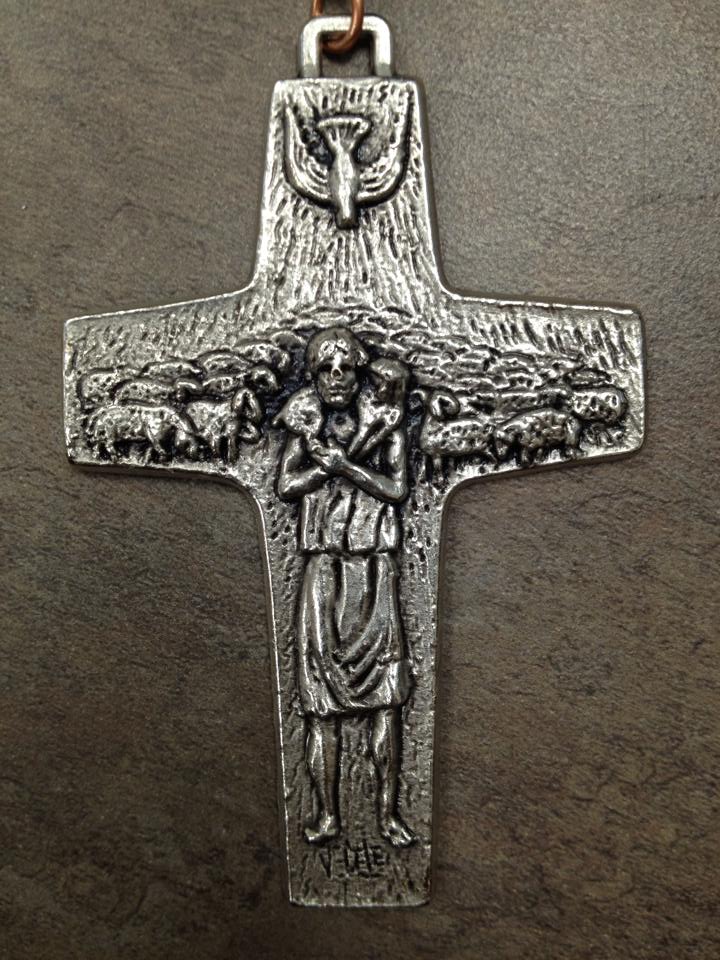
This is a prayer bead chain that I made. It isn’t a rosary, but it kind of is. It is a reminder to pray but there are no set prayers for it. I’m open to adding more beads to it in the future, but it is still good the way it is. It would be too heavy to make into a necklace. It is meant to be carried in a pocket so that it is ready to be used as a prayer aid whenever needed.

cross
The cross is a replica of the cross that Pope Francis wears. It is not a crucifix – rather than depicting Christ crucified, it celebrates his life and teaching by depicting him as the good shepherd, one who seeks out the lost and protects them, even willing to lay down his life for them.

heart
The next bead is a heart, as a reminder of God’s love for us, that God loved us enough to come down to earth to experience life among us.

recycled
This bead is made from broken pieces of glass that have been put together and remade into a new bead. It is a reminder that God can make something new out of our brokenness.

This bead is a chevron bead.
chevron1

It doesn’t look special until you see the sides.
chevron2

The only way you can see it is if you cut the bead and then grind away at the edges. This is a reminder that our true beauty isn’t on the surface, but is what is revealed after we are tested.

copal
This bead is made of copal. It is a reminder of the incense used in churches as “an aroma pleasing to the Lord”. Instead of making animal sacrifices, our prayers and work are what God desires.

millefiori
This millefiori bead has six pointed stars, as a reminder of the faith of Israel that told the world about the One God.

egg
This is a glass bead that I made myself many years ago. Unintentionally, it looks like an egg. It is a reminder that what I did many years ago can still be of value and needed today. It is also a reminder to use whatever talents I have to glorify God.

people
This bead is also a millefiori bead, but it has faces. Because it is made of many different canes of glass fused together, it is a reminder that the Body of Christ is made up of many people, all working together in unison to do God’s will on earth.

The Hunt (an Easter musing)

It is kind of hard to ignore that Easter is soon upon us. I’ve always been mindful of how strange it is to be the minority faith in America, even though I’m part of the majority. My closest friends were Hindu or Jewish while I was in school, and I still remember how awkward it was that the principal would say a Jesus-centric prayer at every football game at our public (meaning not private, thus not religious) high school football games.

It seems so strange that non-religious organizations such as grocery stores and pharmacies and craft supply shops will have displays for every Christian holiday but totally ignore the fact that there are people who have other festivals and observances who live in the same community. I think it is best to have all, or none.

But I digress.

I saw a sign at the local grocery store saying “The Hunt is On” over a huge display of Easter candy. The hunt? Oh right. Easter eggs. Hidden. And you go find them.

Plenty of people say that Easter is a pagan holiday, that the Christians simply adopted the celebration of Ostara as their own. They say that to celebrate Easter is to worship a false god (or goddess). Maybe this is true. It bears further research.

But, it seems backwards, this entire idea of us hunting for eggs.

We aren’t the ones who do the seeking. God is.

God is the one who seeks us.
God is the father to the prodigal son.
God is the one who goes to find the lost sheep.
God is the one who seeks the lost coin.
God puts everything aside to find us, to gather us up like a hen shelters her chicks.
God is the one who heals us.

We are the eggs, hidden, lost, confused, ashamed.
God finds us, brings us out into the light.

Notice how beautiful hand painted Easter eggs are. Each one is different and special. That is how God sees us.

Traditional-Easter-eggs-008

Melissa’s story

3


Melissa knew it was time to leave her job when her boss sent her that email. Nearly 20 years with the same firm and it all came down to one thing – trust. She simply didn’t trust him to be honest. Or fair. Or rational. He was her third boss, but they were all the same. All toed the party line, all had degrees in “CYA”. Normally, she would have put her head down, not drawn any attention, and soon things would blow over or the manager would retire or get transferred.

It took her six years to realize that her job, while saying that it cared for its employees, didn’t back that up with real action. The bullies and incompetents got the management positions. They wrote the performance reviews too, and they were all one-way. All the reviews were top-down, so the subordinates never had a say in how they were being managed. This was the norm all over, so it never occurred to her that it was wrong, never occurred to her that it was possible to change it.

Her friend Bobby had died because of it. He’d drunk himself to death over anxiety and fear, too much stress and a job he had to have to pay his mortgage and his alimony. He managed to work up the momentum to leave the sinking ship of his marriage, but his job was another matter. He was dead three days before he was found. In many ways it was three years.

Melissa wasn’t going to go out like that. She wasn’t going to give her boss the pleasure of knowing he’d won with his squirrely ways. She ran over Paul Simon’s song in her head for options. Hop on the bus? Make a new plan? Drop off the keys? Well, she wasn’t leaving a lover, but it still sounded like a good exit strategy. And, after all, she had been screwed.

The email that morning said it all without saying anything. She’d asked for some time off. Her only joy now was looking forward to vacations, yet she was told, in writing, that her request did not meet his guidelines. There was also a mention that this was her second attempt to violate this policy. The only problem was that it wasn’t written policy. It certainly wasn’t corporate policy. And he did not say at the time that it was his policy, but just a guideline. She had no way of knowing that she’d stepped over some line into dangerous territory.

He told her more with that email than simply “no”. By putting it in writing, his not-so-veiled threat was made clear. Two violations, without the first one even being intentional, meant that three and you’re out. What nonsense. How could she have known she broke a rule the first time she did it when he hadn’t told her the guidelines? Heck, he hadn’t even given her a list of her job duties. Suddenly she was one step away from trouble. It was like driving on a road that had dangerous curves and no guard rails and no warning signs.

He was a squirrel.  That was certain. Everybody knew that he was a manager in title only. The problem was that nobody bothered to tell him. So he sent passive aggressive emails rather than confronting people directly. He didn’t manage. There was no plan or direction. He didn’t lead. Well, he led by negatives. Don’t do what he does. He didn’t even know what people did for their jobs, so how could he manage them?

Melissa took a breath in and reminded herself that Jesus said only God is above us. Don’t follow people. If you do, you are saying that they are more important than God is. To follow a person, no matter who they are – brother, father, aunt, boss, teacher, minister, spouse, governor, president, – anybody – was to make them into an idol.

She often wondered why she had so many bad bosses, so many who let the power go to their heads and quit working. It wasn’t fair that they got paid four times what so she did yet did a fourth of the work. It’s like they forgot what it was like to be a subordinate.

Perhaps that was the problem. Where could she work with there were no was no hierarchy? She left the social group she was in because of that kind of bullying. She left the church too for the very same reason, among many others. Over and over again she kept hitting that wall. The lesson wasn’t learned yet, apparently.

She’d waited out bad bosses before. How long until he retired? But deep down, she knew that if she didn’t learn the lesson with this one, it would resurface with another one.

Back to Jesus. What does he say? First, give thanks for the situation because it reminded her to pray and seek his help. Sometimes that was as far she got in her prayer, but now she knew there was more.

Jesus said that before you take your offerings to the Temple that if you have issue with anyone, you must leave your offering and go make things right. But how was she to do that? She was starting out in the negative. And she wasn’t even the one who had caused the problem.  Her boss was in the wrong.  This was backwards.

She remembered that story in the Bible when David was small and had no armor. With God’s power he killed Goliath with just one stone. Not even a sword. Anything was possible with God on your side.

Would talking with him make him feel threatened and thus worsen her standing? She knew she’d get no backup from higher up in the corporation. She’s gone that route before with an even worse manager. She still had unresolved trauma from that time. There’d be no help from her husband, either. He was even more bullied in his past. He couldn’t be objective.

So she was alone, again. Sure she had Jesus, and God, and the Holy Spirit. That had to count for something, right? But they weren’t physically here. They couldn’t go talk to him for her, or find her another job, or kill him off, or magically change everything. Perhaps that was the point too.

Perhaps Jesus came and said all that he did to tell her to not even have him above her, but within her, to give her the strength to do it herself. She wasn’t alone, then. She was doubled. Enhanced. There was a synergy, more than the sum of the parts.

But she still didn’t know what to do. Wait, and seem passive? Or wait until there is a clear path, a plan, and instruction from God? In the past, she always found herself doing the right thing, like a puppet, motivated by God. This current problem was a jigsaw puzzle and she didn’t have all the pieces yet, but God always does.

Was this event shifting her away from this job? Was it right to stay in a place, work 40 hours, and not feel like she fit? Had she outgrown it? It isn’t like she married this job. It wasn’t “till death do you part”. It certainly wasn’t for richer.

She prayed some more, and then she knew what to do. She was grateful that even though God doesn’t provide a map for life, God most certainly provided a compass.  With her heart focused on God, she knew she could walk through any situation, knowing that it would come out the way it was supposed to be.

Little Jake and the chicken

chicken

Little Jake Royce hated his chicken. He wanted a dog, the same as Billy had. His Ma said “If Billy jumped off a bridge, would you do that too?” Little Jake was only four but he already knew not to answer that question. There were some questions that had no answers. There were some, however, that if you didn’t answer you got a spanking.

But not at Little Jake’s house. They never spanked him, never would. Ma and Pa would talk to him if he broke some house rule. They’d use reason and explain how he was violating the social contract. They’d express how sad they were about his poor choices. This was of course when they actually noticed what he was doing. Most of the time they let him do whatever he wanted.

His parents had both been raised by missionaries. While they liked the wildness of not having a fixed address, they couldn’t stand the rules. Do this. Don’t do that. Whether it was about God or chores made no difference. They both craved unending vistas of freedom as children, so when they finally had a child of their own, they gave it to him. Except when it came to that chicken.

In general, he could do whatever he pleased.  He could stay up as late as he wanted, learn or not learn his numbers and letters whenever the mood struck him, or eat hot dogs and popcorn for three weeks in a row. They wanted him to be free to live his life. He still wasn’t potty trained and they were delighted, saying it was oppressive to insist a child do anything he wasn’t ready for. Of course, how could he be ready? He didn’t even know it was an option. He thought it was normal to poop wherever and whenever you wanted. He thought that his parents didn’t need to go as often as he did because they were so big. They had more room to store it. He never understood what they were doing when they said they were going to “step down the hall”. The bathroom was where you had a bath, and that was it.  Not like he had one of those very often, either.

But the chicken was not a debatable issue. If he had to have a pet, it had to be a chicken. Both his parents were allergic to anything with fur, so dogs and cats were out. Even hamsters weren’t okay. Ferrets weren’t even considered.  Even if they didn’t have fur, the smell was a real turn-off.

Hattie the hen and Reggie the rooster lived next-door at the co-op. Little Jake liked Hattie better (when forced to choose between a rock and a hard place), but his parents thought it was like supporting an indentured servant to have a hen – all that egg laying. She wasn’t free like a rooster to their minds. So that Monday, Reggie the rooster came home, seemingly pleased as punch to have a whole yard to himself. It didn’t take long for him to make a roost for himself in Little Jake’s favorite climbing tree. His parents took it as a sign that they were going to get along famously. Little Jake took it as a sign that the rooster liked pooping on his head. This made Little Jake think that maybe it was time to learn how to use the potty. He couldn’t be upstaged by a rooster.

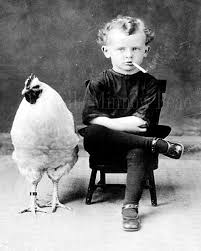
The day came for the annual family portraits, so of course Reggie was brought along to the studio. Pets were family in the Royce house. The photographer, Abe Johnson, was an old family friend and had learned years ago not to question the unusual behavior of the Royces. He set up a chair for Little Jake, who promptly fished into his pocket and pulled out a rollup cigarette and put it in his mouth before sitting down, saying  “Don’t want to crush it, you know, Abe? Got a light?”

Abe was unsure what to wonder about first – the fact that this toddler had a cigarette, it looked like he rolled it himself, or that he was being called by his first name by a four-year-old.

Was the problem simply that he acted like he was an adult, or was it something more? It was all too much. Maybe was time to retire. Or maybe it was time to talk to the matriarch of the Royce clan. “Being free” was a great concept until it got weird. Maybe she didn’t know how “free” her great-grandchild was being raised. Could be that his parent’s trust fund needed to be tightened up. Maybe they’d stop living in La-la land if they had to pay their own bills for change.

Abe always said that it did no good to children to give them a free ride in life. He was all for sparing the rod but not for spoiling child. A child with no direction and no boundaries wasn’t any good to himself or anybody else.

Just as Abe released the shutter, the startled chicken released a loud squawk and an even larger splat of poop on the studio floor.  Little Jake looked at the chicken, then at the horrified look on his parent’s faces, and decided that this chicken thing might just work out after all.

Time to make art?

People sometimes ask how long a piece I made took. This usually is in reference to beaded jewelry, but I soon expect it to happen for my collages. I’ve not been creating in that manner as long, and I’ve not started to try to seriously sell them, so I’ve not had this happen yet.
Why does it matter how long something took to make? Does that devalue it if it didn’t take the artist very long? Does it mean that it should cost more if it took more time?
How long does it really take? When do you start the clock? When you first had the idea? When you bought the materials? When you started putting paint or ephemera onto the canvas? Or does it start before that – with classes and study, learning how to use the materials?
There have been plenty of times when I’ve realized that the only way I could have learned how to make the piece I just did was to have made the twenty other ones that the potential customer does not see. Sure, this one took two days to make. But in reality, it took two years of trial and error to learn how to do this in two days.
If a necklace took twenty minutes to make, does that mean that it shouldn’t cost $45, because you only make $15 an hour? What if the same customer would spend $30 on a meal that took ten minutes to cook?
Food is a good analogy – the raw ingredients have to be raised or grown or processed (chicken, asparagus, pasta). All of these things take time and skill – before you even get to cook them into a meal. Learning how to cook takes time and a lot of practice.
Making art is the same. The materials used have to be created and / or purchased. The expense (time and money) involved in just the materials alone must be considered, as well as the time it took to learn how to prepare it.
Perhaps artists should start saying the real time it took, starting with when they first had the idea for that piece or bought the first supply that was used. or when they first learned a technique they used in that piece. In some cases, that would be 20 years for me.