Crucified between two criminals
They made their way to Golgotha (which means “Skull Place”). It was late morning by this point. There were two criminals who were crucified that same day along with Jesus. There was one on either side of him. This fulfilled the scripture which said “He was counted among the outlaws.”
Jesus said “Father, forgive them, because they don’t know what they are doing.” They offered him bitter wine with an anesthetic called gall in it but he refused to drink it after he tasted it.
Pilate had the charge against him mounted above him and written in Greek, Latin and Hebrew. It said “This is Jesus the Nazarene, the King of the Jews.” Many Jews read the sign because Golgotha was near the city. The chief priests said to Pilate “Don’t write that he is ‘the King of the Jews’, but that ‘he claimed to be the King of the Jews’.” Pilate replied, “I have written what I have written.”
Four soldiers took Jesus’ clothes when they crucified him, dividing them between them. They decided to cast lots for his tunic because it was woven as one piece, without seams, so they didn’t want to tear it up. In doing this they fulfilled the scripture that said “They divided my clothes among them, and they cast lots for my clothing.” The soldiers then sat down there to guard him.
The passers-by were yelling insults at him, shaking their heads and saying “You said you would demolish the Temple and rebuild it in three days!? Save yourself by getting off that cross if you are the Messiah!”
Likewise, the chief priests and scribes were mocking him among themselves and saying “He saved other people but he can’t save himself! Let the ‘Messiah’, the ‘King the Jews’, save himself now so we can see and believe in him! He said that he is God’s son. If God loves him, then let God rescue him!”
One of the criminals being crucified alongside Jesus also began to mock him, saying “Save yourself and us if you’re the Messiah!” But the other criminal rebuked him, saying “Don’t you have any fear of God since you’re being punished in the same way? We deserve to be punished like this for the things we’ve done, but this man is completely innocent.” Then he added “Jesus, Lord, think of me when you come into your kingdom.” Jesus replied “Truly, you will be with me today in paradise.”
MT 27:33-44, MK 15:22-32, LK 23:32-43, JN 19:17-24
Jesus’ provision for his mother
Jesus’ mother, along with Mary Magdalene and his aunt Mary (who was the wife of Clopas), were standing by his cross. When Jesus noticed his mother standing with the disciple he loved, he said “Woman, here is your son.” To the disciple he said, “Here is your mother.” From that point on the disciple made her a part of his family.
JN 19:25-27
Jesus dies
Darkness came over all the earth from noon until three. Jesus knew that all the Scriptures had been fulfilled at this point. Around three pm he yelled out “Eloi, Eloi, lema sabachthani?” which means “My God, My God, why have you abandoned me?”
The people standing by thought he was calling out for Elijah. Jesus then called out, saying “I’m thirsty!” Someone ran to get a sponge, soaked up some sour wine that was in a nearby jar, and put it on a long hyssop reed to hold up to his mouth so he could drink. Another person said “Let’s wait to see if Elijah comes to rescue him!”
After Jesus had some of the wine, he said with a loud voice “Father, I entrust my spirit into your hands. It is finished!” He bowed his head, breathed his last, and released his spirit.
Suddenly the curtain that separated the Holy of Holies from the rest of the sanctuary ripped in half from top to bottom. The earth shook, rocks broke in half, and the tombs of the dead were broken open. The bodies of the righteous were raised from the dead. They left their tombs after Jesus was resurrected and walked to Jerusalem, where many people saw them.
The centurion and the soldiers who were guarding Jesus saw all that had happened and were terrified. They said “This man really was the Son of God!” The crowd that had gathered to watch the spectacle went home, striking their chests in grief after they witnessed the events.
MT 27:45-54, MK 15:33-39, LK 23:44-48, JN 19:28-30
Women with him
Many women were there who had followed and helped Jesus from when he was in Galilee. They were watching the crucifixion from a distance. They included Mary Magdalene, Mary who was James and Joseph’s mother, Salome, and the mother of James and John (the sons of Zebedee). Many other women had traveled with him up to Jerusalem.
MT 27:55-56, MK 15:40-41, LK 23:49
Jesus’ side pierced
The Jews didn’t want the bodies to stay on the cross through the next day because not only was it the Sabbath, but it was also the first day of Passover. They asked Pilate to have the men’s legs broken to hasten their death so that their bodies could be removed before the Sabbath began. The soldiers came and broke the legs of the two men who had been crucified alongside Jesus. They saw that Jesus was already dead when they came to him, so they did not break his legs. However, a soldier used a spear to pierce his side and blood and water immediately flowed out.
The one who saw this has told you this so that you might believe. He speaks the truth and is convinced that what he is saying is true.
These things fulfilled the Scriptures that say “None of his bones will be broken” and “They will look upon the One they have pierced.”
JN 19:31-37
The burial
Joseph, a wealthy man from Arimathea in Judea, came to Golgotha in the evening. He was an important member of the Sanhedrin who had not agreed with what they had decided to do about Jesus. He was also a righteous man and secretly one of Jesus’ followers. He looked forward to the coming of the kingdom of God.
He boldly approached Pilate to claim Jesus’ body. Pilate agreed to his request once he learned from the centurion that Jesus had already died. He was surprised that he had died so quickly.
Joseph removed Jesus’ body from the cross and wrapped it with fine linen he had bought. Nicodemus (the Pharisee who had earlier come at night to secretly talk with Jesus) was also there and he brought a large mixture of myrrh and aloe. They used it along with the linen to prepare Jesus’ body in accordance with Jewish burial customs.
Joseph placed the body in an unused tomb that was cut into the rock in a nearby garden. They did this because they did not have time to fully prepare the body because the Sabbath was quickly approaching. Joseph rolled a large stone over the entrance and then left.
Mary Magdalene and Mary the mother of James and Joseph were seated nearby, watching where the body was placed. They returned to where they were staying and prepared spices and perfumes for the body. Then they rested, because it was the Sabbath.
MT 27:57-61, MK 15:42-47, LK 23:50-56, JN 19:38-42
The closely guarded tomb
The next day the chief priests and Pharisees assembled before Pilate and said “Sir, we remember that while that liar was alive he said ‘I will rise again after three days’. Therefore, we request that you give orders for the tomb to be secured until then. If not, his disciples may steal his body and tell everyone that he has been raised from the dead. If they do that it will make a bad situation worse.”
Pilate told them to use some soldiers as a guard saying “Go make it secure in the best way you know.” Then they left and secured the tomb by putting a seal around the stone and posting guards.
MT 27:62-66
Resurrection morning
Mary Magdalene, Mary the mother of James and Joseph, Joanna, and Salome went to the tomb while it was still dark on the first day of the week, after the Sabbath had ended. They brought the spices and perfumes they had prepared to anoint the body. They were wondering among themselves how they would roll back the stone that was covering the entrance to the tomb.
An angel of the Lord suddenly descended from heaven, causing the earth to shake. He rolled back the stone door and then sat upon it. He shone with a brilliant light and his robe was snow-white. The guards were paralyzed with fear when they saw him. The women bowed down to the ground, amazed and terrified.
The angel said to the women “Do not be afraid! I know that you are looking for Jesus of Nazareth, who was crucified. Why are you looking among the dead for the living? He is not here – he has been resurrected! Remember how he told you when he was in Galilee that the Son of Man would be betrayed into the hands of sinners, be crucified, and will rise on the third day?” Then they remembered that Jesus had said this.
The angel continued, saying “Come and see where they put him. Go quickly and tell his disciples ‘He has been raised from the dead. He is going ahead to Galilee – you will see him there, just as he said.’ Make sure you tell them this.”
The women, trembling with amazement and alarm, ran from the tomb to tell the other disciples the news.
MT 28:1-8, MK 16:1-8, LK 24:1-8, JN 20:1
Mary Magdalene and the other women see Jesus
Mary saw a man in the garden not far from the tomb. She assumed he was the gardener. He was Jesus, but she did not recognize him. When he said “Mary”, she instantly knew who he was.
“Teacher!” She exclaimed, reaching for him.
He cautioned her, saying “Don’t hold on to me, because I haven’t yet gone up to my Father. But go and tell my brothers that I am ascending to our Father – mine and yours. I am leaving for Galilee, have them meet me there.”
The other women saw him as well, and they held his feet and worshipped him.
The women reported to the disciples on all that had happened and relayed the message from the angel and Jesus to travel to Galilee, yet they didn’t believe them. The disciples thought they were making up the story.
MT 28:9-10, MK 16:9-11, LK 24:9-11, JN 20:14-18
Peter and John go to the tomb
Peter and John ran to the tomb. John outran Peter and got there first. He stooped down to look into the tomb and saw the linen cloths, but he stayed outside. Then Peter arrived and went inside the tomb. He saw the linen cloths for the body along with the linen that was used to wrap Jesus’ head folded up and separate from the rest.
John, who had gotten there first, entered the tomb after Peter and when he saw the linen cloths he believed. At this point they still did not understand the Scripture that said Jesus must rise from the dead. Then the disciples returned home.
JN 20:3-10, LK 24:12
The soldiers are bribed to lie
While the women were returning to the disciples, the soldiers who had been guarding the tomb reported what had happened to the chief priests. The priests met with the elders to decide what to do. They gave the soldiers a lot of money and told them “Say ‘His disciples stole his body while we were sleeping.’ If Pilate hears about this we will handle it and cover for you.” The soldiers took the bribe and did as they were told. This story has been repeated among the Jews to this very day.
MT 28:11-15
On the road to Emmaus
The same day, two of Jesus’ followers were on the way to a village named Emmaus. It is about seven miles from Jerusalem. They were discussing everything that had happened while they were walking. While they were talking and arguing, Jesus began to walk along with them but their eyes were prevented from recognizing him. Jesus asked them, “What are you two arguing about on your way?” They stopped walking and looked dejected.
Cleopas answered, “Are you the only person visiting in Jerusalem who hasn’t heard the news?”
“What news?” Jesus asked.
They said “All the news about Jesus of Nazareth, who was a prophet that was powerful in word and deed before God and everyone, and the fact that our own Temple priests and leaders handed him over to the civil authorities to be sentenced to death and then crucified. We had hoped that he was the promised Messiah who had come to liberate Israel. In addition to all of this, three days have passed. Also some of the women in our group told us something amazing. They went out early in the morning to the tomb and didn’t find his body there. They told us that they had seen an angel who said he was alive! A couple of people from our group went to the tomb to check and found it as the women had said, but they didn’t see him.”
Then Jesus said to them “How slow you are to believe everything the prophets said was to happen! Didn’t they clearly say that the Messiah had to endure everything that has happened before entering into his glory?” Then he began telling them everything that the Prophets had said about him, starting with Moses and going through all the Scriptures, explaining what everything meant.
By this time they were almost to Emmaus and the end of their journey. Jesus gave the impression that he had further to go, but they urged him to stop for the evening because it was so late. So he went in with them to where they were staying.
While he was reclining at the table to eat, he took the bread, gave thanks for it and broke it, and then gave it to them. Suddenly their eyes were opened and they recognized him but then he immediately vanished before their eyes. They began to discuss this, saying “Weren’t our hearts full of fire while he was explaining the Scriptures to us on the road?” They immediately returned to Jerusalem and found the rest of Jesus’ followers who told them “The Lord is risen! He has appeared to Simon!” Then the two who had returned from Emmaus began to share what had happened to them and how he had revealed himself to them while breaking bread.
LK 24:13-35, MK 16:12-13
Jesus appears before them
That same evening, the disciples were all together behind locked doors because they were afraid of the Jewish authorities. Jesus suddenly appeared among them saying “Peace to you!” They were terrified, convinced that they were seeing a ghost.
“Why are you upset?” he asked. “Why do you doubt that I’m real? Look at my hands and feet. Touch me and know for sure that I’m real. A ghost doesn’t have a body like I do.” He then held out his hands and feet for them to look at. Even though, they still had a hard time believing that he was really there because they didn’t dare believe it was true. He then asked if they had something to eat, so they gave him some broiled fish and a piece of honeycomb, and he ate it while they watched.
Then he said “Here is what I told you before, about how everything written about me in the Scriptures must come to pass.” He then opened their minds so they could understand the Scriptures. He then said “It was written that the Messiah must suffer and then rise from the grave on the third day, and there would be repentance and forgiveness of sins declared in his name, beginning in Jerusalem and spreading to the whole world. You are all witnesses of these facts. Behold, I will send to you what my Father promised. But for now, stay here in Jerusalem until you receive that heavenly power.”
LK 24:36-49, MK 16:14, JN 20:19-20
The great commission
The 11 disciples went to Galilee, to the mountain where Jesus had directed them. They worshiped him when they saw him there. Then Jesus approached them and said “Peace to you! My Father has given me authority over all the earth and heaven. As my Father has sent me, so I send you.”
Then he breathed on them, saying “Receive the gift of the Holy Spirit. If you forgive anyone’s sins, they are forgiven. If you do not forgive their sins, they are not forgiven. Go preach the gospel and disciple everyone throughout the world, baptizing them in the name of the Father, the Son, and the Holy Spirit, instructing them to follow everything I have commanded you to do. Anyone who believes and is baptized will be saved, but anyone who does not believe will be lost.
These signs will follow believers – they will cast out demons in my name, they will speak new languages, they will handle snakes and not be harmed if they drink poison, and the sick will be healed when they lay hands on them. Look! I am always with you, to the end of this era.”
MT 28:16-20, MK 16:15-18, JN 20:21-23
Doubting Thomas
Thomas, the disciple known as “Twin” was not with the others when Jesus appeared before them. They kept telling him “We have seen the Lord!” He kept saying “I’ll never believe unless I see the nail marks in his hands with my own eyes and touch them with my own fingers and put my hand into the spear wound on his side!”
Eight days later the disciples were again indoors, but this time Thomas was with them. The doors were locked, but then Jesus suddenly stood among them, saying “Peace to you!”
Looking at Thomas, he said “Look at my hands – touch them! Put your hand into my side as well. Don’t be without belief – be a believer!”
Thomas replied “My Lord and my God!”
Jesus said “Have you believed only because you have seen? Blessed are those who believe without seeing.”
JN 20:24-29
John’s commentary
The disciples saw Jesus perform many other signs that are not recorded here, but these which have been included are written so that you will believe that Jesus is the Son of God, the Messiah, and that through this belief you will have life in his name.
JN 20:30-31
Jesus appears on the shore
Jesus also revealed himself to his disciples by the Sea of Galilee. This is what happened: Simon Peter, Thomas, Nathanael from Cana of Galilee, James and John (Zebedee’s sons) and two other disciples were together. Peter announced “I’m going fishing.” The rest of them decided to go with him. They caught nothing that night.
At daybreak, Jesus stood on the shore, but they did not recognize him. He called out to them, saying “Boys, don’t you have any fish?”
“No,” they replied.
He said “If you cast your net on the right side of the boat, you’ll find some.”
They cast their net as he said, and the net was so full of fish they were unable to haul it in. John, the disciple Jesus loved, said to Peter “It is the Lord!”
When Simon Peter heard this, he tied his tunic around him (he was bare-chested) and jumped into the sea to swim ashore. The other disciples decided to steer the boat ashore instead, since it was only about a hundred yards away. They dragged the net full of fish with them.
When they came ashore they saw a charcoal fire with fish cooking over it, along with some bread. Jesus said to them, “Bring over some of those fish you just caught.” Simon Peter got up and dragged the net ashore. It was full of large fish – 153 of them – but even though there were so many fish, the net did not tear.
Jesus invited them to have breakfast with him. None of them were brave enough to say “Who are you?” to him. They all knew it was Jesus. He then served them the bread and fish.
This was the third time he had revealed himself to his disciples after he had been raised from the dead.
JN 21:1-14
Feed my sheep
After they ate breakfast, Jesus asked Peter, “Simon, son of John, do you love me more than the others?”
“Of course, Lord,” Peter replied. “You know that I love you.”
“Feed my lambs.” Jesus said.
Then a second time he asked, “Simon, son of John, do you love me?” Peter answered “Yes, Lord. You know I love you.”
“Shepherd my sheep.” Jesus said. Then Jesus asked him for the third time, “Simon, son of John, do you love me?”
Peter was upset and even a little sad that Jesus had asked him three times if he loved him. He said “Lord, everything is revealed to you! Surely you know that I love you.”
“Feed my sheep.” Jesus said. “Listen to me closely. When you were young, you could do anything you wanted to do however you liked, but when you grow old you will reach out your hands and others will take you where you don’t want to go.” In saying this, Jesus indicated how he would die that would glorify God.
Then after saying this he said to Peter “Follow me!”
JN 21:15-19
What about him?
Peter noticed John, the disciple Jesus loved, following along behind them. That was the same disciple who had leaned in and asked Jesus at the supper which one of the disciples was going to betray him. Noticing him, Peter asked Jesus “What will happen to him, Lord?”
Jesus replied “If I want him to stay until I come again, what concern is that of yours? Your task is to follow me.”
So this message spread throughout the community of believers that John would not die. Yet Jesus did not say that, but only “If I want him to stay until I come again, what concern is that of yours?”
JN 21:20-23
John’s epilogue
This disciple is the one who speaks the truth about these events and who wrote them down. We confirm the truth of his testimony.
Jesus did many other things which were so numerous that, if they were written down, would fill up so many books that I believe there wouldn’t be enough room for them throughout the whole world.
JN 21:24-25
The Ascension
Jesus led his disciples near Bethany. He lifted his hands up and blessed the disciples. During his blessing, he rose up into the heavens and went to sit at the right hand of God.
The disciples spoke words of praise and worship and then returned to Jerusalem, overflowing with joy.
When they weren’t blessing God in the Temple complex, they preached the message of Jesus everywhere they went. The Lord worked with them and confirmed their message by the accompanying miracles.
MK 16:19-20, LK 24:50-53
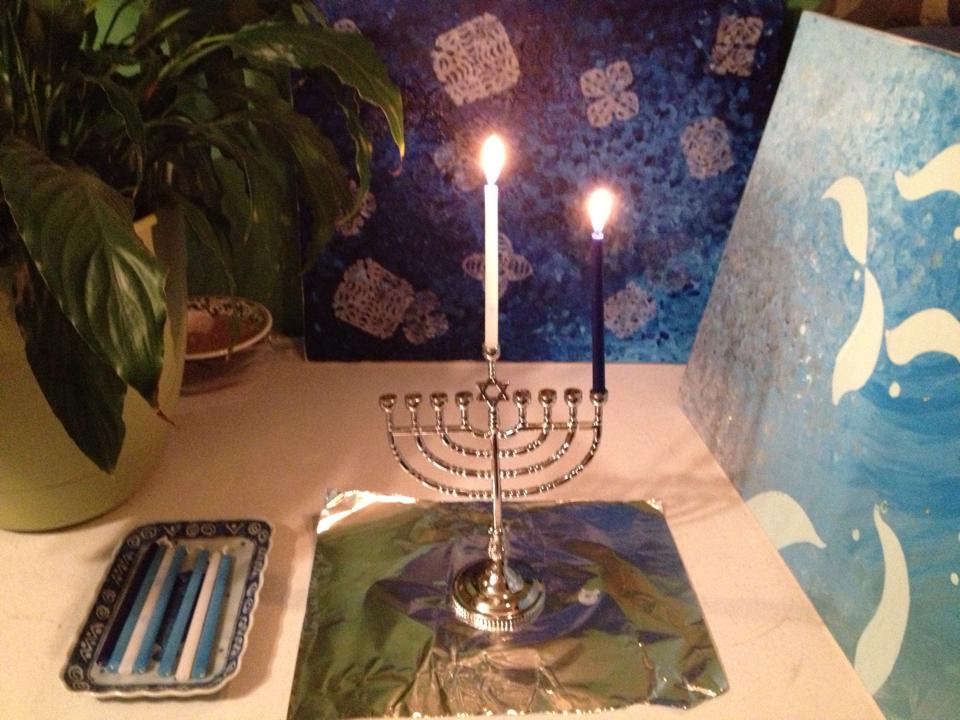 (the lights from the first night of Chanukah)


 betsybeadhead
You must be logged in to post a comment.