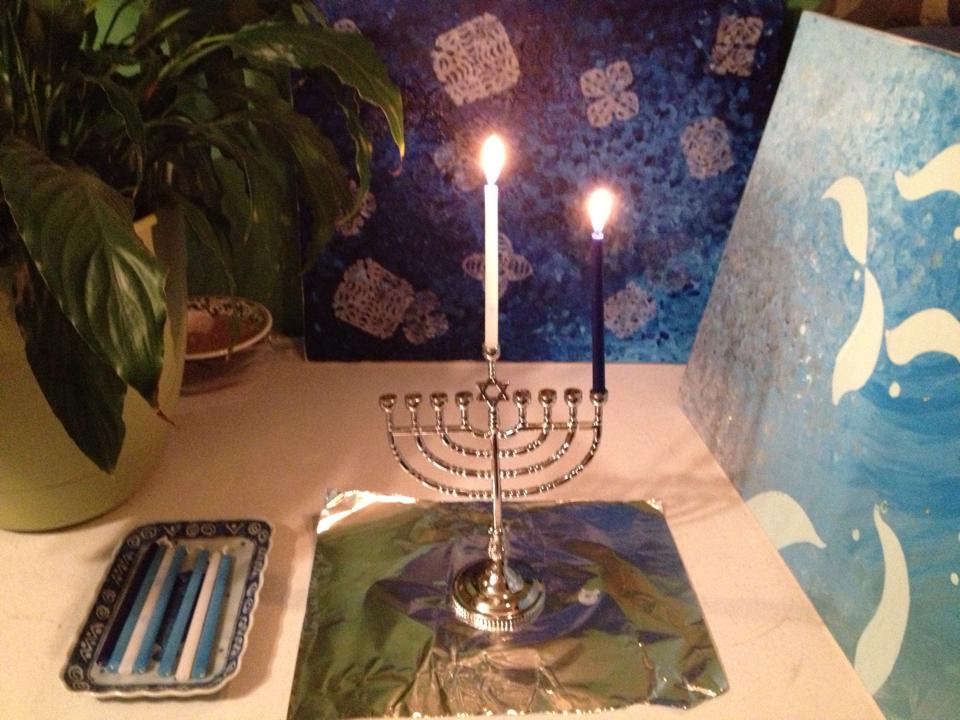
The Chanukkah gift

Chanukah1 (the lights from the first night of Chanukah)

I learned something on the second night of Chanukah.
I learned to trust that God will provide.

I have a small box of Chanukah candles that I bought last year on clearance. That was the first year that I have lit Chanukah candles. If I did it the normal way, by the time the whole thing is done the entire box would have been used. That is 44 candles. That seemed really wasteful.

What I did instead that first year was to light them and say the prayers, let them burn for maybe ten minutes and then I’d blow them out. I’d use the same candles over and over, so over the course of the holiday this meant that the candles were different heights and looked very odd. There was a definite slope downward to the right where the first night’s candle was, which had been burned the most.

This year I learned that not only are the candles supposed to burn for at least 30 minutes, but the woman of the house is not supposed to work for those 30 minutes. I’m not one for sitting still, so I decided to dedicate that time to making 4 x 6 collages.

I’d started making these this year and posted some here, but got out of the habit of assembling them. I’d taken the time to cut out and sort words and pictures already, so I really have no excuse. The funny thing is that so many of my craft projects are like “There’s a hole in the bucket” song – where in order to do one part, I have to do another part, and I have to do yet another part to get to that part. So sometimes I don’t do anything at all. I’m learning to break up the projects into small bits so that I feel that I’ve gotten something done. Since I already have all the pieces, it is easy to do at least two of these while the candles burn.

This year, while making the collages, I looked at the candles on the second night and saw how lopsided they looked already after letting them burn the longer time the first night. I got up and blew them out.

And then I thought about it. Part of what is celebrated in Chanukah is the miracle that the oil that was supposed to only last for one day lasted for eight. They needed to rededicate the Temple after it had been desecrated, and didn’t want to wait. It took eight days to make more oil, but they knew that it was too important to delay. They lit the light anyway, and God made it last long enough until the new oil was ready.

It is about trusting that God will provide for our needs.

Why was I being so guarded about these candles, only letting them burn for a little bit? I got them on sale, after all. Even before that, they cost $7. I can buy another set next year. They’ll make more.

Things are tight right now, with my husband out of a job, but even before that I’ve lived like a pauper most of my life. I was raised poor. Not having much is my normal. Worrying about future finances was part of my training.

We are comfortable, but not set by any means.

But God is using these candles to teach me something important.

I relit the candles and watched them, delighting in their cheery light.

I don’t think God wants us to be wasteful – certainly not. I think that God wants us to be good stewards of what we are given.

What does Jesus teach us?

Jesus tells us in the story of the loaves and fishes that God can make the little we have much more. We have to give thanks first, and we have to give what little we have away. This isn’t about making more money and hoarding it.

Jesus tells us in the story of the ten talents that we have to use what we are given. God gives us resources (as they said in my previous church – “time, talent, and treasure”) to use them for God’s glory, not our own, and not to hide away.

Jesus tells us to not worry about anything, that God provides for the least of the creatures, so surely God will take care of us.

So this was the gift that God gave to me – to trust, and not be afraid. To not think that I have to do it all. To remember that everything comes from God, and God can do anything.

Poem – terrorist incident

How about we agree
that any time a person
willfully attacks
another person
it is an act of terror,
regardless of the color
of the people involved?
Regardless of politics or creeds,
regardless of belief,
regardless?

If a person attacks another person
with a gun,
a bomb,
a knife,
it is a terrorist act.
They are trying to terrify,
to instill terror,
plain and simple.

How to play the Dreidel game at Chanukkah

The traditional Chanukkah dreidel is a reminder of the times when the armies of King Antiochus controlled the Holy Land. This regime passed a series of laws making it illegal to study or practice Judaism. The Jews decided to do their Torah learning secretly in outlying areas and forests. The children brought along small tops to pull out and play with after hiding their texts, so that they could pretend to be playing games instead of studying if a patrol came by.

Playing the dreidel game reminds us to always be true to our faith even when it is dangerous. This is a valuable thing to remember for all faith traditions.

Here’s how to play the dreidel game –

Things you need –

1 Dreidel (or several to speed up the game play)
2 or more players
The “Ante” Chocolate coins, nuts, or pennies, for instance.
A flat surface to spin the dreidel on, such as a table top or floor.

A platter of Latkes (hash browns) and/or Sufganiot (jelly doughnuts) add to the fun. Fried foods are part of the holiday. They commemorate the miracle of the one small jar of oil lasting eight days during the re-dedication of the Temple.

1. All players sit around the playing area.
2. All players get an equal amount of the “ante”
3. To choose who goes first, everyone takes a turn at spinning the dreidel. The one with the highest spin has first turn. (Nun is highest, then gimmel, hey, and shin.) Spin again if there is a tie.
4. Everyone puts one unit of the ante (Chocolate coin, penny, etc.) into the pot. (A bowl is useful for this)
5. Player A spins the dreidel and does the appropriate action according to the result.
6. The play proceeds to the left.

Nun looks like נ
It stands for the Yiddish word nul, which means nothing.
Take nothing from the pot.
This letter also refers to the Hebrew word “nes” – which means “miracle”.

Gimel looks like ג
It stands for the Yiddish word gantz, which means whole.
Take everything in the pot.
This letter also refers to the Hebrew word “gadol” – which means “great”.

Hay looks like ה
It stands for the Yiddish halb, meaning half.
Take half of what is in the pot.
This letter also refers to the Hebrew word “haya” – which means “happened”.

Shin looks like ש
In Yiddish, Shin is for shenk, which means give.
This means put one item from your ante into the pot.
This letter refers to the Hebrew word “sham” which means “there”.

These four letters together are an acronym for the sentence “nes gadol hayah sham” which means “a great miracle happened there.”

In Israel, the letter “shin” is replace with a “pey” פ – which refers to the Hebrew word “po” – meaning “here” , saying “A great miracle happened here.”

May we all be ready to receive miracles at all times and in all places.

Poem – In the winter, we can see

In the winter,
we can see the bones of things.
We can see the true shapes
of the trees.
We can see where the birds
have made their homes.
We can finally see
the river that nourishes both,
that sustains.

In the winter,
we know what is what,
without any pretense,
without any show.
No more padding,
no more guile.
In the winter,
you know where you stand
and what you have
to work with.

It is like this in our lives
when the storms tear down
our defenses,
our walls,
our artifice.
Only when we have nothing
do we see what we really have
to work with.
Only when the tornado has come through,
the divorce is final,
the tragically died has been buried,
do we see what we really have,
what is our foundation.

Who knew?
We might have been building
all our hopes
on something frail,
something false.
We might have been
pinning our dreams
on something as insubstantial
as the morning mist.

It is a gift, this stripping away.

A list of books about Judaism

Here is a short list of books that would be useful to anyone who is interested in learning more about Judaism, especially if they are Christian. They are in no particular order.

Menorahs, mezuzas, and other Jewish symbols by Chaikin, Miriam

The book of letters : a mystical alef-bait by Kushner, Lawrence

God was in this place and I, i did not know : a spiritual encounter : Genesis 28:16 by Kushner, Lawrence

The book of words by Kushner, Lawrence

The book of miracles by Kushner, Lawrence

Living Jewish life cycle by Milgram, Goldie

Jewish ritual by Olitzky, Kerry M

Reclaiming Judaism as a spiritual practice by Milgram, Goldie

Traditions : the complete book of prayers, rituals, and blessings for every Jewish home by Shendelman, Sara

How to run a traditional Jewish household by Greenberg, Blu

Jewish living: a guide to contemporary reform practice by Washofsky, Mark

The Jewish home : a guide to the Jewish holidays and life cycles by Syme, Daniel B

Honey from the rock : an introduction to Jewish mysticism by Kushner, Lawrence

And here’s small selection of Jewish movies that might be useful –
Ushpizin
Arranged
Under the domim tree