Knowing the soul

Western medicine treats the patient like a machine, not like a person. They see the body as the sum of the moving parts, but they don’t see the soul within. They don’t understand the connection between the two – they don’t understand that you can’t separate them.

But then, this is because Western society does the same.

This is the same with modern food production. Animals are treated like parts, like products. They are not treated fairly or humanely. They are not even accorded the kindness we give to pets that live outside. They are treated as a commodity. Their physical needs are barely met, and everything else is ignored.

This started with women and birth. Women used to give birth at home. Then it changed so that women were expected to give birth in a hospital. Birth stopped being a private thing, a personal thing. It started to become as impersonal as possible. Strangers assisted your mother when you were born. Strangers took you away from her just after. You were just another baby in a bassinet. They had to put a nametag on your arm to make sure that you didn’t get mixed up with the other babies who were there. It wouldn’t do any good to send you home with the wrong family, would it? If you’d been born at home, none of that would have happened.

But that is just the tip of the iceberg.

Do we look at the packaging, or at the gift inside?

Do we judge a book by its cover? Sure. All the time.

Women are judged all the time for their appearance and not their ability.

How many people do you know by name? How many people know yours? Plenty of people see me every day. Some have seen me every week for the whole time I’ve worked at the library, and they still don’t know my name. Some, if they know my name, only know the one on my name tag. They don’t know the name I like to go by. They don’t know anything about what I like to read, but they insist on recommending or even giving me books to read.

We can’t get upset about how everybody else has been doing this, and how long it has been going on. The change begins with us. We have to be the change we wish to see in the world.

We can change this. We have to stop and look people in the eyes. We have to slow down and really connect. It starts with us. It starts today. Turn off your cell phone and really connect with one other person today. Ask them how they are doing and wait for the answer. If they say “fine” and they don’t look like they mean it, ask again. Be brave. This can be someone you know or a stranger. Sometimes the people we think we know, we really don’t know at all. Sometimes we’ve been faking it with small talk all along.

It doesn’t have to be everybody you meet. Start with one. If you feel brave, try two. It is hard at first but it gets easier. Just don’t let it get so easy that you forget to really do it.

Imagine what the world will be like if we all did this, every day, for the rest of our lives? Time to start. Let’s go.
Tutoring – and the desk

Many of you may be wondering why I’ve not written about tutoring recently. We are shorthanded at work right now, so I’ve not been able to go like I normally have been. I’ve really appreciated the ability to tutor on work time. This is something that the Mayor of Nashville has made available to Metro employees. Metro schools need help, and there are a lot of Metro employees. He made it possible that if you wanted to, and if it wouldn’t adversely affect your workplace, you could go volunteer in a Metro school for an hour a week. It isn’t much, but everything counts.

We’ve been without a fifth person in my department for months. While we can get by on four, it isn’t even that sometimes. Plenty of people have been out sick so that makes it three. Sometimes one of those three is a temp, so it is more like two and a half. The new branch manager was concerned about how things were backing up on Wednesdays when I go to tutor, so she asked me to put it on pause.

There have been pauses before, and we’ve gotten through them. I’m sure it was a surprise to the students. I wasn’t able to warn them, because it was a sudden decision at work. Time is different when you are five. Patterns are just developing. I remember when I’ve had to pause before and come back I get really amazing hugs from the kids. These are different kids and they are a little standoffish. We’ll see.

I could go tutor on my time off. I’ve thought about it. I’ve done it before. While that is a good idea for the kids, it isn’t a great idea for me. Forty hours a week is a LONG time at work. It just doesn’t leave much time for doing anything else. So while they need me, and while I’d like to go, I don’t think I’ll be going on my own time.

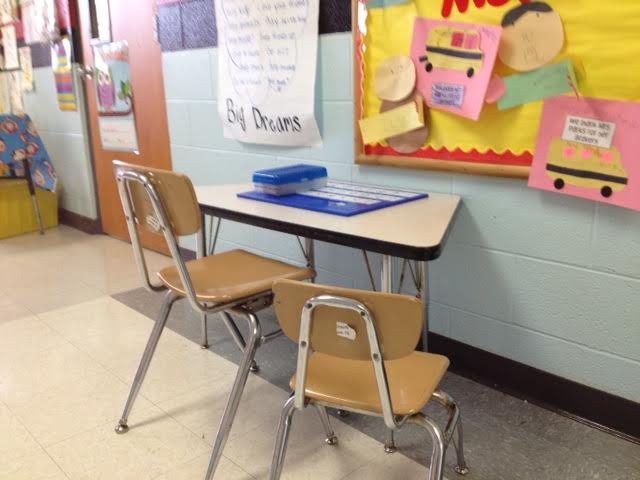
I thought I’d share this with you. It is my “desk” when I tutor.

desk

This is in the hallway just a few steps away from the classroom. There are always two chairs, one big one and one small one. I put them this way – with the big one in the center for the student, and the small one to the side for me. I know this is backwards from how it is normally done. I do it so that when we sit, we are both the same height, so we work on the projects together.

This is really important to me. This is very subtle and psychological. I don’t want them to see me as above them or better than them. I’m a tutor. I’m here to help them help themselves. I’m a guide and a cheerleader. I’m not teaching them anything. I’m showing them the assignments that we have to work on and we are figuring them out. I provide feedback and direction. But all along, they are doing the work.

Food and money

This makes absolutely no sense. I’m strictly budgeting my money by buying everything with cash. I’m cooking more, so I’m buying the groceries for the household now. We have fresh produce, most of it organic. Somehow, we are saving a lot of money and eating a lot better at the same time. It doesn’t make any sense but I’m grateful.

I’ve always been told that it was cheaper to buy prepackaged and conventional, but healthier to eat fresh and organic. I decided to start small and build up. It started with a box of organic oatmeal. Then I got some organic apples. It wasn’t much, but it was a start. Every little bit counts in health. But then I started buying organic as much as possible. I didn’t see that much difference in price. Somehow I was able to justify it even while living on a strict budget. Perhaps I eat less food. Perhaps I’m just more mindful about what I eat. I don’t know, but it seems to be balancing out. Better food and saving money – win/win.

I think part of it is that we aren’t eating out nearly as often. We have fresh food that needs to be eaten. If we don’t eat it, it goes to waste. If you are saving money, wasting food is tops on the list of dumb things to do. Somehow I’ve realized that it is just as fast to cook our own food at home rather than go out and wait for food at a restaurant. And I’ve realized that when I cook, I know what went into the food. I know the amount of butter and salt. I know if the vegetables are organic. I know that all the ingredients are the best they can be.

I’m not cooking gourmet meals, but they are tasty. I’m not following recipes really. I’m following general guidelines. I think all the time I spent watching cooking shows has helped me to understand the general idea of cooking.

I’m coming to realize that I’m grateful that I didn’t learn how to cook from my Mom. I remember one year writing in my diary that all I wanted for my birthday was food that wasn’t brown. Everything was cooked to within an inch of its life. Everything was mushy and dull. Nothing was colorful and crisp. She was from England, and her Mom had cooked all the meals to suit a man who had ulcers. Everything was thick gravies and no fresh vegetables. She even had a special rectangular steamer pot for the frozen vegetables that came in a block. The only time she cooked from scratch was when guests came over, and that wasn’t very often.

Now, I know that some of this was because of the fact that we didn’t have a lot of money when I was growing up. She had to make do with what she had. I also know that some of it comes from the time period. I remember reading a recipe from that era that said for green beans almandine, you should boil the green beans for 20 to 30 minutes, or until tender. By that time they’d be limp and grey and all the goodness would have been cooked right out of them. That was normal for our house. That was normal for a lot of people.

I remember when Mom got sick with cancer and I started cooking. I went to the grocery store and got fresh, colorful veggies for a stir fry. I remember her looking at what I was cooking in amazement. I cooked it all for just a few minutes. She looked at it and asked “Don’t you want to cook that a little longer?” I told her that no, that we could eat the vegetables raw. We were just cooking them for fun. She was unbelieving, but tried anyway. After that meal she was sold on the idea and bought me an electric wok to use to make her more.

I remember seeing a documentary about a family that said they could only afford to eat from the McDonald’s value meal. They spent so much money on diabetes and cholesterol and blood pressure medicine that they couldn’t afford to eat real food. This, sadly, is the norm for America. If we eat better, we don’t get sick. Prevention rather than cure, you know. Food has to be seen as the ultimate medicine.

It is easy to cook and eat right, and it is cheap. I didn’t believe it, but I’m doing it. If I can do it, anybody can. They just have to get started. Little steps at first. Part of it is knowing that you can. Part of it is knowing that the desire to do it is the seed. Nurture that seed and you are on your way.

Death guilt – on the relief you feel after a parent dies after a long illness.

There is a lot of guilt that comes when a loved one dies that we have taken care of. If you have been the primary caregiver, you are suddenly relieved of the majority of your duties. You duties don’t end totally – there is most likely an estate to settle – but they change. You aren’t “on duty” constantly.

There is part of where the guilt comes in. If your loved one has been sick a long time and you have been the main (or only) caregiver, you are worn out from that constant work. Sick people take a lot of attention. They are often sick at very inconvenient times. The middle of the night is a common time for things to go south. Everything is harder to deal with when you have just a little sleep. It is even harder to deal with when that has been going on for weeks. Or months. Or years.

Very few people talk about this, but there comes a time when you look forward to your loved one dying, because that means you are free to start living. It sounds cold to say this, so people will say that they want their loved one to “pass on” or “transition” so that they can be free of pain. They want that too, of course. Part of the pain of dealing with a very sick loved one is seeing them suffer and knowing there is little you can do for them other than bring them food and fluff their pillows. Death is a release and a blessing at times.

In reality, death is a release and a blessing for the patient as well as the caregiver. When the patient dies, the caregiver is now free to live. The caregiver no longer has to stay by the bedside of the sick person. She no longer has to sleep on the sofa, hurting her back. She no longer has to call in to work, using up personal leave or vacation time (if she has it). She no longer has to do double duty of taking care of her parent’s home and her own.

There is something to be said for having families live together. The more the nuclear family explodes into satellite units, the more problems are created when a member needs help. Also, why have three households who have to buy three sets of lawn equipment, when you can have one big one that shares? I wonder if this is part of the “commune” idea. Instead of having friends living communally, start at the source and have families live that way. But I digress.

Sometimes the reason children leave the household as soon as they can is because they don’t really like their parents. Just because someone is your parent doesn’t mean that he is a good person. Becoming a parent isn’t the same as being an adult or a mature person. Sometimes “parent” just means someone who has reproduced. The parent is little more than a maladapted child himself.

Our society doesn’t speak about this very much. We laud parents. We think that parents are all knowing and all powerful. They aren’t. Nothing magical happens when they have a child. They don’t suddenly stop being neurotic or needy. In some cases their problems just get deeper and darker. So when such a parent-person gets sick enough to need help, the child is conflicted. They are expected by society to help. They are expected to drop everything and take care of their sick or dying parent. The only problem is that the abuse that the child received is often never revealed. Sometimes even the child is not aware of how mistreated she was. She just knows deep in her gut that she doesn’t want to take on this task. It isn’t because she is selfish.

It is a double bind. The child was taught her whole life to serve the parent. She was taught that she deserved to be treated badly. She was taught that her own needs didn’t matter. So when the parent is terminally ill, the child is expected to drop everything to take care of him. Then she feels conflicted.

It is hard enough to take care of a really sick person. Nurses have training for this. The average person does not. You don’t just wake up with the know-how to be a competent caregiver. When that sick person is your parent it is extra hard. When that parent was abusive it is nearly impossible.

When your parent is very sick, you have to become the parent. You are in charge. There aren’t classes for this. We don’t talk about this in Western society. I’m not sure any society talks about this, but I know this one sure doesn’t. But Western society rarely talks about anything real anyway.

For years, the child is subservient. Even if the child has become an adult and has a family and household of his own, he is expected to defer to his parents. That role never stops unless he establishes boundaries. The only problem is that there isn’t training on this, and there isn’t a lot of social support for it. If his parents die before he has established these boundaries and stood his own ground, he has a lot of ground to make up.

Even if none of this is going on, even if the relationship is healthy and sound, there are conflicting feelings when the parent dies. One of those feelings is relief, but that feeling alone causes guilt. You aren’t supposed to feel relief when your parent dies. You are supposed to be sad. Often you are sad. Sometimes you are angry too, at them having left you. Sometimes you are frustrated about all the mess they left you to have to clean up. But sometimes it is relief, because it is a lot of hard work taking care of a sick parent. Sometimes it is relief because now for once you can live your life your way without being second guessed by your parent.

It is healthy to feel whatever you feel when your parent dies, regardless of what you feel. Your feelings are yours, and they are valuable. If they have died after a long illness where you were the caretaker, your feelings will be even more complex. Don’t ignore those feelings, and don’t feel embarrassed or ashamed. They are natural. It is healthy to feel them and express them. You may not have heard other people talk about the relief they felt because they thought they shouldn’t talk about it – but it doesn’t mean you are alone. Sometimes just sharing this feeling with others who have been in a similar situation is very healing. This is why I’m sharing this with you.

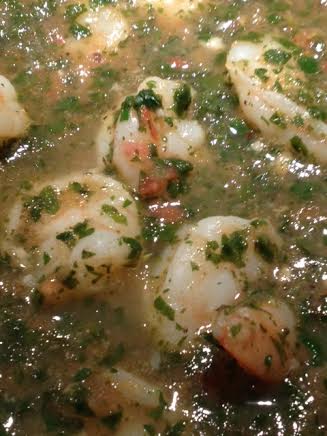
Shrimp Italian-ish

italian shrimp

Ingredients –

1 tablespoon butter

1 tablespoon minced garlic

1/2 tablespoon ground mustard

3 tablespoons dried Italian seasoning blend

3 tablespoons dried parsley

Pinch of salt

A pound of shrimp, no shell or tail.

1 large “ugly ripe” tomato or similar meaty tomato.

1/2 bunch fresh cilantro.

Half a cup of wine (I used white Zinfandel)

Instructions –

Slice up the tomato so it will fit in the food processor. Remove the leaves from the cilantro, discarding the stems. Process the tomato and cilantro leaves in the processor until puréed. Set aside.

Put the butter in a large covered sauté pan over medium-low heat. When that has melted, add the garlic. Then add the shrimp and the dry seasonings. Stir to evenly distribute the seasonings.

Let this cook for a few minutes, then add the wine. Cook a little longer, then turn over the shrimp to cook the other side. Add the tomato-cilantro purée, stir, and cover.

Lower the heat if the mixture starts to bubble.

Allow to simmer for about five minutes or until the shrimp is done (when it turns opaque). Do not overcook the shrimp or it will be tough.

Serve over shell pasta with a glug of olive oil. Makes four servings.

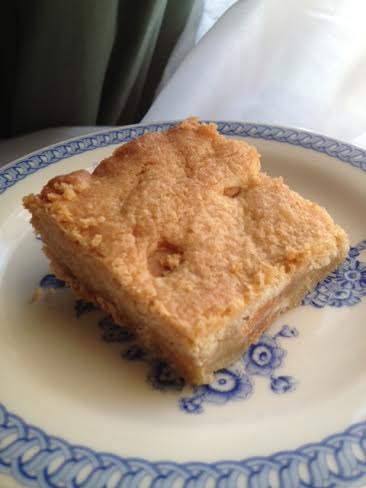
OMG Blondies

blondie

First ingredients –

1/2 cup of butter, melted (one stick)

1 cup of turbinado sugar (I use “Sugar in the Raw” brand)

1 egg, lightly beaten

1 teaspoon of vanilla

Dry ingredients –

1/2 teaspoon baking powder

1/8 teaspoon of baking soda

Pinch of salt

1 cup of all-purpose flour

1/4 teaspoon pumpkin pie spice blend

Mix-ins –

1/3 cup of butterscotch chips

1/3 cup of pine nuts (option – toast them first)

Instructions –
1 Preheat the oven to 350°F. Lightly butter and flour an 8X8 pan. Whisk together the melted butter and sugar in a bowl.

2 Add the egg and vanilla extract and whisk.

3 In a separate bowl, blend together dry ingredients – flour, baking soda, baking powder, salt and pumpkin pie spice.

4 Pour the dry ingredients into the wet ingredients, stirring together with a fork. When blended, stir in the butterscotch chips and pine nuts.

5 Pour into the pan and spread evenly. Bake for 20-25 minutes or until a toothpick comes out clean. Allow to cool. Cut into squares and serve.

Notes –
Modified from the Simply Recipes website. I added the pine nuts and the pumpkin pie spice, and substituted turbinado sugar for “tightly packed brown sugar”. I also changed it so that the dry ingredients are mixed separately.

A little poem I wrote in honor of the first batch of blondies I made –

Welcome.

You smell of warmth, and love.
You smell of home, and old school buildings.
You smell of mornings and mysteries solved.

Welcome.

Voice (of reason?)

I’ve come across several people recently who say they have something important to say. They want people to read their books or have them speak at events. The only issue is their books look like manifestos and their speeches sound like rants.

One guy writes conspiracy theory tracts. He self published a book, then cut it down to a booklet because people said it was too long to read, then kept cutting it down until now it is all on one sheet of paper, front and back, small print. I think they said it was too long to be kind. They didn’t want to read it at all. He uses a lot of capitals and bold face and italics. Visually his handouts are a mess. Even this short, it is too much.

Another guy is equally paranoid. He wants to grow everything himself because he thinks the government and then the economy is going to collapse. While it is good to be self sufficient, his level of paranoia is palpable. He talks fast and doesn’t listen to the other person’s opinions. He thinks they are deluded. He thinks he is the only person who knows what is really going on.

Another guy is trying to get himself invited as a “controversial speaker” to a local religious group meeting. He has stated that you can’t declare yourself a prophet, but then he say he is one and he is the only one talking. His “introduction” took up the whole page of the group’s homepage.

They sound crazy. They may have something important to say. Truth very well might be revealed to them. But how they are presenting it makes their message questionable.

I’ve considered telling them what I see. I’ve considered pulling them aside and handing them a clue. Nobody is going to take them seriously if they seem wackadoodle.

But then I think maybe it is for the best to not tell them.

If you put a new coat of paint on an old car, it will still run the same. If you try to sell this new looking car to someone they are going to be fooled. They will get in and drive down the road a bit and end up stranded.

I don’t want to do that to the passenger. It is important to not mislead people. Even if I’m not delivering the message, I will have aided and abetted. If I help someone repackage their message so that other people finally listen to it, I’m responsible for the fallout.

Maybe their message is crazy. Maybe that is why they seem messed up.

Survey – the questions are all wrong.

My afternoon was interrupted by a survey call a week ago. I informed the guy that I’m on a “no call list” but he told me that my opinions matter, so I went through with it. In a way I wish I hadn’t. I learned that my opinions only matter if they fit in the boxes he had to tick off his survey.

He said that the survey would only take a few minutes. When it was over, half an hour was gone. Perhaps he was lying about it taking a short time just to get me to do it. Perhaps it took so long because the questions were all wrong.

The survey was about reducing America’s dependence on foreign oil. The choices were using more ethanol or fracking.

I of course am opposed to fracking, for numerous reasons. It poisons the water supply, it harvests yet another non-renewable resource (natural gas), and the product itself is dangerous and hard to transport. Natural gas isn’t the answer, and in order to use it for our cars we’d all have to buy new ones. You can’t get more wasteful than that. What would we do with all the old ones that won’t work anymore?

But I’m opposed to ethanol too. The more land we use to grow corn for ethanol is less land we use to grow food for people. Empty stomachs rate higher than empty gas tanks.

At one point he said as part of the survey that the corn used for ethanol wasn’t the same kind of corn used to feed people – and that it was also used to feed cattle. I had even more problems with that. Cows aren’t meant to eat corn. They develop E-coli in their guts when they eat that. It isn’t how they are designed. They are meant to eat grass. But then, that isn’t even the point. Again, there is a distraction there. The more meat we eat, the more unhealthy we are. Skip the whole issue about feeding corn to cows. Skip the cows entirely.

See my frustration? No matter what he said, it was wrong.

So, what about ethanol? It isn’t oil. We would reduce our “dependence on foreign oil” and “become more independent” as he said. Ethanol isn’t an efficient fuel. For many older model cars, just using it voids the warranty. It is a cheap filler.

So from my perspective, he was asking the wrong questions. Really, if we want to become less dependent on foreign countries by our need for oil, we need to stop using up so much energy.

My husband takes the train or the bus to work. Mass transit is more efficient. It is better to use one vehicle to take forty people to work than forty vehicles. When the weather is nice he takes his bike. As for me, I bought the house close to work. It is a short drive. Not only am I saving fuel, but time.

Both of us fill up our gas tanks only once a month. It isn’t everything. Everything would be not using gasoline at all. Because of how American neighborhoods are laid out, that is nearly impossible. The grocery store is too far away to bike to and get everything. We drive as little as possible, being mindful of combining errands and catching rides with friends if we are going to the same events.

It is something, and something counts. We are reducing our use.

Better than that, we as a culture need to start using renewable resources. Solar. Wind. Water. Oil and natural gas will be used up. Probably not in our lifetime, but does that matter? We need to think about future generations. What are we leaving our children, and their children? An empty husk of a planet? We had the party and left them the mess to clean up.

The guy administering the survey was just reading off the script. I had a hard time with them because they weren’t the right questions. If the choice is get more oil or go for more ethanol or go with fracking, it is still wrong. I argued with the questions in my frustration. There simply wasn’t a way to answer the questions the way he was asking them. I could tell he was trying to shoehorn me. I kept questioning. I kept getting frustrated.

I doubt I woke him up. I doubt he was even listening to what I was saying, because I wasn’t really answering his questions. The call “was being monitored for quality assurance purposes”, but even then I doubt I was able to wake the monitor up and make him think. I’m pretty sure they think I’m another quack who just doesn’t understand the questions. The problem is that I understand them too well.

I’m pretty sure my answers are being tabulated and calibrated and measured and made to fit whatever theory they had before they even started calling people. Surveys don’t prove anything. If you know what you are doing, they can mean anything you want them to.

I wish I’d not even talked to him. I feel like I wasted my time. I feel like my personal space was invaded for half an hour. To let someone talk mindlessly at you on the phone is just as invasive as letting them in your house. It is all space.

Baking with Jesus

When I bake banana bread, I think of Jesus. I remember him saying this in Luke 6:37-38 –

37 “Do not judge, and you will not be judged. Do not condemn, and you will not be condemned. Forgive, and you will be forgiven. 38 Give, and it will be given to you; a good measure—pressed down, shaken together, and running over—will be poured into your lap. For with the measure you use, it will be measured back to you.” (HCSB)

Only somebody who has measured out flour would talk like this. Jesus baked bread with his Mom. I think how amazing it must have been for Mary to include her son in the kitchen to help her with the cooking.

Children aren’t much help in the kitchen. They make a big mess. Kitchens are dangerous places. Hot surfaces, sharp knives, raw ingredients that shouldn’t be eaten – kitchens aren’t places for children.

And yet kitchens are great places for them. Kitchens are where they learn about the alchemy that is cooking. Kitchens are where they learn about measuring and proportions and following the order that is a recipe. Cooking teaches more than just being able to feed yourself.

Cooking teaches independence. I’m amazed at how strong I feel now that I can cook. I don’t have to rely on someone else to take care of me. I don’t have to wonder what went into my meal. When I cook, I cook from scratch.

For Jesus to know about measuring flour means that his Mom included him. For Jesus to talk about measuring flour means to me that he fully intended his message for everybody. It isn’t for the elite. It isn’t just for men. It is for the average, everyday person, just making do and just getting by.

He includes us all.

I know plenty of women who refuse to listen to the words of Jesus because they think his words aren’t for women. They’ve gone to churches and heard from the pulpit words that say that women should be silent and they have no business with the church other than cleaning it up and cooking for potlucks. They’ve heard that they are worthless and that they are sinful and it is because of the sin of Eve that we are all cursed.

And none of this is from Jesus.

Jesus loved women and loved his Mom especially. Jesus’ message of love and acceptance and forgiveness and grace is for women and men and young and old and rich and poor. Jesus’ message is for everybody. Jesus says you are good enough, smart enough, and gosh darn it, God loves you.

If someone says otherwise they aren’t speaking for Jesus, because they don’t know Jesus. If they did, they’d know better. If they read the Word for themselves instead of having it spoon fed to them, they’d see through all the lies they have been told.

Morning meditation

I know many people who say “The whole day is blown” when they’ve had a bad morning. I like to think of it as the bad stuff has gotten out of the way early. It isn’t a foretaste of the way the day is going to go.

It is the same thing with your week or your year or your life. Just because it starts off bad doesn’t mean it is going to finish that way.

If you look for the bad then that is all you will see. The more energy you give it, the more it will have. There will always be bad things happening, but do you really want to give them your time and attention?

I know plenty of people who think that bad things always happen to them, that they are victims. They think there is some cosmic joke and they are the punchline, or the punching bag. The interesting thing is that the same events, or worse, happen to other people and they just let it roll off of them.

Just because you have always thought in a certain way doesn’t mean you have to continue thinking that way. Just because your parents and their parents and their parents were gloomy and doomy doesn’t mean you have to be. Attitude is not genetic. It isn’t like a tendency towards heart disease or diabetes. And even with those, a genetic weakness doesn’t mean you will get the disease. It just means you now know what to watch out for and prevent against.

How do you prevent against an unhealthy attitude? Isn’t it just like a reflex? Something bad happens and you react to it. You get hit in the knee and your leg pops up. You get hit with a subpoena and your blood pressure pops up.

Attitude is controllable. It isn’t easy. It takes a bit of unlearning. But this is true with everything. The first step is knowing that there is a way out, that you don’t have to stay in that mental space.

Then, every time you find yourself getting angry at an event, try to notice yourself doing it. Observe without judgment. This is hard, because judgment is all you had going for you for a long time. Just look at your reaction as if it is a small child having a temper tantrum. It isn’t you. It is a thing outside of you. Forgive it, because it is a childish thing. It doesn’t know better.

This will take a while to get to. Forgive yourself for not doing it right. Nobody makes a change instantly. It isn’t possible. Forgiveness is essential. And if you can’t forgive yourself all the time, forgive yourself for that too. Being thankful is helpful too. Be thankful for the bad situations, because they are teaching you how to change. They are opening you up to a new side of life. They are your way in.

Soon you will be letting things just roll off of you. They will happen, but they won’t affect you. You’ll be like a boat in the sea, moving with the waves but not toppled by them. They won’t wash over you and drown you like they used to.

Then, because you have a better control of your reaction, the event won’t have as much power as it did over you. Instead of events controlling you, you have control. Because you have control, the events don’t seem as bad.