Money and church – a dangerous combination.

I really don’t want money to be involved with a church. I don’t want people to feel guilt about having to tithe and I don’t want the government to get involved.

The government has nothing to do with church. If there is no money involved then it is simpler all around. Forget the idea of registering a church as a nonprofit. A church isn’t a business and shouldn’t be run like one. It is a group of people, united in a common goal to serve God and humankind.

Tithes make people feel excluded. They are guilt inducing. Have I paid enough? Is it ten percent of my net or of my gross? The poor person knows that he hasn’t paid anywhere near the amount that the rich person has, so he feels that he is not an equal member.

To expect people to pay to go to church is to exclude some people. It certainly will shame some of them. It will make some people feel like modern day lepers.

To have the alms basin pass through the pews right before communion is even more excluding. If you pay, you can play. If you put some money in the plate then you get to meet Jesus. I suspect that most people don’t see it that way. But you notice the alms basin isn’t passed at the beginning of the service, or at the end. It is right in the middle, right before communion. This is the worst time ever.

I get it. People would bring their offerings to the Temple. They would bring an ox or two doves or some grain, depending on the degree of the sin that they had committed. The bigger the sin, the bigger the offering. Since we don’t deal in animal sacrifice any more, we use money. It is a lot more portable.

Also, the modern idea of offerings is to make us mindful of the idea that everything we have comes from God. Everything. If we hold on to it like it is all ours then we start to think that we are responsible for our fortune, and by fortune I mean not only money but luck. When we give some of our money back to God we are acknowledging that it isn’t ours. It wasn’t really ever ours to start off with.

But I just don’t like the idea of money mixed up with church. Jesus never collected money for his services. Jesus never carried money.

The disciples rarely carried money either. When he sent them out to preach he told them to not take any money (or much of anything else) with them.

Jesus says in Luke 10:4,
“4 Don’t carry a money-bag, traveling bag, or sandals; don’t greet anyone along the road.”

We are told to not worry about money or material possessions.

Jesus says in Luke 12:27,
“Look at the lilies and how they grow. They don’t work or make their clothing, yet Solomon in all his glory was not dressed as beautifully as they are.”

Now, of course people have to have stuff to survive. They need food and clothing and shelter. But we aren’t supposed to worry about it.

When they got to a certain town, they had to pay the temple tax. Jesus tells Peter to go fish. Jesus tells Peter to use the talent he has, that he is good at and trust that God will provide. And God does provide in an amazing way.

In Matthew 17:24-27 we read this amazing story.
24 After Jesus and his disciples arrived in Capernaum, the collectors of the two-drachma temple tax came to Peter and asked, “Doesn’t your teacher pay the temple tax?” 25 “Yes, he does,” he replied. When Peter came into the house, Jesus was the first to speak. “What do you think, Simon?” he asked. “From whom do the kings of the earth collect duty and taxes—from their own children or from others?” 26 “From others,” Peter answered. “Then the children are exempt,” Jesus said to him. 27 “But so that we may not cause offense, go to the lake and throw out your line. Take the first fish you catch; open its mouth and you will find a four-drachma coin. Take it and give it to them for my tax and yours.”

But churches need money too, right? Of course they do, if you think of church as being a building. Of course they do if you think of that building being staffed by paid ministers.

But this isn’t the model that Jesus gives us.

In Luke 12:33-34, Jesus says,
33″Sell your possessions and give to charity; make yourselves money belts which do not wear out, an unfailing treasure in heaven, where no thief comes near nor moth destroys. 34″For where your treasure is, there your heart will be also.”

In Matthew 6:19, Jesus says,
“Do not store up for yourselves treasures on earth, where moths and vermin destroy, and where thieves break in and steal.”

We’ve started to think of the buildings as church, and forgotten that the Church is the people. The Body of Christ is made up not of bricks but of bodies. Every one of us is a living, breathing cell in the Body of Christ.

When we forget this, we start to worship the building and not even notice the Body.

Jesus never built a building. If you go to the Holy Land, you can’t take a tour of the First church of Jesus. Jesus never ordained anybody. Jesus never consecrated a place or a person. Jesus said that everything and everyone was of God. So why are we doing otherwise?

We shouldn’t spend our time and our money building up a church made of bricks and stones. We should spend our time and our money building up a Church made of people. If we spend our time and our money on education, on health, on arts, on healing people inside and out, we will have a stronger Body. We’ll have a stronger world.

If we wake people up to their true potential then this Body will be very strong indeed.

There is no division.

For us to even allow the idea of ministers is to negate the sacrifice of Jesus. Jesus came to do away with all boundaries and all hierarchies. In Jesus, we are all equal, all blessed, all worthy.

It is like if you are arrested. The police officer will read you your rights, which include not talking unless an attorney is present. He will then ask you if you understand your rights. The moment after you say yes, he will start asking you questions.

So you answer. He’s an authority figure, and you have nothing to hide, right? But part of the Miranda rights state that anything you say can and will be used against you. But you talk anyway. And you get in trouble, because your words are taken out of context. You would have been better off staying silent.

We give away the power that Jesus gave us when we let ourselves be led by ministers. When we allow a division of us and them, of lay and ordained, we are ignoring the very essence of Jesus’ sacrifice.

Jesus came to remove all boundaries between us and God. Jesus came to set us free from all the guilt that we’ve been given all of our lives, where we’ve been told we aren’t good enough, aren’t worthy enough – basically that we aren’t enough, period. We have been told over and over that whatever we do, whoever we are, it isn’t enough and we need to do more.

We are told this in every facet of our lives. We are told this not only about our relationship with God but our relationship with the world, with each other, with ourselves. We are told that we’ll never measure up. If we just dress better, listen to the right music, get another degree, date the right person, we’ll get there – except when we get there we are told that we are still lacking and we need to try harder.

Jesus tells us that we are there already.

Jesus tells us that we are perfect like we are.

We don’t need an intermediary. To allow anyone to be over us other than God is to ignore the whole reason Jesus came and died.

It is way past time to rethink church and what it means and how it looks and how it works. This is part of why I write this blog. I know I’m not alone in this feeling. But it is hard to undo and remake something as basic as our idea of church. In part, I’m stripping it down to the basics. What did Jesus say? What did Jesus teach? What did church look like? What didn’t it look like? What are we doing right? What are we doing wrong?

It is all a feeling-out-in-the-dark kind of thing. Yet I feel that this is better than blindly following someone who it turns out is also blindly following someone. I think our souls are too precious to place in the care of a person. And I think that isn’t what Jesus wanted.

Ashes to Ashes

I was looking around for a church that did Ash Wednesday services. It is coming up. I go into work in the afternoon that day, so I need one that is early enough that it won’t affect my schedule. I can’t go to an evening service because I’m closing that day.

I looked around and there are very few options nearby. Not every church has an Ash Wednesday imposition of ashes service, so I’m already limited there. I could go to the nearby Catholic church, but I’d have to fake being Catholic. While that is easy to do from my many years of Episcopal worship, I resent that I’d have to. I resent the whole idea of exclusion in church. Jesus didn’t make any such rules.

Jesus wasn’t Catholic. Jesus wasn’t a member of any denomination. Any denomination that says they have a lock on the Word hasn’t read it right. Any denomination that says only members can participate hasn’t gotten the message that we are all members of the same Body. There aren’t any limits. We are all in.

I could go to an Episcopal service at another church. I’m not stepping foot inside the one I used to go to. But even if I did go to another parish, I feel that it would get back to the priest at my former parish. I don’t feel like giving her the satisfaction of feeling like I’ve caved in.

Then I thought I could go to a Lutheran or Methodist church, but by this point I realized something. I really just don’t like the idea church as it exists right now. I don’t like that it seems more social club than social justice. I don’t like the idea of the division of lay and ordained. I reject that whole idea as not being of Jesus.

Then I thought that I could do this myself, at home. I’ve got the palms from Palm Sunday from last year. I could burn them on Shrove Tuesday (which is also Mardi Gras). This is what is traditionally done. The very same palms that we waved to welcome Jesus into Jerusalem on Palm Sunday are kept for a year. They are dry and brittle by that point – and perfect for burning. They are burned in a fire and the ashes are sifted and mixed with a little anointing oil. It is then applied to the forehead with the words “Remember you are dust, and to dust you shall return.”

Easy. I can do this. I have all the ingredients.

And then I really woke up. What am I trying to do? What do I expect to gain from this?

Ash Wednesday is the beginning of Lent. It is the beginning of forty days of penance and sacrifice. It is in memory of the forty days that Jesus spent in the desert being tempted by the Devil. During all that time he gave up eating and drinking. During this time, many liturgical Christians traditionally just give up meat, at least on Fridays. Some go all the way and give up oil and eggs and a slew of other things in addition to meat, for the whole time.

Some people give up more than that. Some people will give up drinking, or chocolate, or playing video games. The idea is to give up something that you like. The idea is to then make space for something that you’ve not made space for. The idea is to make space for Jesus.

In Lent, we give up so we can take on. In Lent, we gain far more than we give up.

But the unspoken message of it is sacrifice, and in a way, that we are being punished. The unspoken message is that we aren’t worthy of God’s love unless we give up something. The unspoken message is that God has to be appeased in order for us to get anywhere, or anything.

And that isn’t the message of Jesus.

So I’m skipping Ash Wednesday. I’m skipping Lent. I’m skipping the whole idea of it, because the message of Jesus isn’t about making myself lesser than what I am in order to be considered worthy.

Jesus says I’m worthy just like I am, and that is good enough for me.

Follow

So many people say that they follow Jesus, but they don’t. They can’t. They don’t know Jesus. They know their pastor’s idea of Jesus. They know their denomination’s idea of Jesus. But they don’t know him for themselves.

All they have to do is read the Gospels for themselves, and ask Jesus into their hearts. It really is that simple. But they’ve been taught for years that they aren’t good enough to follow Jesus on their own. They’ve been taught that they need an intermediary, a go between.

Jesus is directly accessible to every one of us. We don’t need someone else doing the interpreting. He speaks directly to us if we let him.

Many of us were raised in churches where we were taught that we are not worthy, or that we are not capable of even approaching the idea of Jesus. Just look at the physical layout of the standard church. The congregation sits in one place and the minister sits in another. The minister sits closer to the heart of the holy space, which is removed from the people. If your denomination has weekly communion the altar isn’t right next to you. It is far back, removed. Sometimes it is up stairs. Sometimes there is a rail. Only the priest and a few chosen people are allowed near the altar.

This is exactly the same as in the Holy Temple, where only the High Priest could approach the Holy of Holies. Not the people. Not even a regular priest. Just one, just once a year, a special person was allowed to enter this sacred space. There were different levels of approach all the time, but this area was more off limits than most.

When Jesus died on the cross, that all changed.

Let us look in Matthew 27:50-54. This is just as Jesus is dying.

50 And Jesus cried out again with a loud voice, and yielded up His spirit. 51 Then, behold, the veil of the temple was torn in two from top to bottom; and the earth quaked, and the rocks were split, 52 and the graves were opened; and many bodies of the saints who had fallen asleep were raised; 53 and coming out of the graves after His resurrection, they went into the holy city and appeared to many. 54 So when the centurion and those with him, who were guarding Jesus, saw the earthquake and the things that had happened, they feared greatly, saying, “Truly this was the Son of God!” (NKJV)

The veil of the temple was torn. This is what kept the common people from seeing the Holy of Holies. The old way of doing things has been removed. There is nothing more that separates us from God. There are no divisions. There are no barriers. There is no need for intermediaries.

Jesus did this for you. Yes. You.

He tore away everything that stood between you and God. He still does it now.

And if anybody tries to make you think that you are not good enough, not smart enough, not capable enough to approach God directly, then they are standing in your way. They are not acting in the place of Jesus, as they might say they are. They are doing the exact opposite.

Making people feel welcome.

(Thoughts on hosting a retreat at a local State Park)

Everybody has to be made to feel welcome and included. If they have anything that may prevent them from going it has to be addressed.

No worries about how to pay for it, or how to get there. Road trips can be hard. People can’t drive long distances or don’t have a reliable car.

Dealing with money. Some can pay, some can’t. How to do this in a way that is fair? Do the teachers/presenters make money? If so, how so? How much?

Childcare. Who does this? If the parents have to, then they can’t participate in the event. Have child-appropriate activities separate from the adult activities? Or find a way to include them? Children need to be included, but also know how to share space. It isn’t fair to the adults to be interrupted by loud children. All must be able to enjoy the retreat, regardless of age.

All are ministers. All have gifts to offer. None are greater or lesser than.

Food. Buffet at the on site restaurant sounds best to start off with. Less trouble, and people can choose what they want.

It isn’t fair to those with dietary issues to not consider their needs – whether for health or conviction. But it also isn’t fair to those who don’t share their food concerns. Not all want a vegan gluten free kosher diet.

My idea of heaven is an international buffet, with guides to explain all the new foods. If you want to stick with steak and potatoes that is fine. If you want to stick with beans and rice that is fine. And there is no judgment and no guilt.

We all have to take into ourselves what we need. We all are at different levels of being, and none is better than another.

You have to do what you know to be best for you, right now, as you are. It is helpful if you are also ok with the idea that choice may change.

If you set up rules of “I can’t ever eat meat again” you may miss out on a lesson or connection that you would make if you allow some wiggle room. The goal is more important than the rule.

Rethinking the idea of church, and religious organizations entirely.

We need to rethink church. It isn’t about a building or a particular minister. The more money a congregation spends on a building, the less it is spending on people who need it.

But people need a place. They can meet in a park if it is a pretty day, but the weather is so unpredictable. They can meet in a gym in a school if it is agreeable to that, or in a community center. Sometimes the trick is finding a location that isn’t being used for its original purpose during the time that the group needs it. It is sort of like a time-share arrangement.

I like the idea of the building being a community center, because it is supported by all members of the community. But then there will be arguments about the separation of church and state, and people who are atheist might get angry that their tax dollars are being used for something they are opposed to. So that might not work out.

Some people like a solid place. They don’t want to wonder from week to week where they are meeting, and find out too late that it has been moved to the school up the road. Some people identify with a building, and want the constancy of it. So in that case, what do you do?

Instead of a congregation building a church that is only used on Sundays and maybe Wednesdays, why not create a space that is open to all faiths? The Muslims can use it on Fridays, the Jews on Saturdays, and the Christians on Sundays. During the week, there can be gatherings for all three groups (and any others) so they can meet and mingle. The same meeting area will be used by all, just at different times. There are certain accessories that each group uses – have a separate storage room for those, and the different groups can pull them out for use.

Each group contributes to the cost of the building and its upkeep. Thus, they are only spending a third of their normal expenses. Thus, they have more money left for helping people who need help. It is important the people they help not just be members of the congregation. We are called to help everybody, not just those in our “family”.

It is important that congregations remember that they are called together to be stronger together. More people working towards a common goal makes it more likely that it will happen. Their goal is to serve God – not to serve the idea that is “church.”

Now, there is no worry about the congregations getting too big and needing a bigger building. The congregation isn’t the group of people. It is the people who share the same idea.

Build another building, with the same concept, in a nearby community. Have it be the same size. People who live near there can meet there. Think of this kind of like branches of a library, or a franchise of a food establishment.

It has nothing to do with ministers, or people all being in the same place to listen to the same person. This is critical that it is not personality-driven. In fact, the less hierarchy, the better. The moment a church starts identifying itself with its pastor, it stops being a church and starts being a fanclub. Having different speakers throughout the year is good, or having the meetings be unprogrammed is good.

Now, it is perfectly OK to have a video camera and screens in the meeting halls, and occasionally the different halls can be “connected” by technology, rather than physical proximity. Think of it as a teleconference. This needs to not be the norm, however.

Have gatherings during the week for the different congregations in the different buildings to meet together. Make sure that the meetings are more about service, and not socialization. People can meet and network while they are serving.

People join religious organizations because they want to serve God, not because they want to go to potluck dinners. The purpose of a religious organization should be to enable people to serve God.

Boat – on an anchorless faith.

I’m starting to think that the Episcopal church is better off without me. The whole deacon discernment process was put on hold a year ago. I understand now that there is no way I could speak freely and have them put their stamp of approval on me.

Because how dare I say that God is talking to me?

As Christians, our goal is to be connected with God. How can we possibly do the will of God if we can’t hear God?

Oh, right, I forget. We are supposed to trust that the priest/minister/pastor is hearing from God, and telling us what to do.

Yet, this isn’t what Jesus wanted.

So I’m on my own now. I’m non denominational. I’ve been without a church home for half a year, and it is a bit terrifying. There isn’t a road map for this. I keep wanting to go back to the old way, but then I feel a pain in my gut every time I think about it. I know that I can’t. I know that isn’t my path.

I’ll go to a Christmas Eve service. I’ll take communion in a gym. I’ll celebrate Christ in the pool at the Y. I’ll go to my spiritual director. I’ll go to a friend’s house where we share what the Spirit leads us to share. I’ll host events at my house. I’ll pray over my meal in silence at a buffet. I’ll make healing jewelry for a grieving friend. I’ll write.

God is connecting with me in new ways.

It is like I’m on a boat, sailing far away at sea. I’m no longer following the coastline or the man-made lights along the shore. The lights I’m following are the same lights that sailors have followed for thousands of years.

I’m going backwards to go forwards.

The radio doesn’t work here, this far out. There’s no map on the sea either. I have no way of knowing if I’m headed the right way. I have no way of knowing if I’m lost.

I’m pushed along by the breath of God, and that suits me just fine.

This is the same breath that created the world, that gave life to Adam.

I feel safe in this boat, this ark, the ark of Noah, the ark of Moses as a baby. Both went out on trust, went out in wooden boat on the ocean, adrift. Both were there because all was lost and the old ways didn’t work anymore. Both were there because to stay where they were meant certain death.

The Covenant has an ark too. So do Torah scrolls.

The main body, the sanctuary of a traditional church building is known as a nave. It is from naval, from ship. It is an ark for people. It looks like a ship, upside down. The sharp pointed roof is the hull of the ship, pointed towards the sky.

I don’t want that ship anymore. I want to take it and turn it all upside down and set it afloat again.

I don’t think that God wants us to be grounded or set in our ways, or stuck in one place. I think God wants us to be forever trusting in God’s ways, and the only way to do that is to set sail, rudderless, anchorless, free. God wants us to take us further than we’ve ever gone and right where we need to be.

God is, was, and shall be. The Hebrew YHWH is a contraction of these words. It is a good name for God, the infinite, the forever, the now and always is. God is endless and eternal.

We can’t understand this, we humans. We invented time. We invented the idea that tomorrow follows today and each day has a separate name and that time takes place. Perhaps that is why we are confused. We don’t understand God because we can’t limit God. We can’t define God because God is indefinable.

Wake up. Hear the gulls. The day is dawning here.
There’s no shore, but we are not alone.
The beings of the sea and sky keep us company.
Wake up, and smell the salt in the air.
We are safe.
We are home.

I miss church.

I miss going to church. It has been 8 months since I have been to church. I miss church in the same way I miss my family. When holidays roll around I miss the warm fuzzy feeling of family that I never had. It is part of why Mother’s Day hurts so much. I miss the never-was, or the might-have-been. When the holidays roll around I miss going to church even more. I feel like I’m missing out.

I think a lot of people go to church because of those very same feelings. I think that church fills a hole in them that family couldn’t. It provides a sense of belonging. It is an artificial construction, but a good one, usually. Family is an accident. Friendships are chosen. Church, being (hopefully) a conscious choice, is more like the latter. It provides some of the same kind of support that family should provide but often doesn’t.

The problem is that I can’t go back to my old church. Even if the priest there leaves, I can’t go back. I’ve seen behind the curtain. I know too much. The magic spell has faded away to tinsel and mirrors.

I can’t go back to church as it is, because it isn’t what Jesus meant for us to be doing. But every now and then I have a hankering to go back.

I know three families who left that church before me (because of the same priest) and attend another one of the same denomination. I know that the priest of church A has called the priest of church B to tell him about those families. She told me this back when I was still on her side. She thinks she was “smoothing the path” and “building bridges.” If she was so good at doing that, then how come she couldn’t do that at her church with these families? Now I wonder if she has called the priests at the other local Episcopal churches to warn them about me? I wouldn’t put it past her.

I went to a “Lay Ministry Appreciation Day” at the Cathedral last year. It was the second one they had. I went to the first one too. I felt that something was wrong when I went to the first one, but I couldn’t put my finger on it. After the second one I figured it out. At the end we were asked to write our impressions. I wrote that I was very sad to find that we’d spent the whole day learning how to “do church” and not learning how to be better Christians.

There were classes on how to be an acolyte, a chalice bearer, a person who administers home Communion, a lector, and an altar guild member. There wasn’t a single one on how to serve Jesus outside the church. There wasn’t anything about building up the Body. If you wanted to know how to wear vestments or hold a candle or prepare enough Communion wafers for a crowd, they had a class for it. Everything else, forget it.

Here are some examples of things I saw at the Cathedral that opened my eyes.

These are kneelers at the altar rail.
6

I wonder how much time was spent needlepointing them. Wouldn’t it be more Christ-like to spend that time visiting the sick and those in prison?

This column is one of many. The marble is imported from Scotland. They are at least twenty feet high, by my estimation.
9

I wonder how much that cost? Wouldn’t it have been more Christ-like to spend that money housing the homeless?

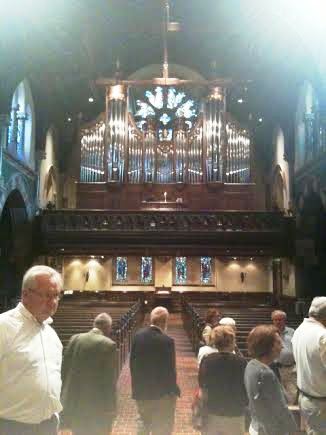
Check out the stained glass window and the pipe organ.
8

There are stained glass windows throughout the building. One is from Louis Comfort Tiffany. The tour guide says that the Cathedral paid for none of them – they were donations. He’s missing the point. If someone can donate 5 to 10 thousand dollars for stained glass, they can donate the same amount to feed the hungry and clothe the naked instead – you know, the stuff Jesus tells us to do?

God didn’t come down to Earth for us to spend time and money prettifying a building. Jesus didn’t die for us to debate over where to keep the reserved sacrament. The more I went to church, the more I realized that I wasn’t serving Jesus at all. I was serving the administration. I was serving the institution.

Sadly, there are a lot of us who are stuck in this hamster wheel. There are a lot of people who go to church who have invested a lot of their lives and their egos in what they thought was being a good Christian, and what they are doing isn’t Christ-like at all.

It isn’t un-Christian. It just isn’t what Jesus would do.

Breaking out of this mindset is very hard, especially for people who have spent a lot of their time and money in and on the institution that is church. It is especially hard for those who get paid to lead. They have the most to lose. Yet, the way I’m seeing it, they have even more to lose if they keep on following the wrong master. We can follow only one master – make sure it is God, and not the institution.

So yes, I miss church, but it is more like I still haven’t found what I’m looking for. I can’t miss what I never had. There are a couple of options I’m looking at that have a lot of the qualities I feel Jesus meant. I think they are a good start. But I’m wary. I’m wary of getting sucked in and fooled again, like I was last time. I’m wary of letting down my guard and getting really hurt.

Not one stone will be left.

I read “Forward Day by Day” every morning. It is a quarterly periodical that has a commentary on every day’s Bibley readings. Sometimes the commentary adds to the meaning. Sometimes it takes away. I think today’s commentary got it entirely wrong and took it literally. The author took today’s reading to be about the literal destruction of the Temple, and of church buildings today that get burned to the ground.

The reading is Matthew 24:1-14, but for brevity I’m just going to quote the beginning and sum up the rest.

Matthew 24:1-2
1As Jesus came out of the temple and was going away, his disciples came to point out to him the buildings of the temple. 2Then he asked them, ‘You see all these, do you not? Truly I tell you, not one stone will be left here upon another; all will be thrown down.’

He goes on to explain to his disciples the signs that they will see for how to know this. It is all pretty apocalyptic, with “wars and rumors of wars” etc. The author of today’s Forward Day by Day says that ultimately there is hope in the end, that God will prevail. Sure, that is in there. That is always in there. But I don’t think that the literal destruction of the Temple is what Jesus was talking about.

Remember, Jesus came to tell us that we are the temple. We are the Body of Christ. We aren’t supposed to build up our treasures on Earth and build buildings to worship God. We are to love and serve God, and if we are going to build buildings, we need to build them to house the homeless.

So Jesus wasn’t talking about the Temple, or modern church buildings at all.

Jesus was talking about the WAY we worship God. Jesus came to strip everything away – all the rules and regulations that kept us from seeing God in everyone and serving each person. Imagine how amazing our world would be if everyone saw God in everyone, and served them accordingly? That is the heart of the Sanskrit word “Namaste”. They had it figured out long before anybody else. God put a bit of light into each of us. We all have a little bit of God in us, and our goal is to recognize that and tap into it.

We can’t do that with the church structure the way it is. In fact, we can’t do that until we understand that “church” has nothing to do with a building or administration or ordained ministers. It means us, the believers. We are the Church. No stones required. Until we get that the Body isn’t a Building – we are still waiting for the end times. Jesus hasn’t come again until that time.

Recipe for a new church, in part.

Church isn’t a place or a building. It can’t be burned down or broken into. It can’t be venerated. It isn’t a pilgrimage site.
It would be nice if people can just meet at each other’s houses, rather than have a separate building to have to keep up and pay rent on. If a separate building is required, it would be awesome if it could be multi-faith. Muslims on Friday, Jews on Saturday, Christians on Sunday, and a joining of all three during the rest of the week. This seems like an efficient use of space. Or have it like a community center, where religious groups just happen to meet.

But really, the most important idea is this. Church is within us. Every person has within them the light of God. Every person was created by God. So “church” can be here, online, where we share ideas and encourage each other.

What does it matter if we have huge cathedrals that are filled every week if the people inside are not awake to their divine connection with God? Jesus tells us about the dangers of storing up treasures for ourselves here on earth. He tells us about the danger of losing your own soul, of forgetting our connection with God.

Church is a community of like minded people. The community is meant to build each other up. To encourage and support. To heal. To work together for the fixing of the world.

A church service is anything that helps further the goal of loving God and loving our neighbors as ourselves. We are called to love God with all of our hearts and all our minds and all of our souls. We are called to love our neighbors in the same way.

Who are our neighbors? Everyone. We are called to be nice to everyone. Sure that is hard. Jesus tells us that if you love only the nice people, what’s the point? We need to love the mean people because they need it more. We are to treat others as we would like to be treated – not like we have been treated. We are commanded to serve people because we are Christian. It isn’t about us converting them to be Christian. It is about being a servant.

Each person needs to know that God is real, and active, and present. God isn’t a “past tense” God. God is right now.

Each person needs to be empowered to hear from God.

Each person needs to be encouraged to share what they have heard from God.

Prayers should be offered for everyone. This includes those who are gathered, those who are part of the community, all seekers, and all who are lost. Pray for nations and the world. Pray for everyone. The Buddhists have a nice way of praying that asks for all beings to be well.

Prayers need to be balanced. If there are petitions for healing, then there also need to be prayers of thankfulness.

People need to learn how to determine their spiritual gifts, and then how to apply them.

Everyone needs to have a volunteer activity in the community. Faith without works is dead.

This isn’t an ego trip. We aren’t special. We are workers in the field. God owns the field.

Whenever anything new is considered, it must be measured against the command to love. Does it show love?

Everyone is expected to read the Bible, especially the Gospels. It is helpful if they also read any religious text(s) from any other faith tradition they are called to.

We are not here to worship and serve anything or anyone other than the Creator.

It is essential that people do not confuse themselves with God. We are the creation, not the creator. We have within us the light of God. This does not make us God.

There is no leader. Everybody takes turns. This is a journey together.

We are all walking up this mountain together, and we are here to encourage each other and point out things along the way. This includes butterflies as well as rocks. (beauty as well as danger)

It may help to have certain items as part of the worship service. But these things must not be venerated. They are reminders or signifiers. They point toward the truth, but they are not the truth. These things could include candles, incense, icons, or bells for instance. We are corporal beings, and sometimes we need corporal ways to access the spirit.

The goal is for each person to awaken to their own divine nature, and then take that awareness out. Each person is the Buddha, each person is the Christ. Each person, once awakened then needs to make that nature visible through action. How do we bring healing to the world?

Love made visible. Social action.

Go have a walk afterwards, and then have lunch together. It is important to get exercise, and it is important to share food together. It is what Jesus did with the disciples, so it is what we should do. If the group goes out to eat, be sure to be nice to the waitress and tip well. So many Sunday patrons are really rude to the staff. “How you treat the least of these…” didn’t get into their heads. If you are rude to the staff, then you didn’t hear the message. You are reflecting badly on God and His followers.

How you act reflects on God. Watch yourself at all times. How would I act if this person were Jesus?

Encourage exercise – walking, yoga, water aerobics, whatever.
Encourage creativity – painting, embroidery, beading, writing, whatever.
Encourage prevention rather than cure.