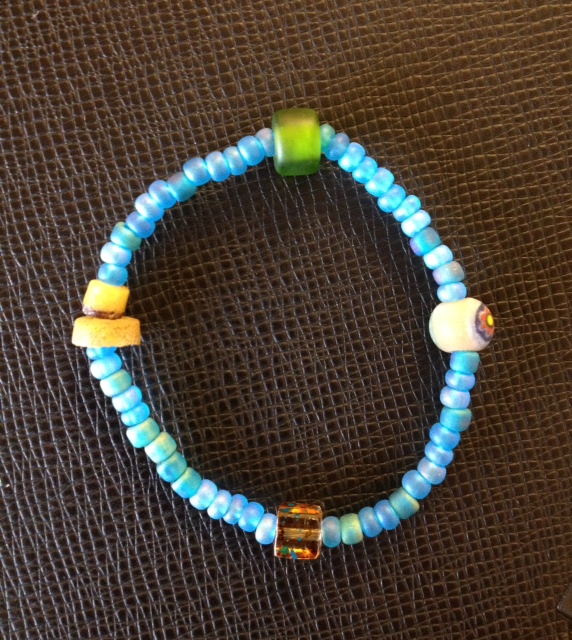
Thanks for chips and salsa

I went to lunch at my favorite Mexican restaurant a few weeks ago. I’ve not been there for lunch in a while. Normally I eat lunch at work or at a buffet. I started to remember why I go to buffets.

The server was taking a long time to get to me to take my order. Then I’d have to wait for my food to be prepared. I started to get a little anxious. I don’t want to be late back to work. Well, I do want to be late, because I don’t really want to go back right away because I like luxuriating at lunch and not being ruled by the clock – but that wasn’t really an option. What I want and what I’m going to do are sometimes two different things.

So I started to freak out a little. We’ve got a new manager and I think it is important to get there on time. When is the server going to come? I started trying to spot him, or in fact any server. Somebody could take my order- it didn’t have to be my server. Things needed to start happening soon. Soon I wouldn’t have time to eat my meal in a calm fashion. Snarfed down food isn’t really great on your digestion.

And then I looked right in front of me. I have something to eat right here. Here’s the chips and salsa. It’s hardly a meal, but certainly something. I gave thanks for it, and started eating it. I started to calm down immediately. As soon as I did this, the server came and apologized for the wait and took my order. The moment I appreciated what I had, I got more.

This is the way, I’m learning. Give thanks for what you have, not what you want. Whatever you have, enjoy it and appreciate it, even if it is small. Be thankful.

Strangely, then things seem to open up – but that isn’t the point. Don’t be thankful so that you’ll get the next thing. Be thankful for the current situation, as it is, whatever it is. If you’re not happy now, you’ll certainly not be happy then. If you’re constantly wanting more, then you’ll never be content. So foster a state of constant thankfulness, and you’re already there.

Wrench

I had a meeting with a different spiritual director while at the retreat. She is the lady who is hosting it. I scheduled for just thirty minutes in the afternoon. I figured by then I’d be a little antsy and want a break from the whole silent thing.

Last time I was going stir crazy around 2 pm on Saturday. This time, not so much. This time I feel like I’m almost overscheduled. This time I don’t have a four hour block of time with nothing specific to do. Some of that is because I’ve got to keep going into the conference room and check on the prayer bracelet station. I’ve got to tie them and make sure the supplies are stocked.

I feel oddly calm and yet there’s more I can’t quite name. Maybe because I’ve done this, here, before. I brought stuff to work on. I know it isn’t like Cursillo. I know where everything is. I know the schedule.

But I digress. This usually means I’m trying to avoid something. So, let’s plunge on in. The best way to confront a fear is to face it.

She asked me what had I intended for this retreat. What was I trying to get out of it?

I had decided not to intend anything. I think that is part of my problem. I plan, and then either I’m disappointed or I only look for that intention.

I will set an intention before yoga and by the time the class is over I’ve learned something entirely different. I’ve received a different gift, and it wasn’t what I expected.

The last time we were together, my usual spiritual director had asked me how would I feel if I knew Jesus was standing behind a door with his arms full of gifts for me. Would I open the door?

So this lady went with that. She told me to imagine that Jesus has a gift for me right now. What is it?

We closed our eyes and I imagined this.

Here’s Jesus, all smiles, and he has a gift. It is wrapped up in shiny blue paper. No bow. Tidy wrapping job. I take off the paper. I’m pretty excited. This is a gift from Jesus, so it has to be good, right? He knows me better than anybody, and has my best interests at heart. It’s going to be awesome.

It’s a wrench. It is a used wrench, in fact. There’s oil on it. Not on the handle, but on the adjusting part.

Confused? Sure. Crestfallen? Definitely. I’m a bit hurt. What the heck am I going to do with a wrench?

Uh, thanks, but no thanks, buddy. It is this kind of thoughtlessness that is the reason I hate Christmas.

So the director asked me to sit with this feeling a bit. What does this mean? Ask Jesus why he gave me a wrench.

“It is for your heart” he says. To loosen it up. To stop being so tight and rigid. To be more playful, more childlike. To not have so many rules and limitations.

The more I decide how things have to be, the less I’m allowing them to just be the way they are.

It is like a bonsai. The more you force a plant into a certain shape, the less you are letting it grow the way God wants it to grow.

Something about organic and trust is in there. Not resisting. Acceptance. Being open to possibility.

I wasn’t really happy about this to start off with. Jesus should love me as I am, right? This sounds a little mean, giving me a wrench. I felt it was like going up to a friend and saying that she isn’t pretty enough, so here’s some makeup.

Nope, it isn’t that at all. True friends want the best for you. They want you to grow into your full potential. They challenge you. They call you on your BS too.

If I truly believe that Jesus is my friend, then I have to believe that he wants the best for me. I have to believe that this is an awesome gift, and exactly what I need, and in fact exactly what I’ve been looking for but I just didn’t know it.

So, a wrench. Why? I asked.

Because a seed doesn’t grow into a flower unless it is watered. It needs work. The seed is great as a seed. Jesus isn’t saying that I’m broken. He’s just saying that if I want to be better, then here’s the tool, and here’s the part that needs work.

So why is it oily and used, I asked?

Because he’s already broken it in for me. It is ready to go. Smooth action.

Then I get silly and realize that wrenches are used on nuts, which are just beads after all. They are hexagonal metal beads, with spiral holes.

Now I want to make a bracelet with nuts and wire.

But it isn’t about that. It is important not to iconize this. It isn’t about the symbol but what the symbol points toward.

While writing this I got a snack of hot chocolate with tiny marshmallows, and honey graham crackers shaped like teddy bears. I think this is a good start.

(Written on retreat, around 3 pm on 1-18-14)

On process and pain – chewing the steak.

We all have problems. Don’t identify with your problem.

You aren’t an addict. You aren’t an abuse survivor. You aren’t a cancer patient.

With the new guidelines for talking about children with disabilities, we are supposed to talk about the child first, and the disability second. He isn’t an autistic child. He is a child with autism. He is a person first. He isn’t defined by his diagnosis.

Apply the same rules to yourself. You are a person first. The diagnosis is second. It isn’t you. It isn’t who you are. It affects you, certainly. But you are so much more.

When you define yourself by your diagnosis, you are giving it power, and you are diminishing your own.

Now, you also aren’t going to win any friends if you are constantly talking about your terrible childhood or your abusive husband or your sciatica or how you have to take care of your Mom with Alzheimer’s.

We all have problems. We all have something we have struggled with. Sometimes we have overcome it. Sometimes not. Sometimes it seems we can’t ever catch a break. But if you only talk about this, you are going to be lonely. The only companion you will have will be your problems.

Buddhism has a story that speaks to this. A lady’s child had died, and she was unable to accept it. She carried her dead child around the village, going to every house asking for medicine. They were all horrified. One kind person suggested she go to the teacher and sent her to Buddha. Buddha told her to go to each house and ask if they had experienced a death in the family. If nobody had died in that family, she was to get a mustard seed from them. She was to collect all the mustard seeds and bring them back to Buddha, who would then make a medicine for her.

She went all over the village and wasn’t able to find a single family that had not experienced death. She came to realize that her experience wasn’t unique or special. She came to realize that death was part of life, and to hold onto it and identify with it was causing her more problems than the death itself.

Simply going to each person’s house, she created her own medicine. Buddha taught her to look outside of herself, and to not identify herself with her suffering.

How often do we hold on to our pains and sufferings, just like that lady carried around her dead child? How often do we think we are alone in our suffering, that we have it worse than anybody else?

We all suffer. That is just part of life. Holding onto it makes it worse. Accept your loss and your pain, but don’t identify with it. Accept it, because to not accept it means to not process it.

Pain, like a big steak, needs to be chewed thoroughly to be digested. Choke it down and you’ll get sick. Spit it out and you’ll miss the lessons it has to teach you.

Pain teaches us about holding on and letting go. It teaches us about what we think we have to have in our lives and what we really need. It teaches us to accept, and live in the now, rather than in the past or the future.

The past never was as awesome as we think it was. Even in the past we were looking back to “the good old days” and thinking about how great things will be “if only I get…if only I can have…when I finish…” In the future we will do the same thing.

The only island is now. When we aren’t on that island, we are drowning in the sea, stuck away from the solid stability of that island. The past isn’t real. The future isn’t real. The more we live there, the more we are missing out on the only real thing that is, and that is now.

How to get back to now? Start looking at it. Start being thankful for it. Make a gratitude list. Notice what you have, right now, and be thankful.

Pain teaches us about ourselves.

Once we are through chewing on it, we need to swallow it, and then digest it. Then it does its work and then we have to let it go. Holding into pain is just like holding onto poop. We get sick if we can’t eliminate our toxins. But it still has to go through us, all the way. Resist it, fight against it, and you’ll only hurt yourself. Just like a tree in a strong wind, if you don’t bend, you’ll break.

Tiredness and thankfulness.

This last week I’ve woken up tired. We’ve been going to bed late, and getting up early. Sometimes it seems no matter how much I plan or cajole or wheedle or lament, this keeps happening.

I have gotten really angry about it. It is important to both of us to get in bed at a decent hour. Me, because I’m bipolar, and not enough sleep brings out the weird side of my brain. Scott, because his work schedule means that he has to be up two hours before I do.

But this week I rounded a corner on this. Instead of getting upset about it, I decided to see it as a “this is the way it is” kind of thing. I decided to see it as something that God needs to happen. The fact that I’ve tried to get us to bed on time and we keep not managing to do it means that there is some other force acting on this. I prefer to see that force as God. I prefer to think that God is in charge of everything, and always is moving us in the proper path so that God’s will is properly unfolding.

Perhaps I need to be a little “off” in order to see a situation or a person in certain way. Perhaps being the way I am is helpful to God’s plan. Perhaps being a little tired means that we will both take more time to do something, and thus do it better. Perhaps someone else needs to see either one of us moving more slowly to know that it is OK to go slower, and that life isn’t all about rush rush rush.

The moment I accepted the way things are as part of God’s plan was the moment I felt better.

I think this is what the Lord’s Prayer is all about. I think that what Jesus is trying to teach us is to be OK with what is happening, and not to fight against it. I think that Jesus wants us to totally submit to God, all the time, in everything. I think that Jesus wants us to know that we need to relax into life in order to live life. The more we fight against it, the harder it gets. The more we let God use us as we were made to be used, the better off everything will be.

I think this is part of what Jonah teaches us when he was in the belly of the whale. Everything looked like it was lost. Nothing was going according to his plan. It was dark and smelly and lonely. And yet, in that moment, he gave thanks to God.

In the moment he praised God he was freed.

When is a Frog?

At what point is a frog a frog? When does it stop being a tadpole and become a frog? When it breathes air? When it no longer has a tail? When it has all four legs?

frog
(unknown photo credit)

I tell you, the frog was always a frog. Even before it was a tadpole. Even before then.

It is we who give it names, that limit when it is one thing and another. It doesn’t have names for itself. It just swims. It hops when it can. It breathes water, then air. It just is.

We have rules about what is and what is not, we humans. We are male, or female – until we aren’t. When a child is born that isn’t of one particular gender, the child is “intersexed” or “of ambiguous gender”. We don’t know what to call such a child – She? He? We don’t have a word for both and neither, yet the reality is there.

It doesn’t matter that we don’t have a word for that particular reality. The reality is still just as real. It is like a platypus. Is it a mammal, because it has fur? Or is it a bird, because it lays eggs? It is both. And neither. And something else.

Our words don’t shape reality. Reality shapes our words. Reality keeps on being, and we keep on trying to describe it, and we keep failing.

There is a Zen saying – “What did your face look like before your parents were born?”

Words are the same. What would a frog be if we weren’t there to call it a frog?

Bucket.

If you are in the hospital and you call for a chaplain, she heals you in a way that the doctors and nurses can’t.

They bring pills and IV medication. She brings a bucket. The bucket is herself. She empties out herself and you pour your problems in.

She listens to the deeper problems. She isn’t hearing for physical symptoms. She is listening for deeper down. What is the source of the pain? What is the root of it all? What are you afraid of?

People tend to be motivated out of fear or love. A fear-based life results in one full of pain and anxiety. Relieve the reasons for the fear and you relieve the pain and anxiety.

Sometimes you can’t take away the problem. Sometimes the situation can’t be changed. Then the only thing to do is change your opinion of it. The more you fight against it, the more pain you will feel. Stop. Relax into it. Accept it. It will hurt less.

Life is a lot like giving birth to ourselves over and over. The more we resist it, the harder it will be.

Accept. Relax. Explore it. Don’t fight it. Don’t define it. It isn’t good or bad.

It just is.

Regret

I often feel like I should have started yoga ten years ago. I wish I started my boundary work 20 years ago. I wish I’d taken advantage (or even noticed) the walking path at my work when I started working there 13 years ago. I wish I wish I wish…

And then I decided to change it around and think about it differently. At least I started. At least I got over the entropy and malaise and started to take care of myself.

And five, ten, twenty years from now I’ll be glad I started now and got going.

Focusing on what I don’t have only makes it worse. Thinking of myself as a victim only reinforces it.

Every time I catch myself sitting with my shoulders slumped, I have the option of good or bad ways of thinking. I can choose to be grateful I caught it and can fix it. Or I can get upset that I’m slumping again.

It is all about choice.

I can choose to get upset when others complain that they can’t get healthy and they seem to come up with more excuses than answers. I can choose to get upset if they refuse to take my suggestions, hard learned that they are, on how to get better.

Or I can remember that it is their choice to be miserable.

Or maybe it just isn’t their time to start yet. Maybe their complaints are just birth pains and they just aren’t ready to be born yet.

My spiritual director says that things come to is when we are ready to deal with them. I’m trying to remember that to have more patience with myself, and with others.

How about I just try to be happy with now, and not what wasn’t, or what isn’t, or what I think it should be?

Home remodeling for the soul.

I’ve realized that some of what I’m writing in this blog is like the “how-to” articles in home-repair magazines. They show you how to build a deck or remodel your kitchen. They show you the tools to buy and all the insider tricks to make it come together well. There are pictures and words, and somehow in the middle of it you figure out how to do it in your own home. Perhaps you don’t have a square deck – yours is rectangular. Perhaps you don’t want granite countertops in your kitchen, but the pictures of the cabinets going in explain something that you needed. This is that, but for the rooms in your heart and head.

Sometimes “home remodeling” hits closer to home. Your first and truest home is you.

This is my journey, and my work. If any of this helps you figure out things, all the better. Our paths will be different, but there will be some similar landmarks along the way.

I’m “growing up in public” as one friend tells me. Either he learned it from his therapist or from group work. Either way, it is a good phrase. It isn’t easy when you haven’t gotten all of your growing-up out of the way when you should, but late is better than never. Writing, beading, and drawing are how I do my growth-work these days. I use eating well and regular exercise to help keep me on this path. It is all connected, body-mind-spirit.

Recently I went to my spiritual director (kind of like a personal trainer for the soul) and she told me that there are many rooms our hearts, and Jesus wants to enter into all of them. This includes the good and the bad, the happy and the sad. Hmm. Kind of sounds like wedding vows when I phrase it that way.

One room we are working on is my childhood, and feelings of loss. I’m angry about the bad choices my parents made. I’m angry that they smoked themselves to death. I’m angry that they died young, leaving me to defend myself against a predatory brother and an insensitive, bossy aunt. I’m angry that they weren’t there for my graduation and my wedding, because of their bad choices and their lack of self-control. I’m angry that they left me alone a lot, even when they were alive.

But she pointed out that anger is a symptom. There is always something that comes before anger. I’ve been working on this technique recently, so I understood where she was going. Trace it back to the root. Dig down to the source.

The feeling before anger in all of this is sadness. It is grief. It is loss.

Instead of dealing with my sadness, my grief, my loss, I went straight to anger. Anger is useful but you can get stuck there. If you don’t dig out the root cause of anger, and dig down to the grief, you’ll be treating the symptom and not the cause.

She asked me to name this room. I call it “The Room of Abandonment”. I spent a lot of time alone as a child. There were a lot of things that I wasn’t taught before they died – basic things like taking care of a house inside and outside. How to cook, how to garden. I’m learning these things backwards. I still am terrible at plants, but I can get by without a garden. I’m not great at cooking, but I make do. I celebrate everything that I do figure out. I’m pretty awesome with hedge shears. I make a pretty fabulous stir-fry. My hummus is getting better too.

I felt abandoned before they died. I felt abandoned after they died too. I was just 25, so I was old enough to take care of myself. But being the youngest in a family where the older brother is abusive is hard. It was hard to claw myself out from underneath his mountain of lies. I didn’t have any perspective on what “normal” was.

So. This room. Look how I’m not really dealing with this room. This is normal. We want to turn away from hard things. So I’ve drawn it. I’ve made it into a prayer bracelet as well. I have reminders of it to force me to look at it. These are like writing notes to myself on my hand – “pick up spinach and cheese and Triscuits”. They are reminders for what I’m trying to forget.

She asked me to visualize what it would look like. I saw a light-blue room, empty, save for a chair. The walls are blue like a robin’s egg. The walls are windowless, but there is light. I’m not sure where the light is coming from, but the room feels clean and bright. The chair is an old wooden chair, like the one I rescued from my grandmother’s house when the time came for her to be put into a nursing home.
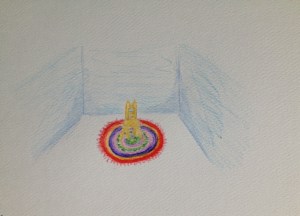
WP room 2.
(The drawing of the room)

My director told me to invite Jesus into the room, and to invite Him into any hard feelings. He wants to be there, to help me with them. This is some pretty foreign stuff. Jesus as a friend? Jesus wants to heal me? Jesus wants to hang out with me, in the boring times as well as the beautiful times? She says that Jesus wants to be with me all the time, in all the rooms of my heart. He wants to be with all of us like this.

It is like getting a notice that the President of the United States, or the Queen of England, or the Pope is coming over to my house and wants to hang out in my basement. I want to say no – come sit over here in my living room. It doesn’t have a lot of clutter. There are comfy chairs. There is natural light. Surely you don’t want to hang out in the basement with the spiders and the one overhead fluorescent light. There is a lot of clutter in the basement. It is really embarrassing. Nope- that is where Jesus wants to go. Not only does he want to hang out there, he wants to help me with it. He wants to help me clean it out, or be OK with it as it is.

When she asked me to invite Jesus into it, and I felt that while I wasn’t ready for Him to be in the room with me, He came in and put a fuzzy green shawl around my shoulders while I sat in the chair. The shawl was a reminder of His presence, and it was comforting.

While there in that visualization, with that shawl, I worked on my feelings. I’ve been working on this for days. I return to it again and again, refusing to turn aside. I’m trying not to obsess about it because that isn’t healthy either. Just like with yoga, it is important to have rest periods in this work.

When I started drawing the room, I felt that it needed something extra. I was wary of putting too much in the room. If I clutter it up with tools or toys then I’m being distracted from the work at hand. Often it is so easy to use noise and activity as an escape from being by ourselves. There is a lot of fear of silence in our society. We don’t like to be alone with our thoughts. This room needs to be quiet and clear, so I can process this feeling.

When I was thinking about it, trying to remember what events made me feel abandoned, I felt that I had to draw a rug under the chair. While I was drawing it, the events came to me. While inviting Jesus in, I started to see things clearer. He is helping me to deal with these feelings. I wasn’t ready to process this years ago. I’d put a wall around it because I wasn’t strong enough to deal with it. I don’t feel like I’m ready yet either, but I think that is normal. There are a lot of things that God calls me to that I don’t think I’m ready for.

One of the biggest things I realized was that I was taught shame about my body, and of being female. This was taught to me by my mother. Ignorance was masked by fear, which lead to more ignorance and fear. The body was always to be clothed, and periods and sex where embarrassments. Necklines were always high, and bras were always padded so no nipple showed. I learned about the mechanics of sex from a library book. I learned about how to deal with periods by accident, on the sly. Bodies and how they worked were seen as disgusting, shameful, wrong.

And then I dug down further, past the grief. All of it traces back to a feeling that I didn’t get something that I thought I deserved. All of it traces back to not being OK with things as they were, as they are. It has to do with not trusting the process, and the Director of the process, God. All of it has to do with not being ok with the Now. Anger comes from grief. Grief is a sense of loss. It is an unwillingness to accept change. That is an unwillingness to accept things as they are. It is a desire to shape the world to fit me. Nothing is ever “good” or “bad” or “half-full” or “half-empty”. It just is.

It is our society that trains us to define things as good or bad. We can unlearn this. I believe that all the sages from all the ages have been trying to teach us this.

Jonah praised God in the whale. Jesus tells us to turn the other cheek. The apostle Paul tells us that all things work together for good, for those called by God. There is something in these ideas that is so revolutionary and yet so simple.

Sometimes I feel that I’m trying to make wine out of grapes, and it just isn’t ready yet. I’m reminded of my story of when I tried to encourage the tadpoles to be frogs sooner than they were ready by pulling on their tails. I think I need to hang out in that room for a little more, and let things ferment. I’m not very good with waiting, but I’m inviting Jesus into that too. I think He understands the quiet times, the waiting times.
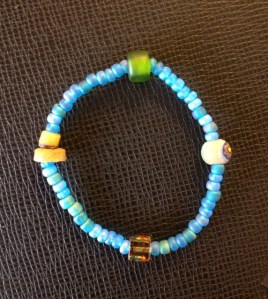
WP room 3

Here’s the bracelet I made to remind me to work on this. The blue beads are for the walls in the room. The Green bead at the top is the green shawl from Jesus, to remind me that He is there with me. Going clockwise, the white bead is me. It has two millefiori on it, one on either side. The square brown bead represents the chair. The broken-looking beads represent the “stuff” that created the need for the room. They are made from recycled glass from Africa.

Rain

We have heard often that “it rains on the just and unjust alike.” It isn’t that bad things only happen to good people. Bad things just happen. Being good is no shield against pain and loss.

Nobody “deserves” for something bad to happen to them. People may make bad choices and they have to deal with the repercussions. That isn’t what I’m thinking of when I say “bad things” That is an expected event. It isn’t “unfortunate” when a man gets heart disease after a lifetime where his only exercise consisted of making yet another trip through the buffet line. “Unfortunate” has at its root “fortune.” There is nothing about luck going on here.

I’m thinking about when an accident occurs or a mistake. When you go in for a tonsillectomy and the surgeon cuts your foot off instead. Or when a tornado comes to town and reduces your just-paid-off house to toothpicks. That “something bad” is what I’m talking about here.

Yelling at God won’t help. Wondering if you are guilty of some unknown sin won’t help. You aren’t being punished. It just happened. Now what? What do you do with your one-foot-having, no-house-having self?

Accept it and move on. Deal with your new reality.

Don’t cheer about the “bad guy” when “bad things” happen to him either. That is gloating. It wasn’t polite or pretty when you were five and did it. It is even uglier now.

So what do you do?

Practice with the idea of loss and disappointment just being a part of life. You can’t always get what you want, and sometimes that is a real blessing. Sometimes what we want isn’t very good for us.

Some parents will get their child a hamster as a gentle way to warm them up to the reality of death. Hamsters don’t live very long. So the child has the hamster as a way to brace themselves against the time when Grandpa is going to die.

Learn acceptance of what is, and forget about what was, and what might be coming. The past is gone, and the future is always changing. All you have is right now. Fighting against it only makes it harder.

Remember the Serenity Prayer by Reinhold Niebuhr?

God, grant me the serenity to accept the things I cannot change,
The courage to change the things I can,
And wisdom to know the difference.

It isn’t just for people in recovery from drug and alcohol addiction. It is for everybody. We are all addicts. We are all recovering. We are all returning to our roots, to our source.

We had it all figured out when we were babies. Then things got harder, and we got given a lot of rules and ways of thinking that weighed us down.

It isn’t easy to do this, this recovery. I think there is something in first acknowledging that we are broken. I think there is some healing in that.

I think there is some healing in knowing that the “bad stuff” isn’t personal. That it just happens.

You still get wet when it rains, but you don’t have to feel guilty about it.

Well, unless you are constantly forgetting your umbrella or hat, then that is all on you.

All together now.

Michael Pollan has a book called “Food Rules.” In it, he explains that he read a bunch of books about nutrition, and the root of it all came down to this little phrase. “Eat food. Not too much. Mostly plants.” He then spent the rest of the book explaining that.

So I’m going to try to do the same with enlightenment and freedom from pain and how to appreciate life. I’m a gestalt learner, so it is coming together all at once and I’m seeing a lot of connections. Some of it is from child-rearing books, some from autism books, some from books about how to deal with being part of an abusive family or a co-dependent relationship. Some comes from Jesus, from Buddha, from Eckhart Tolle, from Lao Tzu. Sadly, I’m pretty sure I’m not going to be able to quote anybody on any of this, as it is a synthesis.

I suspect you’ve heard most of this before, but perhaps not in this way. If you are like me, you have to hear things several different ways before something clicks and it goes in and sets up shop in your head. Hopefully some of this is helpful to you. So let’s begin.

Here’s my synthesis.

Give up the idea of control. Give up deciding what is “good” and “bad.” Be thankful, right now, for what is. Learn as much as you can about everything.

Here’s my explanation of that.

Resistance is futile. That which you avoid must be faced. Run away and it only becomes bigger. Face it, and it gets smaller. It is a normal human reaction to avoid pain. But by not facing painful things, you don’t get rid of them. You just delay dealing with them.

Yes, it is hard to face your fears. Nobody wants to. But strong people were those folks willing to try, step by step, to face what they were afraid of. It is worth the effort. It gets easier the more you do it.

Everybody and everything wants to be noticed. Notice, fully. See every person as if they are God in disguise. See every situation as an opportunity to learn and grow. It is all in your perspective.

What you focus on expands. (I think Oprah said that.)

Love is indeed the answer. Don’t judge anything or anyone. This includes people, ideas, and events. The more you decide what is “good” and what is “bad,” and the less you accept things just as they are, the better things will go for you.

Hate is another name for fear. Face what you are afraid of. Learn all about it. Lean into it. Study it. Then you will learn it isn’t what you thought it was. Fear is often ignorance in disguise. Learn as much as you can and the fear goes away.

Nothing is ever what you think it is.

Don’t make up stories about why people do what they do and what they are thinking. Ask them. When you make up stories, it is always going to make the situation worse, and you’ll often be wrong.

Try not to use the word “why” when you are asking people what their motivations are. “Why” causes defensiveness. One way is to say “I was wondering if you could tell me more about…” or “Could you help me understand about…”

Two people who have gone through the same experience will have different reactions to it. Just because you have lived through a car crash doesn’t mean that your friend who did the same has the same emotional reaction to it. They have a different history and a different emotional makeup.

Tell people how their actions make you feel. Feelings are very important.

If you don’t know how you feel about something, it is helpful to journal. You don’t have to be a great writer. This isn’t the great American novel. This is for you and you only to read, and it will be messy. Writing is surprising – you learn stuff while you write. It isn’t about putting things down on paper. It is about receiving as well. Pray while you write for insight.

We are a product of our environment and our conditioning. Often we do it that way because we’ve always done it that way – but that isn’t a good reason to keep doing it that way.

Examine everything.

If someone (or an institution/authority figure) doesn’t like you asking why they do it that way, then dig harder. You are onto something.

The more resistance you encounter, the bigger the sign that is something you must work on. This is true with every situation.

Our need to label things good and bad causes a lot of our distress. It just IS, without a label. (Look in my “Resources” section under “Prayers and Stories I like” for the Rumi poem and the Chinese story for illustrations of this.)

Don’t even judge your healing. You are moving, and you have identified the disease. You are on the path to a cure. Every time you catch yourself falling into your old habits, don’t focus on the habit – notice the fact that you caught it and are changing it. Change takes a long time, and habits take a long time to undo. Be patient with the process.

There is something to be said for enjoying the right now, for not waiting for the future to bring relief.

Jonah prayed to God, gave thanks to God, while in the whale. He was thankful in the middle of a terrible situation. It was only then that he was freed. There is something powerful in this. It isn’t about praying and going through the motions of being thankful so that you will get some future goal of happiness. It is about actually being thankful in the moment. This is opposite what Western society teaches, so it isn’t easy to learn but it is worth it.

There is so much dis-ease, or lack of ease, with the 21st century Western way of thinking. It is about getting more and more. This is why people suffer from depression and heart problems and high blood pressure and chronic pain and bankruptcy. They are filling in their holes with the wrong things. They are unhappy, so they eat more. They are unhappy, so they comfort themselves by buying more. It is hard to change this cycle, but it is essential. It gets easier the more you do it.

I think there is a lot to be learned by the fact that Jesus often says to people that their faith has healed them. He didn’t heal them. They were seeking healing. They asked for help. Something about the seeking and asking worked. Jesus tell s us “Ask and it shall be given unto you, seek and ye shall find, knock and the door shall be opened unto you.” All of these require action on your part. It isn’t passive. You have to make the first step.

Like in the story of the prodigal son, he started to return to his father. When his father saw him, far off, his father ran to greet him. But he still had to start on the journey to return. So you have an impact on your situation. You don’t have to wait to be rescued.

Life is about focusing on the can, rather than the can’t. The more you focus on what you don’t have or can’t do, the less you will notice what you do have, and what you can do. Regret never built a raft.

Life is about being thankful for what you have, right now. If you can’t appreciate what you have, then how are you going to appreciate what you will get in the future?

Even “bad” things need to be appreciated. They are ways in. They are excuses and reminders to pray to God. They keep us awake and paying attention. And sometimes the “bad” thing is a blessing – we just don’t know it yet.

Part of loving God is trusting God. Know that all things are within God’s hands. Everything comes from God. God has a plan bigger than you could ever imagine. We humans don’t have that perspective. We think “Why is this happening to me?” while we forget to be thankful for all the blessings we get. (We learn this in the Book of Job).