Paintings and collages, posted 6-13-14

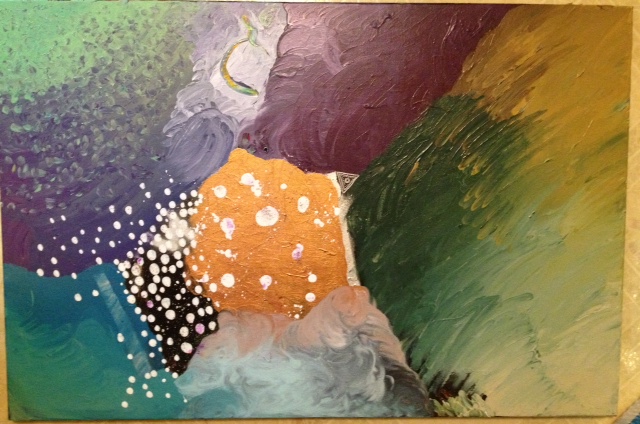
Early morning behind the rock, on the planet Graille. (a picture is worth a thousand words series) Acrylic on canvas, 16 x 20
19

Swimming. Silver and aqua acrylic paint on canvas. 8 X 10

18

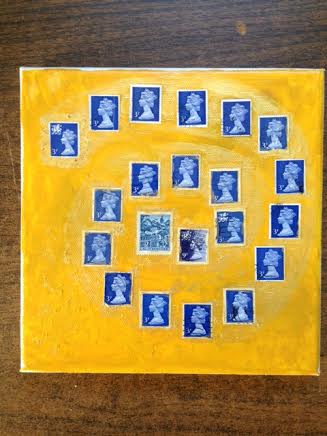
Yellow queen. Acrylic paint, English stamps of the Queen facing left with one Austrian one of a dragon facing right, in a gold spiral path. On 8 X 8 canvas.

16

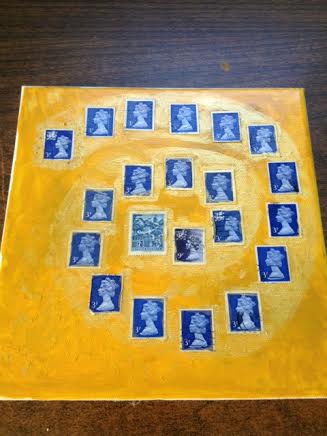
Angled view of the above, to show the gold.

17

Luggage. Stamps and money from around the world, with Chinese fortunes. Acrylic paint on 5 x 7 canvas, with decoupage glue.

15

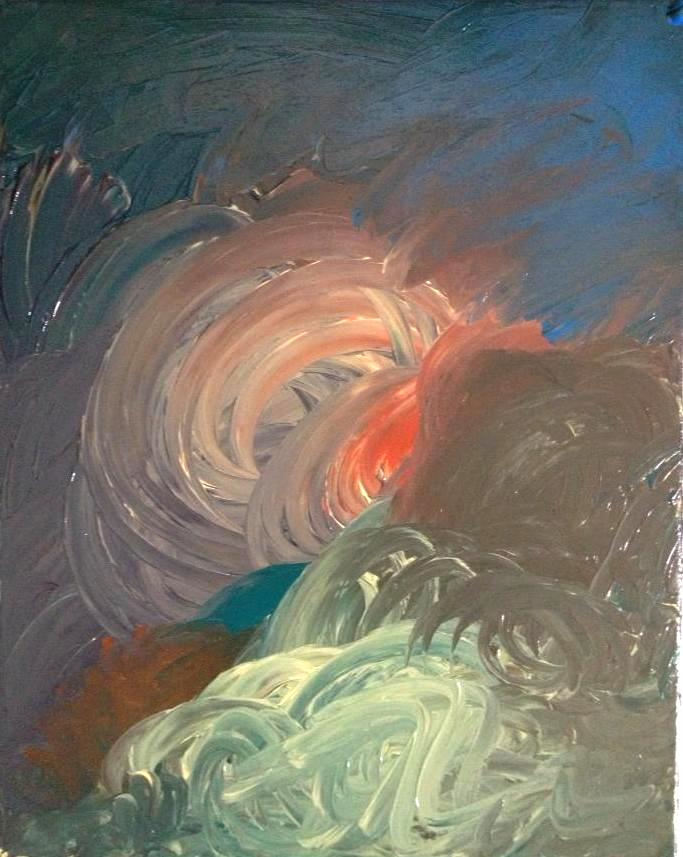
Mid afternoon rain on the planet Graille (a picture is worth a thousand words series) Acrylic on 11 x 14 canvas

14

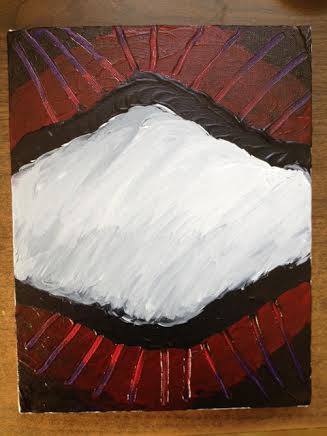
Angry eye. Acrylic on 11 x 14 canvas

13

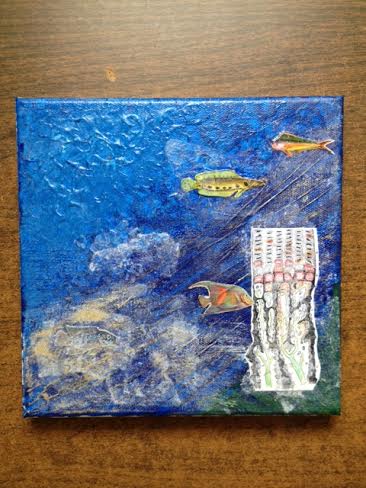
Underwater rabbit fish. Acrylic, photocopy of a cross section of rabbit bone, water color pencils, cut out fish stamps, tissue paper, gold pastel, decoupage glue, canvas 8 x 8

8

Side angle of the same.

9

Leaves in water. Acrylic, gold foil, real leaf skeletons, decoupage glue, canvas 8 x 10

6

Sunset clouds. Acrylic on 5 x 5 thick canvas, sides painted as part of the design as well.

4

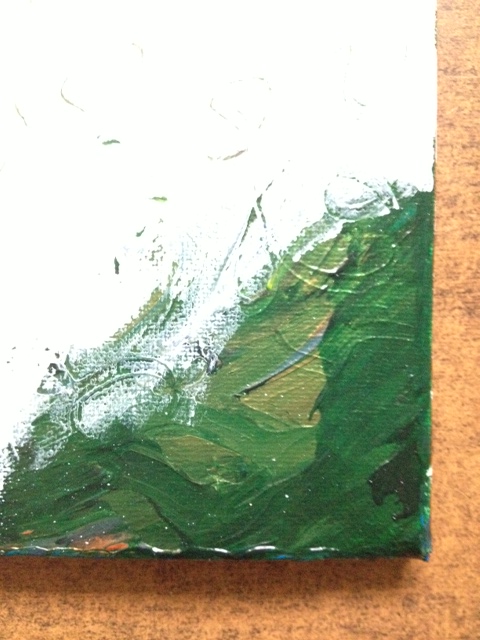
A side view.

5

Deer Yeshua (see separate post explaining name) Acrylic, silver sharpie on 24 x 36 canvas
3a

All of these are available for sale. Please write a comment for more information.

Paintings set 1(including acrylic and watercolor pencil)

I was asked if I had some of my paintings on my blog, and I do, but they are in various posts. Here I’m going to put together some of the ones I’ve posted here and create a new category for my blog so if people want to look at my paintings / collages, they can go here.

For the 1000 word story, part 2 2-3-14

story2

A painting using light language, painted 2-1-14

light3

A close up.
light4

This is the first layer of that painting. It has light language on top of light language.

light1

From “Thousand Word story” part 1 1-24-14
waves

A watercolor pencil drawing of figs.

f4

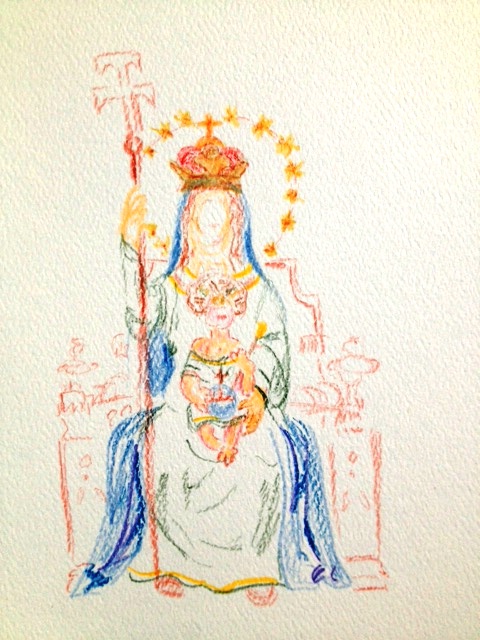
Mary and Jesus at Mercy Convent 9-17-2013

Mary 4

Blue vase 7-24-13
7-24-13 sketch

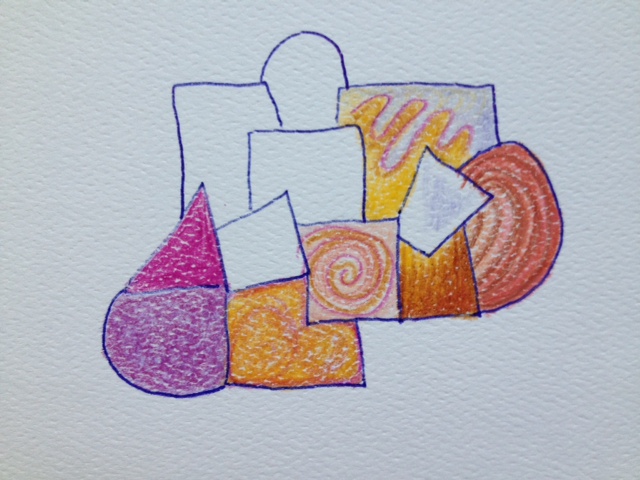
Praying in color 10-29-13
praying in color 10-29-13

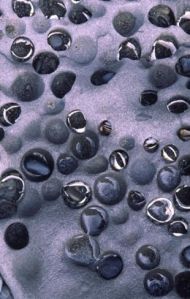
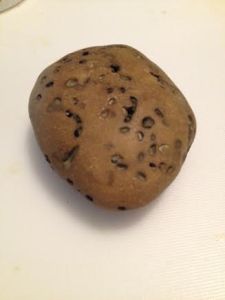
Rock with holes

I found this rock at a thrift store in Boone, NC.
rock2

It cost a dollar. I was on the lookout for something to use as a “talking piece” when I do a circle. That is the thing that you hold while you talk, and everybody has to listen. Then you hand it to the next person.

But I also like cool rocks. I have a collection of rocks from all over.

I was wondering what could have caused these holes. Erosion? Animals?

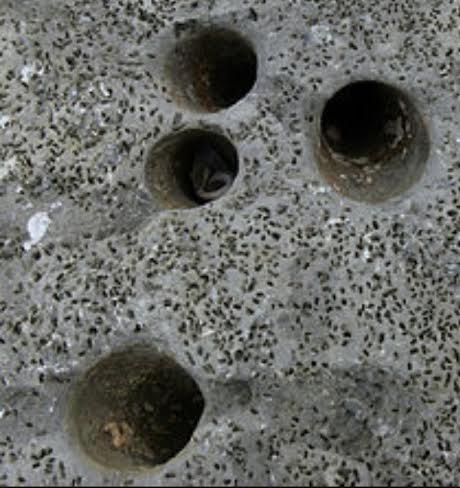
I Googled “rock with holes” and came up with the most likely option so far – pholad boring.

“Pholads are small bivalves that bore holes into shore rocks a few centimeters across, living their lives inside that shelter and sticking their siphuncles out to filter the seawater. If you’re at a rocky shore, or if you suspect that a rock has once been there, then look for these biological holes, a type of organic weathering. Other marine creatures make marks in rocks too, but the real holes generally belong to pholads.” (From the article “11 Types of Holes in Rocks” on the Geology section of About.com)

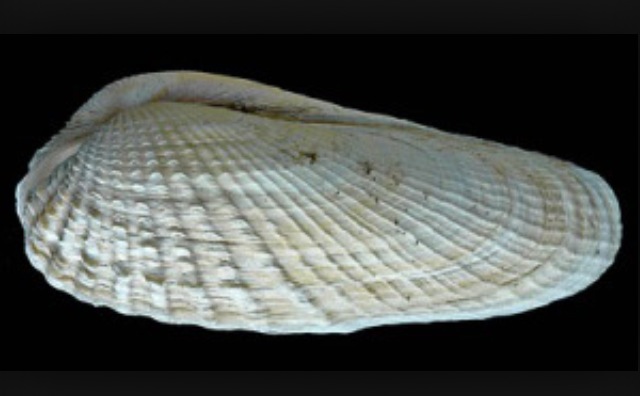
These pholads are known as “angelwings” because of the shape of their shell.

pholad4

Here are some pictures from that article.

pholad3pholad2pholad1

Then this started a whole line of thinking. The rocks themselves are made of limestone, which is, in itself, derived from other sea creatures’ shells. Many animals with shells lived and died, and their shells degraded and got compressed together and shaped into a rock. So these modern shelled creatures are actually living inside the remains of other shelled creatures, which are many many years distantly dead.

Also, I find it interesting that these creatures have a shelled body, but they feel the need to dig a hole into a rock for even more protection. They never leave this hole. They live their lives here. Reminds me of some people I know. They’ve traded in safety for boring.

But, back to the rock with holes.

This is known as “bioturbation.” It happens any time a living creature disturbs soil. Sea creatures do it, insects do it, animals do it – including humans.

Back to the About.com article – “One of the agents of organic weathering, bioturbation is the disturbance of the soil or sediment by living things. It may include displacing soil by plant roots, digging by burrowing animals (such as ants or rodents), pushing sediment aside (such as in animal tracks), or eating and excreting sediment, as earthworms do. Bioturbation aids the penetration of air and water and loosens sediment to promote winnowing or washing.”

Cool, right? And I just thought it looked like a potato with the “eyes” cut out. I’d seen rocks with these kinds of holes before but never knew how to look it up. I’m so glad that a search term as simple as “rock with holes” was enough to get me on the right track.

Later I was playing with it and found out that the holes can be used in a flute-like manner. Yes, this means I can play my rock. More importantly, it means that I tried to play it.

I’m glad I’ve gotten back to the state of being a child.

Edit 7-4-17:
I have learned that rocks with holes all the way through are sometimes known as “Hag stones”. From the Etsy shop “SeaMadeDesigns” – – “Hag stones, in folk magic systems, these are often believed to ward off the dead, curses, witches, sickness, and nightmares. They are also used as windows or doorways to see ‘otherworlds’, invisible spirits, or how a being ‘really’ looks beyond their physical image. They have always been deemed a rare and treasured stone.” The item description also refers to them as healing stone, Odin stone, adder stone, fairy stone, alter stone

Pods!

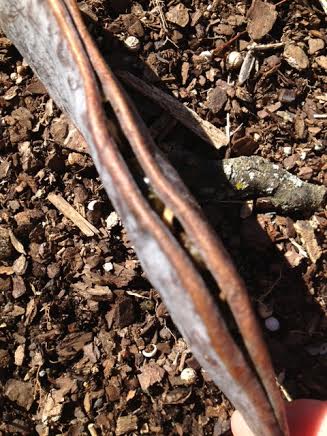
Check out this awesome seed pod.
pod1

It is about 6 inches long, and an inch and a half wide.

Let’s look at it closer.
pod2

Such a pretty color. Sort of like a fig, all purple and brown. I think it might be a honey locust. I’m not sure. It is way too big and too thick to be a redbud pod.

It is ripe. Here is a picture of it turned on the side. The seeds are trying to come out.
pod3

And another.
pod5

Yet another.
pod4

I kept trying to take a picture of just the seeds, but my camera wanted to focus on the ground instead.

Then I had to smell it. The smell was warm and a little musty. The seeds had rotted a little with all the rain. This pod had sat on the ground a while. The skin of the pod is very thick, but the shell had opened so the seeds could get out. This also means rain can get in. It smelled a little sweet, like honey.

It is good to stop and examine things anew – to see them and try them out. When was the last time you picked up something interesting off the ground and looked at it and smelled it? I hope you do so very soon. It is rewarding.

Wallpaper

Here is an early Christmas gift for you. Wallpaper for your desktop or phone! These are pictures I’ve taken that are interesting but not too busy, so they go well behind other things.

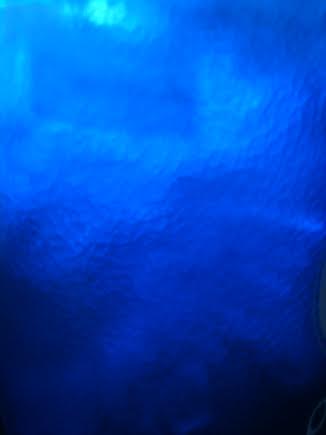
The plastic cup of water at a local Mexican restaurant, with light shining through it.
9

Sunlight through slush on the windshield.
28

A different shot of the same thing.
29

Sunlight patterns on a wall in my bathroom – I fingerpainted the wall, and there is a picture I painted in the top right.
30

One of the floor in the Frist. See “A Trip to the Frist” for the backstory.
31

Another one.
32

A blurry accident. I think this was taken on the day I went to get an MRI.
wall1

Digital manipulation from me – I’d taken a picture of some spirally art paper, then used two different photo manipulation applications to get to this point.
wall2

The Formica countertop at the same Mexican restaurant in the first picture.
wall3

A guy’s shirt at a “Compassionate Nashville” event. He is from India, and has no idea what the shirt says.
wall4

Sunlight through a sheet of seaweed paper. Part of my breakfast.
wall5

Please let me know if you use these and what you think about them.

The hackberry that wouldn’t stop.

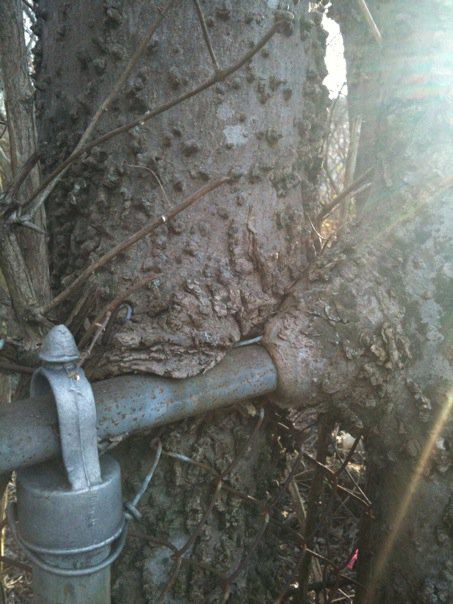
I went to eat at a tiny Persian restaurant in Nashville about two years ago. There was a chain-link fence that surrounded the parking lot. The restaurant was in a former house, so I suspect this was the original fence that marked the back yard. There were three hackberry trees that had grown up around the fence.

Nobody notices hackberry trees. They are weeds. They aren’t that pretty. The bark is bumpy and scratchy and terrible for climbing. The leaves are tiny and don’t turn any color other than brown when fall comes. The berries aren’t for eating unless you are a bird.

But hackberry trees have a lot to teach us about perseverance. They quietly grew. They get taller. These three trees grew closer to the fence. And then they grew around the fence. They didn’t push it aside. They just enveloped it. Year by year, millimeter by millimeter, they wrapped around the fence, becoming part of the fence.

tree2

tree3tree1

Boone, part two

But wait, there’s more! At the same time that “STUFF” was going on, there was more stuff. Some of it was recycled. Some of it was really imaginative. Some of it was really weird. But most of it made me think and wonder and see the world in a different way, and that is the purpose of art.

I apologize for the fuzzy pictures. It is a smidge dark in there.

Look – a “lawn chair”.

b7

Closer. Astroturf on an old metal chair. I’m pretty sure nobody has ever sat on this.
b8

In the same area. I don’t think it does anything except look like it does something.
b12

This artist has taken the old family tablecloth, with its tears and stains from years of use, and highlighted the damaged parts by embroidering them.

b13

Closer view of the top.
b15

A view of the edge.
b14

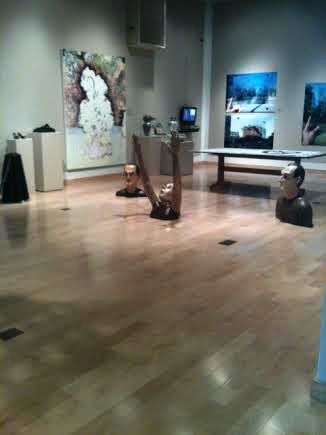
I don’t know what this is. I like it though. People, either jumping through the floor or falling through it. They are carved wood, and larger than life size.
b19

Closer.
b20

Behind that. Something about large photographs of areas with overlays held in front of what the area looked like a hundred years ago.
b21

I thought this was cool. Of course it looks better without the glare from the glass. Day for night, anyone?
b22

A photo of a flag being put up in Antarctica, I think. But the guy on the right is familiar…
b24

Oh yeah, it’s Death.
b23

We went down a different way to get to another floor and ended up in the service area. This wasn’t part of the regular exhibit, but I like it.
b16

b16

Just the head.
b18

In another area. It reminds me of a mandala, but not.
b25

Outside the gallery, down the street, is a statue sitting on a bench. While cool looking, it takes up half of the bench so it defeats the purpose of the bench. I found out later why the flowers were there – it was in honor of Earl Scruggs, who had died recently. The statue is of him. He was born in North Carolina and was a popular bluegrass musician. When we came back to this corner there were hundreds of flowers here.
b11

I’m a little confused because Earl Scruggs is known for banjo, not guitar, but there you go.

Doors of Sewanee.

The University of the South, also known as Sewanee, is found on Monteagle Mountain, in Tennessee. It is glorious. It is beautiful. It is a regular university with regular classes, and it also is a university that trains Episcopal priests to be Episcopal priests. Walking on the campus makes me think that I’ve been transplanted to England, three hundred years ago.

There is a lot to this campus, and it is fun to prowl around it. There are many fun nooks and crannies, and most of the buildings are open for the casual wanderer. I’ve taken many pictures there over the years, but here what I’m going to share with you are some examples of doors from Sewanee.

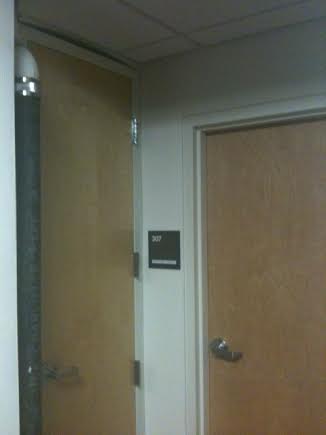
I don’t think they know how to make normal sized doors here. This was found on the second floor of a building that has rooftop access. It is outside of a classroom. Perhaps it fits the fire code’s requirement to have two ways out of a room. Perhaps it is a joke. I’m not very wide anymore, and I think that even I would have to turn sideways to use this door.
25

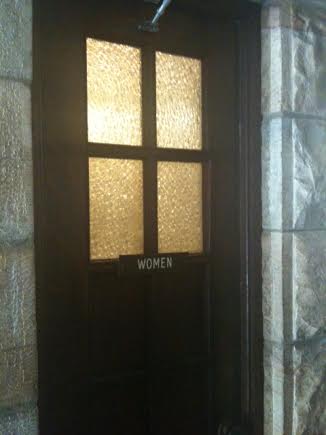
This is a tiny bathroom. It is just big enough for one, barely. I think the door looks a bit like the TARDIS.

228453_3850036647804_1535274110_n

15

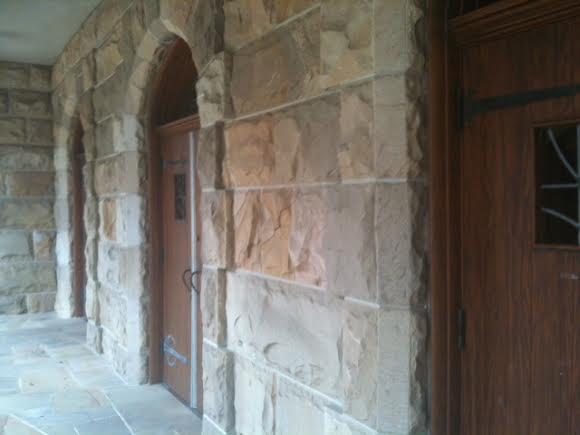
Here’s a classic door from Sewanee. Lots of stone and wood and iron fittings.

3

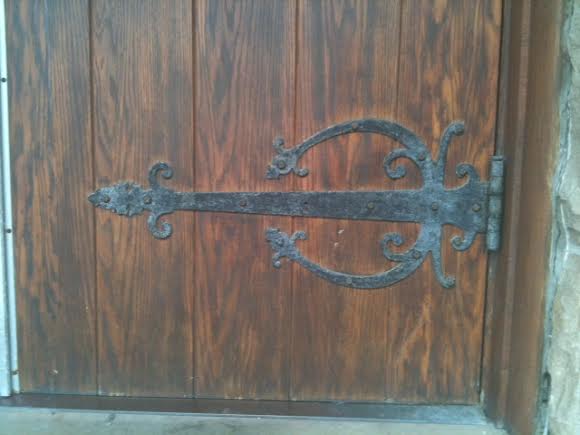
Here’s a detail shot of it.
2

This was on the door for the “Center for Religion and Environment.” In order to find this office you have to find the bell tower. And then you have to go up about five flights of steps. Maybe more. Only fit people can come up here. The room for the bell is just opposite this door. It was lovely to listen to the hiss and wheeze of the pneumatic valves that work the mechanism. It was a little overwhelming to listen to the bell ring that closely, however.

18

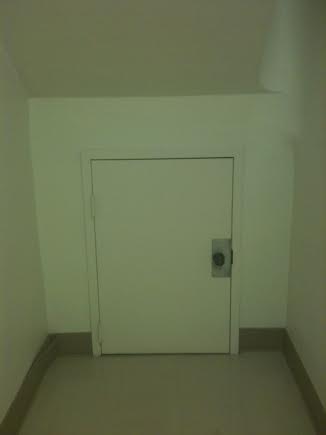
Here’s a tiny door underneath a flight of stairs. At the top of the stairs is the observatory. I have a fascination with tiny doors. I don’t know if I love tiny doors because of Alice in Wonderland, or the other way around.

29

And last, but not least, are some doors for professor’s offices. Perhaps the doors are adjusted to the height of the professor, in the same way that Frank Lloyd Wright adjusted the homes and the furniture he designed for the size of the client? Or perhaps they got a discount on mis-matched doors?

32

31

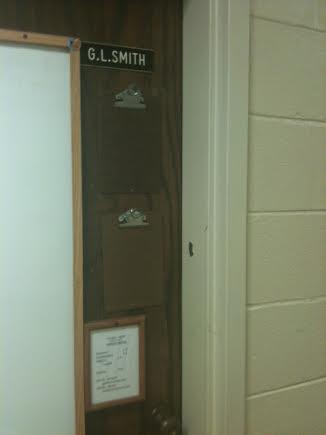
This is outside another office. The door is normal sized, but I really like the tiny clipboards so people can leave him notes.
47

Sure, I didn’t take any pictures of the usual doors you’d expect to see there. Anybody can take those pictures. I wanted to share with you some doors that the usual person wouldn’t see.

I leave you with these words from Jesus in Matthew 7:13 “Enter through the narrow gate. For wide is the gate and broad is the road that leads to destruction, and many enter through it.”

Winter sunset

There are some colors that are impossible to name. They are beautiful and elusive and fragile.

I seem to be enamored of colors that aren’t really solid. They shift from one to another. If you wait ten minutes they change. If you take a picture it will never look like what your eyes saw. Yet, you still try.

I’ve tried to paint these colors, knowing all the while that they can’t be nailed down. That is part of their beauty. They don’t exist on a paint sample card from Lowe’s. They are several colors at once, and nothing in particular.

The winter sunset is one such example.

winter1

winter2

winter3

60492_1433893285730_8354804_n

Sleeping cows.

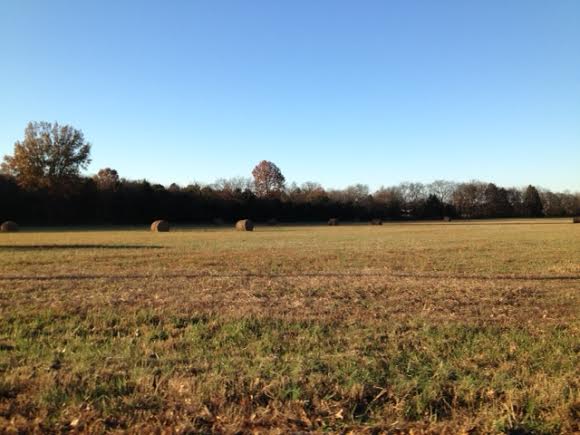
This is the time of year that you see large round bales of hay on farmland. You’re driving along and you’ll look over to a bit of farmland and there they are, haybales.
cow1

Normally, you’d see cows there, but it is fall, and getting colder, so now you see bales of hay.

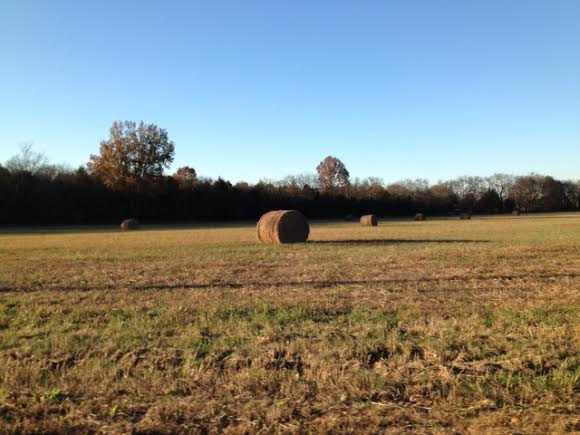
You either see cows, or you see big round haybales, but you never see both at the same time.

So I have a theory. These are hibernating cows.

They’ve rolled up, snug in a nice warm bundle of hay, and they are going to sleep right through the winter.

Now, you’ll never look at a big round bale of hay the same way again.
cow2