Twenty years gone.

It has been twenty years since my parents have died and I almost forgot. The thing that reminded me was a notice from AAA telling me it is time to renew my membership. I’d gotten it after my parents died because I realized I didn’t have anybody to call if I was stuck somewhere with a broken down car.

They died six weeks apart. Mom died first of lung cancer and then Dad died of a heart attack. Mom’s was an expected death, Dad’s wasn’t. It wasn’t a total surprise – he’d never taken care of himself. But I hadn’t prepared for it like we’d had to do with Mom’s.

I remember the first few years after they had died. Every year when the date for Mom’s death would come up I would dread it. I didn’t have to write it on the calendar to remember it. It would rise up, unwelcome. The memories of my loss would come to visit and stay with me like a crazy relative who overstays her welcome. Then, because my Dad died six weeks later, I’d be in a holding pattern. I’d feel like my life had been put on pause for all that time. Six weeks of feeling my feelings, of holding them and examining them. Six weeks of waiting.

What was I waiting for? It was like I was holding my breath until the day that Dad died would roll around. Somehow that day was the day that the strange double-grieving period was over in my head. It was time to start life again then. I was released.

This pattern went on for years. Sometimes I would meet up with a friend of my Mom’s on her death date. We would console each other over a beer and a burger, or a trip to a craft show. Sometimes I would do something in honor of Mom and Dad. I’d listen to their favorite music, or try a hobby that they liked. They were ways of trying to bring them back to me, if just for a little while. It helped.

But this year I’ve forgotten. This year I’ve found myself in the middle of their death days. This year nearly two weeks have passed since my Mom’s death day and I missed it. I figured that this year would be extra different because it was twenty years.

Every year it has gotten easier. I’ve heard there is a sort of half-life to grief. However long you knew the person, take that time and divide it by two. That length of time is the length of time you will grieve for that person. I’d known them for twenty-five years – so twenty years grieving is way past that time. By that reckoning I should be over it.

You aren’t ever over the death of your parents, or of anyone who meant something to you, who impacted your life. Their loss will always mean something. There is a hole that can’t ever be filled.

The hole does get smaller. It can’t ever completely go away, but it can get less like a gaping wound and more like a scar. It will never be perfect. You’ll always know it is there, but it won’t cripple you like it did.

Maybe this is why I felt the need to make lemon delights this weekend. Maybe in the back of my mind I did remember. This was my favorite dessert that my Mom would make. I’d ask for them for my birthday instead of cake.

A few years ago my mother-in-law tried to make them for me when we were visiting around my birthday. She didn’t have baking powder and used baking soda instead. They weren’t the same, but she got bonus points for trying to console me anyway. Even if she had made them exactly according to the recipe, they wouldn’t have been the same because she isn’t my Mom. Nobody can ever fill that spot. But her trying to soothe me was kind.

But somehow, this week, I got the hankering to make them. I’ve never made them before. I haven’t really cooked before, so I haven’t had flour or eggs or baking powder in the house. I hadn’t thought about buying them because I thought it would be wasteful to have these things here just for this one recipe. But this year I’ve been cooking, and with that, baking.

I talked with my Mom while I made the lemon delights this weekend. People rarely tell you that the relationship continues after the person’s death. They don’t tell you how to do it, how to communicate with them and have a relationship. It turns out that they are still with you, in your heart. You can talk to them, and if you are quiet enough, you can hear them. It is beautiful and sad and special. You can work things out. And that is what we did.

I followed her recipe, that same recipe card that she used, in her funny squiggly handwriting. The card is smeared with stains from dozens of years of use. My husband had gone out on a bike ride so it was just me and the recipe. So I started to talk to my Mom. I told her how sad I was that she had not taught me to cook. I told her how hard it was to be without her, that I wish she could see how well I’m doing now. I wish she could meet Scott. I wish she could read my writing. I wish I wish I wish.

And I heard her. I heard her back, gently, lovingly, sadly. I heard her back in my heart as I mixed and blended and sifted. I heard her tell me that in everything I had ever done I had surprised her. I heard her tell me that she thought that because I was “gifted” that I didn’t need to learn these simple basic things like cooking and housework. I heard her tell me that she was sorry, that she didn’t know. She didn’t know that just because I can grasp things quickly doesn’t mean I don’t need them to be handed to me first. She didn’t know, because she couldn’t know.

And I forgave her. And I move on in my grief. I move on in my loss, the loss of my Mom at a young age. I move on in my loss of all the things I wasn’t taught and didn’t even know I needed to know. I move on, but at the same time I’m moving on I’m moving back, and in, and within. I’m moving around inside this hole that was left when my Mom died.

Maybe she was the one prompted me to make lemon delights this weekend. Maybe she knew that I’d come to in the middle of this time and be sad that I didn’t remember, didn’t memorialize it. Maybe she knew that I would need something to hold on to.

She has given me something in this. This isn’t a blanket or a talisman. This isn’t a token or a fetish. There isn’t something to point to or to work with like worry beads. What she has given me is the knowing, the sure knowing, that she is not gone. She has come back to me in my heart, and in that coming back she has restored a bit of myself to me. She is filling that empty hole that was left when she died. She is filling it with herself.
Eulogy for a young mother who died tragically. (Be open to grief)

There are no words for our grief. We are here together, wordless, numb, and hurting. We cannot make sense of this senseless loss.

But we are here. We are here to pay our respects to Hannah. We are here together as a testament to our love for our friend, our coworker, our wife, our mother. We are here searching to make sense out of a senseless thing.

Let us comfort each other in our grief. Let us take this time now to cry with each other, to hold each other, to wail with each other. I invite you to do this now.

In some traditions there is something known as Passing the Peace. You do it by shaking the hand or hugging all the people next to you, one at a time. You say “Peace be with you” It is done as a sign of reconciliation. It is done right before communion, because it is important to approach the Lord’s table with an empty heart – one that is free of the burdens of grief and anger. Those feelings keep us away from our true nature, which is love.

When we are angry or grieving we are closed off and cold. The purpose of reconciliation is to make us open and warm. When we are open we grow. When we are closed we die.

Many of us are angry right now. We want answers and there aren’t any. Why did Hannah have to die? Why did someone we love get taken away from us, so soon in her life?

Many of us are angry at God, and that is alright. Be angry. God can handle it. We are the ones who can’t handle it if we hold it in.

I’m not here to explain any of this. I can’t tell you why she died the way she did. I’m not here to tell you that it will all make sense and it is part of God’s plan. Because it will never make sense. And I don’t believe that God plans for us to feel pain, certainly not this kind of pain.

I believe that God is crying with us, is wailing with us, and is holding us right now. I believe that each time we share our grief with each other, God shares our grief with us.

God is there, acting through us. God is in the arms of the person you hug in your grief. God is in our arms as we hug them.

I invite you to be open. I invite you to open yourself to these feelings and to let them out. Cry. Wail. Talk about Hannah. Talk about how you love her.

Notice I said love, and not loved. There is no past tense with love. Love doesn’t end with death, it just changes shape. Where before the shape was the size of Hannah, now it has to expand. It has to get big enough for us to include each other in it. Every person here has a tiny bit of Hannah in them. When we share our grief with each other, we are also sharing Hannah with each other.

Open up. Don’t close yourself off.

Our society teaches silence and stoicism. Our society teaches us to have a stiff upper lip and that big boys don’t cry. Our society is full of it.

Cry. Let it out. Let it out because that grief will hold you back from life. That grief will hold you back from love.

That grief, locked up, will hold you down under the waves for so long that you’ll stop being able to breathe. That grief, locked up, will kill you. Maybe not literally, but you’ll be dead just as certainly as you would be if you drowned. Grief, locked up, leads to a certain half-life, a certain zombie like existence. Grief, locked up, only delays the pain, it doesn’t get rid of it. Let it out, and live.

Let it out because you have to. Let it out because you must, because you love Hannah.

Talk about her. Celebrate her life. Celebrate the time she spent with you and everything you did together. Do something in honor of her, something that you both enjoyed doing together. Donate to a charity in her name. Plant a tree. Paint. Write. Dance.

Many people say that to show joy in grief is to show disrespect to the person you are grieving for. I say that to not show joy is to not show the love you have for her.

We grieve deeply because we love deeply.

Be open. Be open because you love Hannah.

Peace be with you.

(Written as a eulogy for a young mother who died tragically.)

On process and pain – chewing the steak.

We all have problems. Don’t identify with your problem.

You aren’t an addict. You aren’t an abuse survivor. You aren’t a cancer patient.

With the new guidelines for talking about children with disabilities, we are supposed to talk about the child first, and the disability second. He isn’t an autistic child. He is a child with autism. He is a person first. He isn’t defined by his diagnosis.

Apply the same rules to yourself. You are a person first. The diagnosis is second. It isn’t you. It isn’t who you are. It affects you, certainly. But you are so much more.

When you define yourself by your diagnosis, you are giving it power, and you are diminishing your own.

Now, you also aren’t going to win any friends if you are constantly talking about your terrible childhood or your abusive husband or your sciatica or how you have to take care of your Mom with Alzheimer’s.

We all have problems. We all have something we have struggled with. Sometimes we have overcome it. Sometimes not. Sometimes it seems we can’t ever catch a break. But if you only talk about this, you are going to be lonely. The only companion you will have will be your problems.

Buddhism has a story that speaks to this. A lady’s child had died, and she was unable to accept it. She carried her dead child around the village, going to every house asking for medicine. They were all horrified. One kind person suggested she go to the teacher and sent her to Buddha. Buddha told her to go to each house and ask if they had experienced a death in the family. If nobody had died in that family, she was to get a mustard seed from them. She was to collect all the mustard seeds and bring them back to Buddha, who would then make a medicine for her.

She went all over the village and wasn’t able to find a single family that had not experienced death. She came to realize that her experience wasn’t unique or special. She came to realize that death was part of life, and to hold onto it and identify with it was causing her more problems than the death itself.

Simply going to each person’s house, she created her own medicine. Buddha taught her to look outside of herself, and to not identify herself with her suffering.

How often do we hold on to our pains and sufferings, just like that lady carried around her dead child? How often do we think we are alone in our suffering, that we have it worse than anybody else?

We all suffer. That is just part of life. Holding onto it makes it worse. Accept your loss and your pain, but don’t identify with it. Accept it, because to not accept it means to not process it.

Pain, like a big steak, needs to be chewed thoroughly to be digested. Choke it down and you’ll get sick. Spit it out and you’ll miss the lessons it has to teach you.

Pain teaches us about holding on and letting go. It teaches us about what we think we have to have in our lives and what we really need. It teaches us to accept, and live in the now, rather than in the past or the future.

The past never was as awesome as we think it was. Even in the past we were looking back to “the good old days” and thinking about how great things will be “if only I get…if only I can have…when I finish…” In the future we will do the same thing.

The only island is now. When we aren’t on that island, we are drowning in the sea, stuck away from the solid stability of that island. The past isn’t real. The future isn’t real. The more we live there, the more we are missing out on the only real thing that is, and that is now.

How to get back to now? Start looking at it. Start being thankful for it. Make a gratitude list. Notice what you have, right now, and be thankful.

Pain teaches us about ourselves.

Once we are through chewing on it, we need to swallow it, and then digest it. Then it does its work and then we have to let it go. Holding into pain is just like holding onto poop. We get sick if we can’t eliminate our toxins. But it still has to go through us, all the way. Resist it, fight against it, and you’ll only hurt yourself. Just like a tree in a strong wind, if you don’t bend, you’ll break.

“I’m sorry” – on forgiveness.

There is a difference in saying

“I’m sorry.”
or

“I’d like to apologize for…”
or

“I’m sorry that you felt hurt when I….”

They reflect different degrees of admitting responsibility. They reflect different degrees of accepting how the other person has been hurt by your actions.

There is the true sincere apology statement, and then there is the one where the person understands the social obligation of at least acting sorry. One is real, the other is fake. Don’t be mislead. Even saying “I’d like to apologize for” doesn’t mean anything. The person would like to apologize, but isn’t actually doing so.

And worse, saying sorry doesn’t really even mean anything. If you hammer nails into a tree, and then pull them out, there are still holes there.

Expecting the victim to forgive can actually revictimize her. It puts the burden on her, instead of the abuser. It minimizes her feelings. It glosses over the reality of her pain and loss.

If there has been no apology, no restitution, then there is no closure or healing. Even if there has been an apology or restitution, then is no guarantee that closure or healing has taken place. Once a person has been harmed by another person, sometimes saying “sorry” won’t fix it, and the damage is permanent, especially if the offender has a habit of repeatedly hurting people.

It isn’t fair to the victim to expect her to forgive at all.

Sure, Buddha says that holding on to anger is like drinking poison and hoping the other person will die. Sometimes you have to forgive so you can go on with your life. But forgiveness comes when it comes, and no sooner.

Saying “Aren’t you over that by now?” isn’t kind, or helpful.

Saying “But have you forgiven him in your heart?” makes no sense. What about the liver? Is it OK to still hold some resentment there?

It is the same as getting frustrated with someone who is grieving. Grief takes time, and there isn’t a fixed amount. It takes as long as it takes.

I think people are nervous around grief, or unforgiveness, or anger, because it frightens them. They want to rush right ahead to the happy bit, where all is good and everybody is loving and kind. That Hollywood ending isn’t real. That’s why it is in the movies.

Movies don’t show reality. Sadly, a lot of us have used movies as our role models. This is why a lot of us are in pain. A lot. Our reality never matches up to that reality, and we feel like we are doing something wrong.

Working through feelings is a long process, and our society doesn’t give a lot of help along the way. You have to process your pain, just like how a cow chews its cud. You have to work on it, and wait, and work on it a little more, and wait. You have to transform it into something else. Cows transform grass into energy for their muscles, and then milk.

There is a sort of alchemy here.

Trying to take shortcuts on the process only results in it not really being processed. It will come out half way, unfinished, lumpy. It will come out sideways, if it comes out at all. Sometimes it will get stuck inside, with little jagged bits poking into your soft parts, just causing more pain.

Take as long as you need.

You don’t have to forgive to the extent that you let the abuser hurt you again. You don’t have to forget.

It helps if you can move on, where this rock of grief and pain doesn’t define you, doesn’t limit you, doesn’t keep you stuck in one place.

Work on it. Chew on it. Draw. Paint. Write. Go for a walk. Take your anger with you.

You aren’t running away from your anger and pain and loss, you’re using it as fuel. You’re transforming it into something useful and necessary. It takes a while. It takes as long as it needs to take.

Tear necklace

tears

Shortly after my parents died, I took to expressing myself primarily with beads. I had learned to work with beads when I was in my early 20s when I worked at the Kennedy Center. I had no idea that a few years later beads would be therapeutic for me.
Talking about my grief only seemed to make it worse. Nobody was around to help me know how to process my pain and loss. I was raised in a family that wasn’t very good at expressing feelings anyway. A lot of “friends” left after both my parents died, saying they didn’t know how to help me. It made an awful situation terrible.
I took to beads. Beads have their own rhythm and harmony and logic. Putting beads in order is like putting the world in order, one piece at a time. It gave my hands something to do and my mind something to focus on. One bead, then another, then another. Somehow I made it through. It wasn’t perfect – there was a lot still stuck in my head that I didn’t know how to deal with, but it there was less of it after I made jewelry. And, I made a little extra money by selling what I made.
Beads have a lot of symbolism. Sometimes it is because of the materials, sometimes where they were bought, and sometimes because of how they were made. A lot can be expressed with beads that isn’t obvious to the casual observer. They just see something pretty. Me, I see layers of meaning. A good necklace can tell a story to rival any piece of fiction. A good necklace can exorcise the demons like no crucifix can.
I don’t do this as often now. I’ve found that walking, writing, and yoga help keep me on an even keel. I make jewelry, sure, because I still enjoy it. I just don’t use the beads in the same way as often.
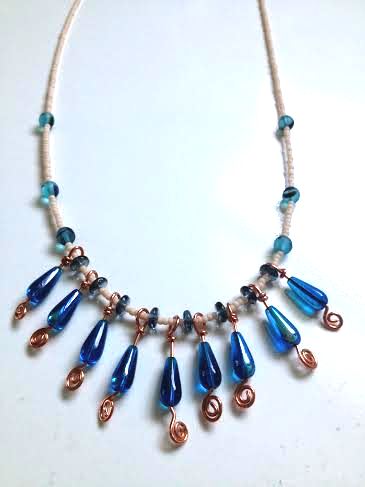
This weekend was hard. I made a necklace. Well, to be honest, I made the pendants on Sunday, and I made the necklace last night. The pendants are “tears”. I didn’t use my full complement of bead-symbolism tricks on this design.
I’d gotten a bag of beads a few weeks ago from a local bead store. The whole bag was only $3, and it had enough beads to make maybe 5 necklaces if you added in others to space them out. The bag was full of blue beads in different shapes – all Czech glass. Sure, I could have used just the beads from the bag to make necklaces, but all of one color in a necklace is a little much and the design tends to get lost.
The bag had lots of these little teardrop shaped beads in it, and I’d wondered what to do with them. I could create a pattern with two of them, round end facing each other, with a larger rounder bead in the center. That didn’t really appeal at the time. The beads were sitting in a saucer near me when I was having a down day on Sunday (hooray for the holidays!) so I started working with them. One of my favorite things to do is work with copper wire. I pulled it and the beads out and started making pendants. By the time I was done I felt better. Probably the fact that I was discussing how I felt with my husband at the same time had something to do with it. I still think the beads helped too. They are like a security blanket.
Last night I put it all together. The other blue beads are from the same bag. The tiny “11s”, the white beads, are from a separate purchase. I like how it came out. Some people turn lemons into lemonade. I turn pain into jewelry.

Victim beads

The last time I went to my spiritual director, we talked a lot about the people who have harmed me in my past. This wasn’t really what I wanted to talk about. I’d rather just jump right ahead into forgiving them. She wants me to pick open that wound and study it for a bit. She wants me to dig down to what I’m feeling. Then dig down below that.

Anger, sure. But beneath anger is sadness, and grief. It is a sense of loss, of not-having, of never-will. It is a sense of something that I think should be mine, isn’t.

This is a foreign feeling, and even more foreign that an expert is telling me to stay with this feeling. Surely I should “turn the other cheek,” right? Surely I should “forgive and forget,” right?

But she says to stick with it. Every month I come back and I’m ready to forgive and she thinks I’m not ready yet.

So, par the course for me I made a bracelet to help me remember. I put a bead to remind me of each person who has harmed me. I did this fairly fast, so there are some I’m forgetting, I’m sure, but fast work means that I don’t overanalyze it.

prayer victim

I’ve also been writing about how I was harmed by my parents, and also my brother. Writing about it is hard. I don’t want to dig up these old bones. She had me look at that feeling – why do I not want to talk about it? In part it is because I feel like I am betraying them. I feel like I’m being disloyal to them. We aren’t supposed to speak ill of the dead. Nothing is stronger than blood, right?

I say that they meant well, that they didn’t know any better, that they themselves were raised badly. She says those are covers. That there is something I’m not looking at. That I need to focus on how I was harmed. I need to focus on that I was harmed.

There is certainly a bit of shame that comes in the mix when using the word “victim.” Am I to blame for what happened to me? Is it my fault? Could I have stood up for myself? Was I too passive? By not speaking up for myself, I allowed it to happen. They couldn’t have known they were harming me unless I said something. To not speak up is to give acceptance.

I hate going to the spiritual director’s. Every month, about a week before, I start to dread it. I don’t want to talk about what she wants to talk about because it is going to be hard. I want to make a list and tell her what we are going to talk about and use up all the time so that I don’t have anything hard to talk about.

But then that wastes the whole point of going. It is like going to a personal trainer at the gym and saying all I want to do is jumping jacks for an hour. I’m not going to work on anything meaningful that way. I’ll have wasted my time and my money. She’s like a personal trainer for my soul. We dig down to uncover broken pieces and blockages.

I read once that the goal in life isn’t to learn how to love. It is to remove all the barriers we have put up against love. I think the person quoted Rumi. I’m sure he said it better.

But look, here I go, walking away from the topic again. I’m a wiggly one, always trying to get away from what bothers me. I guess that is normal human nature. We often try to anesthetize ourselves or run away.

Let’s try again.

It is important to acknowledge loss. It is important to admit that it happened. To heal it, you have to know it is there. And that means a lot of digging.

So while I’m constructing the victim bracelet, I’m realizing that these are all people who have sinned against me. And then I think – what about all the people I have sinned against?

Am I justifying? Am I putting the blame back on me? Am I letting them off the hook? Am I avoiding the problem? Sounds like it.

So I’m staying with this. I’m not through it. I certainly want to be. I want this to be over and done and healed and let’s go on to the next thing and make it a happy one, please.

And I’m running away again.

I’ve heard that grief takes a long time. I’ve heard that you grieve for half the amount of time that you’ve known the person. This is grief. This is going to take a long time. It has grown down deep. And just like digging out privet in the back yard, this is going to take a lot of work and some special tools to get all of it out. Leave just a little bit of privet root and it will come back next year. Cut it down at the top and it will get even stronger and root down further. The only way to get it out is to dig it up, all of it. And the only way to do that is to work on it patiently and thoroughly.

At the intersection of grief and anger.

What is in the middle between grief and anger?

These are conflicting emotions. My spiritual director once asked me what I felt towards God, who took my parents. I’d never thought of it that way. I’d always just thought they made bad choices. They died early because they smoked and ate poorly.

But if I truly believe that God is in charge of everything, then I have to believe that they died when they did because it was the time that God had alloted for them to die. And then the next thought is that all the grief and ugliness of my childhood was meant by God to help me. Eckhart Tolle says that waking up to the truth is easier if you have a hard life. If it is easy, you don’t have to work on it. In the same way, God is said to put trials to us because God wants us to do better.

You push those you want to encourage. It may look like you are being difficult to them, but in reality you are putting a lot of effort into them because you want the best for them.

It is kind of a paradox.

So is this feeling. I was angry at my parents for making bad choices, and for abandoning me. Then I framed it in terms of God’s will. If this is all something from God, then I’m OK with it.

I’m no longer one who gets mad at God. I’m starting to understand that God’s perspective isn’t my perspective, that the things that look “bad” now are just part of the process. Rumi speaks to this in “The Guest House.” Everything is as it is, not good or bad. Grain has to be ground up and then baked to make bread. Grapes have to be pressed and then fermented for a long time to make wine.

The same is true for us. We are the grain and the grapes. We are raw,unprocessed. We are better when we are molded. Our hard experiences create us into who we are.

Once I remembered that God was in charge, I wasn’t angry or sad anymore. I was a bit of both, and then they cancelled out and I found myself somewhere in between.

I think we call that grace.

Grieving the parents that never were. On death, and healing when your experience doesn’t match up with the self-help books.

So many self-help books tell you how to deal with your parent’s death if it was a good relationship. What if it wasn’t good? What if it was terrible?

If your parents were less than ideal, you aren’t alone. Parents are people, and people aren’t perfect. But when a self-help book assumes you are sad and distraught because your “pillar of the family” of “chief cheerleader” dies, you may be feeling even more lost. Your feelings don’t match up with what it says in the book.

Sometimes your grief comes from the fact that you are now doubly missing a parent. The person who gave birth to you is now no longer physically present, while they never were emotionally present. When an emotionally distant or abusive parent dies there is no longer any hope of having a healthy relationship with her or him. All bets are off, all chances are over.

Some books say that you can create a healthy relationship with the person even after the person has died, but this honestly makes no sense. It takes two to have a conversation and work on a relationship. The only thing left to fix is yourself and your understanding of the relationship. Do you let this bad start stop you from going any further? Or do you learn from it and go on?

There are a lot of conflicting emotions when your parents die, and it is made even worse when the self-help books make it worse by making you feel like something is wrong. Worse, it is not only that something is wrong, but something is wrong with you in particular. It is like opening up an instruction manual on how to put together a piece of furniture and the box is missing the bag of nuts and bolts. You don’t have everything necessary to make it work. The instruction booklet assumes you do. The booklet plunges right in, assuming you have all the parts. You read along, trying to make it work, trying to learn how to heal this rift, this grief, all the meantime you didn’t start out on the same ground that it assumes you did. When you get to the end, the picture of the finished product looks nothing like your result.

It can’t. You are missing some important parts that hold things together.

I’m not sure how to tell you how to find those nuts and bolts. I’m just trying to honor where you are coming from, because it is where I am coming from. I think a lot of us had less than ideal relationships with our parents.

I think it is totally normal to be sad that your parents died because now you will never have them as the kind of parents you need. That relationship has ended. They weren’t there for you, and now they never will be.

I also think it is totally normal to be relieved that your parents have died if the household was abusive. I know that there is a sense of guilt for feeling this. I think that is because society assumes you should be sad, when really you can’t be sad. I think to be sad that you are free of an unhealthy relationship is insane.

I think it is healthy to feel however you feel you need to feel, without regard to what people think you should feel. It think it is very healthy to get these feelings out – don’t bottle them in, and don’t deny them. If you stuff them down they will come out in ugly ways later. Trust me on this.

There are a few ways I’ve learned to deal with these feelings. Pick a couple. Try them out. If it doesn’t work, try something else. This is by no means an all-encompassing list.

Talk to a therapist or a counselor or a faith leader or a compassionate friend. Go for a walk or a run. Punch a pillow. Cry, sing, wail. Jump up and down. Dance. Journal – write it out. It doesn’t matter if you are good writer or not – you don’t even have to use sentences. Create – use non-word activities to get it out. Sometimes words fail us. Draw, paint, garden, make jewelry – anything where you can get your feelings out.

Most importantly, have patience with yourself. This work of grief, especially grief concerning a broken relationship, is hard, and it takes a long time. Know that what you are going through is normal. You aren’t alone. It is hard work, and it is important work.

What the books don’t tell you is that this isn’t the end. Just because your biological parent wasn’t up to snuff doesn’t mean you can’t find new role models. You can have second third and fourth parents. You get to pick your parents this way.

You can have one friend teach you how to cook. Another can teach you how to sew. Another can teach you everything you want to know about fly fishing. You can take a class too, or read a book, or watch a video. You aren’t stuck with just one set of parents. There are hundreds of people who are able and happy to teach you whatever skills you need to know.

The escape artist.

It was a very hard time when my Mom was sick. There were a lot of very difficult things that needed to be done, and only me to do them. I was in my early twenties and my family and friends had bailed on me.

I wasn’t prepared for any of this. My Mom wasn’t supposed to die at 53. I didn’t know how to deal with chest tubes or administering medicine every four hours for months at at a time. Just because I’m a daughter doesn’t mean I’m a competent caregiver.

So I separated myself. I believe it is called dissociation. I was there, sort of. I did all the stuff that had to be done, but I didn’t think about it. My mind wasn’t there. It was too hard to deal with but I couldn’t run away from it like my brother and father did. So I ran away in my mind. It was kind of being like an escape artist, like Houdini. I smoked a little pot to take the edge off. Years later when I had the time I went a little crazy because I’d not had the ability or time to grieve. There is nothing like learning how to deal with grief like being in a mental hospital.

There isn’t any training for this. It is hard enough to watch your mother die. It is hard to be a caregiver for someone who is dying. It is impossible when the dying person is your Mom.

It is very intimate caring for someone who is dying. It is very intimate to be with them in the middle of the night when they start freaking out about all the things they haven’t done, or about the afterlife. It is very intimate dealing with bodily fluids and pain.

In a way it was my gift to her. She gave birth to me. I helped her die. There is a strange balance here.

She didn’t die well. She had spent most of her life avoiding thinking about the future or anything really important. She didn’t plan ahead. She had no retirement fund. She didn’t take care of her health. She never got any education past high school. As for her soul, she ended up getting her religious education from me.

It is very weird being your mother’s teacher. I had read quite a bit about religious matters in the previous years, and had returned to church at 20. It was the same church where she was married, but hadn’t gone to since. The minister I found for her was from the Episcopal student ministry I was part of. He didn’t know much about how to prepare someone for death, so I got to do it. Something was better than nothing. At one point I gave her a copy of Stephen Mitchell’s “The Gospel According to Jesus.” The priest thought it was watered down. He didn’t approve of that translation. He wanted her to read the Bible. I pointed out that she didn’t have time to read the original. Sometimes you aren’t able to eat big meals, and all you can handle is baby food. This was the Gospel in a distilled version, just the words of Jesus. Easy to digest. Baby food. It got the point across in a way she could handle.

But there was nobody there to train me. There was nobody around to tell me how to deal with the heaviness of my Mom dying and the heaviness of dealing with the strangeness of dealing with the very real and very gross nature of dealing with someone who is terminally ill. I prayed a lot. God helped.

One “friend” wrote to me to tell me how sad she was that my mother was dying. Her advice to me was to “let Jesus into my heart”. I can’t stand Christians sometimes, and I am Christian. I was really angry when I read that letter. She didn’t know that I’d gotten confirmed years earlier. She didn’t know that I went to church every week on my own. She didn’t know that I’d helped create the Episcopal student ministry. She didn’t know because she didn’t ask. She’d been a friend in high school but we’d grown apart. She assumed that the answer to my problem was Jesus, not knowing that I was already a Christian. She would have taught me more about Jesus if she had shown up and helped. “Letting Jesus into my heart” didn’t get the laundry done or the groceries bought. “Letting Jesus into my heart” didn’t help when my Mom needed more pain medicine or a Valium at four in the morning.

Houdini died from being punched in the stomach. He had a trick that he did where you could punch him in the stomach as hard as you wanted and he wouldn’t be hurt. The deal was that he had to prepare for it first. He had to know it was coming. The person who punched him the last time didn’t know about that and just hit him.

We are like this. We need time to prepare for heavy things. We can handle quite a bit if we have some warning and training. But when we get blindsided, we can get really hurt.

This experience didn’t kill me, but it did teach me a lot. It taught me about my own strength. It taught me that there were a lot of people I couldn’t depend on. It made me grow up fast, a little faster than I was ready for.

In memorium.

Should we grieve more for one person and not another?

Is the death more tragic if it is a young mother, or if it is an old spinster?

Is it more sad if a child dies or if an adult dies having never really lived?

Is it more tragic if a famous person or an unknown dies?

All deaths are meaningful. All deaths are sad. All are different. The homeless woman’s death is just as important as the Queen’s. Death will take us all. Death is the great equalizer. Death wins.

We can pretend that death is far away. We can pretend that it will happen another day, to another person. We are special. We are different.

We aren’t. All of us are going to die, one way or another. Like it or not, you can’t escape it. You can’t take your toys with you. There are no guarantees of life, no do-overs.

Tomorrow never comes.

Until it does. Don’t take it for granted. Take it as a gift. Don’t waste it.

Every day is a new gift. Every day is another chance. Make that phone call. Write that book. Start that search for the job where you feel useful and needed and worthwhile, where you get to do what you feel called to do. Go back to school. Whatever. Or learn how to be happy where you are.

One of my friends from high school died today. She was in her mid 40s. Young. With children. A beautiful soul. We hadn’t seen each other since then, and had only recently found each other in the past few years on Facebook. She had brain cancer. Cancer is a terrible way to go. It eats you up, slowly transforming your cells into cancer cells. The treatment is barbaric. Slash and burn, poison and cut. Sometimes the treatment is worse than the disease.

Sandy and I first knew that we had something in common while we were in Economics class. We were bored. We were sitting several rows apart. Somehow I caught that she was quietly singing a Violent Femmes song with a friend of hers. I knew it – and I started singing along. “I take one, one, one cause you left me, and two, two, two for my family…” I knew it, and I was in. I had the secret code that let her know I was weird. Once you were in, you were there. We were great friends after that. The last thing I remember doing is going trick-or-treating with her and two other friends. We were too old to go, really, but we went anyway. Sandy drove, and we picked the rich neighborhoods for our hunt that night. We did well.

I’m grateful to have known her. I’m sad, not really for me, but for her family. I hadn’t seen her in many years. We’d grown apart, like people do. Her loss won’t hurt me as much as it hurts them. But I hope to remember something of her spark, her spirit, her smile. She was funny, and snarky, and smart, and beautiful in all the right ways.

Rest in peace, Sandy Scott. May your memory be a blessing to all who knew you.