Notes from the Dalai Lama’s talk, May 19th, 2013

I went to Louisville, KY on May 19th to hear the 14th Dalai Lama speak on “Engaging Compassion”, along with about 14,000 other people. These are my notes from that public talk. My comments are in parenthesis.

This is the century of dialogue. More and more people from all over the world and all religions are talking with each other.

America is the leader of the free world, so it is possible to lead the world in compassion.

It would be good if America could import its democracy style to China.

He is Buddhist, and he prays every day, but he accepts the limitation of prayer. Real effect comes through action.

To make the entire world better, start with yourself. Your actions make a difference.

If you have respect for other’s well-being, then there is no room for violence.

Peace starts within you, now. It creates a ripple effect.

When we are born, our survival is based on other’s care and affection. This continues to be true as we get older. The survival of humans and the planet is based also on care and affection from others.

If you have a healthy mind, you will have a healthy body. If you have a peaceful mind, you will show compassion. If you show peace towards others, you will be healthy. Showing compassion is a benefit to yourself as well as the world. Anger is self-destructive. The counter force to anger and hatred is tolerance.

Attachment leads to bias and a loss of objectivity.

It is possible to have faith in your tradition, and still have respect for all traditions.

On war – If one person kills another person, he is a murderer and goes to jail. If a soldier kills a thousand people, he is a hero. (Killing is killing, no matter who does it.)

The biggest moral and social problem is the gap between the rich and the poor. It is similar to the caste system in India.

There is a oneness within all human beings. We all have the right to be happy.

It is possible to oppose another person’s attitude but still love them.

Instead of anger, have pity. (It is more compassionate to feel sorrow at another person’s bad choice of behavior than to be angry.)

Have a genuine concern for other’s well-being.

Separate action from actor. Oppose the action, forgive the person. People are not what they do.

We must respect all of God’s creation. So environmentalism should be part of your faith.

There are over one billion non-believers, so we must find different ways to help them to understand how to have a “happy life and a happy body.”

In India, “secular” means “respect for all religions,” as well as “respect for non-believers.” (It is not negative like in America, where “secular” means “not religious.”)

Thomas Merton was a bridge between Buddhist and Christian monks. If you follow your own tradition, you will discover that we are all following the same practice.

Politically, His Holiness the Dalai Lama is Marxist. He believes that in capitalism, if profit is the goal, then humans suffer. Humans are more important than profit.

(Edit) – I’m adding some pictures to this, since I’ve figured out how.

On the way to the event –
dl6

Waiting outside to get in. We got there about an hour early. There was a long line past us.
dl7

Seen outside the auditorium.
dl8

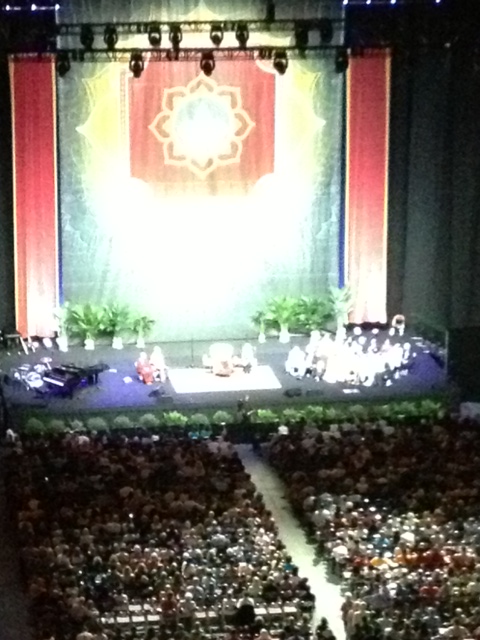
Our seats were really really high up. The rest of the crowd has not arrived yet. We had time to get and eat our lunch there.
dl9

The Dalai Lama has arrived. The tiny red dot in the center is him.
dl1

dl2

On the Jumbotron.
dl 3
dl4

dl5

Compassion

Compassion is about love. It is not only about feeling love, it is about showing it and making it real. Prayer is great, but action is greater.

Part of showing love is being aware that every single person is worthy of love. This includes the nice people and the not so nice people. Jesus tells us that it is easy to love the nice people. The real test is how do we treat people who are mean?

A lady asked His Holiness the Dalai Lama when he was in Louisville, KY on May 19th, 2013 how to be compassionate towards the Boston bombers. I think his answer can be used for any situation where a person has been violent. He said we must separate action from actor. The person is not the deed. The action is bad. But there is hope for the person. The person made a bad choice. The person is still deserving of love.

Jesus tells us we are to love our enemies. Buddhists tell us we are to do the same. I’ll add that perhaps if the person had been shown more love in his or her life, she or he would not have been violent.

All behavior is communication so the behavioral manuals say. Children will seek attention in a negative way if they don’t get it in a positive way. What can we do, in our own actions, to make this world a better place? Every single act of kindness can literally save the world.

Remember the story of Abraham bargaining with God that Sodom and Gomorrah would not be destroyed if just ten good people lived there? Sadly, ten good people weren’t found. But how do you know that the same situation isn’t about to happen with your town?

This gives a whole new meaning to the line “Be good for goodness sake.” Your goodness isn’t about getting you a present from Santa Claus. It is about saving the world. It can bring about true healing.

So how can you show compassion? Start off with not being judgmental. You never know what the other person has gone through. Be kind to everyone. Smile. Complement them. Think of the other person’s needs. Put yourself in their shoes. Learn about other faiths and cultures. Learn how to say thank you in other languages.

Think about what you say you believe and what you do. Are they in harmony? If you believe that it is important to take care of the earth, then you need to recycle, and use less gasoline. Buy less stuff. Consume less of everything. Be mindful about your actions – what are the repercussions of what you are going to do, what you bought? Who is affected? How does this affect the earth? Everything is connected.

Being compassionate is about respecting the idea that every person is on their own journey. It is about being patient and kind with everyone. It isn’t about converting others to your belief system – it is about sincerely practicing your own.

Action and Actor

The Dalai Lama, in his address in Louisville, Kentucky on May 19th, 2013 talked about the difference between “action and actor”. The person is not what they do. While the action may be bad, the person themselves is not. I liken this to when Jesus said “Forgive them, Father, for they know not what they do.” Jesus was dying on the cross. It was a painful, degrading, public way to die. His disciples had left him. The soldiers were gambling for his clothing. In that horrible, embarrassing, difficult moment he showed compassion. He understood the difference between the action and the actor.

Forgive the person. They can’t help it. They would if they could.

Every single person is made in the image of God. Every single person has within them the light of God. It is through the will of God that each one of us continues to exist moment by moment, heartbeat by heartbeat.

Consider Judas. He has long been considered the bad guy in the Gospel story, but his role is essential. There are no saint medals for him, there is no special day set aside to commemorate him. But if it weren’t for Judas, that part of the prophecy would not have been fulfilled. Jesus knew that he was going to be betrayed by Judas, and forgave him. How many of us would be able to forgive someone who was going to betray us?

I have to confess that I have a soft spot in my heart for Judas. He was a pawn. God made him do what he had to do. When he came to his senses he killed himself. What a horrible thing to realize you have just sold out the person you believe to be the Messiah, the Savior, the Son of God.

Something about this story appeals to me personally. I have long wrestled with my calling and felt that it was not real. Who would listen to me, a bipolar lady who says she hears from God? God has enough crazy people who say they are His followers. The Christian faith doesn’t need any more crazy people. But if God can use someone like Judas, the most hated disciple, to bring forth what needs to happen, then who am I to argue?

We are told that if you trust in God, you know that all things work for good.

All things. Even the stuff that looks wrong and crazy and weird. Even the acts of terror. Even war. Everything is in God’s control. If we really believe that “He has the whole world in His hands,” as we teach small children to sing in Sunday school, then we need to start actually acting like we believe it.

Part of that is found in not judging anything. Not just not judging people, but not judging ourselves and events. Not deciding if things are “good” or “bad.” This is very Zen here. But it is all about accepting everything and everyone and every moment exactly as is. Without judgment, without trying to change what is, and without trying to escape.

We are told that every moment is the guru.

Every illness, every failing test score, every unwanted, unkind word, everything is our teacher.

Even Judas.

God bless us, every one.