Jealousy leprosy

Jealousy is a terrible emotion. It makes you think that you are not in control of your life. It makes you think that other people have stolen something from you that is yours. Rather, something that you think should be yours. But the bad part is the reason you are stuck in the place you are is because of your jealousy. When you start to blame other people for your problems, that is your problem.

Eleanor Roosevelt said “No one can make you feel inferior without your consent.” Likewise, all of your emotions are up to you. Someone else cannot make you feel angry or sad or upset or even happy. You choose to feel these feelings when they say or do whatever they say or do. You are entirely responsible for how you feel, not other people. For you to make your happiness or sadness dependent on someone else is to give away all of your power.

Taking care of your parents when the relationship is bad

There is nothing about being an adult child that means you want to take care of your parents. There is nothing about the situation that says you even know how to.

You didn’t enter into this relationship voluntarily. Nobody asked you if you wanted to be the child of these people, and nobody asked you if you wanted to take care of them as they got older.

Just because they raised you doesn’t mean you are obliged.

What if they did a poor job of raising you? What if they were abusive? What are your obligations and responsibilities then?

Sure, there is social pressure and Christian guilt to deal with. Society expects you to drop everything and take care of these people. Forget the fact that you barely have enough time money or energy to take care of yourself.

Getting married is a legal commitment. You swear before your friends and family and a witness that you will take care of each other, no matter what happens. You make no such commitment to your parents. It is all passive. You are born into this family. You have no choice, and you haven’t promised anybody anything.

But yet you are expected to drive them around when they can’t anymore, to cook for them, to spend the night at their house when they are afraid…the list goes on and on.

Taking care of your parents is like taking care of children, but in reverse. As they grow older, they grow more needy and less able to care for themselves. As they grow older, they grow less independent and more dependent.

The really big problem is that unlike children, they remember being independent, and they don’t know how to receive help. They certainly don’t want to get help from their children, regardless of their age. They feel that something is wrong with this situation, and that they are losing control and power. That only makes the situation more difficult.

Another problem is that nobody trains you, the adult child, how to take over responsibility. Nobody tells you that now you are the parent and they are the child. So it is hard for you and for your parents.

If there is a history of abuse or neglect it is even harder.

People who had a great relationship with their parents cannot understand this.

Get me away.

It is very hard for me to be any part of the madness going on with my husband’s family right now. I write about compassion and serving people like they are Jesus. I also write about boundaries and dysfunctional families.

These two things don’t go together very well sometimes.

Dealing with them is like dealing with alcoholics. It is as if I have a friend who is a drunk. I say “Don’t drink and drive, because you might have a wreck” and they think they know better, so they drink, and drive, and total their car. And then they say “Hey, I don’t have a car anymore, can you drive me around? Or lend me money for a new car?”

They aren’t drunks. They are just needy, and manipulative, and making bad decisions. They want things done for them that we don’t have the time, energy, or money for. They want things done that I told them we would not provide, yet they are getting them anyway.

The only trips they took my husband and his brother on were of the guilt variety. Lots of abuse – physical, verbal, emotional. It is hard to muster up the desire to take care of someone who harmed someone I love. It is hard to want to help them when they have not admitted to or apologized for the damage they did. They continue to manipulate and control, even now.

And I just have to get away from all of this. It doesn’t require the skill of a prophet to see where all of this is headed.

I told them not to get a house with a yard when they moved up here. I pushed for them getting an apartment. They are both old and not as able to take care of themselves, much less a house with a yard. Plus, when they die or have to move into assisted living, that house will have to be dealt with. That mortgage will still have to be paid.

By us.

I told them that my husband barely has time to take care of our yard and house, and they said that they wanted a yard because she wanted to garden, and he needed the exercise. Neither has happened. They call my husband or his brother over to work on their yard and to maintain their house. Electrical switches, plumbing issues, hedges trimmed. So work doesn’t get done at our house.

A year ago my mother in law finally started to admit to herself that her cancer diagnosis was terminal. In the meantime, my father in law’s Parkinson’s has gotten worse, and he’s starting to get dementia.

I said they need to move into assisted living, ASAP. Nobody listened to me. They are toughing it out at their house –their house which is too big for them. That house is impressive, a show. It isn’t practical. It is bigger than they need. This is normal for them, always having to impress people, always having to have the best.

She’s in rehab right now. She passed out, hit her head, got a concussion, and broke her leg. Rehab, to teach someone how to walk again – someone who will be dead in probably three months because the cancer has spread to her lungs.

They are not thinking ahead. They are about to leave a big mess for us to have to clean up.

See? They didn’t listen, wrecked the car, and we are having to pay for it.

I’m trying to be Christ-like in this. What would Jesus do? What should I do?

But then I remember that Jesus didn’t have to deal with his parents in law, or even his parents. Jesus never got married, and died before his parents did. He raised people from the dead. He didn’t have to watch them die or bury them or sell their stuff. And he certainly didn’t have to do any of that while working a full-time job.

I finally realized that my parents-in-law or my husband or his brother, or even his wife – none of them have been the caregivers for a dying person. I’m the only one who has. I’m the only one who has also handled an estate. I’m giving advice on what to do next because I’ve been there, and they are ignoring me. They think they know better. They are pretending like this will all go away.

Meanwhile, everything that I said was going to happen has happened. I can see the train on the tracks, headed right for us.

I’m trying to stay out of it. I can’t handle any of this madness.
I hate it.
I’m angry and sad and tired.

I want to do the right thing. I also don’t want to be seen as a hypocrite – someone who talks about Jesus and compassion and service and then bails when the going gets rough, when things get real.

But there is also codependency and enabling to consider too.

If I rescue them, if I essentially say that it is OK for them to screw up their lives and drag us down with them, that isn’t being very loving.

Sometimes there aren’t any easy answers. Sometimes there aren’t any answers at all. Sometimes there isn’t a happy ending. Sometimes it just sucks.

Adulthood – being independent versus being an “adult child”.

I saw a Facebook post recently that I really liked. It said “I think you should pay for your own mortgage, birth control, college loans, food, and cell phones. This isn’t because I’m a Conservative. It is because I’m an adult.”

If you have to have someone else pay for these things, whether it is your parents or the government, you aren’t an adult.

I’ve never identified as a Conservative, but I agree with this.

I feel that people need to take care of themselves, and the more that we do for them, the more we are harming them. The more we let people take care of us, the more we are stunting our own growth.

Remember the phrase “Age is just a number”? That is usually used to say that it is never too late to play. It goes along with “You are only as old as you feel”. These are meant to be inspiring. These are meant to encourage you to follow your dreams and to be yourself.

But they have another side to them. You can be 40, even 60, years old and still dependent. You can be technically an adult and still act like a child – expecting everybody else to take care of you and clean up after you. You can be an adult legally, but a child emotionally.

Now, is that your fault, or the fault of the people who rescue you? If nobody rescued you, you’d have to take care of yourself.

Some important words here –
Codependency.
Enabling.

I know too many “adult children” who use their parent’s library cards because they have run up the fines on their own. I know too many “adult children” who blame everybody else for their own problems. I know too many “adult children” who live at home with their parents.

I’ve met many “adult children” who still use their parent’s address as their legal address. They say “Well, your parents are always going to be there, right?”

No, they aren’t.

I’m starting to think that one of the best things my parents ever did for me was to die when I was 25. It made me grow up fast. It made me have to become independent. If things get hard, I can’t just move back in with my parents. I can’t just quit my job or get divorced when things get hard and retreat back to my old room. I can’t call them up and beg for money when there is an emergency.

I have to plan ahead and look out for myself. I had to become an adult.

And I expect everybody else to do the same.

Memory postcard – me and my grandmother

MP1

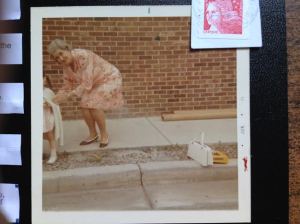
This is a “postcard” of me and my grandmother. She is the only grandmother that I knew. She was my father’s mother, and her name was Mary Frances. I called her Mama. My mother’s mother died before I was born.

My aunt sent me this picture recently. I’d never seen it, but I knew when it was taken. There is another picture of me from that same day, wearing those same clothes. It, however, has all of me and not just half. I’m not sure where that picture is anymore. Probably in a box in a closet. I’d had this picture sitting out for a while. It needed to be put in a frame of some sort. It needed something.

Here’s a closer picture of the photo that started it all.
MP2

The back of the picture says “Betsy and me at the Holiday Inn, Chattanooga”. It is written in blue ballpoint pen in my grandmother’s handwriting. The printing on the side of the picture says “Jun 71”, so I was two years old. I’d been swimming – my hair is wet. I was cold, and my grandmother has put her ever-present white sweater on me to keep me warm. Yes, my hair is wet, and I’m not wearing a swimsuit. So that means I was changed into normal clothes and nobody dried my hair. My grandmother has her handbag nearby. This is big and stiff and white, like all of her purses. The one I remember the most was a white wicker contraption. It was fascinating.

I spent most of yesterday sorting my stamp collection and my collection of fortunes from fortune cookies. I have a slightly disturbing amount of both. Fortunately they are tiny paper things, so having a lot of them doesn’t take up a lot of space. I pulled out ones I liked as I was sorting, with no particular idea what I was going to do with them. At night I knew – put some of them together with this picture. It is like a postcard of memories.

The fortunes all have meanings for me. They are like pithy snapshots all to themselves.

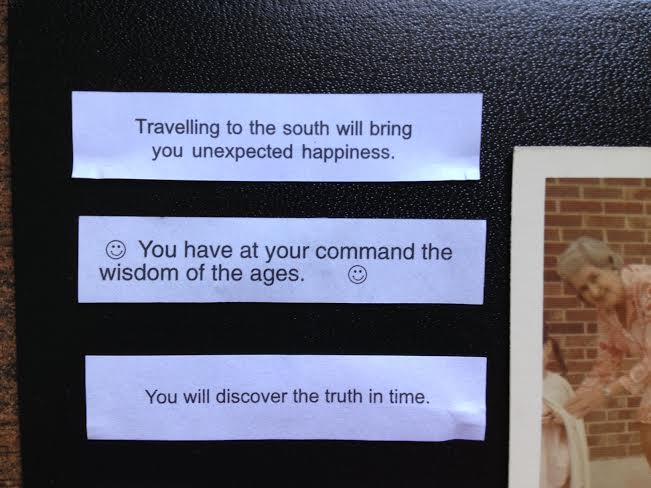
Here’s a closer picture of the first three.

MP4

“Travelling to the south will bring you unexpected happiness.”
There were two of these fortunes in the collection, and I’m amused by how specific they are. The south – not the north, not just traveling, but the south. I found it interesting, so I pulled them aside. Now I know why. I went south to visit my grandparents every summer for two weeks while I was growing up. We’d drive down as a family to meet up with my grandparents in Gadsden, Alabama and go to Noccalula Falls. It was halfway. Then my parents would drive back home, and my grandparents would drive the rest of the way to Birmingham with me in the car. Two weeks later they would reverse the procedure to return me.

Was it unexpected happiness? It was certainly different from the norm. My grandparents slept in separate rooms. My grandmother had two single beds in her room. I’d sleep in the one closest to the wall. The blankets were white with pom poms on them. The “Birmingham fairy” would visit and there would be a present under my pillow. Was it every night? Or just the first night? I don’t remember. No teeth had to fall out to get a present. It was just for being there. I remember being stunned how it happened. I’d see something I liked at a store we would visit and it would show up under my pillow the next morning. It was magic. I never saw my grandmother buy anything that I later got under my pillow. She was part elf, I think. She taught me how to palm money, but that is another story.

At night she would give me chocolate milk to drink, and in the morning she would put sugar in my orange juice. She’d also put a packet of sugar in my applesauce when we went out to eat. We went out to eat every meal. Really. Every meal. “Grandmother’s cooking” means nothing to me. When I think of food associated with my grandmother, I think of the Piccadilly café. Buffet lines were the norm. She didn’t cook. The only time I saw her use the stove was to dry of my shoes if I’d played outside in the rain, or to heat up mud pies that I made in little cast iron skillets.

Real mud. In the stove. Why she didn’t insist that I put them outside in the sun to dry is beyond me. That was my grandmother.

We slept with the windows open. There was no central air in that house. That wasn’t a problem for me because I grew up that way. I’d go to sleep listening to the sound of the train whistles nearby. It is part of why I got a house close to trains. I love that sound. It reminds me of those summers, sleeping in her room, getting presents under my pillow.

“You have at your command the wisdom of the ages”
I bought my first real computer, a Gateway, with the money from my grandparent’s estate. I’d gotten this Chinese fortune around the same time. It seemed an appropriate thing to tape to the monitor. I also taped my grandmother’s name to it, as a reminder of who to be thankful to. I wrote it out in a fancy old script.

“You will discover the truth in time.”
I feel there are a lot of things I don’t know about my family. Something about this speaks to me. I’m uncovering and recovering a lot about my history through writing, art, and prayer. Things are coming back to me, things I never knew were lost. It is beautiful and difficult at the same time. There is a lot that is hidden, that I intentionally forgot. I ask Jesus into it, and it helps.

Here’s a closer picture of the last ones.

MP5

“You find beauty in ordinary things. Do not lose this ability.”
My grandmother was very child-like. Not childish. She knew how to play. She was clever and creative and fun and whimsical. She wasn’t an adult, really, but I don’t know whether that was intentional or was the result of my grandfather’s overbearing nature. Or, was that simply the side of her that I saw?

I like this fortune because it speaks to how I make jewelry, seeing beauty in the everyday. I make treasures out of things that other people see as trash or overlook. Alchemy is part of it – turning lead into gold.

“Choosing what you want to do, and when to do it, is an act of creation.”
I feel this is a message to me from my grandmother. It and the stamp speak to me about the same thing.

Here’s a closer picture of the stamp.

MP3

The stamp is a French stamp, and it reminds me that my grandmother was fluent in French and German, and taught both of them before she got married. When she got married, her husband insisted that she not work. He felt it was shameful to him for his wife to have to work- that it said that he was not a good provider.

Problem is, she liked teaching. She liked translating. She wanted to. But he didn’t want her to, and he won.

This reminds me of the fact that her mother wasn’t allowed to be who she wanted to be either. She wasn’t allowed to work or even to cook. It too was seen as shameful for the woman of the house to work, outside or inside the house. Her husband owned several pipe foundries and made lots of money. He hired cooks and maids. She was allowed to do needlepoint. It wasn’t pretty. It was brittle, and stiff. I feel like she was that way too. A person’s art tells you a lot about the person.

They both were stunted. It was a bonsai kind of a life. But not beautiful, like a bonsai.

This is interesting to me to realize. Both women were “free” of the traditional roles of women, and they suffered because of it. One wanted to work outside of the home. One wanted to cook and take care of the house. Neither woman was allowed to, because it would hurt the pride of their husbands.

This is what I mean about how I’m uncovering the truth through my artwork. I’ve learned quite a bit and put together quite a number of pieces this way. Things make more sense.

So then I look up how to spell Noccalula, and I find out more about the story. This is from Wikipedia. She was a “Cherokee maiden who, according to local legends, plunged to her death after being ordered by her father to marry a man she didn’t love.” Fascinating. It ties into these other women -my grandmother, and her mother. They didn’t kill themselves, but they let a part of themselves die when they got married.

I’m not anti-marriage at all. And I’m not saying that women need to work or cook to feel fulfilled. But what I am saying is that people should feel free to be who they are, and do what they want. Other people should not make decisions for them as to what they think is best for them. This applies to parents and spouses, regardless of gender. To suppress yourself in order to appease a family member is the most damaging thing you can do. It is the heart of codependency.

(I have this collage framed in a simple pop-together frame. I’ve taken it out of the frame for the pictures.)

Just say “I don’t”

There are times when I have a couple signing up for library cards together and one introduces the other as the fiancé. Sometimes one will do all the talking, or fill out the forms for both of them. Or worse, will talk down to or belittle the other. I want to say to them to not get married to each other, that this is a train wreck waiting to happen.

I don’t, in part because of the unwritten rules of customer service. I don’t, because it is up to each person to live their own lives. I don’t, because people never listen anyway.

People don’t listen when their friends tell them not to marry someone. Why would they listen to a stranger?

Sometimes I’ll say “be nice” if someone is being rude to their partner. If nothing else, it tells the other person that what just happened to them isn’t normal.

Now, it isn’t just engaged couples that do this. Married couples will be hateful or condescending in front of me sometimes too. But they are already married. My hope with the engaged couple is that they still have a chance to back out.

It is a really bad sign if one member of a couple is talking down to or trying to embarrass their partner in front of a stranger. It means that it happens all the time when they are alone.

But, for me to say something is to get involved in a codependent kind of way. It is up to the hurt party to stand up and set boundaries. It is up to that person to say “You can’t talk to me like that.”

It is still hard to see. I feel kind of helpless when it happens.

Piety

I had a dream that I was at some church gathering where we all were going to get lunch. It was at a local restaurant, not at the church itself. Near the entrance of the restaurant were four beggars. Also near the entrance was the pastor, but hiding.

It was a test. Do the members stop to talk with the beggars? Do they give them money or food? At the very least do they give them a smile and treat them like they are human? Or do they ignore them?

There is a saying from Jesus to not let your piety be seen. It is rude to do something good so that you will get bonus points. Matthew 6:1 “Beware of practicing your piety before others in order to be seen by them; for then you have no reward from your Father in heaven.”

But it is also a bad idea to learn to love your neighbor in the abstract but not show it in the concrete.

But how loving is it to allow someone to be dependent? To give food or money to someone who has the capacity to earn it themselves is to undermine their basic humanity and dignity. It is to encourage them to continue to be a beggar.

And how is it loving of a pastor to try to trap people? The purpose of a pastor is to lead, to teach, to educate.

It is all very complicated. Sure, it was a dream, but it has a basis in reality.

It reminds me of the videos that Jon Quinones’ show “What Would You Do?” where they secretly films people in posed morally questionable situations. Instead of teaching people what are good ways of dealing with the situation, he basically mocks people who fail to rise to the occasion.

I think the goal of any leader, but especially of religious leaders, is to instruct and inform, rather than point out flaws. Instead of figuring out ways to catch people sinning, help them to know what is the right thing to do. If they fail in a “test” – it isn’t their fault. It is the leaders’ fault for not teaching them correctly.

The whole verse is here (Matthew 6:1-8) (NRSV)
1 “Beware of practicing your piety before others in order to be seen by them; for then you have no reward from your Father in heaven. 2 “So whenever you give alms, do not sound a trumpet before you, as the hypocrites do in the synagogues and in the streets, so that they may be praised by others. Truly I tell you, they have received their reward. 3 But when you give alms, do not let your left hand know what your right hand is doing, 4 so that your alms may be done in secret; and your Father who sees in secret will reward you. 5 “And whenever you pray, do not be like the hypocrites; for they love to stand and pray in the synagogues and at the street corners, so that they may be seen by others. Truly I tell you, they have received their reward. 6 But whenever you pray, go into your room and shut the door and pray to your Father who is in secret; and your Father who sees in secret will reward you. 7 “When you are praying, do not heap up empty phrases as the Gentiles do; for they think that they will be heard because of their many words. 8Do not be like them, for your Father knows what you need before you ask him.

Personal accountability

I knew a guy who joined a gym, and he wanted me to “Make him accountable.” He wanted me to remind him to go, and to ask him if he had gone. I didn’t. I made sure to tell him that I wouldn’t.

That isn’t my job. I’m not his Mom, or his wife, or his boss. And here’s the most amazing thing – even if I was any of those things, it still isn’t my responsibility.

This is the heart of codependence. He was trying to get me to be responsible for his actions, rather than making himself responsible for his own actions.

He has to want to change, and to want to make it happen. If he isn’t motivated enough to do it on his own, he isn’t ready for it yet. If he needs a coworker to remind him, he isn’t ready.

Imagine what would happen if I had said I would remind him, and I didn’t. Then, the fact that he didn’t go would have been my fault. This is the heart of it all.

Blaming other people for your problems is the problem itself.

Once you become an adult you are responsible for everything you do. Nobody gets you up in the morning to go to work. Nobody makes your breakfast. Nobody takes you to work. Nobody does your work for you. It is all you, all the time. Anything less than that and you aren’t an adult.

Being over 21 doesn’t make you an adult. Your actions do. And the core of all of that is being responsible for yourself and not expecting other people to take care of you. Going hand in hand with that is that if you make a mistake, you own up to it.

If you have to have someone else make you do something, then you really didn’t even do it. You can’t take credit for it. The work isn’t really yours.

Walking to Nashville

A lady came up to me at work a few days ago and said “I’m walking. How do I get downtown?” She was middle aged and looked healthy in mind and body. This was around 6 pm.

Now, you need to understand that downtown Nashville is about twenty minutes away, by car, from where we were.

I said that was going to take her hours. She said it didn’t matter, she had to get to work in the morning and she didn’t have any money for a taxi and she didn’t understand the bus routes. She again asked for directions on how to walk to downtown Nashville.

I was torn, a little. Should I give her money? She didn’t ask for it. She looked like she was in her right mind, even though I didn’t think she was acting like it.

So I gave her directions. If you walk north to the main road and go left it is a straight shot to downtown. It is how I go, but I drive. The freeway traffic in Nashville is terrible. I hope to never walk to downtown, but if I had to I’d go this way.

This all raised more questions.

Why doesn’t she have a car?
Why doesn’t she have any money?
Where are friends she could call for a ride?
Where is she going to sleep – or is she?
How did she get here to start off with?
How did she get to be my age and be in such a situation?

But then again, I think I was more concerned about her than she was. I felt that this was a bad situation, but one brought about by bad choices. She seemed rather matter of fact about it, blasé even. I got the impression that this was her normal.

While I wanted to rescue her by giving her money for a cab, I got the impression didn’t feel like she needed to be rescued. And I knew deep down that if I bailed her out this time, it wouldn’t prevent the next time. If she hasn’t learned how to plan ahead by now it is highly unlikely that she is going to any time soon.

I wonder if she made it to where she was going. I wonder if she knew what to do when she got there.

I gave her the help she asked for, and secretly I was relieved that she didn’t ask for money. I’m always wary of panhandlers. I never know if they are going to spend the money I give them on what they asked for. I don’t want to aid and abet an addiction.

I wanted to save her from what I saw as bad choices. If I’m being honest, I wanted her to be me. I wanted her to be independent and self sufficient. But if I’m digging even further and being really honest I have to admit that she already was, she just wasn’t in a way that I recognized and approved of.

Lifeguard

Lifeguards have to know how to rescue you and not get drowned themselves. Not only do they have to be good swimmers, they have to watch out for the drowning person who is thrashing about.

Drowning people don’t do anything right to stop themselves drowning. They will hit the person who is trying to save them. They will grab at them, pulling them under the water. The more they thrash and grab, the worse things get.

Lifeguards are trained to approach the victim from behind to rescue them, and to look out for sudden movements. If drowning people relaxed they’d be a lot easier to rescue. In fact, if they relaxed in the first place they probably wouldn’t need to be rescued.

Try it the next time you are in a pool. Tense up, pretending you are anxious. Feel like you aren’t going to make it to the wall. You’ll start to sink. Relax and you’ll start to float. Let go, and you are fine.

How much of this is like everything in life? Just tensing up makes an already bad situation worse. Freak out and you’ll need to be rescued. Then, when someone comes to help, you fight them. The smart helper knows how to approach you so they too don’t get dragged down.

Drowning, finances, drugs, dependency- whatever. It is all the same.

People have to get certified to be lifeguards. There are manuals to study and a test to pass. Kids in high school can do this.

Too bad that helping people not drown in other ways requires more advanced training. Maybe if it could be simplified and destigmatized it would be easier for everyone. If we can help people before they are really going under we will be doing very well.