Poem – Message

Now is the time of lightness,
of leanness. Teardown.
Travel simply.
Take little with you.
Consider what you carry
(and this isn’t just about supplies)
Life is a journey
even if
you never leave your own town.

Don’t plan far ahead.
Don’t scatter your resources.
Read one book at a time,
do one craft at a time.
Finish one thing
before starting another.
Simplify.

This is the time of winnowing.
Those who carry too much,
are spread too thin,
will not survive.
Only those who can
conserve their resources
mental emotional physical
will make it through.

Become childlike again
or for the first time.
Try without expectation.
Color without lines.
Create without a need to be perfect.
Trust the process to work out
without your direct input.

Stuffy nose message

I had a friend who was complaining of a stuffy nose. He wanted some tea for it, but I wasn’t sure what to use. I gave him what I had but it wasn’t enough. Later I prayed about it and this was the message I received.

(Please research this for yourself. I am not a doctor.)

Stuffy nose can be cured by rose petals – fresh, in hot water, inhaled.
The message is “stop to smell the roses.”
Pause to appreciate life, don’t take life (or any experience) for granted.
Look for the beauty in the moment.
Be always on the lookout for tiny moments of joy.

Stuffy nose represents a fear to breathe deeply, expansively. It represents a lack of trust that all will go well. Deeper – it represents a lack of belief that all is already well – that here and now is good. Trust in God in all things.

Meditations on death

burial 073116

I’ve been thinking quite seriously about what I would like done with my body when I die. I’ve read a lot of books recently about the options, and learning about what to insist on and what to refuse. This information will help me if my husband dies first, so I will be a well-informed consumer.

Most of us don’t think about this at all, and that is the problem. When we refuse to face the reality of our death, we are unable to embrace the beauty of our life.

Perhaps you’ve heard the terms “green burial” or even “conservation burial”?  This artwork is about my mediation on that.  These burials refer to the body being put into the ground as simply as possible – no embalming, no fancy coffin, no vault.

Many modern cemeteries (often euphemistically termed “memorial gardens” these days) insist on a vault to help with subsidence.  All grave sites cave in somewhat, and that makes it more difficult to mow with large equipment.  Most cemetery owners don’t want to take the time that is required to maintain graves by back-filling with dirt occasionally or mowing with small lawnmowers.

Also, some consumers are under the impression that the are preserving their loved one’s body for eternity with all they do – embalming, buying a metal sealer coffin, using a cement vault.  They are unaware (and often don’t want to be aware) of the reality of death – once a person has died, the body starts to decay.  Nothing will prevent that.  In fact nothing should prevent that.  If we say “ashes to ashes and dust to dust” we should mean that.  Our bodies should return to the earth when our souls return to heaven.

If people are concerned about having a pristine corpse for the resurrection of the dead at the second coming of Jesus, then they need to understand that a God who can make people out of dirt can restore us however we are.  It isn’t right to try to preserve the body unnaturally.  This can become idolatry, where we are more concerned with the outer shell – the body, than the inner essence – the soul.

It is not right for a family to go into debt in a vain effort to preserve their loved one’s body.  In general, the funeral industry charges way too much for its services, and they often rely upon the ignorance of the consumer – the  grieving family  – and their guilt and social pressure to “do the right thing by their loved one” and give them the best (read – most expensive) burial possible.

The “death positive” movement is trying to make informed consumers of the public so that we don’t feel pressured into buying what we don’t need.  It also aims to have people understand the very reality of death – that it is unavoidable.  Choosing not to make your own funeral arrangements is to leave that inevitable decision to those you love.

Not many generations back people took care of their own dead at home, and some are reclaiming that.  A number of federal and state regulations make this difficult if not impossible to do for the average person.  I recommend doing research on this before the need arises if this is of interest to you.

Embalming is not required by any federal, state, or local law.   Funeral directors will heavily insist upon it however if there is to be a viewing, or if the viewing is to be longer than an hour – or away from the funeral home.  The longer the body is at room temperature, the more decay will occur.  Most people in our generation have not seen someone look dead.  They look like they are peacefully asleep.  The funeral industry thinks we need this “memory picture” (their words) to help us accept death.  This makes no sense, as the person does not look dead.  I believe that they have as an industry lulled us into a delusion.

(Warning  – this gets a little hard to read from on out, yet provides important information to consumers.)

Not everything the funeral industry attempts to push on a grieving family is a good idea.

Embalming is an unnecessary and toxic procedure, using chemicals that are known carcinogens.  It is far more invasive than most of us realize.  It is not just replacing the blood with embalming fluid.  That is the first part.  The second part involves using a tool called a trocar to puncture the organs in the abdomen, suck out the fluids in the abdominal cavity, and then refill with more embalming fluid.  All that is left of the person’s body is a facade.  When the second coming occurs, they won’t have a body to resurrect.  You’re better off not embalming at all.  Also – all the bodily fluids that are sucked out simply go down the drain, untreated, into the municipal sewer system.  If prevention of the spread of communicable diseases is the concern, direct cremation is the best way.

Likewise, a sealer coffin is a terrible idea.  It is promoted as a way to “keep Mother Nature out” – but by law the funeral home cannot say that it will preserve your loved one’s body.  It can’t.  With air unable to escape, anaerobic bacteria increase their work and the body decays that much faster.

Vaults or grave liners were originally intended to deter grave robbers.  While that is not the concern it was, it has become common as part of burials.  They are promoted as a way to protect the body from the elements, but they are not permanent.  They often crack, letting in water.  The body ends up swimming in liquid – from inside and outside.  While there are no laws insisting on vaults or grave liners, most cemeteries will insist on them.  This can add several thousand dollars to the cost of the burial.

Meanwhile – you might be thinking cremation is a good idea.  The amount of energy required to cremate a body is equivalent to driving 600 miles.  The average cremation is anywhere from 1400 to 1800 degrees, and lasts 2 to 3 hours.  Afterwards, the body is NOT reduced to ash, as some might think.  The bones are placed inside a machine known as a “cremulator” that crushes them into little pieces, much like a blender.  All told, cremation is a violent process.  Also, the emissions from that are often not cleaned – going straight into the air.  Toxic mercury from fillings goes directly into the atmosphere.


In honor of teachers

(From my pastor-friend Becky Rice Yates, published here with her permission)

Those that can’t, teach. It’s true.
Those that can’t sit back while a child is struggling, teach.
Those that can’t let a generation of children have no future without education, teach.
Those that can’t work an 8 hour day while there are still children that need help outside of class, teach.
Those that can’t let children go without a snack without pulling something out of their stash, teach.
Those that can’t let children not have a pencil or crayons or a notebook without buying it out of their own pocket, teach.
Those that can’t let a child think he is stupid without proving them wrong, teach.
Those that can’t let a child think she hates reading without helping her learn to love books, teach.
Those that can’t stop looking for the light of “getting it” come on in a child’s eyes, teach.
Those that can’t stop training future doctors, presidents, accountants, construction workers, and, yes, even teachers, teach.
Those that cannot say “no” to the call to shape the future of our nation, teach.
Those that can’t, teach. It’s true – thank God.

-Becky Rice Yates

Late July 4×6 collage

Both finished 7-29-16.  I’ve realized that even if this looks like a simple project, it takes more time than I am able or willing to give to it to complete one from start to finish in a single sitting.  So I accept that doing it in stages counts.  Finding and cutting out the images and words from magazines is very time consuming, so I’m grateful I have them organized well to find the clippings when I need them

postcards from the curious 072916


share 072916

Mimeomia

mimeomia 072816

Mimeomia

  1. n. the frustration of knowing how easily you fit into a stereotype, even if you never intended to, even if it’s unfair, even if everyone else feels the same way—each of us trick-or-treating for money and respect and attention, wearing a safe and predictable costume because we’re tired of answering the question, “What are you supposed to be?”

Strathmore art journal

art papers

tissue paper with Distress ink

“crushed glass” glitter, decoupage glue

dead flying insect

Asian stamps

Russian candy wrapper

colored pencils

label from a glow-in-the-dark skeleton arm pen

Monachopsis

Monachopsis 072516

Monachopsis
n. the subtle but persistent feeling of being out of place, as maladapted to your surroundings as a seal on a beach—lumbering, clumsy, easily distracted, huddled in the company of other misfits, unable to recognize the ambient roar of your intended habitat, in which you’d be fluidly, brilliantly, effortlessly at home.

Strathmore art journal
art paper
antique stamps
Tim Holtz press-apply words

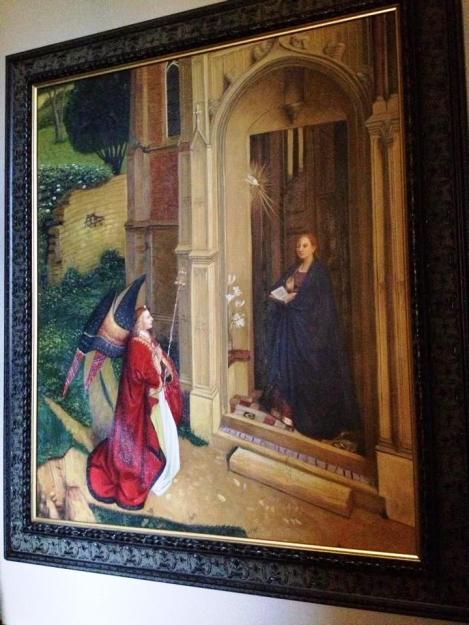
Annunciation

In a gloomy little corner at St. Meinrad’s, there is a painting of the Annunciation.  It is very hard to see – there is little natural light and I couldn’t find a light switch for artificial light.  It is the the only painting in that corner.  It is more of a passage way to get to another room.  It is an afterthought.

annun 1

Yet notice that they have a holy candle mounted on the wall next to it.  A white candle, especially in a red sconce, indicates that the presence of Jesus is there.  Yet someone has let the candle go out.  These candles are normally placed next to the tabernacle or aumbry that has consecrated hosts (Communion wafers).  I’ve never seen one next to a painting – but this painting indicates the moment that Jesus became a physical part of the world by entering into Mary’s womb.


5

Because the only light was right in front of it, I had to stand at an angle to take the picture otherwise my shadow would have gotten in the way.


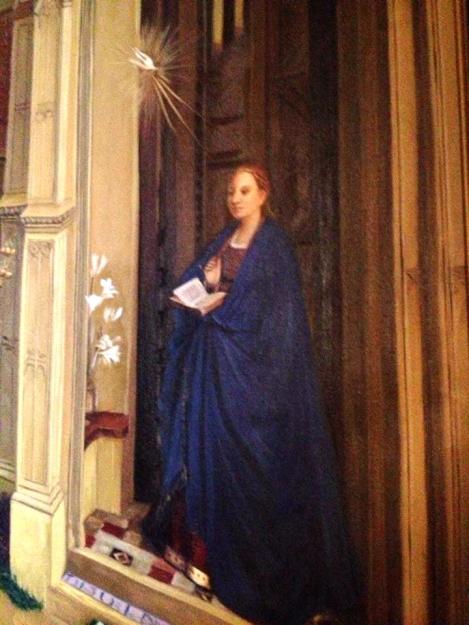
Notice the dove, a sign of the Holy Spirit.  There are lilies too – symbols of the purity of Mary.

4

This is the archangel Gabriel, come to ask Mary if she is willing to be the bearer of Christ.

3

Everything is immaculate in this painting – so why is there a breach in this wall?  Does it refer to when Jesus died on the cross and the division between the Holy of Holies was rendered in two?  That signified that God and humans are reconciled – there is no longer a division between us.  We no longer need an intermediary of a priest to speak with God – we can do it directly.

annun 2

Gerald’s big truck

Gerald got a Ford F-150 years back, and he was never the same. He had always been mild-mannered, meek even. Never spoke up at work or home, never insisted on his way. It wasn’t like he was content with his life, just complacent. He’d spoken his mind before but nobody paid him any heed, so he just quit trying.
All that changed when he got his truck. He wasn’t even looking for one. The lease had run out on his Chevy Malibu and he no longer needed a car with all that passenger space. The dealer noticed he was tall and suggested a truck. “This is just like the one I drive!” the dealer said as he steered him over to a huge red truck. “All the big strong guys drive trucks these days” he said with a guffaw and then slapped Gerald’s back.
Gerald didn’t like the slap or the big booming voice of the salesman. He had never thought of himself as being big or strong, and he certainly wanted to make the salesman happy, even though he’d already forgotten his name. Two hours of paperwork and a test drive later and he was the owner of a brand-new pick-up truck and a five year loan at 5% interest.
It didn’t happen overnight. It wasn’t obvious at first. But over the first month, Gerald changed, and not for the better. It seemed better at first, sure. He was more confident, more self-assured. Something about sitting way up high in that all-American piece of machinery made him feel he could do anything. He’d never felt so bold or brave before. His confidence carried into the rest of his life, and he started telling people what he thought for a change. Since he’d had no practice at it before, he would state his mind and not wait to see if there was a rebuttal. He ran over other people in conversation, and before long he was cutting them off on the road as well.
No more mister nice guy, he was a truck owner now so he feared nothing and no one. Nobody could tell him he was wrong, and nobody could get in his way. He’d transformed from an inchworm into a snake and there was no turning back.