Tithe

I don’t tithe. Not anymore.

I don’t like that the plate is passed around during the service, right before Communion. It says “if you pay, you can play”. It says that God’s love can be bought. It isn’t at the beginning of the service, or at the end. It is right in the middle, before Communion.

God’s love, as demonstrated through the sacrifice of Jesus, was, is, and shall always be free. There are no strings attached. You can’t earn it, and you can’t buy it.

But I also don’t tithe because I feel like I’m supporting an addict friend. You know the one. The one who never quite seems to have enough money to pay his bills, but she has enough for soda and cigarettes. The one who always forgets to have his wallet on him when you all go out to eat. The one who never quite seems to have it together.

Now, certainly this isn’t the way with all churches. Some pool their money together and do really good things with it. If a hundred people donate a dollar each, that provides enough for four families to have a healthy meal. That kind of tithing I like.

But so often it isn’t that kind of tithing that happens. So often the money goes to buy more vestments, or pay the mortgage on the minister’s home, or to re-carpet the sanctuary.

The money goes to the church building, not the Church Body.

Perhaps I should look at it like when I get approached by a homeless person. I have no way of knowing if he is going to use it to buy a sandwich or a shot of tequila.

Many names of God

When Muslims pray the 99 names of God they don’t believe that there are 99 different gods. They believe that there are 99 different attributes of God. God has many names but is still one God.

It is kind of like me. I am Betsy, but legally I am Elizabeth. To my husband I am his wife, to my coworkers I am their coworker, to my friends I am their friend. I am always me, but other people have different ways of interacting with me and know me in different ways. It depends on how they see me as to how they refer to me.

God is the same. “God” is just a descriptive, after all, not a name. In the Bible, God uses the name “I AM”. God is known as Elohim, as Jehovah, as Lord, as the Almighty, the Creator… the list goes on and on.

While there are different names for God, we are still talking about the same God that created the Earth, spoke to Abraham, and was made known on Earth as Jesus.

I’m not so sure if people are talking about the same God when they refer to Spirit.

I know a lot of people who are disillusioned with church and have left. They seem to like parts of it but not all of it. I get that. I left church too.

Some of them like the ritual. Some like the community. Some like the hymns. They are creating their own version of “church” with the pieces they like, but leaving out the pieces they don’t.

They are having circles where people talk about what is important to them, or they paint, or they drum, or they recite poetry.

I get that too.

But I’m strongly opposed to them calling it “church” if Jesus isn’t present. If they don’t read the Word of God and they don’t celebrate Communion, then why call it church? It is more coffeehouse gathering than church.

Let us call things by their true names. Let us not deceive ourselves and say that we are going to “church” when Jesus isn’t present. The same is true of the “mega churches” with their “Prosperity Gospel”.

Things evolve, of course. I left a medieval reenactment group because it stopped being a medieval reenactment group. Years ago, people who were thinking about joining asked if they could dress up like fairies and vampires, and the members told them no. They said that had nothing to do with the group. The focus of the group was “A day in the life of a European court.” The time period was pre-1500s. But then slowly it became more and more “early period” with more and more people showing up in shapeless garments with animal skins tied around them. Then, the Middle-Eastern re-enactors started showing up.

Now this group looks nothing like what it looked like when I joined. It has stopped being “A day in the life of a European court” and started being a “come as you want to be” party. When will the Klingons and the Silurians show up?

I’m all for everyone feeling welcome and included. I like the idea of “All are welcome” and “radical inclusion”. But I feel like at some point a line has to be drawn. Are we talking about the same thing? Are we still on the same page?

Hummus has a few basic things that make it hummus – garbanzo beans, oil, citrus juice, and tahini, all blended up in a food processor. While you can exchange black beans for garbanzo beans, and you can use lime juice instead of the traditional lemon juice, that is as far as you can go. After that, it stops being hummus. You can’t put apples in a blender and call it hummus. You can’t add tahini to a pot roast and call it hummus. There are certain things that you must have, and if you don’t have them, you don’t have hummus.

Church is the same way. You can strip away the ritual and the hymns and it is still church. You don’t even have to gather together in person – you could have a videoconference. You can add in dance, or painting. You don’t need musical instruments, or you can have a whole symphony.

But you have to have God, and you have to have Jesus, for it to be church. And they can’t be implied or guessed at. There has to be no doubt about it.

What about “the Goddess”?

While I’m fine with the idea of the many sides of God being welcomed and included, actually including the idea of the “Goddess” is totally not acceptable in church. Remember “Thou shalt have no other gods before me”? That is a big one. To worship the “Goddess” is a complete violation of that commandment.

God has many aspects, not all of them related to gender. You can be a feminist and still worship God. But the Goddess isn’t God – she is another thing entirely. If you want to worship the Goddess, fine. That is your choice. But then it isn’t church. It is something else. To call it church is deceiving to yourself and others.

So what about those names of God? At what point does God stop being God? At what point are you worshipping something else? At what point are you not in a worship service at all?

These are important questions to ask yourself.

Communion loaves and fishes

The Last Supper, the model for our Communion service, is linked to when Jesus fed the multitudes. This event happened twice.

Here, he feeds over 5,000 people, using five loaves and two fish. There were twelve baskets of leftovers. The story starts just after Jesus has heard that his cousin John the Baptist has been murdered.

Matthew 14:13-21
13 When Jesus heard about it, He withdrew from there by boat to a remote place to be alone. When the crowds heard this, they followed Him on foot from the towns. 14 As He stepped ashore, He saw a huge crowd, felt compassion for them, and healed their sick.
15 When evening came, the disciples approached Him and said, “This place is a wilderness, and it is already late. Send the crowds away so they can go into the villages and buy food for themselves.”
16 “They don’t need to go away,” Jesus told them. “You give them something to eat.”
17 “But we only have five loaves and two fish here,” they said to Him.
18 “Bring them here to Me,” He said. 19 Then He commanded the crowds to sit down on the grass. He took the five loaves and the two fish, and looking up to heaven, He blessed them. He broke the loaves and gave them to the disciples, and the disciples gave them to the crowds. 20 Everyone ate and was filled. Then they picked up 12 baskets full of leftover pieces! 21 Now those who ate were about 5,000 men, besides women and children.

Shortly after that, he feeds over four thousand people, using seven loaves and a few small fish. There were seven baskets left over.

Matthew 15: 29-39
29 Moving on from there, Jesus passed along the Sea of Galilee. He went up on a mountain and sat there, 30 and large crowds came to Him, having with them the lame, the blind, the deformed, those unable to speak, and many others. They put them at His feet, and He healed them. 31 So the crowd was amazed when they saw those unable to speak talking, the deformed restored, the lame walking, and the blind seeing. And they gave glory to the God of Israel.
32 Now Jesus summoned His disciples and said, “I have compassion on the crowd, because they’ve already stayed with Me three days and have nothing to eat. I don’t want to send them away hungry; otherwise they might collapse on the way.”
33 The disciples said to Him, “Where could we get enough bread in this desolate place to fill such a crowd?”
34 “How many loaves do you have?” Jesus asked them.
“Seven,” they said, “and a few small fish.”
35 After commanding the crowd to sit down on the ground, 36 He took the seven loaves and the fish, and He gave thanks, broke them, and kept on giving them to the disciples, and the disciples gave them to the crowds. 37 They all ate and were filled. Then they collected the leftover pieces—seven large baskets full. 38 Now those who ate were 4,000 men, besides women and children. 39 After dismissing the crowds, He got into the boat and went to the region of Magadan.

What are the common elements in this story? Jesus takes what he has, little though it is. He doesn’t pray for more. He gives thanks for what he has and blesses it. Then he breaks it and distributes it.

This is what happens to us when we become part of the Body of Christ, and what we are supposed to do. It is something we receive and something we are to give.

We aren’t enough for the task. We are small and weak. We are broken. Yet God loves us, and is thankful for us. We are blessed by Jesus. And through that thankfulness and that blessing, we are enough. We are exactly what the world needs. We are food for a hungry world.

We are to take that thankfulness and that blessing and multiply it through our actions and our lives.

This is what Communion is. It feeds us, and through that, we are able to feed the world. We are able to be the healing the world needs, because we have been healed.

Communion words in Hebrew and English.

These are traditional Jewish blessings that I’ve incorporated into the Communion service. They seem logical to use, as Jesus would have known and used these prayers every week for Sabbath. I’ve included the Hebrew, the transliteration, and the English for all the blessings. Feel free to use both the Hebrew and/or the English. It is important to make the people you are celebrating Communion with feel special and included. Use what you feel would be most meaningful and inclusive.

Put out a nice cloth that has room for everything you need. You’ll need two candles, a plate, a goblet, an unbroken piece of matzo, and some grape juice (or wine).

Light the candles with these words –
——————————————————————————————————-
ברוך אתה ה’ א לוהינו, מלך העולם, אשר קדשנו במצותיו וצונו להדליק נר של שבת

Barukh atah Adonai Eloheinu melekh ha’olam asher kid’shanu b’mitzvotav v’tzivanu l’hadlik ner shel shabbat.

Blessed are You, Lord our God, Ruler of the Universe, who has sanctified us with commandments, and commanded us to light Shabbat candles.
————————————————————————————————————-
Then, touching the matzo lightly, bless it with these words –
———————————————————————————————————–
ברוך אתה ה’ א לוהינו, מלך העולם, המוציא לחם מן הארץ

Barukh ata Adonai Eloheinu melekh ha’olam hamotzi lehem min ha’aretz.

Blessed are You, Lord our God, Ruler of the universe, who brings forth bread from the earth.
—————————————————————————————————————
Break it into smaller pieces – enough for everybody there, and distribute it.

Then, holding up the goblet with the grape juice (or wine), say these words –
——————————————————————————————————————
ברוך אתה ה’ א לוהינו, מלך העולם, בורא פרי הגפן

Barukh ata Adonai Eloheinu melekh ha’olam borei p’ri hagafen.

Blessed are You, Lord our God, Ruler of the universe, who creates the fruit of the vine.
—————————————————————————————————————-
Pass around the goblet and let everyone drink from it. They can also choose to dip their matzo piece into the grape juice (or wine) and then eat it.

(If this has been of use to you, you might want to read “The Condensed Gospel” and “Free Range Faith”, both available in print and e-book from Amazon, by Betsy Nelson)

Communion as freedom

The Last Supper was a Passover meal, and like the Passover, is meant to be done as a remembrance. The Passover meal is observed once a year with the goal of reminding the Jewish people that God freed them from slavery from Egypt. Today’s Communion service is also done as a reminder of freedom from slavery, but it is the slavery of sin.

Just because people are freed from slavery doesn’t mean they are free.

Life didn’t easier after the Jews were freed from being slaves. They wandered for forty years in the desert trying to reach the Promised Land. There was hardship and pain. There were tests and perils. Not everybody made it. A lot died. Moses, the great leader, the one who intervened with God on behalf of the Jewish people, was one of them. Even Moses, handpicked by God, one of the few people to get to talk with God face to face, even Moses failed and wasn’t allowed to enter the Promised Land.

The same is true for following Jesus. It isn’t an express ticket. It isn’t a “get out of jail free” card. It is a transition. It is an end to your old life yet a beginning to a whole new life of work and hardship. It isn’t easy following Jesus.

Jesus instituted this ritual meal the night before he was captured. He knew what was about to happen, but his disciples didn’t. He knew that they would need a reminder of the life of Jesus and the prophecies that he fulfilled. He knew that they would need a reminder of the promises that he embodies.

Both ritual meals celebrate freedom, but Passover is only done once a year. Communion can be done every time that Jesus’ followers get together. In some churches this is once a week (Episcopal). In some it is every day, several times a day (Catholic). In some it is quarterly (Baptist). In some it is yearly (Jehovah’s Witness). In some it is almost never.

Every time I get together with friends to study the Scriptures, I celebrate Communion. It is a reminder of who we are there for. It is a reminder of who is at the center of our circle. It is a reminder that this isn’t just a social gathering.

I love ritual, and I really love the ritual of Communion. While anybody can celebrate Communion, I realize that not everybody is comfortable performing a ritual. So I provide this part of our gathering.

I try to make it interesting every time. I try to share the meaning and history of the ceremony. I don’t go from a script. There is no order of service as such. There isn’t much liturgy yet either. But I’m working on that. I think that it is important to have everybody participate in the ceremony, rather than just being part of the audience. Communion isn’t a passive thing.

It is a remembering in the truest sense. It is where Jesus joins us, not only joins with us, but joins us together. Jesus enters into our selves, our very beings, in a literal and spiritual way. Also, we are knit together with all other members of the Body of Christ, past, present, and future. We become one.

In the same way that separate grains of wheat become one loaf of bread, we become one in the Body of Christ when we celebrate Communion. Somehow, we stop being free, and yet we become free at the same time. We stop being individuals and we become part of something bigger. We give up our petty needs and join together for something greater. Together, we are stronger.

God is in the darkness

dark1

I was painting the background for a space picture. This alone is a new thing for me. I’m trying to learn that it is OK to work on a project over the course of time. I’m trying to learn to do things in stages. I don’t have to do the whole thing at once.

I’m not sure where I got the idea that I had to finish a painting all at once. I have wirework projects that I can’t finish all at once. The work is too hard on my hands and wrists to complete it in one day. There are certainly beading projects that are sitting in plastic bags in bins right now, half finished. I may never finish them.

Perhaps part of it is that acrylic paint can’t be worked with once it is dry, and it dries very fast. Beads don’t care. With beads, I can take the whole thing apart and redo it as many times as I want. Paint isn’t forgiving like that.

But I keep reading about image transfer and collage, and I keep thinking it is cool. I’ve got all the materials I need (I think) and I’ve read quite a number of books about it. I still don’t think I know what I am doing, so I haven’t tried. But I’m trying to convince myself that if I don’t try, it is worse than trying and failing. Not using art supplies for fear that I’ll mess them up is worse than using them and not getting what I was aiming for. At least when I use them, I’m learning how to use them, and I’m learning what works and what doesn’t.

All the image transfer and collage techniques are multi-day projects. You have to paint the background, and let it dry a day. Then you paint a layer of clear glue on it. And let it dry a day. Then put something else on. And let it dry a day. You get the idea. Lots of waiting. Lots of days.

Part of my issue is that I want results now. I’m trying to get over that. I’m trying to use these kinds of projects to get over that. I always have “quick” projects to give me that “I made something” buzz, in the meantime.

So, back to the painting. I needed a black background, but I didn’t want to use black. That is too easy. So I used a really dark grey called Paynes Grey, and a really dark purple called Dioxazine Violet (Hue). I squirted some of each on the canvas and swirled them around and together. I really like the color I got. It isn’t traditionally black, but it is plenty dark. I figure space isn’t black, but more purple/grey, if it had to have a color.

In reality, I figure it is the absence of light, and that doesn’t have a color at all.

But then I didn’t like the lines in it. Because I use my fingers to paint, there were large lines in it. No matter how I swished and flicked my fingers, the lines were still there. I don’t want lines, because they will draw attention to themselves. This is a background. Backgrounds are supposed to stay in the back, right? They are the supporting role, not the main character.

So I started “writing”. I have a friend who does “light language”- which is really the gift of tongues. It can be done with the voice or with writing. Her coming out about it has reminded me of the fact that I’ve done this for years. I stopped doing it because it felt silly. I got really self conscious of it and stopped. I never showed anybody what I was doing. I guess there was some shame in it, because I felt like an oddball.

You aren’t weird if there are other people who do the same thing, though.

So I’ve started doing it again, intentionally. I’m letting the Holy Spirit work through me in this new/old way, and it is really freeing. I’m still really aware how unusual it is so I don’t do it all the time. I’m mindful of my audience.

I don’t think I’ll ever forget that a minister told me to stop talking about how God was talking to me, was waking me up at night to give me messages. A minister, telling me to stop talking about God. In church. To church members. Isn’t that the place where people who have those kinds of experiences go? Isn’t that the place where people seek to have those kinds of experiences? Isn’t that the place where people read about other people in the Bible having those experiences?

I’m glad I chose to leave that church rather than to be silent.

So when I started to write on this painting, I learned something. I didn’t write down or record my experience. I spoke the words out loud and “wrote” them in my light language shorthand. When I write this way, I write left to right, then right to left. I kind of make an S across the page, going back and forth, until I am done.

Here is what I remember of it:

Under the sea, and deep in space, it is very dark. The darkness is vast and silent.

There is potential in darkness.

Babies grow in darkness.

The seed is the same way, swelling, stretching.

And God is there in the darkness.

This reminds me of Jeremiah 1:5 “Before I formed you in the womb I knew you, before you were born I set you apart; I appointed you as a prophet to the nations.”

Which then leads to Psalm 139-12-16
…even the darkness is not dark to You.
The night shines like the day;
darkness and light are alike to You.
13 For it was You who created my inward parts;
You knit me together in my mother’s womb.
14 I will praise You
because I have been remarkably and wonderfully made.
Your works are wonderful,
and I know this very well.
15 My bones were not hidden from You
when I was made in secret,
when I was formed in the depths of the earth.
16 Your eyes saw me when I was formless;
all my days were written in Your book and planned
before a single one of them began.

I was afraid of darkness when I started this project, and now I am at peace. I’ve gotten the message that God is there, at work, even if I can’t see it. I’ve gotten the message that God has a plan for my life.

Then this leads me to Jeremiah 29:11-13
11 For I know the plans I have for you”—this is the LORD’s declaration—“plans for your welfare, not for disaster, to give you a future and a hope. 12 You will call to Me and come and pray to Me, and I will listen to you. 13 You will seek Me and find Me when you search for Me with all your heart.

What an amazing message to come from just painting the background to a piece that I don’t even know what it is going to be.

Thanks be to God.
seed

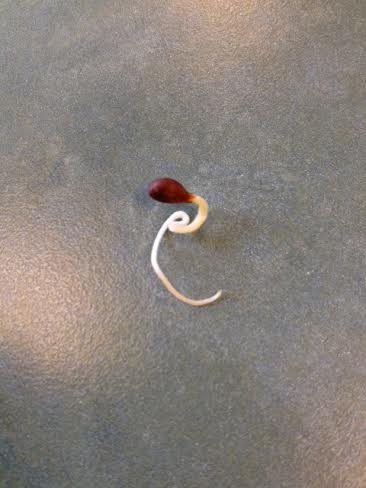
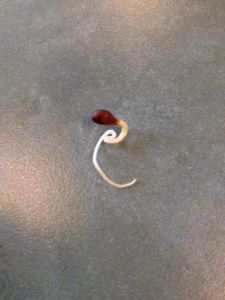
An apple seed, sprouting.

Poem – homeless, helpless?

Is being homeless a bad thing?
Like night, like winter
Perhaps it is a phase
A pause.

And then what if we got homes
For all the homeless,
what then?
Do we tackle
drug abuse,
prostitution,
morbid obesity?

How many different ways
can we harm ourselves?

Jesus says that the poor
will always be with us.
But he also says that
whatever
we do to the least of these
we do to Him.

So what do we do?
Do we help?
And if so, how?

Is helping really helping
or is it weakening?
If you carry someone
then they don’t learn how to walk
On their own.

Poem – the hand of God.

Opening up the mess with God
is the point
where I think
it would make a difference.

Between us
a little more energy
would help.

A little more energy
between us
would help.

We have all these things available
but then again
we have nothing at hand.

Our fingers are feeble,
are fragile,
are faulty.

We point the way with them.
We beckon, we accuse.

The hand of God is made up
of these same fingers.

And sometimes it feels more
like a slap from a bully
or a stop sign from a crossing guard
than a help.

Piety

I had a dream that I was at some church gathering where we all were going to get lunch. It was at a local restaurant, not at the church itself. Near the entrance of the restaurant were four beggars. Also near the entrance was the pastor, but hiding.

It was a test. Do the members stop to talk with the beggars? Do they give them money or food? At the very least do they give them a smile and treat them like they are human? Or do they ignore them?

There is a saying from Jesus to not let your piety be seen. It is rude to do something good so that you will get bonus points. Matthew 6:1 “Beware of practicing your piety before others in order to be seen by them; for then you have no reward from your Father in heaven.”

But it is also a bad idea to learn to love your neighbor in the abstract but not show it in the concrete.

But how loving is it to allow someone to be dependent? To give food or money to someone who has the capacity to earn it themselves is to undermine their basic humanity and dignity. It is to encourage them to continue to be a beggar.

And how is it loving of a pastor to try to trap people? The purpose of a pastor is to lead, to teach, to educate.

It is all very complicated. Sure, it was a dream, but it has a basis in reality.

It reminds me of the videos that Jon Quinones’ show “What Would You Do?” where they secretly films people in posed morally questionable situations. Instead of teaching people what are good ways of dealing with the situation, he basically mocks people who fail to rise to the occasion.

I think the goal of any leader, but especially of religious leaders, is to instruct and inform, rather than point out flaws. Instead of figuring out ways to catch people sinning, help them to know what is the right thing to do. If they fail in a “test” – it isn’t their fault. It is the leaders’ fault for not teaching them correctly.

The whole verse is here (Matthew 6:1-8) (NRSV)
1 “Beware of practicing your piety before others in order to be seen by them; for then you have no reward from your Father in heaven. 2 “So whenever you give alms, do not sound a trumpet before you, as the hypocrites do in the synagogues and in the streets, so that they may be praised by others. Truly I tell you, they have received their reward. 3 But when you give alms, do not let your left hand know what your right hand is doing, 4 so that your alms may be done in secret; and your Father who sees in secret will reward you. 5 “And whenever you pray, do not be like the hypocrites; for they love to stand and pray in the synagogues and at the street corners, so that they may be seen by others. Truly I tell you, they have received their reward. 6 But whenever you pray, go into your room and shut the door and pray to your Father who is in secret; and your Father who sees in secret will reward you. 7 “When you are praying, do not heap up empty phrases as the Gentiles do; for they think that they will be heard because of their many words. 8Do not be like them, for your Father knows what you need before you ask him.

Poem – Made in the Image

There is something honest
about babies and old people.

They don’t look like any one
gender. They just look like
themselves.

Perhaps this is what is meant
about
being made in the
Image of God.

Perhaps these beings
that are before or beyond
the need
to be
a specific gender,
before or beyond
sex

have it figured out.

Perhaps being intersexed or unisexed or unsexed is it.

When we are past the need
to be female or male
and we get down to the business
of being human

maybe then is when we start
getting to the good stuff

the God stuff.