It’s always the quiet ones…

There is a lady at my workplace who seems really antisocial. Maybe she is just shy. She stutters a little, so maybe she is afraid to talk.

I know very little about her, even though I have worked with her for 13 years. She likes football. I’ve heard she used to be a nurse. She has never been married. This isn’t much for all these years of working together.

I used to say hello to her when I saw her in the morning. If she replied at all it was a grunt. More often she would turn her eyes away from me and not even look at me. She would never initiate a “hello” or a “good morning.” This isn’t personal. She does this to everyone. She does this to her boss. Fortunately her job does not require interacting with the public.

I started to think about this. Maybe she doesn’t like to say good morning. Perhaps I am expecting too much. So I thought about it more. Perhaps she doesn’t see the value of social pleasantries.

It sure makes things awkward.

When she does talk it is to complain. She will suddenly speak up and say “I don’t mean to complain, but…” and then will launch into a complaint. This is the most common phrase I’ve heard from her. This isn’t a great thing to be known for – complaining, and not being friendly. Kinda makes me think about the stories in the news, you know, the ones where they say the killer was quiet and kept to himself.

Maybe she has a learning disability, and interacting with people is hard. Maybe she is embarrassed of her stutter and has decided it is easier to not talk at all. Maybe I’m making up a story so that I feel better.

I want to have a better relationship with her, but then again, I don’t want to. Sometimes I think I don’t want to go to the effort of making it work. It takes two to make a relationship after all.

Then I think maybe I’m trying to make her into my own image. I’m expecting her to be like me. I’m not letting her be her. Maybe being quiet and aloof is how she wants to be and I need to adapt to it.

Apparently I already have. I’ve not pushed it. It has been many years.

It still feels weird.

Thankfulness for an apple.

I had an apple for a snack at work today, and I thought of all the different things to be thankful for, just with this apple.

It is really pretty.
That I had the money to buy it.
I have teeth to eat it with.
That I can digest it.
I had a car to go to the store.
I have the desire to eat healthy food.
I have the desire to buy organic.
The farmers who grew it.
The workers who picked it.
The truckers who transported it.
The bees who pollinated it.
There was good weather to grow it.
It was tasty.
I have a job where I have the luxury of being able to take a break.

This is all from appreciating an apple. Now, to try to be this level of thankful about everything. It is good to be not only thankful for my food, but having a house to store it in, and a refrigerator, and electricity to run the fridge… and on and on. There is so much we take for granted, that when it is gone we miss it. I pray for new eyes and a new heart, that I can see and appreciate all that I have, right now.

White is white – on blind obedience to the Church, and going it alone.

Some of you will remember that I was in the deacon discernment process for the Episcopal Church. This means that I believe (and the priest believed) that I was being called by God to serve “the least of these” – the poor, the homeless – those who have no one to serve them. Some of you have been reading along since April of this year, when I stopped going to church. The part that is interesting to me is that only a handful of people have even seemed to notice I’m gone.

I’ve recently written to the team that was involved in the process. It took me this long to get over my anger at and sense of betrayal by the priest. I didn’t want to write an angry letter. There are/were (what tense do I use?) nine people on that team, all trying to “listen” with me to see if it was a call from God. None of them have written back. I then sent a copy of the letter to the Bishop. Nothing, again. I feel like I’m standing at the front of an auditorium and the microphone isn’t on so nobody can hear me. Or maybe they are ignoring me, hoping I’ll go away. But the weirdest part is that more people from a church that prides itself on being welcoming and friendly hasn’t contacted me.

I was very active in this church. I was there every week. I was the leader of the team of lectors and chalice bearers. I was also an acolyte. I served up front as part of the worship team nearly every week. It is a small church. I’m hard to miss.

To be a deacon in the Episcopal Church is a big crazy process. It takes years. It takes homework and meetings. You have to submit your transcripts. You have to submit your baptism and confirmation records. You have to submit to a physical and psychological exam. Basically, you have to submit. They want to make sure that you are hearing from God, sure, but they also want to make sure they can control you. They want to make sure that the Church is safe by not signing off on a wacko, sure, but they also want to find out if the priest or the Bishop tell you to do something, you’ll do it.

The odd part is that you have to go through all this for an unpaid position. You are expected to keep your day job. You have to do more at church and in the community, but you don’t get paid for it. They have this whole multi-year process to shape you into a deacon. The process is arduous.

But it turns out that they don’t really have a framework to teach you how to follow God when the Church isn’t. That’s the scary part. There’s a group in the Catholic Church that embodies this blind faith in the Church. The Jesuits say that if they see that something is white, and the Pope says it is black, they are to say it is black.

I’m not about that kind of obedience. I understand it, somewhat. We humans are fallible. I entered into this process because I know of my weakness. I’m bipolar. So I wanted training and oversight. I wanted to make sure that if I thought I was seeing white, it was indeed white. It is my greatest hope that I not deceive or mislead anybody. I think it is really important to make sure it is God’s voice I’m hearing and not my own imagining.

I left church because I could see white and everybody else was doing black. The more I read of the Gospels, the more I realized that what we, collectively as a Church, are doing, is wrong. It isn’t about building church buildings or having ordained ministers. It is about building up the Body of Christ – by teaching every person who is called to be a Christian how to be a loving servant of God and how to hear the voice of God. Everybody. Not the elect, not ordained people – everybody.

I think everybody needs to go to Cursillo and be woken up to the Holy Spirit. I think the homework assignments for the deacon process are very helpful for helping people “hear” their calling. I think small groups where people “listen” to each other and keep each other accountable are useful. I think reading books by progressive Christian authors about their struggle to integrate the ways of God with the ways of the world are helpful. I think we all need to work on our faith rather than take it for granted.

Perhaps this is what they are afraid of. Perhaps this is why they haven’t contacted me. I represent a total upheaval of the way things have always been done. No more church buildings. No more vestry. No more priests. Church isn’t a social club but a way of life – and that life is service. Perhaps this frightens them.

It is like the early Christians, who knew in their hearts that what they were doing was right, was in fulfillment of all the promises that they as Jews had been told. They knew that Jesus was the Messiah. But everybody else railed against them. How dare you upset the way we’ve always done things? How dare you tell us that we are doing it wrong?

I get that. People are like that.

But white is white, and black is black, and the blinders are off now.

Glass (half full? half empty?)

The glass isn’t half empty, or half full. It is half a glass of water. Simple. See? No “positive” or “negative” spin. It just is, with no definition or judgment.

See how we are shaped to think in certain ways when we are given only certain choices? Our language frames us. We are shaped by it. When you are asked to decide whether the glass is half empty or half full, you aren’t actually being given a choice. It looks like it. But really, the smartest thing you can do is to step back from the question and wonder why the person is trying to get you to decide either way. Whoever is asking you wants to define you. Are you an optimist, or a pessimist?

In reality, the glass is half full and half empty at the same time. You can look at it however you want, and it has nothing to do with your perspective. There is only half a glass of water. Defining it as half-full or half-empty does nothing for the amount of water.

Sure, you can get excited that you have some water to drink, or you can get sad that you don’t have a full glass of water to drink. Or, far healthier for your head, you can just notice that there is half a glass of water. It isn’t full, and it isn’t empty. It is right in the middle.

A lot of our problems come from a need to define something as good or bad. Often we define it in relation to ourselves – does it benefit me, or harm me? Often we define it in relation to our experience at the moment. We don’t have the full picture, so we decide something is bad at the time, when later we think it is good, or vice versa. Situations change. We change.

But sometimes the issue is that we are tricked. We are asked to define something that doesn’t need defining. Someone points out something for us to notice, and by omission we don’t notice everything else. It is a pretty powerful trick. Look over here, meanwhile the real action is going over somewhere else.

If you ask a child if she wants to wear the blue jumper or the red jumper, you’ve deftly sidestepped the issue of maybe she doesn’t want to wear a jumper at all. Maybe she wants to wear a sarong or a sweater. And maybe she doesn’t want to get dressed to go out right now and wants to stay in her pajamas.

Be wary of how you are being directed and channeled. See what is there.

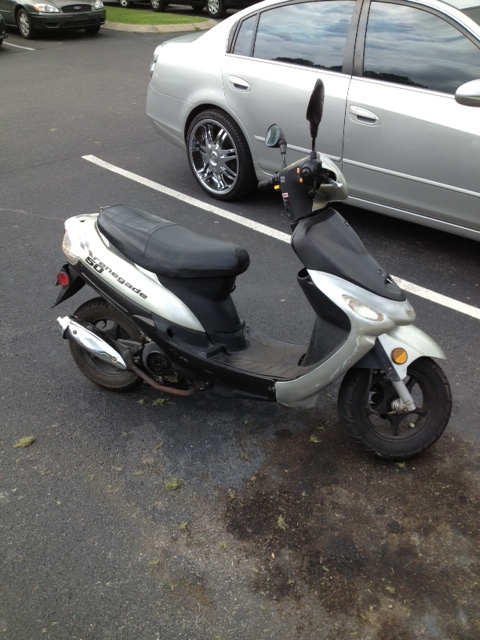
Renegade – meditation on a scooter.

I saw a scooter parked at my work. The make was “Renegade”. My first thought was that the manufacturer was trying to make a scooter seem tough. A scooter isn’t like a motorcycle. Motorcycles are for renegades. But scooters? Not so much.

renegade

But then I thought again. It takes a bit of counter-cultural thinking to drive a scooter. It uses less gas. Some are electric. So you are as far away from the Hummer mentality as possible. You are being environmentally conscious in a society that prides itself on big cars and big debt.

You are also risking your life. You don’t have two tons of 14 gauge steel insulating you from the vagaries of drivers. Driving in Nashville is risky business. People don’t pay attention normally, even when they aren’t texting and updating their Facebook and eating their lunch. Zipping around on a scooter is pretty brave.

So perhaps it is a renegade act to drive a scooter. I still think scooters look funny. But perhaps that is my problem. I think “tough” should look a certain way. I forget that Mother Teresa was tough, and so was Gandhi. “Renegade” isn’t about looks but action.

A million dollars worth of enlightenment.

What would you do if you were given a million dollars? A lot of people say that they would give it to charity. They’d spend it on something good or worthwhile – defeat cancer, solve hunger, stop war. Maybe they’d also give some to family members who were in debt.

Sometimes I think they are lying for the sake of sounding like they are nicer than they are. Would any of us, really, give away all that money to help others? Wouldn’t we spend some of it on ourselves first? I know I would. Perhaps I want everybody else to be honest. Or perhaps I don’t want to think I’m the only selfish person around.

Sure, I’m not entirely self-centered. I want to learn how to do conflict negotiation. I want to be a peacemaker. Learning how to do that will take time and money – and I won’t get that money back. The peacemaking I’ll do will be for free. And I want to learn how to perform life-cycle ceremonies for people, like weddings and funerals. There are plenty of people who need these ceremonies but they don’t belong to a faith community. I would perform those ceremonies for free. The classes and time to learn how to do that are not cheap, however.

If a million dollars came my way I’d show it a good time. I’d pay off the cars and the house. I’d build a storm shelter in the basement. I’d put away a large chunk in savings. I doubt I’d quit my job because I like having some structure to my days, but I might go part time and spend the rest of the time taking classes or volunteering. I certainly would take more time to work on my art.

But I wouldn’t just give it away. There are so many things that might be helped with a judicious application of money, but they won’t be cured. Throw a million dollars at the homeless problem and you’ll just have another batch of homeless people in a year. Throw a million dollars to solving child abuse and you’ll have more abused children later. Sometimes it isn’t about money, but about attitude. So often we are trying to fix something with a band-aid when really only an amputation will cure it. So often we treat the symptom rather than the cure.

I’ve heard of people making “blessing bags” for homeless people. The bags have food for a day, along with toiletries and some underwear and socks. That is something – and I’ve long said it is better to do something than nothing. But that is only for that day. And meanwhile, the person still will be sleeping in the cold and the rain.

Maybe it is the yetzer hara speaking. Maybe I’m getting frustrated because I think the goal should be to prevent people becoming homeless, and I can’t figure out the solution. But I also want to prevent people becoming drug addicts, or bullies, or child abusers, or rapists, or prostitutes. I want to prevent the problem, and it seems so much bigger than I can possibly get my head around. I’d rather prevent someone becoming a child abuser than say I want to prevent child abuse. See the difference? It is the difference between teaching women to not be a target for a rapist, and teaching men to not rape. The person being attacked has a problem, certainly. But the person who is the attacker has a problem too. Stop the problem at the source and you’ve fixed two problems rather than one.

I have some ideas about this. The attacker feels lesser-than. The attacker feels that the other person has something that they need. The attacker often does not feel that the other person is a person at all – and that is why it is OK to attack them. Empathy is part of the solution. How do we teach this?

I don’t think money is the cure for this. I think some of it is an attitude shift in our society that needs to help people feel comfortable expressing themselves. They also need to be comfortable with other people being different and having different opinions. Teaching people dialogue versus debate would be helpful. But that isn’t money, but time and mindset. It is time for a different way of thinking.

Money just short-changes growth. It is like putting training wheels on a bike. You may be able to ride that bike, but you don’t really have the balance necessary. You haven’t built up those muscles yet. You ran right past the experience of falling down (many) times. So you can ride, but you have to have the training wheels to do it, and you can’t empathize with people who had to do it the hard way.

I’ve heard that people who have a lot of money are the least likely to volunteer or to donate money to charity. Perhaps something about having it easy makes it harder to understand those who have it hard.

The value of slow.

I’ve realized I’m trying to write a blog in a time where people can’t even take the time to write out what they are saying. We have acronyms for everything. I just learned a new one – “tltr”. This means “too long to read.” I’m part amused and part saddened that we don’t even have the time to write out that something is “too long to read” but have to have an acronym for it. We don’t have time to have time.

I could change how I do things. I could shorten everything down to small digestible chunks. I could distill out the essence of the thing. I could write it out, but post the synopsis at the beginning so people don’t have to wade through to the end. I could post just two sentences, or a paragraph at most. Or I can keep doing what I am doing. Sometimes you have to go through the whole thing to get it. The Cliff’s notes may tell you what happened, but you’ll miss everything else.

I’ve learned that if you really want to see something, you have to draw it. Go find some paper and a pencil. Draw one thing. Pick something that you look at all the time or that you’ve seen every day for years. When you draw it, you’ll notice it for the first time. You’ll see lines and curves that you’ve never noticed before. You’ll notice blends of color that you’ve never seen. Did you know that a fig has a bit of green in the purple? Did you know that there were five washing machines in a row at the laundromat you go to, not four? When you take time to draw what you see instead of what you think you see, you start to notice other things. You start to wonder what else you’ve missed because you’ve assumed something about it.

We often want to get to the punchline before we’ve even heard the joke. We want things to be fast. We don’t want it now – we want it yesterday. We think that we have gained an advantage by making everything fast.

We want to blast through our emotions and stop feeling sad and go straight to happy. But how can we appreciate the mountain top unless we have been in the valley?

We want to have labels for people and put them in boxes. But how can we really get to know someone if we assume they are the same as everyone else of that race/gender/nationality/creed?

We want to have our lives prepackaged. We want to be told what to do, to eat, to think. Until we don’t. People are starting to wake up to how much power we have given away by letting others make our decisions for us. It isn’t that long ago that major life events were done at home. Now we are born in a hospital, get educated in a school, and when we die we are taken to a funeral home. Strangers take care of us our whole lives. And because they take care of us, we don’t know how to take care of ourselves. The old knowledge is fading away. We barely know how to feed ourselves – everything is prepackaged.

Fortunately, there are people who are realizing the danger in this prepackaged, convenience-store life. The more we give away, the less we have. The more we let others do for us, the less we know how to do.

I’m grateful for the upsurge in crafting. I’m glad that people are relearning how to sew, knit, crochet, quilt, and embroider. I’m grateful that people are taking the time to paint and bead for fun. I’m grateful that people are starting to appreciate the value of slow.

People are taking the initiative and not only learning how to cook their own food but how to grow it as well. They are learning the value of taking care of their bodies instead of getting a doctor to treat the symptom rather than the cause. They are exercising for health, not weight loss. They are looking at the long term rather than the right now. They are starting to question everything that they have been told – education, government, religion – nothing escapes their scrutiny. “We’ve always done it this way” no longer stands as an excuse for ignorance.

Slow down. Slow down, because you might miss something. And the thing you will miss the most is your life.

Organic food is just a start.

One advantage to eating organic food is that you feel like you are making a difference. Whether the benefit is all in your head or real, you feel healthier and more vibrant. I feel like I’m doing something good for myself and the planet. I think also that if more of us eat organic food, then it will get less expensive.

I don’t eat a lot of organic food because of the cost. I have a low level civil service job with the government, so I’m paid very little. I feel like I’m being paid in a future pension and in health insurance rather than in wages. But that is part of the package. Government jobs aren’t get rich quick. They aren’t get poor slow, either. They are middle of the road.

Currently I eat organic oatmeal and apples and hummus. It isn’t much but something is better than nothing. You have to start somewhere.

The disadvantage to eating organic food is you retrain your taste buds. I had some regular oatmeal this morning and it tasted terrible. I felt like I had a coating of chemicals in my mouth. I felt a little dizzy too. This was the same flavor as the organic version, so there isn’t a flavor issue I’m dealing with. Perhaps it was artificially flavored as well? Generally maple and brown sugar flavor isn’t messed around with. Dang it, I just checked. “Natural and artificial flavors”. Bleah.

It reminds me of when I switched to drinking water instead of sodas. I used to drink Mello Yello every day, several times a day. Lots of caffeine and sugar and fizz loaded in that. Let’s not forget the artificial coloring too. I hated drinking water at first because it is so boring. But then after a month of water, a soda tasted terrible. I burped a lot from the carbonation. The sugar was too much and made me feel weird, or maybe that was the caffeine. Or maybe it was both.

I started to wonder why I even drank that stuff to start with. Now I wonder how I could eat regular oatmeal. I’m starting to dread finishing that box in the pantry.

I’m wondering what else I’ve come to think is “normal” that isn’t normal at all.

This isn’t just about food. I’ve been looking into everything I can and trying to uncover and unveil what I’ve ignored. I’m trying to open my eyes and my mind. What am I missing? What have I always assumed? What have I not questioned? This applies to education, healthcare, government, religion – everything.

There is a lot to studying other ways of doing things involved in this. Different ways of communicating, eating, thinking, believing all factor in. There is a lot to learning different traditions and faiths. The more I question why “we’ve always done it that way” the more things open up.

The bad part is that the more I become aware, the harder it is to fit in. Perhaps there are others who are faking it too. Perhaps by just talking about it, we can start to change things. Wouldn’t it be nice to go into a restaurant and have everything on the menu be not only tasty to eat but good for us and the planet? Wouldn’t it be nice to go into a doctor’s office and be told how to prevent our illnesses by eating the right things and exercising properly?

I want everybody to be awakened and empowered.

Comfort food and Western medicine are killing us.

I know a lady whose adult daughter has Crohn’s disease. She has done well with it for several years, but it has flared up again. She is recently divorced and has moved back in with her parents.

Her mom wondered if she should buy her a Blizzard from Dairy Queen after she found out the test results weren’t good. Uh. No. As another person said – what health condition would that be good for?

But it isn’t physical health she is trying to treat. She is hoping to soothe with food. We do this a lot. We soften the blows of life with ice cream and cake and brownies.

These are celebration foods. Perhaps what we are trying to do is “turn that frown upside down”. Perhaps by eating the same foods we eat at parties we are trying to trick our brains into thinking that everything is fine. We aren’t in the middle of a bad situation. We are at a party!

But junk food never fixes anything. Good food will fix quite a bit. Exercise will always help.

I’m not sure how we got to the point that we treat the symptom rather than addressing the cause. I’m not sure how we have become reactive rather than proactive. I’m not sure how we have become so passive about our health and our lives.

I know that I’m not playing that game anymore. Sometimes I think I want to go back to school to learn how to be a nutritionist, or a life coach, or anything that helps people prevent their own suffering. But then I think I can’t save the world. It seems like such a logical thing – eat well and exercise and you’ll do fine (barring accidents). Eat terribly and be a couch potato, and you’ll suffer. But that is the way of things. I don’t think we’ve always been this way, but we sure are now. Our medical institutions don’t help either. Coughing? Take a pill. Diabetes? Take a pill. There is no education on how to get well.

Doctors who made a pledge to “do no harm” aren’t doing any good either.

Where does the change start? I think it has to start with us. We have to take control of our own health and lives. We have to essentially homeschool ourselves on our health and wellbeing. The more we expect others to do for us, the more passive we are. And the more passive we are, the more we will fall behind.

When bullies become adults.

Most of us, when we think about the term bully, think about a schoolyard. We think about some large, brutish kid, generally a guy, stealing lunch money and pushing kids around on the playground. But sometimes bullies grow up – in age, but not in attitude. Nobody has managed to intervene and teach him how to behave like a human being. His actions get him the results he wants, so he continues.

A bully is even worse when he grows up because he is harder to manage. If he has children then the disease spreads. He either bullies his children and wife or he teaches his children that bullying people is normal. They either learn to be victims or tyrants.

Now, it is important to say that women can be bullies too. Women can be abusive and manipulative and mean. But I have to pick a pronoun to use here, because saying “him or her” is tedious, so I’m going with the default male bully. Sadly, males are more likely to be bullies, but this post isn’t about gender so much as behavior and repercussions.

A bully will treat others that they are lesser than him because he needs this version of reality to prop himself up. A bully at the heart of it all is a weird combination of a narcissist with low self esteem. This seems contradictory. But if someone has a healthy sense of self esteem then he doesn’t have to keep shoring it up. A narcissist spends all his time thinking about his needs and how things affect him. He doesn’t care about what other people need or think unless it directly will affect him.

A narcissistic boss will get angry if an employee calls in when she is in the hospital because this means the project that she was working on won’t be finished on time. He doesn’t care that it means that she is suffering and that it has made things difficult at home with taking care of her children. It is all about him.

Bullies are narcissists sometimes. Sometimes they are also simply sadists. Either way, they don’t care about other people. Other people are simply a means to an end. It is all about their needs, and if other people get hurt, that doesn’t matter.

A bully who becomes a father will teach his children that they are lesser than him so that he can maintain a sense of control. He will try to show how important he is by making them dependent on him.

If he really wanted to show how awesome he was as a father, he’d teach them to be able to take care of themselves. The sign of a good parent is one who is able to teach his child how to be successful and happy and self sufficient. If your adult child has to move back in with you after her divorce, you haven’t done a great job. If your adult child has to constantly ask you for advice or money, then you haven’t taught her anything about what it means to be an adult.

Baby birds need to fly. If they don’t learn how to fly, how to leave the nest and go out on their own, then there is a problem. The same is true with humans, but somehow we forget that. Prolonged childhood is becoming normal. Some adult children (the term itself is a sign) don’t have the emotional, mental, or financial resources to live independently until they are in their 30s. How much of this is because of bad parenting? And how much of that is because of parents who they themselves aren’t mature? But I digress.

Imagine how terrified a bully is when he discovers his wife is very sick. He won’t have her around to push around or prop up his ego. It will all be about him. Her sickness becomes his burden. Her sickness means it isn’t all about him. She gets terminally ill, and he is no longer the center of attention. He either has to learn how to become a caregiver (not a natural role for a bully) or he becomes even more “helpless”. He will become passive-aggressive and “forget” to take his medicine. He will expect her to do all the cooking while he acts like a king during family gatherings.

He isn’t fooling anybody. Well, he is. He is fooling himself. He hasn’t figured out that the way to look important is to not feel the need to push other people around. It is to be self-sufficient.

Some people will be bullies all the way up to their death.

It is a sad way to die. It is even more sad to live this way.

Perhaps what bullies need is love. Perhaps they need to have people stand up to them and tell them what they are doing is wrong, too. But bullying is a desire for attention and a need for a good sense of self-esteem. Perhaps they need to be taught new ways to feel good about themselves other than knocking other people down. Perhaps they need to be taught that how their actions affect other people.

Perhaps the root of it all is that the bully was himself bullied, and just doesn’t know any better.

One of the strangest stories I’ve heard recently is from a man who was abusive to his sons who still tries to push them around through guilt and a mis-applied sense of service to him. He told me a story about how a current neighbor had a dog that he left outside all the time, regardless of the weather. He felt so sad for that dog, whining in the cold and the rain. Sometimes he would speak through the fence to the dog to try to comfort it.

Yet he didn’t see the connection between that dog and his children.

He didn’t see how his constantly talking down to them, belittling them, and beating them was abusive. He didn’t leave them outside in the cold or the rain, but he didn’t provide any warmth or comfort inside the house either.

There is a lot more to taking care of children than just providing for their physical needs. You can make sure they have food and a place to live, but if you neglect their emotional and mental needs, you are abusing them. You may not ever hit them, but if you don’t hug them either you are still abusing them.