Firefly

I’m always surprised by fireflies. Every year, they appear slowly, quietly. I think there is a glint of light on my windscreen, or I see a flash of light out of the corner of my eye when I get out of my car in the evening. It takes me about a week to realize that it is time, that the fireflies are here.
A month, and then another go by. They keep appearing. They keep lighting up the dusk sky with their lazy mating dance.
And then they aren’t there. One day finally comes when I realize that I’ve not seen a firefly in weeks. I’d not noticed them leave. Just as quietly as they came, they are gone.
Sometimes people are like fireflies. They are there, and then suddenly they aren’t. Their light illuminates my life for a brief time. I think they’ll always be around. And then they aren’t.

Steve Heydel, who I knew as Edmund Cavendish, is one such person.


This isn’t a close friend, one I’ve known well. I didn’t even know he was sick. He was in my medieval reenactment household. We camped together. We spent weekends in the woods, wearing medieval clothing. His always looked better than mine because he bought it.
He was a realtor, and sold me my house. More than most realtors, he helped me move by lending the use of his trailer that he used for events.  He was also an actor.  Later in life he started working for Rodale, a skin cream company.
He died October 18th, at 67, and it is hard to believe.

From IMDB – Steve Heydel is an actor, known for Ashes 2 Ashes (2014), Left Behind or Led Astray?: Examining the Origins of the Secret Pre-Tribulation Rapture (2015) and Held Up at Work(2011). He has been married to Vikki King since April 28, 1995. Height, 5’11”.

The funeral was at 10 a.m. on Thurs Oct 20,2016  at the First United Methodist, Lebanon TN, at at 415 W. Main St. in Lebanon.

From his obituary  –

Mr. Heydel passed away peacefully Oct. 18, 2016 at the age of 67, surrounded by loved ones in Nashville. Steve is survived by his loving wife of 21 years, Vikki King-Heydel, of Lebanon.

He is preceded in death by his mother, June Love Heydel, of Lebanon.

Steve is also lovingly remembered by his father, William David Heydel; brother, Richard David (Sally) Heydel; daughters, Wendy Heydel (Shane) Lynn, Chrissa Heydel (Jim) Gatton; stepson, Aaron Hester; grandsons, Mason Lynn, Connor Lynn, Ethan Lynn, Jacob Gatton, Caleb Gatton; and granddaughters, Bailey Hester, Shyann Hester; and numerous loved ones and dear friends.

Steve was born Nov. 26, 1948 in Rockwood. He graduated from Lebanon High School in 1966 and went on to earn a bachelor of arts in economics from Cumberland University and the University of Tennessee in 1970. He also attended the University of Tennessee Law School in 1971.

Steve’s passion was acting in local Lebanon community theaters and did several commercial and short film acting roles in the Middle Tennessee area. He also had an avid interest in British and European history, and was a member of the Society of Creative Anacronisms, affectionately known amongst his SCA friends as Edmund Cavendish.

In lieu of flowers, memorial donations may be made to First United Methodist Church or the Leukemia and Lymphoma Society.


Here are other pictures of him.


…and more recent ones, showing his illness.  He’d had a bone marrow transplant in May, and it had started to fail in October. These are from his Facebook page.


According to his Facebook page, he liked to read John Sanford and listen to Led Zeppelin, Jefferson Airplane, the Kingston Trio, Connie Laine, Tick Bryan.  For films, Hav Faith, Star Wars, Anne of the Thousand Days, Arn, Wyatt Earp, Ashes to Ashes, the Terminator, Indiana Jones.

I didn’t know know all this about him.   I suspect there is a lot that I’ll never know. I know that he loved to watch local football, and had a room in his house that was perfect for it.  His home was unique – there was a great hall that looked like a hall in a medieval castle.  He had a booth in his kitchen so he and his wife could sit as if they were eating out.


Poem – Lost mothers, daughters


We all

are daughters

searching for our mothers.

We all

are mothers

searching for our daughters.

We all

are lost,

and have lost.


Sometimes our arms

have to wrap around the shoulders

of someone else, someone

we are not related to

to comfort ourselves

and to comfort them.


Sometimes we have to be

for each other

what we don’t have

for ourselves.

Grief shuffle

Inertia is absolutely normal and to be expected when grieving. This is a hard journey, this journey of grief. How to walk forward, when half of you is gone?

And yet we must walk forward, all of us, who have lost someone we love. We walk forward because they would want us to. We walk forward because to not do so is to die slowly, is to let that dull nothingness win.

Yes – we must sit with our grief for a time. We must make time for it, to absorb it, to let it speak to us. We must let it move through us, changing us, transforming us. How much time does it take? As much time as it does.

Consider the caterpillar in its cocoon. Consider the seed in the ground. They don’t know what they are becoming, but they are becoming. They are changing, sometimes painfully. Who would recognize them after they transform? Who would know what they had been, and how hard it was to get there? And yet they do.

And so do we.

Roadside memorial

grave

Another roadside memorial.  This is at an intersection on Gallatin Road, in Madison, TN (part of Nashville).  They are everywhere.  This one’s front cannot be viewed from this angle, which makes it all the more mysterious.  The front faces Gallatin, and that is a very busy road.  There is no way someone would be able to read it from there, zipping along on the road.  There isn’t a stop sign there.  This is in a between place.


There is a small metal tag attached to the top – it looks like one for a motorcycle.  The front looks like it is painted red. I kind of wish I’d gotten out of the car to look at it up close.

These memorials raise more questions than answers for me.

Who is this for?  Did s/he die here?  Is it to warn others that this is a dangerous intersection?

Did the person who placed it get permission to put this here?  Is this public property? Does this mean anybody can post whatever they want here?

How long will it stay? Forever?

When did this trend start, to memorialize the dead where they died?

When will it stop?  Why do I want it to stop?

Will it spill out and go everywhere – one at the desk of the person who died at work?  One on the sidewalk for the person who had a heart attack while walking her dog?

Why is it OK to celebrate grief in random places?

Why has a private feeling become public, yet anonymous?

Why am I so uncomfortable with this?  Why do I think it is low-class, gauche, tacky?

Why are they always Christian crosses – do Buddhists and Jews and Muslims and Hindus not die in traffic accidents too?  Do their families not care?  Or do they just know how to contain their grief in better ways?

Why is a graveyard better?  Why is hiding away grief better?

Are these to be seen as “memento mori” signs – reminders that you will die, that life is fleeting?


A Scot’s Farewell (memorial service reading)

When I come to the end of the road,
and the sun has set for me,
I want no tears in a gloom-filled room.
Why cry for a soul set free?

Miss me a little but not too long,
and not with your head bowed low.
Remember the love that we once shared.
Miss me – but let me go.

For this is a journey that we all must take
and each must go alone
It’s all part of the Master’s plan,
a step on the road to home.

When you are lonely and sick of heart
go to the friends we know
and bury your sorrows in doing good deeds.
Miss me – but let me go.

– source unknown

Funeral or memorial service template

(Feel free to use this as a template to construct your funeral or memorial service. You can add too or delete parts.)

Full Baptismal Name
Name as you would like it on the Program:
Date of Birth Date of Death
Time & Place of Funeral
Location of Visitation & Hrs.
Casket ______ or Cremains _______in Church
Main Celebrant Concelebrating Clergy
Processional Hymn
Scripture Reading I Reader
(From Old Testament)
Psalm (to be sung):
Scripture Reading II Reader
(From New Testament)
Gospel Reading
Homily
General Intercessions (Reader)
Preparation of Gifts Hymn
Gift Bearers
Communion Hymn
Communion Meditation Hymn
Family Comments
Recessional Hymn
Special Requests and Arrangements
Contact Person & Tele. No.
Pallbearers
Brief Biography both factual and personal for Priests information:

My memorial service

(Here’s an exercise – create your own memorial service. Death is the one true equalizer. It will happen to all of us. Better to create your service now and save your loved one’s the trouble when the inevitable happens. You can edit it later if your change your mind, but get it started. And share it with them now.)

Song – “Oceans” by Hillsong United

Psalm 107
Give thanks to the LORD, for He is good;
His faithful love endures forever.
2 Let the redeemed of the LORD proclaim
that He has redeemed them from the hand of the foe
3 and has gathered them from the lands—
from the east and the west,
from the north and the south.
4 Some wandered in the desolate wilderness,
finding no way to a city where they could live.
5 They were hungry and thirsty;
their spirits failed within them.
6 Then they cried out to the LORD in their trouble;
He rescued them from their distress.
7 He led them by the right path
to go to a city where they could live.
8 Let them give thanks to the LORD
for His faithful love
and His wonderful works for all humanity.
9 For He has satisfied the thirsty
and filled the hungry with good things.
10 Others sat in darkness and gloom—
prisoners in cruel chains—
11 because they rebelled against God’s commands
and despised the counsel of the Most High.
12 He broke their spirits with hard labor;
they stumbled, and there was no one to help.
13 Then they cried out to the LORD in their trouble;
He saved them from their distress.
14 He brought them out of darkness and gloom
and broke their chains apart.
15 Let them give thanks to the LORD
for His faithful love
and His wonderful works for all humanity.
16 For He has broken down the bronze gates
and cut through the iron bars.
17 Fools suffered affliction
because of their rebellious ways and their sins.
18 They loathed all food
and came near the gates of death.
19 Then they cried out to the LORD in their trouble;
He saved them from their distress.
20 He sent His word and healed them;
He rescued them from the Pit.
21 Let them give thanks to the LORD
for His faithful love
and His wonderful works for all humanity.
22 Let them offer sacrifices of thanksgiving
and announce His works with shouts of joy.
23 Others went to sea in ships,
conducting trade on the vast waters.
24 They saw the LORD’s works,
His wonderful works in the deep.
25 He spoke and raised a tempest
that stirred up the waves of the sea.
26 Rising up to the sky, sinking down to the depths,
their courage[i] melting away in anguish,
27 they reeled and staggered like drunken men,
and all their skill was useless.
28 Then they cried out to the LORD in their trouble,
and He brought them out of their distress.
29 He stilled the storm to a murmur,
and the waves of the sea were hushed.
30 They rejoiced when the waves grew quiet.
Then He guided them to the harbor they longed for.
31 Let them give thanks to the LORD
for His faithful love
and His wonderful works for all humanity.
32 Let them exalt Him in the assembly of the people
and praise Him in the council of the elders.
33 He turns rivers into desert,
springs of water into thirsty ground,
34 and fruitful land into salty wasteland,
because of the wickedness of its inhabitants.
35 He turns a desert into a pool of water,
dry land into springs of water.
36 He causes the hungry to settle there,
and they establish a city where they can live.
37 They sow fields and plant vineyards
that yield a fruitful harvest.
38 He blesses them, and they multiply greatly;
He does not let their livestock decrease.
39 When they are diminished and are humbled
by cruel oppression and sorrow,
40 He pours contempt on nobles
and makes them wander in a trackless wasteland.
41 But He lifts the needy out of their suffering
and makes their families multiply like flocks.
42 The upright see it and rejoice,
and all injustice shuts its mouth.
43 Let whoever is wise pay attention to these things
and consider the LORD’s acts of faithful love.
(HCSB)

(New Testament reading)
Matthew 14:22-33
22 Immediately He made the disciples get into the boat and go ahead of Him to the other side, while He dismissed the crowds. 23 After dismissing the crowds, He went up on the mountain by Himself to pray. When evening came, He was there alone. 24 But the boat was already over a mile from land, battered by the waves, because the wind was against them. 25 Around three in the morning, He came toward them walking on the sea. 26 When the disciples saw Him walking on the sea, they were terrified. “It’s a ghost!” they said, and cried out in fear. 27 Immediately Jesus spoke to them. “Have courage! It is I. Don’t be afraid.” 28 “Lord, if it’s You,” Peter answered Him, “command me to come to You on the water.” 29 “Come!” He said. And climbing out of the boat, Peter started walking on the water and came toward Jesus. 30 But when he saw the strength of the wind, he was afraid. And beginning to sink he cried out, “Lord, save me!” 31 Immediately Jesus reached out His hand, caught hold of him, and said to him, “You of little faith, why did you doubt?” 32 When they got into the boat, the wind ceased. 33 Then those in the boat worshiped Him and said, “Truly You are the Son of God!” (HCSB)

(Sermon)
“Walking Towards Jesus”
I love the story of Peter walking on water. Sure, we remember Jesus walked on water, but so did Peter. This means that the miraculous is available to all of us, if we have our focus right.
The disciples were by themselves. Times were getting tough. There was a big storm that had pushed them far from safety. Our lives are like that. When we are alone the storms of life beat up against us and push us even further away from security.
Then they see Jesus walking towards them at three in the morning. The light isn’t great at that time of day. It isn’t quite night, but it isn’t quite day. Everything looks strange. Also, at three a.m., I’m pretty sure the disciples are shot. They’ve been up all night because of the storm. They haven’t had a good night’s rest because of all turbulent sea and the wild sounds of the storm. Then they think they are seeing something. Why would they expect to see Jesus walking on water towards them? This is a whole new experience.
But this is Jesus. He takes the shortcut. He walked straight towards the disciples rather than waiting for them to get safely to shore. This is Jesus. He walks through danger, straight towards us, right when we need Him.
Of course they were afraid. They were worn out from the storm. They were afraid they were going to die. Then this ghost comes towards them? Things have gone from bad to worse. But what does Jesus do? Immediately he calls to them, telling them to have courage and not be afraid.
That again. “Don’t be afraid.” The same words that have been echoed throughout the Old and New Testament. Don’t be afraid. Don’t freak out. It’s OK. These are good words to remember. God is in charge. Everything that happens is part of God’s plan. If we believe in a loving God, then we have to trust that God’s got it under control, so there is nothing to worry about.
But then something even more unusual happens. Peter asks Jesus to command him to come out on the water to Him. I find this fascinating. Why did Peter ask to come out there, rather than asking Jesus to come closer, towards the boat? This seems like the last thing I’d do. Terrified, worn out from a terrible night on a boat, seeing things – yeah, I’m going to stay in the boat, thank you very much. Getting out of the boat seems insane. The boat is the only sure thing in this picture. But Peter doesn’t see it that way. Peter asks Jesus to command him to come out to Him.
The Jews have a big concept about commandments, in that God sanctifies us by His commandments. By God giving us commandments to follow, we are made holy. Peter didn’t say “ask me to come to you”, he said “command”. The result would have been the same, but in this case he’s giving over control. Peter would be doing the walking on the water whether he was asked or commanded, but by being commanded, there is a measure of authority and force. The fact that Peter gave Jesus the authority, by asking him to command him, means a lot.
Jesus’ command is simple. Just one word. Just “Come!” Jesus doesn’t waste words, or even really command or ask. Just one word is all Peter needs, and he’s right over the side of the boat, and he’s walking towards Jesus. On water. In a storm. At three a.m. It sounds crazy. But it happened. And it still happens today. Not necessarily people walking on water, but doing things that they never thought they could, because they are walking towards Jesus.
Peter was doing fine until he got distracted. He saw the strength of the wind. He got afraid. How often does this happen to us? We start off fine, and then we start to think about it. He didn’t look at the waves, or think about how deep the ocean was. That didn’t scare him. Surely he saw all that before he got out of the boat. The wind got him. He lost his focus. He stopped looking at Jesus and he started getting afraid. This is the secret, here. The more we look away, the more likely we are to get afraid.
Then Jesus reaches out His hand and rescues Peter, marveling at how little faith he had, wondering at his doubt. Peter has been with him a long time and seen a lot of amazing things. Surely he should be able to get this, right? Nope. Fear is an old habit, and hard to break. Perhaps Peter’s doubt didn’t come from a lack of faith in Jesus, but in his own ability. Peter was used to seeing Jesus perform miracles. He wasn’t used to doing them himself.
I think God came to us in human form, not only to know what it was like to experience human life from the inside, but also to watch us. God learned a lot about our limitations by not only being one of us, but by living among us.
We are fragile, frail, and fallible. We fear a lot. We fall a lot. And every time, Jesus is there to rescue us. Jesus took Peter’s hand and pulls him up, out of the water, out of danger. This is Jesus, every time. He’s there to save us from ourselves, from our fears and doubts. This isn’t just a story of something that happened back then. This happens every day. Jesus is real, and present, and with us, now. Get out of the boat, and keep walking towards Jesus.

(Song chosen by the person officiating)

“Gone from my Sight” by Henry Van Dyke
I am standing upon the seashore. A ship, at my side,
spreads her white sails to the moving breeze and starts
for the blue ocean. She is an object of beauty and strength.
I stand and watch her until, at length, she hangs like a speck
of white cloud just where the sea and sky come to mingle with each other.
Then, someone at my side says, ‘There, she is gone’
Gone where?
Gone from my sight. That is all. She is just as large in mast,
hull and spar as she was when she left my side.
And, she is just as able to bear her load of living freight to her destined port.
Her diminished size is in me – not in her.
And, just at the moment when someone says, ‘There, she is gone,’
there are other eyes watching her coming, and other voices
ready to take up the glad shout, ‘Here she comes!’
And that is dying…
Death comes in its own time, in its own way.
Death is as unique as the individual experiencing it.

Meditations on death

burial 073116

I’ve been thinking quite seriously about what I would like done with my body when I die. I’ve read a lot of books recently about the options, and learning about what to insist on and what to refuse. This information will help me if my husband dies first, so I will be a well-informed consumer.

Most of us don’t think about this at all, and that is the problem. When we refuse to face the reality of our death, we are unable to embrace the beauty of our life.

Perhaps you’ve heard the terms “green burial” or even “conservation burial”?  This artwork is about my mediation on that.  These burials refer to the body being put into the ground as simply as possible – no embalming, no fancy coffin, no vault.

Many modern cemeteries (often euphemistically termed “memorial gardens” these days) insist on a vault to help with subsidence.  All grave sites cave in somewhat, and that makes it more difficult to mow with large equipment.  Most cemetery owners don’t want to take the time that is required to maintain graves by back-filling with dirt occasionally or mowing with small lawnmowers.

Also, some consumers are under the impression that the are preserving their loved one’s body for eternity with all they do – embalming, buying a metal sealer coffin, using a cement vault.  They are unaware (and often don’t want to be aware) of the reality of death – once a person has died, the body starts to decay.  Nothing will prevent that.  In fact nothing should prevent that.  If we say “ashes to ashes and dust to dust” we should mean that.  Our bodies should return to the earth when our souls return to heaven.

If people are concerned about having a pristine corpse for the resurrection of the dead at the second coming of Jesus, then they need to understand that a God who can make people out of dirt can restore us however we are.  It isn’t right to try to preserve the body unnaturally.  This can become idolatry, where we are more concerned with the outer shell – the body, than the inner essence – the soul.

It is not right for a family to go into debt in a vain effort to preserve their loved one’s body.  In general, the funeral industry charges way too much for its services, and they often rely upon the ignorance of the consumer – the  grieving family  – and their guilt and social pressure to “do the right thing by their loved one” and give them the best (read – most expensive) burial possible.

The “death positive” movement is trying to make informed consumers of the public so that we don’t feel pressured into buying what we don’t need.  It also aims to have people understand the very reality of death – that it is unavoidable.  Choosing not to make your own funeral arrangements is to leave that inevitable decision to those you love.

Not many generations back people took care of their own dead at home, and some are reclaiming that.  A number of federal and state regulations make this difficult if not impossible to do for the average person.  I recommend doing research on this before the need arises if this is of interest to you.

Embalming is not required by any federal, state, or local law.   Funeral directors will heavily insist upon it however if there is to be a viewing, or if the viewing is to be longer than an hour – or away from the funeral home.  The longer the body is at room temperature, the more decay will occur.  Most people in our generation have not seen someone look dead.  They look like they are peacefully asleep.  The funeral industry thinks we need this “memory picture” (their words) to help us accept death.  This makes no sense, as the person does not look dead.  I believe that they have as an industry lulled us into a delusion.

(Warning  – this gets a little hard to read from on out, yet provides important information to consumers.)

Not everything the funeral industry attempts to push on a grieving family is a good idea.

Embalming is an unnecessary and toxic procedure, using chemicals that are known carcinogens.  It is far more invasive than most of us realize.  It is not just replacing the blood with embalming fluid.  That is the first part.  The second part involves using a tool called a trocar to puncture the organs in the abdomen, suck out the fluids in the abdominal cavity, and then refill with more embalming fluid.  All that is left of the person’s body is a facade.  When the second coming occurs, they won’t have a body to resurrect.  You’re better off not embalming at all.  Also – all the bodily fluids that are sucked out simply go down the drain, untreated, into the municipal sewer system.  If prevention of the spread of communicable diseases is the concern, direct cremation is the best way.

Likewise, a sealer coffin is a terrible idea.  It is promoted as a way to “keep Mother Nature out” – but by law the funeral home cannot say that it will preserve your loved one’s body.  It can’t.  With air unable to escape, anaerobic bacteria increase their work and the body decays that much faster.

Vaults or grave liners were originally intended to deter grave robbers.  While that is not the concern it was, it has become common as part of burials.  They are promoted as a way to protect the body from the elements, but they are not permanent.  They often crack, letting in water.  The body ends up swimming in liquid – from inside and outside.  While there are no laws insisting on vaults or grave liners, most cemeteries will insist on them.  This can add several thousand dollars to the cost of the burial.

Meanwhile – you might be thinking cremation is a good idea.  The amount of energy required to cremate a body is equivalent to driving 600 miles.  The average cremation is anywhere from 1400 to 1800 degrees, and lasts 2 to 3 hours.  Afterwards, the body is NOT reduced to ash, as some might think.  The bones are placed inside a machine known as a “cremulator” that crushes them into little pieces, much like a blender.  All told, cremation is a violent process.  Also, the emissions from that are often not cleaned – going straight into the air.  Toxic mercury from fillings goes directly into the atmosphere.


Pretty little corner

Is it possible to miss a place more than a person? It is acceptable to say that the garden is more beautiful than the gardener? The creator made the creation. Surely the beauty of it is a reflection of the beauty of the one who made it.

I once was part of a debate on an artist page, where a customer was dismayed to see that so many artists used their art as their profile pictures instead of a head shot. He wanted to see what the person looked like. I commented that the outside of the person is arbitrary. We have little control over that. But what a person makes, their art, comes from the inside. That is their true face. That is what they truly look like.

I am coming to realize that there are things in my life that I will never see again. They pass, or change, or go away before I realize it. The moment is gone. The chance to really notice it is over, and will never happen again. Places that I loved as a child, that I spent a lot of time in, are no longer available to me. People move, or die, or stop being friends. Places burn down, or get remodeled. Change is the only constant.

Here is a picture of the garden at a family friend’s house. I found this online, after realizing that I could never go there again. They’d moved to assisted living and sold the house. The husband had grown too frail, too ill with Parkinson’s.

ellen2

We’d spent a lot of time at their house when I was growing up, and after my parents died I visited monthly. The couple here were like extra parents to me, but that has changed. He has died, and she has grown distant. The mourning is many layered.

He was from Iran, but long enough ago that it was called Persia. His name was Mohammed Hosein Rafiee (pronounced Raff-ee-ee) but was sometimes called “Joe”. He was a metalurgist at Combustion engineering. She is named Ellen, and they were married longer than I have been alive. Sometimes I think they stayed together out of habit or inertia. Sometimes I think the house is what kept them together. Neither wanted to leave it.

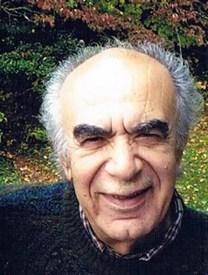
This is a photo of him that I got from the obituary that was online. Why had I not taken the time to take a good picture of him? I have some, I’m sure, but they are casual snapshots. Why can’t I find them? How did I not know that this was not forever, that he would be gone one day, that everything would be gone?

Hosein

He called the garden in Persian “Zebah Kenar” – pretty little corner. Ellen made it. He’d designed the house in a very Japanese style, where it wrapped around the garden. Most of the rooms had windows that opened out onto it. In Japan, the symbol for “home” is the the one for “house” plus the one for “garden”. A garden makes a house a home.

Hosein understood this. The soul of the place is the center, the inside, the living part that you work on.

I just found a picture of the garden that I’d taken.
Rafieepond

…and after some digging, I found some more. Here are shots of the lovely lantern by the front door.  Almost nobody came in that way, but you had to drive by it to get to the “real” entrance.


The window on the right side is one that Hosein designed and made himself.  He taught himself how to do stained glass work just so he could make the windows for the house.  They do not look like beginner’s efforts.  He chose a difficult design and rose to the occasion.  He never made a stained glass window again after he made the ones he wanted for this house.

I have a fondness for up close pictures and unusual angles.  These were taken near the front door.  The house is very close to the edge of the bluff.  A short walk out the back door and you will fall off a very high sheer cliff face.


Here are some that give you an idea of the shape of the house.  There was a lot of height in the rooms – only a small bit of the height was used for upper rooms.  The living room was quite cathedral-like.


Here is a nice picture of the front door, the lantern, and the windows he made.
r100

I know I have more pictures of the interior.  I’ll add them when I find them.

I found this – from my wedding. The only person I still speak with is my husband. How odd that I thought these people were so important to invite for this event.
raf

and yet more I’ve found, on my husband’s phone.

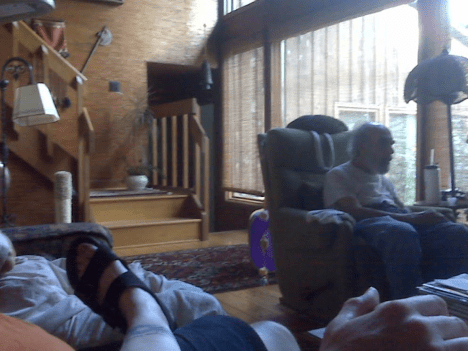
This was taken on the sly while on a visit a few years back.  This is in the living room.  Hosein is on the right.


1

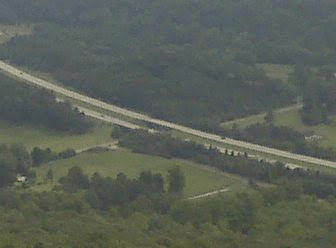
The view from their deck.  When they built their home this road didn’t exist  – thus the noise didn’t exist either.

4

This might be at their house – but then again, it might be at the Choo-Choo.  I wonder what happened to their Koi when they moved?  They surely didn’t take them with them.  Koi live a long time.

2

Death is every day

There’s an old story about a man who was walking towards a town and he sees Death walking along beside him. They start to talk and Death says that he is going to kill everyone in the town. The man bargains with Death and says “Please don’t kill that many people” and Death says “Okay, I’ll only take 100.” When they get to the town, the man warns everyone there that Death was there and he was going to take 100 people. After a week a thousand people had died. The man finds Death and speaks with him, saying “You promised you would only kill a hundred people!” Death replied “I did. Fright killed the rest.”

There’s yet another story going around that says that the world is ending soon. This most current one says that they miscalculated the Mayan calendars and that it really is going to be June 3-4. This doesn’t give us a lot of time to get ready.

When my mother-in-law found out that she had a terminal diagnosis of cancer, I asked her what she wanted to do. She said she wanted to live. I pointed out that there is a difference between living and being alive. What do you want to do with the time that you have? What do you want to be remembered for? How do you want to contribute to the world? She didn’t have an answer. All she knew was that she didn’t want to die.

Our life is God’s gift to us. How we use it is our gift back to God.

“Ask not for whom the bell tolls. It tolls for thee.” – John Donne

Jesus had many parables about constantly being ready for the kingdom of heaven. This could be interpreted as death or a change in our way of understanding. Perhaps the “Kingdom of Heaven” can be seen as a death of the way things have always been, and a new life of peace and harmony.

But he also said that even he didn’t know when this would happen. So how could these predictors know, when they aren’t anywhere as connected as Jesus, who heard directly from God? They don’t. But it doesn’t matter. The idea of being ready for death is useful.

People many years ago would keep a souvenir of a loved one who had died. It was called a “memento mori” – a reminder of death. It was not only to remember the loved one, but also to remember that death is their fate too.

Our society has sanitized death to the point that we don’t even see it anymore. Our dead are taken away from us by professionals. We don’t experience death as a part of life like our ancestors did just a hundred years ago. They took care of their own dead at home. They washed them, laid them out, built a coffin, and buried them, all on their own. Now because that is done for us, we are divorced from the idea of death. We see it as an aberration, instead of as normal, which it is.

Death waits for nobody. Death is every day. There are no second chances, no do-overs when death comes. Death isn’t a punishment or a failure. Death is the natural result of life. It is best to make friends with it because it isn’t going away.

What would you do if you knew you had only a year to live?
Why aren’t you doing that now?