Easter and Ostara

I have an opportunity this week to go to two different religious events that are not part of my faith tradition. They are being held at a Unitarian Universalist Church. I’m interested in other faith traditions and attending their events. I feel that we cannot truly “love our neighbors as ourselves” if we don’t know anything about them. It is important to know where we are both coming from.

But I’m conflicted. The first one is a Purim celebration. That is a Jewish festival, celebrating the defeat of people who wanted to kill the Jews. It centers around the story of Queen Esther. I’d like to attend because I’ve never participated in this festival, but do I want to do it at a place where they might not be doing it correctly? It might be more “show” than real, because the Unitarians aren’t Jewish. Going to a synagogue would be the best option if I want an authentic experience, but I don’t want them to feel threatened by the fact that I follow Jesus.

This then leads me to this thought. I find it interesting that the very things that the Jews hold against Jesus for why they can’t accept him as the Messiah aren’t true. They think it is blasphemous that he said he was God. But, he never said he was God. He said all the time that he was the Son of Man. He said he was the son of God, but said that we all are. They are also repulsed by the idea of human sacrifice, as well as the concept of sacrificing yourself for other people’s transgressions. I’ve not found anywhere that Jesus said he “died for our sins” – Paul said that, but he isn’t the Messiah. Jesus died out of obedience to God’s commandments, and to show us that death is not final.

I’m also little confused as to why the Unitarian Universalists even call themselves a “church” – as the term is associated with Christianity. If they want to be inclusive, then the word “church” is going to be a problem for the very people they are trying to attract. “Congregation” or “community” might be a better term for them. They don’t consider themselves particularly Christian, nor do they act in usual Christian ways. They don’t even mention Jesus or God in their services. They don’t read from Christian scriptures, and in some gatherings they don’t read from any scriptures from any faith tradition. They want to not offend anyone and be as inclusive as possible. This means that they have watered everything down so much that it doesn’t taste like anything at all. Sure, some Christians go there, but so do atheists and agnostics. How can it be a “church” if you can be a member and not even believe in God?

There is also going to be an Ostara celebration at the same place in the evening. This is the origin of the Easter celebration in Christian churches, where they celebrate Jesus being raised from the dead. But Ostara is most certainly a pagan celebration, not Christian. Is it appropriate for me, a disciple of Jesus, to go to?

What does the Bible say? When in doubt, it is good to look to good examples.

Paul, when asked if it was OK for Christians in the early church to eat food that had been sacrificed to idols said that it would not harm them, but that it could cause other members to falter in their faith.

1 Corinthians 8
About food offered to idols: We know that “we all have knowledge.” Knowledge inflates with pride, but love builds up. 2 If anyone thinks he knows anything, he does not yet know it as he ought to know it. 3 But if anyone loves God, he is known by Him. 4 About eating food offered to idols, then, we know that “an idol is nothing in the world,” and that “there is no God but one.” 5 For even if there are so-called gods, whether in heaven or on earth—as there are many “gods” and many “lords”—
6 yet for us there is one God, the Father.
All things are from Him,
and we exist for Him.
And there is one Lord, Jesus Christ.
All things are through Him,
and we exist through Him.
7 However, not everyone has this knowledge. In fact, some have been so used to idolatry up until now that when they eat food offered to an idol, their conscience, being weak, is defiled. 8 Food will not make us acceptable to God. We are not inferior if we don’t eat, and we are not better if we do eat. 9 But be careful that this right of yours in no way becomes a stumbling block to the weak. 10 For if someone sees you, the one who has this knowledge, dining in an idol’s temple, won’t his weak conscience be encouraged to eat food offered to idols? 11 Then the weak person, the brother for whom Christ died, is ruined by your knowledge. 12 Now when you sin like this against the brothers and wound their weak conscience, you are sinning against Christ. 13 Therefore, if food causes my brother to fall, I will never again eat meat, so that I won’t cause my brother to fall.

Jesus said after being resurrected from the dead that we wouldn’t be harmed, even if we drank poison or handled snakes.
Mark 16:17-18
17 And these signs will accompany those who believe: In My name they will drive out demons; they will speak in new languages; 18 they will pick up snakes; if they should drink anything deadly, it will never harm them; they will lay hands on the sick, and they will get well.”

Jesus did not separate himself from people and only associate with people who were “safe”. He constantly was challenged by the religious authorities who mocked him for “dining with sinners”. They said that if he was a prophet, he should know that the people he was hanging out with weren’t righteous. His answer to their challenge –

Mark 2:17
17 When Jesus heard this, He told them, “Those who are well don’t need a doctor, but the sick do need one. I didn’t come to call the righteous, but sinners.”

Jesus touched and healed lepers. Nobody touched lepers – they lived apart from everyone else because their disease was so contagious. To touch a leper was to become one. Yet he touched them, along with those with other infirmities that were seen as socially stigmatizing.

Matthew 8:1-3
When He came down from the mountain, large crowds followed Him. 2 Right away a man with a serious skin disease came up and knelt before Him, saying, “Lord, if You are willing, You can make me clean.” 3 Reaching out His hand He touched him, saying, “I am willing; be made clean.” Immediately his disease was healed.

I remember one time I went to a talk and guided meditation that was sponsored by a Hindu meditation group. The vast majority of the attendees were Caucasians. I felt OK listening to the talk, but very uncomfortable closing my eyes and participating in the group meditation, so I didn’t. Afterwards, the members all descended upon the newcomers and started questioning them in a manipulative way. Yet I had chosen to wear a necklace that had the Sacred Heart of Jesus as the image on the pendant. I used it as a way to show them a side of Jesus that they had never heard of, with Jesus being so open and vulnerable that he was willing to share his heart with the world. He didn’t hide who he was from people. He lived fearlessly.

So instead of being afraid that I’m going to be led astray by the Ostara celebration, perhaps I need to go as a representative of Christ. Perhaps I need to go in case there is an opportunity to show people who Jesus really is. But I still don’t know. I don’t want to “crash” their party. I don’t want to be “that Christian” who is rude and who covers over other traditions with her own. There are too many of those kinds of people. But, perhaps I am being called to go, to hang out with people who have either been excluded from the Church for being different, or have never heard the message of Jesus clearly.

I’m still praying about it, and I think this is always the path we need to take. We should always remember that it isn’t what we want to do, but what God wants us to do. Only through prayer and discernment can we know the difference. Only if we are truly following God can we do any good in this world.

(All Bible translations are from the Holman Christian Standard Bible.)

Pod people

pose


Nell was having none of it. Not anymore. Her husband simply refused to even try to breathe air. The doctor said he could, that his lungs could adapt to this environment, but he disagreed. Trouble was, he’d never know unless he tried.

Elowyn had read about other Marenians who had converted to air breathing. He’d never met one, of course. How could he? There were only three who lived in this state, and the closest was two hours away by plane. No airline would let him on a plane with his argon suit, that was a given. Their fears were unproven, but policy was policy.

They’d met three years ago at the landing site. She was a reporter, alerted by the scanner in the office that something was coming from the skies again. That scanner was worth its cost from all the leads it provided. Quick as a wink she was downstairs and in her car, trying to not drive off the road as she followed the plumes of green clouds stretching like a tightrope from the eastern sky to some nearby cornfield – Mr. O’Reilly’s, most likely. He had the biggest one, so it stood to reason. She turned down Ellis Way and got there before the locals did. Farmers listened to the scanner same as reporters did, and for much the same reason. It was the best way to know what was going on that might be of interest. Something like this would pull them out of their barns for sure.

Just think of it! Aliens! Here! In Mill City!

Nell had guessed the pod’s trajectory right and reached the small crater it created just after the police had gotten there. The ground was still steaming next to the blue (metal?) craft. She noticed that there was a bright iridescent sheen across the pod’s surface, reflecting the late afternoon summer sun, as well as a distinctive sharp smell much like ammonia, but she couldn’t quite place it.

They didn’t know at the time but it turned out that the color and the smell were both hallmarks of the Marenians. They both came about because their ships were alive, growing out of the same stuff as the people. This way they could self-repair. It saved a lot of money and time that way. It worked perfectly as long as they stayed in the Marenian solar system because the elements were more or less the same throughout.

Earth, however, was another matter entirely. The stresses of the previous crashes had resulted in every pod going into automatic repair mode, sending wispy tendrils into the soil to gather the raw materials needed to boil up replacement parts in the integral kitchen/lab. Three minutes after the tendrils went down, they came back up, spit out what dirt they’d sampled, and retracted back into the beetle-like shell, refusing to budge. The self-preservation instinct was the strongest one, so the pods calmly explained in their proto-language to the pilot inside them that the soil was not compatible with their electrochemical makeup, so repairs would not be forthcoming. As trained, each pod then sent out a trans-space summons for another pod to make the trek to bring dirt from home so repairs could proceed.

The only problem was that these supply pods came and they too became stranded. They’d underestimated the amount of dirt needed for the repairs.  The pods were small, with barely enough room for the pilot.  Even if they were able to navigate without a pilot there still wouldn’t have been enough room for dirt to repair both ships.

No matter – flying without a pilot wasn’t an option. Each pod was raised with its pilot from the moment s/he was formerly admitted to the astro-nav program. Saying that they were synchronized wasn’t the half of it. Cells were harvested from under the tongue of the pilot and cultured over three weeks, growing into a ship that learned as the pilot learned. This was no simple cloning. The two beings were separate in body only. All past, present, and future were shared.

This created a dilemma when the pods, and thus the pilots, began to be stranded. Without hope of repair, the pods chose to self-terminate, opting for a quick death over a slow lingering one. The pilots had to be tranquilized before the pods could self-euthanize. Otherwise it would have been too painful for them to endure. Some later, once they’d learned the local language, said it was like amputation of half your limbs and your brain.  Many were encouraged to adopt dogs afterwards as the closest Earth option to the deep connection that they had shared with the ships.

Nell had worked closely with Elowyn after the crash, helping him to adjust to Earth living.  There was no going back to Marenia, so he had to learn a whole different culture. This was made easier because of his astro-nav training, but it was still understandably difficult.

She’d not planned on adopting a stray, but the Mayor assured her that she was the most qualified person in the city for the job.  Simply being a reporter, curious about new things, made her ideal, he said.  Put that way, how could she refuse? It was a high honor to be deemed worthy of helping a stranded Marenian.  You were serving as an ambassador for the whole planet, after all.  The future of the relationship between the two solar systems would be created from these one-on-one relationships.

It was about a year later that they both realized that they were quite compatible together and decided to formalize their pairing.  Fortunately for them, other human-Marenian pairs had formed before they had even met, and laws had been changed to allow for interspecies marriage.  There was only one difference with these marriages and all others – one member of the union had to be sterilized.   Doctors weren’t comfortable with what could happen if a child was created.

There was no way a child could have been created in the case of Nell and Elowyn. He was still hermetically sealed inside his argon suit.  He had to have it to breathe on Earth, he insisted.  The material in the suit was fortunately impervious to decay, or he would have a more difficult time of it.

Nell was quietly upset when she learned this, hoping that he’d eventually be forced to adapt to Earth ways.  She loved him, of course, but she thought that things would be better for both of them if he didn’t wear that darned suit.  It made going out to visit friends awkward.  Plus, the smell took some getting used to.  The ammonia-like smell was a byproduct of the impervious material.  It was unnoticeable on Marenia, but on Earth it alerted others that there was a foreigner around even before they saw him.  It made some people not want to deal with Marenians at all, saying that they smelled like used gym socks.

Nell and Elowyn mostly kept to themselves at home when she wasn’t working.  He didn’t have to work – none of the stranded pilots did.  They didn’t need food, and they weren’t interested in owning anything.  If they couldn’t carry it, they didn’t need it – this philosophy was part and parcel of being a Marenian.  It was how they had finally adapted to a planet with too many people and not enough land.  They didn’t even need to live in homes anymore, having selectively bred themselves over twenty-three generations to be unaffected by temperature changes or ultraviolet rays.  Some did live in homes on Marenia out of habit or convenience, and most pilots on Earth did as well, but it wasn’t uncommon to see one hanging out with homeless people under overpasses or near street corners. They were comfortable wherever they happened to be.

The Marenians got along with the homeless population uncommonly well.  They had in common their philosophy of “less is more”, albeit perhaps unwillingly for some of the homeless.  Soon the Marenians and homeless had developed a spiritual system – not a religion – about this, encouraging others to get rid of their addiction to things. They explained that there was a reason that the Earth language used the word “possession” to refer to things as well as being taken over by demons.

It had to be a spiritual system because a religion would require stuff – books or buildings, for instance, and this was totally opposed to their beliefs.  Of course, many years later, after the founders had died and no more new Marenians came to Earth, their simple way was converted like all other spiritual paths had been and there were not only cathedrals to “less is more” but also gift shops with plastic trinkets made in China.

Nobody told me about death

It was such a surreal time when my mom was dying. Nothing in my life had prepared before it, and nobody helped me through it. It was strange for her to, of course, so she was not able to help. The person I had always looked to for guidance was looking to me for strength.

The hospice social worker read off a set list questions – “What do you want to do?” “What life goals have you not achieved?” I guess the idea was to try to do some of these things before she died. It all seemed cruel and thoughtless. She couldn’t do these things – not enough energy anymore, or time. Visit England, her birthplace? Not possible. See me graduate / get married / be an adult? Not possible. 53 is a young death, and all preventable. She signed her death certificate the day she started smoking. She tried to quit but didn’t stick with it for many reasons. Something stressful would happen. She was bored. Dad wouldn’t quit.

Milton suggested that Adam ate the apple because Eve had, and he didn’t want her to be alone in being banished from the garden. He sacrificed his own happiness to be with her, to support her. Is this part of it? Or was it just a simple ugly habit, an addiction?

Near the end hospice sent over an aide they’d hired from a home healthcare company. She was a skinny black woman of limited education. She browsed our bookshelves and pointed out those that she felt were expensive. They weren’t – we often found large hardback photo books on the remainder table for under $10. We collected them and savored them, as the library in our city was small, and far away. After she said this I felt obliged to stay in the room with her all the time, which defeated the purpose of having her there. The point was to have a trained person with my Mom so I could go get errands done, or simply have some time off from the endless task of tending her by myself.

The aide also wanted to use Vaseline to swab my Mom’s mouth, saying that dying people’s mouths get dry. They do, but Vaseline isn’t the answer. That is weird. “Would you want Vaseline in your mouth?” I asked her. No answer. She couldn’t empathize.

She also had a bit of note paper in a folder she brought in. She’d written “The devil is real” and “You’re going to die!!!” on it. I asked her about it. She said that sometimes the people she tended would “act up” and she’d shove this in their faces to quiet them. I called hospice and said she never needed to tend my mother or anyone else ever again. They said she was leaving that company to go tend people who were profoundly mentally and physically handicapped. I replied that “She does not need to be around anyone who cannot defend themselves”. They had no answer, it was out of their hands they said. She wasn’t hired by them, it was through another company.

Around the same time a lady named Bernice was there. She went to the Episcopal Church that Father Rainsford had visited at and preached. He used Mom’s story in a sermon. He did not ask if he could, but that is another story. Bernice felt moved by the story to ask if she could help since I was tending Mom all by myself. She helped watch the watcher and later went, by my suggestion, to get hoagies from Ankar’s. She’d never had them before. They are my family’s comfort food. Submarine sandwiches don’t even come close.

I remember how weird it was when Father Rainsford came over towards the end and did last rights. That made it really real. He called out the page in the Book of Common Prayer. I was one I’d never seen before, and I scanned the title of the section. It is page 462 if you are interested, and it is titled “Litany at the Time of Death”. I’d not asked him to do it, but he knew it was time. I wasn’t ready for it. She died maybe a week later. She’d not talked for a week before this, but chimed in when we recited the Lord’s Prayer.

People who are dying see things that others don’t. Mom asked about that man who was sitting there, pointing towards the couch. No man had been in the house for days at that point.

People who are dying do unusual things. She was picking at her bedclothes. She took all the Kleenex out of a box, one by one. She filled in random letters in the crossword puzzle she was working on. Late one night she had nightmares, visions. She was quite anxious, calling out. I could not calm her. I called hospice, who sent out a nurse who gave her more anti-anxiety medicine. He said that people tended to die the way they lived. Since Mom had smoked a cigarette every 20 minutes of her adult life, she was quite unable to calm herself without chemical intervention.

Months earlier she’d finally came to understand about my pot usage at the time. She refused to try it, afraid that the doctor would find out through blood tests. What would they do – arrest a dying woman? Refuse further treatment? If she had tried it she would have been happier, more at peace, better able to process her feelings. It takes the edge off, and it is hard to think when life is all edges and angles. Plus she might have not lost much weight since she would have been hungry, and pot is also an anti-emetic. The wasting away from throwing up from chemotherapy drugs is awful. The “cure” is sometimes worse than the disease. Surely there has to be a better way to heal than by putting poison into people’s veins. It makes no sense at all.

The neighbors provided food. The priest visited. Hospice nurses and volunteers came. It still wasn’t enough, and still none of them told me what to expect. Hospice provided a page of “things that might happen” but it wasn’t enough. I needed someone to sit down with me and let me know that this crazy event that was happening was normal, and here’s what to do and not do.

Nobody told me what to expect. Nobody counseled me. Nobody thought to care for or about me, the 25-year-old child, not yet an adult, he was tending her mother, her friend, her roommate, alone and without training. I would suspect it is just as hard to do this at 50, but at least then you’ve had a bit more life experience to call upon.

At the end my aunt came, even though we were against it because of letters that she had written my Dad, saying that Mom would be better off dead. There was no one else I could invite to stay over to help me. Friends left me. In spite of my years of church involvement, church members never showed. Did they know? This is one of the disadvantages of being in a large congregation.

If I was pregnant, for instance, I suspect that someone would tell me what to expect, how to handle this. There are books at least. But people don’t talk about death. It is the elephant in the room. Perhaps they don’t know what to say? Perhaps I appeared to be handling it so well that they thought I knew. It was a façade, a front. In the back behind the scenes, I was alone, made more so by the fact that my counselor, my support, my friend, my roommate was leaving me, fading away to nothing right before my eyes.

Mountain waves (visual poem)

mountain waves 031116

I spend part of May in the Blue Ridge mountains celebrating my wedding anniversary. The view from Grandfather Mountain (in Western North Carolina) is like this – when is it a mountain, and when is it a wave in the ocean? It is overwhelming, especially at sunset

This is composed of cut up cardstock tests of Distress Ink – the edges of the main test. Reassembled like this, it looks like I’m trying to take pictures of the mountains, and putting captions underneath.

Card stock
Distress Ink
gold paint with glazing medium
Tim Holtz Idea-ology quotes.


(Click on the image to see it larger)

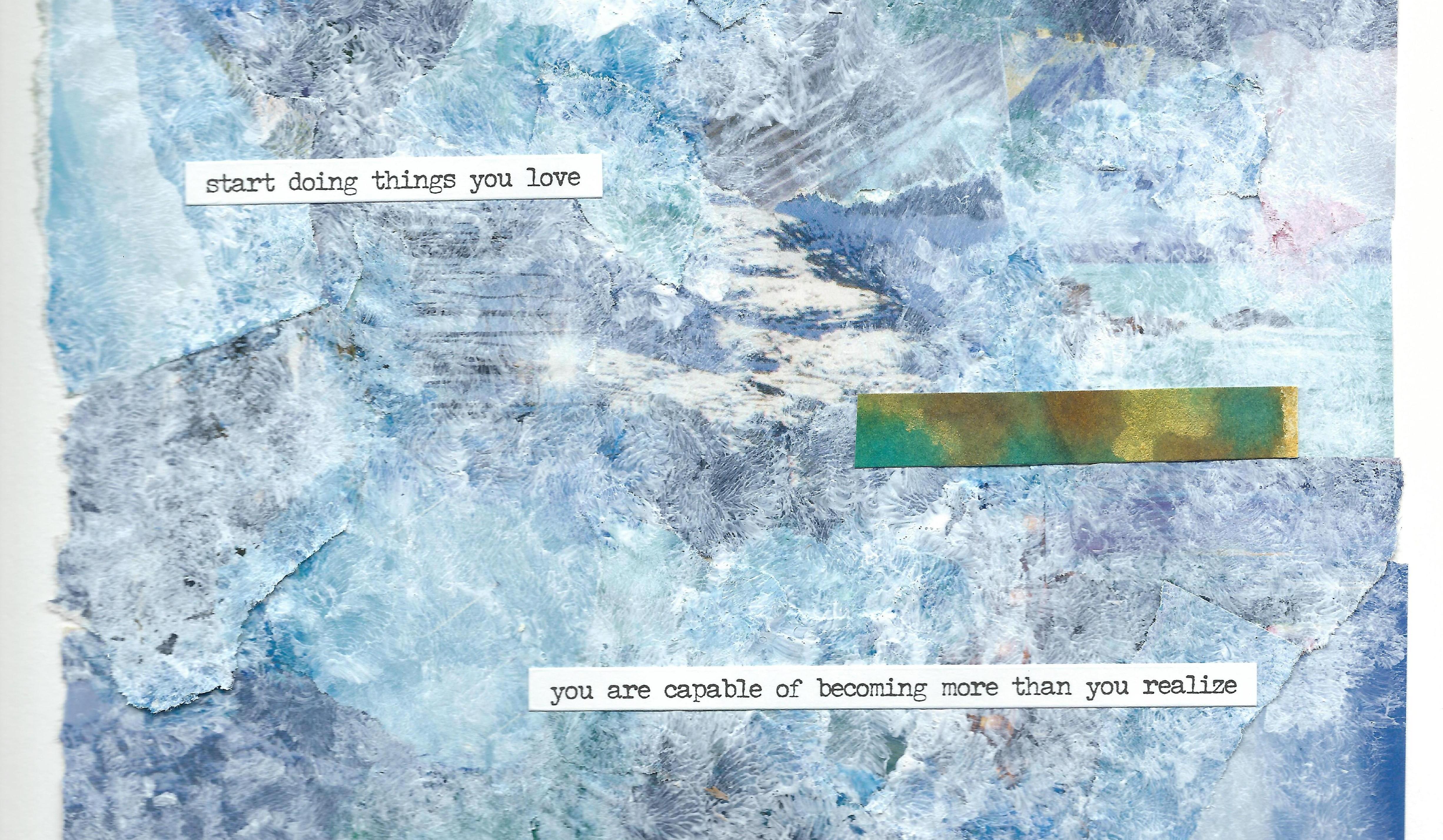
Hidden messages

Hidden messages 031116

The base of how to do this was inspired by Nick Bantock in his book “The Trickster’s Hat.” My library system did not own this so I used the “suggest a book” feature and they ordered it as an e-book for me. I read it on my device and enjoyed being able to copy the exercises I was interested in trying onto a Note so that I could save them for later. This particular exercise involved tearing out color images from magazines (I used a travel magazine from AAA) and gluing them down. Bantock recommended using only blue and green (with no yellow-green), and then using blue paint to cover up the torn edges. I did this, but wasn’t happy with it after looking at it for a few days. I dabbed titanium white mixed with glazing medium to it to soften it. I like how it looks like fingerprints, because I usually use my fingers when painting, but not this time.

The “filler” paint used was a mix of acrylic – light blue, permanent green, phthalocyanine blue, and white. It was just too bold to blend in with the existing images, but the color mix was excellent so I’ve used it in two other projects I’m working on. I learned in a project from about a year ago that I get excellent and random results from putting the paint blobs on my palette right next to each other but not blending them. I dab the brush between them, picking up random mixes of color. I also enjoy doing this with a brush that is a little beat up, with some bristles missing. This produces unexpected shapes in the painting, depending on the angle I hold the brush.

(detail)
Hidden messages detail

I then added words from Tim Holtz’ “Idea-ology” line along with and paper pieces I created. They are from a previous experiment, using card stock, Distress stains (vintage photo, peeled paint, mermaid lagoon, cracked pistachio) that were then sprinkled with water from a free toothbrush from my dentist. I added gold paint mixed with glazing medium. Once dry, I cut up the art into strips. None of that was intended for this project – I was learning how the stains worked (not like I thought or hoped) and I’d needed gold paint for another project and had some left over and didn’t want to waste it. I picked the best card stock test and added the gold to it.

Projects are not linear. One influences another. Sometimes to complete one, you have to stop it and learn (or discover) an entirely different technique on a separate project. What seems hopeless or at a dead end often just needs to sit aside for a while and be looked at again later with new eyes. Keep working. Keep experimenting. Also, art materials don’t have to be expensive. You can be a “starving artist”, but still be a good one. In fact, a little difficulty/disability/oppression/resistance helps with making art. Contented people don’t make art, because they are happy with things the way they are. Artists show how things can be, but they often have to do that from a place where things aren’t great.

Created 3/7 through 3/11 2016 Base is a Strathmore Visual Journal.

Library manners

How about we act like we are in a library – everywhere? Restaurants. Home Depot. The shopping mall. No matter where you are, act like you are in a library. This will make for a saner world.

Speak softly. Nobody needs to yell to be heard. You don’t have to whisper, but yelling isn’t cool. Find a middle ground.

No running. Unless you are at a track meet or are being chased by a bear, there is no reason to run inside a building.

Share – don’t act like everything belongs to you. This applies to material items, as well as the road, as well as public space, as well as at a buffet. Leave something for someone else.

Keep the space tidy. Don’t leave a mess.

There is no need for music or television noise everywhere. Silence is OK. Why do restaurants have to play music so loudly that you can’t even hear your dinner companion? Why do doctor’s offices have to have the TV on news, or talk shows, or other things that are stressful? You aren’t feeling well as is – why add to it? If people want to be distracted (if silence scares them) they can turn on their iPods and plug in their headphones. But for those who don’t want the noise, there is no escape.

Treat everybody who helps you with respect. I worked many years in retail before going to work at the library. They are very similar – but with a major difference. The same person who would be brusque with a clerk at the gas station is nothing but smiles to the library worker. I came from working at a Jo-Ann’s craft store, where I would ask people “How are you?” all day long. They’d answer, but not reciprocate and ask me how I was doing. Then I got hired at the library, and patrons initiate the question. Here’s a shocker – to do what I do only requires a high school diploma. Librarians have master’s degrees, but I’m not one. But does that mean that the public thinks that people with degrees should be treated better?

On modern conceptual art.

I read a post on an artist group page that wondered what was wrong with modern conceptual art. The video that was used to spark discussion had a commentator that said that it was all crap, and showed recent examples to prove his point, some of which was in fact fecal matter. No, I’m not being euphemistic. It was actual fecal matter, used as “art” and hanging in a museum. There were other examples that were equally bizarre and unsettling.
What I found most interesting was that the people who commented in defense of the “art” said that at least it provoked a reaction. To them, simply making someone react was proof that the artist had done a good job.
However, the issue is that the reaction isn’t a healthy one, or one that inspires. It is a reaction of confusion (what is the artist trying to say?), or anger (how did this random paint smear get into a museum/get bought for a million dollars?).
Perhaps the reason so many people like modern conceptual art is because it reminds them of their own feelings. It is “misery loves company”. People like things that remind them of who they are. Deep down they must be very lost and confused and broken. Therefore they like art that is also lost and confused and broken. This art is a reflection of a feeling of loss, of anger, of destruction, of violence, of hopelessness. This art tries to show us how meaningless our existence is, how random, how pointless.
Madeline L’Engle, the author of the “Wrinkle in Time” series, said that art should elevate and make us feel better. Art should point the way out of the bad situation. Art should remind us of our inner strength and point us towards hope.
Art that is purely used to express rage and destruction and violence and anger can be useful as a catharsis. It can be a way to get out those feelings rather than letting them bottle up inside. It can tell other people that it is safe to have and express those feelings. But the problem occurs when we get stuck with that kind of art, when we are only shown the darkness of the world or ourselves.
At that point we are idolizing pain. We are making a fetish of our failure. We are saying that loss and destruction is our lot in life and where we must stay.
There must be another way. Art should be a rope ladder rather than a noose. Art should inspire and encourage and enlighten in the truest sense of the word. It should shed light on a dark situation and reach that small part of ourselves that wants healing, that knows how to heal.
Rather than being a passive thing where we expect others to save us or heal us or help us, art should remind us of our own inner healing nature. It should be a map to the center of our being that shows us how to get out of the hole we are in. Art that is only about loss and violence and anger cheats us, because it speaks only to itself and does not point beyond.
Consider this – poetry that is purely descriptive, that details for us what is right now isn’t poetry. It is merely a news story written in verse form. True poetry elevates and points beyond itself and hints to other and greater things. True poetry guides us back to the best parts of ourselves. Likewise, art that only shows the ugly side of life is not art. It is a photograph that happens to use paint or collage.
True poetry, like true art, can speak about the horrors of life, but to make it poetry or art, it has to show us a way out of it. Art and poetry have to be doors that are open. They show us that while we are on one side of the door, there is a way out of it to another place.

Positive, please

Remember this phrase? “If you don’t have anything good to say, don’t say anything at all.” I think it is time for all of us to try following this advice.

Remember the phrase? “Misery loves company.” Bad news grows, like a cancer.

We have to stop giving attention to the wrong things. Try this – post only positive, uplifting posts on your social media pages for a week. Don’t give energy to evil – it grows from it.

Don’t share something that is hateful or harmful because your friends “need to know about it.” You aren’t the news. They can read terrible things anywhere. Just don’t let it come from you.

I have a friend who usually shares innocuous things, but then she felt it was necessary to post a news report about a clergy member doing something extremely inappropriate. I challenged her – why did you feel the need to share this? She didn’t answer, but a friend of hers did, saying “Because we need to know!”

No. We don’t. We don’t need to know about things we have no control over. We don’t need to know about tragedy and tabloid news. We don’t need to know what celebrity or politician said or did something stupid. We don’t need our friends to tell us that the bees are dying or about the dangers of genetically modified food.

We don’t need to know about news that has nothing to do with you. We can read that for ourselves. Tell us about you – what are you doing? What are you making? How are you living your life? We can’t find that out from reading Google news or the newspaper. Share that. That is why we are friends with you. We want to read about you – not negative posts about things that have nothing to do with you.

Sharing negative posts with your friends isn’t friendly. It isn’t kind at all. It is infecting them with your own personal brand of paranoia. It is the equivalent of showing up at their house and dumping a load of trash in their living room.

All the “what were they thinking” posts are the same – they spread negativity. Just say no to bad news. Don’t be bad news by sharing it.

Use your words (a meditation on making art)

Parents tell children to “use your words” when they are feeling frustrated. But what if they don’t have words? What if the problem is that the things that they are experiencing are too large for words? It is important to give children as many different ways of expressing themselves as possible. Consider this – studies have proven that babies who are taught sign language before they are able to communicate verbally show a greatly reduced level of frustration.

I think that learning many ways for self expression is the cure for everything. Everyone needs to learn different ways to communicate. Sometimes words fail us.

The arts provide us with many other ways to communicate. Dancing, singing, playing a musical instrument, drawing, painting, knitting, beading – the list is endless. It is only limited by your imagination. Whatever you try is good.

Plenty of people are upset that the public schools are cutting their budgets and eliminating the arts. You don’t need to go to school to make art. In fact, school can’t teach you how to make art. You already know how to do that. Children do it without thinking, and this is the best way. Just have fun playing and you are on your way.

Not having a lot of money is also not an excuse. Crayons and paper are cheap. You can find used musical instruments at a thrift store. You can even create your own tools to create with.

I used to write a lot before my parents died. After they passed, writing was too much for me. Every time I tried, too much would come out and it would get tangled up. My feelings were too big to be expressed with words. Thankfully, I had beads as a form of self-expression at the time. I would string together beads like I had strung together words. They had rhythm and feeling. There was an internal logic to them. Did others know what I was saying? Not always. But that isn’t always necessary. In that instance, it wasn’t important that I communicate an idea to others. It was essential that I got those feelings through and then out of me.

These days I work on visual arts such as painting and collage as well. I find I can process deep emotions this way, handling them in a safe and healing way. Some things that come up while I’m making art were so buried that I didn’t even know they were there. I’m grateful for my practice of making art as a form of self-healing.

Art doesn’t have to be “good” to be useful. It can be more abstract than representational and still do the job. Nobody else has to even see it. In fact, not thinking about an audience usually means that you’ll do more and better work because you aren’t trying to edit it to make it “safe”.

If you want to use images and you aren’t good at drawing (yet), you can cut out pictures from magazines. Don’t have any? Ask your friends – someone has a few that they would normally throw away. Not good at mixing paint? Buy art paper with pretty designs and cut it up and glue it on. Consider having an art-supply swap meet, where everybody brings materials that they are tired of and switches out. You’ll find new ways to express yourself with new supplies.

Remember that anything you want to do well takes time and practice. Nobody is a Rembrandt overnight. Have patience with yourself, but most of all – play.