Into the deep (part 2)

deep1
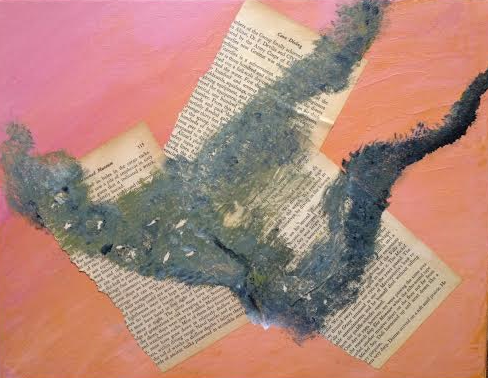
This is the full piece, but just the second layer. More to come. I’m documenting the creation of it.

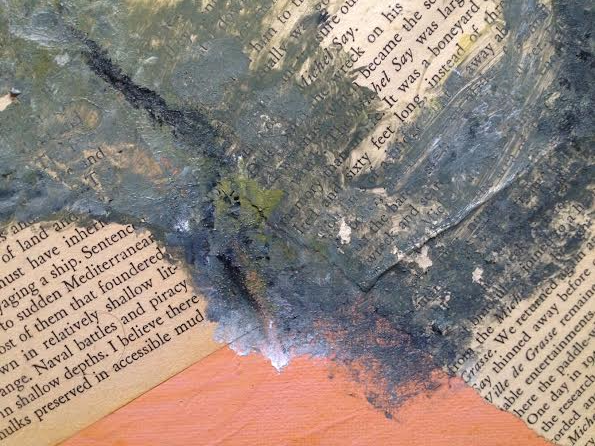
The base of this was a generic painting background I did maybe a year ago. Yesterday, I was working on another piece and had some spare paint. I fished around the not-yet-completed stack of canvases and found this one. I decided to add some pages to it first because I like the look of words showing through paint. It is hard for me to remember what order things should be done, but I’m getting better. Rather than just gluing or painting on the canvas by feel, I’m trying to think about how I want the finished piece to look.

deep2
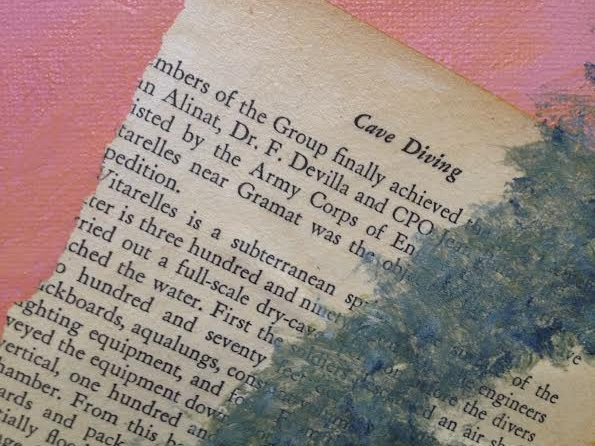
(top left detail)

Sometimes making art is about just going with the feeling, and sometimes it is about trying to say something. Sometimes it is a little of both.

deep3
(top middle detail)

I dug around my “to be torn up” pile of books and chose “The Silent World” by Captain J. Y. Cousteau.

deep4

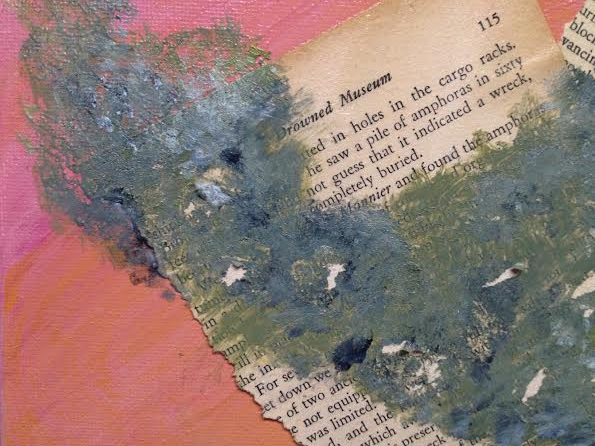
(bottom right detail)

Tearing up books to use in art was a hard thing to get over, being a life-long reader and a library worker. I have about five books to do this with, and I got them all for free. I guess ideally I’d use different books for each piece, but I can’t justify trashing a book for just three or four pages.

deep5

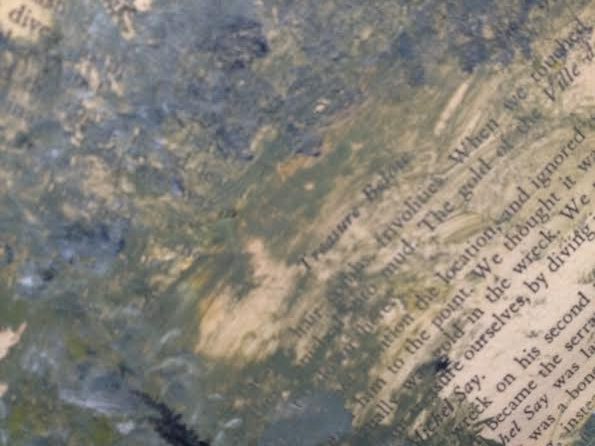
(middle detail)

I pulled out random pages, and here are the chapter titles for the three different pages. I liked them enough to make sure that I don’t totally obscure them.

Drowned museum
Cave diving
Treasure below.

I don’t remember what the base coat colors are. The paint colors that are over the pages are – titanium white, cadmium yellow deep hue, Payne’s grey. I put blobs of them into a large yogurt lid and put some glazing medium on top. I blended them only as I went, using the brush. I was surprised to discover the mix ended up being a mossy green. It looks worn, like rocks with lichens. But it also looks a bit like bird poop. While trying to remove some of the paint from the pages so I could see the words, the paper tore. I liked the look, so I kept doing it.

I’m meditating while working on this about young people who are lost, who haven’t been raised with any moral foundations. They don’t know right from wrong because they weren’t ever taught. After a certain point, a person is too old to be taught this in any meaningful way. On the surface, they look normal, but deep underneath there is darkness. These people are the scariest of all, because they don’t even know when they have crossed a line.

This is a way to meditate and pray yet make something at the same time.

Purification

Remember when Jesus said that the words of the Pharisees were like walking over dead bodies? This is in Luke 11:44 –

“Woe to you! You are like unmarked graves. People walk over you not even knowing that they have become defiled.” (from “Religious Hypocrites Discredited” in the Condensed Gospel rendition.)

(The original reads “Woe to you! You are like unmarked graves; the people who walk over them don’t know it.”)

What does this mean? How bad is it to have contact with a dead body? Pretty bad, it turns out.

The entire 19th chapter of Numbers covers the very difficult process of becoming ritually clean after contact with a dead body. I’ve included it at the end of this post so you can read it for yourself.

This is no simple process – you can’t do it overnight.

Here is the summary –
First, a pure and unblemished red heifer that has never been yoked has to be taken outside of the camp and slaughtered. Then all of it is burned to ash, along with cedar wood, hyssop, and crimson yarn. The ash is mixed with water, and that water is then used to purify the person who was rendered unclean from a dead body.

All along the way, each person involved in the process of creating this substance becomes unclean themselves for various lengths of time. There are four different people who become unclean – the priest, the person who burns the heifer, the person who gathers the ashes, and the person who sprinkles the water on the unclean person. This is a huge inconvenience for each person involved. Being unclean means that you are separated from other people to various degrees.
The person is unclean for seven days, and must be purified with the water on the third and seventh day. If not, he is cut off from Israel forever, and remains perpetually unclean.

It is bad enough when you intentionally become unclean – but terrible when it is unintentional. You are defiled, and you don’t even know. You won’t know that you have to undergo the process to become clean because you don’t even know you are unclean.

What Jesus is saying is that the teachings of the Pharisees are leading people so astray that they are in danger of becoming unclean to the point that they will never be able to be part of the community again. The fact that they don’t even know that they have become defiled means that they don’t have an opportunity to become clean again. He is warning us about false teachers today as well. Always match up whatever any minister tells you with the Word of God to make sure that you don’t get misled.

Numbers 19 (Holman Christian Standard Bible translation)
The Lord spoke to Moses and Aaron, 2 “This is the legal statute that the Lord has commanded: Instruct the Israelites to bring you an unblemished red cow that has no defect and has never been yoked. 3 Give it to Eleazar the priest, and he will have it brought outside the camp and slaughtered in his presence. 4 Eleazar the priest is to take some of its blood with his finger and sprinkle it seven times toward the front of the tent of meeting. 5 The cow must be burned in his sight. Its hide, flesh, and blood, are to be burned along with its dung. 6 The priest is to take cedar wood, hyssop, and crimson yarn, and throw them onto the fire where the cow is burning. 7 Then the priest must wash his clothes and bathe his body in water; after that he may enter the camp, but he will remain ceremonially unclean until evening. 8 The one who burned the cow must also wash his clothes and bathe his body in water, and he will remain unclean until evening. 9 “A man who is clean is to gather up the cow’s ashes and deposit them outside the camp in a ceremonially clean place. The ashes must be kept by the Israelite community for preparing the water to remove impurity; it is a sin offering. 10 Then the one who gathers up the cow’s ashes must wash his clothes, and he will remain unclean until evening. This is a permanent statute for the Israelites and for the foreigner who resides among them. 11 “The person who touches any human corpse will be unclean for seven days. 12 He is to purify himself with the water on the third day and the seventh day; then he will be clean. But if he does not purify himself on the third and seventh days, he will not be clean. 13 Anyone who touches a body of a person who has died, and does not purify himself, defiles the tabernacle of the Lord. That person will be cut off from Israel. He remains unclean because the water for impurity has not been sprinkled on him, and his uncleanness is still on him. 14 “This is the law when a person dies in a tent: everyone who enters the tent and everyone who is already in the tent will be unclean for seven days, 15 and any open container without a lid tied on it is unclean. 16 Anyone in the open field who touches a person who has been killed by the sword or has died, or who even touches a human bone, or a grave, will be unclean for seven days. 17 For the purification of the unclean person, they are to take some of the ashes of the burnt sin offering, put them in a jar, and add fresh water to them. 18 A person who is clean is to take hyssop, dip it in the water, and sprinkle the tent, all the furnishings, and the people who were there. He is also to sprinkle the one who touched a bone, a grave, a corpse, or a person who had been killed. 19 “The one who is clean is to sprinkle the unclean person on the third day and the seventh day. After he purifies the unclean person on the seventh day, the one being purified must wash his clothes and bathe in water, and he will be clean by evening. 20 But a person who is unclean and does not purify himself, that person will be cut off from the assembly because he has defiled the sanctuary of the Lord. The water for impurity has not been sprinkled on him; he is unclean. 21 This is a permanent statute for them. The person who sprinkles the water for impurity is to wash his clothes, and whoever touches the water for impurity will be unclean until evening. 22 Anything the unclean person touches will become unclean, and anyone who touches it will be unclean until evening.”

Lamb meatballs

Makes four servings. Total prep time is about an hour and a half.

Ingredients:

1 pound ground lamb

half a cup of fresh breadcrumbs

1 tablespoon of Kabsa

1 tablespoon of dried ground lemon

1 tablespoon of parsley

1 teaspoon of salt

A tablespoon of unsalted butter

olive oil to cover the bottom of the pan

Details:

I used grass-fed lamb. This was available in my local grocery store in the organic section. I used two pieces of week-old Italian bread from the Publix bakery. The Kabsa is a spice blend found at an Middle-Eastern grocery. I bought the dried ground lemon from an Ethiopian market. I used plain dried parsley, but fresh would be good too, if you avoid the stems. I used Himalayan pink salt and ground it up with a mortar and pestle.

Instructions:

Mix the breadcrumbs, Kabsa, ground lemon, parsley, and salt together. I did it all in the food processor because I’d used that to render the bread.

Put the ground lamb into a large bowl that has a lid. Add the breadcrumb and spice mix. Mix together thoroughly using your hands. Leave as a big lump in the bowl and put the lid on the bowl. Let it sit in the refrigerator for an hour.

When it is time to cook, add the butter first to a large deep sauté pan and let it melt at medium-high heat. Then add the olive oil, making sure that it covers the entire pan. You don’t want the meatballs swimming in it – this is not a deep-fryer – but you also don’t want bare patches. Select a pan that is wide enough that the meatballs do not touch.

Form the meatballs with your hands, and add them to the pan. You want to heat the meatballs so they are seared and brown on the outside, but still moist (yet cooked through) on the inside. Thus, use medium-high heat at first, rotating the meatballs to sear the outside. Lower the heat a couple of notches after about five minutes. Rotate the meatballs every five minutes or so.

When done, drain on a plate that has several layers of paper towel.

Serve as is, or with a tzatziki sauce.

Kenopsia

Kenopsia 032516

n. the eerie, forlorn atmosphere of a place that’s usually bustling with people but is now abandoned and quiet—a school hallway in the evening, an unlit office on a weekend, vacant fairgrounds—an emotional afterimage that makes it seem not just empty but hyper-empty, with a total population in the negative, who are so conspicuously absent they glow like neon signs.

created 3-25-16
Strathmore art journal
glue stick
scissors
art paper
ad from AAA travel magazine
chopsticks wrapper from a Japanese restaurant I ate at alone on my day off, even though my husband had been gone on a trip for a week and had just come back.

Enouement

enouement 031716

n. the bittersweetness of having arrived here in the future, where you can finally get the answers to how things turn out in the real world—who your baby sister would become, what your friends would end up doing, where your choices would lead you, exactly when you’d lose the people you took for granted—which is priceless intel that you instinctively want to share with anybody who hadn’t already made the journey, as if there was some part of you who had volunteered to stay behind, who was still stationed at a forgotten outpost somewhere in the past, still eagerly awaiting news from the front.

created 3-17-16
Strathmore art journal
glue stick
scissors
art paper
map pieces
origami paper

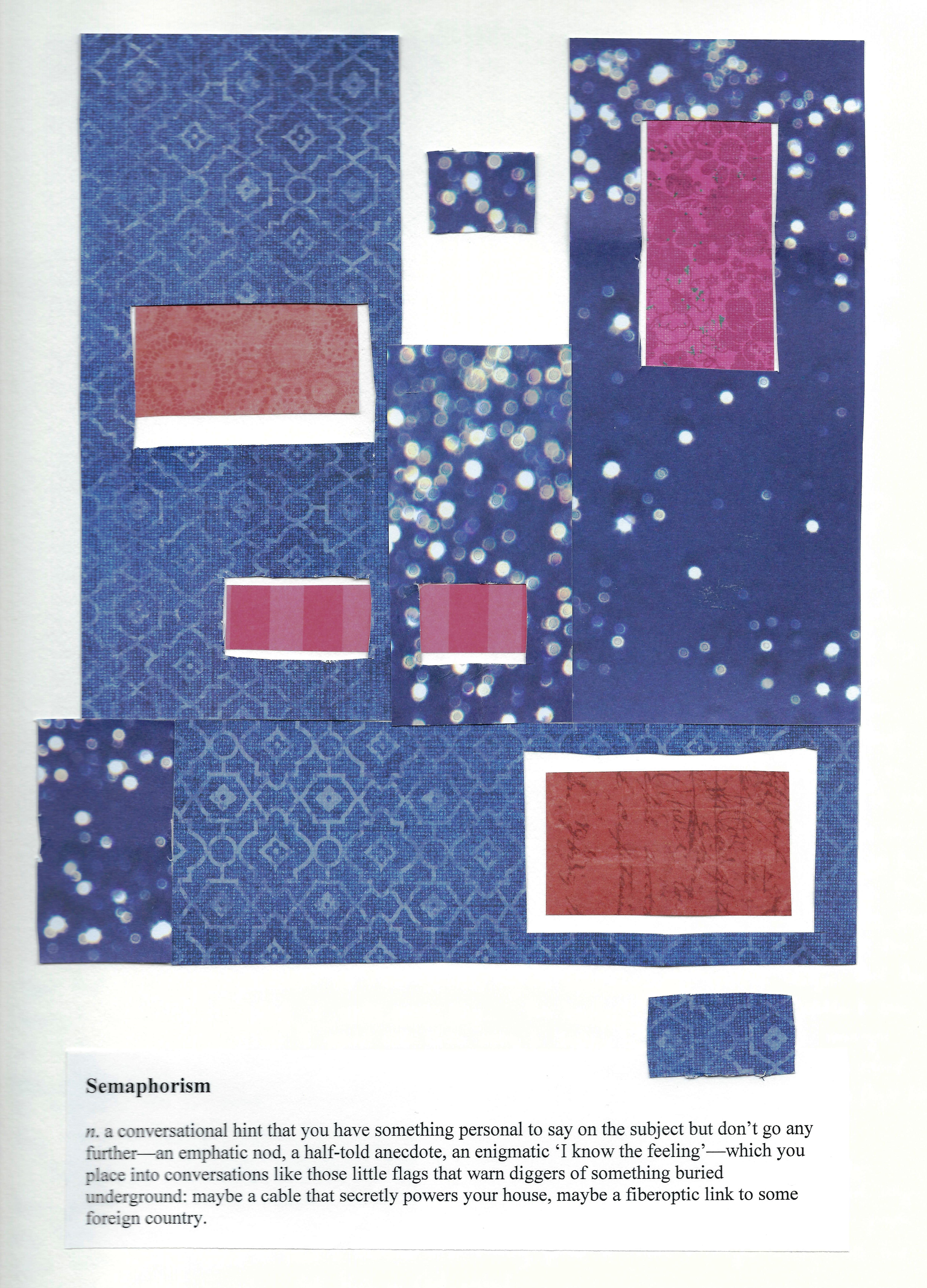
Semaphorism

semaphorism 031316

n. a conversational hint that you have something personal to say on the subject but don’t go any further—an emphatic nod, a half-told anecdote, an enigmatic ‘I know the feeling’—which you place into conversations like those little flags that warn diggers of something buried underground: maybe a cable that secretly powers your house, maybe a fiberoptic link to some foreign country.

Created around 3-13-16
Strathmore art journal
glue stick
scissors
art paper

Spiritual but not religious (poem)

There are many people who say
that they are spiritual but not religious.
Perhaps they are this way
because there are so many
other people
who are
religious but not spiritual.

These are people who
go to church
but they don’t realize that
they are the Church.

They go into a building
but they don’t realize
that the Church
isn’t that.
It is them.

They believe that their
entire obligation to God
is to go sit passively
in a building
and listen
to someone else talk
for an hour
once a week.

This is not what Jesus meant
when he died for us
to create his Church.
When he said
“upon this rock I will build my Church”
to Peter,
he’s talking to a human being.
He didn’t mean a building.
He meant that we are supposed
to serve God
with every moment
of our days.

This does not mean
sitting in a church building
and singing hymns
and praying for people.
This means actually working.
This means actually helping people.

Many people have
left the Church
because the church
has left Jesus.
Many people don’t go to church
because they don’t find
Jesus
there.

Sealed (poem)

What would you do
if I told you
that the same oil
used to mark you
at your baptism
is the same
used to anoint
priests, bishops, kings, emperors?

You, in being marked
as Christ’s own forever
have a share in his kingship,
a part in his priesthood.

You, yes, you.

It was not for nothing
that you were born.
You are anointed,
consecrated to God.

Royal. Holy.

This honor is not limited to those
in the royal family.
Look at David.
A poor shepherd boy,
the youngest in the family.
Look at Moses,
raised in a stranger’s house.
They were nobodies until God called.

God called you too,
marked you as God’s own at your baptism.
Sealed. Sanctified. Saved.

What would you do now,
knowing this?

Why are you giving away your power,
your calling, to others?
Why do you follow priests and pastors, bishops, popes?
Your one teacher is God,
and God only.

Jesus says that we will do more and greater than he did –
more and greater than
restoring sight to the blind,
making the deaf hear,
making the lame walk,
making the dead come alive.

Us.

Imagine the healing of the world
at our hands,
the power of God
coursing through us.

It is here, now.
Anyone who tells you otherwise,
who keeps this to themselves,
is misleading you.

Easter eggs at the public library

I spy with my little eye, something that begins with E.

3

Eggs.

4

Easter eggs, to be specific.

2

At a public library.

1

The idea of separation of church and state means in part that the state cannot do anything to hinder people’s practice of their faith. But it also means that the state should not promote a particular faith either.

For a government-run entity to have any display of any one faith tradition implicitly excludes all others.

Where was the Purim festival for the Jewish families? How about an observance of Holi for the Hindu families? Both of these celebrations happened this week, but there was no notice of them.

How about understanding that there are people who do not practice any faith tradition at all? How about understanding that there are people who have been psychologically harmed by Christians?

Government-run organizations get their money from tax dollars from every citizen. That means that it should represent all of them, not just a few. If they are going to have religious displays, then they must have all of them. Ideally, they would not have any displays at all.

The little white house

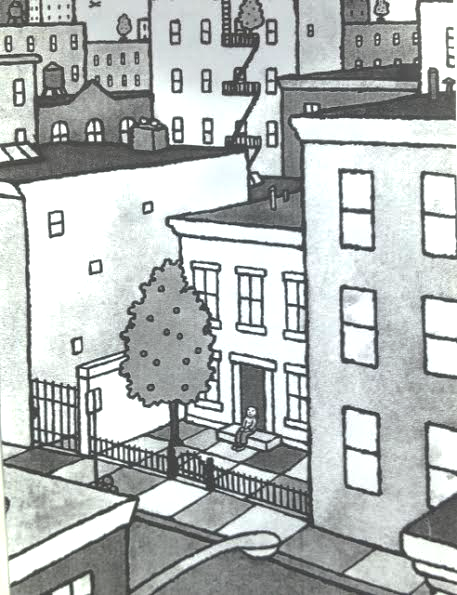
little white house

The little white house had been there longer than anyone could remember. The cornerstone said 1781, but nobody thought that was possible. Sudbury wasn’t a town that far back. The archives in the local library said the first deed had been issued in 1824 to Saul Abrams, a fur trader, but it was the only house for miles then. It was four years later before the town had its first boom and then there were a dozen homes scattered about like corn thrown to chickens. Close enough to help if there’s a need, but far enough away that you didn’t have to worry about your neighbor seeing your business. Not like anybody was up to anything, mind you, but it was still nice to have the breathing room.

Nell was currently the youngest resident of the little white house, but she certainly wasn’t going to be the last. Her mom was due to give birth within a week to her latest sibling. Meanwhile, grandma Rose and uncle Pat lived upstairs in the north-east facing room. They preferred the early morning light to paint by. They said it meant they got a head start on the day before the rest of the family got up.

The little white house had resisted all sorts of change over the years. It had plumbing but no electricity. The family had never seen a need for it, preferring natural light over artificial. Plus the money they saved was nothing to sneeze at. Of course, money wasn’t a problem for Nell’s family. Up to four generations at a time lived there, sharing their skills and resources along with their joys and sorrows. It was so much cheaper to pay one mortgage than four (or more). The money saved was worth the minor annoyance of the cramped quarters. For starters, it meant that they didn’t all have to work full-time, and especially not at jobs that took more than they gave.

The Abrams family realized early on that they would have to be careful about how many children they had if they were going to share a house. It wouldn’t do to be too crowded. Plus, more mouths meant more food, and food wasn’t cheap. They’ve had a lot of land to work with years back, but now that the city had grown up around the house they had to buy food just like everyone else.

Of course, there was always the apple tree out front. It had been the reason Saul had bought the property in the first place. The apples had just ripened on it once Saul came over the hill, looking for a campsite for the evening after a long day of marmot trapping. That tree’s beauty stopped him in his tracks and he set up his canvas tent smack dab under it to spend the evening with it as his company. The next morning he knew he’d finally found a place he could call home. He dreamed about that tree the whole night long.

Saul’s family put great stock in dreams, being descended from Jacob, who God renamed Israel. Jacob knew that where he slept was a holy place and so set up an altar to God once he awoke. Saul knew the same was true here, but he knew he was to establish a house rather than a temple.

There wasn’t much difference, really, to his mind.

The city had grown up around the house, getting closer and closer. The yard had shrunk down to a little patio in front with the tree. Tall buildings bracketed the little white house on the sides but not at the front or back. Somehow, there was still an alleyway to one side, and Nell would often play there when she wanted to be alone.

The alley was gated, and only her family had a key, but it didn’t matter. Nobody would even think of walking through that gate. Most didn’t even notice it. It was kind of like one of those Japanese gates that weren’t really gates, marking out a difference between “there” and “here”. “Here” was the difference between storm and calm, between noise and harmony. Most people walked on by because this little island wasn’t what they were looking for, even though it was what most of them needed. Most people were looking for peace in the wrong places – more activity, more possessions, a different job / spouse / church / hobby. They figured if they weren’t happy it was because of something outside of them. Change that and they’d change how they felt, they thought. Yet they made the changes outside and they still felt empty inside.

The little white house had no ornamentation to speak of but it was always clean and tidy. It stuck out only in that it didn’t stick out at all, taking up just enough space but no more.

The residents kept a low profile, always doing things the same way. They always put the trash out on Wednesday mornings, always went to get the groceries on Thursday. On Friday they prepared for a day of rest by cooking double portions of food to make Saturday easy. On Sunday they might travel or work on school projects. They were always learning, whether they were enrolled in an institution or not. All of the Abrams kids went to public school and then to college, yet they also were expected to follow their own inspirations and learn as much as they could about whatever they wanted. The Sahara desert, bowling, tea, it made no difference. Anything was fair game to do a research project on, but each person had to do something.

Right now, for Nell, that something was sitting on the front steps, sketching the apple tree. Year after year it produced crisp red apples that the family lovingly harvested and ate fresh, baked into pies, made into sauce and preserves. Every single fruit was carefully harvested and used or processed immediately. “An apple a day keeps the doctor away” should have been engraved as the Abrams family motto because they sure took it seriously. Even if they were traveling they were sure to take enough applesauce or apple butter along with them so each person could have their daily allotment. Every day they ate from the fruit of that tree just like it was medicine, just like it was prescribed by the family doctor.

In a way, it was. All those many years ago, God told Saul in that dream to eat the fruit of that tree every day – him and his descendants, and they would never get sick. He took God at his word and had an apple for breakfast first thing when he woke up. Within moments the usual aches and pains he’d had for the past three years of making his living out of the wilderness were gone, like he never had them.

The family never told a soul their secret, out of concern that someone would try to steal the tree or chop it down out of spite. Some folks would rather destroy something beautiful than share.

Of course, they had to tell anyone who married into the family, but marrying into that family was harder than getting a job at the real White House.

Background checks were just the beginning. Then there was a complete physical. Financial records were obtained. Even visits to a psychiatrist were required. It was like applying for full term life insurance, a second mortgage, and a Secret Service job all at once.

In the end, if you were in, you were made truly part of the family by a dip in the local river. And, no matter what, you had to change your last name to Abrams. After that you were the same as anyone else who lived in the little white house, and you too got your daily serving of apple.

Getting a serving a day meant you didn’t get sick, but it didn’t mean you wouldn’t die. Accidents and old age could kill an Abrams the same as anyone else. They tended to heal faster from accidents, and age slower, but death still visited that house on occasion. Even then it wasn’t a sadness, because they’d always lived long and well there.

(The image is from the book “Trainstop” by Barbara Lehman. It is a wordless picture-book for children. My story was inspired by this image and not by her story that she told through her other pictures.)