Poem – healing in darkness

Consider Noah and Jonah and Jesus.
At one point, each was separated
from the rest of the world.
Through their time away
hidden they were able
to heal and bring salvation.

Also Joseph,
he was in prison for many years
but that put him in the right place
to be able to rescue the entire Jewish people
from certain extinction.

There is something for us
about these stories of people
retreating from the world
in order to save the world.
They are enclosed
in quiet dark places
they are like seeds
waiting for the right time
for bringing new life.

Remember when you are in
those dark times.
You are not being buried.
You’re being planted.

Everything starts in darkness.
It is not an end.
It is a transition
time to change
a time of stilling yourself
for something new to come.
Go into those times mindfully
and with rejoicing.

Grave-keys

gravekeys2

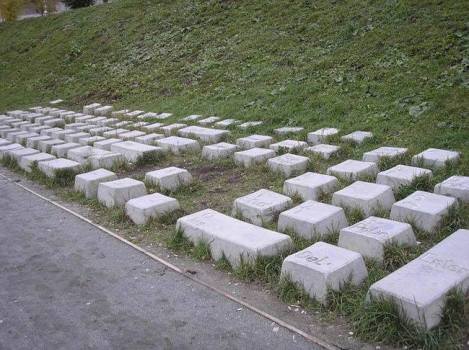
There is something magical about this picture.  I found it online, and I don’t yet know where this photo was taken.  Where is this garden?  When I find out, I’ll change this post to reflect that.

Keys from a computer keyboard, and they look like gravestones.

This reminds me of the scene in “Iris” when the aging writer Iris Murdoch is on a beach in England with far more stones than sand.

iris

She wants to write, but she can’t remember the words anymore. Or perhaps she can’t remember the letters.  So she takes pages from her notebook and puts them on the rocks, holding them down with other rocks.  She points joyfully to them and says that is her writing.  Her caregiver is distraught at how lost she is.

Yet she wasn’t lost.  I understand this completely.  This is writing.  Trying to hold down thoughts.  Trying to capture the uncapture-able.  Pinning down butterflies kills them, after all.  They are no longer butterflies when you try to define them, to draw them.  Ideas are the same.

This image above speaks to that.  What is writing, but memorializing what was?  The thought has changed now, evolved.

Docility through culture

We’ve slowly developed a culture that tells women that they deserve to drink – that it is a sign of being a mature woman. This is simply another way of getting us to be submissive and docile. A drunk woman doesn’t stand up when she’s being pushed around. She just goes and refills her glass.

Just because alcohol is legal doesn’t make it safe. It may be culturally acceptable to have a drink but that doesn’t mean that regularly doing so is good for our well-being.

When I finally decided to stop smoking pot, I learned I was a very angry person. I had a lot of learning to do – learning that I stopped doing when I started smoking to “enjoy” life. I had to learn how to stand up for myself and set boundaries and decide how I wanted to live my life on my terms. I’d been covering up my pain with pot all those years.

Now that drinking is something that our culture says adult women do, we need to step back and examine the repercussions. If more women drink, then more women will accept that the way things are is the way things should be. We will become numb to our own pain, rather than working to change it.

Now more than ever is a time to be awake. Being conscious and involved in life isn’t easy, but sleeping through it is wasteful and sad.

A Scot’s Farewell (memorial service reading)

When I come to the end of the road,
and the sun has set for me,
I want no tears in a gloom-filled room.
Why cry for a soul set free?

Miss me a little but not too long,
and not with your head bowed low.
Remember the love that we once shared.
Miss me – but let me go.

For this is a journey that we all must take
and each must go alone
It’s all part of the Master’s plan,
a step on the road to home.

When you are lonely and sick of heart
go to the friends we know
and bury your sorrows in doing good deeds.
Miss me – but let me go.

– source unknown

Carrying burdens

There is a Buddhist story about a woman whose child had died. She carried him around the village in her arms, asking everyone she saw if they had medicine to help heal her child. Everyone who saw her was horrified and a little concerned about her but didn’t know how to help. One person finally suggested that she go to the teacher at the center of the village. The teacher was Buddha.

He looked at her with compassion, noticing her grief. She was carrying her dead child with her everywhere she went, desperate for help. He said “Go to every house in this village and ask every person if they’ve ever suffered from grief. If no one who lives in the house has ever experienced a death, then take a mustard seed from them, and I will make a medicine for you from those seeds.”

She did just that and discovered very quickly that every single person in the village had experienced grief in one way or another through someone they know dying or a difficult situation happening to them. All had suffered loss of some sort. She was unable to obtain any mustard seeds but she was able to obtain the medicine she needed through this exercise. She was able to accept her loss, and understand that it was no greater than anyone else’s.

We are like this when we continuously carry our burdens and we present them to others all the time.

We are like this when
we identify with our wounds.
When we describe ourselves as chronically ill
or that our parents died when we were young
or we are exiles from our homeland
or we are victims of any sort
having suffered from trauma, abuse, addiction.

When we do this, we are expecting others
to heal our wounds
forgetting that they have
similar ones,
ones that cut just as deep
and hurt just as much.

We have all suffered loss
and we all have brokenness.
Recognizing that is the medicine.

Tutoring pictures

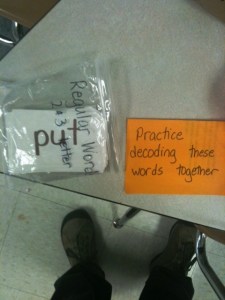
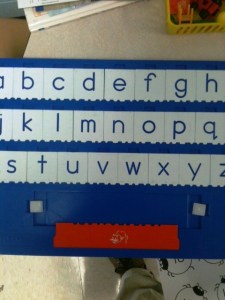
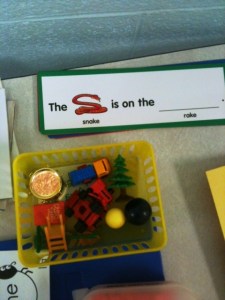
I’ve tutored ESL and special-needs kindergarteners for about five years.  When I first started, I wondered how I would do it.  Thankfully, the teacher has a lot of tools to use.  They seem like games to the kids, but in the meantime they learn their letters and then how to put them together to make words.

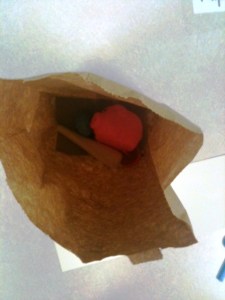
Here is an example.  Here is a brown paper bag with small toys inside.

photo_d2

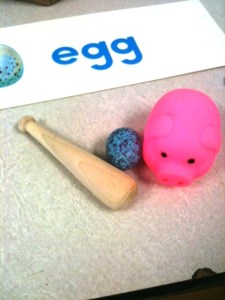
In this case, a pig, a bat, and an egg.

photo_d3

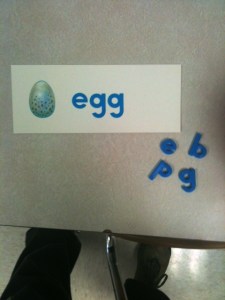
There are cards with a picture of each image and the letters that spell it out.  The child then finds the letters that match and puts them on top of the ones on the card.  This way they associate these letters with that item.  This is a good time to notice if a child has dyslexia, as b, p, d, and q are all very similar.  I notice if they reverse the letters and report it to the teacher so she can refer them for extra help.

photo_d1

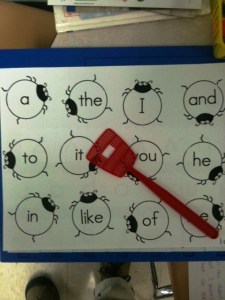
Here are some other things we play with to teach children how to read and write.

photo_e3     photo_d4

photo_e4      photo_e1

The teacher gives me a list of what children I need to work with, as well as what tools to use with them.

photo_e2

I like that there are different sized chairs for us to use.  Everybody needs a chair that fits them.

photo_c1

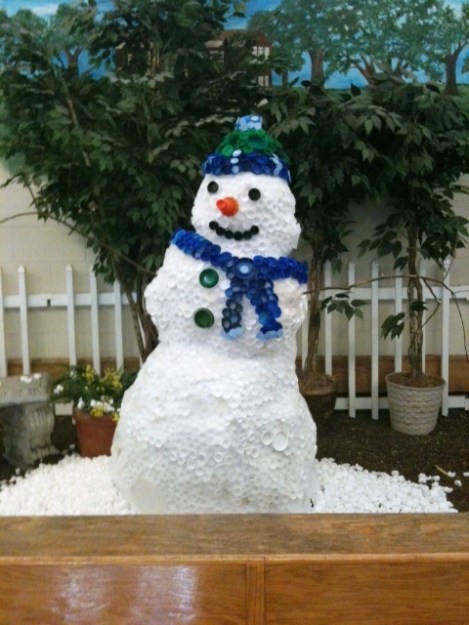
The entire school collected bottle caps throughout the year and did various things with them – counted, sorted by color, and made art projects.  It was a free way to get items that could be used to teach in various ways. Here is a snowman that was created with caps.

photo_c2


Here are some outside scenes.  The HVAC unit is impressive.

I’m not sure what this is but I like the patina and the graffiti.


The brick walls have interesting textures.

A radiator?

Mud and straw from a hiking boot on a rainy day.

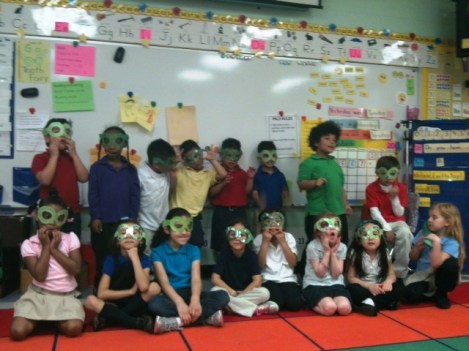
And finally, a picture of one year’s class.  They had made “glasses” to wear.

photo_e5

Boat

The disciples were fishermen, and Jesus traveled with them in a boat all the time. Their journeys are the same as ours.

They didn’t just drift along, ending up wherever the wind blew them. They used the power of the wind to help them get where they were going, but sometimes they had to row. We have to lend our effort to the task at hand.

There is only one captain of the ship. Only one person gets to make the final decision where they are headed. If more than one person tries to decide, then the boat is going nowhere. For them, that captain was Jesus. Who is the captain of your boat? Who is the captain of the “boat” that is your place of worship? Are they headed in the right direction? Is everybody rowing together?

Sometimes storms came up, but Jesus was either with them or came to them. They were always safe as long as they traveled with him. Know that you are safe no matter what happens. Remember Peter, who was able to walk on water as long as he kept his eyes on Jesus.

No matter where they landed, large crowds soon came to see them and be healed. God can use you no matter where you are.

Art books

Here are some books I’ve read that have helped me on my creative journey. Some have taught me tricks that have saved me years of struggle. Some have made me see the world in new ways. If your local library does not have them, ask for them to get them for you from Inter-library Loan (ILL). Remember, the more money you save from not buying books means more money for art supplies.

When Wanderers Cease to Roam. Vivian Swift

Gardens of Awe and Folly. Vivian Swift

The Art of Expressive Collage. Crystal Neubauer

Graffiti World – Street art from five continents. Nicolas Ganz (

Art Before Breakfast: A zillion ways to be more creative no matter how busy you are. Danny Gregory

The Creative License: Giving Yourself Permission to Be The Artist You Truly Are. Danny Gregory

An Illustrated Life: Drawing Inspiration from the Private Sketchbooks of Artists, Illustrators and Designers. Danny Gregory

The Trickster’s Hat – a mischievous apprenticeship in creativity. Nick Bantock

Urgent Second Class: Creating Curious Collage, Dubious Documents, and Other Art from Ephemera Nick Bantock

The Art of Cardboard: Big Ideas for Creativity, Collaboration, Storytelling, and Reuse. Lori Zimmer

Freehand: Sketching Tips and Tricks Drawn from Art: sketching tips and tricks drawn from art. Helen Birch

The art of urban sketching: drawing on location around the world. Gabriel Campanario

Urban watercolor sketching: a guide to drawing, painting, and storytelling in color. Felix Scheinberger

Urban sketching: the complete guide to techniques. Thomas Thorspecken

The Art of Whimsical Lettering. Joanne Sharpe

Acrylic Solutions: Exploring Mixed Media Layer by Layer. Chris Cozen

Map Art Lab: 52 Exciting Art Explorations in Mapmaking, Imagination, and Travel. Jill K. Berry

Art Journal Kickstarter: Pages and Prompts to Energize Your Art Journals. Kristy Conlin

Wreck this Journal. Keri Smith

How to be an explorer of the world- portable life museum. Keri Smith

How to avoid making art. Julia Cameron

The Artist’s Way: A Spiritual Path to Higher Creativity. Julia Cameron

Drawing Lab for Mixed-Media Artists: 52 Creative Exercises to Make Drawing Fun. Carla Sonheim

Watercolor Pencil Magic. Cathy Johnson

Collage Discovery Workshop: Make Your Own Collage Creations Using Vintage Photos, Found Objects and Ephemera. Claudine Hellmuth

The Creative Edge: Exercises to Celebrate Your Creative Self Mary Todd Beam

Art Lab for Kids: 52 Creative Adventures in Drawing, Painting, Printmaking, Paper, and Mixed Media-For Budding Artists of All Ages. Susan Schwake

Watercolor Journeys: Create Your Own Travel Sketchbook. Richard Schilling

Taking Flight: Inspiration and Techniques to Give Your Creative Spirit Wings. Kelly Rae Roberts

How to Make a Journal of Your Life. Dan Price
Monastery Immaculate Conception

150 Sisters of Saint Benedict live in community in Ferdinand, Indiana.  Here are some pictures I took when I went on a silent retreat there.

I hope you are in good shape if you go there.  The dormitory is downhill from everything else – dining hall, the chapel…and there are over 70 steps to get there.

There is a way to get where you need to go if the weather is bad.  There can be some pretty impressive snowfalls in Indiana, so there are tunnels all over this complex. They can be a bit damp, however.

Here’s one of the places you are headed to – the dining hall.  The food is served cafeteria style, and guests and nuns eat the same food.  They keep a separate eating area for us so we can be silent. The nuns are quite chatty and amiable, and while that is nice, it is hard if you are trying to have a silent retreat.

dining1

Some scenes in the dormitory.

In my room, I made  little votive shrine of the saint cards I bought at the gift shop.  All churches should have gift shops, in my opinion, and the Catholics do not disappoint in this regard.

icons1

In the basement is a lounge area with a lot of recliners.  It is quite homey and inspires naps.  I wonder if the chairs came from the nuns when they entered and had to give up all their possessions?

There is a statue of a young Mary with Jesus in the basement dining area – I’ve seen the same statue, painted, at a Sisters of Mercy convent.

There are some other interesting things in the dormitory that seem very old.

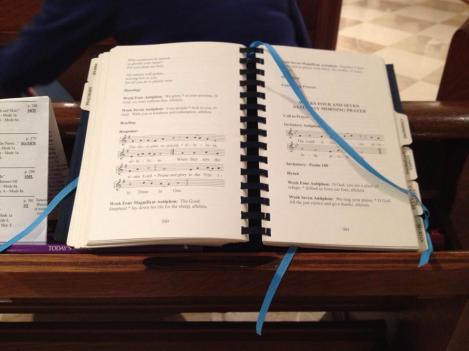
The various services were quite confusing.  We were fortunate that the nuns understood and took the time to set up our prayer books for us so we could follow along without getting lost.  They recite the office of the hours several times a day. Note all the different bookmarks – this is for just one service.


inside7

The pews were cleverly designed – you could create your own bookstand. This is closed, and then open.

Here is the pew-side view of the service.  The nun who helped us at this one is sitting in front of me on the right.  They no longer wear their habits. But you can still tell they are nuns by their kindness.  They have a sort of inner glow.

More of their impressive chapel – the baptismal font is the first thing you notice (on purpose).  Ideally, it is always in line with the table where the Lord’s supper is celebrated. This unites the two sacraments.


Views from outside the chapel, and the grounds.

I was especially enamored of this corner, and took the time to sketch it. It looks a little strange broken up like this, but I didn’t know my phone could do panoramas at this point. While sketching, some nuns noticed me and started to ask me questions.  They thought that I should stay with them.  I’m not sure how that would work out since I’m married, not a Catholic, and past their age requirement for entry. But it was kind of them to see a calling in me.