Together we live or die.

We’re all in this life together.

I can heal myself. I can be awake and mindful. I can plant trees or buy land that has them on it already to preserve them – but it won’t matter much if others chop theirs down and build malls (our new temples to the god of consumerism) complete with parking lots dedicated to cars (mobile air destroyers). Each parking space is a gravesite, a memorial to a tree. A garish monument, an epitaph, a mockery of what was there before. The air will get more polluted, and without trees, there won’t be anything to clean it. The Earth will get warmer and warmer, and my efforts won’t matter. While I’ve done what I can to help, others have done more to destroy.

I can protect that stream of water on my hypothetical piece of land, keep it safe from pollution, taking debris out when I arrive there, not putting poisons in, but what about upstream? Their actions affect me. Then, what about the people who buy this land after I die? Who says that they will keep it pristine?

How to live in such a way that it inspires others to live – that is my goal.

What it’s like (art journal page)

what-its-like

A meditation on being estranged from my brother. I have only one sibling, and our parents are dead. I do not talk to him by choice because he is abusive. Even his apologies are abusive. He somehow is able to make it sound like it is my fault that he is abusive to me.  Then, after that, he starts doing the same abusive behavior all over again.  I have given him multiple chances.

I had not planned on working on this topic again – I’ve written about it a lot. But then I was cutting out some pictures and words from magazines for a project at work and came across the one at the top – about how awkward it is to have a sibling you don’t talk to. It isn’t normal or expected. I was initially upset about these words (I felt it in my gut) and thought it too personal to make an art journal page about. But then I realised that is exactly why I needed to do it.

Sometimes it takes a long time for wounds to heal. Sometimes it takes a lot of different ways to do it, too.  Sometimes it doesn’t ever heal, and that is OK too – to sit with the wound and let it be filled with something else, something better.  But first you have to see it, and clean it out all the way.

detail
what-its-like2

I have dashes under the “all of the fun, none of the” collage piece for “fill in the blank”. I’ve written a list of words – good and bad, about what it means to divorce your sibling. I’ve used washi tape to affix it to the back of the page. I use only one side of each page in this journal so that I can cut out and frame / sell / give away a page and so that the ink / watercolor / Sharpie doesn’t bleed through or smear and mess up the other page.

Words that are there  –

(things I’ve lost because I don’t have a sibling I can trust)

Friendship trust history promises future reliability cooperation resource dependability traditions insights help failsafe backup hope

(things I have lost because I’ve gotten rid of an abusive person in my life)

narcissism psychopath being used arrogance delusions subterfuge bullshit megalomania psychological abuse hidden harm manipulation gaslighting lies hypocrisy

———

The craziest thing is that a relative wrote me after a blog post I wrote once about how abusive my brother is.  The relative begged me to make peace with my brother because we were the last relatives that he had on this side.  As if it is my fault that the damage is there.  As if it is up to me to apologize and make amends.  That too is abuse – to expect the victim to “make things right”.

People say “But do you forgive him in your heart?” They are usually Christian.  They think there is some magic formula.  If I “forgive him in my heart” then I’m off the hook.  This is crazy-making.  Sure, I forgive him in the way that I understand a shark can’t help being a shark.  But that doesn’t mean I’m going to go back in the water and let that shark bite me again.

———-

Created around 1/2/17 – Strathmore art journal, magazine clippings (many from Cosmo), gesso, Distress ink, colored pencil

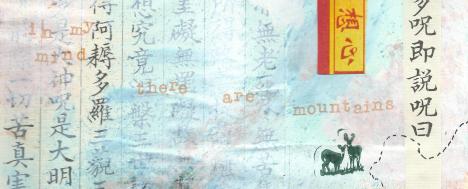
“In my mind” art journal page

“In my mind” completed 1/2/17.   Asian ephemera – printed calligraphy and map, “Hell money” pieces.  Gesso tinted with Distress ink.  “in my mind there are mountains”  – letters printed with “rusty hinge” Distress ink pad.  Stamped images – deer and Celtic. Gel pen. Includes art from Lilian deMello called “Ghost Dance” in bottom left corner.

in-my-mind

Detail –

in-my-mind2

When do lines mean words, and when do they mean places?  What if they are the same? Can words be maps? Can maps be words? Are wrinkles small mountains? Hide and reveal.

December 2016 art journal pages

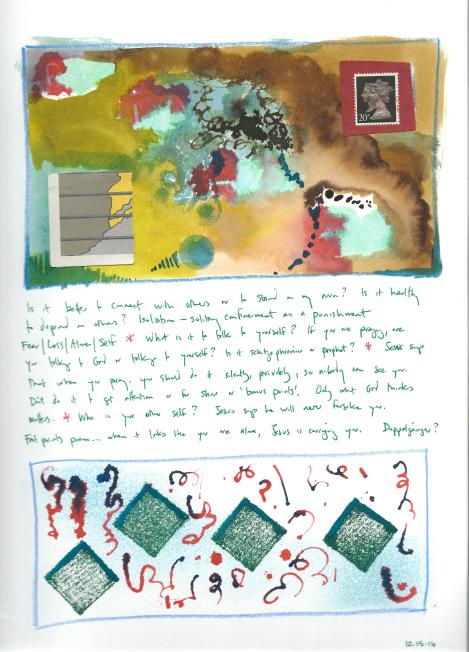
While cleaning out my craft room I rediscovered my list of intentions for 2016.  I’d not done many of them – perhaps because I lost the intention list.  Can’t get anywhere without a map. Some I had done, and was glad.  Some I’d forgotten about, and have refocused my commitment.  One thing on it was to make an art journal page at least once a week.  I had some time off from work so I decided to catch up a bit.


“Fragile” – 12/12/16 – 12/15/16       Distress Ink, ephemera, gel pen

fragile

(detail of “Fragile”)

fragile2

“Doppelganger” – 12/15/16  Distress ink, ephemera, colored pencil, gel pen, water

doppleganger

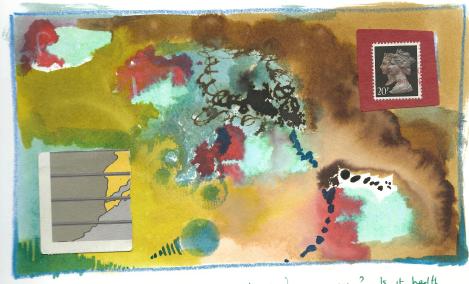
(detail for “Doppelganger”)

doppleganger2

“To be a queen” – 12/16/16   Distress ink, stamps, gel pen, colored pencil

to-be-a-queen

(Detail – “To be a queen”)

to-be-a-queen2

“Paramecium” made around 12/22/16   copied images from 100 year old Biology textbook, Distress ink, broken glass glitter, gel pen, matte medium, Sharpie, white gel pen

paramecium

(detail, Paramecium)

paramecium2

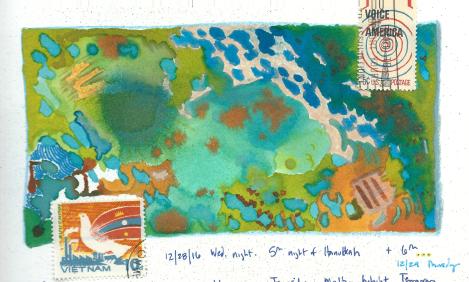
“Shamash” – 12/28 and 29th, 2016   5th and 6th nights of Chanukah.  Distress ink, stamps, gel pen, Sharpie

shamash

(Detail, “Shamash”)

shamash2


Privet

This is privet.  It is a woody plant.  In certain situations it is an invasive weed.

privet1

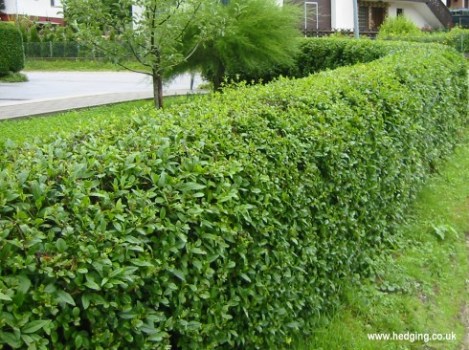
Yet when planted intentionally and carefully cultivated, it is a hedge, a living wall.

The same thing can be “good” or “bad” depending on where it is, and how much of it is there.

Too much water is just as bad as too little. Too much water in the wrong place can be devastating.

A hedge can be low –

privet2

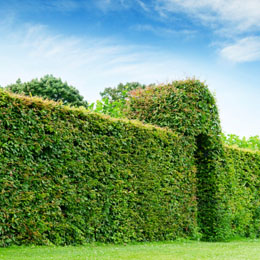
…or high.  It can keep people out…

privet4

…or let them in.

privet3

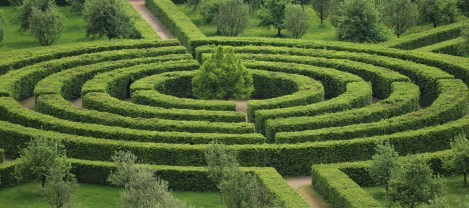
It can even be shaped into a maze, where you can let people in, but they have to find their own way out. (Hint – pick a side, left or right, and follow that exclusively.)

privet-lab

What would be at the center of your maze?

Would you make your privet into a wall to keep people out?

How high would you let it grow?

How long are you willing to wait for that?  It can take a decade to make an impenetrable.

Will people notice that you are growing a barrier, or will it be a surprise to them?

Will they step over it in the meantime?

—————————————

(All pictures are from the internet. Used for illustrative purposes.)


Books that wish they were apps.

Perhaps there are too many kids growing up with books that are digital. They don’t know how to appreciate a book that doesn’t move or make noise.

Here is a list of books that think they are apps. They don’t beep or wiggle, but they are interactive, nonetheless. They are all picture books.

“Mix it Up!” by Herve Tullet

“Press Here” by Herve Tullet

“Tap the Magic Tree” by Christie Matheson

“Touch the Brightest Star” by Christie Matheson

“Shake to Assemble” by Calliope Glass

“Look” by Edouard Manceau

The hidden stress on female caregivers.

So many people are embarrassed to admit that being a caregiver is not part of who they are. That makes the whole experience that much harder. They labor along under the expectations of society, meanwhile taking care of someone who is very ill.

Women are expected to selflessly drop everything to take care of a sick relative, regardless of ability, interest, or skill. Simply being female doesn’t mean that you are also a cook, a nurse, a counselor. These are skills that must be learned. You don’t suddenly know how to care for someone who is terminally ill. Nor do you suddenly have the desire to, just because it is expected of you.

What about your income in the meantime? You don’t still get to take in a paycheck when you quit your job to care for a relative. There is the Family Leave Act – but that only ensures that your job can’t fire you for going on leave. They have to give you a job back. It may not be the job that you had, however. It also does not mean that you will get paid in the meantime. It is leave without pay.

The caregiver’s closeness to their relative is irrelevant. The mother is abusive? Father raped her? Brother stole, lied to her? Mother and father in law are dismissive and treat her like she is stupid? Doesn’t matter – your duty is to tend them, because you are a woman.

This is unreasonable.

There is a reason that my “Death Guilt” post always gets a lot of hits. People don’t talk about this stuff. We should.

When a man is well enough to go home from the hospital but not well enough to take care of himself, he’s sent home if he has a wife there. When the same thing happens with a woman, she’s sent to a nursing home to recuperate. It is assumed that the wife will know how – and be able to (mentally and emotionally) take care of him. It is assumed that a man will not. This is insulting to both sexes.

I’ve heard from people who work in nursing homes that they judge a family that doesn’t visit. They think they are selfish. They don’t know the history of the relationship. They have no way of knowing how abusive (mentally, emotionally, physically, psychologically) the person was to their family members. The effects of this abuse remain even when (if) the abuse stops. They may never go away.

Sometimes the abuse stops because the person is no longer able to be abusive – not because they don’t want to. It is far harder to hit someone when you have Parkinson’s disease. It is far harder to insult your children when you have dementia and can’t even remember that they ARE your children.

Being a caregiver should be a gift, not a demand. It should be because you want to, not because it is expected.

Just because your parents gave you life does not mean that you have to take them into your home and care for them when they get old. They chose to have you. You did not choose to have them. This is an unequal relationship.

When you marry, you marry that person – not their family. You make a legal statement that you will stay with them regardless of their health. You do not make the same promises to their parents. There is nothing about the marriage vows that obligates you to sacrifice yourself to take care of them. This is an unspoken assumption that is damaging and must be called out.

Latkes

Makes about 14 latkes – serves 4 to 6.

– Ingredients –
4 medium potatoes – organic if possible
1 medium onion
2 eggs
2 pieces of matzo (or ½ cup flour)
1 Tsp. salt
¼ Tsp. pepper
Olive oil to coat the pan

– Method –
Wash and peel the potatoes. Grate them on the medium side of the grater (by hand- don’t use a food processor). Put the results into a colander and rinse well to get out the starch. Place colander over a large bowl. Press down on the grated potatoes to remove moisture. Leave the colander sitting over the bowl to drain out more moisture while you do the rest.

Peel off the outer layer of the onion. Slice off the top and bottom. Cut into four wedges and place into a food processor. Mince the onion in the food processor. Set aside in a separate colander over a bowl to drain.

Beat the eggs in a separate bowl. Add the salt and pepper.

Crush the matzo into tiny pieces – flour-like consistency. You can do this in a thick sandwich bag, using a rolling pin.

Gently mix the potatoes, onions, and egg mixture together in a large bowl. Fold in the matzo (or flour) Do not overmix – this will transform the grated potatoes into mashed potatoes, totally altering the texture.

Pour the oil into a pan and heat medium-high. When hot, use a tablespoon to scoop up the mixture. Flatten gently with the back of the spoon. Use two spatulas to turn, cooking the latkes golden brown on each side. You will likely need to add more oil to the pan as you cook the rest of the latkes.

Transfer the latkes to paper towels over newspaper to drain.

Keep them warm while you cook the rest by placing them on a cookie sheet covered with brown kitchen paper – placing them into the oven at 250 degrees.

Serve warm with sour cream or applesauce (traditional)

Little Red Riding Hood

red-riding2

This is not a simple fairy tale. This is a story designed to control young girls. The moral – stay on the path, or else you will get hurt. This is victim blaming at the core. It teaches that it is Little Red Riding Hood’s fault that she and her grandmother got eaten by the wolf.

The wolf is every single male she ever encounters in her life. The “being eaten” is everything from getting a lesser job to getting raped or killed. This story teaches girls – and only girls – that if we don’t stay in our defined roles then we deserve everything bad that happens to us.

Notice she isn’t even named. Her “name” is what she wears – exterior only. She isn’t even real, just a placeholder. She isn’t a person, but a thing. People look at her outside only.

Notice that it is a strong male who saves her – the hunter comes by and hears the grandmother snoring and decides to investigate. Why is snoring loudly seen as a sign that something is wrong? Do women not snore? Are we expected to maintain control over ourselves at all times – even while unconscious?

Notice that the townspeople don’t send the hunters into the forest to clear it of dangerous animals. They don’t make it safe for her or others.

red-riding

————————

Art made on a Strathmore art journal – mixed media paper, using various pens and painted using Distress Ink. Words are photocopied from a book about Little Red Riding Hood and then dyed/stamped/inked.

Poem – to wander

To wander is to go forth,
eyes and heart open
into the unknown.
It doesn’t have to be in the wilderness.
It can be in the library.
It can be anywhere you have not explored.
To wander is to find yourself
in the middle of nowhere,
not lost
but awake and aware and curious.
To wander is to take the time
to appreciate the journey
instead of just the destination.
To wander is to venture forth
in body or mind
or both
with no goal other than to truly see
what you find
while out there.
There is danger in this
for you might get lost.
There is salvation in this
for you might find yourself.