Jesus builds upon the old

Jesus came to uphold the words of God, not tear them down. His message was fresh but not new. The more you read of the Hebrew Bible, the more you’ll see it echoed in the words of Jesus.

Jesus says in Matthew 5:17-20
17 “Don’t assume that I came to destroy the Law or the Prophets. I did not come to destroy but to fulfill. 18 For I assure you: Until heaven and earth pass away, not the smallest letter or one stroke of a letter will pass from the law until all things are accomplished. 19 Therefore, whoever breaks one of the least of these commands and teaches people to do so will be called least in the kingdom of heaven. But whoever practices and teaches these commands will be called great in the kingdom of heaven. 20 For I tell you, unless your righteousness surpasses that of the scribes and Pharisees, you will never enter the kingdom of heaven.

Here are some illustrations of this –

Consider his words in Luke 14:7-11
7 He told a parable to those who were invited, when He noticed how they would choose the best places for themselves: 8 “When you are invited by someone to a wedding banquet, don’t recline at the best place, because a more distinguished person than you may have been invited by your host. 9 The one who invited both of you may come and say to you, ‘Give your place to this man,’ and then in humiliation, you will proceed to take the lowest place. 10 “But when you are invited, go and recline in the lowest place, so that when the one who invited you comes, he will say to you, ‘Friend, move up higher.’ You will then be honored in the presence of all the other guests. 11 For everyone who exalts himself will be humbled, and the one who humbles himself will be exalted.”

This is an illustration of Proverbs 25:6-7
6 Don’t brag about yourself before the king,
and don’t stand in the place of the great;
7 for it is better for him to say to you, “Come up here!”
than to demote you in plain view of a noble.

Likewise, Proverbs 25:8-10 continues on, saying –
8 Don’t take a matter to court hastily.
Otherwise, what will you do afterward
if your opponent humiliates you?
9 Make your case with your opponent
without revealing another’s secret;
10 otherwise, the one who hears will disgrace you,
and you’ll never live it down.

These teachings are illustrated in various verses –
Matthew 5-21-26
21 “You have heard that it was said to our ancestors, Do not murder, and whoever murders will be subject to judgment. 22 But I tell you, everyone who is angry with his brother will be subject to judgment. And whoever says to his brother, ‘Fool!’ will be subject to the Sanhedrin. But whoever says, ‘You moron!’ will be subject to hellfire.23 So if you are offering your gift on the altar, and there you remember that your brother has something against you, 24 leave your gift there in front of the altar. First go and be reconciled with your brother, and then come and offer your gift. 25 Reach a settlement quickly with your adversary while you’re on the way with him, or your adversary will hand you over to the judge, the judge to the officer, and you will be thrown into prison. 26 I assure you: You will never get out of there until you have paid the last penny!

Matthew 18:15-20
15 “If your brother sins against you, go and rebuke him in private. If he listens to you, you have won your brother. 16 But if he won’t listen, take one or two more with you, so that by the testimony of two or three witnesses every fact may be established. 17 If he pays no attention to them, tell the church. But if he doesn’t pay attention even to the church, let him be like an unbeliever and a tax collector to you.18 I assure you: Whatever you bind on earth is already bound in heaven, and whatever you loose on earth is already loosed in heaven.19 Again, I assure you: If two of you on earth agree about any matter that you pray for, it will be done for you by My Father in heaven.20 For where two or three are gathered together in My name, I am there among them.”

Jesus expands and illustrates the lessons and teachings from the Scriptures he grew up with, and explains them in relatable ways to people. Instead of just repeating them, he made the teachings meaningful by telling them as stories. But he didn’t make up the original teaching. He built upon the old to create something new.

(all Bible translations are HCSB)

Creative book list

Here are some books I’ve read that have helped me on my creative journey. Some have taught me tricks that have saved me years of struggle. Some have made me see the world in new ways. If your local library does not have them, ask for them to get them for you from Inter-library Loan (ILL). Remember, the more money you save from not buying books means more money for art supplies.


Bantock, Nick  The Trickster’s Hat – a mischievous apprenticeship in creativity.

Bantock, Nick     Urgent Second Class: Creating Curious Collage, Dubious Documents, and Other Art from Ephemera

Beam, Mary Todd  The Creative Edge: Exercises to Celebrate Your Creative Self

Berry, Jill K.  Map Art Lab: 52 Exciting Art Explorations in Mapmaking, Imagination, and Travel.

Cameron, Julia   The Artist’s Way: A Spiritual Path to Higher Creativity.

Cameron, Julia   How to avoid making art.

Campanario, Gabriel  The art of urban sketching: drawing on location around the world.

Conlin, Kristy Art Journal Kickstarter: Pages and Prompts to Energize Your Art Journals.

Cozen, Chris Acrylic Solutions: Exploring Mixed Media Layer by Layer.

Currie, Jim.  The mindful traveler – a guide to journaling and transformative travel.   

Diehn, Gwen  The Decorated Page – Journals, Scrapbooks and albums made simply beautiful. 

Doggett, Sue   Bookworks.

Evans-Sills, Faith and Mati Rose McDonough Painting the Sacred Within

Ganz, Nicolas   Graffiti World – Street art from five continents

Gregory, Danny   Art Before Breakfast: A zillion ways to be more creative no matter how busy you are.

Gregory, Danny Everyday Matters

Gregory, Danny   The Creative License: Giving Yourself Permission to Be The Artist You Truly Are.

Harrison, Sabrina  Spilling Open – the art of becoming yourself.

Hellmuth, Claudine    Collage Discovery Workshop: Make Your Own Collage Creations Using Vintage Photos, Found Objects and Ephemera.

Hennessy, Alena  Alter This!   Radical ideas for transforming books into art.

Jacobs, Michael and Judy Creative Correspondence.

James, Angela  The Handmade Book

Jones, Heather.  Water Paper Paint.  Exploring creativity with watercolor and mixed media.  

Koch, Maryjo   Vintage Collage Journals – journaling with antique ephemera.

La Plantz, Sherren Cover to Cover – creative techniques for making beautiful books, journals and albums.

MacLeod, Janice   A Paris Year: My day to day adventures in the most romantic city in the world.  

Nerjorde, Arne   Make your own ideabook with Arne and Carlos 

 Neubauer, Crystal   The Art of Expressive Collage.

 Newburger, Emily    Journal Sparks.  Fire up your creativity with spontaneous art, wild writing, and inventive thinking.

Pickett, Jan Decorated Lettering.

Roberts, Kelly Rae   Taking Flight: Inspiration and Techniques to Give Your Creative Spirit Wings.

Scheinberger, Felix  Urban watercolor sketching: a guide to drawing, painting, and storytelling in color.

Schilling, Richard Watercolor Journeys: Create Your Own Travel Sketchbook. 

Sharpe, Joanne    The Art of Whimsical Lettering.

Smith, Keri   Wreck this Journal.

Smith, Keri   How to be an explorer of the world- portable life museum.

Swift, Vivian   Gardens of Awe and Folly.

Swift, Vivian When Wanderers Cease to Roam.

Sonheim, Carla   Drawing Lab for Mixed-Media Artists: 52 Creative Exercises to Make Drawing Fun.

Thorspecken, Thomas   Urban sketching: the complete guide to techniques.

Tourtillott, Suzanne   Making and Keeping Creative Journals. 


How Jesus heals

Jesus heals by taking your burden from you, or carrying it with you. Just like how we can hand him our worries, we can hand him our diseases.

Because they are the same.

Diseases are worries that have grown because they were not addressed early on. Worry, fear, and doubt if not dealt with early on become cancer and addiction.

For instance, your liver does not fail on its own. It grows weak because of your drinking, which you did as a flawed coping mechanism for stress.

Disease is the result of you carrying a burden that you aren’t made to.

Give it Over and Up to Jesus – that thing you are worried about. That thing you are trying to control.
Don’t let the world become your worry. Don’t let the world become your idol – the thing that controls you. Put your faith back into the hands of God.

The room of abandonment (prose poem)

What does it look like?
Invite Jesus in, so you aren’t exploring this scary room alone.
What is in there?

Silence
Alone
No tools or toys

The walls are light blue, robin’s egg. There is a handmade wooden chair in the center. And a green fuzzy shawl, a gift from Jesus There is no door, but there is plenty of sunlight from the windows.

What situations, people are the cause of this room?
Why did I have to build it?

I must practice Self care to heal
be my own Shaman
Exercise food sleep, you know the drill.

What happens before the anger? Anger is a response, a protective thing. It shields from grief. Dig down to find the truth.

Don’t make God an afterthought. Make God the base of the building, of the life.

Anger comes from grief, a sense of loss, any loss. It is an unwillingness to accept change. That is also an unwillingness to accept things as they are. It is a desire to shape the world to fit me.

So roll with the punches. Accept, in a fluid way. Don’t resist. Turn the other cheek to stop that same one from getting too bruised.

(This is from an exercise I did with my first spiritual director, probably around 2013.)

A choice to return

It is tiresome to hear someone point out negative things all the time. Like a coworker I had who was always talking about the bad things – patrons, news stories. Like the friends who have to share only bad news on Facebook – their own, the world’s. It is hard to stay centered and focused and calm when this happens.

But we are told to love our enemies. That is the test. It is easy to love people when they are good. Jesus tells us that even unbelievers do that. But the rubber meets the road when people and situations are difficult. That is when we must rise above our human nature.

The only way to do that is to ask Jesus into the situation, to take up his yoke. It is when things are hard that we are given an opportunity to grow, to get stronger, to get better. It is when things are difficult that we have a reminder an opportunity to recommit to our path. It is then we can choose again to follow Jesus, and not the world.

Time-slip. Abandoned project #5

Savanna could see the open door, plain as day, but she chose not to walk through. Not yet. It would disturb the counselors. She’d been in this particular asylum for two days now, and wasn’t yet bored. They treated her well enough, as well as could be expected, you understand. A time in the loony bin wasn’t a vacation by any stretch. The food was okay, and the beds were nicer than those in a real hospital, that was for sure. They weren’t hospital quality, of course, but they didn’t have the weird side-rails either.

Maybe tonight she would walk out and look at the stars. They never let the patients out to see the stars, or even the sun. Fresh air was forbidden to them, as if their disease was catching, like it could spread in the air. They were locked away in theory for their own good but really it was for the community. It wouldn’t do to have any sort of weakness on display. It was like how some communities banned homeless people from selling newspapers on street corners out of embarrassment that they were proof that homeless people lived within their boundaries.

She’d walk out as she always did. She would simply walk forward, shifting her vision to the past, back to before the building was there. She’d done this for most of her life. It would get her out of here. It was also what happened to get her into here.

Perhaps her unusual gift was a side effect of her amblyopia. Her eyes hadn’t worked together her whole life. Abnormal vision was her normal. She’d learned to switch her vision from her left eye to her right, because she didn’t have bifocal vision. Her eye doctors didn’t like it one bit that she could switch, didn’t understand it. But it made sense. You make do with what you have. You make it work, even when others think it is broken. If you don’t know otherwise, “broken” becomes a blessing, because it teaches you to see in other ways. Sometimes literally.

While figuring out how to use her (unknown to her) defective eyes, she learned to see the space between time, the shimmering edge between “then” and “now”. These days, Savannah calls this a time-slip, but then she wasn’t aware that what she was doing was any different from anyone else. She could push that shimmering line a little, bend it, fold it back upon itself. Then it was just a little effort more to focus with her inner eye to see what used to be. Thankfully her crib had been on the first floor or she would have been in for a terrible drop the first time she tried her talent.

The first time she tried she was six months old. She shifted back to long before the house was there, before the subdivision, before the town even. She fell 3 feet from what was the first floor of the house onto a rolling hill. Breath knocked out of her, she sputtered in her amazement and suddenly found herself in her own time again, but this time falling into the basement. Her Mama found her there, wailing and dirty near the abandoned coal chute. They never did figure out how she got there. She certainly didn’t know, and at that age wasn’t able to tell even if she did.

That experience stuck with her, and over the course of her childhood she learned how to stay in the past longer and walk around. When her Sunday School teacher told the class about Peter walking out of prison she had an idea it wasn’t an angel who helped, but she wasn’t saying. She knew better by then to not talk about it.

She’d noticed that her ability wasn’t just unusual, it was downright unheard-of. After a few tentative efforts to inquire about it, she learned it was better to keep silent. If nothing else, it made games of hide and go seek much easier.

She learned she could walk to wherever she wanted to while she was in the past and then refocus and return to the present. By that point she could be on the other side of the playground or the neighborhood. She could stay hidden for as long as she wanted, or if she was “it” she could pop in on her prey without making a sound. After a while the other kids stopped playing with her, but she didn’t mind. This gave her more time to play with her friends in the past.

They were native children, who had lived here long ago, but had been dispersed when the whites came. They were like wild animals to these new settlers, who were fleeing religious persecution. It was too bad that their religious practice didn’t extend to seeing the natives as neighbors. The natives were relocated – land was found hundreds of miles away. It wasn’t the same quality of land, but it was somewhere, and the whites thought them ungrateful for not accepting their “charity”. The thought never occurred to them that if they had lived in harmony instead of pushing the inhabitants out that such kindness of a gift of scrubland wouldn’t be necessary.

When she was on her early wanders, Savanna had thankfully shifted into a time before all that unpleasantness, a time before the natives had reason to be wary. Plus, she was a child. Nobody felt threatened by a child.

But this was now, and the amusement of being in a loony bin was wearing thin. She wasn’t afraid like most of the residents. She knew she wasn’t trapped. The counselors and doctors didn’t know (or didn’t care) that their locked-door policy only made the symptoms worse for the residents. Large signs warning of patients “eloping” were affixed to the doors to warn visitors to not let a patient sneak out as they left.

There was no sneaking out now. She’d had her supper and the night shift was signing in. It was as good a time as any. She squinted and saw the shimmer of time bunch up. A twist, a shift and she was over the threshold, neat as you please. She walked out into the twilight painted field and went west towards the sunset. A mile later and she shifted back near a corner café with a payphone. She had researched this place a year ago when she moved to the area. It was best to be prepared. She knew the area around the jail too, just in case. Fortunately she had not concerned anyone enough to get put in there, but you never knew. Some small towns didn’t know the difference between dangerous and delusional so they ended up erring on the side of caution.

How has she ended up in this hospital? A time-slip wander that led to a fall, and a trip to a regular hospital had been the beginning. She had not planned on that wander, not that time. She was tired, overworked. Not enough “work/life balance” as her job prattled on about. She mused that if they really cared they would let her work less and pay her the same. Five days of work with two days off wasn’t balanced no matter how you did the math. This was especially true when most of her time off was spent doing chores and errands. When was she supposed to have some of that “me” time that people were always going on about?

That Thursday afternoon she had wandered at lunch and never came back to work. She was found, unconscious, near the river. She had gone back two hundred years before the river had come this far west, before the flood that had rerouted it almost overnight. She had gone back without thought, without plan and lost her bearings in the foggy haze of sleep deprivation and anxiety which had become her normal over the past year. She had spent so long feeling bad that feeling good was a distant memory. She would have been suspicious of it if it had dared to show up.

But then she slipped and knocked her head while “then”, so she woke up “now”, her head bruised. She forgot what had happened, forgot to keep her mouth shut too when she was found, and babbled on about the past and her native friends, and that very night found her the newest resident of the funny farm.

Yet it wasn’t funny at all, and it certainly wasn’t a farm. If it had been either, or both, maybe it could have done some good for its hapless residents. As it was, it only made things worse with its insistence on mind-bending drugs and no exercise out in the fresh air. Her time-slip wander was the only way to get out in under a week, when most were freed in eleven days. Not because they were healed, you understand. That was just when the insurance money ran out.

But now she was out, and it was time to look for a new place to live. It wouldn’t do for word to get out that she was less than normal. She’d have to be more diligent in the next town. All this moving was getting old.

(The photo was found on Pinterest. Unknown photographer or location.)

A different communion

I was at St. Meinrad Archabbey monastery on Sunday, September 11th, 2016.

I knew that I was not officially allowed to take communion there, because I’m not Catholic.  Jesus made no such rules or limitations, but that does not seem to bother them. Perhaps the monks understand the hurtful nature of this made-up rule.  Or perhaps they think that those of us who are not Catholic are in the dark, and not deserving of this sacrament.

I’d already checked out of my room and was wandering around the grounds by this point.  I wasn’t sure when Mass would end, but I wanted to be in there afterwards to smell the incense.  I walked up to the side door and saw that it was still going on.

There is no way to sneak into that place.  The doors are very creaky and loud.  I couldn’t slip in and stand at the back and just listen.  They were at the main point, where the priest was facing the altar and saying the words that (they think) blesses the bread and wine.

God blesses it, and blesses us.  People don’t do that.  They can’t.

I sat outside, near the Mercy door.  There are windows there.  Perhaps one of the many priests there saw me, outside, sitting, listening to their ritual.

These rules of who is in and who is out are man-made.  They are not from God.

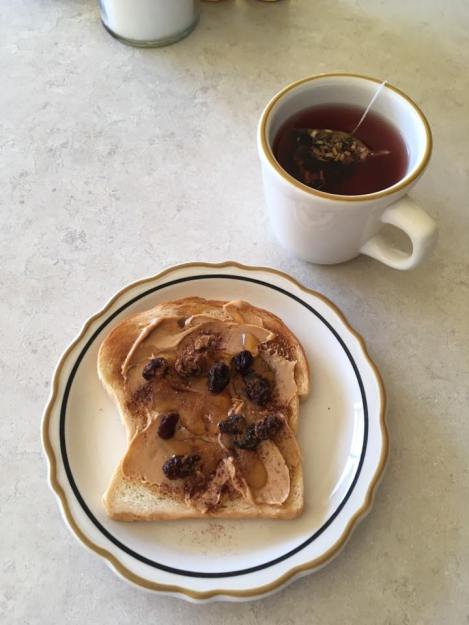
So I left, and found my own communion.  I went to the kitchen and made tea and toast.  The tea was herbal – and to my surprise, red.

c1

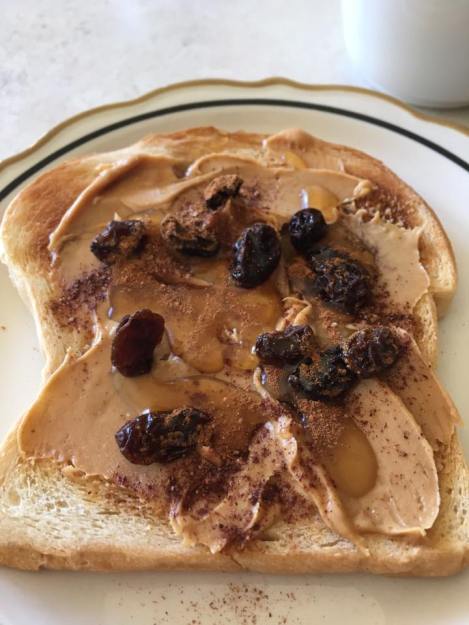
The toast was from bread the monks had made there, with their own hands.  I added peanut butter, and honey, and raisins, and cinnamon.

c3

I chose to say the blessings in Hebrew, and enjoy my quiet moment with God.

c2

You can’t wish depression away.

This is a conversation I had online about how to cure depression. I read something in a group I belong to that I felt needed some comments from someone who had been there. However, it was a waste of my time to even try.

You can’t wave the victim flag and the victor flag at the same time. As long as people are stuck in the same old broken story that people’s mental health is entirely due to their attitude, they will continue to be sick. This is victim blaming at its finest. We don’t blame people who have diabetes for their bodies not working properly.  So why do we blame people with depression for their minds not working properly?  We must get over the idea that body and mind are separate in order to heal.

The Original post – “This is a special request that only a true friend can give and I appreciate all you Beautiful people out there,so I post this- I have a Beautiful Friend called Ruth who fights depression every day,She has an Absolute heart of Gold so I thought what better way than to show how much she is loved by others.Would you be so kind as to post a lovely heart or picture that you have done so I can save it to show she has support and well wishes because she just could do with that extra boost that she can’t do for herself right now!!! Thank you kindly and I can’t wait to share with her your Beautiful posts and love- God bless you All.”

I waited for a few hours before replying.  It was a knee-jerk response, and I wanted to cool down first.

I replied – “From personal experience – take her for a walk outside. Take her out for lunch and feed her healthy food. Depression is fed by inactivity and junk food – fried foods, few vegetables, too much carbs, too much sugar. It is something that can be overcome. It requires a lot of work, but the results are worth it. Pretty pictures will not do it.”

One person commented – “Anything done with love is a great idea. Maybe it isn’t a solution. But, it may put a smile on her face. Or even stop the tears. And that is positive.”

My reply – “Yes, love and positivity are good. However, I’m aiming for something more permanent than a quick fix. It requires a lot of self-discipline, which is super hard when you are depressed. It is like pushing a heavy ball up a muddy slope. But – the view from the top is so much better than the one at the bottom. We don’t treat diabetes and heart disease by kind thoughts. They require complete lifestyle changes. Depression is the same. Full disclosure- I am bipolar and have hospitalized myself twice. I take medicine daily. But the best medicine I take is self-care. Journaling is part of that. So is eating well and getting regular exercise.”

Another person replied – “Art journaling would be a great thing for Ruth – Art heals, for sure.”

By this point I was getting frustrated.  Nobody was listening.

The original poster said  – “I appreciate your comments and Ruth does try very hard with diet but its abuse from others that causes alot of her depression its not just from not trying other methods because she does really try,she just needed to know people love with a genuine love right now xxx”


Silence and stillness and stuff

When I read this verse “He said to them, ‘Take nothing for the journey, neither walking stick, nor sack, nor food, nor money, and let no one take a second tunic…'” (Luke 9:3) I think I’m doing retreats entirely wrong. I take a lot of “stuff” so I won’t get bored. Perhaps it isn’t the silence that is the issue – but the fear of really being alone with God. Making art, writing, reading books – all of that can be noise. Maybe “silence” for me is more about “stillness”.

rock 5

The rock garden at St. Meinrad used to be my favorite place. Now it is full of “stuff”

I feel that the garden needs some editing. Like the “stuff” needs to be rotated out, like an art display. How much is “whimsy” and how much is “crazy”?

Yes – you need to slow down and really look here. That is part of the point. To get you to see things that are small or hidden.

You will never see this rock unless you crouch down.  It is at most five inches high.

rock 2

How are you to hear God’s voice amidst a lot of noise?  Noise isn’t just sound – it can also be visual clutter, or too many things to do.

rock 1

God didn’t start speaking to Moses from the bush until Moses stopped – turned around – and came back to look at it. He almost walked by. He almost didn’t get the order to lead Israel out of slavery.  What are we missing being freed from – and leading others out of their slavery (to false gods, to addiction, to worry) by failing to take the time to really notice God’s messages to us?

This was in another courtyard, but I have seen the same thing in the rock garden.

This is a daylily –

rock 6

While this is a seed pod – brown and decaying.

rock 7

There is a lot of this decay in the garden.  And yet – this is beautiful.  I’d never see this shape if it had been taken away in a need to keep everything tidy.  Sometimes “clutter” is helpful.