Poem – go walk yourself

How interesting that people will
buy a dog because
they
want to go for a walk.
They know that the dog
has to be walked at least
once a day
and so they have to
take him out.
They get the dog
as an excuse
to go for a walk.

It seems like it would be far cheaper
to forget the dog
and take yourself
out for a walk.

Why do we put more value
on the needs of others
rather than ourselves?
Why is a dog’s need to walk
more important than
the fact that
you
need to walk?

We have all been trained that we
should be
self-sacrificing
and serve others.
But they should not be
at the expense
of not taking care
of ourselves.
There should be a balance
where both happen.

So, skip the dog.
Skip the dog food,
the shots,
the veterinarian bills,
getting her fixed,
taking him to the groomers,
the whole thing.
Skip all of that.

Save your money
and go take
yourself for a walk.

Poem – afterlife

Nobody can tell you
where the flame goes
after it is
blown out,
so how do we know
where the soul goes
after
we die?
How do we know
there is more,
there is life after life?

Is it a bedtime story we tell
(our children, ourselves)
to keep away the boogeyman,
the things that go bump in the night?

Now is all we have.
Why worry about
the afterlife
and waste the life you have?

Live before you die.

If there is an afterlife,
let it be a bonus,
an extra.
Don’t let it be your only,
because it might not be.
Don’t worry
about whether
it is
or is not,
because that steals away
time
from the life you have,
now.

November 1 2015 memory map

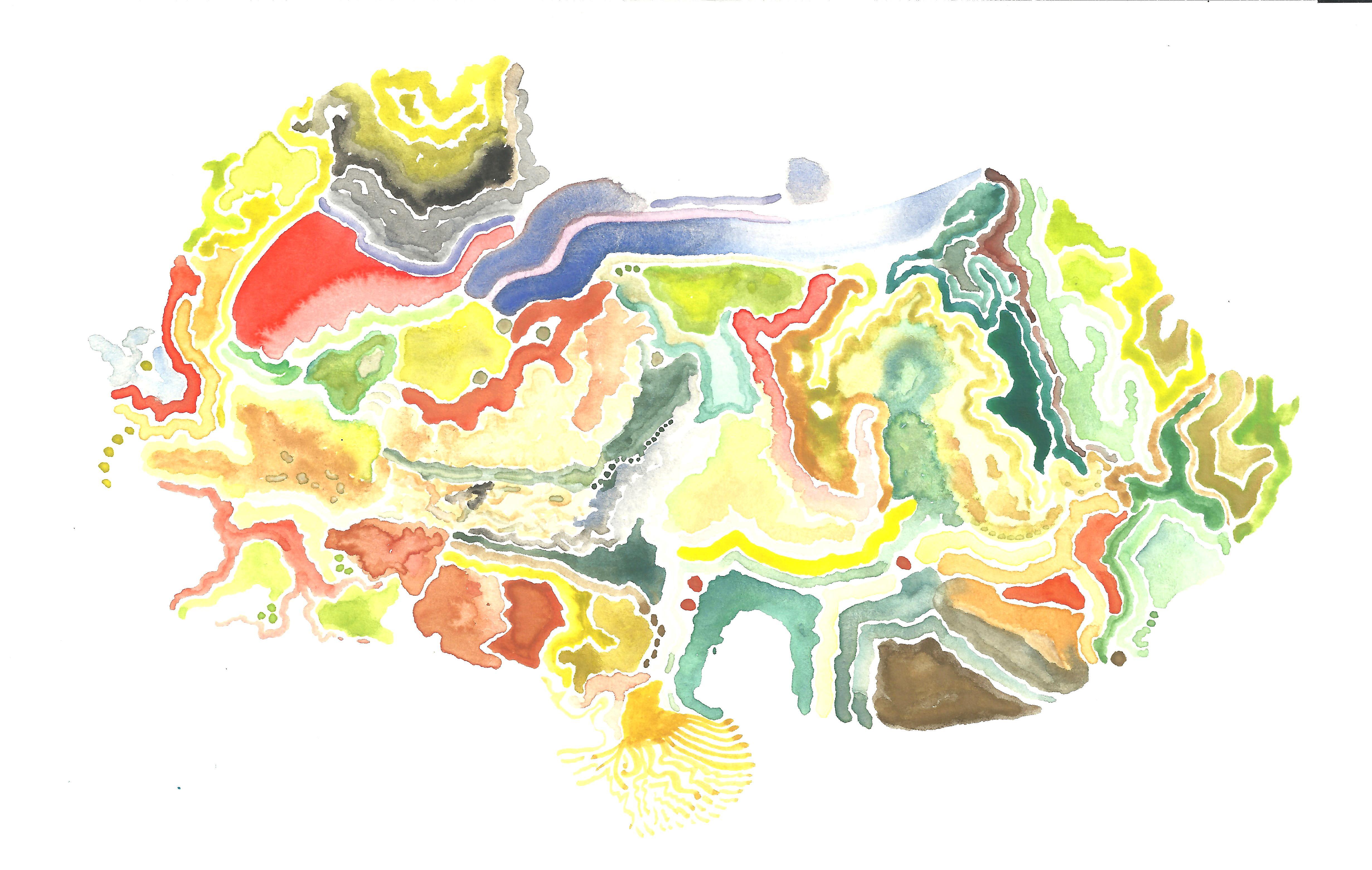
11-1-15 map watercolor

This was inspired by the artwork of Walter Inglis Anderson as well as that famous Moody Blues album, along with –

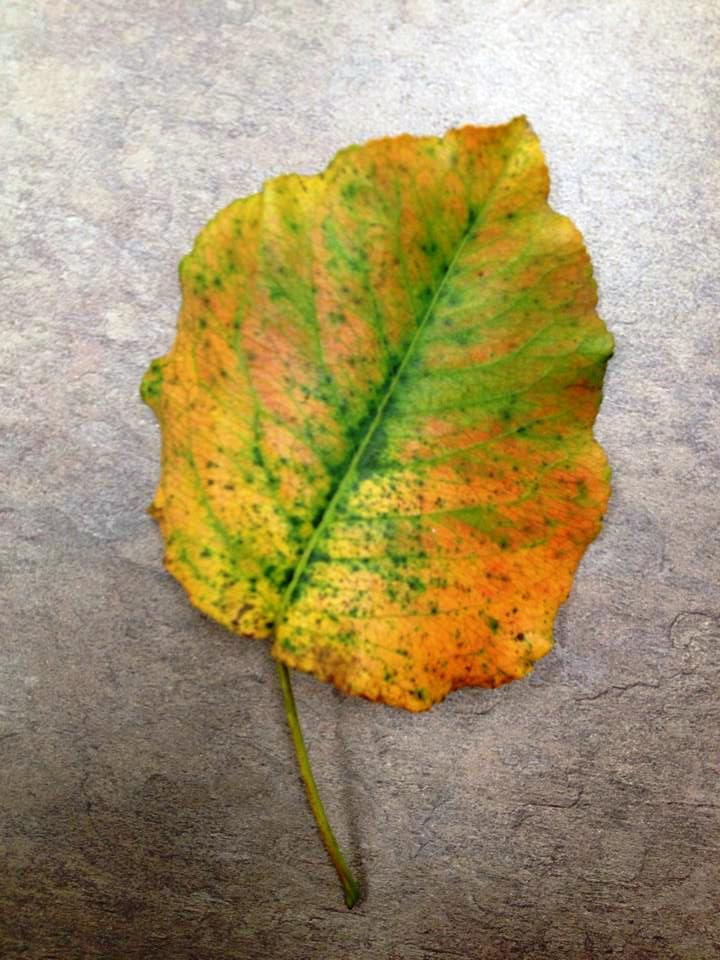
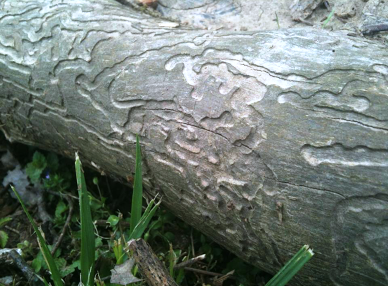
Topographic maps. Botswana agates. The glorious colors of fall leaves. The aimless trails left by burrowing insects in wood. Cloisonné. Geodes. Fractals. Intestines and the villi inside them. The meandering shiny trails left by snails on spiderwebs and across fallen damp leaves. “Ghosts of leaves” – Tannin stains on sidewalks left from falling leaves and rain in November. Rorschach tests. Misty mornings. The smell of decay and over-ripeness of wild muscadines rotting on the vine. Unknown secrets, so dark and forgotten that no one even knows they are secrets anymore.

Shrouds, palls, and veils.
Inlets, coves, and fjords.
Maps, puzzles, and labyrinths.

Lightning amongst the clouds on a humid late summer’s night. Tendrils on grapevines, blindly reaching, binding. How the letters don’t touch each other on Torah scrolls.
——————————————————

I mostly let my mind go free and “filled in the blanks” on a blank piece of paper. I selected color moment by moment. There was no pre-sketching or planning. This took a little over an hour to do. I kept another piece of paper nearby to write the words for what I was seeing/remembering/being inspired by. I think of it as a sort of memory map that works both ways. It shows me where I have been and shows me where I’m going, and something more.

Watercolor on 8” x 6” medium-heavy paper.

A picture of something that inspires me. Found on a walk at lunch at the Hermitage library. There is a small creek that runs beside it. This is a wonderful log with insect-wandering-doodles.

worm

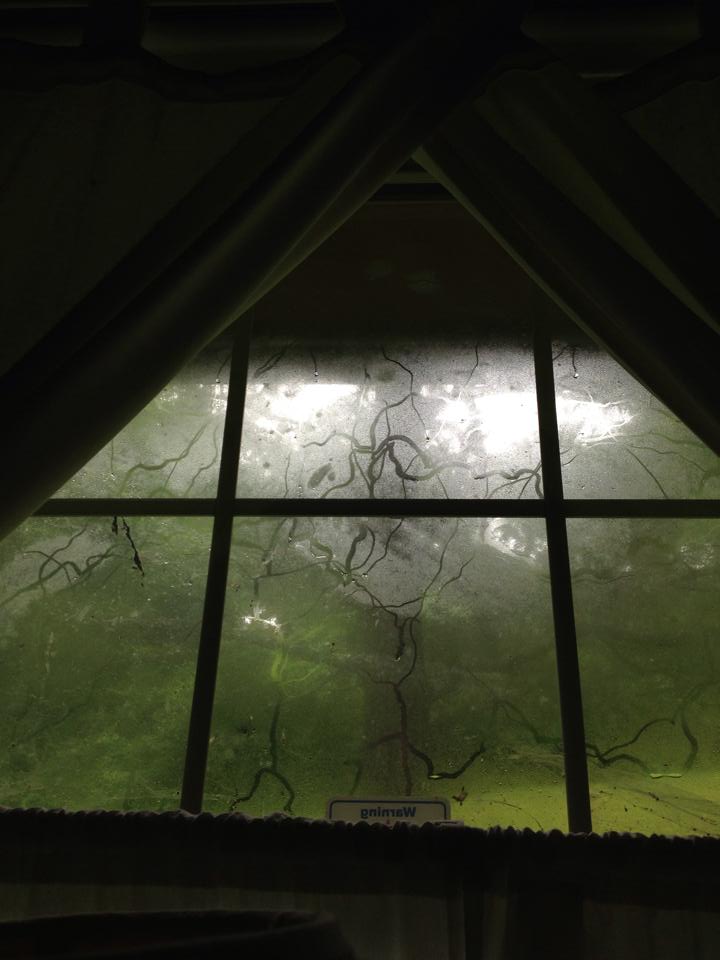
Lines on a humid window.
13319772_10207423467083259_2720958521476053776_n

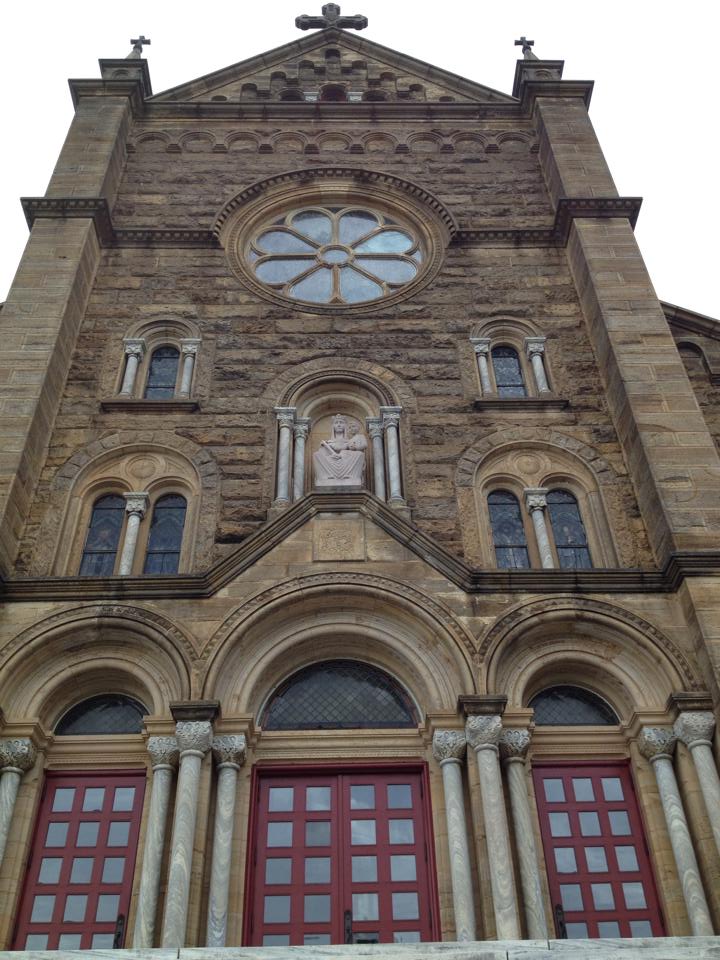
The red doors of St. Meinrad’s Archabbey

Red is a common color for doors in liturgical Christian churches. It is a symbol of the Holy Spirit, the fire and spark of God that animates all things. Interestingly, red is also the color that Tibetan Buddhists use to mark its buildings that have a statue of Buddha in it, as well as the color of the robes for their monks – for the very same reason. Red is a symbol of the Divine presence within. Red is also the color of Torii gates in the Shinto faith tradition. They are used to mark spiritual gateways, to indicate that beyond them is a holy place. It can also be described as being a visible symbol of the Presence of God, or as Jews would say, the Shekinah.

These were taken late September 2015 in St. Meinrad, Indiana, at the Archabbey and the seminary.

1

abbey

abbey2

door

private

The front of the Archabbey with the three sets of red doors.
front1

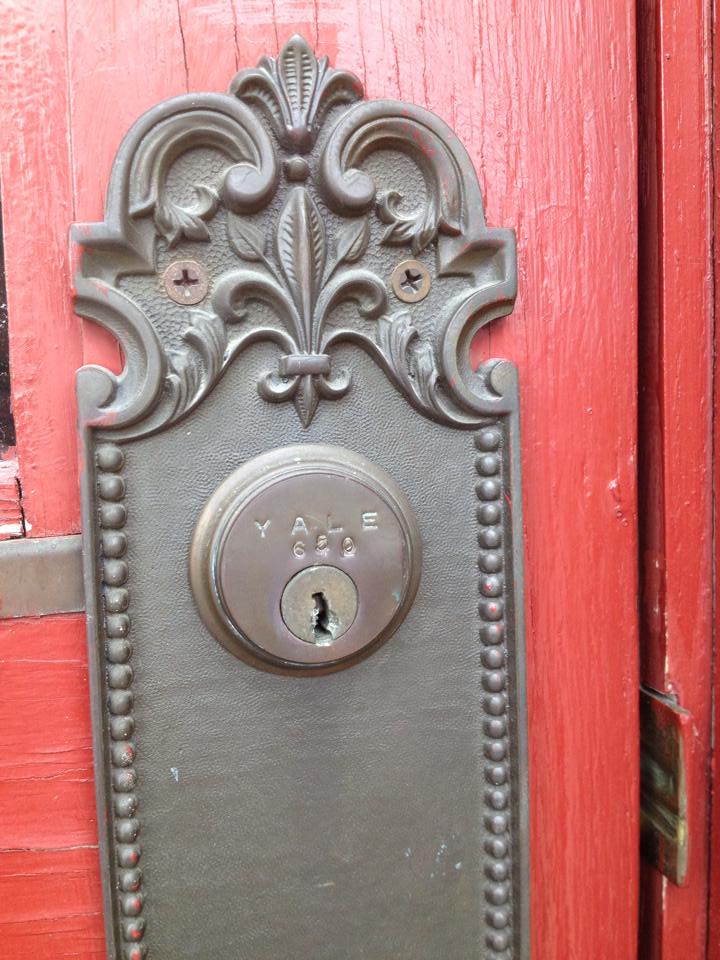
A closeup of the Yale lock on one of those doors, with the red paint better visible.
yale

The cemetery at St. Meinrad’s Archabbey

November first is an appropriate day to share these pictures. Today is All Saint’s Day, where all the famous Christians who have died are remembered. These are notable people who have led the way and been examples of being the Body of Christ – of making love visible in the world. November 2nd is All Soul’s Day, where everyone else – family members and friends, for instance, who have lived honorable lives are remembered.

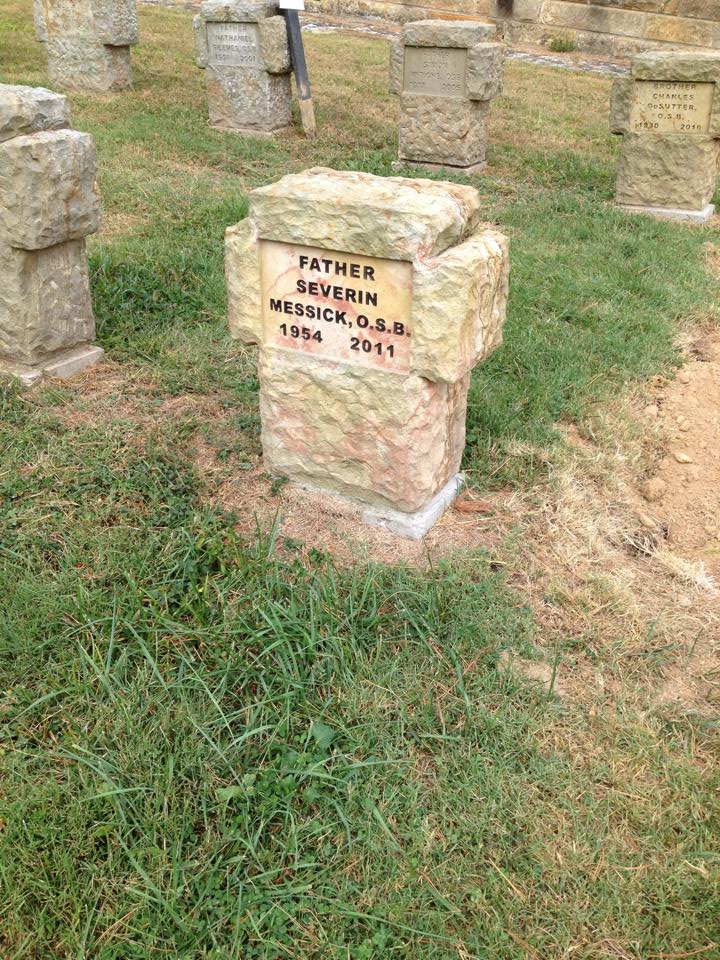
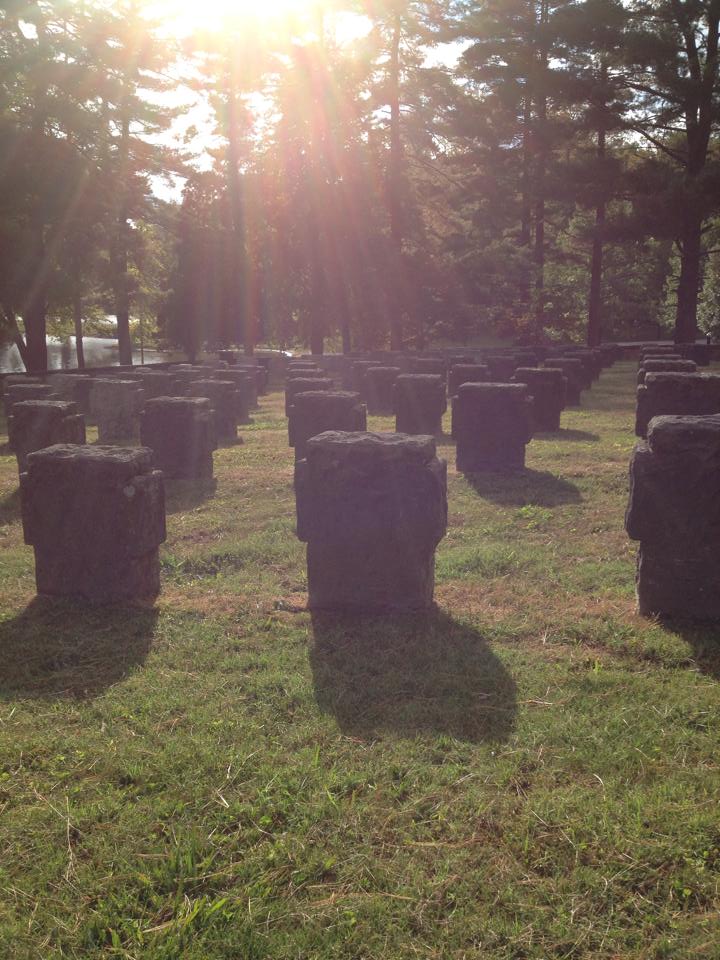
These pictures were taken in late September at St. Meinrad’s Archabbey (Benedictine monastery) in St. Meinrad, Indiana. This is the cemetery for the monks. The cemetery is slightly downhill from the seminary, and the headstones are made of the same local rock that the Abbey itself is built out of. They are very stout.

sign

8

The 5 former abbots are buried in the walkway. The first abbot was buried elsewhere and then relocated here.
6

5

A newer grave, showing the same color of rock as the Abbey. The older ones have weathered to a grey.
4

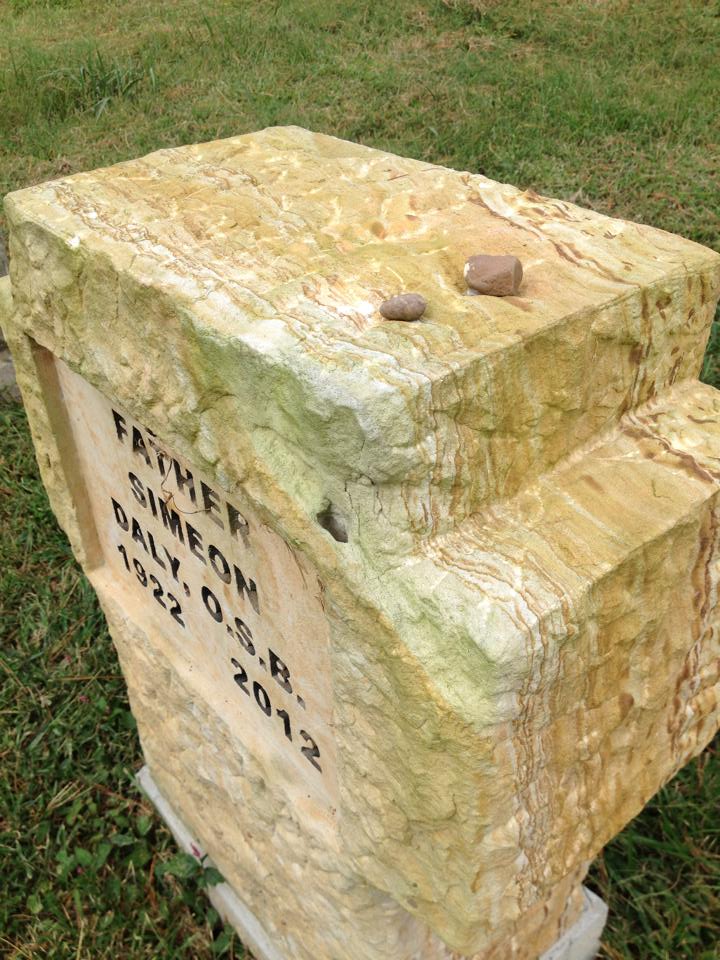
Even though they do not decorate graves, someone has practiced the Jewish custom of leaving a stone atop the headstone as a way of marking that they have visited it.
3

Quite atmospheric in the late Autumn sun.
2
1

There was a new grave – for Brother Benedict Barthel, born 1919, died September 15th, 2015. His birth name was Carl Frank.

The graveyard is walled, so it is limited as to how many more brothers can be buried here. There are only 42 spaces left. There are 252 monks already buried here. There are seven rows deep on two sides, with 21 columns.

Trunk or Treat

Why do some Christian churches celebrate “Trunk or Treat” rather than Halloween? It is because some denominations are strongly opposed to the idea of Halloween because they think it is honoring the devil. They also are concerned about the safety of their children knocking on strange neighbor’s doors asking for candy. So they want to find a safe alternative.

Instead of having “Trunk or Treat”, perhaps would be better not to have anything at all. “Trunk or Treat” still gives reference to Halloween. Perhaps have a harvest festival if you have to have something. To observe even part of a holiday that you are opposed to is still acknowledging it. Referring to it gives it credence. If they are truly opposed to it, then don’t have any festival of any kind on Halloween or in the week before.

But there are other things to consider. As to worrying about the neighbors, remember that part of being a follower of Jesus means that you should treat your neighbors as you would like to be treated. So you want people to be afraid of you and to never talk to you? If not, then why would you treat the neighbors like that? Why is it that Halloween is the one time of year where we are encouraged to talk to our neighbors? Halloween is a great time to be a Christian. You can meet your neighbors and make new friends.

Another problem is that there is no “trick” in “Trunk or Treat”. It is all “treat”. There is no risk of anything unusual happening. The risk is part of Halloween. Halloween is about things being different, where the unexpected can happen. It is about acknowledging that we aren’t in control of our lives. This too is in line with the words of Jesus, who reminds us constantly that God is in charge, and we aren’t.

Tilly and the lawn.

Tilly and the lawn


It was a big yard, and somebody had to mow it. 82° in the shade, and there wasn’t much of that to be had, but the grass still needed mowing.

Tilly was pleased with herself. All 7 acres in one day! Maurice said it couldn’t be done, but she did it. All week long he doubted her and it only egged her on. It was years later before she suspected that was his plan – to fire her up to do it by saying she couldn’t.

He was forever getting out of doing things one way or another. He thought he was so clever, but she was the real winner. He spent his whole life making others do everything for him and had never learned how to do anything for himself. Now he was a manager at a forgotten branch office of a small appliance outlet. Upper management had been fooled for years, thinking he did all the work.

When employee after employee quit, the house of cards tumbled down. They’d held it together for a very long time, but there was only so much they could take, watching him get the praise, the bonuses, the requests for motivational speeches. They couldn’t get why nobody else could see through his lies. Finally they left, one by one, and he was left by himself to run the shop. He didn’t even know how to run the cash register. It took the corporate office a week to suspect something was wrong. It took them a month to find an out-of-the-way office where he couldn’t do the company a lot of damage.

They couldn’t fire him, no, that wouldn’t do. Nobody really knew why. It wasn’t like he had tenure, not officially. This wasn’t a college after all. Plenty of half-rate incompetents had slid under the wire in that field. He was likable, in an odd kind of way. Perhaps that was how he could cajole everyone – employees, family, neighbors, into doing things for him.

He wasn’t pushy in an obvious kind of way. He just knew how to put a little pressure here and a little finesse there and before you knew it you’d agree to give up your one day off to work his shift. Somehow, at the time, you forgot you had plans you made weeks ago with friends you’d not seen since September. Somehow, it took several hours into your shift – his shift – to remember, and get angry and even a little resentful.

He was far away by then, and maybe that was part of his magic. The closer he was to you, the more you couldn’t resist, the more you couldn’t say no. Even 30-some-odd feet away at the other end of the building, his influence could still be felt. When he was at home he didn’t have the same power over them. But he sure had it over his wife.

Tilly made less than Maurice, always had. She was fine with that, because she had something he’d never have, something more than money. She had respect. She was respected by her coworkers and her family – people who had to be around her. Her friends didn’t just respect her – they adored her. They were drawn to her charm like a child is drawn to fireflies. They all did what she asked joyfully because she rarely asked – asked only when absolutely necessary, and even then she always said “You can say no”. They never did. Doing for her was like doing for a saint. You felt better after doing it, whatever the task.

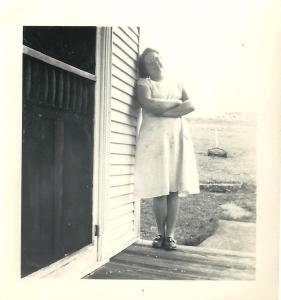
Years later Tilly saw the picture of her standing on the front porch and laughed. If she’d only known just a few years later there’d be gas powered motors to speed things up. Just a few years later and there’d be tennis shoes, not loafers, for better grip. Just a few years later and she could have worn a T-shirt and shorts to do this chore, free to choose to wear a dress rather then it be the only option. All these advancements made her mowing accomplishment at the time all the more impressive because she did it without them.

She’d always thought that handicaps were advantages in disguise. They made you work harder, not take anything for granted. They handicapped the athletes who were stronger, didn’t they? Or was it horses? Something about making it a fair match. So being handicapped meant something good to her, meant that she secretly was better, stronger, more capable. Like she had secret powers and had to figure out what they were, hidden under that handicap. She always said that the more you focus on what you don’t have, the more you miss what you do.

Maurice was her handicap, so he was her blessing. Because of him she learned how not to treat others. He gave her so many examples of how not to act that she had a clear road in front of her showing her the way. It was like he’d gone through the test book of life and crossed out all the wrong answers, leaving her with all the right ones. It was an odd way of learning but it was learning nonetheless. It took her years to understand the gift that he given her by teaching her backwards.
Pictures from St. Meinrad’s monastery – the Abbey. September 2015

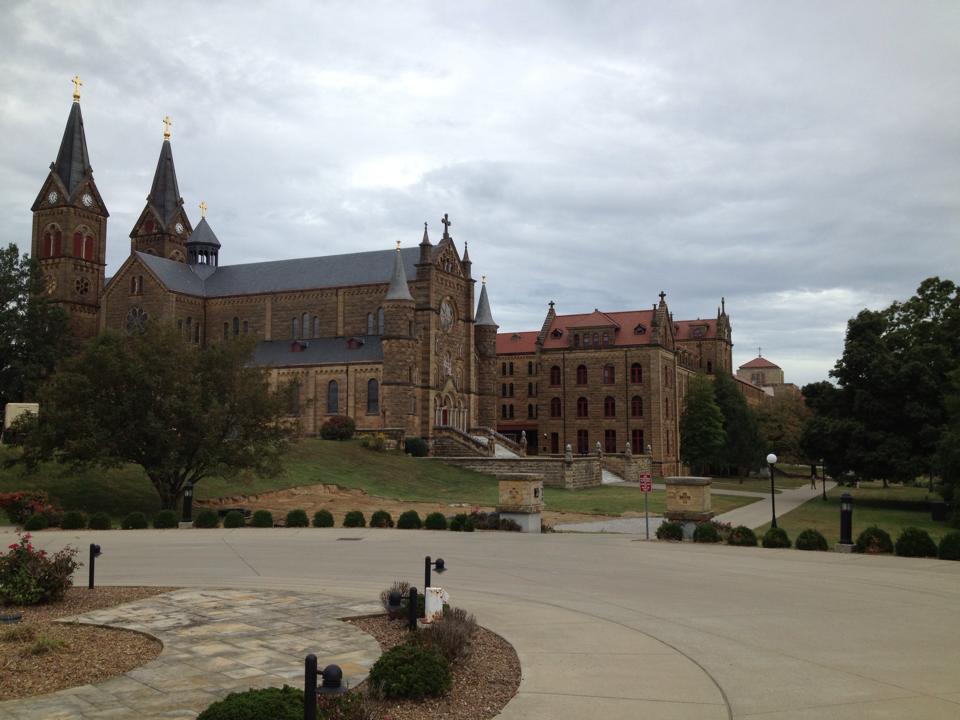
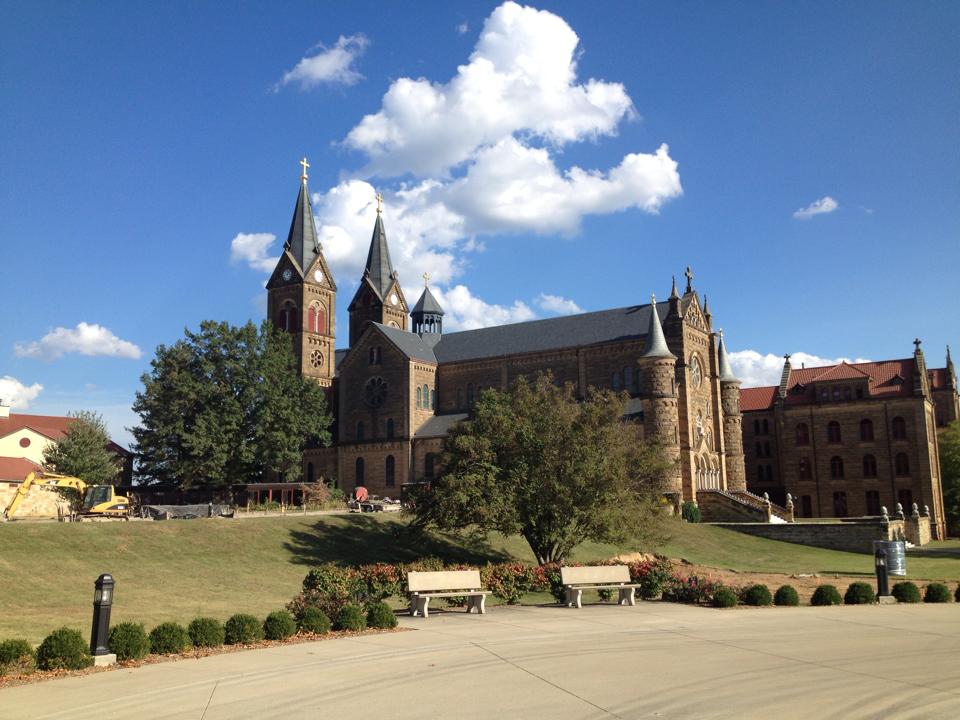
Outside. Looks like Hogwarts. The building to the right is the seminary.
Abbey outside<a>

Stained glass inside. The tree with the forbidden fruit becomes the cross that Jesus is crucified on in atonement for our sins.
adamcross

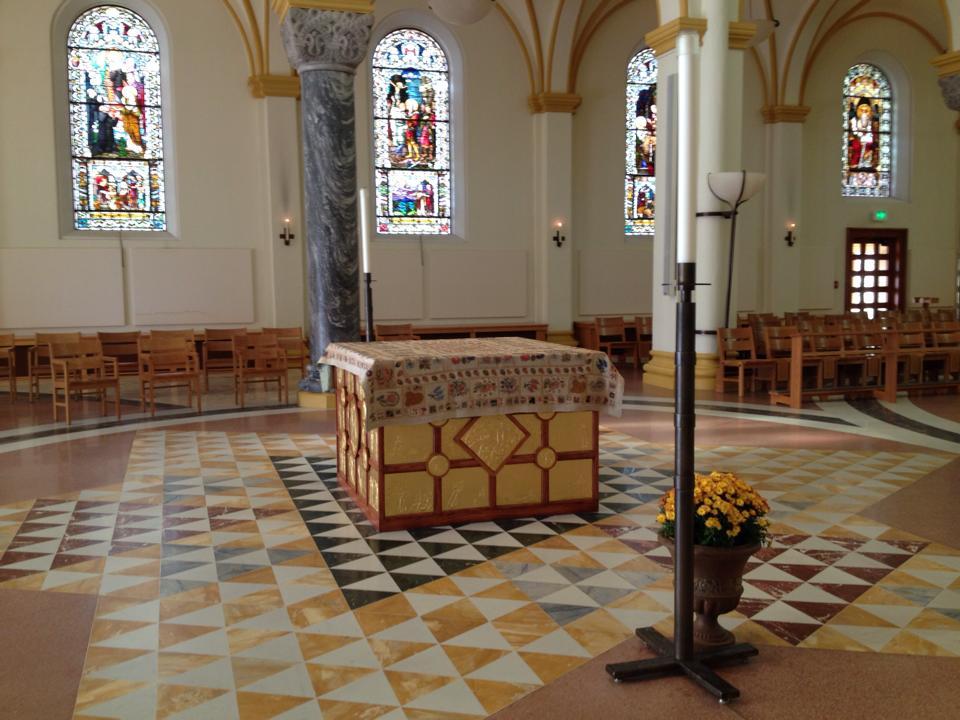
The altar, set out in the middle, amongst the people, rather than far away and separate from them. Note the two large candle holders. Two candles represent the Old Testament and the Gospels – and are also reminiscent of the two candles used at the head and foot of a dead body lying in state.
altar

Another picture of the altar. Note the really unusual Christus painting on the back wall. It is all in black.
altar1

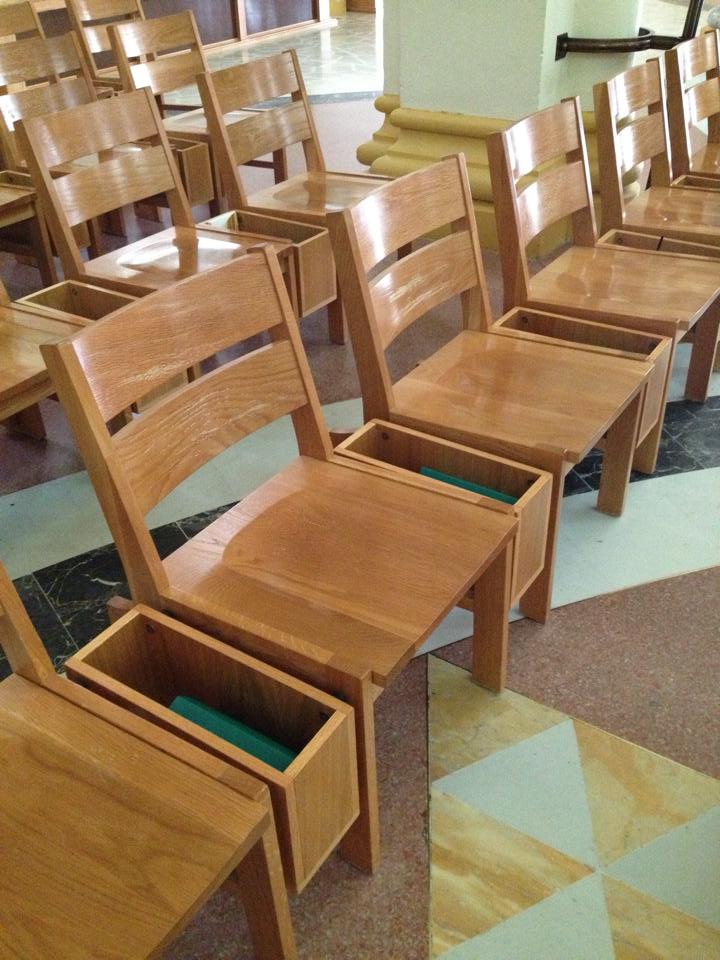
Where the laity sit. Note the small amount of informational books to help you follow along.
congregation pews

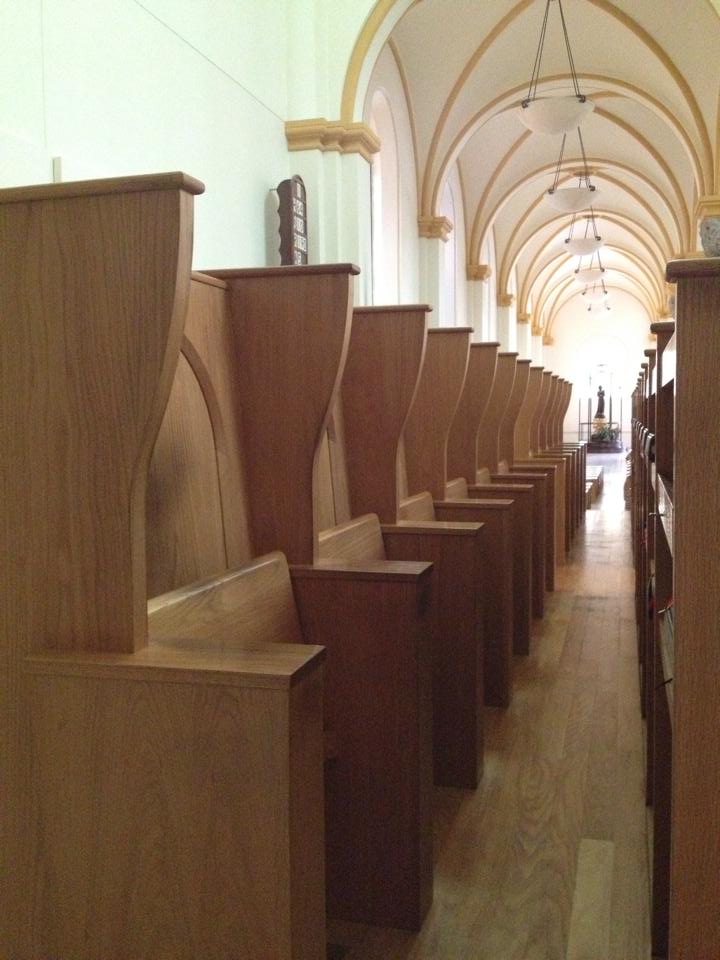
Where the monks sit. Solid, with slight dividers. This way they pray together, but also have some privacy.
monk pews2

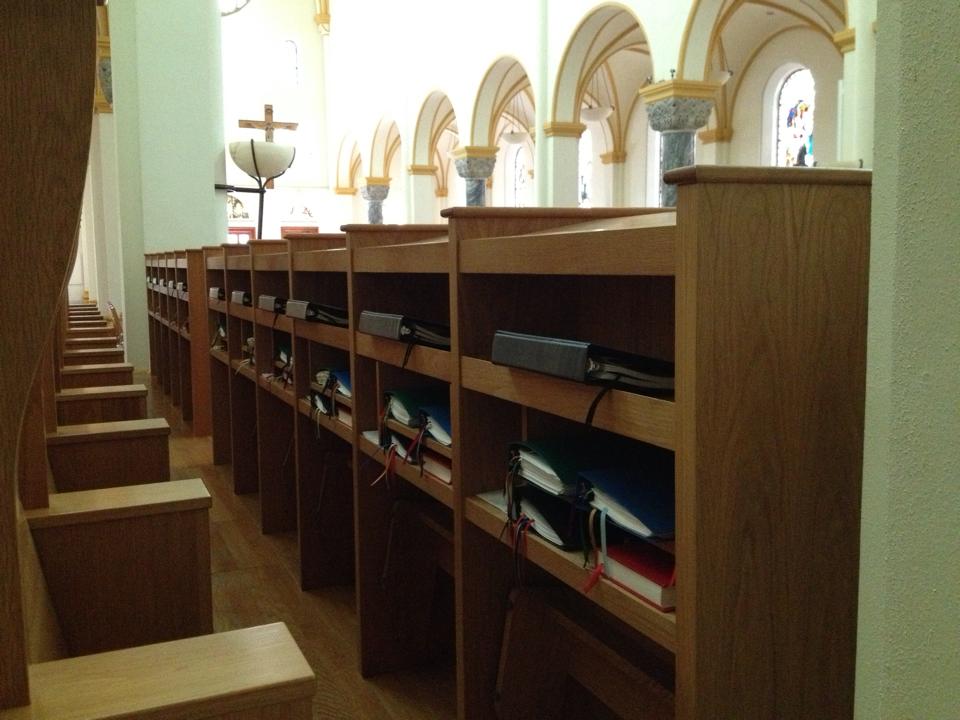
Note the vast amount of informational books here for the monks. You’d think they wouldn’t need it more than the laity.
monk pews

The flying cross
cross

The cross
cross2

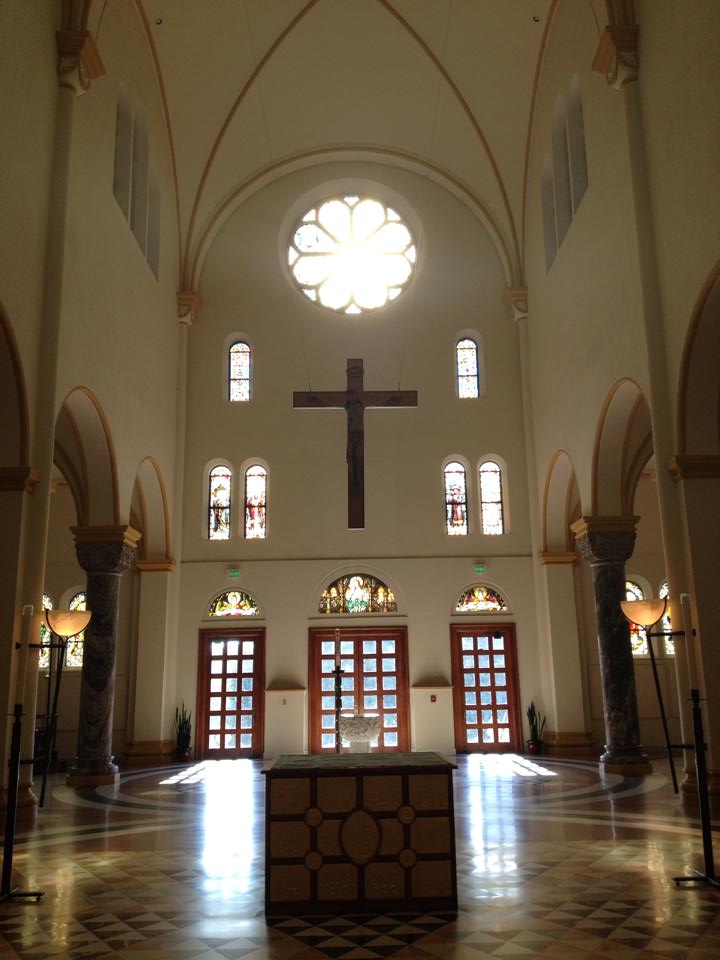
The cross and altar. Note how the baptismal font looks like a chalice atop the altar at this angle.
dark2

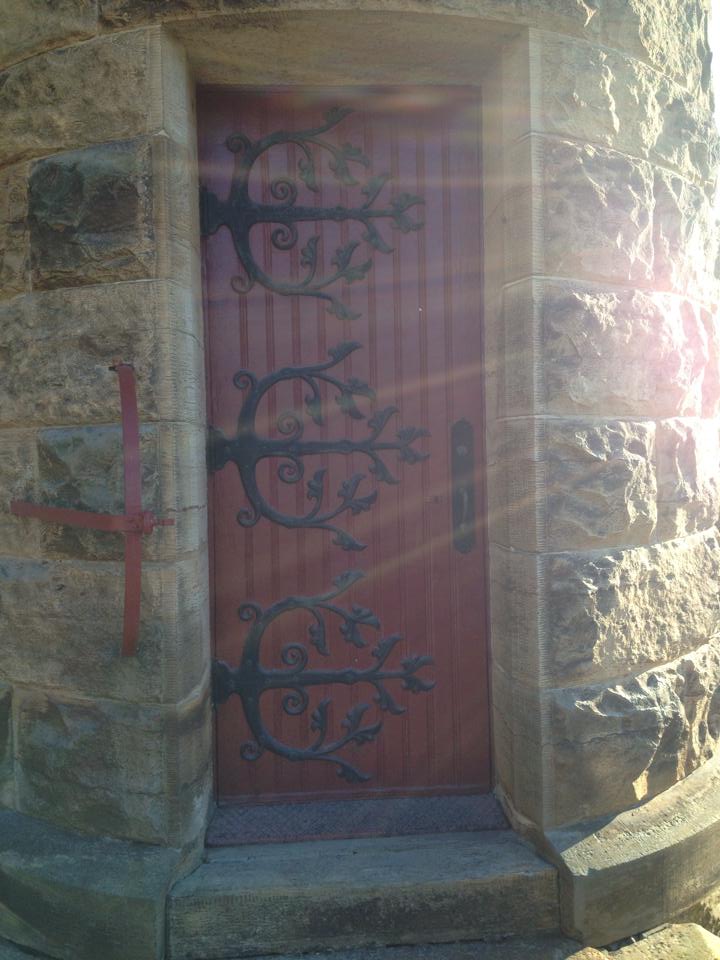
Outside door in the sunlight. This is a door that is not normally used.
door

It is quite atmospheric this time of day and year.
door2

The baptismal font. Covered in scenes depicting stories about water in the Bible. The font is connected to a water pump so it burbles all the time with fresh water. It is quite large.
font3

Outside the Abbey front doors.
front1

Inside the Blessed Sacrament chapel.
host6

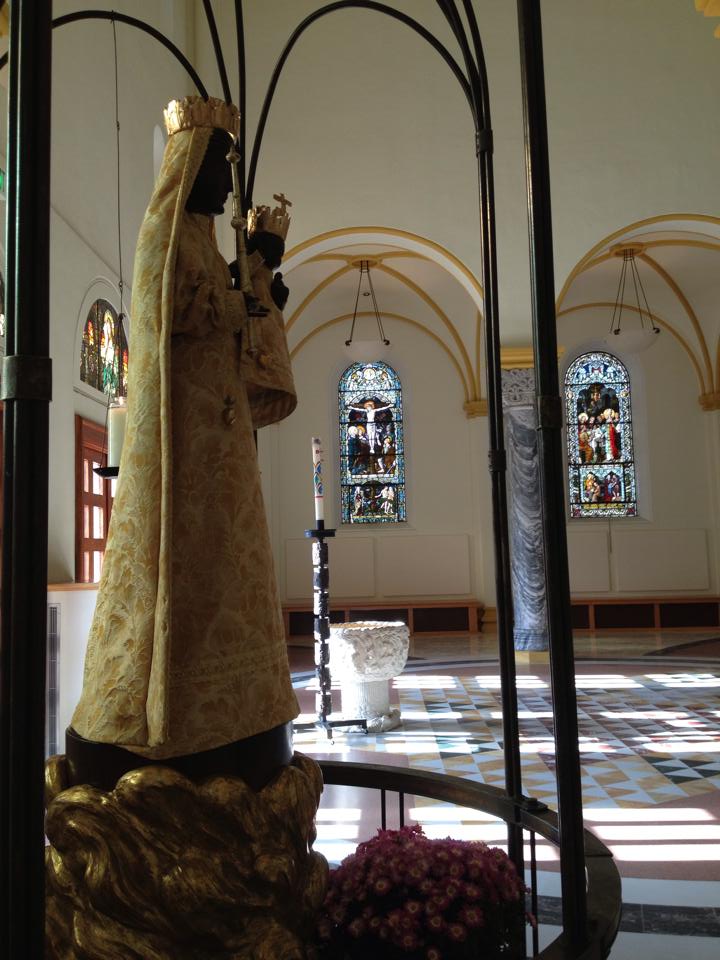
The Black Madonna.
Mary 1

A sunny picture of the Abbey.
outside17

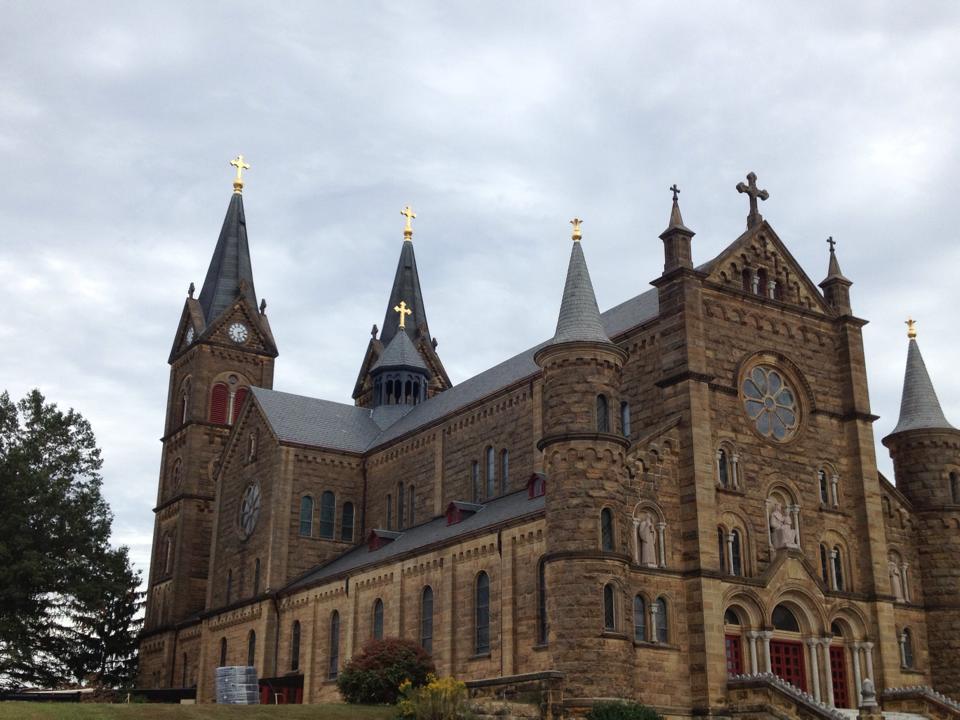
Very ornamented.
outside12

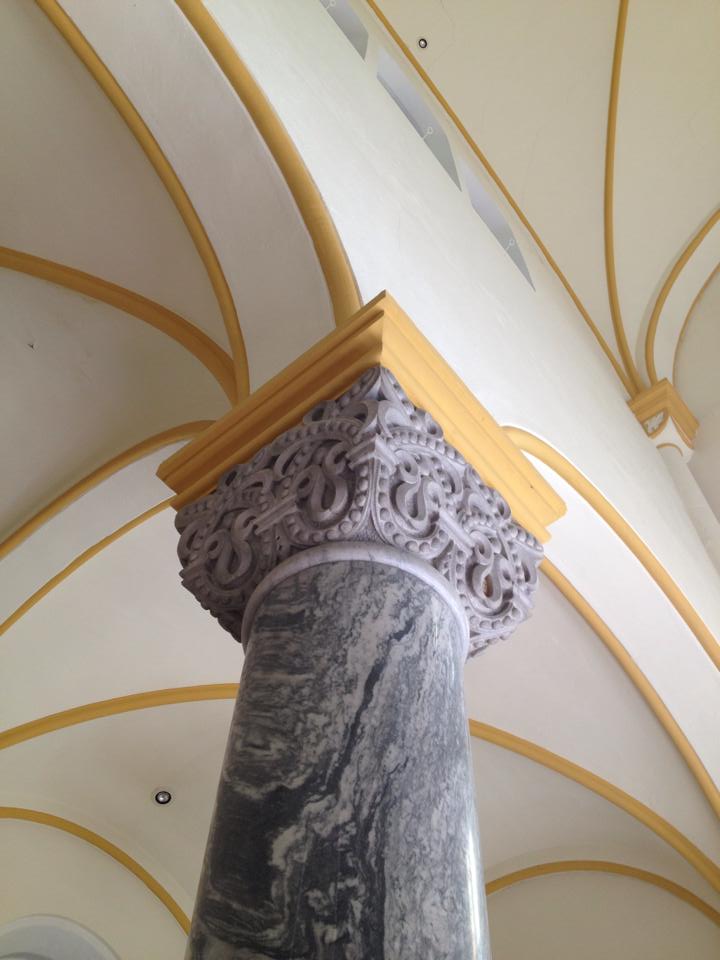
Inside, a Corinthian column.
pillar

A Yale lock on the front left door.
yale

Halloween and Christianity

I’ve met a lot of people in the small community I work in who say that they don’t celebrate Halloween because “It’s the Devil’s holiday”.

There are a couple of points to be made. Halloween is, fully spelled out, “All Hallow’s Eve” – the name refers to the day before All Saints Day, which is observed on November 1st. The word “hallows” refers to “hallowed”, meaning “sacred”. All Saints Day is a holiday that is primarily observed by Catholics and Episcopalians. All other Christian denominations generally have no idea of its existence, thus they don’t know what the word “Halloween” refers to. All Saints Day is the day to remember and honor all the famous people who have died who were strong in their faith and lead the way for us. This includes people such as Saint Francis of Assisi, Saint Patrick, and Mother Theresa. They are our role models in faith. Lesser known is that November 2nd is “All Soul’s Day” – where we remember all the people we know and love who have passed on. This includes any relatives or friends we might have who have inspired us to be better people.

Another point is that we believe that there is just one God. To give any power to another force is in violation of the commandment saying “You shall have no other gods before me.” Everything is from God. To personify the idea of evil and to ascribe power to it is to say that there is another god, which is not possible. To say that it has power over you verges on idolatry. So remember that God is in charge, first and foremost.

When I was at Cursillo, I received a bookmark that really helped re-frame Halloween for me. I’ve reworded it a little to polish it up. Here you go –

Being a Christian is like being a pumpkin. God chooses you, raises you up, takes you in and washes the dirt off of you. He opens you up, reaches deep inside, and scoops out all the yucky stuff – including seeds of doubt, hate, greed, and the like. Then God carves a new smiling face for you and puts His light inside of you to shine for all of the world to see.

“Let your light shine before men, that they may see your good deeds, and praise your Father in heaven.” Matthew 5:16