The parable of the large banquet.

There once was a very wealthy man who decided to give a large banquet. He invited a lot of people. On the day of the banquet, he sent his servants to go remind everyone who had been invited because everything was ready.

Without exception, all of them sent excuses instead of coming. Some of them said they had to work on their farm, some at their business, and some said they had just gotten married. All of them were too busy to show up to this feast that they had been invited to a long time ago. Some of the guests were quite abusive to the servants as well.

When the host learned the news, he told his servants to go into the streets and alleyways of the city and invite anyone they could find, including the poor and handicapped. The servants did this and there was room for even more people, so the host sent them out to get even more guests. The host was determined that none of the original guests would enjoy his banquet.

MT 22:1-10, LK 14:16-24

When the host came in to look at his guests, he saw a man who was shabbily dressed – not appropriate for a grand feast such as this. He asked him how it was that he was admitted in without appropriate clothing. The man didn’t know how to answer, so he didn’t. Then the host told his servants “Tie this man up by his hands and feet and throw him out with the trash. For many people are invited but few make the cut.”

MT 22:11-14

The parable of the two sons.

“What do you think about this story? There was once a man who had two sons. He asked the first one to work in the vineyard, and the son refused, yet later he changed his mind and went to work. When the man asked his second son to work in the vineyard, that son said he would but then he didn’t go. Which of the two did what his father wanted?”

“The first,” they replied.

“Mark my words, tax collectors and prostitutes will get into the Kingdom of Heaven before any of you! John the Baptist came to warn you about your evil ways and you didn’t repent and return to God. The tax collectors and prostitutes did. Even when you saw this happening for yourself, you refused to change your minds and believe John’s message.”

MT 21:28-32

The parable of the vineyard owner.

Jesus began to teach them again using parables.

“There once was a landowner who planted a vineyard. He put a fence around it and included a winepress and a watchtower. He leased it to tenant farmers and then he went away for a very long time. When it was harvest time, he sent his servant to the farmers so that he could collect some fruit from them. Instead of giving him fruit, the farmers beat the servant and sent him away with nothing. The landowner sent another servant and they treated him just as badly. Then the landowner sent a third servant and the farmers killed him. He sent other servants, and they were all either beaten or killed.

Finally he decided to send his much loved son thinking ‘Surely they will respect him.’ But the tenant farmers talked amongst themselves and decided that since this was the heir they should kill him and collect the inheritance for themselves. They did just that and then threw him out of the vineyard.

Because of their shameful behavior, the owner of the vineyard went there himself to destroy the farmers and let other people manage his land and crops.”

Jesus asked the religious leaders if they had ever heard the verse from Scriptures that says ‘The stone that the builders rejected has become the cornerstone. The Lord has done this and it is wonderful to see!’

“Therefore it follows that the kingdom of God will be taken away from the original tenants and given to those who are good stewards and can produce healthy fruit. All who stumble on this rock shall be broken, and all those who this rock falls on will be ground to dust!”

The chief priests and scribes started to look for a way to arrest him because they knew he was speaking these words against them. However, they were afraid of the crowds because they regarded him as a prophet, so they left him alone for the time being.

MT 21:33-46, MK 12:1-12, LK 20:9-19

Musings on friendship

When I was in fourth grade, my teacher approached me with an unusual request. She asked me to befriend a girl who was a little odd. I’ll call her Susan.

She and I both liked to read, specifically science fiction. She wrote a little then too. We both thought Steve Martin was very funny.

Her father was dead, but worse, her father had been abusive. Her mother had to work a lot to support them, so spent a lot of time alone. This was unusual at the time – most families stayed together. Single mothers were unheard of. They lived in a tiny house that was just behind the school. At the time, that size house would have been considered poverty level. These days, the micro-house people would think it was immense.

She had wild hair – too curly to be manageable. She was a bit overweight, and smelled like cat. Perhaps she had Asperger’s. Perhaps she just didn’t know how to fit in.

Did this hamper my social life because I was seen with the weirdo? I wasn’t much of a social butterfly anyway. I would have been just as happy being alone. I never understood all the fuss people (girls) made over boys and makeup and pop stars. Perhaps the teacher thought I needed a friend, rather than the other way around.

Did this help her? She got to socialize with another person. But it was an artificial relationship. Like an arranged marriage. It definitely stopped her from becoming worse.

I didn’t think of it in this way at the time. More than thirty years has colored my feelings. In a way I feel cheated – I made very few other friends while in elementary school. She stuck with me. Out of habit? Desperation? Did this keep others away?

I was far from normal – but I had a stable home. At the time I felt it was a big honor to be asked – this meant I had extra to give. This meant I had a kind heart.

This has softened me to the plight of the “other” the weirdo, the loner. Folks say “he was quiet, and he kept to himself” – yes – so introduce yourself. Talk with him. Become a friend. It is hard to be a friend to the friendless, but it is important. It may save a life (or hundreds), the life of the person, or the people they might harm.

Back in my day, unhappy loners just killed themselves. These days they kill innocent strangers.

However, this hampered my ability to make friends in a different way – it became the pattern for my friendships. I fixed problems. I was the one who listened. I was the one who understood. But when I had a problem or needed to be listened to, nobody could help.

She showed up, unannounced, at my workplace one day years after school was over and asked if we were still friends. I’d not called, she’d not called. We were adults now. This was after my parents had died – -and she had been nowhere during that very traumatic time.

What is friendship? A name in a phone book? A connection on Facebook? If only one person is making the effort, then it really isn’t a friendship.


Rembrandt’s secret

This is my favorite place in the whole world. It is a little garden area behind Rembrandt’s coffee shop in Chattanooga, TN. It reminds me of pictures I’ve seen of Roman and Arabic gardens that are in the center of the house – open to the sky, and protected from view from outsiders. It is a little bit of nature that is cultivated and secret.

Let us enter.

1

Going down the narrow path.

2

We’ve entered, and here I’ve stepped to the far right to show you the fountain and the courtyard.

wide fountain

Stepping slightly to the left to take a picture of the tree for you.

tree

Stepping slightly to the right and looking up to take a picture of the terrace that it attached to the art gallery (worth a trip inside, it is called the River Gallery)

left up

Looking to the left of where I’m standing, a small rock garden. Very nice in this wintertime.

rock garden

A closer view of the fountain.
fountain

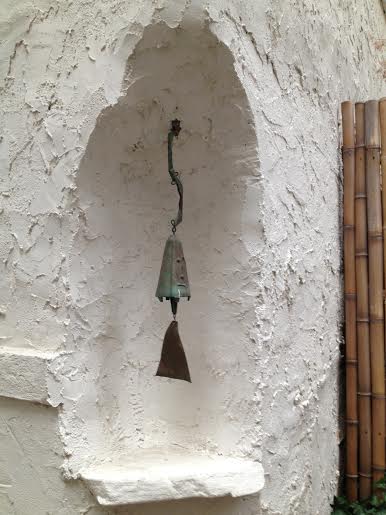
The windchime alcove, going slightly left.
bell

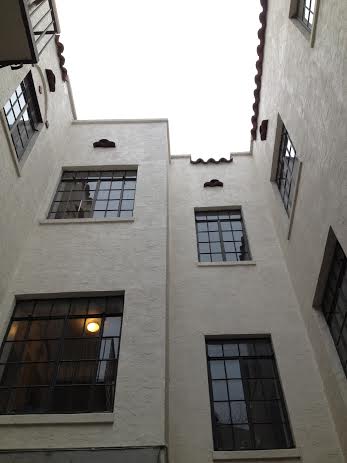
This is looking straight up behind where I’m standing.

high

Slightly to the left of that. The fountain is immediately on your left at this point.

around

Going further left, the stairs leading out. The fountain is in front of you here.

steps

The fountain

fountain

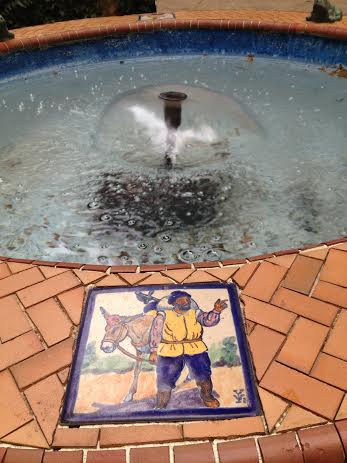
The tilework on the fountain.

close fountain

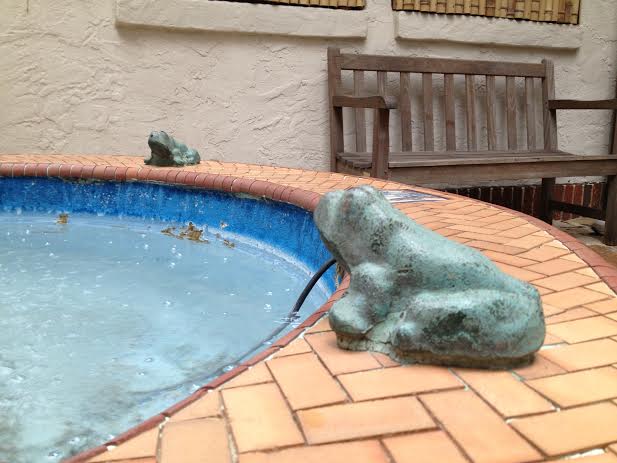
The Frogs.
frog

The Triumphal Entry into Jerusalem

Then they went on to Jerusalem. Near the Mount of Olives, Jesus sent ahead two of his disciples, saying “Go into the next village. As soon as you enter the village you will find a young donkey that has never been ridden. Untie it and bring it to me. If anyone asks you why you are doing this, say ‘The Lord needs it, and will send it right back.'”

The two disciples left and did as Jesus had asked them. They found everything as he had told them they would.

This fulfilled the prophecy that was spoken by Isaiah, which said “Tell daughter Zion, ‘See, your King is coming to you, riding humbly on a donkey’s colt!'”

His disciples did not recognize the significance of what was going on at the time. However, after Jesus was raised from the dead, they remembered this prophecy and that it had been fulfilled in their presence.

They returned to Jesus, laid their cloaks on the donkey, and helped Jesus up so he could sit on it. The crowds began to place their cloaks and leafy branches from the nearby trees on the road.

When he approached the path that went down the Mount of Olives, the whole crowd began to loudly praise God because of all the miracles they had seen, such as the miracle of Lazarus being raised from the dead. They were chanting “Hosanna! Blessed is the King who comes on the name of the Lord! Praise God in heaven!”

Some of the Pharisees said “Teacher, make your followers be quiet!” Jesus answered, “Even if they were to be quiet, the stones would speak for them!”

When he entered Jerusalem, the whole city was abuzz, saying “Who is this?” The crowds with Jesus answered “This is the Messiah, the Son of David, our King!” The Pharisees were very angry, realizing that all they had done to discredit Jesus hadn’t worked. They said “Look! The whole world is following him!”

Because it was late, Jesus and his followers briefly looked around at everything in the Temple area and then went out to Bethany.

MT 21:1-11, JN 12:12-19, MK 11:1-11, LK 19:28-40

In the name of Jesus

Praying “in the name of Jesus” always seemed like a talisman to me. It was a crazy thing to tack on. It sounded like a magical charm – not a prayer. Yes, Jesus tells us to ask for things in his name.

John 16:23b-30 (NRSV)
23 On that day you will ask nothing of me. Very truly, I tell you, if you ask anything of the Father in my name, he will give it to you. 24Until now you have not asked for anything in my name. Ask and you will receive, so that your joy may be complete. 25’I have said these things to you in figures of speech. The hour is coming when I will no longer speak to you in figures, but will tell you plainly of the Father. 26On that day you will ask in my name. I do not say to you that I will ask the Father on your behalf; 27for the Father himself loves you, because you have loved me and have believed that I came from God. 28 I came from the Father and have come into the world; again, I am leaving the world and am going to the Father.’ 29His disciples said, ‘Yes, now you are speaking plainly, not in any figure of speech! 30Now we know that you know all things, and do not need to have anyone question you; by this we believe that you came from God.’

I get it now – Jesus is the proof that God is real, that God makes good on his promises. Jesus is God made flesh, is real, is here with us. Our God loves us so much that he comes down to be with us, right next to us, even inside us. When we pray in Jesus’ name, we are recalling that – to ourselves, and to God. We are reminding ourselves and God that he cares and wants the best for us.

(Started 12-3-12, left to work on for later and forgotten. Edited today. I think I’ve written something similar since I started this.)

Money and energy

If somebody comes up to you and asks for $20 and you give it to them and it’s not a hardship for you, then everything is okay. They aren’t borrowing it – they just want $20.

But what happens when they come up to you the next day and ask for another $20? Do you give it to them? If you do and it’s not a problem, then again everything is okay.

But what about the next day
and the next day
and the next day?

If they keep asking you for money and you keep giving it to them you might start to feel resentful. You might think “I really don’t have this kind of money to give away. Why does this person keep asking me for money?”

Really the question is – why do you keep giving it to them if there’s a problem?

This isn’t about money, but money is a good way to get into this idea. Money represents energy. Someone can’t take something from you without your permission. Someone can’t take advantage of you without you letting them do it.

If there’s a coworker who is constantly shirking at work and you constantly have to pick up her slack, then that’s your problem, not her problem. She is a genius. She figured out how to get paid to do half her job. Meanwhile, you’re doing twice the amount of work for the same pay.

If you feel put upon and upset and hurt by this, then that is all about you not establishing safe boundaries for yourself. Time to say no, and mean it. The other person will push you and test you – this is normal. Keep saying no.

Why do we so often care about not hurting other people’s feelings, while feeling hurt and upset ourselves? Time to change things. We don’t need to turn this so far around that we aren’t considerate of how others think and feel, but we do need to factor in how we think and feel. It isn’t fair if feelings aren’t equal.

Things we found in books

A bus pass.

Rolling papers.

Boarding passes.

Plane tickets.

Gift cards.

Pieces of toilet paper.

Gum wrappers.

Grocery lists.

Family photographs.

Birthday cards.

3 x 5 note cards with study questions on them.

Outgoing mail.

List of errands or chores.

Envelopes with fine money and a note with their library card number inside.

Handmade and store-bought bookmarks, some of which are very old and obviously cherished.

–Medical stuff–
A sonogram.
Doctor’s appointment notices.
Prescription.
Medical test results.

–Money–
Biggest bill was $20.
Checks made out to the patron.
Checks that have not been cashed that are made out to the patron.

–Three dimensional things–
Pens.
Nail files.
Hair ties.

Children are promised

There are many times in the Bible where children are prophesied. Sometimes they are long-wanted, sometimes they are a surprise. Sometimes they are the answer to a prayer and sometimes their birth causes more questions than answers. In each case, God shows us that our lives and our concerns are always in God’s hands. God knows our needs before we do.

This is a complete list as far as I know. If I find more, I’ll add them. Please comment if you know of other examples of God telling people that they were going to have a child.

Ishmael (Gen. 16:7-16)
Isaac (Gen 18:1-15)
Samson (Judges 13:3-20,24)
Samuel (1 Samuel 1:1-20)
John (Luke 1:5-25)
Jesus (Luke 1:26-38)