Poem – kin/kind

Just because someone is kin to you
doesn’t mean anything.

Kinship without kindness
requires no fealty.

If your brother, mother, father
show you “love” couched in
threats, shame, or guilt
then walk away.

Love that hurts isn’t love.

There is nothing
about the accident of birth
that guarantees
kindness.

There is nothing about
being a sister
that fosters
protection.

If kin are not kind
then “family” is an empty word.

Walk away.

You owe them nothing.

If they treat you
as an accident,
an embarrassment

then that is their loss.
It is not a reflection
of your worth
but of their blindness.

Set a high price for yourself.
even if your “family”
says you are worthless.

Or perhaps even because of it.

If the family you were born into
does not treat you as a friend
but ignores, belittles, embarrasses you

Walk away.

You owe them nothing.

Bullies can be brothers.
Rapists can be relatives.
Murderers can be mothers.

There is no “normal”.
There is no “average”.

There is only you, right now.
If your “normal”
feels wrong
feels unhealthy
feels strange

Walk away.

You can create
a new family
from friends
who know how
to love
the beautiful person
that you are.

Question the questionnaire.

Have you ever noticed when you go to a doctor’s office how many things they ask you on the forms? How much of this is just they are able to ask?

A form I filled out recently asked for my husband’s name, his social security number, and where he worked. I can see how this would be appropriate if I got my insurance through him, but I don’t. There was nothing on the form saying “only fill out if…”

I think a lot of it is that they ask because they can. We have been trained to trust doctors. We have been trained to follow their instructions without question. The receptionist is swept right up in that. She is part of the authority structure.

So when the receptionist asks for personal information, we tend to give it. Me, I question everything, everywhere.

“Why?” is a powerful tool. If you don’t get a good reason why they need the information, don’t give it. “Because” is not an answer. Understand that the person behind the desk is just a cog in the machine. She doesn’t make the rules. So don’t get upset with her. Even talking to her manager won’t help sometimes.

I’m one of those cogs. I understand. There are plenty of things that we are told to do that don’t make any sense. Sometimes administration even gives us scripts to follow to explain a particularly weird rule change. It would be better if they asked us beforehand if this is a good policy change, but they don’t. Ever. We find out about it just as it is about to roll out, or just as it hits the news.

But, sometimes the rules or the policy does make sense. Sometimes I am all about enforcing it because I agree with it. But I’m still all for people asking questions and not following blindly. It is best not to give away something that you don’t have to.

Occupy your health

Perhaps the Occupy movement needs to teach us something else – don’t wait on the government to take care of us. We need to do it ourselves. While we are all holding our breath about the Affordable Care Act and whether Congress will get over its collective snit fit and start working again, we can do something ourselves.

Let’s not wait for tragedy to strike before we take care of ourselves. We’ve already seen that the government doesn’t really care about taking care of us. Instead of getting upset about it, use it as an impetus to not need to be taken care of. Remember, prevention is cheaper than cure.

The insurance companies, sadly, don’t think like this. Yet.

I remember one time when I lived in Chattanooga. There was a tree that was leaning too close to my house. I could see that any time now the thing would topple over and destroy my roof and everything under it. I called the insurance company and asked if they would pay to have the tree cut down. Nope. They would pay to repair the house and for a hotel room for me to stay in while the repairs were going on. But prevention? No. Prevention was a lot cheaper and faster. They would rather wait for the inevitable to happen and clean up the mess.

Insurance companies are doing the same with our health. Let’s spend a lot of money on a cure for cancer. Let’s spend a lot of money on diabetes supplies. They don’t think to encourage exercise and eating well.

If the government really wants to regulate health, it needs to ban cigarettes and vending machines. Ideally, we’d have enough self-control to know that we need to not smoke and not eat processed “food.” Obviously we don’t. So we have way too many people dying of entirely preventable diseases.

Sometimes the government does us a favor. Remember when you would go into a restaurant and they would say “smoking or non-smoking”? It really didn’t matter what section you went to – if there was smoking in that place, it travelled all over the whole restaurant. You were in the not-as-much-smoke section, but not the smoke-free section.

Sure, people have the right to smoke. They have the right to kill themselves that way. But they don’t have the right to take other people out with them when they do it. That is where the government stepped in and made it illegal to smoke in public buildings, and for that I’m very grateful.

I remember a lady who got really upset when she heard that she was no longer going to be able to smoke in restaurants. She got mad at the government telling her what to do. I was glad that finally they did something to protect me. But we can’t expect the government to take care of us all the time. We have to step up.

This should be an idea that will appeal to all the people who think government needs to get out of our lives and let us live the way we want to. This should be an idea that will appeal to all the do-it-yourselfers.

Let’s not sit around and wait for the government to do anything for us in regards to our health. We see what they have done with education. Why let them dumb down something else? We don’t need our health reduced to the lowest common denominator.

If health insurance is going to live up to its name, it needs to insure health. Paying money to restore what has been lost is backwards. Health insurance should pay us to go to the gym and eat well. We should go to nutritionists and personal trainers more than we go to doctors. We should all get stress-reduction training before we even are stressed.

We go to the dentist every six months to get our teeth checked. This prevents bigger problems. We brush our teeth three times a day to prevent problems too. Why are we so reluctant to take care of our bones, our muscles, and our hearts? We can get replacement teeth. Replacement bones, muscles, and hearts are another matter entirely.

People say they don’t have the time to exercise. That is all in your head. You have the time. You don’t want to do it – just be honest. You’d rather spend the time playing videogames or drinking beer or watching “reality TV”. I do all of these things to – well, except for the TV part, but I do them in moderation. And I exercise. I realized that my health was more important than my leisure time. If I didn’t take care of my health, I wouldn’t have any leisure time in a few years.

We have to change the way we think.

People say they don’t need health insurance and they shouldn’t be forced to buy it. OK, so do they have a card on them so that when they are in a car crash that they don’t get rescued? They don’t get their bones set? They don’t get a blood transfusion? If we all don’t pay into it, then we all don’t get to benefit from it. That only seems fair. But it isn’t the way we do things.

We have a way of thinking in America that if someone is hurt, they will be taken care of and that we’ll just sort it out later. So do you need health insurance? Yes, but not the kind that we currently have. Take matters into your own hands. We need insurance for accidents, but not for the things we can do for ourselves.

We are looking at the problem backwards.

Are you my “friend”?

I think we need a new definition of the word “friend”. Or perhaps we need different levels of “friend.” We use the word so loosely these days that it has no real meaning anymore.

One reason we need different levels of “friend” is when we are talking to one about another. I’ve recommended that one “friend” connect in a business relationship with another actual friend. But I don’t know the “friend” very well – and I don’t want the actual friend to think badly of me if the “friend” acts strangely. I can’t vouch for him. I’ve only met him once. I know people he knows, but I’ve not personally spent much time with him.

I think Facebook has blurred the lines of what “friend” means. There are plenty of people who I think of as friends who I only barely know. I only know about their lives virtually. With some people this is how I get to know them. I’ll meet them somewhere at some gathering and “friend” them. In reality I know nothing about them. My plan is to learn more about them, and them about me, in the safe near-anonymity of the cyber world.

I’m discovering that this causes a whole new set of problems for me because I’m still working on my boundaries.

Sometimes I’ll keep someone as a “friend” who only posts to complain or argue. Maybe I’ll move them to another page that I only look at every few days instead of every few hours. Then they will comment on my page only to complain or argue. Seems like that is all they do. This reminds me of the coworker who starts of every (rare) conversation with me to say “Now, I don’t mean to complain…” and then she complains. I need balance. I really can’t handle someone who only complains. This gets really old. I’m not paid to be a therapist.

Perhaps I’ll keep someone as a “friend” who never posts or never comments or even “likes” anything. Will they even notice that I’ve unfriended them? Plenty of people have a Facebook page and don’t really use it. Plenty of people lurk too. Perhaps I need to understand that they just aren’t that into me. Perhaps I need to not take it personally.

Maybe I keep some people around as “friends” because I think they may be useful some day. I think that I may need to contact her or him, so I’ll not “unfriend” just yet. Maybe I’m thinking of people like craft supplies.

Maybe I need to edit. I do this, but perhaps not as deeply as I should. I try to keep my “friends” list to under 200, when in reality I only really interact with a tenth of that, at most.

I care, sort of. I feel like I should care. They are “friends” after all, right?

Recently I unfriended two women that I thought I should get along with, but don’t. One I met in my old church. I’ve finally come to realize that she is just an unhappy person, and I don’t care to participate in her angry world. Another person was a girlfriend of a friend of mine. She was really interesting for a while. Then she started being threatening to me. Nothing big, and I suspect she thought she was being funny. Jokes aren’t funny if both people aren’t laughing.

Rather than tell them how I felt, I deleted them. If I really cared about the relationship I would have told them how I felt. But I didn’t really care. And that was a turning point. I realized that I didn’t owe them anything. I may never see them again. And I’m OK with that.

Would it be different if I did see them often? Maybe. It gets really awkward when people confront you for unfriending them. I’d think they should get the clue and not ask, or not take it so personally, but that is probably my desire to not be confrontational.

There is nothing saying you have to be friends with anybody, cyber or otherwise. Being a friend should be a choice, not an obligation.

I have to think of Facebook as like my home. Sure, they aren’t physically there. But they are inside my head, which is far more intimate. Why would I let someone rummage around in my home who doesn’t really respect or resonate with me?

So why would I let that person in my head?

For a while I’d keep my really conservative friends because I thought that I might have a positive influence on them. In fact, they ended up having a negative influence on me. I got more bitter and cynical. I felt really tense every time they would post something hateful. So I deleted them.

I’m getting more and more protective of my space. I’m just glad that I realized that my space also refers to the space in my head.

Poem – the way of the zombie

Zombies and the way.
The Way of zombies.

Bring meat in breath. Being meat that breathes
pray the Lord has a hard drive.

It is a long road home.

Anywhere you sleep the second night
the bed will be harder.
The benefits of this is that the way home
is me saying
You are the way.

You are the way
once you wake up.

We are all zombies.
We are all dead.

We are animated meat, my friends.

Unplug yourself to come alive.
That TV, that movie, that fashion, that style,
they chain you down, tie you up,
leave you breathless and brainless

Zombies, all of us.

Turn it off
to turn inward
and outward
and onward.

Disconnect to connect.

Skeletons in the middle class
Home page
Home run
Run away
Wake up.
Come alive.
Come outside.

The water is wonderful.

Let me baptize you
with your own tears
you’ve kept inside
for so long.

Walk in healing

Have you noticed the number of walk-in medical care places? They are popping up in grocery stores, in pharmacies, and strip malls. They are urgent care, quick care. They are fast – no appointment. It is designed to be easy and available for people who don’t have primary care doctors or don’t have insurance.

Why not have a faculty for quick care for other needs? Spiritual, mental, emotional – these areas need attention too. There are plenty of three a.m. crises that happen. What if you need to talk to a counselor and it is past office hours?

It isn’t severe enough to need a crisis hotline. You aren’t about to kill yourself. Those phone lines are the equivalent of the emergency room. Sometimes it isn’t just an emergency, it is just inconvenient.

And sometimes the issue is just too big or too heavy for friends. Sometimes friends are helpful and sometimes they are a hindrance. Sometimes the issue is so personal, so embarrassing, that you need to talk to a stranger.

Just like with primary care providers, some people don’t have primary faith providers.

These places could also do other services that people need, like performing marriages. There are plenty of people who don’t have a faith community that they belong to. There are plenty of people who feel betrayed by the church, but still want the rituals.

We humans need rituals to mark transitions. Graduation is more than just finishing high school or college. There is more to it than just getting a diploma. We dress up, have special words, and there is a meal afterwards. We know something different has happened, that we are different. The ritual helps us to know that. Sure, people could get married at the courthouse, but sometimes they want a place where they can invite their family to see them get married and to wish them well.

While I’m all for the idea of the idea that every person become self-reliant to the fullest extent possible, there are some things that we can’t do for ourselves. I reject the idea of hierarchy in faith – I believe that we are called to walk together in our faith journey, not be lead like sheep. I believe that everybody is called by God, and everybody has special abilities.

But sometimes we can’t do it all ourselves. Sometimes we need a compassionate listener. Sometimes we need someone who can listen to our pain and help us find a way out of that hole. Sometimes we need someone who can say “that sucks!” or “that has to be hard for you” or “take a nap and call me in the morning.”

You need to be able to validate the other person’s feelings and experiences, to let them know that they aren’t going crazy, that life is in fact really hard right now.

It isn’t easy to be a good listener. You have to show that you are interested. You have to be patient. You can’t get distracted. You can’t start telling people how it is so much harder for you. That is the worst. Bad listeners are like my aunt, who when you say “I may have cervical cancer”, she says “my daughter had a bad case of melanoma last year.” Don’t be that person.

You can’t go into this to tell people off or tell them what to do. I know way too many people in ministry who think that is what they are called to do. Being a good minister is about kenosis. It is about emptying yourself out and letting God fill in the space. Being a good minister is about being like a shaman. It is about connecting the here with the there. It is about reminding people that “there” is right here. Being a good minister is like being a musician, where you can “translate” the needs of the moment into a song that is healing, except it is with prayers.

This all takes a lot of practice. It takes a lot of faith.

Not everybody wants to be a minister, in much the same way that not everybody wants to be a nurse. Not everybody can handle the intimacy of the soul or the body when it is exposed. So while I think that everybody is called by God, and that everybody can minister in their own way, perhaps there are some people who are just better suited to be good listeners. I think that everybody needs healing, whether it be physical or metaphysical. There is a lot of healing found in just being able to listen, and I mean really listen, to someone else.

Perhaps that is what we all want. We all want to be heard. Perhaps those phone sex lines aren’t about sex at all, but about connection. Perhaps that is why bartenders and hairdressers are so sought out. It isn’t for the beer or the bob cut. It is for someone to listen.

“While you’re up…”

When I was growing up, I thought “While you’re up” was my father’s name for me.

He sat. A lot. He sat so much that he got a new recliner every few years or so. I got the box.

I loved getting those boxes. I could make a house out of them, and did. I would drag the box down under the porch where the dog sheltered. I cut out windows and I drew in art on the walls. I spent as much time in that box as I was allowed. When I wasn’t in school or in bed, I was there. Until the box rotted from the exposure to the elements, that was my home away from home.

The more I think about my childhood, the more I understand why I escaped so much.

But I digress.

My Dad would sit in that recliner, staring at the TV, seemingly waiting for me to get up so he could ask me to get something for him. More coffee. Wash his glasses. A snack. Whatever. He never did any of these things for himself. He didn’t even know how to put a band-aid on himself.

How he managed to survive to adulthood escapes me.

Meanwhile he gained more and more weight, and smoked more and more cigarettes.

He said “while you’re up” until the day I stood my ground. I’d sprained my ankle, and was hopping around. Everywhere I went, I hopped. I was a teenager by this point, so I’d had a few years of getting used to this phrase.

I wanted a glass of lemonade, and I had sat for quite a while figuring out how I could get it from the kitchen to the living room with a minimum of mess. Once I decided on getting half a cup, and in a plastic cup, not a glass, I was set. Then I thought about it a little more.

I braced myself. I knew, deep down, like how the shore knows the tide will come in, that my father would say those inevitable words, those fateful words. I knew all the way down to my core that he would be totally oblivious to the fact that I couldn’t walk and everything was that much harder. I knew that he wouldn’t say “Oh, let me help you – what do you need?” That makes me laugh just thinking about that. I would have known that aliens had possessed my Dad if he had said that.

I prepared for that eventuality with the same planning I’d used to figure out how I was going to get a glass of lemonade while hopping.

I got up. Payoff. He said it. “While you’re up…”

And I let him have it. I let him know about how insensitive he was. I let him know that he could very well get up and get his own whatever-it-was. I probably put in something about how it would do him some good to get up and move every now and then.

He never asked me again.

Yes, children should respect their parents. But parents also need to respect their children, and teach them through their actions about self-respect and discipline and fortitude. Sure, there is a Commandment saying that children should honor their mother and father. But there is also Jesus saying that we need to love each other. There is nothing loving about using your child as a servant. There is nothing loving about expecting someone else to do everything for you.

In fact, being an enabler isn’t being loving at all.

Goin’ on a book hunt…

I love going to used book stores. I’ve created a method to find the next great book I’m going to read in the speculative fiction section. I’ve discovered some amazing gems this way.

At any point the book can be passed aside. There are various tests that each book must pass. Sometimes a book will pass several tests, but not the following one. Then, depending on how high they rate in the previous tests, I may still give it a try.

First, the book has to be half an inch thick or less. Less is better. If the author needs 500 pages to get to the point, I’m not interested. Break it up into a trilogy if you have that much to say.

One reason for this requirement is that I often hold paperbacks with one hand while eating, and I often carry paperbacks in my purse. The smaller, the better. Size does in fact matter.

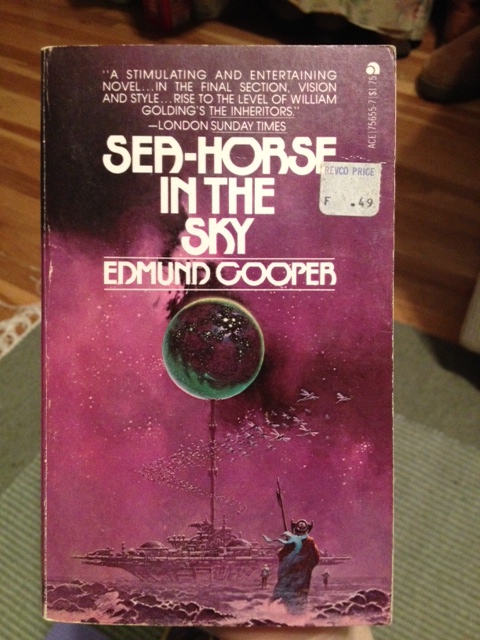
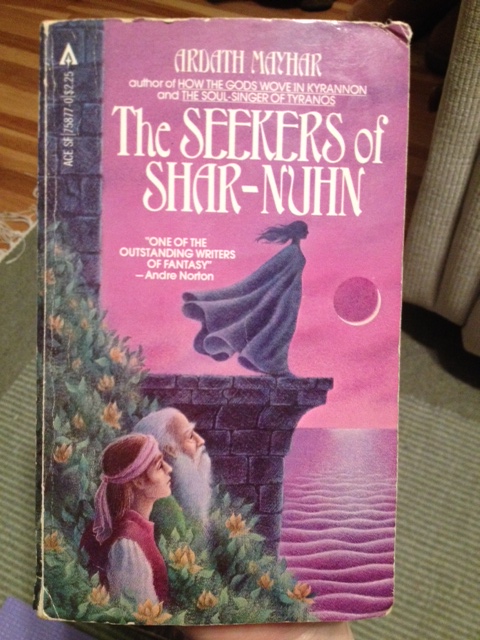
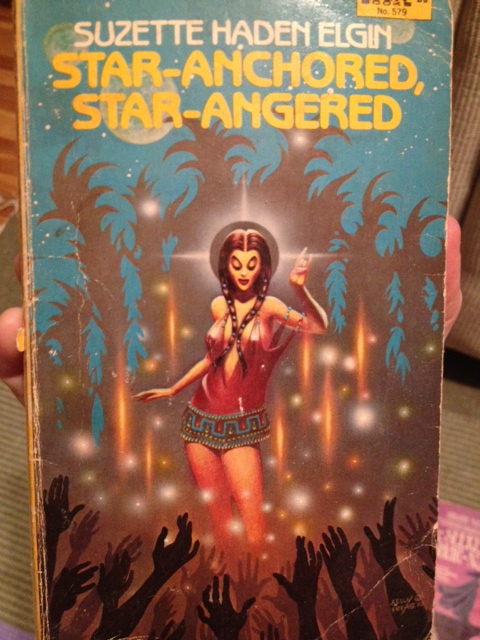
Second, I look at the cover art. Yes, I do judge a book by its cover. We all do, don’t look at me like that. There are some really amazing covers out there. There some real clunkers too. If a picture is worth a thousand words, then I want to see a picture that is worthy of the words I am considering reading.

Deal-breakers? The cover has a picture of a muscle-bound man with a sword or a gun. Especially if he has a nearly-naked woman by his side. If the woman has a sword too, I reconsider. I am tired of books where the woman has to be rescued. Then there are covers with lots of spaceships and antennae. I’ve found I like books that are set on other planets with other cultures, but I’m not so interested in books that are set on a spaceship. Somehow I get claustrophobic reading those.

Camp is not my thing, so covers that look excessively silly won’t do.

This “druid” looks like he has been mainlining steroids.
mckay3

Now, if the cover art is really good I’ll consider buying it just for the cover, but the cost is then an important factor.

Third – the price has to be right. Under $2 is good. $0.75 or less is ideal. Because of this, I don’t look at well-known authors. Because of this I’ve found some amazing “new” authors. They aren’t new at all. They are probably dead, because most of the books I’m reading are 30 years old or more. But there are probably other books by that author to find the next time I go.

If the price is over $2, there had better be other factors that change the balance. It doesn’t mean it is out, but it does mean there had better be other points in the book’s favor. Now, $4 or more is right out.

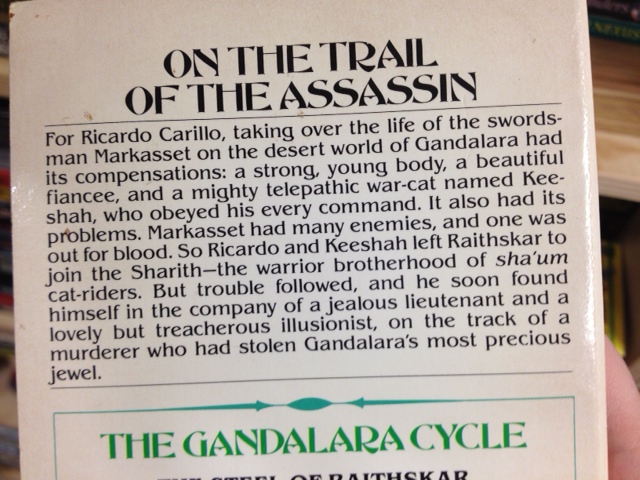
Fourth – I flip to the back and read the blurb. Is it interesting? (plus) Is there excessive capitalization? (minus)

mckay 2

Are there long silly names? (minus)
mckay1

Fifth, I open it. If the print is tiny then everything ends right there, even if everything else passed. I am getting older, and tiny print is a real pain. I love my Kindle in part because I can make the print as big as I need, but that doesn’t factor into used book selection. Plenty of these books will never make it to Kindle. Even if they did, they’d cost too much. I love the Kindle, but you can’t trade in used Kindle books like you can real books.

I’ll flip to a random section and try it out. How does it read? Are there lots of unintelligible words? (minus) Does it seem plausible yet surprising? (plus) I’ll flip to several sections to check it out at this point. This part takes the longest, which is reasonable. I’m going to spend the longest amount of time reading it, so it had better be worth my time.

Sixth- How does the book smell? And I don’t mean that old-book smell. That is a plus. I mean does the book smell like pee – human or pet? Does it smell like cigarette smoke? Does it smell of some cloyingly elaborate perfume that some ladies wear to cover up the other two smells?

Those are definite deal-breakers. I have no desire to spend hours really close to a book that smells.

Here are some covers of books I’ve enjoyed recently using this technique. I hope it inspires you to find new authors. Happy hunting!
mckay b2mckay b1mckay a5mckay a4mckay a3mckay a2mckay a1

Here’s a collection of some I found using this method for the first time. It was on a road trip.
books

Possessed pigs.

Jesus wasn’t always appreciated for healing people. He healed two people who were possessed by demons, and the townspeople begged him to leave the town.

In Matthew 8:28-34 (NRSV) we read that –
“28 When he came to the other side, to the country of the Gadarenes, two demoniacs coming out of the tombs met him. They were so fierce that no one could pass that way. 29 Suddenly they shouted, “What have you to do with us, Son of God? Have you come here to torment us before the time?” 30 Now a large herd of swine was feeding at some distance from them. 31 The demons begged him, “If you cast us out, send us into the herd of swine.” 32 And he said to them, “Go!” So they came out and entered the swine; and suddenly, the whole herd rushed down the steep bank into the sea and perished in the water. 33 The swineherds ran off, and on going into the town, they told the whole story about what had happened to the demoniacs. 34 Then the whole town came out to meet Jesus; and when they saw him, they begged him to leave their neighborhood.”

I always find it interesting that the people who recognize Jesus as the Son of God are always the possessed ones. Everybody else had to figure it out the hard way, if they figured it out at all. Many times Jesus tells those who recognize him to not tell anybody. He wants to keep a low profile.

But there is no hiding when you kill off a bunch of pigs.

Sure, these two people were possessed. They weren’t just a problem to themselves, they were a problem to others. They were “so fierce that no one could pass that way.” When he cast out the demons and they went into the nearby herd of pigs, the people went back to being normal. The pigs were not. The pigs drowned themselves.

I can see how this would be a problem. The town had probably already written off these two people who were possessed. They were just the crazy folk who stand at the edge of town and yell at people. This happens sometimes.

But pigs, now, that’s starting to get into money. They were being raised for sale. When the whole herd jumps off a cliff, that is a lot of money jumping off a cliff too. Sure the townspeople were ticked off.

Forget that two members of their town were now restored to sanity.

Forget that a miracle just occurred.

How often do we do this today? How often do we get our priorities mixed up? How often do we see how things affect us and forget to see the big picture?

Lots.

People are meant to be loved, and things are meant to be used.
All too often we get that backwards.

Hide the bad stuff.

Smart artists hide the bad stuff, like how smart criminals hide the dead bodies. Part of being a good artist (or writer, or musician) is not showing people your false starts. And there are a lot of false starts in being an artist. There is a lot of “I wonder what this does” or “I wonder how this looks”. Those questions are the same as “Hey, watch this” and result in the same number of skinned knees and broken bones. But they also lead to amazing discoveries.
Part of being an artist is trying out new things. Part of it is just being willing to try. Part of being an artist is being willing to make really amazing mistakes. Part of being an artist is learning from those mistakes and not doing them again. Part of being an artist is discovering something entirely new and amazing and wonderful from those mistakes.
Sometimes I’ll show off something that I think is “eh” and others think is “oh yeah!” And other times I’ll put out something that I think is “wow” and others think is “meh”. You really never know. The audience always brings itself to your art.
What you meant to say is never what they hear. Ever. Get used to it. Even of you go out of your way to make what you mean to say as crystal clear as a lake on a still summer’s day, it still won’t mean that to the audience. Because the audience brings its own past and impressions and feelings to the table and sees your art through different eyes.
So just create. Learn to edit. Try. Show off the good stuff. Realize that some of what you think is the bad stuff isn’t that bad. Show it off too.
Artists just make creativity look easy. It isn’t. What the audience sees is the result of many years of work and refining. The audience sees the tip of the iceberg, while the artist sees all that ice. The artist scaled that ice, clawing and scraping to the top, step by agonizing step.
Consider Bruce Lee. He made martial arts look so easy and effortless. It wasn’t effortless or easy. He practiced all day. When he broke his back and was immobile he thought about his practice and had his wife write down his ideas. He was constantly working on his art.
So go make stuff. Make more stuff. Show it off. Make more stuff. But keep practicing your art, no matter what.